



When you're ready to upgrade from your TV's built-in speakers, the world of soundbars can feel overwhelming. Two products that caught our attention during our research are Ultimea's Poseidon D70 and Skywave F40 – both representing dramatically different philosophies for creating immersive home theater experiences. The fundamental question isn't just which sounds better, but which approach to surround sound makes more sense for your specific situation.
The soundbar market has evolved significantly since these systems first appeared. Basic 2.1 setups (left, right, plus subwoofer) dominated for years because they were simple and affordable. But as streaming services began offering premium audio formats and 4K content became mainstream, manufacturers started pushing the boundaries of what's possible in a single-box solution.
Both the Poseidon D70 and Skywave F40 reject the "everything in one bar" approach that most budget soundbars use. Instead, they embrace multiple physical speakers positioned around your room – but they do it in completely different ways. The D70, released in 2024, represents the "more speakers everywhere" philosophy with its 7.1 channel setup. The F40, arriving in 2025, focuses on Dolby Atmos technology to create three-dimensional audio using fewer but more strategically placed speakers.
When evaluating these systems, the key considerations are channel configuration (how many speakers and where they go), spatial audio coverage (how sound fills your room), connectivity with modern devices, installation complexity, and ultimately, how much immersion you get for your money.
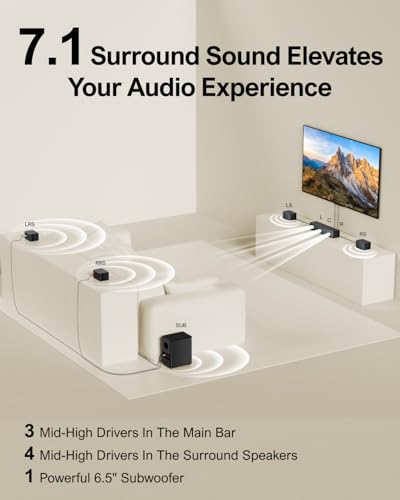
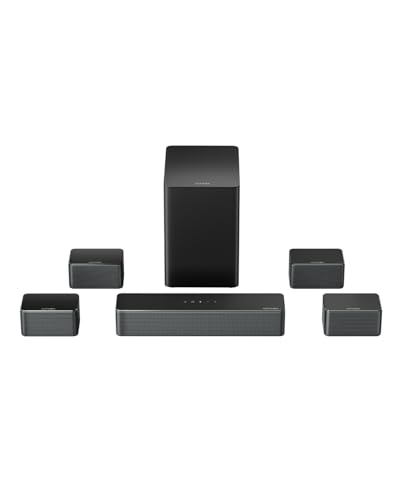
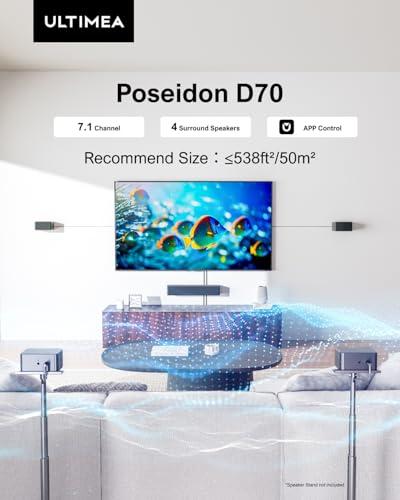
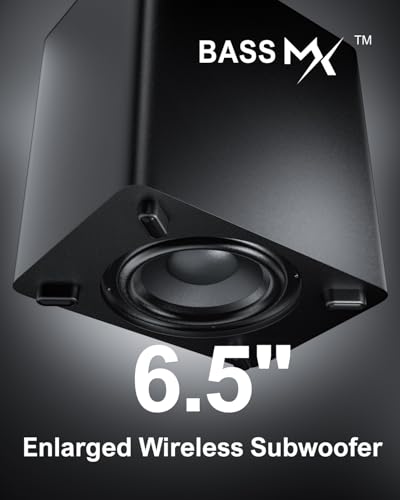
The Poseidon D70 takes a straightforward approach: if you want surround sound, you need surround speakers. This system gives you eight discrete speakers total – a three-driver soundbar, four separate surround speakers positioned around your room, and a wireless 6.5-inch subwoofer. At the time of writing, it sits in the budget-friendly category while delivering genuine multi-channel audio that most competitors fake with digital processing.
The 7.1 configuration means seven main channels (front left, center, front right, side left, side right, rear left, rear right) plus one subwoofer channel for low-frequency effects. Each of those four surround speakers houses a 2.25-inch driver, which might sound small but actually works well for directional audio cues. The wireless subwoofer is a standout feature – many systems at this price point force you to run cables to everything.
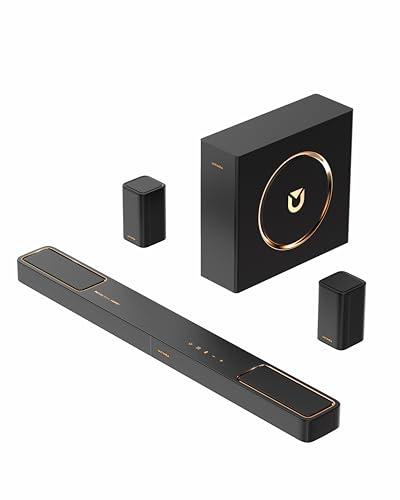
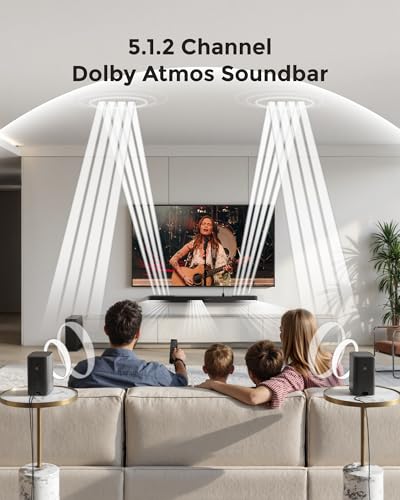
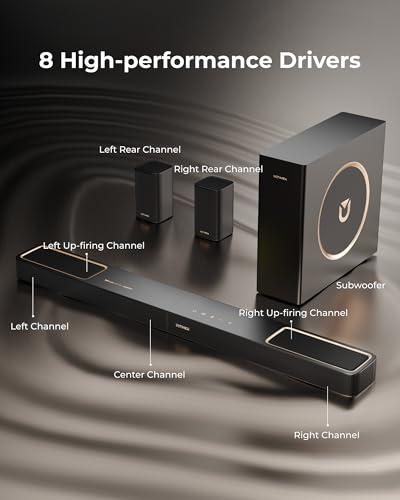
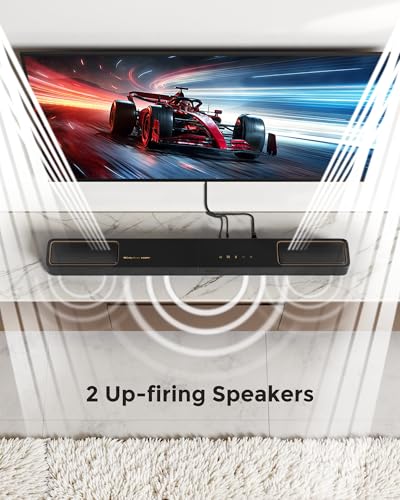
The Skywave F40, on the other hand, represents Ultimea's entry into the Dolby Atmos world. Instead of maximizing horizontal surround speakers, it focuses on creating a three-dimensional soundscape using 5.1.2 channels. The ".2" refers to two up-firing drivers mounted on top of the soundbar that bounce sound off your ceiling to create the illusion of overhead effects.
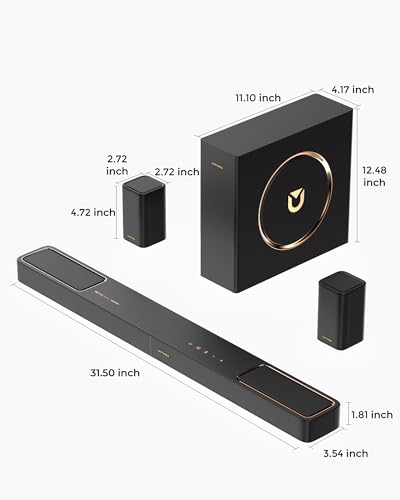
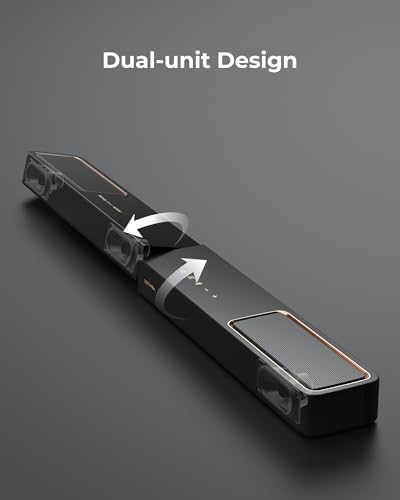
This system includes the main soundbar (which actually splits into two pieces that twist together – a clever shipping solution), two wireless rear surround speakers, and a wired subwoofer. The Atmos approach is fundamentally different because it treats sound as objects moving through three-dimensional space rather than just discrete channels.
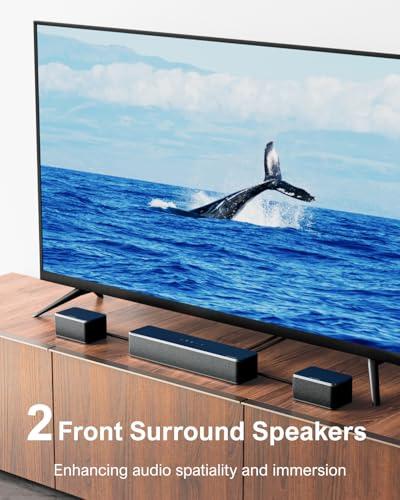
The most significant performance difference lies in how these systems create immersion. The Poseidon D70 surrounds you with speakers – literally. Four physical surround speakers means sound can genuinely come from four distinct directions around your seating position. When a helicopter flies overhead in a movie, you'll hear it move from speaker to speaker in a convincing arc. For gaming, this translates to precise directional audio cues that can give you a competitive advantage in shooters or help with navigation in open-world games.
However, the Skywave F40 creates immersion differently through Dolby Atmos processing. Instead of relying purely on speaker placement, it uses psychoacoustic principles – basically, how your brain interprets sound reflections and timing differences. Those up-firing drivers bounce sound off your ceiling with specific delays and frequency adjustments that trick your brain into perceiving overhead audio. When it works well, which depends heavily on your ceiling height and material, the effect can be genuinely startling.
Based on our research into user experiences, the D70's approach is more consistently effective across different rooms. Physical speakers pointing at you from multiple directions will always create directional audio, regardless of your room's acoustics. The F40's ceiling reflection method can be magical in the right environment but may fall flat in rooms with vaulted ceilings, textured surfaces, or unusual shapes.
Raw power specs tell part of the story. The Skywave F40 delivers 460 watts peak power compared to the Poseidon D70's 410 watts, but peak power ratings can be misleading. More meaningful is the RMS (continuous) power distribution and driver quality.
The D70's 144 watts RMS breaks down to 36 watts from the soundbar, 48 watts across four surround speakers, and 60 watts from the subwoofer. That might seem modest, but it's distributed across eight drivers, each optimized for its specific role. The 6.5-inch subwoofer driver is notably larger than what you'll find in most budget systems, explaining why reviews consistently praise its bass response down to 35Hz – low enough to feel explosive movie effects and deep bass lines in music.
The F40 uses more advanced driver technology, including neodymium magnets in the up-firing speakers and larger voice coils overall. Neodymium magnets are stronger than traditional ferrite magnets, allowing for more precise driver control and better frequency response. The system's frequency range extends to 20kHz compared to the D70's 18kHz, which means it can reproduce more high-frequency detail in music and movie soundtracks.
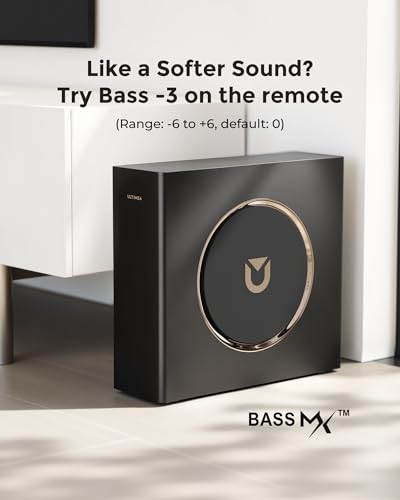
Both systems use Ultimea's BassMX technology for bass enhancement, but their subwoofer implementations differ significantly. The Poseidon D70 includes a larger 6.5-inch subwoofer that connects wirelessly to the main soundbar – a genuine convenience advantage. Based on reviewer feedback, this subwoofer delivers satisfying punch for both movie explosions and music, reaching down to 35Hz where you start feeling bass rather than just hearing it.
The Skywave F40's subwoofer is wired, which seems like a step backward until you consider the system's overall wireless design philosophy. The rear surround speakers are wireless, which matters more for room aesthetics since they're visible and need to be positioned precisely. The subwoofer typically gets tucked away where a single cable isn't as much of an issue.
From a performance standpoint, both subwoofers appear to deliver adequate low-end extension for their price categories. The D70's slightly deeper bass response (35Hz vs 45Hz) gives it an edge for pure home theater use, while the F40's integration with Dolby Atmos processing may provide more sophisticated bass management for compatible content.
Here's where the Skywave F40 clearly pulls ahead. Its HDMI eARC (enhanced Audio Return Channel) support versus the Poseidon D70's standard ARC makes a significant real-world difference. eARC provides much higher bandwidth – up to 37 Mbps compared to ARC's 1 Mbps limit. This means the F40 can receive uncompressed Dolby Atmos signals, while the D70 is limited to compressed audio formats.
The F40's Bluetooth 5.4 implementation also represents a meaningful upgrade over older Bluetooth standards, offering lower latency and more stable connections. For users who frequently stream music from phones or tablets, this translates to better synchronization between audio and video, plus fewer dropouts during playback.
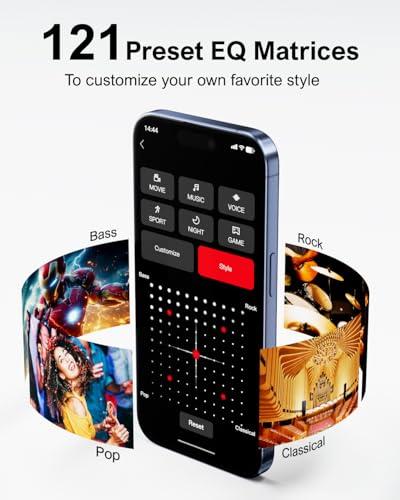
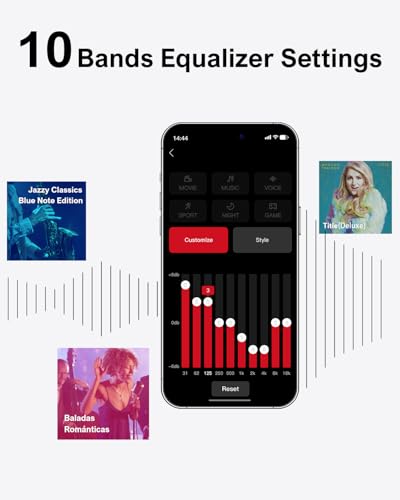
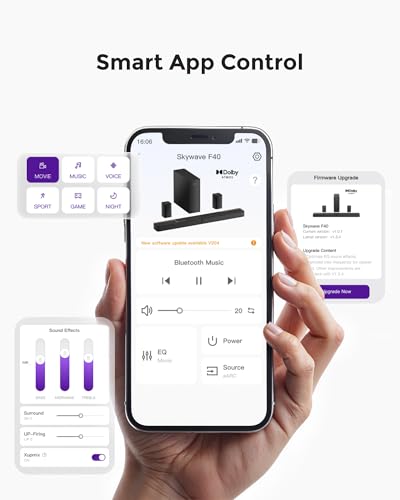
Both systems offer smart app control with extensive EQ customization – 121 preset matrices and 10-band equalizers. However, the F40 adds Xupmix technology, powered by Dolby DAP (Digital Audio Processing), which can enhance regular stereo content into multi-channel surround with spatial positioning. This feature effectively makes more content feel immersive, even sources that weren't originally mixed for surround sound.
The installation experience differs dramatically between these systems, and it's worth considering honestly how much complexity you're willing to accept for better performance.
The Poseidon D70 requires running cables to four surround speakers positioned around your room. Ultimea includes 3-meter and 6-meter cables, which should reach most seating positions, but you'll need to plan cable routing carefully. In our research, users who took time to properly hide these cables behind furniture or along baseboards were consistently happier with their setups than those who left cables visible.
The reward for this extra effort is genuine 360-degree sound placement. When properly positioned, those four surround speakers create an exceptionally convincing soundfield for movies and games. The wireless subwoofer does eliminate one cable run, which helps with the overall installation complexity.
The Skywave F40 significantly reduces installation hassle with its wireless rear speakers. You still need to position them correctly and ensure they have power outlets nearby, but eliminating speaker cables makes room setup much cleaner. The soundbar's split design is initially puzzling but actually makes setup easier – the two halves twist together with a secure locking mechanism that ensures proper electrical connection.
The trade-off is that you get only two rear speakers instead of four, which may reduce the precision of surround effects. However, the Dolby Atmos processing helps compensate by creating virtual sound positioning between physical speakers.
Your viewing habits should heavily influence this decision. The content landscape has shifted dramatically toward Dolby Atmos support since 2020, with Netflix, Disney+, Amazon Prime, and Apple TV+ all offering extensive Atmos libraries. Most new 4K Blu-ray releases include Atmos soundtracks, and even gaming consoles now support the format.
If you primarily watch current movies and shows on streaming services, the Skywave F40 provides access to those overhead sound effects that content creators specifically designed into their Atmos mixes. Rain falling from above, aircraft flyovers, and environmental ambience gain an extra dimension that the Poseidon D70 simply cannot reproduce, regardless of its speaker count.
However, Atmos content still represents a minority of what most people watch daily. Regular TV shows, older movies, and standard streaming content may actually benefit more from the D70's comprehensive speaker placement, which can make even basic stereo sources feel more spacious and engaging.
For gaming, the choice becomes more nuanced. Competitive multiplayer games often benefit from the Poseidon D70's precise directional audio – hearing footsteps from specific directions can provide tactical advantages in shooters. The four surround speakers create more accurate positional cues than virtual processing alone.
Cinematic single-player games with Atmos support, however, shine on the Skywave F40. Games like those in the Call of Duty or Battlefield series use Atmos to create convincing environmental immersion that adds to the storytelling experience.
Your room's physical characteristics significantly impact which system will perform better. Both manufacturers recommend these systems for medium-sized rooms (roughly 200-250 square feet), but they interact differently with various room layouts.
The Skywave F40's up-firing drivers work best with 8-10 foot flat ceilings. Too low, and the reflected sound doesn't have enough travel time to create convincing height effects. Too high, and the sound disperses before reaching your ears effectively. Textured or angled ceilings can scatter the reflections unpredictably, reducing the Atmos effect.
The Poseidon D70 requires more careful planning but offers more flexibility once installed. Those four surround speakers can be positioned to work around furniture, doorways, and room layouts that might not be optimal for ceiling reflections. Wall mounting is possible for all speakers, which helps in rooms where floor placement isn't practical.
At the time of writing, these systems sit in different price categories, with the Poseidon D70 targeting budget-conscious buyers and the Skywave F40 commanding a premium for its Atmos capabilities and advanced features.
The Poseidon D70 delivers eight discrete speakers and genuine 7.1 surround sound at a price point where most competitors offer only virtual surround processing. Based on our research, it consistently outperforms more expensive soundbars from established brands in terms of spatial immersion, primarily due to those four physical surround speakers.
For users who prioritize maximum surround coverage and don't need cutting-edge connectivity features, the D70 represents exceptional value. The wireless subwoofer alone would cost a significant portion of the system's total price if purchased separately.
The Skywave F40 costs significantly more but includes features that justify the price increase: true Dolby Atmos processing, HDMI eARC, wireless surround speakers, and advanced connectivity. When compared to other Atmos-capable soundbars with physical surround speakers, it remains competitive in its price category.
The question becomes whether Dolby Atmos and convenience features are worth the premium over comprehensive speaker coverage. For users heavily invested in modern streaming content and 4K media, the answer is often yes.
After extensive research into user experiences and expert reviews, clear usage scenarios emerge for each system.
You're working with a tighter budget but refuse to compromise on genuine surround sound. The Poseidon D70 makes the most sense for users who primarily game, watch older content, or simply want the most speakers possible for their money. If you have a larger room where four surround speakers can be properly positioned and you don't mind running cables, this system delivers immersion that exceeds its price category.
The D70 also appeals to users who prefer straightforward technology. There's no complex room calibration or Atmos processing – just speakers pointing at you from multiple directions creating convincing directional audio.
You prioritize modern content compatibility and convenience features. The Skywave F40 makes more sense for users heavily invested in streaming services, 4K Blu-ray collections, and current-generation gaming. If you have appropriate ceiling acoustics for Atmos effects and prefer wireless speakers to minimize cable management, the F40 offers a more premium experience.
The F40 also suits users who value future-proofing. Its HDMI eARC, Dolby Atmos support, and advanced Bluetooth connectivity ensure compatibility with evolving content standards and devices.
Neither system is objectively better – they excel in different scenarios. The Poseidon D70 maximizes speaker count and horizontal immersion at a budget-friendly price, making it ideal for users who want comprehensive surround coverage without paying premium pricing. The Skywave F40 focuses on three-dimensional audio and modern convenience features, making it better suited for users who prioritize Atmos content and premium features.
Your choice ultimately depends on your content preferences, room layout, installation willingness, and budget priorities. Both systems represent significant upgrades over basic soundbars and standard TV audio, but they achieve immersion through fundamentally different approaches. Consider what you watch most, how your room is configured, and which compromises you're more comfortable making – then choose the system that aligns with your specific home theater priorities.
| Ultimea Poseidon D70 | Ultimea Skywave F40 |
|---|---|
| Channel Configuration - Determines surround sound coverage and immersion type | |
| 7.1 channels with 4 physical surround speakers | 5.1.2 Dolby Atmos with 2 up-firing drivers for height effects |
| Total Speaker Count - More drivers can mean better sound separation | |
| 8 speakers (3 soundbar + 4 surround + 1 subwoofer) | 6 speakers (soundbar array + 2 surround + 1 subwoofer) |
| Peak Power Output - Higher wattage typically means louder maximum volume | |
| 410W peak (144W RMS) | 460W peak with advanced driver technology |
| Subwoofer Design - Affects bass quality and installation convenience | |
| 6.5" wireless subwoofer (35Hz low frequency) | Wired subwoofer (45Hz low frequency) |
| Surround Speaker Connection - Major factor in installation complexity | |
| 4 wired surround speakers (cables included) | 2 wireless rear surround speakers |
| HDMI Connectivity - Critical for high-quality audio from modern devices | |
| Standard HDMI ARC (compressed audio only) | HDMI eARC (uncompressed Dolby Atmos support) |
| Dolby Atmos Support - Essential for 3D audio from streaming and 4K content | |
| No Atmos (horizontal surround only) | Full Dolby Atmos 5.1.2 with overhead effects |
| Bluetooth Version - Affects wireless audio quality and connection stability | |
| Standard Bluetooth | Bluetooth 5.4 (lower latency, more stable) |
| Soundbar Dimensions - Important for TV stand compatibility | |
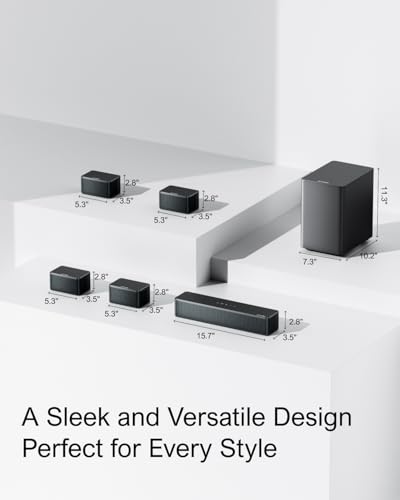
| 400mm (15.7") compact design | 800mm (31.5") full-width design |
| Smart Features - Advanced audio processing and customization options | |
| 10-band EQ, 121 presets, app control | 10-band EQ, 121 presets, Xupmix upmixing, app control |
| Best Use Case - Who should choose each system | |
| Budget buyers wanting maximum surround speaker coverage | Premium buyers prioritizing Atmos content and wireless convenience |
The Ultimea Poseidon D70 provides more comprehensive horizontal surround with 4 physical speakers positioned around your room, creating genuine 7.1 channel audio. The Ultimea Skywave F40 offers 3D surround sound through Dolby Atmos with overhead effects, but uses only 2 rear speakers. For traditional surround coverage, the Poseidon D70 wins, while the Skywave F40 excels at modern immersive audio.
If you watch Netflix, Disney+, or 4K Blu-rays regularly, Dolby Atmos adds genuine overhead effects that enhance the viewing experience. The Ultimea Skywave F40 supports full Dolby Atmos, while the Poseidon D70 does not. However, most older content and TV shows don't use Atmos, so the Poseidon D70's 7.1 setup can still provide excellent surround sound for non-Atmos content.
The Ultimea Skywave F40 is significantly easier to install because its rear speakers are wireless, requiring only power connections. The Poseidon D70 requires running cables to 4 surround speakers around your room. If you want minimal installation hassle, choose the Skywave F40. If you don't mind cable management for better speaker coverage, the Poseidon D70 delivers more comprehensive surround.
The Ultimea Poseidon D70 includes a larger 6.5" wireless subwoofer that reaches down to 35Hz, providing deeper bass extension. The Skywave F40 has a wired subwoofer with 45Hz low-frequency response. For pure bass depth and impact, especially in larger rooms, the Poseidon D70 has an advantage, though both systems deliver satisfying low-end performance for most users.
The Ultimea Poseidon D70 excels for competitive gaming because its 4 surround speakers provide precise directional audio cues crucial for shooters and multiplayer games. The Skywave F40 is better for cinematic single-player games that support Dolby Atmos. If you primarily play competitive online games, choose the Poseidon D70. For story-driven games with Atmos support, the Skywave F40 offers superior immersion.
The Ultimea Skywave F40 has superior connectivity with HDMI eARC support for uncompressed audio and Bluetooth 5.4 for stable wireless connections. The Poseidon D70 uses standard HDMI ARC, which limits it to compressed audio formats. For newest TVs, gaming consoles, and streaming devices, the Skywave F40 provides better compatibility and future-proofing.
The Ultimea Poseidon D70 offers exceptional value by delivering 8 physical speakers and true 7.1 surround at a budget-friendly price point. The Skywave F40 costs more but includes premium features like Dolby Atmos, wireless speakers, and advanced connectivity. Choose the Poseidon D70 for maximum speakers per dollar, or the Skywave F40 for premium features and convenience.
The Ultimea Poseidon D70 has a compact 15.7-inch soundbar but requires space for 4 surround speakers around your room. The Skywave F40 features a longer 31.5-inch soundbar that spans most TV widths but only needs space for 2 rear speakers. Consider your TV stand size and room layout when choosing between the Poseidon D70's compact bar or Skywave F40's full-width design.
The Ultimea Skywave F40 has better frequency response (20kHz vs 18kHz) and more advanced driver technology, making it superior for music reproduction. The Poseidon D70 can create a more enveloping experience for multi-channel music with its 4 surround speakers. For stereo music quality, choose the Skywave F40. For surround music formats, the Poseidon D70 provides better spatial coverage.
The Ultimea Skywave F40's up-firing drivers work best with 8-10 foot flat ceilings to properly reflect overhead audio. Vaulted, textured, or very high ceilings can reduce Atmos effectiveness. The Poseidon D70 doesn't rely on ceiling reflections, making it more consistent across different room types. If you have challenging ceiling conditions, the Poseidon D70 may deliver more reliable surround performance.
Both the Ultimea Poseidon D70 and Skywave F40 offer identical customization with 10-band equalizers and 121 preset sound modes via smart app control. However, the Skywave F40 adds Xupmix technology that can enhance regular content into surround sound. For pure EQ options, they're equal, but the Skywave F40 provides more advanced audio processing features.
Choose the Ultimea Poseidon D70's 7.1 setup if you want maximum horizontal surround coverage, primarily game, or watch older content. Select the Skywave F40's Dolby Atmos if you frequently stream modern movies, own 4K Blu-rays, or want overhead audio effects. The Poseidon D70 excels at traditional surround, while the Skywave F40 delivers cutting-edge 3D audio for compatible content.
We've done our best to create useful and informative comparisons to help you decide what product to buy. Our research uses advanced automated methods to create this comparison and perfection is not possible - please contact us for corrections or questions. These are the sites we've researched in the creation of this article: ultimea.com - provantage.com - ultimea.com - youtube.com - youtube.com - bestbuy.com - the-gadgeteer.com - shopmyexchange.com - youtube.com - youtube.com - youtube.com - ultimea.com - manuals.plus - device.report - images.thdstatic.com - shopmyexchange.com - staples.com - ultimea.de - the-gadgeteer.com - youtube.com - ultimea.com - manuals.plus - youtube.com - ultimea.com - youtube.com - youtube.com - youtube.com - youtube.com - eu.ultimea.com - support.ultimea.com

Privacy Policy
Terms and Conditions - Affiliate Policy
Home Security
© Copyright 2008-2026.
11816 Inwood Rd #1211, Dallas, TX 75244