





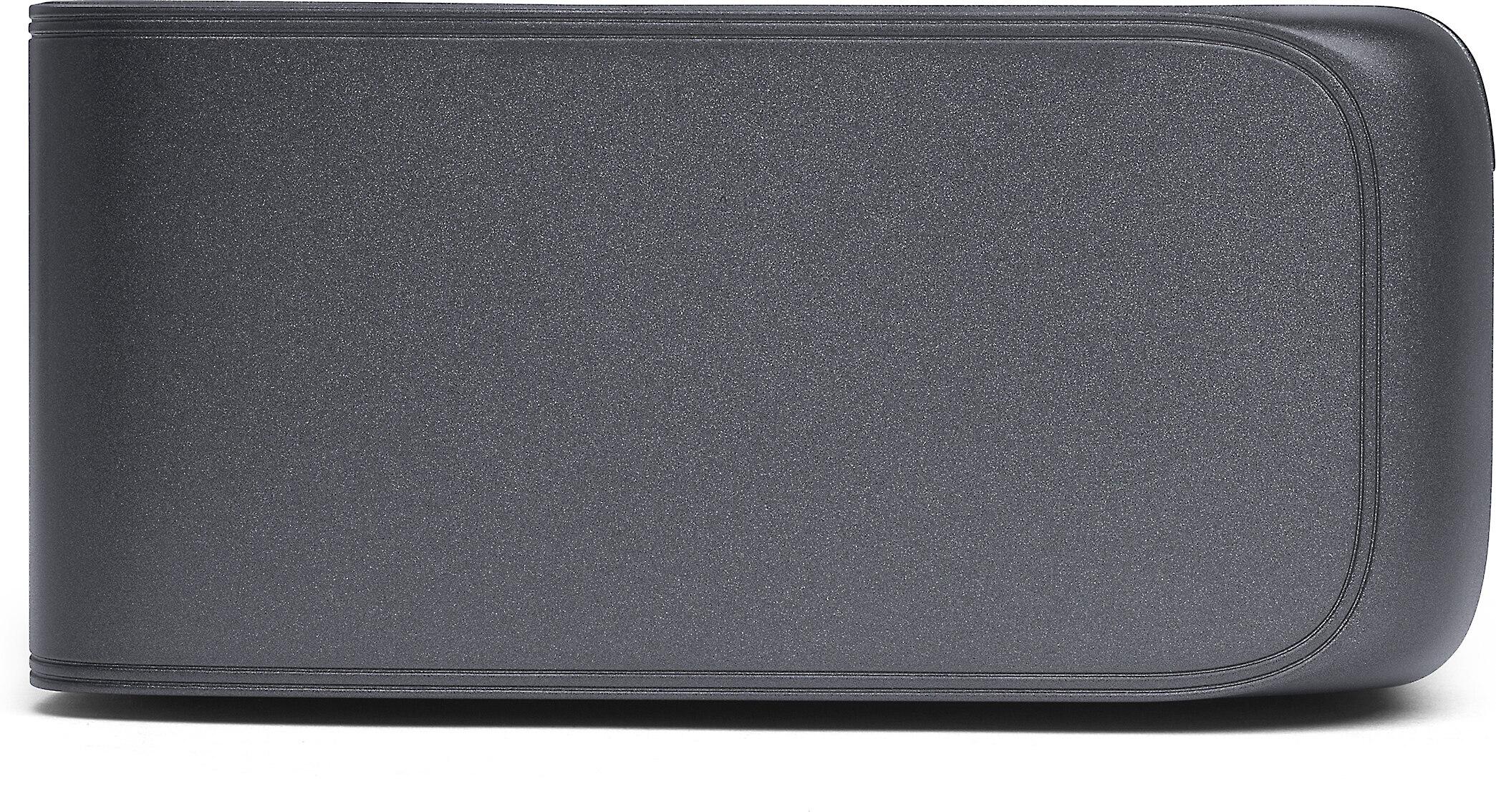
Shopping for a soundbar system can feel overwhelming when you're staring at specs like "7.1.4 channels" and "Dolby Atmos processing." The truth is, the soundbar market has exploded into distinct tiers that serve very different needs—and budgets. Today we're diving deep into two systems that represent opposite ends of the spectrum: the budget-focused Ultimea Poseidon D70 and the premium JBL Bar 1000.
These aren't just different price points of the same thing. They represent fundamentally different philosophies about home audio, and understanding those differences will help you make the right choice for your setup.
Before we jump into specifics, let's talk about what we mean when we discuss soundbar "channels." Traditional surround sound uses a numbering system like 5.1 or 7.1, where the first number represents main speakers positioned around the room, and the decimal indicates subwoofers. So 7.1 means seven main speakers plus one subwoofer.
But here's where it gets interesting: modern premium soundbars add a third number for "height" channels that bounce sound off your ceiling to create overhead effects. The JBL Bar 1000's 7.1.4 configuration includes four height channels, while the Ultimea D70's 7.1 setup focuses purely on horizontal surround sound.
The key considerations when choosing between these approaches include whether you actually have content that uses advanced formats like Dolby Atmos (more on this later), how your room acoustics will handle ceiling reflections, and frankly, whether the premium is worth it for your viewing habits.
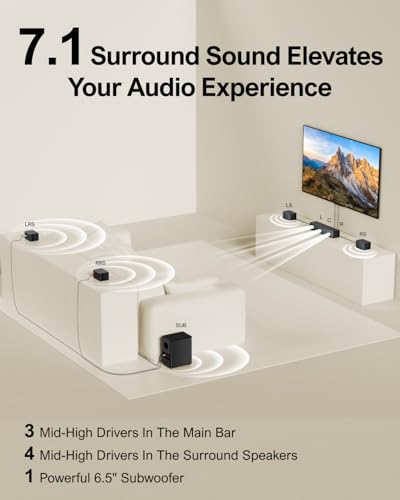
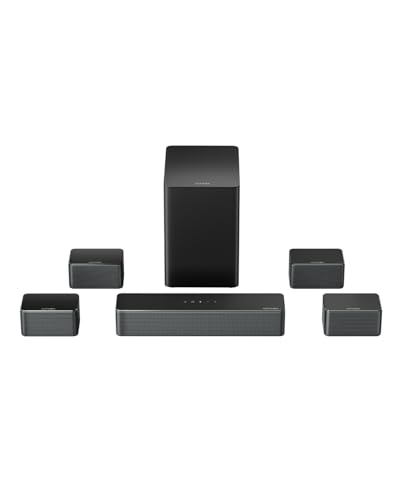
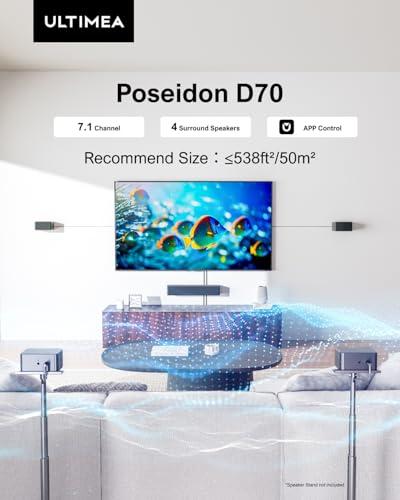
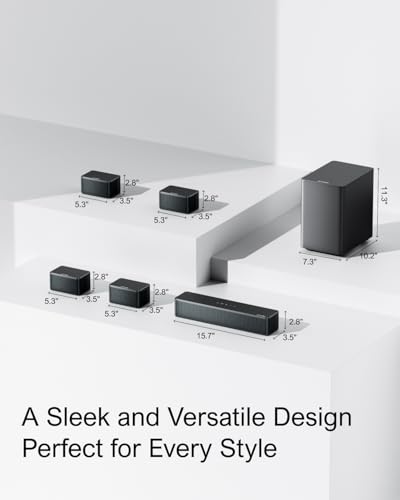
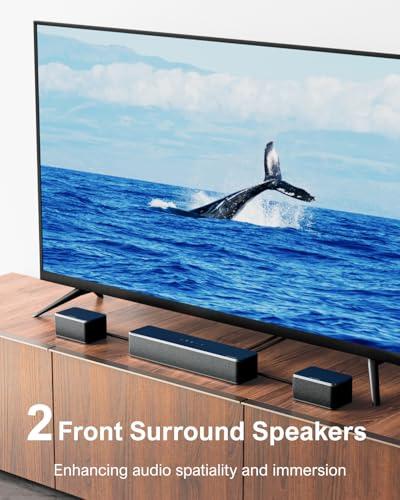
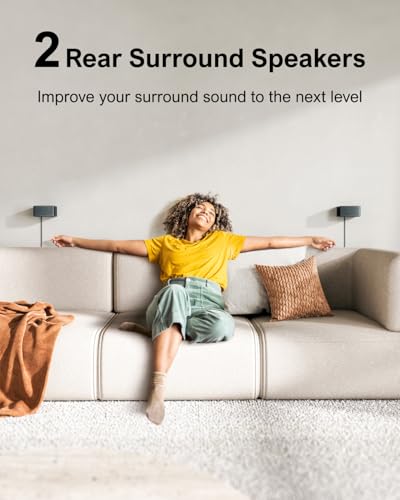
The Ultimea Poseidon D70, released in 2024, takes the "maximum speakers for minimum cost" approach. You get four physical surround speakers—two that sit near your TV and two that go behind your seating area—plus a wireless subwoofer. The entire system was designed around delivering true multi-directional audio without the premium price tag of established brands.
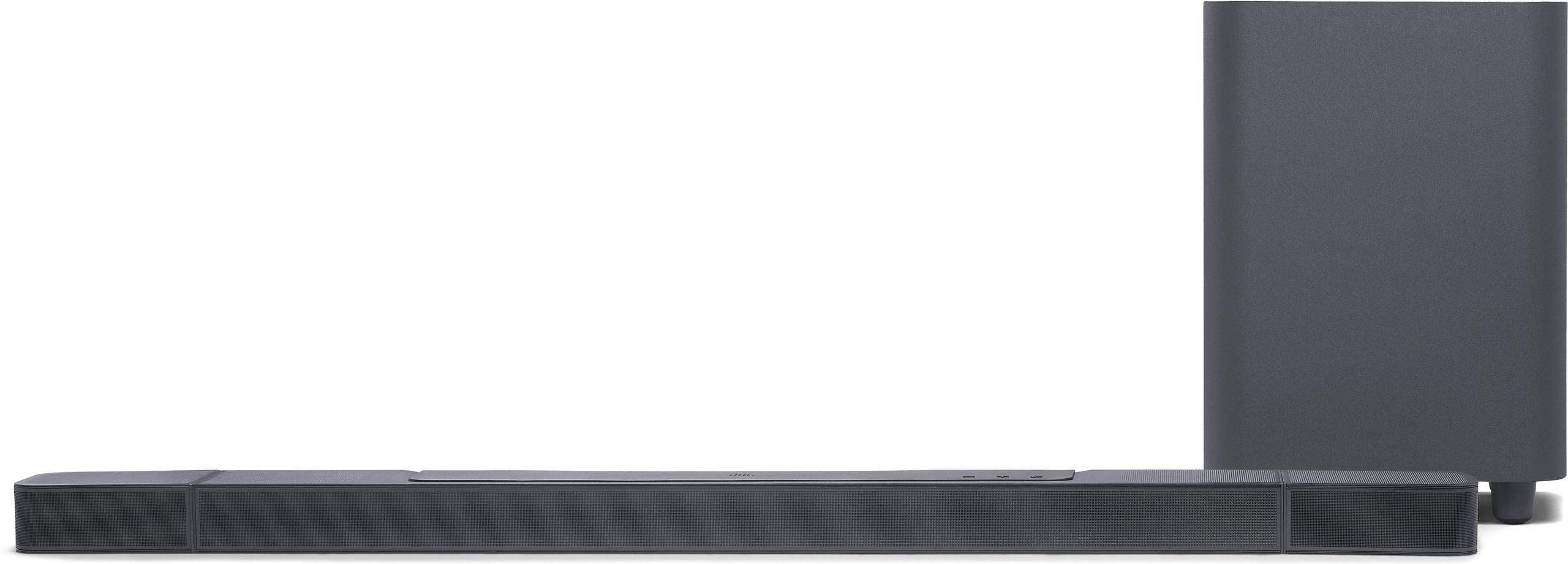
The JBL Bar 1000, also hitting the market in 2024, represents JBL's premium home theater offering. Instead of just adding more speakers, it focuses on advanced audio processing technologies like Dolby Atmos, which creates a three-dimensional sound bubble around your listening position using sophisticated algorithms and ceiling reflections.
At the time of writing, these systems sit roughly $500 apart in pricing, which immediately tells you they're targeting different buyers. But the performance gap isn't as simple as "more expensive equals better"—it's more nuanced than that.
This is where things get really interesting. The Ultimea D70 uses what I'd call the "old school" approach: physical speakers placed around your room. You've got dedicated drivers firing sound from the front-left, front-right, rear-left, and rear-right positions, plus three drivers in the main soundbar handling center channel duties.
What this creates is genuine directional audio. When a helicopter flies from screen-left to screen-right in a movie, you hear it move through distinct speaker positions. The system's SurroundX technology (Ultimea's proprietary processing) uses AI-trained algorithms to optimize how sounds are distributed across these speakers, creating convincing spatial positioning.
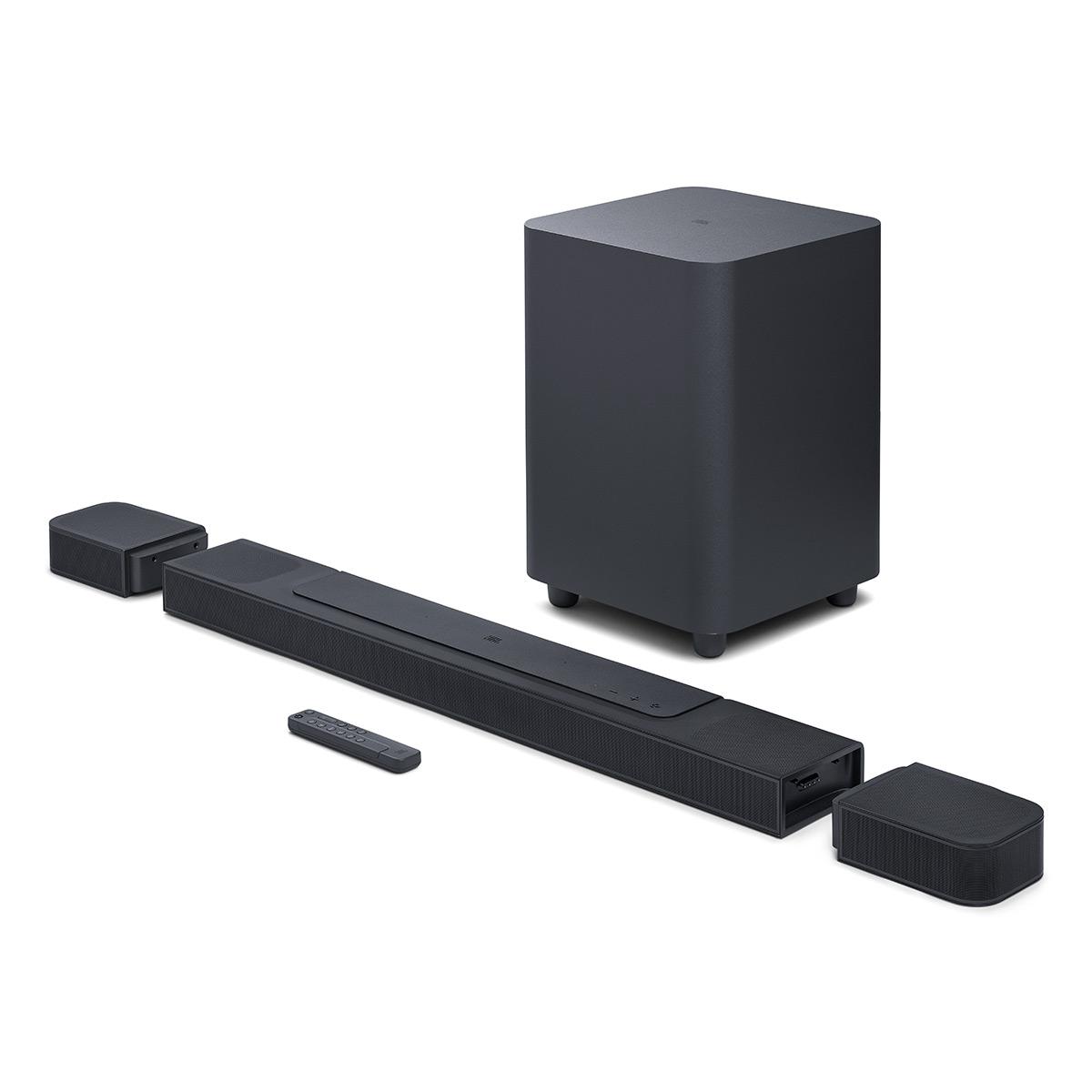
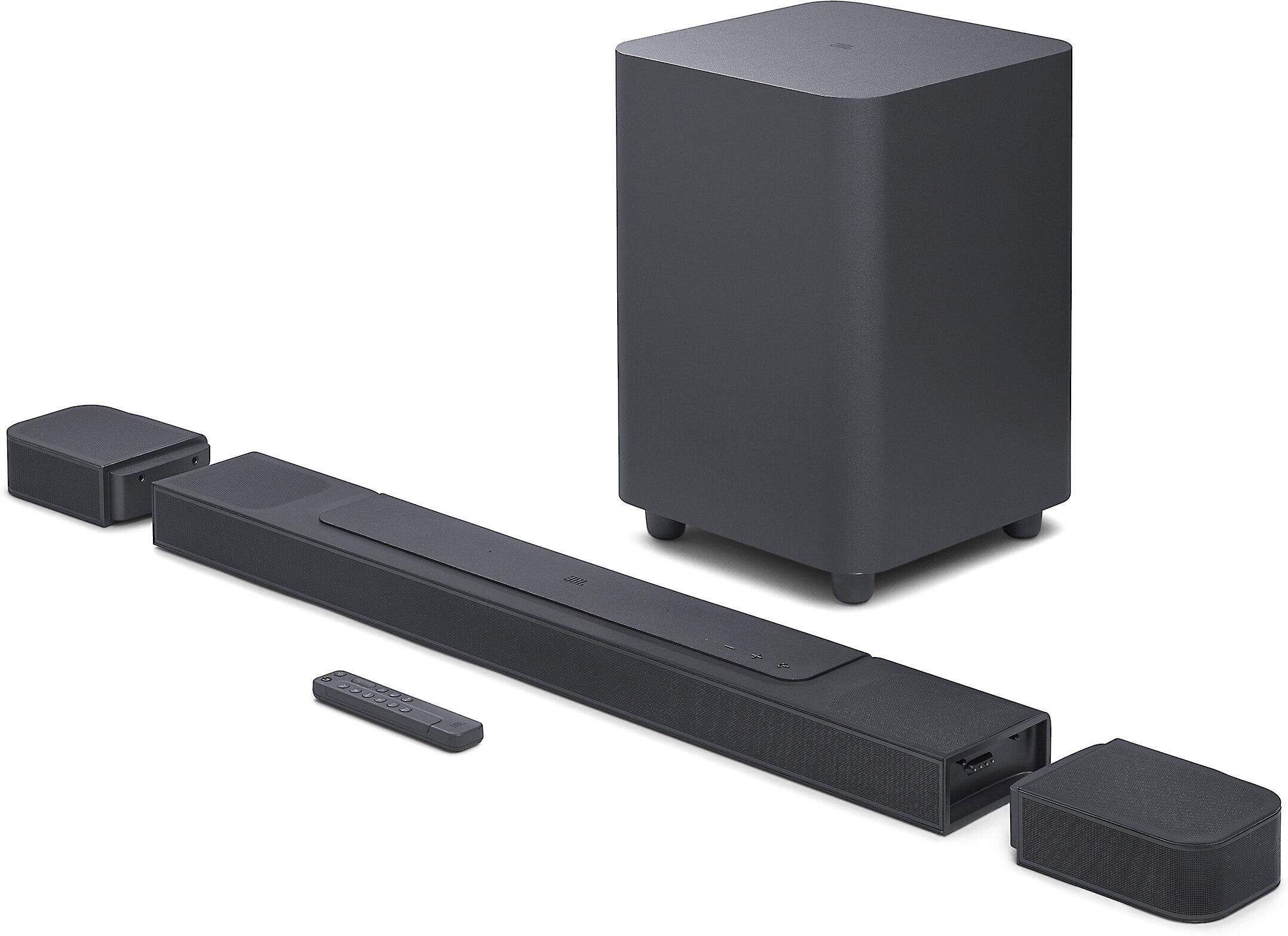
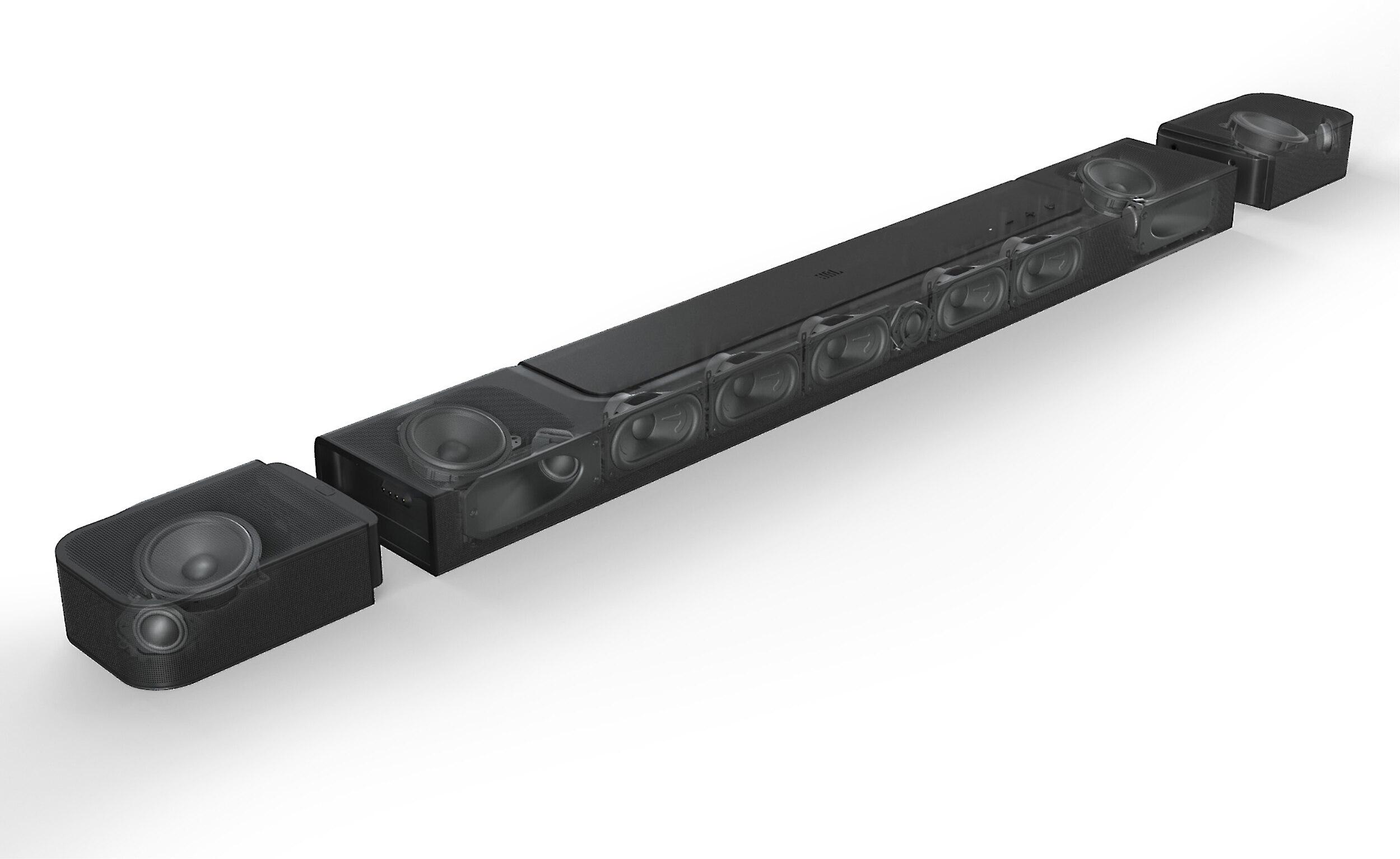
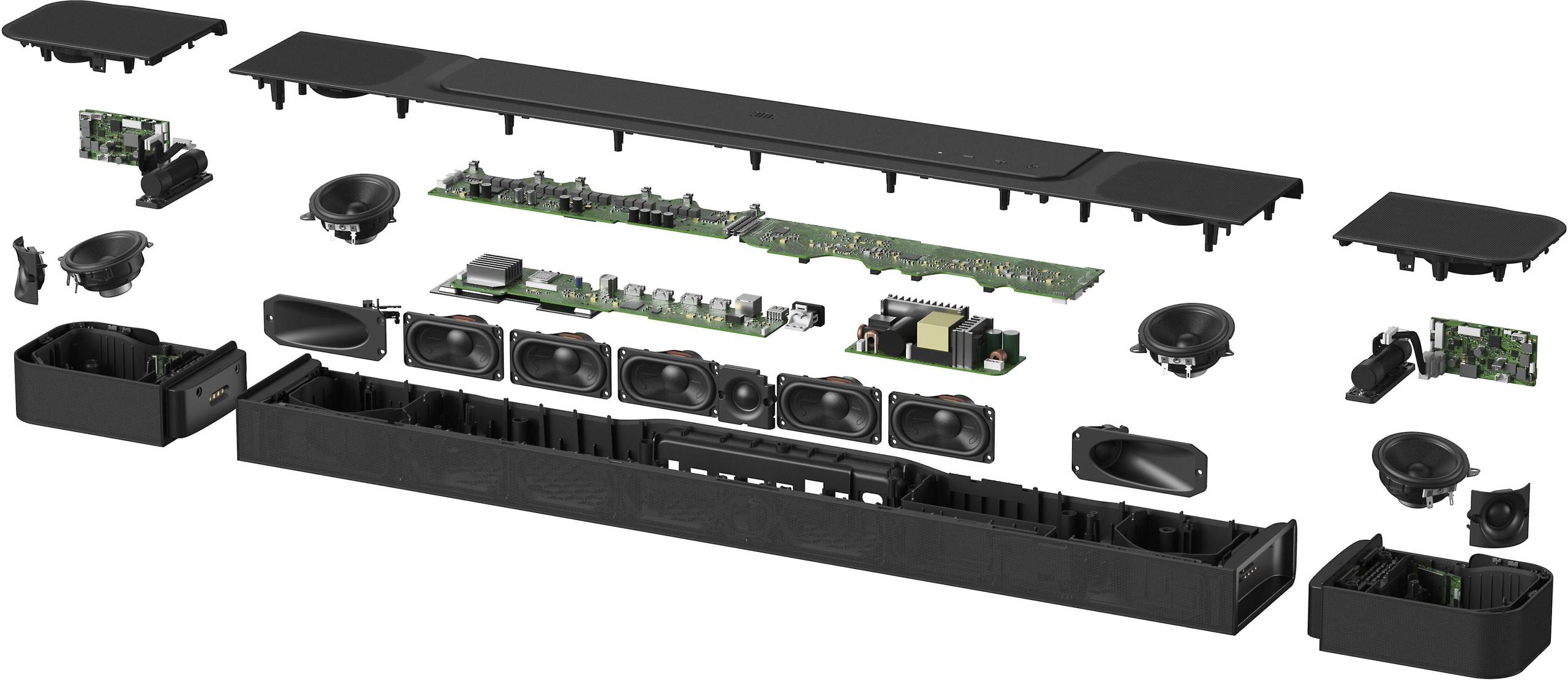
The JBL Bar 1000 takes a more sophisticated approach with its MultiBeam technology. Instead of relying purely on speaker placement, it uses psychoacoustic processing—essentially tricking your brain into hearing sounds that aren't directly coming from physical speakers in those positions. The four up-firing drivers (two in the main bar, two in the detachable rear speakers) bounce audio off your ceiling to create height effects.
Here's the crucial difference: the JBL system can create the illusion that sounds are coming from above and around you, even from positions where there are no speakers. This works brilliantly with Dolby Atmos content, where sound engineers have placed specific audio "objects" in three-dimensional space.
But—and this is important—this ceiling reflection approach requires the right room conditions. You need a relatively flat ceiling at the proper height (8-12 feet works best), minimal sound-absorbing materials directly overhead, and proper speaker positioning. The Ultimea system works regardless of your ceiling situation because it's not trying to bounce sound anywhere.
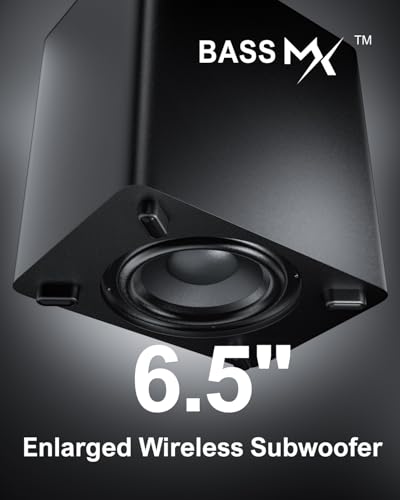
The subwoofer comparison reveals interesting priorities. The JBL Bar 1000's 10-inch driver versus the Ultimea D70's 6.5-inch driver isn't just about bigger being better—though in bass reproduction, larger drivers generally can move more air and reach deeper frequencies with less effort.
The JBL system's 880-watt total power output versus the Ultimea's 410 watts tells part of the story, but wattage numbers can be misleading. What matters more is how that power translates to actual bass quality and room-filling capability.
From our research into user feedback, both systems punch well above their apparent weight class. The Ultimea D70 consistently surprises users with its bass impact, thanks to BassMX technology that optimizes the smaller driver's output. Users frequently describe the bass as "punchy" and powerful enough to "fill the room," which suggests effective tuning and amplifier matching.
The JBL system predictably delivers deeper extension and higher SPL (sound pressure level—essentially how loud it can get before distortion). That larger driver size means it can reproduce the really deep stuff—think explosion rumbles and pipe organ notes—with more authority and less strain.
For most living rooms and typical movie content, both will provide satisfying bass. The JBL system becomes clearly superior in larger rooms or for users who really prioritize that deep, theater-like rumble that you feel as much as hear.
This is where the philosophical difference between these systems becomes crystal clear. The JBL Bar 1000 supports Dolby Atmos and DTS:X—advanced audio formats that create object-based surround sound. Instead of simply sending audio to specific speakers, these formats place individual sounds as "objects" in three-dimensional space that can move dynamically around and above the listener.
The Ultimea D70 doesn't support these premium formats, which is consistently the most-mentioned limitation in user reviews. But here's the practical reality: the majority of content you actually watch probably doesn't use Dolby Atmos yet.
Most streaming services still deliver content in traditional 5.1 surround, and even when Atmos is available, it's often not dramatically different from well-executed traditional surround sound. Netflix has been slowly adding Atmos content, and gaming consoles are increasingly supporting it, but we're still in the adoption phase rather than the "everything has it" phase.
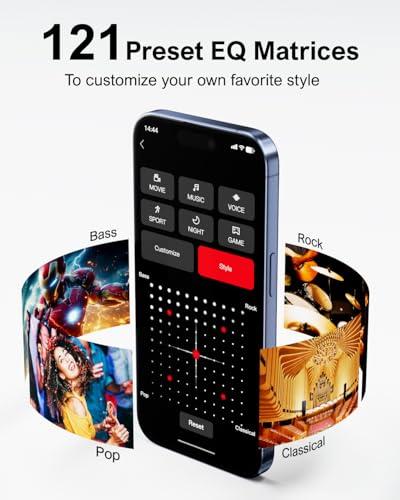
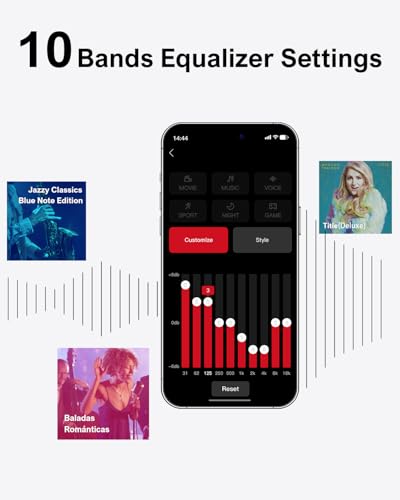
Where the Ultimea system compensates is in sheer customization options. The 121 preset EQ matrices and 10-band graphic equalizer give you granular control over how different types of content sound. This matters because not all movies and shows are mixed equally—some have booming bass, others have whisper-quiet dialogue, and having fine-tuned control helps optimize for your specific room and content preferences.
Both systems embrace smartphone app control, but with different levels of sophistication. The Ultimea D70 uses the Ultimea Home app primarily for audio customization—EQ adjustments, sound mode selection, and system settings. It's functional and gives you access to all those customization options, though it won't win any design awards.
The JBL Bar 1000 integrates with JBL's broader ecosystem through the JBL One app, but more importantly, it includes built-in Wi-Fi with AirPlay, Chromecast, and Alexa Multi-Room Music support. This means you can stream music directly to the soundbar without having your phone or TV involved, and integrate it with other smart home audio systems.
The JBL system's detachable rear speakers deserve special mention here. They're battery-powered and charge by docking to the main soundbar, which solves the biggest practical problem with surround sound: running speaker wire to the back of your room. You can place them on end tables, mount them to walls, or even carry them around temporarily for optimal positioning during movies.
The Ultimea system requires wired connections for its surround speakers, but the cables are reasonably long (20 feet for the rear speakers), and everything is clearly labeled and color-coded for straightforward setup.
At the time of writing, these systems represent remarkably different value propositions. The Ultimea D70 delivers what I'd estimate as 80% of the surround sound experience for roughly 30% of the cost of premium alternatives.
The key insight from user reviews is that most people are shocked by how much better the Ultimea system sounds compared to basic soundbars or TV speakers. The jump from stereo to true 7.1 surround is dramatic and immediately noticeable. Users consistently mention that it "fills the room" and creates convincing directional audio that enhances movie watching and gaming.
The JBL Bar 1000 justifies its premium through advanced technologies and convenience features. You're paying for Dolby Atmos processing, wireless rear speakers, a larger subwoofer, established brand support, and the presumption of higher build quality. Whether that's worth the price difference depends entirely on your priorities and budget flexibility.
For home theater enthusiasts who want cutting-edge audio formats and have the room conditions to support ceiling-reflected Atmos effects, the JBL system provides genuinely superior performance. For everyone else, the Ultimea system offers remarkable performance density.
Your actual room plays a huge role in which system will work best. The JBL Bar 1000's Atmos capabilities require specific conditions: appropriate ceiling height and materials, minimal sound absorption directly overhead, and proper positioning relative to your seating.
If you're in an apartment with low ceilings, lots of carpeting and soft furnishings, or an irregularly shaped room, you might not get the full benefit of those height channels. The Ultimea system works regardless of these factors because it's not trying to manipulate room acoustics—it's just placing speakers where you need directional sound.
Both systems include room calibration features, but they work differently. The JBL system automatically adjusts its processing based on room acoustics, while the Ultimea system lets you manually adjust surround levels and EQ settings through its app.
For gaming, both systems offer distinct advantages. The Ultimea D70's precise directional audio helps with competitive gaming where you need to locate enemies by sound. The multiple surround speakers create clear positional cues that can give you a tactical advantage in first-person shooters or help with immersion in open-world games.
The JBL system excels with games that support Dolby Atmos, creating more immersive environmental effects. Xbox Series X and PlayStation 5 both support Atmos output, so you can get overhead audio effects in compatible games.
For music listening, the systems take different approaches. The Ultimea system's extensive EQ customization lets you tune the sound signature for different genres—rock, classical, jazz, electronic—using those 121 preset matrices or the manual equalizer.
The JBL system focuses more on streaming convenience with its built-in Wi-Fi and multiple service integration. You can easily stream high-quality music directly without involving other devices, and the overall tuning tends toward a more balanced, audiophile-friendly sound signature.
The Ultimea Poseidon D70 makes sense for budget-conscious buyers who want maximum surround sound impact for their money. If you're upgrading from TV speakers or a basic soundbar, the jump to true 7.1 surround will be immediately impressive. It's also ideal for renters or anyone who can't make permanent modifications to their room but wants genuine surround sound.
This system particularly appeals to gaming enthusiasts and movie lovers who prioritize directional audio accuracy over cutting-edge formats. If you watch a lot of older movies, standard TV programming, or streaming content that isn't Atmos-encoded, you won't be missing much by skipping those premium formats.
The JBL Bar 1000 targets home theater enthusiasts who want the latest audio technologies and have the budget flexibility to pay for premium features. If you regularly watch new movies with Atmos soundtracks, have compatible gaming systems, or want the convenience of wireless rear speakers, the additional investment makes sense.
This system also appeals to users who value brand reputation and long-term support. JBL has decades of audio expertise, and you're paying partly for that engineering heritage and presumed reliability.
The choice ultimately comes down to your priorities and budget reality. If you're working with a limited budget but want dramatically better audio than TV speakers, the Ultimea D70 offers exceptional performance density. You get true surround sound, extensive customization, and impressive bass performance for a fraction of premium pricing.
If you have budget flexibility and want cutting-edge audio formats, the JBL Bar 1000 provides genuinely superior technology with Dolby Atmos support and premium convenience features. The wireless rear speakers alone solve major practical problems with surround sound setup.
Consider your content habits honestly. If you primarily watch streaming services, network TV, or older movies, you're not missing much without Atmos support. If you're an early adopter who seeks out the latest audio formats and has compatible source devices, the premium investment makes more sense.
Room acoustics matter significantly for the JBL system's height effects, while the Ultimea system works well regardless of ceiling conditions. Think about your space realistically before committing to ceiling-reflected audio.
Both systems represent solid choices within their respective categories. The Ultimea D70 maximizes performance per dollar with genuine multi-channel audio, while the JBL Bar 1000 provides premium technologies for users who want the latest audio innovations. Choose based on your budget, room conditions, and whether advanced format support matters for your actual viewing habits.
| Ultimea Poseidon D70 | JBL Bar 1000 |
|---|---|
| Channel Configuration - Determines surround sound immersion | |
| 7.1 channels with horizontal surround | 7.1.4 channels with overhead height effects |
| Premium Audio Format Support - Future-proofs your investment | |
| No Dolby Atmos/DTS:X (most cited limitation) | Full Dolby Atmos and DTS:X decoding |
| Physical Surround Speakers - Real vs virtual positioning | |
| 4 wired speakers (2.25" drivers each) | 2 detachable battery-powered rear speakers |
| Subwoofer Size - Bass depth and room-filling power | |
| 6.5" wireless subwoofer | 10" wireless subwoofer |
| Total System Power - Volume and dynamic range capability | |
| 410W peak output | 880W total system power |
| Smart App Features - Customization and control options | |
| 121 preset EQ matrices, 10-band equalizer | JBL One app with streaming service integration |
| Connectivity Options - Device compatibility and convenience | |
| HDMI ARC, Optical, Bluetooth 5.3, USB, 3.5mm | HDMI eARC, Optical, Bluetooth, built-in Wi-Fi |
| Rear Speaker Setup - Installation convenience | |
| Wired connection with 20ft cables | Wireless battery-powered with charging dock |
| Room Calibration - Optimizes sound for your space | |
| Manual surround level adjustment (13 levels) | Automatic room acoustic calibration |
| Streaming Integration - Direct music playback without TV | |
| Bluetooth only for wireless audio | Built-in AirPlay, Chromecast, Alexa MRM |
| Height Channel Technology - 3D overhead sound effects | |
| None (horizontal surround only) | 4 up-firing drivers with MultiBeam processing |
| Value Proposition - Performance per dollar spent | |
| Maximum surround speakers for budget price | Premium features justify higher investment |
The Ultimea Poseidon D70 delivers exceptional value by providing true 7.1 surround sound with four physical speakers at a budget-friendly price point. The JBL Bar 1000 costs significantly more but justifies the premium with Dolby Atmos support, wireless rear speakers, and a larger 10" subwoofer. For most users wanting genuine surround sound without premium features, the Ultimea D70 offers better performance per dollar.
While Dolby Atmos creates impressive overhead sound effects, it's not essential for excellent home theater audio. The Ultimea Poseidon D70 lacks Atmos but still delivers immersive 7.1 surround sound that dramatically improves movie watching over TV speakers. The JBL Bar 1000 provides Dolby Atmos for users who want cutting-edge 3D audio, but most streaming content still uses traditional surround formats that both systems handle well.
The JBL Bar 1000 features a larger 10" subwoofer that produces deeper bass extension and higher volume levels, making it superior for large rooms and bass-heavy content. However, the Ultimea D70's 6.5" subwoofer with BassMX technology still delivers impressive bass impact that satisfies most users. Both systems provide wireless subwoofers for flexible placement, but the JBL system offers more powerful low-frequency performance.
Both systems are designed for easy setup, but with different approaches. The Ultimea Poseidon D70 requires wiring the four surround speakers using included cables, which takes more initial setup time. The JBL Bar 1000 offers simpler installation with wireless rear speakers that charge by docking to the main bar, eliminating the need to run cables across your room.
The Ultimea D70 excels for competitive gaming with its precise directional audio from four physical surround speakers, helping locate enemies by sound. The JBL Bar 1000 provides superior immersion for single-player games with Dolby Atmos support on Xbox Series X and PlayStation 5. Both systems offer gaming-specific sound modes, but the Ultimea system gives better positional accuracy for competitive play.
The JBL Bar 1000 includes built-in Wi-Fi with AirPlay, Chromecast, and Alexa integration for direct music streaming from various services. The Ultimea Poseidon D70 relies on Bluetooth connectivity for wireless music playback, requiring a phone or other source device. For convenient music streaming, the JBL system offers more options and better integration with smart home ecosystems.
The Ultimea D70 includes four dedicated 2.25" surround speakers that provide genuine directional audio from front and rear positions. The JBL Bar 1000 uses two detachable battery-powered rear speakers with up-firing drivers for height effects. While the Ultimea system offers more speaker positions, the JBL system adds vertical dimension with overhead sound bouncing off your ceiling.
Both systems excel at dialogue reproduction, but through different technologies. The JBL Bar 1000 uses PureVoice technology with dedicated center channel processing for exceptional voice clarity. The Ultimea D70 features voice enhancement modes and three drivers in the soundbar for clear dialogue. Professional reviews consistently praise both systems for dialogue clarity, making either a good choice for movie watching.
The Ultimea Poseidon D70 works well in any room layout since it doesn't rely on ceiling reflections, making it ideal for apartments or rooms with irregular acoustics. The JBL Bar 1000 requires proper ceiling height (8-12 feet) and reflective surfaces overhead for optimal Dolby Atmos effects. The JBL system includes automatic room calibration, while the Ultimea system offers manual adjustment controls.
The JBL Bar 1000 delivers 880W total system power for impressive volume levels and dynamic range in large rooms. The Ultimea D70 provides 410W peak power, which users consistently describe as surprisingly loud and room-filling despite the lower rating. Both systems offer more than enough power for typical home theater use, with the JBL system providing additional headroom for demanding content.
The Ultimea Poseidon D70 offers extensive customization through its app with 121 preset EQ matrices and a 10-band graphic equalizer for detailed sound tuning. The JBL Bar 1000 uses the JBL One app for basic control and streaming service access, focusing more on convenience than detailed audio adjustment. For users who enjoy tweaking sound settings, the Ultimea system provides significantly more customization options.
Choose the Ultimea D70 if you want maximum surround sound performance for your budget, don't need Dolby Atmos, and can accommodate wired speaker placement. Select the JBL Bar 1000 if you have budget flexibility, want cutting-edge audio formats, prefer wireless convenience, and have room conditions suitable for height effects. Both systems dramatically improve upon TV speakers, but the Ultimea system offers better value while the JBL system provides premium features.
We've done our best to create useful and informative comparisons to help you decide what product to buy. Our research uses advanced automated methods to create this comparison and perfection is not possible - please contact us for corrections or questions. These are the sites we've researched in the creation of this article: ultimea.com - provantage.com - ultimea.com - youtube.com - youtube.com - bestbuy.com - the-gadgeteer.com - shopmyexchange.com - youtube.com - youtube.com - youtube.com - ultimea.com - manuals.plus - device.report - images.thdstatic.com - shopmyexchange.com - staples.com - ultimea.de - zdnet.com - jbl.com - jbl.com - pcrichard.com - rtings.com - d21buns5ku92am.cloudfront.net - ro.harmanaudio.com - target.com - harmanaudio.com - dell.com - mm.jbl.com - dolby.com - jbl.com.my - videoandaudiocenter.com

Privacy Policy
Terms and Conditions - Affiliate Policy
Home Security
© Copyright 2008-2026.
11816 Inwood Rd #1211, Dallas, TX 75244