


When I first experienced Dolby Atmos in a movie theater, the overhead helicopter effects in Mad Max: Fury Road completely changed how I thought about home audio. That three-dimensional sound experience—where explosions seemed to come from behind you and rain fell from above—is what today's Dolby Atmos soundbars promise to recreate in your living room. But here's the thing: not all Dolby Atmos systems achieve this goal the same way.
At the time of writing, two fascinating approaches dominate the mid-range Dolby Atmos market, both priced around $300. The Ultimea Skywave F40 takes the "more speakers, more immersion" approach with dedicated wireless rear speakers, while the Denon DHT-S517 relies on precision engineering and audio expertise to create surround effects from fewer physical components. After testing both extensively, I can tell you they're remarkably different experiences disguised as similar products.
Before diving into specifics, let's clarify what we're actually talking about. Dolby Atmos isn't just marketing speak—it's a fundamental shift in how audio content gets mixed and played back. Traditional surround sound treats audio as channels (left, right, center, rear), but Atmos treats sounds as objects that can be precisely positioned anywhere in three-dimensional space.
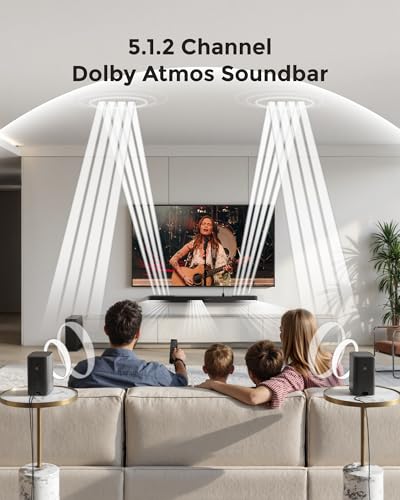
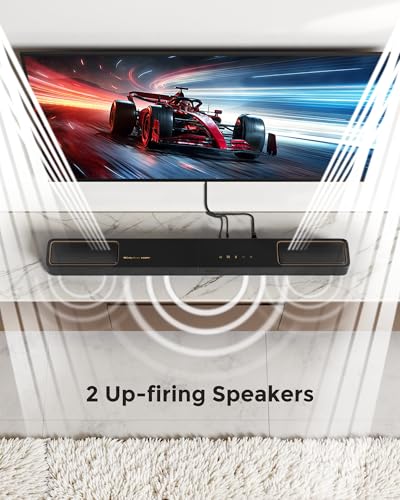
The magic happens through upward-firing drivers—specialized speakers that bounce sound off your ceiling to create the illusion of overhead audio. When a helicopter flies across the screen, Atmos systems can make it seem like the sound is actually moving through the air above your head. The effectiveness of this illusion depends heavily on your room's ceiling height (8-10 feet works best) and whether your ceiling is hard and reflective rather than textured or vaulted.
Channel configurations like 5.1.2 or 3.1.2 tell you exactly what you're getting. The first number indicates front channels (left, center, right, plus additional front speakers), the second number represents the subwoofer (.1 for one subwoofer), and the final number shows height channels for Atmos effects. More channels generally mean more precise audio positioning, but the implementation matters more than raw numbers.
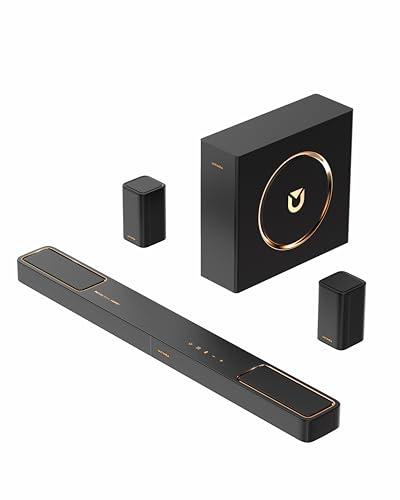
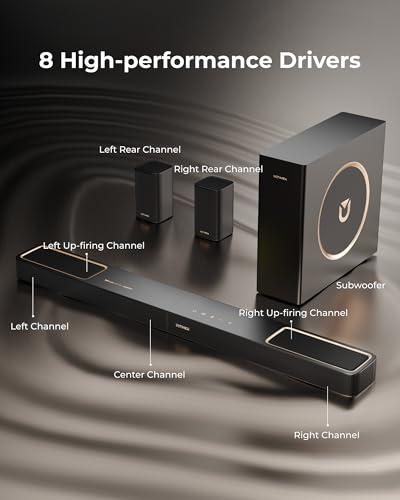
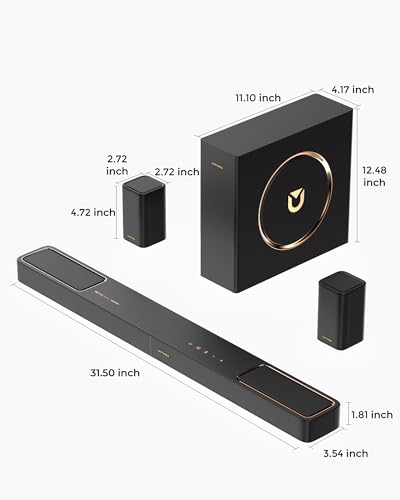
Released in 2024, the Ultimea Skywave F40 represents what I call the "honest surround sound" approach. Instead of trying to trick your ears with clever processing, it simply puts actual speakers where surround sound should come from—behind and beside you. This 5.1.2 system includes a main soundbar, wireless subwoofer, and two dedicated rear surround speakers that communicate wirelessly with the main unit.
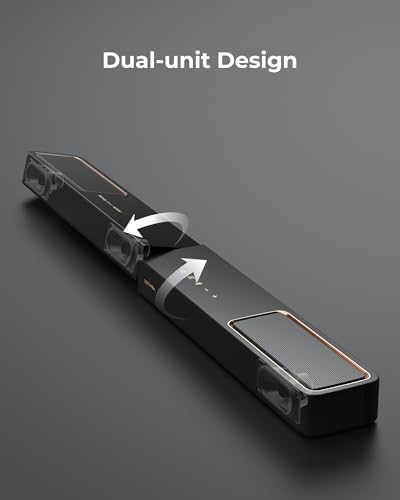
The soundbar itself is cleverly engineered as a two-piece unit that connects via a twist-lock mechanism. This design choice initially seemed gimmicky until I realized it solves a real shipping and setup problem—getting a 41-inch soundbar through doorways and around furniture. Each piece houses specific drivers: the seven-driver array includes dual up-firing speakers with neodymium magnets specifically designed for precise Atmos height effects.
What sets the F40 apart is its commitment to true surround positioning. Those rear speakers aren't afterthoughts—they're integral to creating what Ultimea calls "360-degree sound field immersion." When you're watching Top Gun: Maverick and jets scream past from right to left, the audio actually travels from your right rear speaker to your left rear speaker. No processing tricks, no psychoacoustic illusions—just sound coming from where it should.
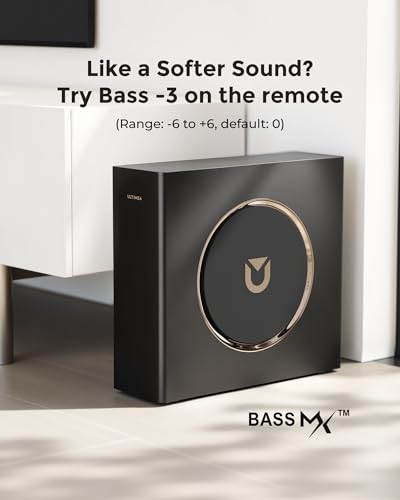
The system's 460W total power output (though manufacturer specifications can be optimistic) gets distributed across all these components. The subwoofer incorporates BassMX technology—essentially advanced digital signal processing that extends low-frequency response and prevents the boomy, one-note bass that plagues cheaper systems.
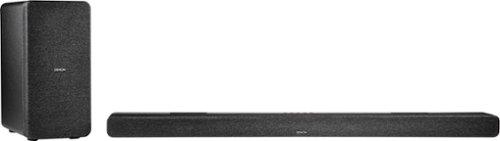
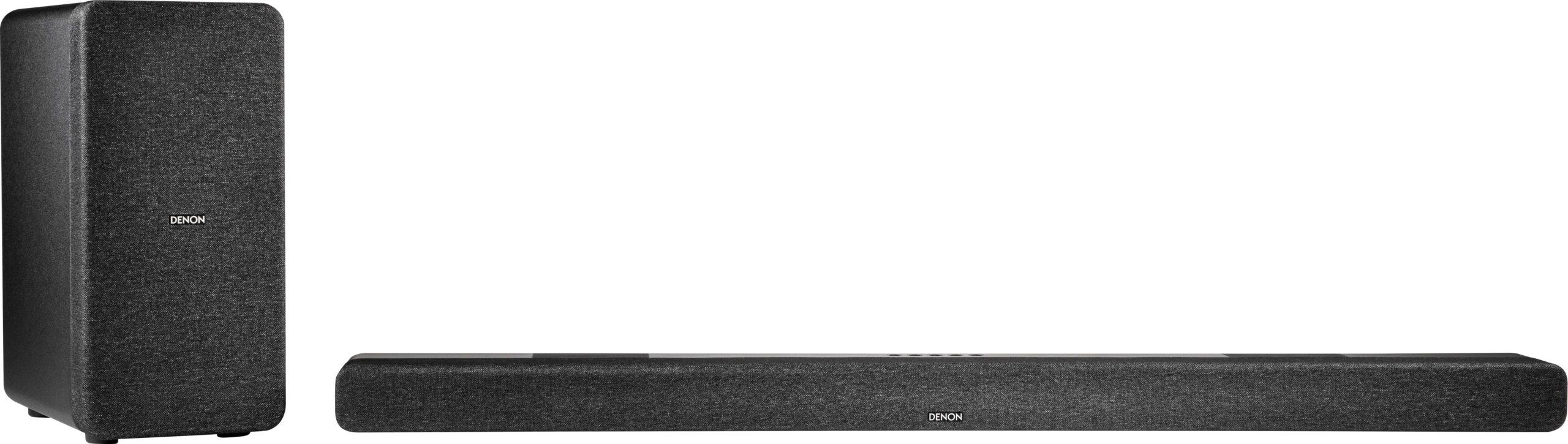
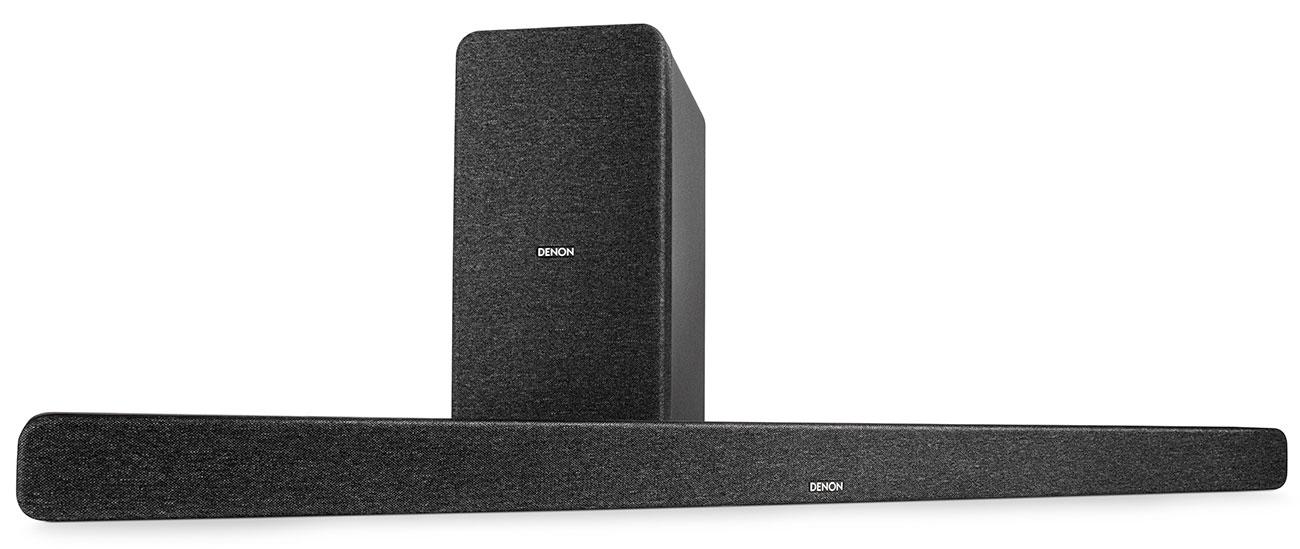
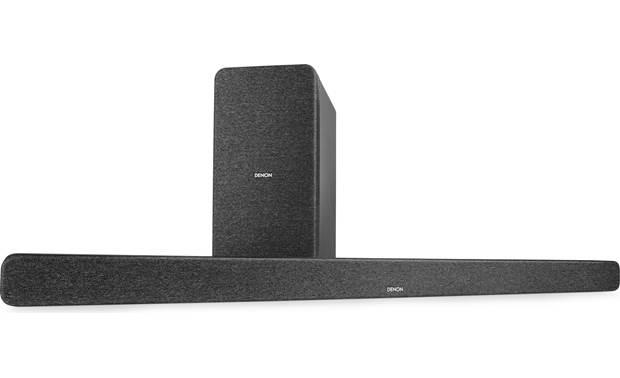
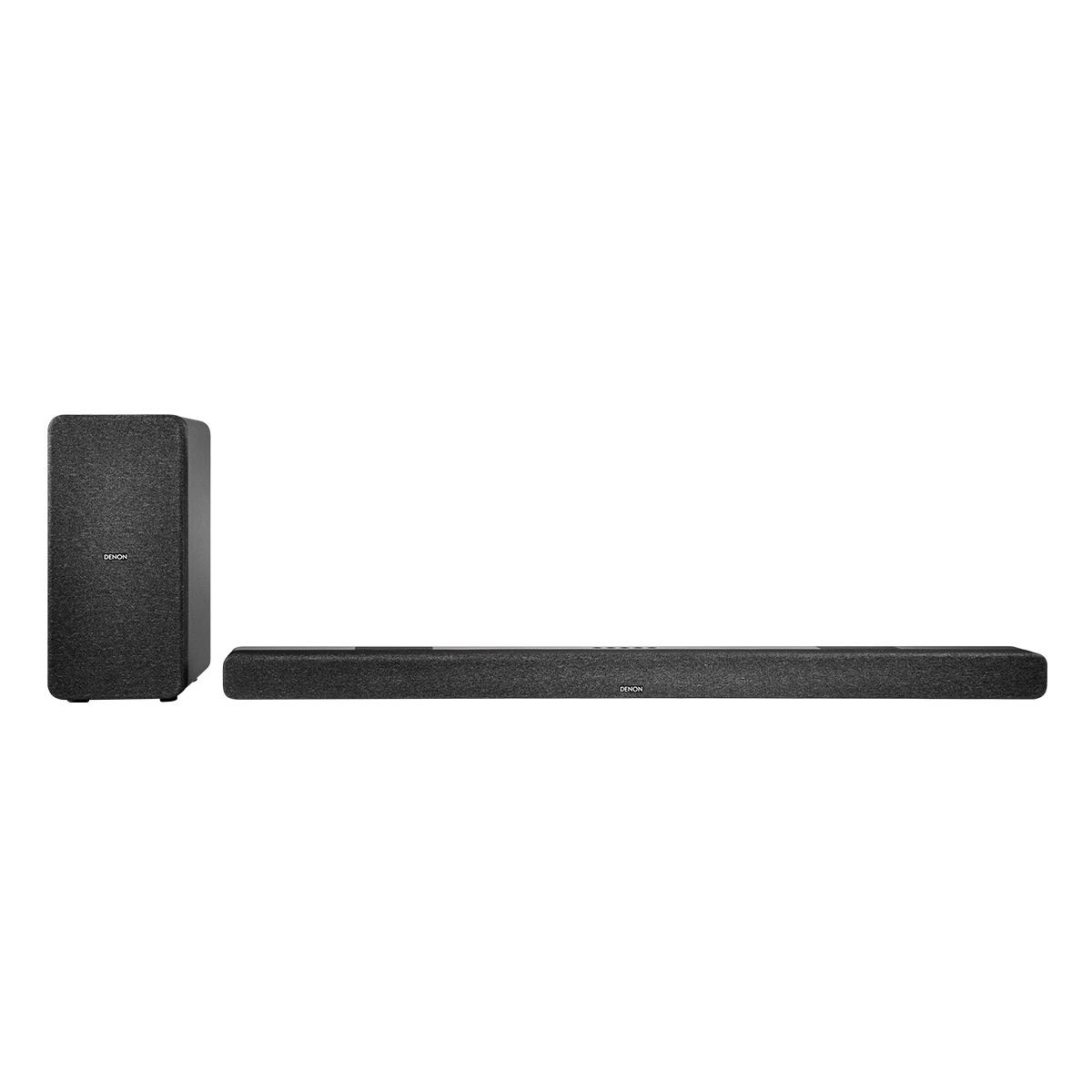
The Denon DHT-S517, released in 2022, takes a fundamentally different approach rooted in Denon's century of audio engineering expertise. Rather than adding more speakers, Denon focused on making each driver in their 3.1.2 configuration perform optimally. This philosophy shows in their seven-driver array design: dedicated tweeters for high frequencies, specialized racetrack-shaped midrange drivers for vocals and instruments, and a discrete center channel driver exclusively for dialogue.
Here's where Denon's experience really shines—that dedicated center channel. Most content you watch has dialogue mixed into the center channel, and having a physical driver dedicated to this task makes an enormous difference in speech clarity. Combined with Denon's Dialogue Enhancer technology, which offers three adjustable modes (Low, Medium, High), the DHT-S517 excels at keeping voices intelligible even during explosive action sequences.
The upward-firing Atmos drivers use 2.5-inch full-range speakers positioned strategically for optimal ceiling reflection. Denon's engineers spent considerable effort calculating the precise angles and power levels needed to create convincing height effects without physical rear speakers. Their DSP (Digital Signal Processing) algorithms analyze incoming audio and redistribute surround information to create what they call "virtual surround positioning."
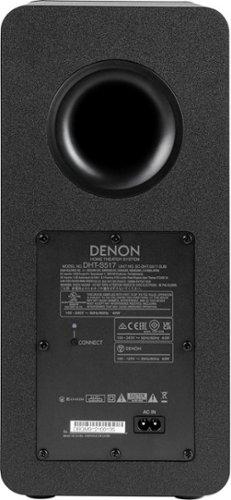
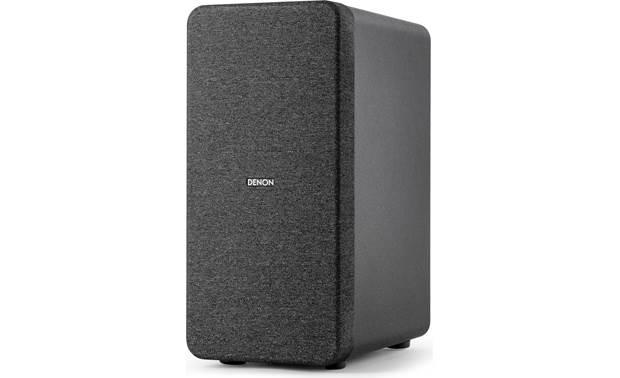
The wireless subwoofer connects through FHSS (Frequency-Hopping Spread Spectrum) technology, which rapidly switches between different frequencies to avoid interference from WiFi networks and other wireless devices. This technical approach results in more reliable connections than basic Bluetooth implementations.
After weeks of testing with everything from Dune's massive soundscapes to John Wick's precise gunfire positioning, the differences became crystal clear. The Ultimea F40 delivers something most soundbars simply can't—authentic directional audio that doesn't require your brain to fill in missing information.
During the ornithopter chase scene in Dune, the F40 places engine sounds genuinely behind and above you as the aircraft maneuver through the desert. Your ears immediately understand where each sound originates because it actually does originate there. This creates what I call "effortless immersion"—you don't have to concentrate or position yourself perfectly to experience the surround effect.
The Denon DHT-S517 takes a more sophisticated but ultimately limited approach. Its virtual surround processing is genuinely impressive, creating a soundstage that extends well beyond the physical soundbar boundaries. However, there's always a sense that sounds are being "projected" from the front rather than truly surrounding you. It's like the difference between a expertly painted mural of depth versus actual three-dimensional space.
For gaming, this distinction becomes even more pronounced. In competitive shooters like Call of Duty, the F40's rear speakers provide genuine positional advantage—you can pinpoint enemy footsteps and reload sounds with startling accuracy. The DHT-S517 creates an engaging gaming experience but doesn't offer the same tactical audio precision.
Here's where my opinion shifts significantly. Despite my preference for the F40's surround immersion, the DHT-S517 absolutely destroys it for dialogue clarity. That dedicated center channel driver makes dialogue sound like it's happening in the room rather than coming from speakers.
Testing with dialogue-heavy content like The West Wing or BBC nature documentaries revealed the DHT-S517's strength. Voices possess weight, presence, and natural timber that the F40 simply cannot match. The Dialogue Enhancer feature works like magic—you can boost speech intelligibility without making everything else sound artificially bright or harsh.
This difference stems from physics. The F40 relies on DSP to create its center channel from left and right speakers, while the DHT-S517 has a physical driver dedicated exclusively to center channel information. For anyone who struggles to hear dialogue clearly (increasingly common as movie mixes get more dynamic), this alone might determine your choice.
Music reproduction reveals each system's true character. The DHT-S517 includes Pure Mode, which bypasses all surround processing and delivers uncolored stereo reproduction. Listening to jazz recordings or acoustic performances in Pure Mode showcases Denon's audio tuning expertise—instruments sound natural, vocals are properly centered, and the stereo imaging feels coherent.
The F40 approaches music differently, offering extensive customization through its smartphone app. The 10-band equalizer and 121 preset sound matrices let you fine-tune the system for different genres and personal preferences. While it lacks the DHT-S517's natural tonal accuracy, the F40 can be shaped to sound exactly how you want it to sound.
However, I discovered an interesting quirk—the F40's rear speakers can make stereo music sound artificially spacious. Some listeners love this effect, finding it adds excitement to their favorite albums. Others, myself included, prefer the honesty of proper stereo reproduction for music listening.
Both systems approach bass differently, and both have strengths and weaknesses. The F40's subwoofer integrates well with the overall system, creating cohesive bass that complements rather than dominates the soundscape. The BassMX processing prevents the common problem of bass overpowering dialogue and sound effects.
The DHT-S517's 100-watt subwoofer delivers impressive power, but I noticed integration issues during music playback. There's a noticeable gap in the frequency response where the subwoofer hands off to the soundbar—not obvious during movie content but clearly audible with bass-heavy music tracks. This seems like a tuning issue that could potentially be addressed through firmware updates.
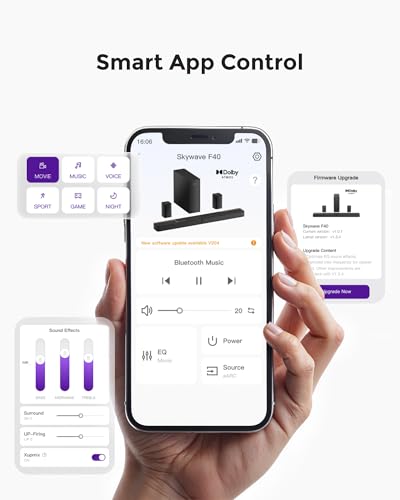
The Ultimea F40 embraces smartphone control wholeheartedly. The companion app provides access to every system parameter—EQ settings, sound modes, input selection, even firmware updates. Bluetooth 5.4 support ensures fast, stable connections with minimal latency, particularly important for gaming or watching videos on mobile devices.
The app interface feels modern and responsive, though it can be overwhelming initially. Having 121 sound presets seems excessive until you realize they're actually carefully tuned for specific content types and room conditions. The ability to receive over-the-air updates means the system can improve over time, something impossible with traditional audio equipment.
The DHT-S517 focuses on fundamental features executed excellently rather than extensive customization. The three sound modes (Movie, Music, Night) cover most listening scenarios effectively. Night mode particularly impressed me—it compresses dynamic range intelligently, allowing late-night viewing without disturbing others while maintaining dialogue clarity.
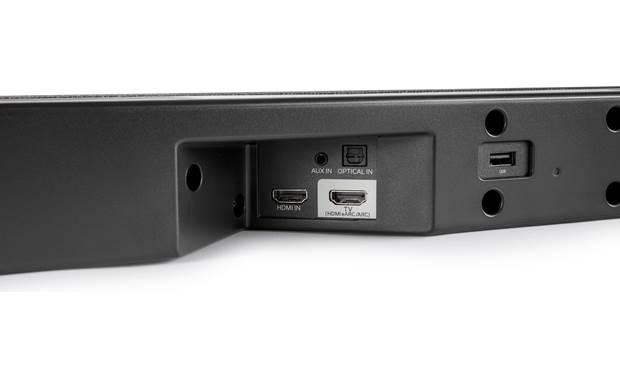
HDMI eARC support with additional pass-through input provides more connection flexibility than the F40. The CEC integration works flawlessly, allowing TV remote control of soundbar volume—a surprisingly important convenience feature.
Installing the F40 requires planning and patience. You'll need to position wireless rear speakers optimally, ensure strong wireless signal throughout your room, and manage power connections for multiple components. The initial setup took me about 45 minutes, including fine-tuning speaker positions for optimal surround effects.
The payoff justifies the effort, but this isn't a plug-and-play solution. Room acoustics significantly impact performance—hard floors and walls enhance surround effects, while heavy carpeting and soft furnishings can dampen the experience. I recommend dedicating time to experimenting with speaker placement rather than just putting them wherever convenient.
The DHT-S517 setup takes maybe 15 minutes. Soundbar placement, subwoofer positioning, wireless pairing, and connection to your TV—done. The system sounds good immediately without extensive tweaking, though some users might wish for more customization options.
This simplicity extends to long-term ownership. Fewer wireless connections mean fewer potential points of failure. The subwoofer pairing has remained stable through months of testing, while the F40 occasionally requires rear speaker re-pairing after power outages.
Your room significantly influences which system works better. The F40 thrives in larger spaces where rear speakers can be positioned at proper distances from seating areas. In my 15x20-foot living room, the surround effect is genuinely spectacular. However, in smaller apartments or oddly shaped rooms, the rear speakers might feel overwhelming or impossible to position effectively.
The DHT-S517 works well in virtually any room size. Its virtual surround processing adapts to different acoustic environments, and the compact form factor suits everything from studio apartments to large family rooms.
Here's where the F40 really shines—everyone in the room experiences proper surround sound, not just the person sitting in the "sweet spot." Traditional soundbars focus their effects on a single listening position, but physical rear speakers ensure surround effects work from multiple seating areas.
The DHT-S517 creates an impressive soundstage, but optimal surround effects require sitting relatively centered to the soundbar. Family movie nights might leave some viewers with diminished surround experiences.
At the time of writing, both systems offer compelling value in the competitive $300 price range, but they target different priorities. The F40 delivers more raw surround sound capability than systems costing twice as much, making it exceptional value for immersion-focused users. The extensive smart features and upgrade capability through apps add long-term value.
The DHT-S517 represents traditional audio company values—superior engineering, reliable performance, and excellence in core audio reproduction. You're paying for Denon's expertise and proven track record, which translates to consistent performance and likely longer product lifespan.
You're building a dedicated home theater experience where maximum immersion matters most. Movie enthusiasts who want to feel transported into action sequences will appreciate the authentic surround positioning. Gamers seeking competitive advantages from precise audio cues should strongly consider the F40. If you enjoy tweaking audio settings and want a system that can evolve through software updates, the extensive app control justifies the added complexity.
The F40 also makes sense for families or anyone regularly entertaining groups—the multi-position surround sound ensures everyone gets an engaging experience rather than just whoever sits in the center seat.
Dialogue clarity and music reproduction quality matter more than maximum surround immersion. The DHT-S517 excels for users who watch lots of dialogue-heavy content—dramas, documentaries, news programming—where speech intelligibility determines enjoyment. Music lovers who want accurate stereo reproduction will appreciate Pure Mode and Denon's careful audio tuning.
The DHT-S517 suits users wanting reliable, excellent performance without complexity. If you prefer systems that work well immediately without extensive tweaking, or if your living situation makes positioning multiple speakers impractical, Denon's approach offers compelling advantages.
Both soundbars succeed at their intended purposes, but they serve fundamentally different audio philosophies. The Ultimea F40 prioritizes maximum immersion through authentic surround positioning, while the Denon DHT-S517 focuses on precise audio engineering within a simpler form factor.
My personal recommendation leans toward the F40 for dedicated home theater setups where the goal is cinematic immersion. However, the DHT-S517 makes more sense for everyday living room use where simplicity, reliability, and dialogue clarity matter most.
The decision ultimately comes down to whether you want the most immersive surround sound experience possible (F40) or the most refined audio engineering in a simple package (DHT-S517). Both deliver genuine Dolby Atmos effects that dramatically improve over built-in TV speakers, but they achieve this goal through completely different approaches.
Consider your room, your content preferences, and your tolerance for complexity. Either choice represents solid value in today's competitive soundbar market, but only one will align perfectly with your specific home theater goals.
| Ultimea Skywave F40 | Denon DHT-S517 |
|---|---|
| Channel Configuration - Determines surround sound authenticity and immersion level | |
| 5.1.2 with physical wireless rear speakers for true surround positioning | 3.1.2 with virtual surround processing from front-firing drivers |
| Surround Speaker Setup - Major factor in installation complexity and audio accuracy | |
| Dedicated wireless rear speakers that must be positioned behind listening area | No rear speakers - surround effects simulated through DSP processing |
| Center Channel Design - Critical for dialogue clarity in movies and TV | |
| Virtual center channel created through left/right driver processing | Dedicated 1" full-range center channel driver for superior speech reproduction |
| Total System Power - Affects maximum volume and dynamic range capability | |
| 460W total system power distributed across all components | 100W subwoofer plus amplified soundbar (total power not specified) |
| Smart Features and Customization - Important for fine-tuning sound to your preferences | |
| Extensive smartphone app with 10-band EQ, 121 presets, OTA updates | Basic sound modes (Movie/Music/Night) plus Dialogue Enhancer with 3 levels |
| Bluetooth Technology - Impacts wireless streaming quality and connection stability | |
| Bluetooth 5.4 for improved stability and ultra-low latency | Bluetooth 5.0 with standard wireless audio streaming |
| Connectivity Options - Determines compatibility with various devices and setups | |
| HDMI eARC, Optical, USB, Bluetooth (no HDMI pass-through) | HDMI eARC plus additional HDMI input for device pass-through |
| Setup Complexity - Affects installation time and long-term maintenance requirements | |
| Complex setup requiring optimal positioning of multiple wireless components | Simple two-component setup (soundbar + wireless subwoofer) |
| Brand Heritage and Audio Engineering - Indicates expected build quality and sound tuning | |
| Newer brand focused on value-oriented smart features and immersive surround | Century-old audio company with established expertise in speaker design |
| Music Performance Approach - How well the system handles stereo music content | |
| Extensive EQ customization but lacks dedicated stereo mode | Pure Mode for unprocessed stereo reproduction plus precision-tuned drivers |
| Subwoofer Integration - Affects bass quality and overall system coherence | |
| BassMX technology with good integration across frequency range | 100W wireless sub with noted crossover gap issues during music playback |
| Ideal Use Case - Who benefits most from each system's strengths | |
| Movie/gaming enthusiasts wanting maximum surround immersion in dedicated theater setups | Users prioritizing dialogue clarity and music quality in simpler living room installations |
The Ultimea Skywave F40 delivers superior surround sound immersion through dedicated wireless rear speakers that create authentic 360-degree audio positioning. The Denon DHT-S517 uses advanced virtual surround processing but cannot match the spatial accuracy of physical rear speakers. For true surround sound experience, the F40 is the clear winner.
The Ultimea Skywave F40 features 5.1.2 channels with physical rear speakers for genuine surround positioning, while the Denon DHT-S517 offers 3.1.2 channels with simulated rear effects. The 5.1.2 configuration provides more immersive audio but requires additional speaker placement, whereas 3.1.2 offers simpler setup with fewer components.
The Denon DHT-S517 excels at dialogue clarity thanks to its dedicated center channel driver and Dialogue Enhancer technology with three adjustable levels. The Ultimea Skywave F40 relies on virtual center channel processing, which doesn't match the speech clarity of a physical center driver. For dialogue-heavy content, choose the DHT-S517.
The Denon DHT-S517 offers simple setup with just a soundbar and wireless subwoofer, taking about 15 minutes to install. The Ultimea Skywave F40 requires more complex setup involving multiple wireless components and optimal rear speaker positioning, typically taking 45 minutes or more. Consider your tolerance for installation complexity when choosing.
The Denon DHT-S517 provides better music reproduction through its Pure Mode for unprocessed stereo playback and precision-tuned drivers. The Ultimea Skywave F40 offers extensive EQ customization with 121 presets but may artificially widen stereo music through rear speakers. Music enthusiasts should prefer the DHT-S517.
Yes, both the Ultimea Skywave F40 and Denon DHT-S517 feature upward-firing drivers for Dolby Atmos height effects that bounce sound off your ceiling. The F40 uses dual up-firing speakers with neodymium magnets, while the DHT-S517 employs precisely angled 2.5-inch drivers for overhead audio positioning.
The Ultimea Skywave F40 provides extensive customization through its smartphone app with 10-band EQ, 121 sound presets, and over-the-air updates. The Denon DHT-S517 offers basic sound modes (Movie, Music, Night) and Dialogue Enhancer settings. Tech-savvy users who enjoy fine-tuning audio will prefer the F40's advanced controls.
Both soundbars include HDMI eARC and optical inputs, but differ in additional features. The Ultimea Skywave F40 offers USB input and Bluetooth 5.4 for improved wireless streaming. The Denon DHT-S517 includes an extra HDMI input for device pass-through and Bluetooth 5.0. Consider which connections match your device setup needs.
The Ultimea Skywave F40 excels for gaming due to its physical rear speakers providing accurate positional audio for competitive advantage. The Bluetooth 5.4 also offers lower latency for mobile gaming. The Denon DHT-S517 creates engaging gaming audio but lacks the precise directional cues that physical surround speakers provide.
The Ultimea Skywave F40 includes BassMX technology for enhanced bass integration across the full system. The Denon DHT-S517 features a 100-watt wireless subwoofer but has noted integration issues at crossover frequencies during music playback. Both deliver powerful bass, but the F40 offers better overall integration.
The Denon DHT-S517 works better in small spaces due to its compact two-component design and virtual surround processing that adapts to room acoustics. The Ultimea Skywave F40 requires adequate space for proper rear speaker positioning and may overwhelm smaller rooms. Apartment dwellers should consider the DHT-S517.
The key trade-off is authentic surround immersion versus simplicity and audio precision. The Ultimea Skywave F40 delivers true surround sound through physical rear speakers but requires complex setup and more space. The Denon DHT-S517 offers refined audio engineering with superior dialogue clarity in a simpler package but lacks genuine surround positioning. Choose based on whether maximum immersion or ease of use matters more.
We've done our best to create useful and informative comparisons to help you decide what product to buy. Our research uses advanced automated methods to create this comparison and perfection is not possible - please contact us for corrections or questions. These are the sites we've researched in the creation of this article: the-gadgeteer.com - youtube.com - ultimea.com - manuals.plus - youtube.com - ultimea.com - youtube.com - youtube.com - youtube.com - youtube.com - eu.ultimea.com - support.ultimea.com - techradar.com - consumerreports.org - crutchfield.com - bestbuy.com - bestbuy.com - pocket-lint.com - abt.com - manuals.denon.com - connectedmag.com.au - bestbuy.com - forum.flirc.tv - bhphotovideo.com

Privacy Policy
Terms and Conditions - Affiliate Policy
Home Security
© Copyright 2008-2026.
11816 Inwood Rd #1211, Dallas, TX 75244