

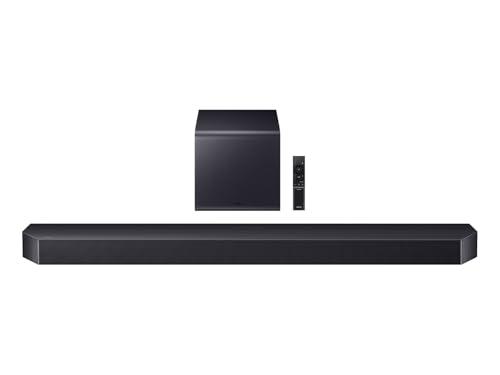
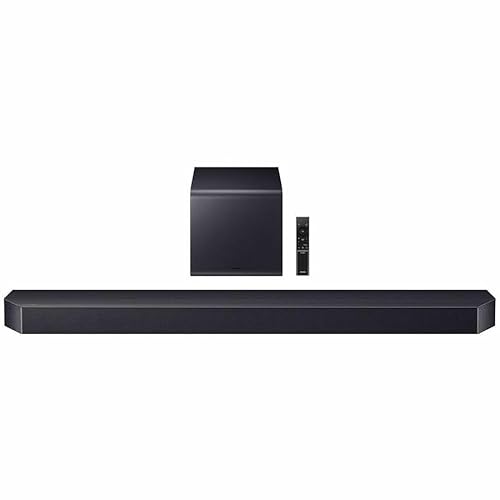

When it comes to upgrading from your TV's built-in speakers, the world of Dolby Atmos soundbars can feel overwhelming. You've got premium flagship models that cost as much as a decent used car, and budget options that promise the moon for the price of a weekend dinner. Today, we're diving deep into two soundbars that represent opposite ends of this spectrum: the Samsung HW-Q990F and the Ultimea Skywave F40.
The beauty of this comparison lies in what it reveals about the current state of home theater audio. One costs roughly four times more than the other, but both promise that magical Dolby Atmos experience where sounds float above your head and surround you completely. The question isn't just which one sounds better—it's whether that extra performance is worth the significant price difference, and more importantly, which one fits your specific situation.
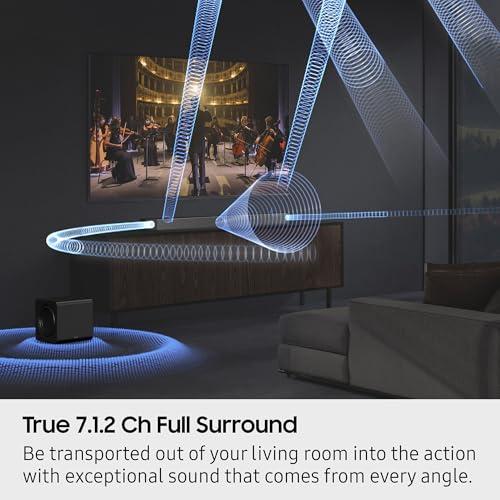
Before we dive into these specific models, let's talk about what makes Dolby Atmos special. Traditional surround sound works in a horizontal plane—think of sounds moving left to right, or front to back. Dolby Atmos adds height to the equation, creating a three-dimensional bubble of sound around you. Instead of just having a helicopter fly across your screen, you can actually hear it moving overhead from one side of your room to the other.
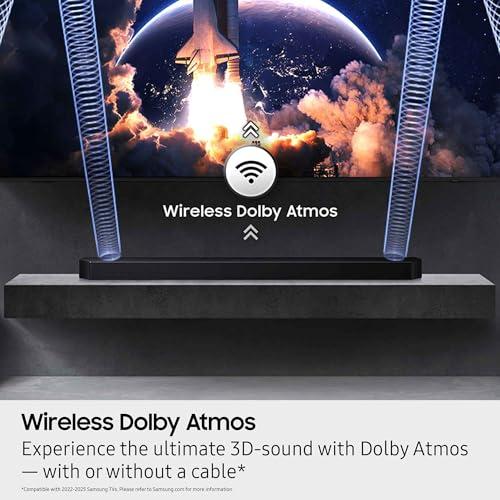
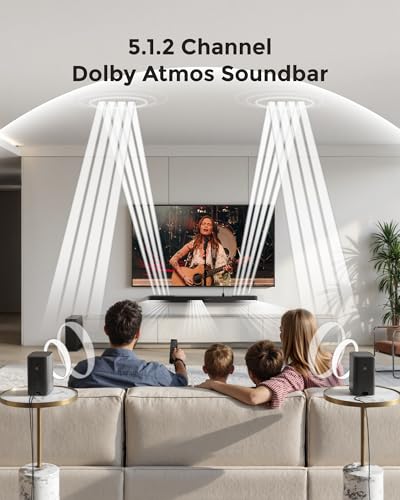
The magic happens through "up-firing" speakers that bounce sound off your ceiling, combined with sophisticated audio processing that can place individual sound effects in specific locations around your room. It's the difference between watching a movie and feeling like you're inside it.
But here's where it gets tricky: not all Dolby Atmos soundbars are created equal. Some manufacturers use creative marketing to call their products "Atmos-enabled" when they're really just using digital processing to simulate height effects. Others, like both the Samsung Q990F and Ultimea Skywave F40, include actual physical speakers that fire upward to create genuine overhead effects.
The key things to look for in any Dolby Atmos system are the channel configuration (more channels generally mean more precise sound placement), the number of actual speakers, whether it includes physical rear speakers or just tries to simulate surround effects, and how sophisticated the audio processing is.
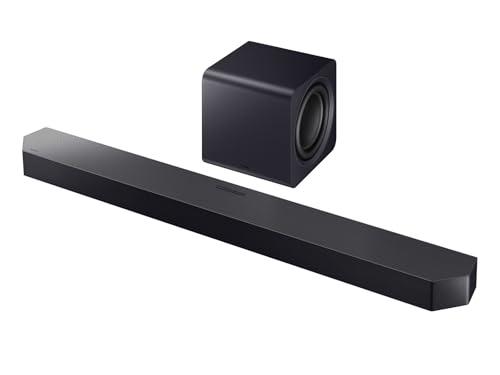
Released in 2025, the Samsung HW-Q990F represents the culmination of Samsung's soundbar engineering efforts. This isn't just an incremental update—it's a comprehensive system that includes 23 individual speakers spread across a main soundbar, a wireless subwoofer, and wireless rear speakers.
The channel configuration reads like audio alphabet soup: 11.1.4. Let me break that down. The first number (11) represents the main channels—front left, center, front right, side surrounds, and rear surrounds, plus some additional channels for width and precision. The ".1" is your subwoofer channel handling all the deep bass. The final "4" represents the height channels—those up-firing speakers that create the overhead effects that make Dolby Atmos so compelling.
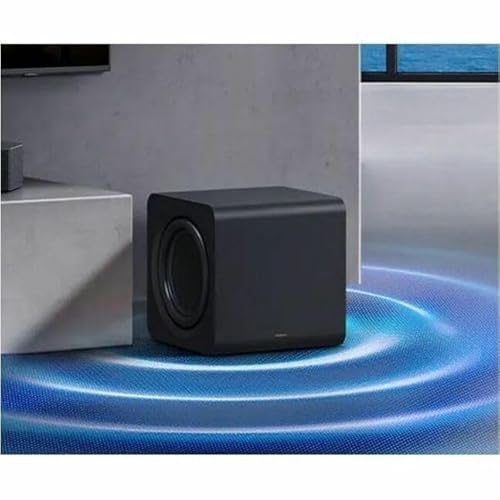
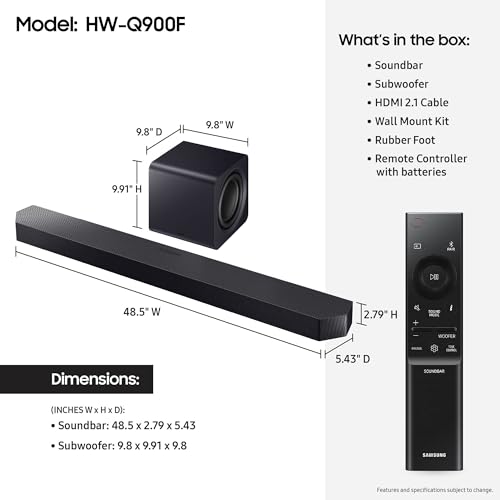
What makes the Samsung Q990F special isn't just the speaker count, but how those speakers work together. The main soundbar houses 15 individual drivers, including dedicated up-firing speakers with neodymium magnets and specialized voice coils that can throw sound higher and more precisely than typical drivers. The wireless subwoofer features dual 8-inch force-canceling woofers in an innovative design that minimizes vibration while maximizing bass output.
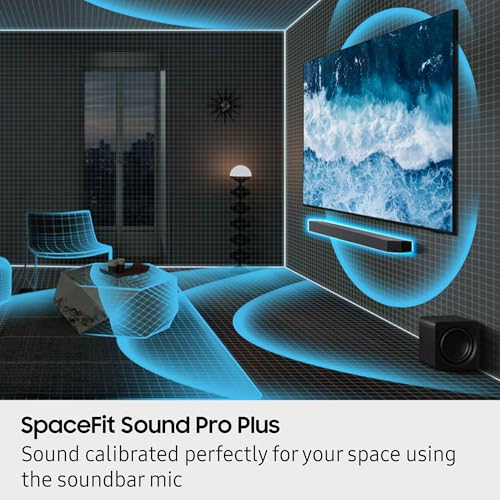
But the real innovation lies in Samsung's SpaceFit Sound Pro Plus technology. This system uses built-in microphones to analyze your room's acoustics and automatically adjusts the soundbar's output to compensate for your specific space. Got a large, open living room? It'll boost certain frequencies to fill the space. Smaller bedroom setup? It'll dial things back to prevent overwhelming the room. This kind of automatic room correction used to require expensive separate equipment.
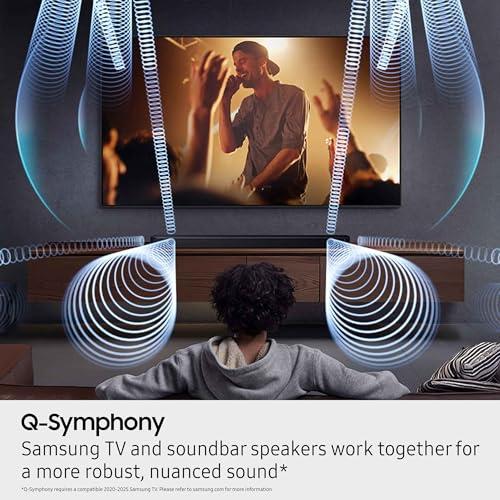
The Samsung Q990F also includes Samsung's Q-Symphony technology, which is genuinely game-changing if you own a compatible Samsung TV. Instead of turning off your TV's speakers when you connect the soundbar (like most systems do), Q-Symphony actually uses both the soundbar and TV speakers together, creating an even larger, more immersive soundstage. It's like having additional height and width channels without buying extra speakers.
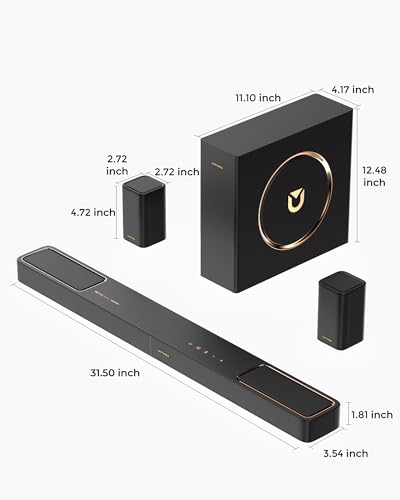
The Ultimea Skywave F40, also released in 2025, takes a completely different approach. At a fraction of the Samsung's price (at the time of writing), it focuses on delivering genuine Dolby Atmos performance without the premium features or wireless convenience.
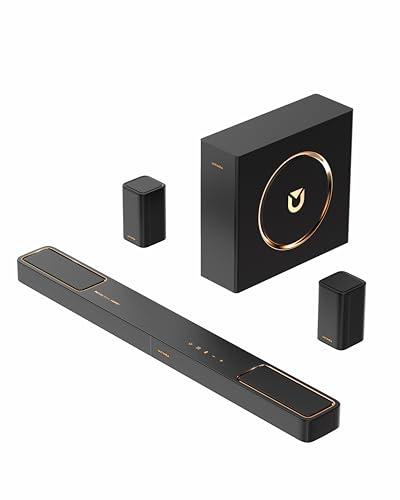
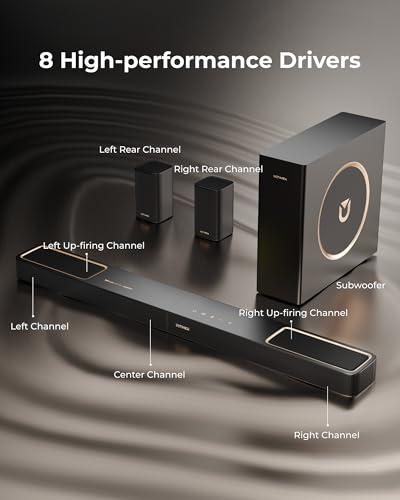
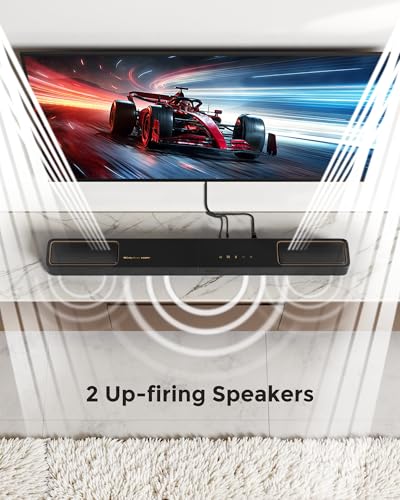
The Skywave F40 uses a 5.1.2 configuration with 8 total speakers. That might sound modest compared to the Samsung's 23 speakers, but it's actually quite impressive for this price range. Many budget soundbars in this category fake their surround effects using digital processing alone, but the Ultimea Skywave F40 includes actual physical rear speakers and genuine up-firing drivers in the main bar.
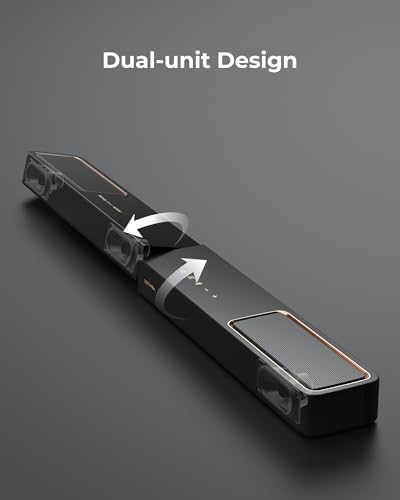
The system comes in several pieces: a main soundbar that splits into two sections (connected by a secure twist-lock mechanism), a wired subwoofer with a 6.5-inch driver, and two compact rear surround speakers. Yes, everything is wired rather than wireless, but that's part of how Ultimea keeps the cost down while maintaining audio quality.
What's particularly clever about the Ultimea Skywave F40 is its Xupmix technology, powered by Dolby DAP (Dolby Audio Processing). This feature can take regular stereo content—like music from Spotify or dialogue from old TV shows—and intelligently upmix it to take advantage of all those surround and height speakers. It's not magic, but it means you're not limited to just Dolby Atmos-encoded content to get an immersive experience.
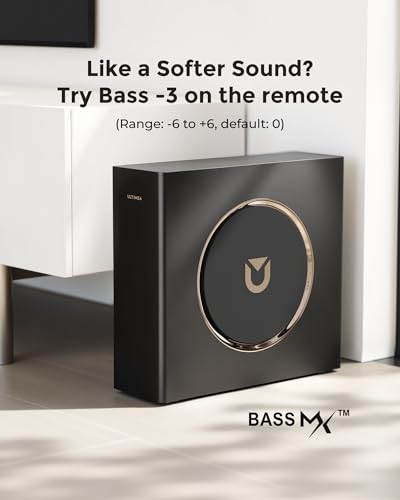
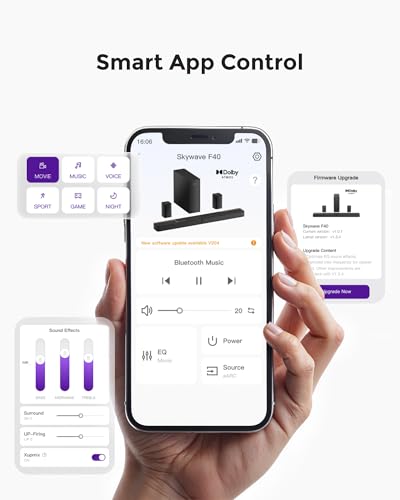
The system also includes BassMX technology, which optimizes the subwoofer's output to deliver more impactful bass without overwhelming smaller rooms. Combined with a 10-band equalizer and 121 preset EQ matrices accessible through Ultimea's smartphone app, you get surprising control over your audio experience.
When it comes to pure audio performance, the differences between these systems become immediately apparent. The Samsung Q990F, with its 23-speaker configuration, creates a remarkably seamless soundstage that truly envelops you. Expert reviews consistently praise its ability to place sounds with surgical precision—a helicopter doesn't just move across the screen, it moves through three-dimensional space around your seating position.
The four dedicated height channels work in concert with the main and surround speakers to create what audio engineers call "object-based audio placement." This means individual sound effects can be positioned anywhere in a virtual sphere around you, not just in predetermined speaker locations. When you're watching a movie like "Top Gun: Maverick," the jets don't just pan left to right—they move through space with convincing altitude changes and distance cues.
The Ultimea Skywave F40, despite having significantly fewer speakers, still delivers a genuinely immersive Dolby Atmos experience. The two up-firing drivers create convincing height effects, and the physical rear speakers provide proper surround imaging that you simply can't get from soundbar-only systems. While it can't match the Samsung's precision or seamless speaker integration, it creates a surprisingly large and engaging soundstage that dramatically outperforms typical budget soundbars.
One area where both systems excel is dialogue clarity. The Samsung Q990F includes Active Voice Amplifier Pro, which analyzes ambient noise and automatically boosts dialogue frequencies to ensure speech remains clear even during explosive action sequences. The Ultimea Skywave F40 achieves similar results through its dedicated center channel and voice enhancement modes, though without the automatic adjustment.
Bass performance represents one of the most significant differences between these systems. The Samsung Q990F's dual 8-inch subwoofer design creates incredibly deep, controlled bass that can shake your room without becoming muddy or overwhelming. The force-canceling design means the woofers work against each other to minimize cabinet vibration while maximizing bass output—you get all the impact without the rattling furniture.
More importantly, the Samsung's AI-powered Dynamic Bass Control continuously analyzes the audio signal and adjusts bass output to prevent distortion. This means the system maintains clean, articulate bass even at high volumes, though some compression does occur at absolute maximum levels.
The Ultimea Skywave F40's single 6.5-inch subwoofer can't match the Samsung's depth or power, but it punches well above its weight class. The BassMX technology helps optimize output for different room sizes and content types. For most living rooms and content, it provides satisfying bass impact that adds real weight to movie soundtracks and music. You won't get the room-shaking experience of the Samsung, but you'll get bass that's leagues better than any TV speaker or basic soundbar.
This is where the price difference really shows. The Samsung Q990F functions as a complete entertainment hub with multiple HDMI 2.1 inputs that support 4K video at 120Hz—crucial if you own a PlayStation 5 or Xbox Series X. The eARC (enhanced Audio Return Channel) support means you can connect all your devices to your TV and send lossless audio back to the soundbar without compression.
The smart features are comprehensive: built-in Amazon Alexa for voice control, Apple AirPlay 2 for wireless streaming from iOS devices, Google Cast for Android users, and direct integration with streaming services like Spotify Connect and TIDAL Connect. You can literally ask Alexa to play music and it'll stream directly to the soundbar without involving your TV or phone.
The Ultimea Skywave F40 takes a more basic approach with a single HDMI eARC connection, optical input, and Bluetooth 5.4 for wireless streaming. The smart features are limited to Ultimea's mobile app, which provides access to all those EQ settings and listening modes. While it lacks the Samsung's comprehensive connectivity, it covers the essentials that most people actually use.
In a dedicated home theater setting, the Samsung Q990F truly shines. The wireless subwoofer and rear speakers allow for optimal placement without running cables across your room. The automatic room calibration adapts to your specific space, whether it's a small bedroom or a large living room with high ceilings. The multiple HDMI inputs mean you can connect a game console, Blu-ray player, and streaming device directly to the soundbar, simplifying your setup.
For living room use where the system needs to handle everything from quiet dialogue in dramas to explosive action sequences, the Samsung's Adaptive Sound and various listening modes automatically optimize performance for different content types. The Night Mode compresses dynamic range so you can watch movies at lower volumes without losing dialogue clarity—essential if you live in an apartment or have sleeping family members nearby.
The Ultimea Skywave F40 excels in smaller to medium-sized spaces where you want genuine surround sound without the premium price. The wired connections mean some planning for cable routing, but many users find this manageable, especially since the rear speakers connect to the subwoofer rather than requiring separate power connections.
Where the Ultimea really impresses is in its customization options. The 10-band equalizer and extensive preset library let you fine-tune the sound to your exact preferences or room acoustics. This level of manual control often requires expensive separate equipment with premium systems, but it's built right into the Ultimea Skywave F40's smartphone app.
Based on our research into user experiences and expert reviews, the choice between these systems comes down to your priorities, budget, and specific use case.
Choose the Samsung HW-Q990F if you want the absolute best home theater experience money can buy in the soundbar category. This system justifies its premium price through superior performance, convenience, and future-proofing. The wireless setup, automatic room calibration, comprehensive smart features, and reference-quality audio make it ideal for serious movie enthusiasts with premium TVs and flexible budgets. If you're building a dedicated home theater or want a system that'll still impress you years from now, the Samsung is worth the investment.
The Ultimea Skywave F40 makes sense for practically everyone else. It delivers 80% of premium soundbar performance at 25% of the cost, making it an exceptional value proposition. The genuine Dolby Atmos experience with physical surround speakers provides dramatic improvement over TV audio without breaking the bank. If you're budget-conscious but still want true surround sound, or if you're testing the waters before committing to a premium system, the Ultimea offers impressive performance with minimal financial risk.
At the time of writing, the price difference between these systems is substantial enough that most buyers will know which category they fall into. The Samsung Q990F is an investment in premium audio that'll serve you well for years to come. The Ultimea Skywave F40 is a smart entry point into high-quality home theater audio that proves you don't need to spend flagship money to get a genuinely immersive experience.
Both systems represent excellent choices within their respective price ranges, and either will transform your movie nights compared to basic TV speakers. The question isn't whether they're good—it's which one fits your specific needs, space, and budget.
| Samsung HW-Q990F | Ultimea Skywave F40 |
|---|---|
| Channel Configuration - More channels provide better surround precision and immersion | |
| 11.1.4 channels with 23 total speakers | 5.1.2 channels with 8 total speakers |
| Physical Rear Speakers - Essential for true surround sound vs. simulated effects | |
| Wireless rear speakers with multiple drivers each | Wired rear speakers with dedicated drivers |
| Subwoofer Design - Impacts bass depth, power, and room-filling capability | |
| Dual 8" wireless subwoofer, reaches 32Hz | Single 6.5" wired subwoofer, reaches 38Hz |
| Up-firing Height Drivers - Creates the overhead Dolby Atmos effect | |
| 4 dedicated up-firing drivers with neodymium magnets | 2 up-firing drivers in main soundbar |
| Room Calibration - Automatically optimizes sound for your specific space | |
| SpaceFit Sound Pro Plus (automatic microphone-based) | Manual EQ adjustment via smartphone app |
| HDMI Connectivity - More inputs mean fewer device switching hassles | |
| 3 HDMI 2.1 ports (2 in, 1 eARC out) with 4K@120Hz | 1 HDMI eARC port only |
| Smart Features - Voice control and streaming convenience | |
| Built-in Alexa, AirPlay 2, Google Cast, Spotify Connect | Bluetooth 5.4, basic app control only |
| Wireless vs. Wired Setup - Affects speaker placement flexibility | |
| Fully wireless subwoofer and rear speakers | All components require wired connections |
| Audio Format Support - Determines compatibility with premium content | |
| Dolby Atmos, DTS:X, TrueHD, Digital Plus, LPCM | Dolby Atmos, basic digital formats |
| EQ Customization - Fine-tuning capability for different rooms and preferences | |
| 7-band EQ with preset sound modes | 10-band EQ with 121 preset matrices |
| TV Integration - Enhanced experience with compatible TVs | |
| Q-Symphony works with Samsung TVs for combined audio | Universal compatibility, no special TV features |
The Ultimea Skywave F40 delivers exceptional value by providing genuine Dolby Atmos with physical rear speakers at a fraction of premium soundbar costs. While the Samsung HW-Q990F offers superior performance with 23 speakers and wireless convenience, the Ultimea Skywave F40 achieves roughly 80% of the audio quality for about 25% of the investment, making it the clear value winner for budget-conscious buyers.
Yes, both the Samsung HW-Q990F and Ultimea Skywave F40 include dedicated rear surround speakers, which is crucial for true surround sound. The key difference is that the Samsung HW-Q990F features wireless rear speakers for flexible placement, while the Ultimea Skywave F40 uses wired rear speakers that connect to the subwoofer.
The Ultimea Skywave F40 is often better suited for smaller spaces due to its more compact design and appropriate power output that won't overwhelm tight quarters. The Samsung HW-Q990F includes automatic room calibration that can adapt to small rooms, but its premium features and higher power output may be overkill for apartment living.
The Samsung HW-Q990F delivers significantly deeper and more powerful bass with its dual 8-inch wireless subwoofer that reaches down to 32Hz. The Ultimea Skywave F40 provides solid bass response from its single 6.5-inch subwoofer extending to 38Hz, which is adequate for most content but can't match the room-shaking impact of the premium Samsung system.
Both soundbars support HDMI CEC control, allowing basic volume and power control through your TV remote. However, the Samsung HW-Q990F offers more advanced integration, especially with Samsung TVs through its Q-Symphony technology, while the Ultimea Skywave F40 provides standard CEC functionality that works with most modern TVs.
The Samsung HW-Q990F offers superior connectivity with multiple HDMI 2.1 inputs, built-in Wi-Fi, Bluetooth 5.3, and support for AirPlay 2, Google Cast, and voice assistants. The Ultimea Skywave F40 provides essential connectivity with one HDMI eARC port, optical input, and Bluetooth 5.4, covering basic needs without premium streaming features.
The Samsung HW-Q990F is excellent for gaming with HDMI 2.1 support for 4K@120Hz pass-through and a dedicated Game Pro mode that enhances directional audio cues. The Ultimea Skywave F40 also works well for gaming through its HDMI eARC connection and game-specific EQ settings, though it lacks the advanced gaming features of the Samsung system.
The Ultimea Skywave F40 offers simpler initial setup with straightforward wired connections, though cable management requires planning. The Samsung HW-Q990F provides easier long-term convenience with wireless components and automatic room calibration, but initial setup involves more configuration options and wireless pairing processes.
The Samsung HW-Q990F includes comprehensive smart features like built-in Alexa, multiple streaming services, and advanced app control. The Ultimea Skywave F40 focuses on essential functionality through its smartphone app for EQ control and basic settings, without voice assistants or direct streaming service integration.
Both soundbars excel at dialogue clarity with dedicated center channels. The Samsung HW-Q990F includes Active Voice Amplifier Pro that automatically adjusts dialogue based on ambient noise, while the Ultimea Skywave F40 provides clear speech through its center channel and voice enhancement modes that require manual adjustment.
The Samsung HW-Q990F is designed for larger spaces with its 23-speaker configuration, wireless placement flexibility, and automatic room calibration that adapts to bigger rooms. The Ultimea Skywave F40 works best in small to medium-sized rooms and may struggle to fill very large home theater spaces with adequate volume and presence.
The Samsung HW-Q990F offers better long-term value with premium build quality, comprehensive codec support, HDMI 2.1 future-proofing, and regular firmware updates. The Ultimea Skywave F40 provides solid construction for its price range but may require upgrading sooner if your audio needs or room size change significantly over time.
We've done our best to create useful and informative comparisons to help you decide what product to buy. Our research uses advanced automated methods to create this comparison and perfection is not possible - please contact us for corrections or questions. These are the sites we've researched in the creation of this article: rtings.com - crutchfield.com - sound-advice.online - samsung.com - soundandvision.com - samsung.com - whathifi.com - youtube.com - youtube.com - bestbuy.com - avsforum.com - content.syndigo.com - samsung.com - businessinsider.com - dolby.com - youtube.com - abcwarehouse.com - the-gadgeteer.com - youtube.com - ultimea.com - manuals.plus - youtube.com - ultimea.com - youtube.com - youtube.com - youtube.com - youtube.com - eu.ultimea.com - support.ultimea.com

Privacy Policy
Terms and Conditions - Affiliate Policy
Home Security
© Copyright 2008-2026.
11816 Inwood Rd #1211, Dallas, TX 75244