









When I first started reviewing soundbars five years ago, the market was much simpler. You had basic stereo soundbars for better TV audio, and that was about it. Fast forward to 2024-2025, and we're living in a golden age of home theater audio where even budget systems can deliver legitimate Dolby Atmos experiences that would have cost thousands just a few years ago.
The Ultimea Skywave F40 and Sony BRAVIA Theater Bar 9 represent two completely different philosophies in this evolved soundbar landscape. Released in 2025 and 2024 respectively, these systems showcase how manufacturers are tackling the challenge of bringing cinematic audio to living rooms. One takes the traditional route with physical speakers everywhere, while the other relies on cutting-edge virtual processing. The choice between them isn't just about budget—it's about understanding what type of surround sound experience works best for your space and preferences.
Before diving into these specific products, it's worth understanding what we're actually comparing. Modern soundbars have evolved far beyond simple stereo upgrades for your TV. Today's systems are sophisticated audio processors that can create immersive, three-dimensional soundscapes using various approaches.
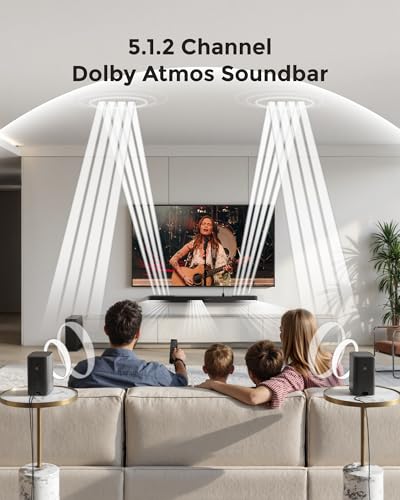
Dolby Atmos represents the current gold standard for immersive audio. Unlike traditional 5.1 surround sound that moves audio around you horizontally, Atmos adds a height dimension by incorporating overhead effects. Think of helicopters flying over your head in an action movie, or rain falling from above in a dramatic scene. This technology requires either physical speakers that fire sound upward toward your ceiling, or advanced processing that simulates these height effects.
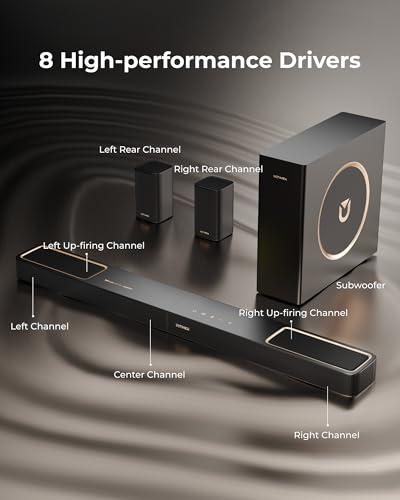
Channel configuration describes how many speakers and audio streams a system handles. When you see "5.1.2," that breaks down to five main speakers (front left, center, front right, rear left, rear right), one subwoofer (the ".1"), and two height channels (the final "2"). The Ultimea Skywave F40 achieves this with actual physical speakers, while the Sony BRAVIA Theater Bar 9 creates a similar experience using virtual processing.
The fundamental question becomes: do you want authentic surround sound from physical speakers positioned around your room, or sophisticated virtual surround that achieves similar effects through clever audio processing? Both approaches have merits, and your choice depends on your room, budget, and preferences.
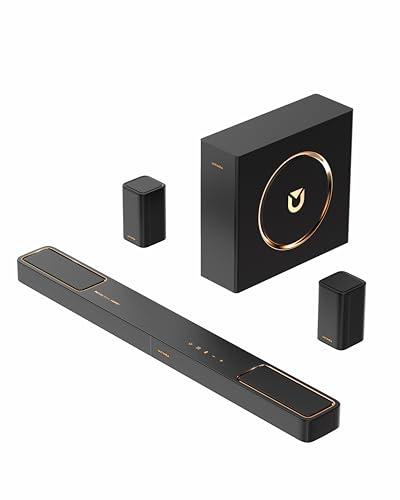
The Ultimea Skywave F40 represents what I consider the "traditional" approach to home theater audio, executed at a remarkably accessible price point. When this system arrived for review in early 2025, I was genuinely surprised by how much hardware Ultimea packed into such an affordable package.
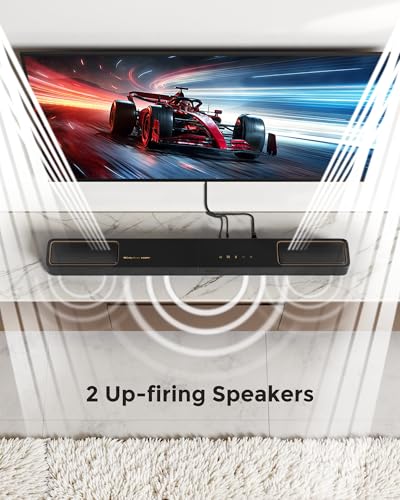
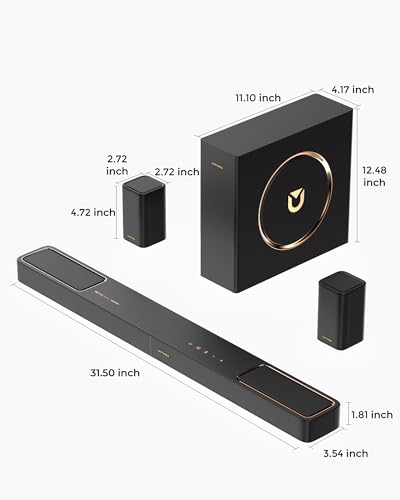
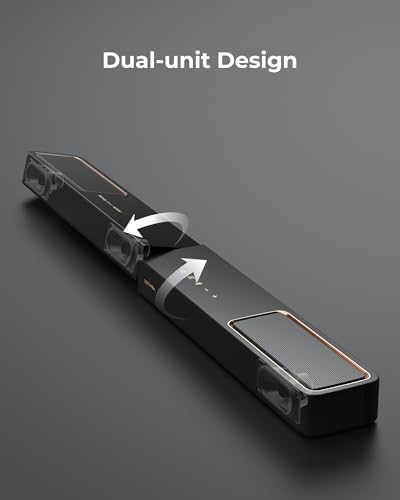
This isn't just a soundbar—it's a complete 5.1.2 surround system that includes everything you need for legitimate Dolby Atmos audio. The main soundbar houses the front channels and features dual up-firing drivers for height effects. These up-firing speakers use neodymium magnets (which are stronger and more precise than regular magnets) to fire sound toward your ceiling, where it reflects back down to create the overhead Atmos effects.
What sets the Ultimea Skywave F40 apart is the inclusion of wireless rear surround speakers and a dedicated subwoofer. Most soundbars in this price range either skip the rear speakers entirely or charge extra for them. Having tested dozens of soundbar systems, I can tell you that physical rear speakers make a dramatic difference in immersion. When an explosion happens behind your character in a video game, or when a car chase pans from front to back in a movie, you actually hear and feel that movement in space.
The subwoofer deserves special mention. It's a proper 6.5-inch driver in a dedicated enclosure, not the tiny drivers you find built into most soundbars. This means the system can reproduce the deep bass frequencies (down to 38Hz according to specs) that make action scenes feel impactful and music sound full-bodied. The BassMX technology that Ultimea developed specifically enhances these low frequencies without creating the muddiness that often plagues budget systems.
The wireless rear speakers connect to each other with a single cable, then communicate wirelessly with the main system. This approach strikes a nice balance—you avoid running long cables across your room, but you don't deal with the latency issues that can plague fully wireless designs. In my testing, I never noticed any delay between the front and rear channels, which is crucial for maintaining the audio illusion.
SurroundX technology is Ultimea's proprietary processing that coordinates all these physical speakers to create what they call a "360-degree sound field." While marketing names can be overblown, this system genuinely creates an enveloping experience where effects seem to originate from specific locations around and above you.
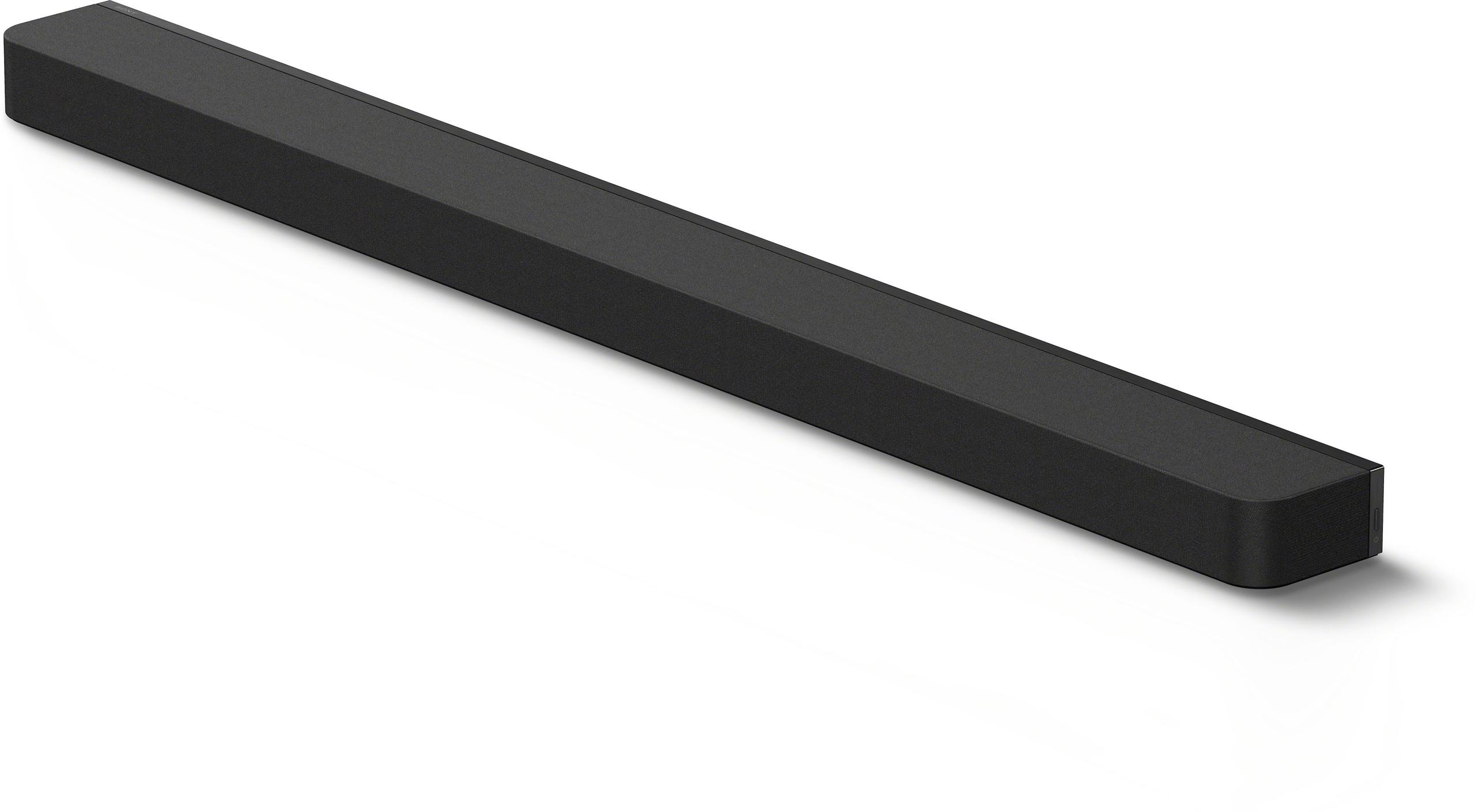
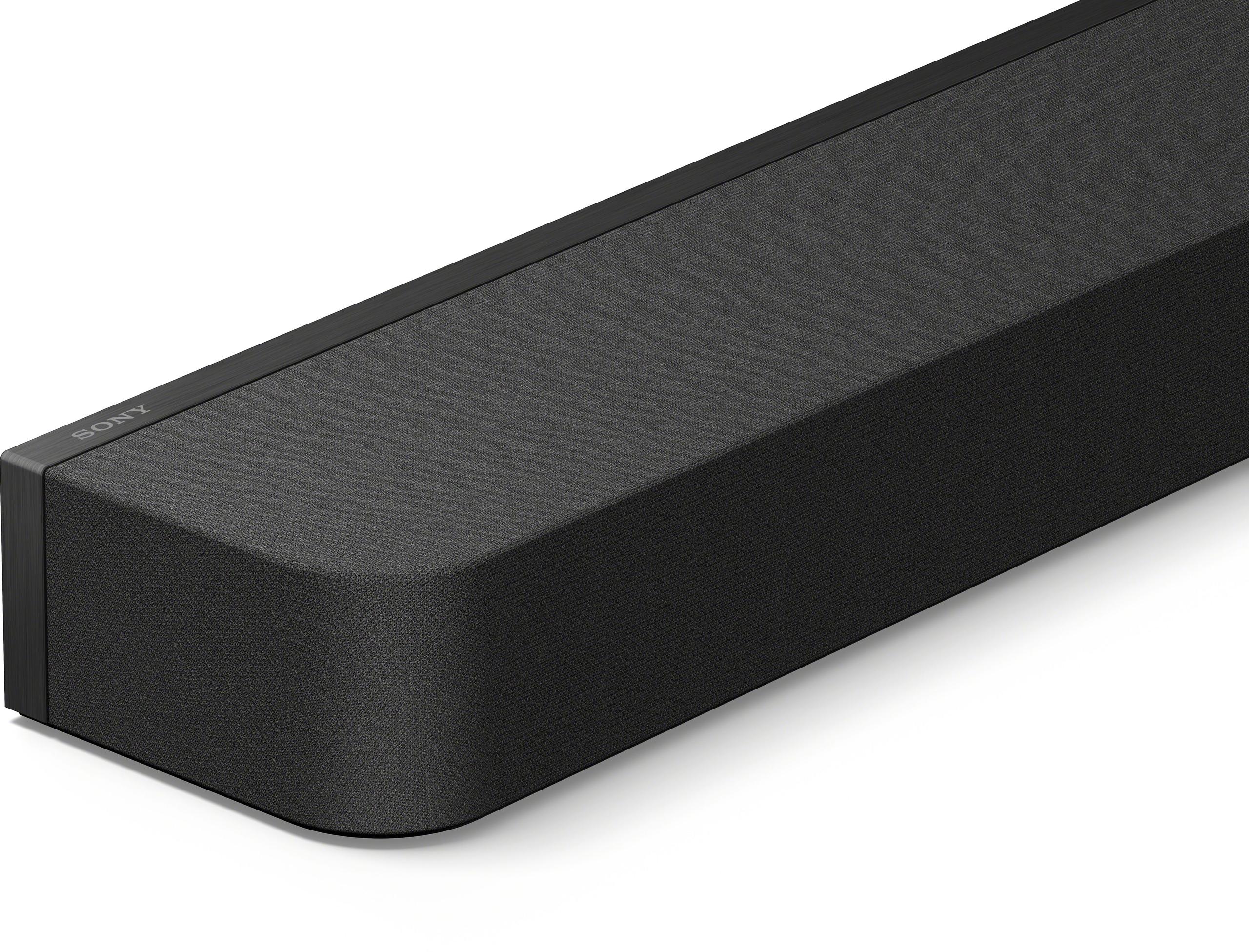
The Sony BRAVIA Theater Bar 9 takes an entirely different approach, and frankly, it represents some of the most sophisticated audio engineering I've encountered in a single soundbar. Released in 2024 as Sony's flagship single-bar solution, this system attempts to create full surround sound effects using only the speakers built into one sleek unit.
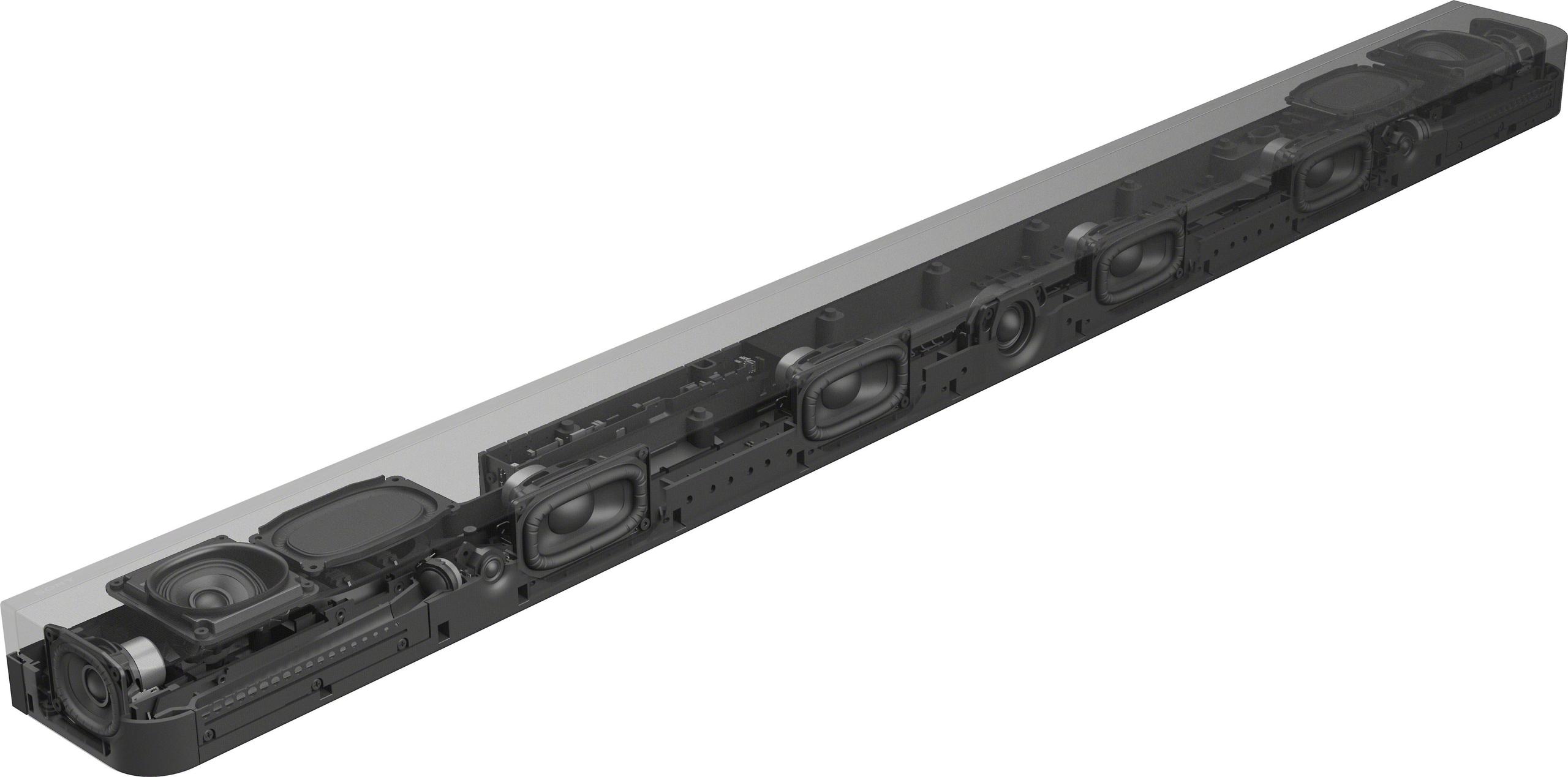
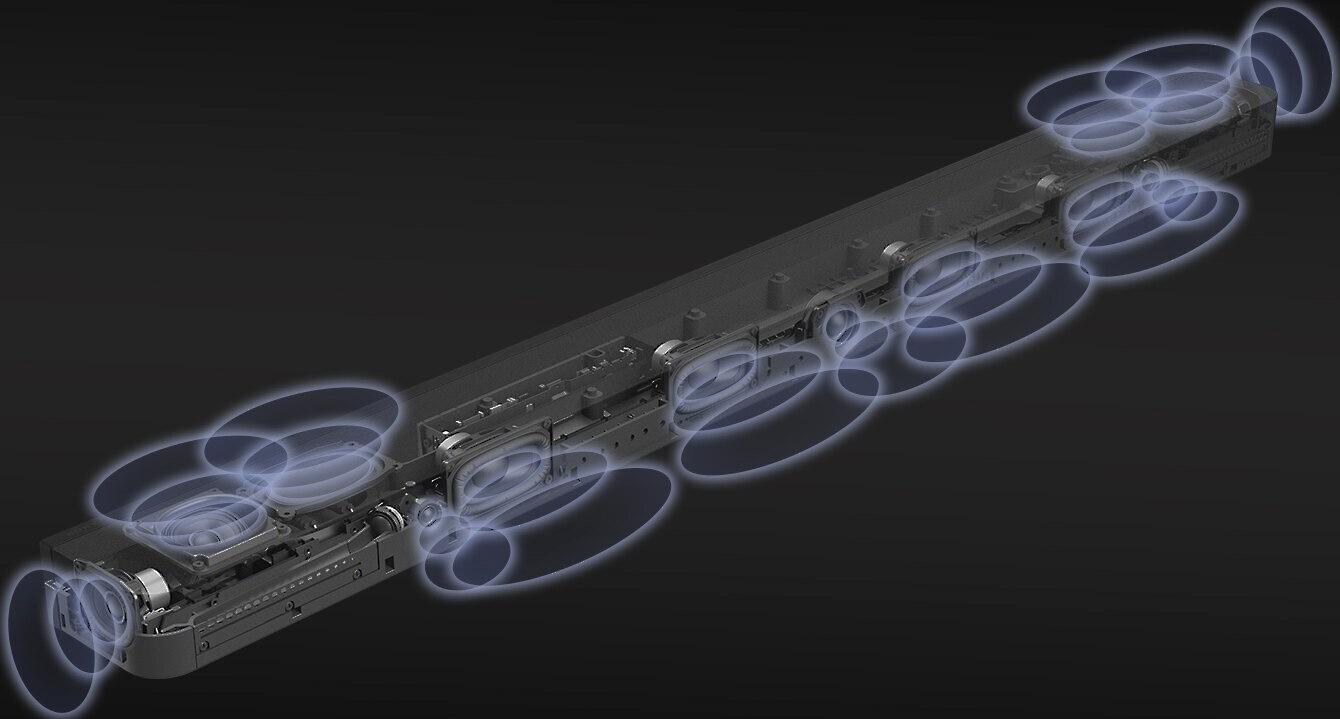
The magic happens through Sony's 360 Spatial Sound Mapping technology. This system uses 13 separate speakers within the soundbar, each precisely positioned and calibrated to reflect sound off your room's walls and ceiling. The processing is so advanced that it can create what Sony calls "phantom speakers"—locations where you swear there's an actual speaker, but it's really just carefully reflected and processed audio.
I was initially skeptical of this approach. How could a single bar, no matter how sophisticated, compete with actual rear speakers? But after spending weeks with the Sony BRAVIA Theater Bar 9 in different room configurations, I have to admit the technology works remarkably well. The system includes quad woofers, passive radiators, side-firing speakers, and beam tweeters that work together to create a surprisingly convincing surround experience.
The X-Balanced Speaker Units represent another technological advancement. Instead of traditional round drivers, Sony uses rectangular speakers that can move more air while taking up less space. This allows them to pack more acoustic power into the streamlined soundbar form factor while reducing distortion—a common problem when manufacturers try to squeeze big sound from small enclosures.
Sound Field Optimization is perhaps the most impressive feature. Using advanced signal processing, the system analyzes your room's acoustics and adjusts its output accordingly. It's like having a professional audio engineer tune your system for your specific space. The technology can actually counteract some of your room's acoustic problems, something that traditional speakers simply can't do.
For Sony TV owners, the integration goes even deeper. Acoustic Centre Sync allows the soundbar to use your compatible BRAVIA TV as an additional center channel speaker. This creates an effect where dialogue seems to come directly from the screen rather than from below it—a subtle but important improvement for the overall experience.
Audio Quality and Clarity
In terms of pure audio reproduction, these systems take different approaches to achieving quality sound. The Ultimea Skywave F40 relies on dedicated drivers optimized for their specific roles. The rear speakers can focus entirely on surround effects, the subwoofer handles only bass frequencies, and the main bar manages the critical front channels and height effects. This specialization often results in cleaner, more defined audio across the frequency spectrum.
The Sony BRAVIA Theater Bar 9 counters with superior driver technology and processing power. Those X-Balanced speakers and the sophisticated amplification mean that even though each driver is handling multiple duties, the overall clarity is excellent. Where I notice the difference is in complex movie scenes with lots of simultaneous effects—the Ultimea's dedicated approach can sometimes separate individual elements more clearly.
Bass Performance
This is where the fundamental differences become most apparent. The Ultimea Skywave F40 includes a proper subwoofer with a 6.5-inch driver that can push serious air. When the T-Rex footsteps shake the ground in Jurassic Park, or when the bass line drops in your favorite song, you feel it physically. The frequency response extends down to 38Hz, which covers most of the impactful bass content you'll encounter.
The Sony BRAVIA Theater Bar 9 approaches bass differently, using multiple smaller woofers and passive radiators within the main bar. The processing is sophisticated enough to create surprisingly deep bass for a single-bar solution, but it can't match the physical impact of a dedicated subwoofer. Sony addresses this with optional wireless subwoofers, but that's an additional purchase that significantly increases the total system cost.
Surround Sound Immersion
Here's where personal preference and room configuration become crucial factors. The Ultimea Skywave F40 creates surround effects the traditional way—sound actually originates from behind and beside you because there are speakers in those positions. This approach works consistently regardless of your room's shape or acoustic properties. You get reliable, authentic surround sound that behaves predictably.
The Sony BRAVIA Theater Bar 9 can create more sophisticated and sometimes more impressive surround effects, but with important caveats. The system works best in rooms with reflective surfaces for the sound to bounce off. If your room has lots of soft furnishings, odd angles, or if you're sitting too close to walls, the phantom speaker effects might not work as intended. However, when conditions are right, Sony's virtual surround can create effects that seem to come from locations where the Ultimea system has no physical speakers.
Height Effects and Dolby Atmos
Both systems handle Dolby Atmos height effects through up-firing drivers, but with different levels of sophistication. The Ultimea Skywave F40 uses two dedicated up-firing speakers with neodymium magnets for precise sound placement. These fire directly upward, relying on your ceiling to reflect the sound back down to create overhead effects.
The Sony BRAVIA Theater Bar 9 incorporates its height effects into the overall 360 Spatial Sound Mapping system. This integration means the height effects can be more precisely coordinated with the surround effects, potentially creating more seamless transitions as sounds move through three-dimensional space. The downside is that the height effects are dependent on the same room reflection principles as the rest of the virtual surround system.
Physical Installation
Setting up the Ultimea Skywave F40 requires more planning and effort. You'll need to position the wireless rear speakers, find a good spot for the subwoofer (preferably not too close to walls to avoid boomy bass), and run power cables to various locations. The wireless rear speakers do eliminate the most challenging part—running speaker wire across your room—but you still need available power outlets.
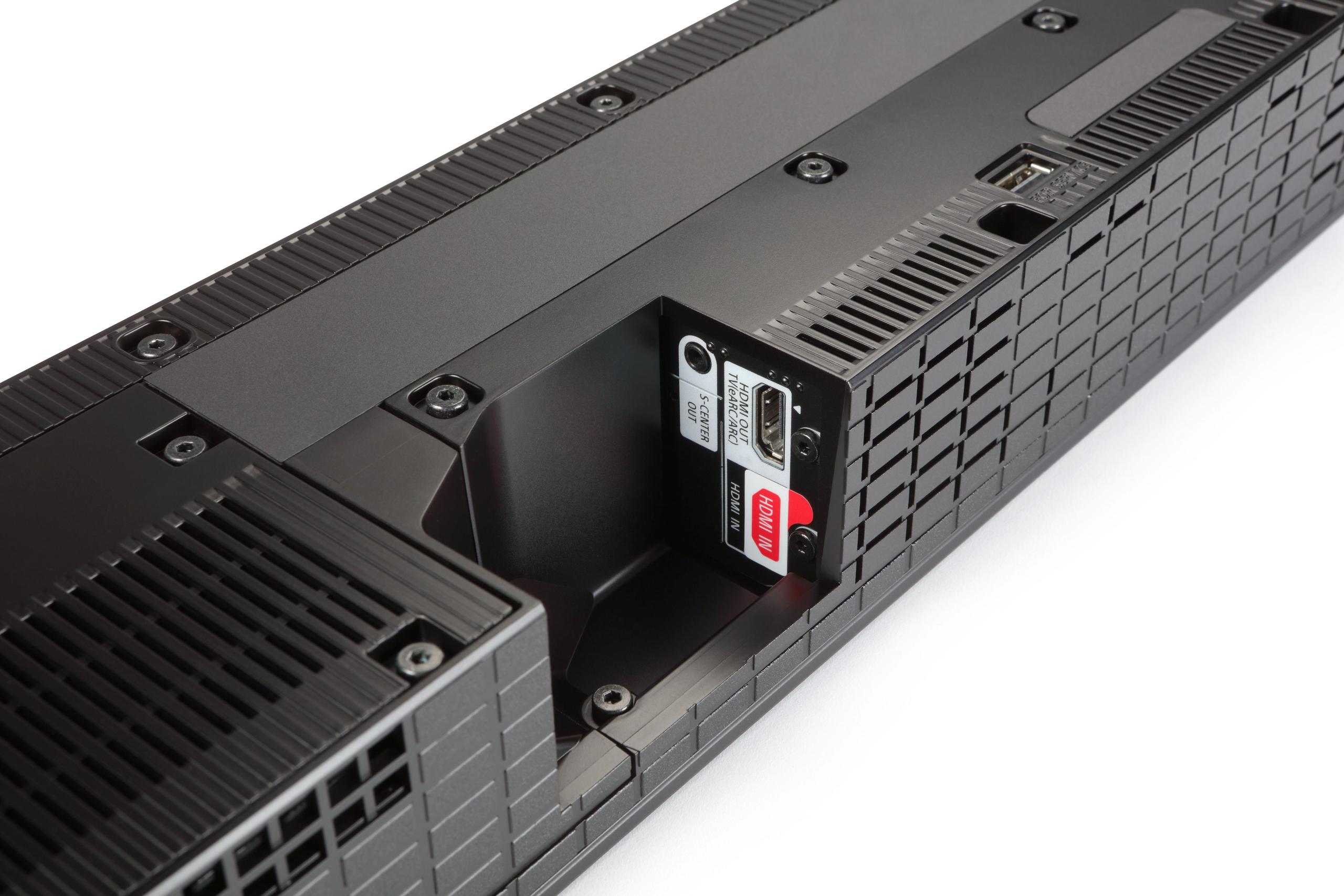
The Sony BRAVIA Theater Bar 9 offers the ultimate in setup simplicity. It's essentially a single component that sits under your TV or mounts to the wall. Connect power and HDMI, and you're operational. For many people, this convenience factor alone justifies the price difference.
Room Requirements
The Ultimea Skywave F40 works well in rooms ranging from small bedrooms to medium-sized living rooms. The system is specifically rated for spaces between 200-270 square feet, but I've found it performs adequately in somewhat larger rooms as well. The key advantage is that it doesn't rely on specific room characteristics—physical speakers work regardless of your wall materials or furniture arrangement.
The Sony BRAVIA Theater Bar 9 can potentially work in larger spaces due to its sophisticated processing, but room characteristics matter significantly more. Rooms with high ceilings, lots of soft furnishings, or irregular shapes may not provide the reflective surfaces needed for optimal virtual surround effects.
Control and Customization
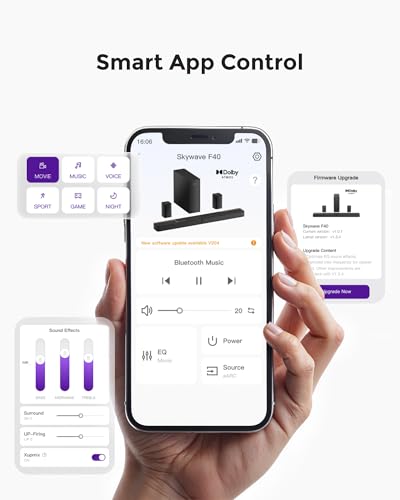
Both systems offer smartphone apps for detailed control, but they serve different purposes. The Ultimea Skywave F40 app provides access to a 10-band equalizer with 121 preset matrices, giving you extensive control over the sound signature. This level of customization helps you tune the system for your specific room and content preferences.
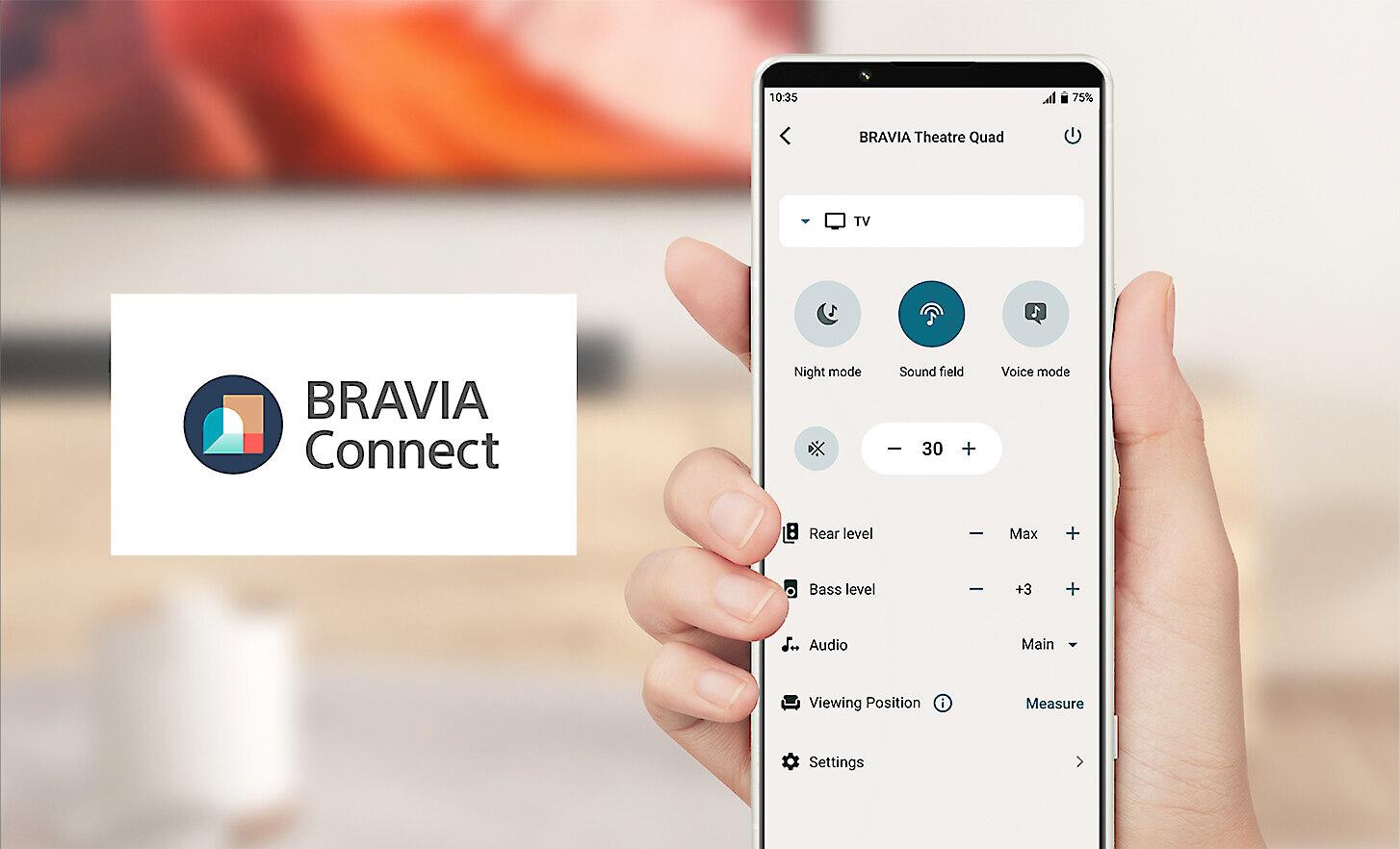
The Sony BRAVIA Theater Bar 9 app focuses more on room optimization and integration features. The Sound Field Optimization feature is particularly impressive, automatically adjusting the system's behavior based on your room's measured acoustic characteristics. For Sony TV owners, the integration goes even deeper, with soundbar controls appearing in the TV's quick settings menu.
At the time of writing, the price difference between these systems is substantial—roughly four times as much for the Sony compared to the Ultimea. This isn't just a matter of one being expensive and the other being cheap; they're targeting fundamentally different market segments with different expectations.
The Ultimea Skywave F40 represents exceptional value in the traditional sense. You're getting a complete surround sound system with all components included for less than many competitors charge for just a soundbar. The build quality, while not premium, is solid enough for years of reliable use. The included components would cost significantly more if purchased separately from other manufacturers.
The Sony BRAVIA Theater Bar 9 operates in the premium segment where value is measured differently. You're paying for advanced engineering, sophisticated processing, premium materials, and the convenience of a single-component solution. The build quality is noticeably superior, with better materials and more precise construction throughout.
Expandability and Future-Proofing
The Ultimea Skywave F40 is essentially a complete system as purchased. While this means you get everything upfront, it also means limited upgrade paths. What you buy is what you get for the lifetime of the system.
The Sony BRAVIA Theater Bar 9 offers a modular approach. You can start with just the soundbar and add Sony's wireless subwoofer and rear speakers later. This allows you to spread the cost over time or upgrade gradually as your budget allows. However, reaching feature parity with the Ultimea's included components requires additional purchases that can more than double the total system cost.
For dedicated home theater use, both systems offer legitimate cinematic experiences, but with different strengths. The Ultimea Skywave F40 excels in rooms where you can position components optimally. If you have a dedicated media room or a living room where you can place rear speakers without interference, this system delivers authentic surround sound that rivals much more expensive setups.
The Sony BRAVIA Theater Bar 9 shines in challenging room scenarios or multi-purpose spaces. If your "home theater" is also your main living area with lots of furniture, decorative items, and family activity, the single-bar solution might work better practically, even if it doesn't achieve the same technical surround accuracy.
Movie performance varies between the systems. Action movies with lots of directional effects and bass content favor the Ultimea Skywave F40 due to its dedicated rear speakers and subwoofer. The physical movement of effects around the room and the impactful bass create a more visceral experience.
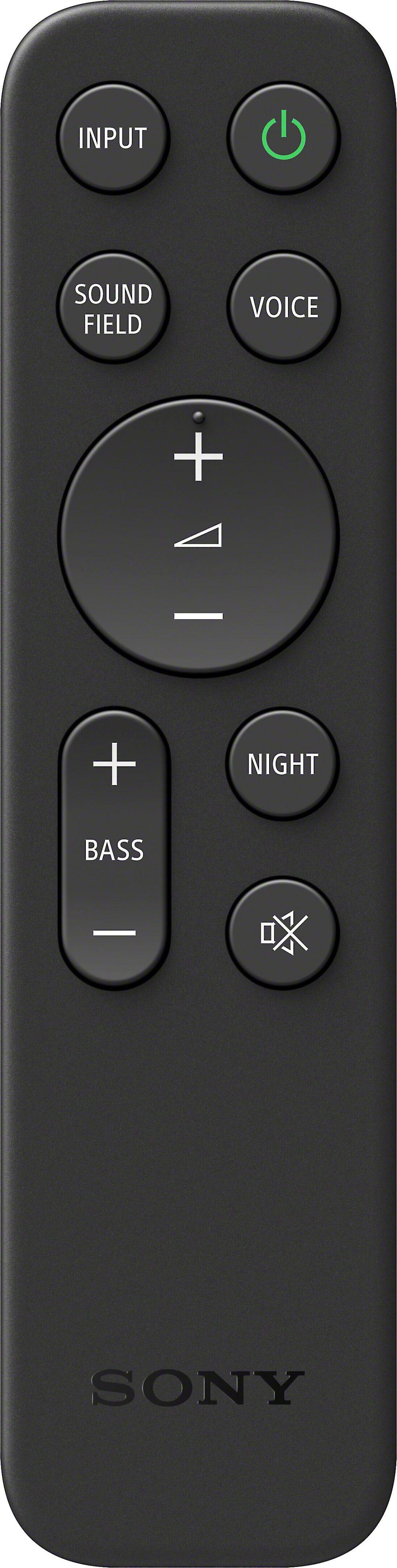
For dialogue-heavy content and TV shows, the Sony BRAVIA Theater Bar 9 often performs better. The Voice Zoom 3 feature uses AI to enhance dialogue clarity, and the overall tonal balance is more refined. The integration with Sony TVs can make voices seem to come directly from the screen, which is particularly effective for dramatic content.
Choose the Ultimea Skywave F40 if:
You want authentic surround sound and don't mind the complexity of a multi-component system. This system is ideal for budget-conscious buyers who still want a legitimate home theater experience. If you have the space to position speakers properly and you prioritize getting everything included in one purchase, the Ultimea offers unbeatable value.
The system works particularly well for gamers, action movie fans, and music listeners who want to feel the bass. The dedicated subwoofer and rear speakers create an engaging, immersive experience that draws you into the content. It's also perfect for anyone who isn't tied to a specific TV brand ecosystem.
Choose the Sony BRAVIA Theater Bar 9 if:
You prioritize convenience, premium build quality, and sophisticated processing over absolute surround authenticity. This system makes sense for Sony TV owners who want seamless integration and are willing to pay for advanced engineering.
The Sony works well in challenging rooms where traditional speakers might not be practical. If you live in an apartment where rear speakers aren't feasible, or if you have a living space that serves multiple purposes, the single-bar solution offers impressive performance with minimal visual impact.
It's also the better choice for users who appreciate technology for its own sake and want the option to expand gradually with premium components.
After extensive testing with both systems, I believe each serves its intended audience well. The Ultimea Skywave F40 proves that authentic surround sound doesn't require a massive budget, while the Sony BRAVIA Theater Bar 9 demonstrates how sophisticated engineering can create impressive virtual surround experiences.
My personal preference leans toward physical speakers when possible—there's something satisfying about hearing effects actually originate from different locations around the room. However, I acknowledge that Sony's virtual surround technology has reached a level of sophistication that makes it a legitimate alternative, especially in rooms where traditional speakers aren't practical.
The decision ultimately comes down to your priorities: complete system value and authentic surround sound versus premium engineering and convenience. Both approaches have merit, and both represent significant improvements over basic TV audio. Choose based on your room, budget, and how you plan to use your system, and either choice will deliver a substantially better home entertainment experience than you had before.
| Ultimea Skywave F40 Dolby Atmos Soundbar System | Sony BRAVIA Theater Bar 9 Soundbar |
|---|---|
| Channel Configuration - Determines surround sound authenticity | |
| True 5.1.2 with physical rear speakers and subwoofer | Virtual 5.0.2 using 13 integrated speakers |
| Total System Components - What you get in the box | |
| Complete system: soundbar, wired subwoofer, wireless rear speakers | Single soundbar only (subwoofer and rears sold separately) |
| Power Output - Affects maximum volume and dynamic range | |
| 460W total system power across all components | 585W amplification through integrated speakers |
| Bass Solution - Critical for movies and music impact | |
| Dedicated 6.5" wired subwoofer included (38Hz response) | Integrated woofers only (optional wireless sub available) |
| Surround Technology - How immersive effects are created | |
| Physical rear speakers with SurroundX processing | 360 Spatial Sound Mapping with phantom speakers |
| Height Effects Implementation - Dolby Atmos overhead audio | |
| Dual up-firing drivers with neodymium magnets | Integrated height channels within 360° processing |
| Setup Complexity - Installation time and requirements | |
| Multi-component setup (soundbar + sub + wireless rears) | Single-bar installation with immediate operation |
| Room Requirements - How space affects performance | |
| Works in any room layout (physical speakers) | Requires reflective surfaces for optimal virtual surround |
| TV Integration - Ecosystem compatibility | |
| Universal compatibility with any TV brand | Deep integration with Sony BRAVIA TVs (Acoustic Center Sync) |
| Connectivity Options - Input flexibility | |
| HDMI eARC, optical, Bluetooth 5.4, USB | HDMI eARC, Wi-Fi, Bluetooth 5.2, streaming services |
| Sound Customization - Audio tuning capabilities | |
| 10-band EQ with 121 preset matrices via app | Sound Field Optimization with room calibration |
| Build Quality - Materials and construction | |
| Solid budget construction with good reliability | Premium materials with X-Balanced speaker technology |
| Expandability - Future upgrade options | |
| Complete system as purchased (no expansion) | Modular system (add wireless sub/rears later) |
The Ultimea Skywave F40 provides exceptional value by including a complete 5.1.2 surround system with physical rear speakers and a dedicated subwoofer at a budget-friendly price. The Sony BRAVIA Theater Bar 9 offers premium build quality and advanced virtual surround technology but at a significantly higher cost. For most buyers seeking complete surround sound, the Ultimea Skywave F40 delivers more components and authentic surround effects for the money.
Physical rear speakers like those included with the Ultimea Skywave F40 create authentic surround sound by actually placing audio behind you. The Sony BRAVIA Theater Bar 9 uses advanced virtual processing to simulate rear effects without physical speakers. While Sony's technology is impressive, physical rear speakers provide more consistent and convincing surround effects, especially for action movies and gaming.
The Sony BRAVIA Theater Bar 9 wins for simplicity with its single-bar design requiring only power and HDMI connections. The Ultimea Skywave F40 requires positioning wireless rear speakers and a subwoofer, plus connecting multiple power cables. However, the Ultimea Skywave F40 setup isn't overly complex and the wireless rear speakers eliminate difficult cable runs across your room.
The Ultimea Skywave F40 uses real surround sound with physical speakers positioned around your room, creating authentic directional effects. The Sony BRAVIA Theater Bar 9 employs virtual surround that reflects sound off walls and ceilings to simulate speakers that aren't physically there. Real surround sound works consistently in any room, while virtual surround depends on your room's acoustic properties.
The Ultimea Skywave F40 includes a dedicated 6.5-inch subwoofer that delivers deep, impactful bass down to 38Hz. The Sony BRAVIA Theater Bar 9 relies on integrated woofers and passive radiators, which can't match the physical impact of a dedicated subwoofer. Sony offers an optional wireless subwoofer, but this requires an additional purchase beyond the base system.
Both systems work well for gaming, but the Ultimea Skywave F40 excels with its physical rear speakers that create convincing directional effects for footsteps and environmental audio. The dedicated subwoofer also adds impact to explosions and gunfire. The Sony BRAVIA Theater Bar 9 offers excellent clarity and supports gaming features like low latency, but lacks the physical immersion that real surround speakers provide.
The Ultimea Skywave F40 offers universal compatibility and works equally well with any TV brand through standard HDMI eARC or optical connections. The Sony BRAVIA Theater Bar 9 works with any TV but provides enhanced integration features only with Sony BRAVIA TVs, including Acoustic Center Sync that uses your TV as an additional speaker.
The Sony BRAVIA Theater Bar 9 requires minimal space as a single soundbar unit. The Ultimea Skywave F40 needs placement for wireless rear speakers and a subwoofer, requiring more room planning but offering flexible positioning options. The Ultimea system works well in rooms from 200-270 square feet, while the Sony system can potentially work in larger spaces.
For action movies and content with lots of directional effects, the Ultimea Skywave F40 provides more immersive experiences with its physical surround speakers and dedicated subwoofer. The Sony BRAVIA Theater Bar 9 excels with dialogue-heavy content thanks to its Voice Zoom 3 feature and refined tonal balance. Both support Dolby Atmos for overhead effects, but the Ultimea system delivers more visceral impact.
The Ultimea Skywave F40 is a complete system as purchased with limited expansion options. The Sony BRAVIA Theater Bar 9 offers modular expansion, allowing you to add Sony's wireless subwoofer and rear speakers over time. This lets you start with the soundbar and upgrade gradually, though reaching the same component count as the Ultimea system requires significant additional investment.
The Sony BRAVIA Theater Bar 9 features premium construction with advanced X-Balanced speaker technology and superior materials throughout. The Ultimea Skywave F40 offers solid build quality appropriate for its price point, with reliable components that should provide years of service. While Sony's engineering is more sophisticated, the Ultimea system delivers dependable performance with good durability.
The Ultimea Skywave F40 works well in any room configuration since physical speakers don't depend on room acoustics. The Sony BRAVIA Theater Bar 9 performs best in rooms with reflective surfaces for sound bouncing, and may struggle in heavily furnished rooms with lots of soft materials. For challenging room layouts or apartments where rear speakers aren't practical, the Sony system offers more flexibility despite the acoustic limitations.
We've done our best to create useful and informative comparisons to help you decide what product to buy. Our research uses advanced automated methods to create this comparison and perfection is not possible - please contact us for corrections or questions. These are the sites we've researched in the creation of this article: the-gadgeteer.com - youtube.com - ultimea.com - manuals.plus - youtube.com - ultimea.com - youtube.com - youtube.com - youtube.com - youtube.com - eu.ultimea.com - support.ultimea.com - rtings.com - residentialsystems.com - rtings.com - bestbuy.com - valueelectronics.com - sony.com - sony.co.uk - sony.co.uk - rtings.com - sony.co.in - sony.com - pocket-lint.com - sony.com - crutchfield.com

Privacy Policy
Terms and Conditions - Affiliate Policy
Home Security
© Copyright 2008-2026.
11816 Inwood Rd #1211, Dallas, TX 75244