


If you've ever struggled to hear dialogue in your favorite show or found yourself constantly adjusting the volume during movies, you're experiencing the biggest weakness of modern flat-screen TVs: terrible built-in audio. As TVs have gotten thinner and more elegant, manufacturers have squeezed speakers into impossibly small spaces, creating audio that sounds like it's coming from a tin can.
This is where soundbars step in to save the day. But the soundbar market has evolved dramatically since the first models appeared in the early 2000s, creating some interesting choices for consumers. Today, we're comparing two very different approaches to solving your TV's audio problems: the Amazon Fire TV Soundbar, which represents the "keep it simple" philosophy, and the Ultimea Skywave F40 Dolby Atmos Soundbar System, which takes the "go big or go home" approach.
Before diving into specifics, it's worth understanding what soundbars are trying to accomplish. At their core, they're attempting to create a better audio experience than your TV's built-in speakers while maintaining the clean, uncluttered look that drew you to a flat-screen TV in the first place.
The challenge is physics. Good audio requires moving air, and moving air requires either large drivers (the technical term for speakers) or multiple smaller ones working together. Your TV's speakers are typically tiny and firing sideways or downward, which explains why dialogue sounds muffled and action scenes lack impact.
Audio channels refer to separate audio tracks that can be played through different speakers to create spatial effects. A 2.0 system means two channels (left and right stereo), while a 5.1 system has five main channels plus one subwoofer channel (the ".1" part). The more channels you have, the more precisely you can place sounds in three-dimensional space around your listening position.
Room acoustics play a huge role in how any audio system performs. Hard surfaces like bare walls and floors reflect sound waves, while soft furnishings absorb them. This affects everything from dialogue clarity to how well surround sound effects work. Understanding your room helps determine whether a simple stereo soundbar will suffice or if you need a full surround system to overcome acoustic challenges.
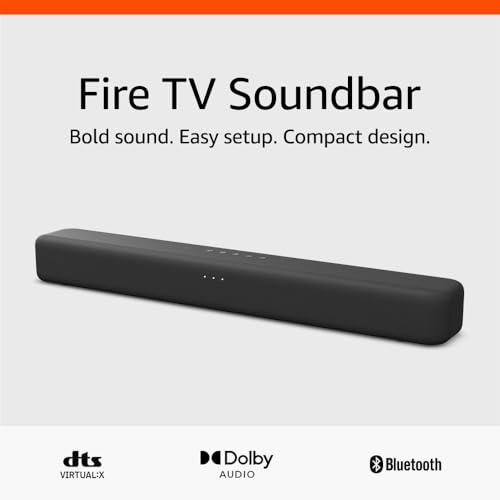
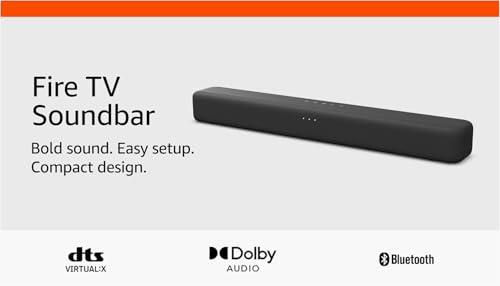
Released in 2023, the Amazon Fire TV Soundbar represents Amazon's entry into the budget soundbar market. At roughly $100 at the time of writing, it's positioned as a no-nonsense upgrade from TV speakers that won't break the bank or complicate your entertainment setup.
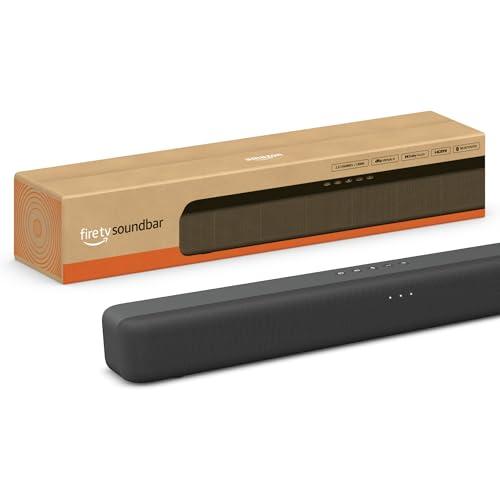
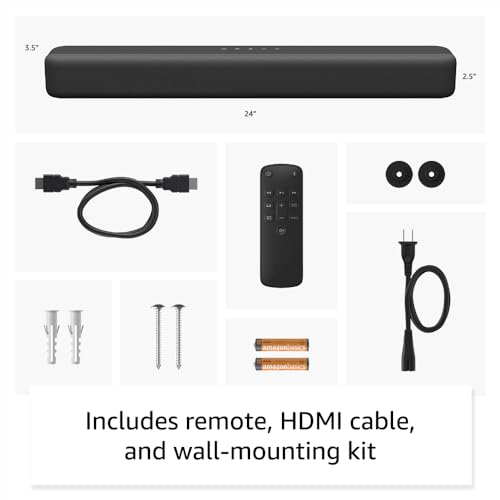
The physical design reflects this philosophy. At just 24 inches wide and weighing under 4 pounds, it's designed to virtually disappear under your TV. The drivers inside are what Amazon calls "Racetrack" speakers – oval-shaped instead of round. This unusual shape allows them to pack more sound-producing surface area into the slim profile while maintaining the low height that modern TV stands require.
What makes this soundbar interesting from a technical standpoint is its bass reflex design. Instead of relying purely on the drivers to produce bass, there's a specially tuned port (essentially a hole) that allows air to move in and out of the cabinet in a controlled way. This port is positioned on the front, which means you can place the soundbar directly against a wall without compromising its bass response – a clever engineering solution for small spaces.
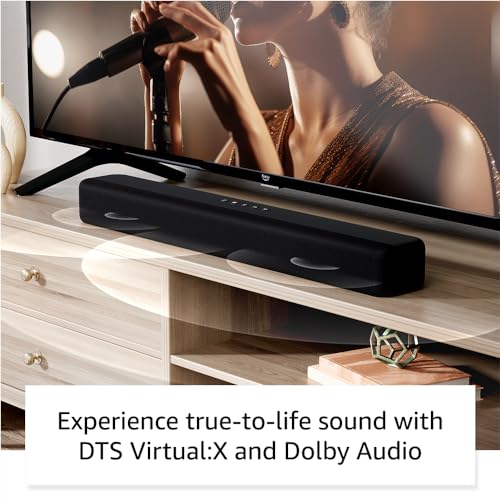
The Amazon Fire TV Soundbar supports DTS Virtual:X, a processing technology that takes regular stereo or surround sound and uses psychoacoustic tricks to make it sound like it's coming from more directions than it actually is. Think of it as audio sleight of hand – your brain is convinced sounds are coming from beside and behind you, even though they're really just coming from two speakers in front of you.
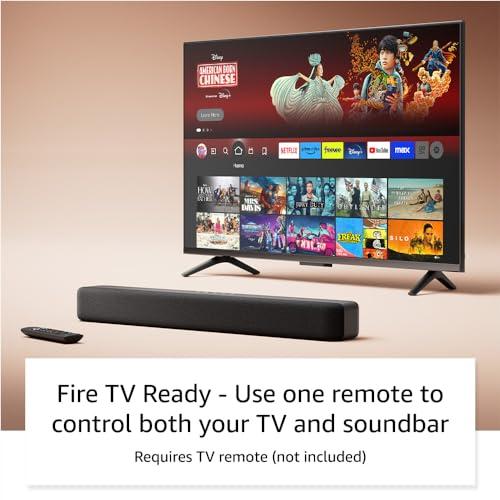
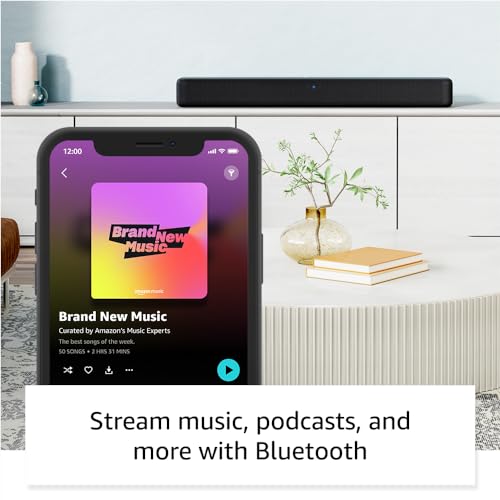
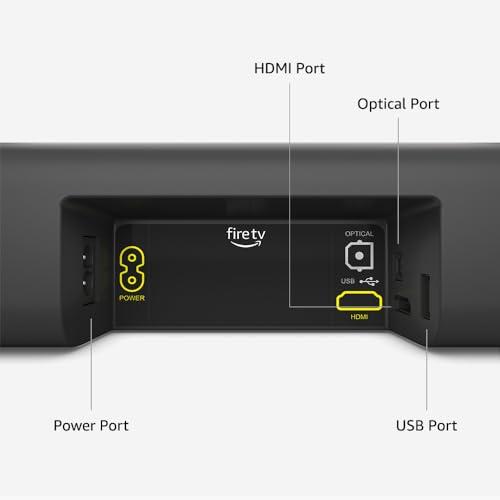
For connectivity, you get the essentials: HDMI ARC (Audio Return Channel, which lets your TV send audio back to the soundbar through the same cable that brings video to the TV), optical input for older TVs, and Bluetooth for streaming music from your phone. The Fire TV integration means it works seamlessly with Amazon's streaming devices, automatically switching inputs and adjusting volume through your TV remote.
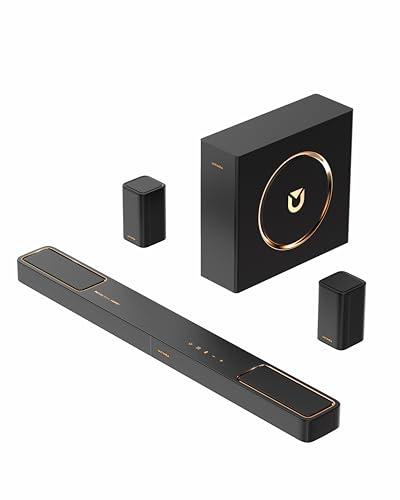
The Ultimea Skywave F40, released in 2024, takes a completely different approach. At around $300 at the time of writing, it's not just a soundbar – it's a complete surround sound system that happens to include a soundbar as one of its components.
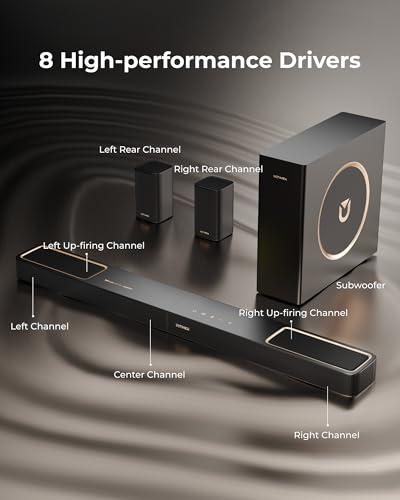
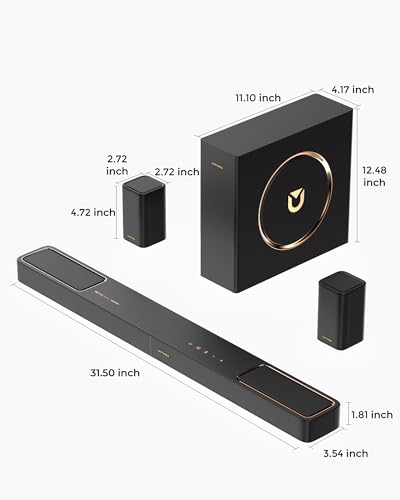
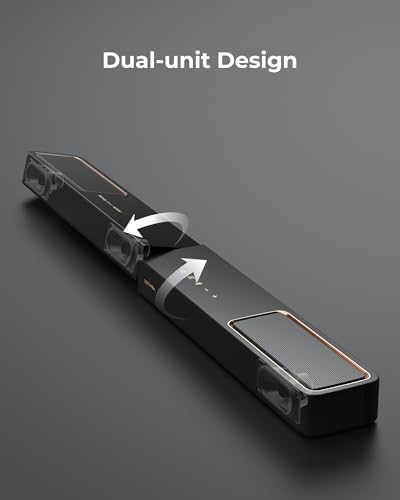
This system includes five separate pieces: the main soundbar, two rear surround speakers, and a wired subwoofer. The soundbar itself is cleverly designed in two parts that twist together during setup, making it easier to ship while ensuring a solid electrical connection once assembled.
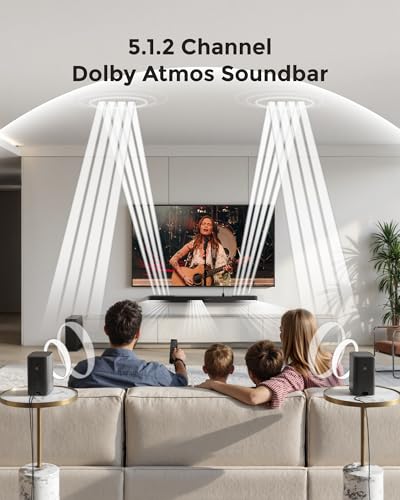
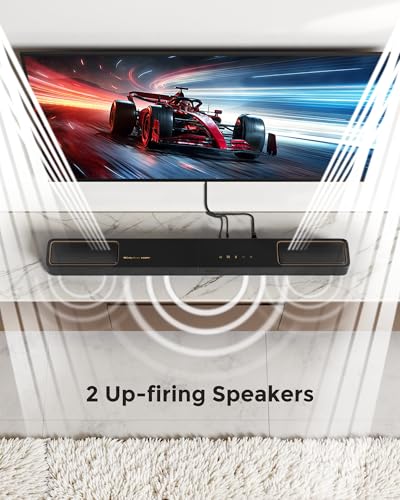
The real technical innovation here is in the Dolby Atmos implementation. Unlike virtual surround processing, Dolby Atmos uses actual height information embedded in movie soundtracks to create true three-dimensional audio. The Ultimea Skywave F40 achieves this through up-firing drivers – speakers pointing toward the ceiling that bounce sound off the ceiling back down to your ears, creating the illusion that helicopters are actually flying overhead or that rain is falling from above.
These up-firing drivers use neodymium magnets, which are significantly more powerful than the ceramic magnets found in cheaper speakers. This allows them to move more air and create more convincing height effects. The system also includes what Ultimea calls SurroundX technology, which optimizes how all the speakers work together to create a 360-degree sound field.
One particularly interesting feature is Xupmix technology, powered by Dolby DAP (Digital Audio Processing). This can take regular stereo content – like a news broadcast or older TV show – and intelligently spread it across all the speakers to create a more immersive experience. It's like having a smart audio engineer constantly adjusting your sound in real-time.
Poor dialogue clarity is the number one complaint about TV audio, and it's where the biggest differences between these systems become apparent. The Amazon Fire TV Soundbar handles this reasonably well for its price point. Its stereo drivers are positioned to fire directly at your seating position, and there are specific EQ modes designed to enhance voice frequencies.
However, the Ultimea Skywave F40 has a significant structural advantage here. In a proper surround sound setup, dialogue typically comes from a dedicated center channel speaker. While the Ultimea system doesn't have a separate center speaker, its soundbar is wide enough to create a strong center image, and the processing is sophisticated enough to anchor voices firmly in the center of the soundstage. More importantly, because you have rear speakers handling background sounds and effects, the dialogue doesn't get lost in the mix the way it often does with stereo systems.
This is where the fundamental difference in approach becomes most obvious. The Amazon Fire TV Soundbar relies on its bass reflex design and relatively small drivers to produce low frequencies. While this works better than you might expect – that front-firing port does make a difference – physics ultimately limits how much bass you can get from such a compact system.
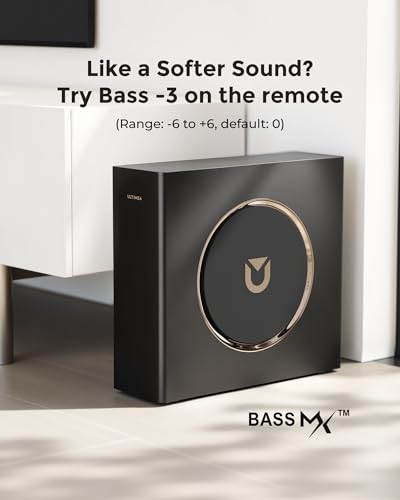
The Ultimea Skywave F40 includes a dedicated wired subwoofer, which is essentially a large speaker designed specifically for low frequencies. This isn't just about volume; it's about the quality and impact of bass. A proper subwoofer can reproduce the deep rumble of explosions, the subtle low-frequency information that makes music feel more natural, and the environmental sounds that make movie soundtracks immersive.
BassMX technology in the Ultimea system optimizes how the subwoofer integrates with the other speakers, ensuring that bass doesn't overpower dialogue or become boomy in smaller rooms. The system also includes a 10-band equalizer, allowing you to tune the bass response to your specific room and preferences.
Here's where these products diverge most dramatically. The Amazon Fire TV Soundbar uses DTS Virtual:X processing to create the illusion of surround sound. This technology has improved significantly since its introduction, and modern implementations can create surprisingly convincing effects. You might actually hear sounds that seem to come from beside or slightly behind you.
But there's no substitute for actual speakers placed around the room. The Ultimea Skywave F40 includes physical rear speakers that can produce genuine surround effects. When a car drives across the screen in an action movie, you'll hear it move from front to back in a way that virtual processing simply cannot replicate. The up-firing Atmos speakers add another dimension entirely, creating height effects that make the soundstage feel genuinely three-dimensional.
The 5.1.2 channel configuration means you have five main speakers (left, center, right, left rear, right rear), one subwoofer, and two height channels. This allows for incredibly precise placement of sounds in the three-dimensional space around your seating position.
Connectivity has evolved rapidly in recent years, and both systems reflect modern standards. The Amazon Fire TV Soundbar includes HDMI ARC, which handles most current audio formats and allows for TV remote control. It also supports CEC (Consumer Electronics Control), meaning you can control both your TV and soundbar with one remote.
The Ultimea Skywave F40 steps up to HDMI eARC (enhanced Audio Return Channel), which supports higher bandwidth and more advanced audio formats. It also includes Bluetooth 5.4, the latest version of wireless audio technology, which offers better stability, lower latency, and higher quality audio transmission than earlier versions.
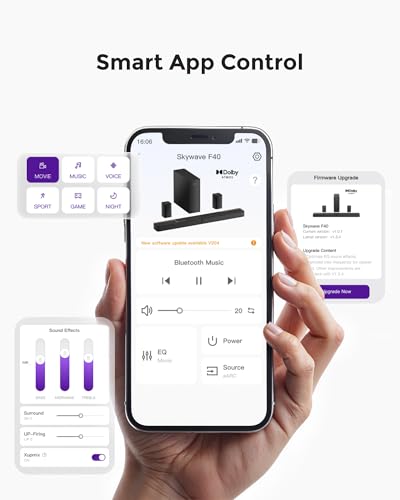
Smart app control on the Ultimea system deserves special mention. Through a smartphone app, you can access all 121 preset EQ matrices and create custom sound profiles for different content types. This level of customization was unheard of in budget audio equipment even a few years ago.
The Amazon Fire TV Soundbar excels in smaller spaces. In a bedroom, small apartment, or any room where you're sitting relatively close to the TV, its simplicity and compact size are major advantages. Setup is genuinely plug-and-play: connect one cable, and you're done. The bass reflex design means it works well even when placed directly against a wall or in a TV cabinet.
The Ultimea Skywave F40 requires more thought and planning. You need to position rear speakers effectively, which might mean running speaker wire across the room or finding creative mounting solutions. The subwoofer needs floor space and some distance from walls for optimal performance. However, for rooms larger than about 200 square feet, this extra complexity pays off with dramatically better sound quality.
Room acoustics affect these systems differently. The Amazon soundbar's virtual surround processing can actually work better in smaller, more reflective rooms where sound bounces create natural ambiance. The Ultimea system, with its physical speakers, tends to overcome poor room acoustics more effectively and scales better with room size.
At the time of writing, the price difference between these systems is roughly $200, but they're targeting fundamentally different needs. The Amazon Fire TV Soundbar represents exceptional value if you want simple improvement over TV speakers without complexity or expense. For casual viewing, news, and basic streaming content, it delivers meaningful enhancement at a price point that makes sense even as a secondary system.
The Ultimea Skywave F40 costs significantly more but delivers exponentially better performance. When you compare it to other true surround sound systems from established brands, which often cost $500-800 for similar features, the value proposition becomes compelling. This is a system that can serve as the foundation of a serious home theater setup.
The Amazon Fire TV Soundbar makes sense for several specific scenarios. If you're living in an apartment where complex speaker placement isn't practical, or if you're setting up a secondary TV in a bedroom or kitchen, its simplicity and size are major advantages. It's also ideal for older users or anyone who finds complex audio systems intimidating. Fire TV device owners get additional benefits from seamless integration.
The Ultimea Skywave F40 is the better choice for anyone serious about their entertainment experience. Movie enthusiasts will appreciate the true surround sound and Atmos effects. Gamers benefit enormously from accurate spatial audio positioning. Even music listeners will find the proper stereo separation and bass extension more satisfying than any single-unit soundbar can provide.
Home theater applications particularly favor the Ultimea system. While the Amazon soundbar improves TV audio, the Ultimea system can genuinely replace a traditional receiver-based surround system for many users. The combination of true surround speakers, dedicated subwoofer, and height channels creates an immersive experience that transforms movie watching.
Both the Amazon Fire TV Soundbar and Ultimea Skywave F40 successfully solve the problem of poor TV audio, but they do so in fundamentally different ways for different users. The Amazon approach prioritizes simplicity, affordability, and space efficiency. The Ultimea system prioritizes performance, immersion, and expandability.
Your choice ultimately comes down to how you balance convenience against performance, and how much audio quality improvement matters in your daily entertainment experience. The Amazon soundbar provides solid value for basic needs, while the Ultimea system delivers premium performance that justifies its higher cost for serious audio improvement.
Given the rapid pace of improvement in budget audio equipment, both products represent good value at the time of writing. The key is matching the product to your specific needs, room, and priorities rather than simply choosing based on price alone.
| Amazon Fire TV Soundbar | Ultimea Skywave F40 Dolby Atmos Soundbar System |
|---|---|
| Channel Configuration - Determines surround sound capability and immersion level | |
| 2.0 stereo (virtual surround via DTS Virtual:X) | 5.1.2 true surround with physical speakers and Atmos height channels |
| Components Included - Affects setup complexity and performance potential | |
| Single soundbar unit only | Soundbar + 2 rear speakers + wired subwoofer + up-firing drivers |
| Power Output - Controls maximum volume and dynamic range | |
| 40W total (2 x 20W drivers) | 460W peak across all channels |
| Physical Size - Important for room compatibility and placement | |
| Compact: 24" x 2.6" x 3.5" (1.8kg single unit) | Multi-component: 31.5" soundbar + separate sub + rear speakers (9kg total) |
| Dolby Atmos Support - Essential for modern movie and gaming immersion | |
| No (DTS Virtual:X simulation only) | Yes (true Atmos with physical up-firing drivers) |
| Bass Response - Critical for movie impact and music enjoyment | |
| Bass reflex design in compact form (limited low-end extension) | Dedicated wired subwoofer (40Hz response with BassMX technology) |
| Connectivity Options - Affects device compatibility and future-proofing | |
| HDMI ARC, Optical, Bluetooth | HDMI eARC, Optical, USB, Bluetooth 5.4 |
| Smart Features - Controls customization and ease of use | |
| Basic Fire TV integration, simple remote | Smart app control, 10-band EQ, 121 preset matrices |
| Room Size Recommendation - Helps determine if system matches your space | |
| Small to medium rooms (under 200 sq ft) | Medium to large rooms (215-269 sq ft recommended) |
| Setup Complexity - Consider your technical comfort level | |
| Plug-and-play single cable connection | Multi-component setup with speaker placement and cable management |
| Target Use Cases - Matches system strengths to your needs | |
| TV dialogue enhancement, casual viewing, small spaces | Home theater, gaming, music, immersive movie experience |
The Amazon Fire TV Soundbar is a simple 2.0 stereo soundbar designed for basic TV audio improvement, while the Ultimea Skywave F40 Dolby Atmos Soundbar System is a complete 5.1.2 surround sound system with rear speakers, a subwoofer, and true Dolby Atmos height channels. The Amazon Fire TV Soundbar focuses on simplicity and dialogue clarity, whereas the Ultimea Skywave F40 delivers immersive surround sound for movies and gaming.
The Amazon Fire TV Soundbar is ideal for small rooms and apartments due to its compact single-unit design and minimal setup requirements. It measures just 24 inches wide and doesn't require additional speaker placement or cable management. The Ultimea Skywave F40 requires more space for rear speakers and a subwoofer, making it better suited for medium to large rooms where you have flexibility in speaker placement.
The Amazon Fire TV Soundbar uses bass reflex technology to enhance low frequencies without a separate subwoofer, providing adequate bass for dialogue and casual listening. However, the Ultimea Skywave F40 Dolby Atmos Soundbar System includes a dedicated wired subwoofer that delivers significantly deeper and more impactful bass, essential for action movies, music, and gaming where you want to feel explosions and low-frequency effects.
Only the Ultimea Skywave F40 Dolby Atmos Soundbar System supports true Dolby Atmos with physical up-firing drivers that bounce sound off your ceiling to create height effects. The Amazon Fire TV Soundbar uses DTS Virtual:X processing to simulate surround sound from its stereo speakers, but cannot produce genuine Atmos effects or overhead sound placement.
The Amazon Fire TV Soundbar offers plug-and-play setup with just one HDMI or optical cable connection to your TV. The Ultimea Skywave F40 requires more setup time as you need to position rear speakers, connect the subwoofer, and manage multiple cables. However, both systems include all necessary cables and the Ultimea Skywave F40 provides detailed placement guides for optimal performance.
For casual TV viewing and dialogue-focused content, the Amazon Fire TV Soundbar provides clear voice enhancement and adequate performance. For movies, especially action films and blockbusters, the Ultimea Skywave F40 Dolby Atmos Soundbar System delivers a far superior experience with true surround sound, height effects, and powerful bass that makes you feel like you're in a movie theater.
Both soundbars support Bluetooth music streaming from your phone or tablet. The Amazon Fire TV Soundbar provides decent stereo music playback for background listening. The Ultimea Skywave F40 offers significantly better music performance with proper stereo separation, deep bass from the subwoofer, and the ability to spread music across all speakers for a more immersive listening experience.
While both soundbars work with gaming consoles, the Ultimea Skywave F40 Dolby Atmos Soundbar System provides a major advantage for gaming with its true surround sound and height channels that help with spatial awareness and immersion. The Amazon Fire TV Soundbar will improve game audio over TV speakers but cannot match the positional audio benefits of the Ultimea Skywave F40's multi-speaker setup.
The Amazon Fire TV Soundbar requires minimal space - just room under your TV for a 24-inch bar. The Ultimea Skywave F40 Dolby Atmos Soundbar System needs significantly more space planning, including floor space for the subwoofer and wall or shelf space for rear speakers positioned 6-10 feet behind your seating area for optimal surround effects.
Both offer excellent value in their categories. The Amazon Fire TV Soundbar provides outstanding value for basic TV audio improvement at a budget-friendly price point. The Ultimea Skywave F40 delivers exceptional value for a complete surround sound system, offering features and performance typically found in much more expensive home theater setups.
The Amazon Fire TV Soundbar is a closed system with no expansion options - what you buy is what you get. The Ultimea Skywave F40 Dolby Atmos Soundbar System is already a complete system, but its advanced connectivity and app-based controls provide more flexibility for fine-tuning and customization through EQ settings and sound modes.
For a dedicated home theater room or serious movie watching, the Ultimea Skywave F40 Dolby Atmos Soundbar System is clearly the better choice with its true surround sound, Atmos height channels, and powerful subwoofer that creates an immersive cinematic experience. The Amazon Fire TV Soundbar is better suited for casual viewing and smaller spaces where simplicity and space-saving design are priorities over maximum audio performance.
We've done our best to create useful and informative comparisons to help you decide what product to buy. Our research uses advanced automated methods to create this comparison and perfection is not possible - please contact us for corrections or questions. These are the sites we've researched in the creation of this article: rtings.com - developer.amazon.com - stereoguide.com - developer.amazon.com - techradar.com - hometechnologyreview.com - whathifi.com - youtube.com - whathifi.com - wirelessplace.com - hometechnologyreview.com - dolby.com - aboutamazon.com - developer.amazon.com - community.anker.com - youtube.com - cordbusters.co.uk - the-gadgeteer.com - youtube.com - ultimea.com - manuals.plus - youtube.com - ultimea.com - youtube.com - youtube.com - youtube.com - youtube.com - eu.ultimea.com - support.ultimea.com

Privacy Policy
Terms and Conditions - Affiliate Policy
Home Security
© Copyright 2008-2026.
11816 Inwood Rd #1211, Dallas, TX 75244