


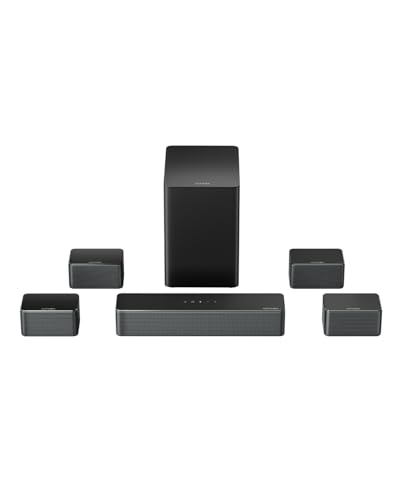













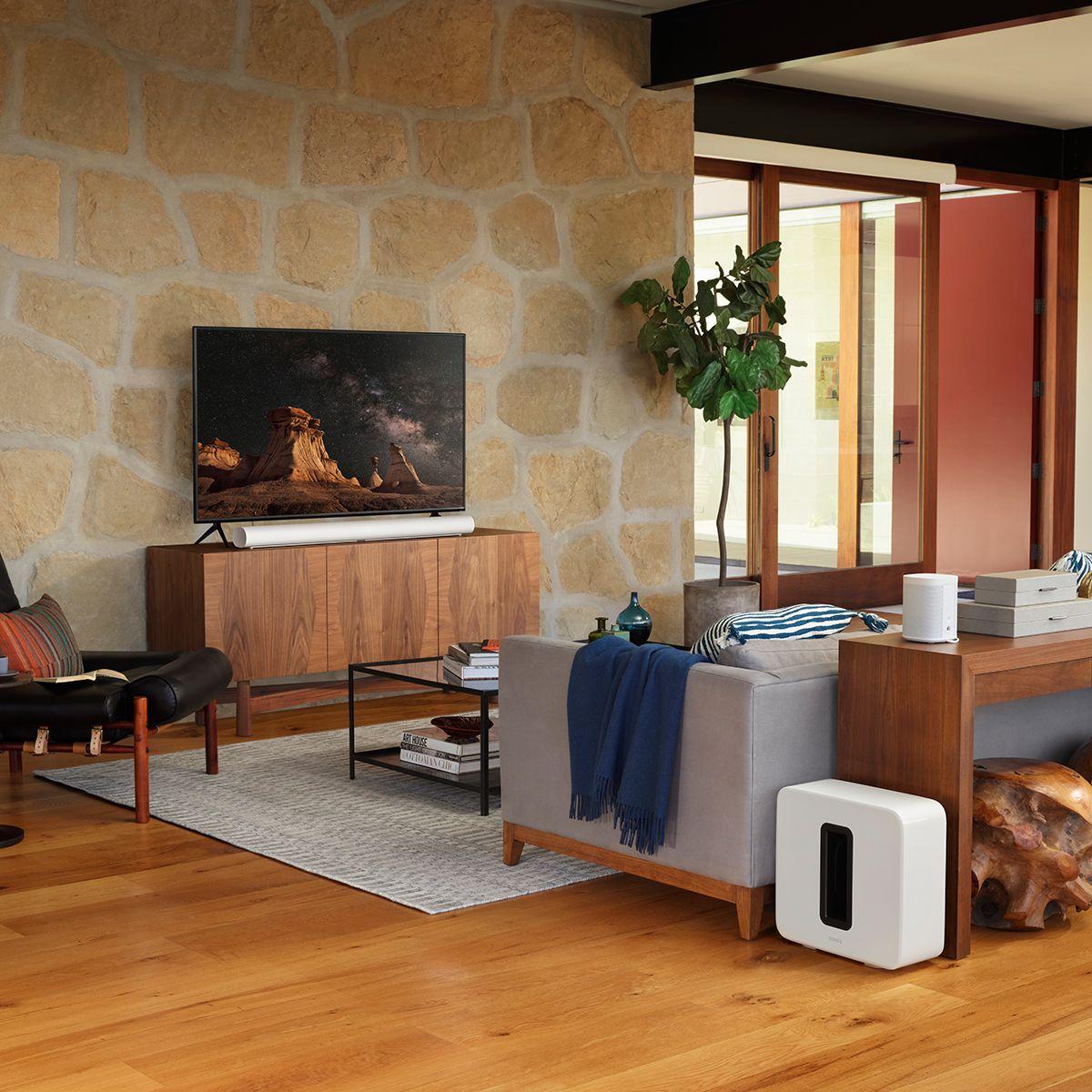










When I first started researching home theater audio upgrades, I was overwhelmed by the sheer number of options available. The soundbar market has exploded in recent years, but it's essentially split into two very different philosophies. On one side, you have systems like the Ultimea Poseidon D70 that give you actual physical speakers placed around your room. On the other, premium single-unit soundbars like the Sonos Arc use sophisticated processing to create virtual surround sound from one sleek device.
After diving deep into user reviews, expert opinions, and technical specifications, I've found that these two approaches serve fundamentally different needs – and understanding which camp you fall into will save you both money and frustration.
The soundbar category has matured significantly since both products launched. The Ultimea Poseidon D70 represents the newer wave of budget multi-speaker systems that emerged around 2022-2023, while the Sonos Arc debuted in 2020 as part of Sonos's push into premium Dolby Atmos territory.
What's fascinating is how these products reflect two competing visions for home theater audio. Traditional surround sound required an AV receiver (a central hub that processes audio signals) plus five to seven separate speakers positioned around your room. The Poseidon D70 simplifies this approach by including everything in one package, while the Arc represents the "invisible surround" philosophy – using psychoacoustic processing (techniques that trick your brain into hearing sounds from different directions) to create spatial audio from a single location.
Since their respective launches, we've seen improvements in both approaches. Virtual surround processing has gotten more sophisticated, while budget multi-speaker systems have added features like wireless subwoofers and smartphone app control that were previously limited to expensive setups.
Before diving into performance differences, it's crucial to understand what "surround sound" actually means and how these systems achieve it.
The Ultimea Poseidon D70 uses true surround sound – it has eight physical speakers positioned around your room. The main soundbar handles front left, center, and right channels (where dialogue and main action sounds come from), while four separate surround speakers create left/right front surrounds and left/right rear surrounds. A dedicated subwoofer handles the low-frequency effects channel (the ".1" in 7.1, responsible for explosions and deep bass).
The Sonos Arc, conversely, houses all eleven drivers in one 45-inch cabinet. It uses virtual surround processing combined with Dolby Atmos technology. Atmos adds height channels by bouncing sound off your ceiling using upward-firing drivers, while sophisticated algorithms analyze incoming audio and redirect specific frequencies to different drivers to simulate sounds coming from behind you.
Based on our research across numerous reviews, the physical approach of the D70 consistently delivers more convincing directional audio cues, especially in larger rooms. Multiple users noted that sounds genuinely appear to come from behind them, creating that "someone's sneaking up on you" effect that makes movie watching more immersive.
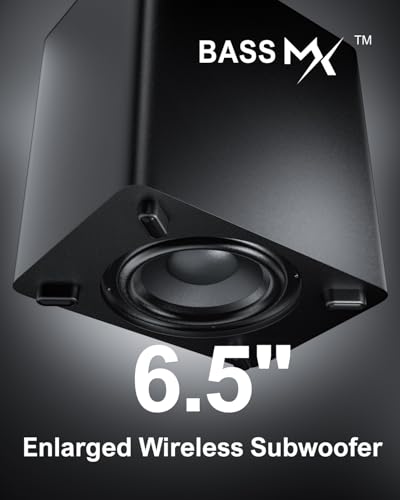
This is where the architectural differences become most apparent. The Poseidon D70 includes a dedicated 6.5-inch wireless subwoofer that operates independently from the main soundbar. Subwoofers are specialized speakers designed specifically for low frequencies – they move a lot of air to create those rumbling explosions and deep musical bass lines that you feel in your chest.
User reviews consistently praise the D70's bass impact. The wireless subwoofer can be positioned anywhere in your room for optimal bass response, and the BassMX technology (Ultimea's proprietary bass enhancement processing) allows you to adjust low-end output to match your room and preferences.
The Sonos Arc, while impressive for a single-unit design, simply cannot match this level of bass performance without adding Sonos's separate Sub, which costs significantly more than the entire D70 system. The Arc's integrated bass drivers do provide controlled, clean low-end response, but they're physically limited by the soundbar's compact form factor.
From a home theater perspective, this difference is crucial. Movie soundtracks rely heavily on low-frequency effects to create tension and impact. The T-Rex footsteps in Jurassic Park, the rumbling spaceship engines in Star Wars, or the deep musical scores in action films all depend on substantial bass response to deliver their full emotional impact.
Here's where the Sonos Arc demonstrates its premium engineering. Multiple expert reviews highlight the Arc's exceptional dialogue clarity, which stems from its dedicated center channel processing and three precision-tuned tweeters (small speakers optimized for high frequencies like voices and music details).
The Arc's Speech Enhancement feature uses digital signal processing to boost vocal frequencies, making dialogue clearer even during loud action sequences. This is particularly valuable for users who struggle with mumbling actors or dense movie soundtracks where dialogue gets buried in the mix.
The Poseidon D70 provides good dialogue reproduction through its center channel, but it doesn't match the Arc's vocal clarity. However, for most users watching standard TV content and movies, the difference may not justify the significant price premium.
This is where our research revealed the most interesting findings. The effectiveness of surround sound depends heavily on your room size and layout.
In rooms under 200 square feet, the Sonos Arc performs admirably. Its virtual surround processing, enhanced by Trueplay room calibration (which uses your smartphone's microphone to analyze room acoustics and adjust the sound accordingly), creates a convincing sense of space and directionality.
However, in larger rooms, multiple user reviews indicate that the Poseidon D70 provides significantly more convincing surround effects. This makes intuitive sense – physical speakers positioned behind your listening area will always create more authentic directional audio cues than virtual processing trying to simulate those same effects from speakers in front of you.
One particularly insightful review compared both systems in the same room, noting that while the Arc impressed with its overall audio quality, the D70's physical rear speakers created "actual surround sound that made me turn around thinking someone was in the room."
The Sonos Arc represents premium audio engineering. Its drivers are precisely tuned, and the digital signal processing is sophisticated enough to handle everything from compressed streaming audio to high-resolution music files. The overall tonal balance is excellent, with smooth frequency response across the entire audible spectrum.
The Poseidon D70, while impressive for its price category, shows some limitations in overall fidelity. The individual drivers aren't as refined as those in the Arc, and the amplification isn't as clean at higher volumes. However, for typical home theater use, these differences are often masked by the dramatic advantage of having actual surround speakers.
The feature gap between these systems is substantial. The Sonos Arc is essentially a smart speaker that happens to be excellent at TV audio. Built-in Amazon Alexa and Google Assistant allow voice control of both the soundbar and smart home devices. Apple AirPlay 2 integration means iPhone and iPad users can stream music wirelessly when the TV is off.
The Arc also integrates into the broader Sonos ecosystem, enabling multi-room audio where you can play the same music throughout your house or different music in each room. Regular software updates add new features and streaming service integrations.
The Poseidon D70 takes a more utilitarian approach. Its smartphone app provides extensive EQ control with 10-band graphic equalization and 121 preset sound profiles, but there's no voice control, no smart home integration, and no streaming service connectivity beyond basic Bluetooth pairing.
For users who primarily want better TV audio and aren't interested in smart home features, the D70's approach is perfectly adequate. But if you're building a connected home or want convenient music streaming capabilities, the Arc's smart features become compelling.
This is where personal priorities become crucial. The Sonos Arc literally takes ten minutes to set up – power cable, HDMI cable to your TV, and you're done. The sleek design disappears under most TVs, and there are no additional speakers to position or wires to hide.
The Poseidon D70 requires genuine installation effort. You'll spend 1-2 hours positioning four surround speakers and running wires. While the system includes color-coded cables and the surround speakers can be wall-mounted, you're still dealing with speaker placement decisions and cable management.
However, this installation complexity brings flexibility. You can optimize speaker positions for your specific room layout, and the wireless subwoofer can be placed anywhere for best bass response.
Our research revealed clear patterns in user satisfaction based on room size. The Poseidon D70 is officially rated for rooms between 108-270 square feet, and user reviews confirm it maintains its surround sound effectiveness throughout this range.
The Sonos Arc performs best in smaller to medium rooms. In very large spaces or rooms with challenging acoustics (high ceilings, lots of hard surfaces), the virtual surround processing becomes less convincing.
This makes intuitive sense from a physics perspective. Virtual surround relies on precise sound reflections and psychoacoustic tricks that work best in controlled acoustic environments. Physical surround speakers will create directional audio cues regardless of room acoustics.
Dolby Atmos represents the newest evolution in home theater audio, adding height channels to create true three-dimensional sound. The Sonos Arc supports Atmos content, using upward-firing speakers to bounce sound off your ceiling and create overhead effects.
The Poseidon D70 doesn't support Atmos, limiting it to traditional 7.1 channel surround. For users who watch a lot of streaming content (Netflix, Disney+, Amazon Prime all offer Atmos content) or play modern video games, this represents a meaningful limitation.
However, Atmos effectiveness depends heavily on room characteristics. Rooms with very high ceilings, unusual shapes, or acoustic treatments may not benefit significantly from Atmos processing.
At the time of writing, these products represent dramatically different value propositions. The Poseidon D70 typically costs less than one-quarter the price of the Sonos Arc, yet provides arguably superior surround sound performance in most rooms.
To achieve equivalent surround sound from the Sonos ecosystem, you'd need to add their wireless subwoofer and rear surround speakers, bringing the total system cost to roughly seven times the D70's price.
This creates an interesting decision matrix. If your primary goal is the best possible surround sound experience for the money, the D70 is exceptional. If you value convenience, smart features, premium build quality, and dialogue clarity above all else, the Arc justifies its premium pricing.
Based on our comprehensive research, the choice becomes clearer when you consider your specific priorities and constraints.
Choose the Ultimea Poseidon D70 if you're primarily focused on movie and gaming experiences, have a medium to large room, don't mind installation complexity, and want the most authentic surround sound possible within a reasonable budget. It's also ideal for users who don't need smart home integration and prefer systems where everything is included upfront.
The Sonos Arc makes more sense for users who value premium audio quality, need excellent dialogue clarity, want comprehensive smart features, prefer minimal installation, or plan to build a multi-room audio system over time. It's particularly compelling for users heavily invested in the Apple ecosystem or who frequently stream music in addition to TV audio.
After analyzing dozens of user reviews and expert opinions, both systems excel in their intended roles. The Poseidon D70 delivers authentic surround sound at an exceptional price point, while the Sonos Arc provides premium features and convenience that justify its higher cost for the right user.
The key insight from our research is that these products serve different philosophies about home theater audio. If you want the most immersive surround sound experience possible within a reasonable budget and don't mind some installation effort, the D70 is remarkably compelling. If you prioritize convenience, smart features, and premium audio quality over authentic surround sound positioning, the Arc represents excellent engineering that will satisfy most users.
Your room size, budget, and priorities around smart features will ultimately determine which approach serves you better. Both represent solid choices within their respective categories – it's simply a matter of understanding which category aligns with your specific needs and preferences.
| Ultimea Poseidon D70 7.1 Channel Soundbar System | Sonos Arc Wireless Sound Bar with Dolby Atmos |
|---|---|
| System Architecture - Determines surround sound authenticity | |
| True 7.1 system: soundbar + 4 physical surround speakers + wireless subwoofer (8 total speakers) | Single soundbar with 11 internal drivers using virtual surround processing |
| Dolby Atmos Support - Essential for modern streaming content and overhead sound effects | |
| No Atmos support (traditional 7.1 surround only) | Full Dolby Atmos with upward-firing drivers for height channels |
| Peak Power Output - Affects maximum volume and bass impact | |
| 410W peak across all speakers with dedicated 6.5" subwoofer | Class-D amplification (exact wattage not specified) with integrated bass drivers |
| Installation Complexity - Time and effort required for setup | |
| 1-2 hours: position 4 surround speakers, run wires, place subwoofer | 10 minutes: single HDMI connection and power cable |
| Smart Features - Voice control and streaming capabilities | |
| Basic app control with 10-band EQ, Bluetooth 5.3, no voice control | Built-in Alexa/Google Assistant, Apple AirPlay 2, Sonos ecosystem integration |
| Room Size Optimization - Where each system performs best | |
| 108-270 sq ft, maintains surround effectiveness in larger spaces | Small to medium rooms, virtual surround less effective in very large spaces |
| Connectivity Options - Input flexibility for different devices | |
| HDMI ARC, Optical, USB, 3.5mm AUX, Bluetooth (no 4K passthrough) | HDMI eARC, Wi-Fi streaming, optical adapter included, IR receiver |
| Dialogue Clarity - Critical for understanding speech in movies | |
| Good center channel performance with voice enhancement mode | Exceptional dialogue clarity with dedicated speech enhancement and 3 tweeters |
| Expandability - Ability to add components later | |
| Fixed system with no expansion options | Full Sonos Arc ecosystem compatibility, can add Sub and rear speakers |
| Total System Cost - What you pay for complete surround setup | |
| Complete 7.1 system included at base price | Base soundbar only; adding Sub and rears costs significantly more |
The Ultimea Poseidon D70 performs better in large rooms because it uses four physical surround speakers positioned around your space. The Sonos Arc relies on virtual surround processing that works best in smaller to medium-sized rooms. For spaces over 200 square feet, the D70's actual rear speakers provide more convincing surround sound effects.
No, the Sonos Arc does not include a subwoofer - it's a single soundbar with integrated bass drivers. The Ultimea Poseidon D70 includes a dedicated 6.5" wireless subwoofer as part of the complete system, providing significantly more bass impact without additional purchases.
The Sonos Arc is much easier to install, requiring only 10 minutes and one HDMI connection. The Ultimea Poseidon D70 takes 1-2 hours to set up because you need to position four surround speakers around your room and run wires, though all necessary cables are included.
Only the Sonos Arc supports Dolby Atmos with upward-firing drivers for overhead sound effects. The Ultimea Poseidon D70 uses traditional 7.1 channel surround sound without Atmos support, which limits its compatibility with modern streaming content that includes height channels.
The Ultimea Poseidon D70 provides exceptional value as a complete 7.1 surround system with subwoofer at a budget-friendly price. The Sonos Arc costs significantly more for just the soundbar, and you'll need to purchase additional components separately to achieve equivalent surround sound.
The Sonos Arc has built-in Amazon Alexa and Google Assistant for full voice control of music, volume, and smart home devices. The Ultimea Poseidon D70 doesn't support voice commands but includes a remote control and smartphone app for system adjustments.
The Sonos Arc excels at music with superior audio fidelity, Apple AirPlay 2 support, and integration with streaming services. The Ultimea Poseidon D70 handles music well but is primarily designed for home theater use, though its 10-band EQ allows for music optimization.
The Ultimea Poseidon D70 includes everything needed for true surround sound: four physical surround speakers plus a subwoofer. With the Sonos Arc, you'd need to purchase separate rear speakers and a subwoofer to achieve equivalent surround sound performance.
The Sonos Arc provides superior dialogue clarity with dedicated speech enhancement features and precision-tuned tweeters. The Ultimea Poseidon D70 offers good dialogue reproduction but doesn't match the Arc's vocal clarity and speech processing capabilities.
Both systems connect to smartphones, but differently. The Ultimea Poseidon D70 uses Bluetooth 5.3 and has a control app for EQ adjustments. The Sonos Arc offers Wi-Fi connectivity, Apple AirPlay 2, and a comprehensive app for streaming services and system control.
The Ultimea Poseidon D70 is excellent for gaming due to its physical surround speakers that provide precise directional audio cues. The Sonos Arc also works well for gaming, especially with Dolby Atmos-enabled games, but the D70's true surround positioning gives it an advantage for competitive gaming.
The Sonos Arc requires minimal space - just room for a 45-inch soundbar under your TV. The Ultimea Poseidon D70 needs space for the main soundbar, plus wall or shelf space for four surround speakers and floor space for the subwoofer, making it better suited for dedicated home theater rooms.
We've done our best to create useful and informative comparisons to help you decide what product to buy. Our research uses advanced automated methods to create this comparison and perfection is not possible - please contact us for corrections or questions. These are the sites we've researched in the creation of this article: ultimea.com - provantage.com - ultimea.com - youtube.com - youtube.com - bestbuy.com - the-gadgeteer.com - shopmyexchange.com - youtube.com - youtube.com - youtube.com - ultimea.com - manuals.plus - device.report - images.thdstatic.com - shopmyexchange.com - staples.com - ultimea.de - whathifi.com - soundandvision.com - en.community.sonos.com - cnet.com - worldwidestereo.com - abt.com - creativeaudio.net - target.com - sonos.com - worldwidestereo.com - businessinsider.com - en.community.sonos.com - youtube.com

Privacy Policy
Terms and Conditions - Affiliate Policy
Home Security
© Copyright 2008-2026.
11816 Inwood Rd #1211, Dallas, TX 75244