






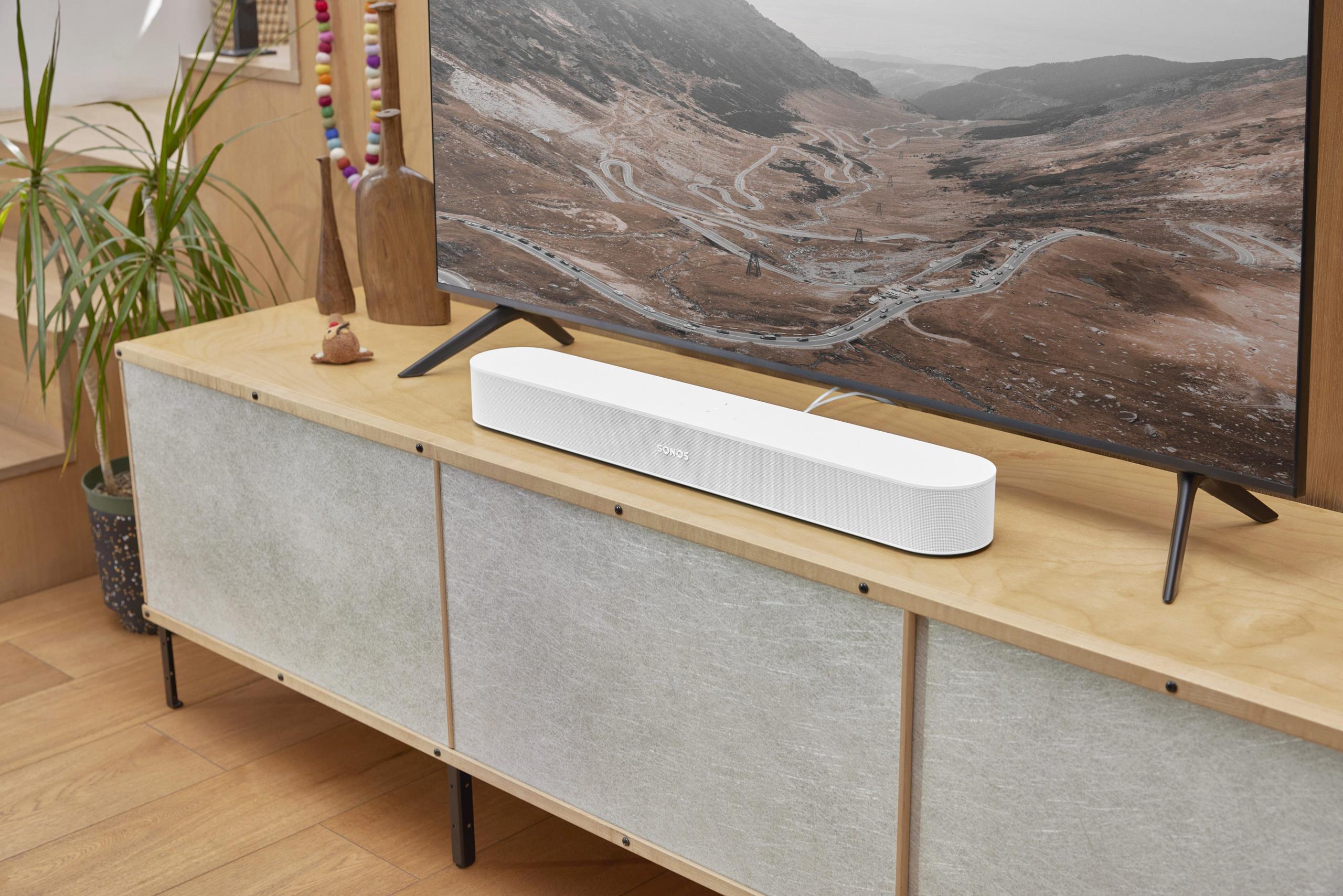
When your TV's built-in speakers make dialogue sound like it's coming from inside a tin can, it's time to upgrade your audio setup. But the soundbar market can be overwhelming, with options ranging from budget all-in-one bars to premium multi-component systems. Today we're comparing two fundamentally different approaches: the Ultimea Poseidon D70, a budget-friendly complete 7.1 surround system, and the Sonos Beam Gen 2, a premium compact soundbar that prioritizes refinement over raw power.
Before diving into specifics, it's worth understanding what makes these products tick. Soundbars essentially replace your TV's weak internal speakers with better drivers (the individual speakers that produce sound) and amplifiers (which boost the audio signal to drive those speakers). The magic happens in how they process audio signals and create the illusion of surround sound.
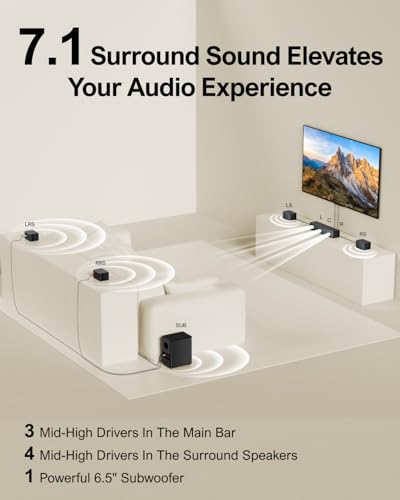
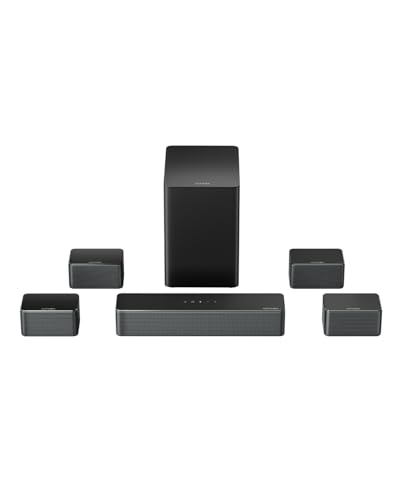
The Ultimea Poseidon D70 launched in 2024, representing the "more is more" philosophy. You get a main soundbar, four separate surround speakers, and a wireless subwoofer—eight total drivers working together. The Sonos Beam Gen 2, released in 2021, takes the opposite approach: everything happens within one sleek unit using advanced audio processing to create virtual surround sound.
At the time of writing, these products sit in completely different price brackets, with the Poseidon D70 positioned as an aggressive value play while the Beam Gen 2 commands a premium price typical of Sonos products. This price gap—roughly 2.5 times more expensive for the Sonos—immediately tells us we're looking at different philosophies and target markets.
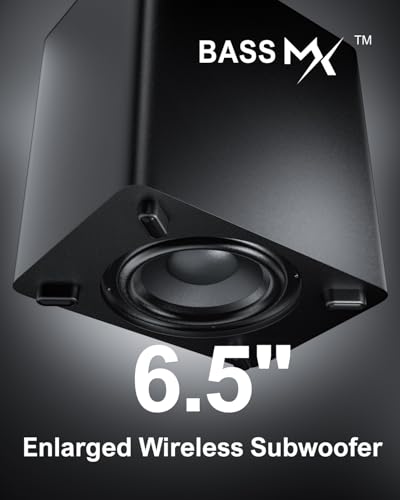
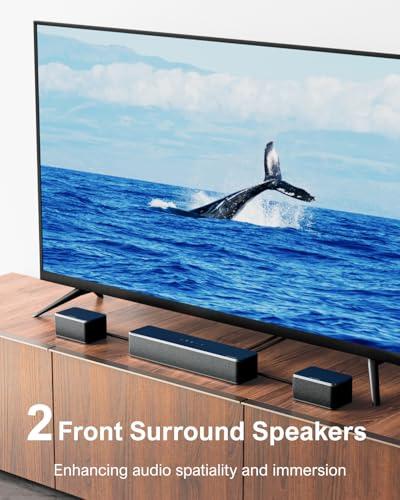
Here's where things get interesting from a technical standpoint. The Poseidon D70 creates surround sound the traditional way: physical speakers placed around your room. The main soundbar houses three 2.25-inch mid-bass drivers handling front channels, while four separate surround speakers (each with their own 2.25-inch driver) connect to create genuine left, right, and rear channel separation. A 6.5-inch wireless subwoofer handles the low frequencies below about 35Hz—those rumbling explosions and thumping bass lines.
This approach works because your ears naturally detect where sounds are coming from based on timing differences and volume levels. When a helicopter flies from left to right in a movie, the Poseidon D70 actually moves that sound from the left surround speaker to the right one. It's physics working in your favor.
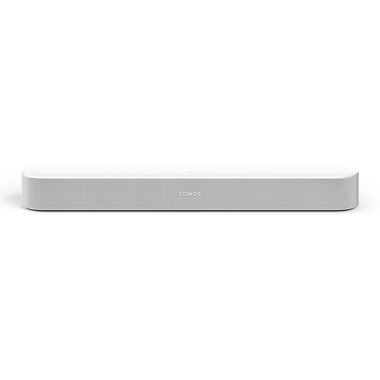
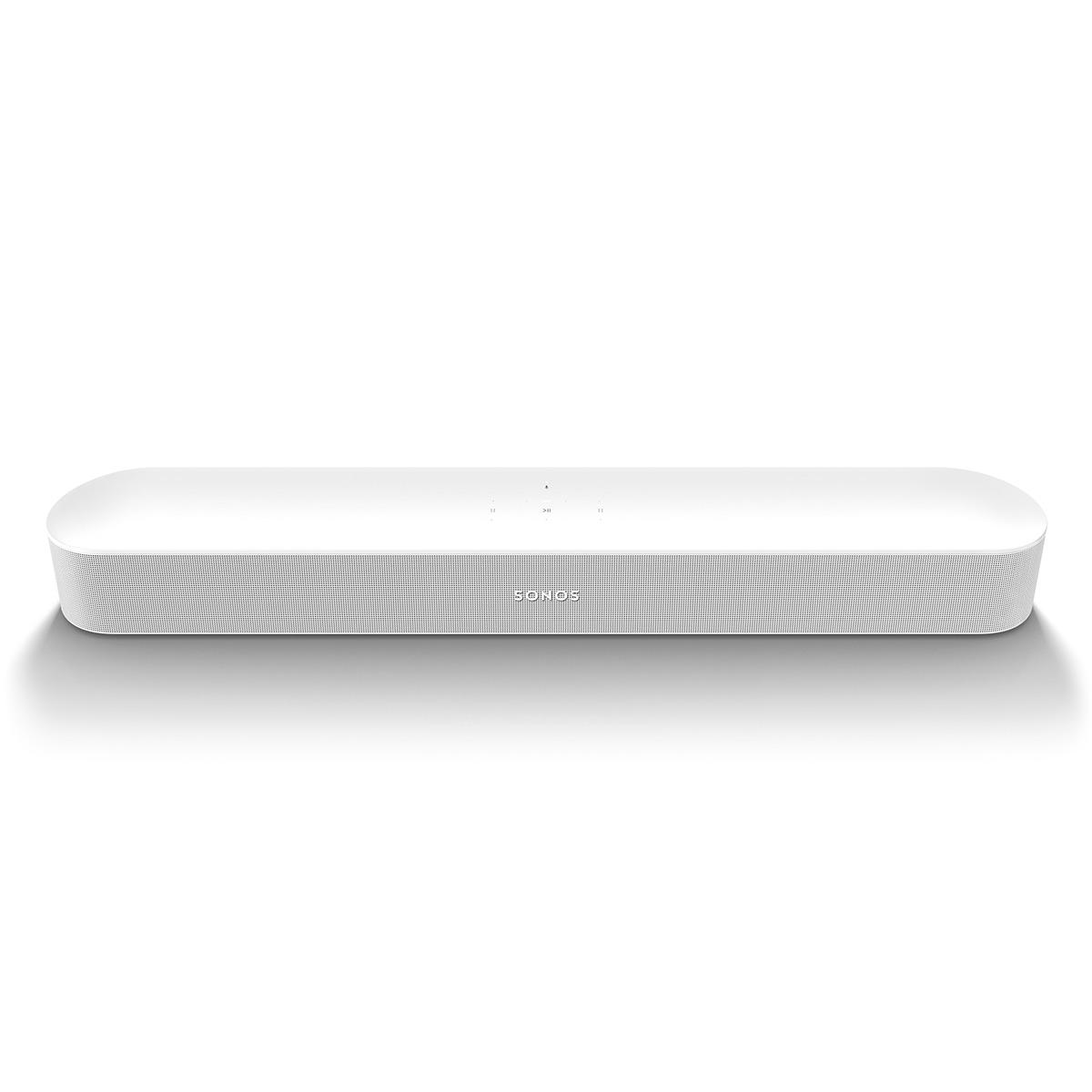
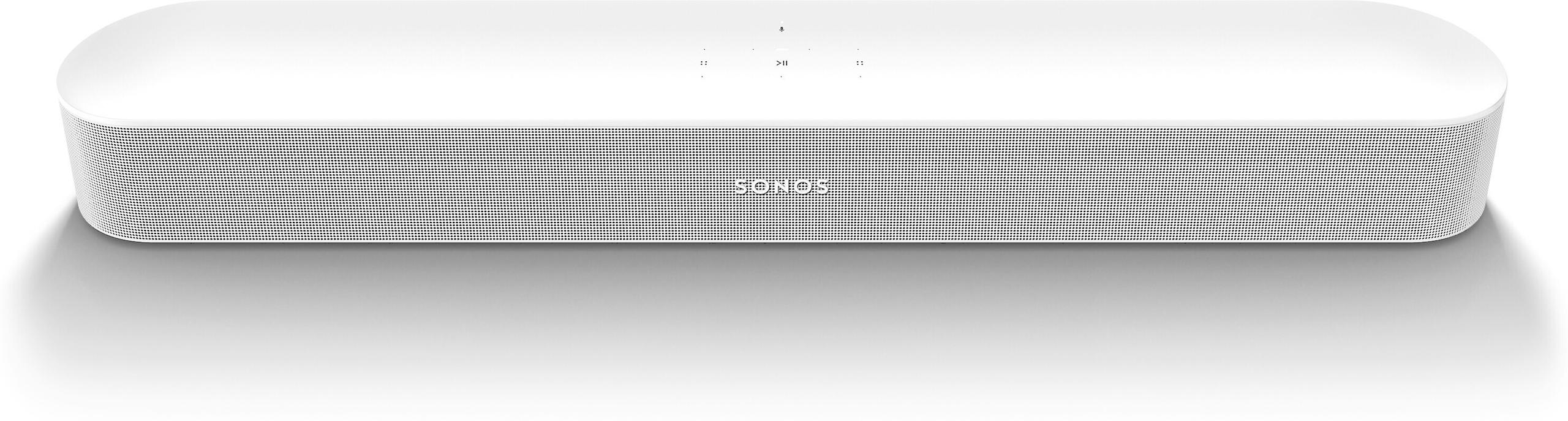
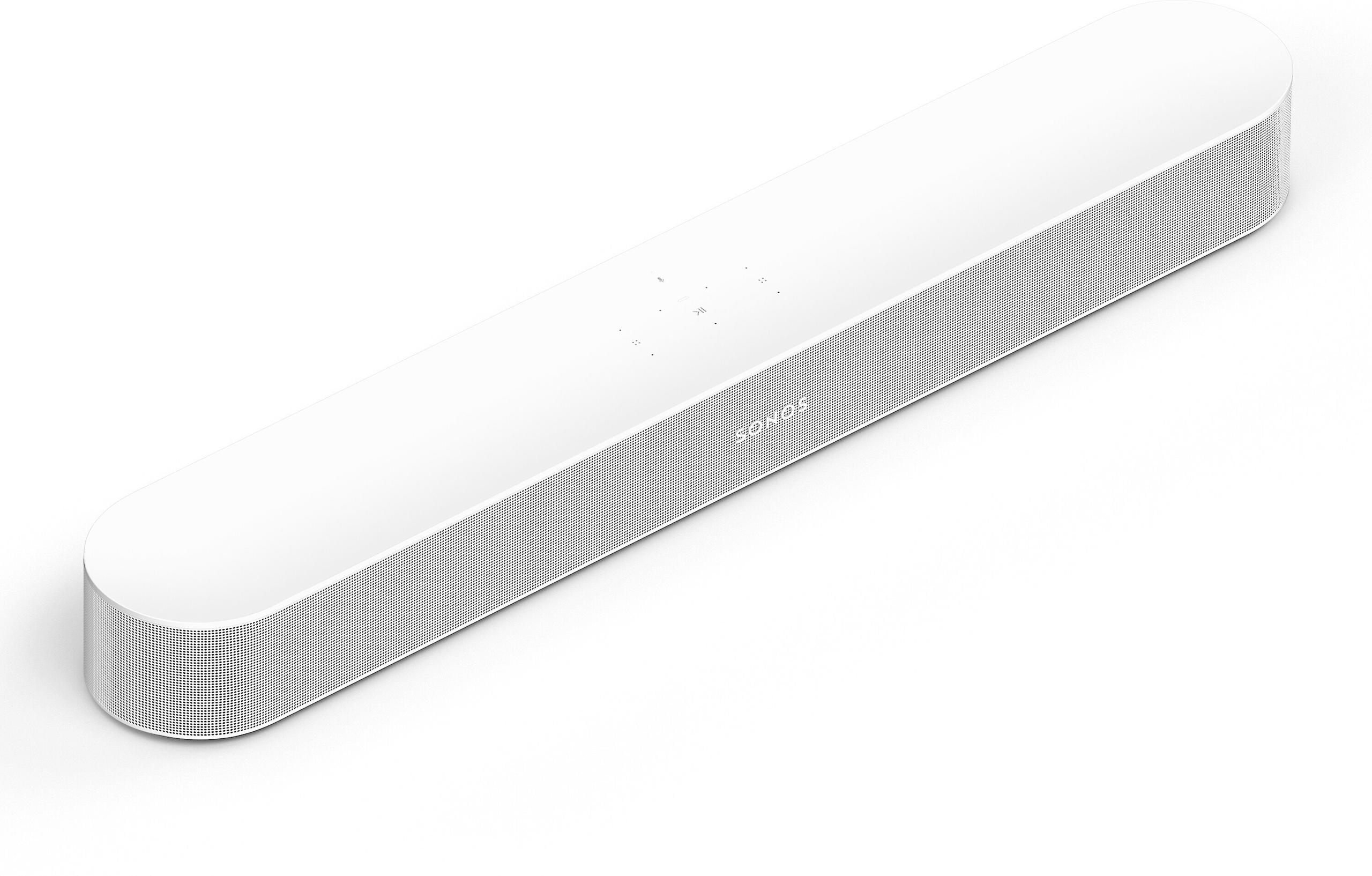
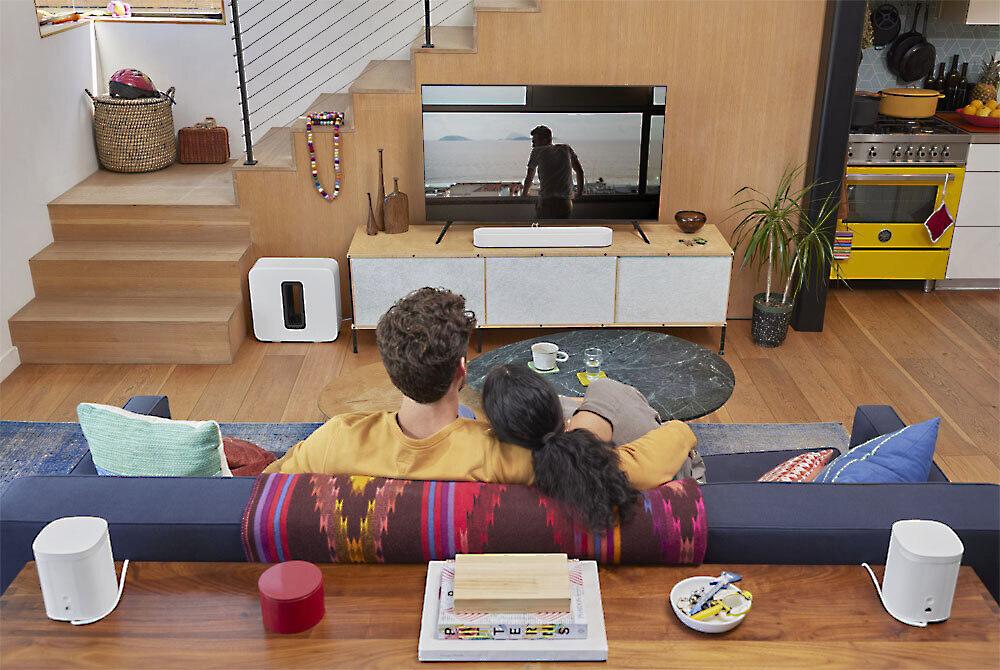
The Beam Gen 2, meanwhile, performs audio wizardry using psychoacoustics—the science of how our brains interpret sound. Its five drivers (four elliptical mid-woofers and one center tweeter) all face forward, but sophisticated digital processing creates the illusion that sound is coming from behind and beside you. This isn't marketing fluff; when done well, virtual surround can be surprisingly convincing.
Raw numbers don't tell the whole story, but they're worth understanding. The Poseidon D70 delivers 410 watts of peak power across its eight drivers, with a more realistic 144 watts RMS (root mean square—a more accurate measurement of continuous power output). That breaks down to 36 watts for the soundbar, 48 watts total for the four surround speakers, and 60 watts for the subwoofer.
The Beam Gen 2 doesn't publish specific wattage figures, which is typical for premium brands that focus more on efficiency and audio quality than raw power. Its five Class D amplifiers (a type of amplifier that's very efficient and runs cool) drive the four mid-woofers and tweeter, with three passive radiators helping extend bass response without requiring additional amplification.
This is where the fundamental design differences become immediately apparent. The Poseidon D70's 6.5-inch subwoofer provides genuine low-frequency extension that you can feel in your chest during action scenes. Bass-heavy music, movie explosions, and the rumble of spaceships all benefit from having a dedicated driver designed specifically for low frequencies.
Our research into user experiences consistently shows the Poseidon D70 delivering satisfying bass impact that transforms the viewing experience for action movies and music. Users frequently mention being surprised by the depth and power, especially coming from a budget system.
The Beam Gen 2, constrained by its compact size, relies on passive radiators—essentially speakers without magnets that move air when driven by the main drivers. While clever engineering helps it produce more bass than you'd expect from such a small unit, it simply can't match the physical displacement of a dedicated 6.5-inch subwoofer. For dialogue-heavy content and moderate listening levels, this isn't a problem. For bass-heavy music or action movies at higher volumes, the difference becomes noticeable.
Here's where the Sonos Beam Gen 2 fights back with superior engineering. Its dedicated center tweeter is specifically designed and positioned to handle dialogue frequencies with exceptional clarity. The psychoacoustic processing doesn't just create surround effects—it also optimizes frequency response to make voices cut through background music and effects.
User feedback consistently highlights this strength, with many noting they can finally understand dialogue clearly at lower volumes. This matters more than you might think, especially for late-night viewing when you don't want to wake the household but still need to follow the plot.
The Poseidon D70 handles dialogue adequately, but without the same level of refinement. Its three front drivers share duties across the frequency spectrum rather than having a dedicated tweeter optimized specifically for vocal clarity.
This comparison gets nuanced quickly. The Poseidon D70's physical surround speakers create genuine directional audio—when a sound effect is supposed to come from behind your left shoulder, it actually does. This works consistently regardless of what you're watching, whether it's a stereo TV show or a full surround sound movie.
The system uses SurroundX Technology (Ultimea's proprietary spatial processing) combined with AI-trained algorithms to optimize how sounds are distributed across all eight speakers. While these terms might sound like marketing speak, the underlying principle is solid: use multiple physical speakers to create authentic surround sound.
The Beam Gen 2 takes a more sophisticated but limited approach. Its Dolby Atmos support uses advanced psychoacoustic processing to create the illusion of height and surround effects. When it works—particularly with properly encoded Dolby Atmos content—the effect can be remarkably convincing. Sounds seem to come from above, behind, and beside you despite all drivers facing forward.
However, this virtual processing works best with compatible content and optimal room conditions. Standard stereo TV shows or music won't benefit as much from the surround processing, whereas the Poseidon D70's physical speakers can enhance any content by spreading it across multiple speakers.
The Poseidon D70 wins on connectivity versatility. It includes HDMI ARC (Audio Return Channel—lets your TV send audio back to the soundbar), optical digital input, USB, auxiliary input, and Bluetooth 5.3. This flexibility means it works with virtually any TV or audio source, including older equipment that might lack modern connectivity options.
The Beam Gen 2 takes a more restrictive approach with HDMI eARC only. The "e" stands for "enhanced," supporting higher-bandwidth audio formats like Dolby Atmos. While this provides superior audio quality when compatible, it requires a relatively recent TV with eARC support. No optical input means older TVs are out of luck without adapters.
Here's where Sonos's ecosystem approach shines. The Beam Gen 2 includes built-in voice assistants (Amazon Alexa, Google Assistant, and Sonos's own voice control), WiFi streaming, Apple AirPlay 2, and seamless integration with other Sonos speakers throughout your home. You can ask it to play music, control smart home devices, or group it with other Sonos speakers for whole-home audio.
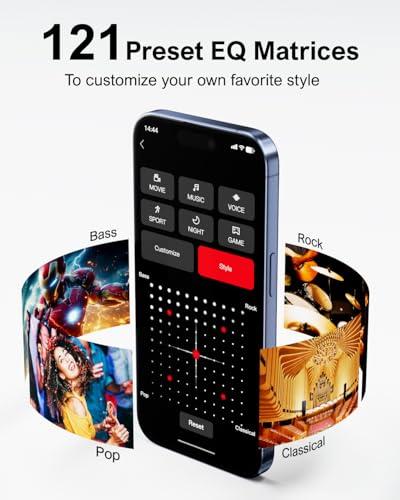
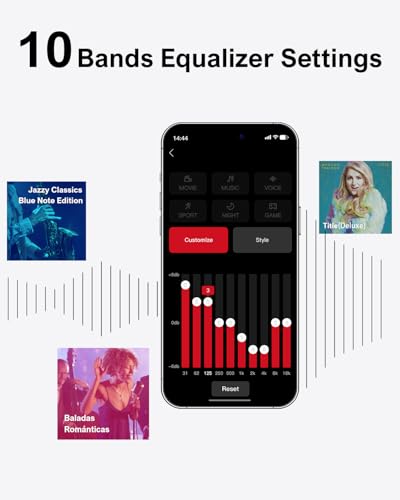
The Poseidon D70 focuses more on audio customization through its smartphone app, which offers a 10-band equalizer and 121 preset EQ settings. While impressive for fine-tuning sound, it lacks the smart home integration that makes the Sonos feel like part of a modern connected ecosystem.
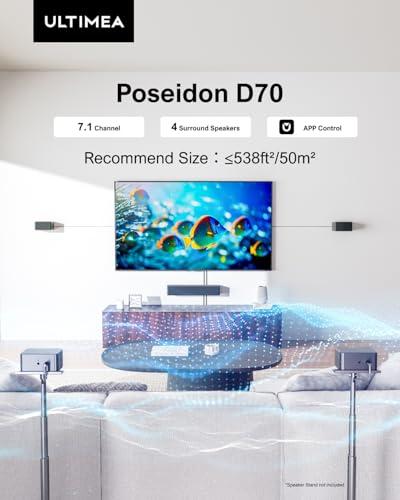
This is where your living situation heavily influences the decision. The Poseidon D70 requires strategic placement of four surround speakers around your viewing area, connected by cables to the subwoofer. While the wireless subwoofer offers placement flexibility, you'll need to run speaker wire to position the surrounds effectively.
This works great in dedicated home theater rooms or larger living spaces where you can properly position speakers. The included cables (varying lengths up to 6 meters) accommodate different room sizes, and wall-mounting hardware is included for clean installation.
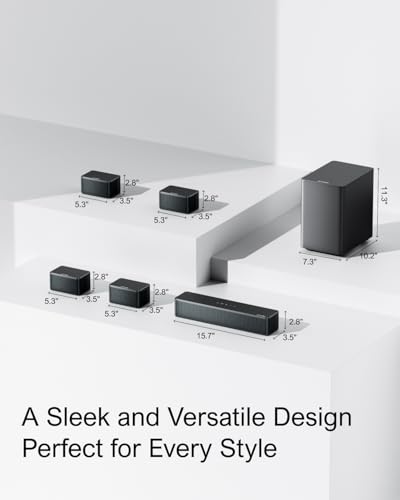
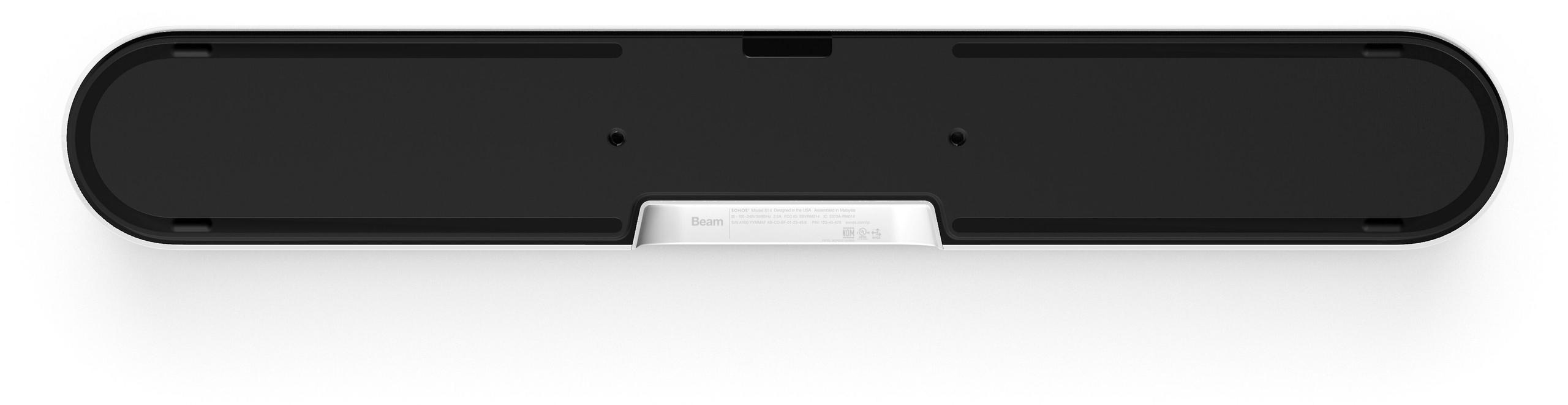
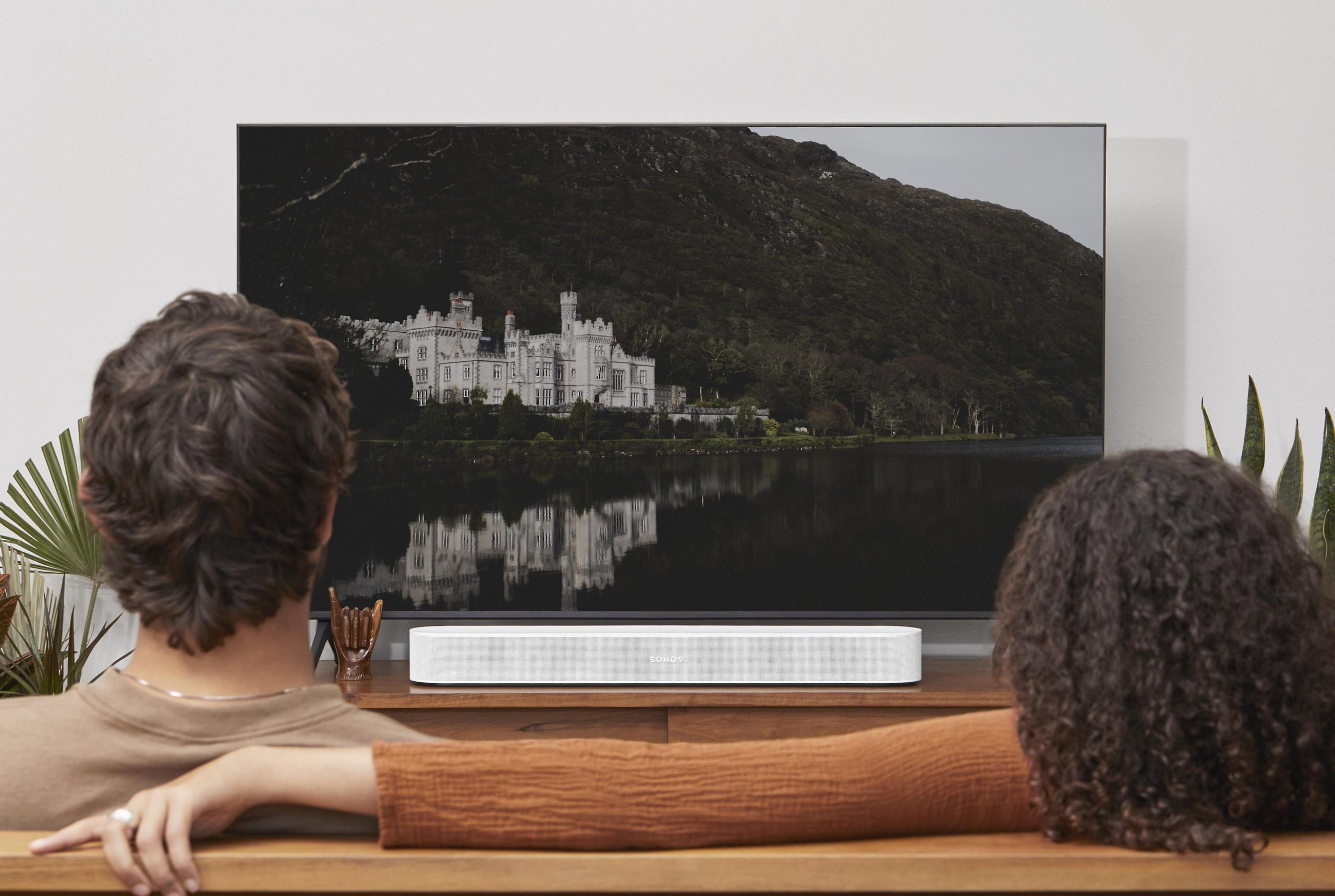
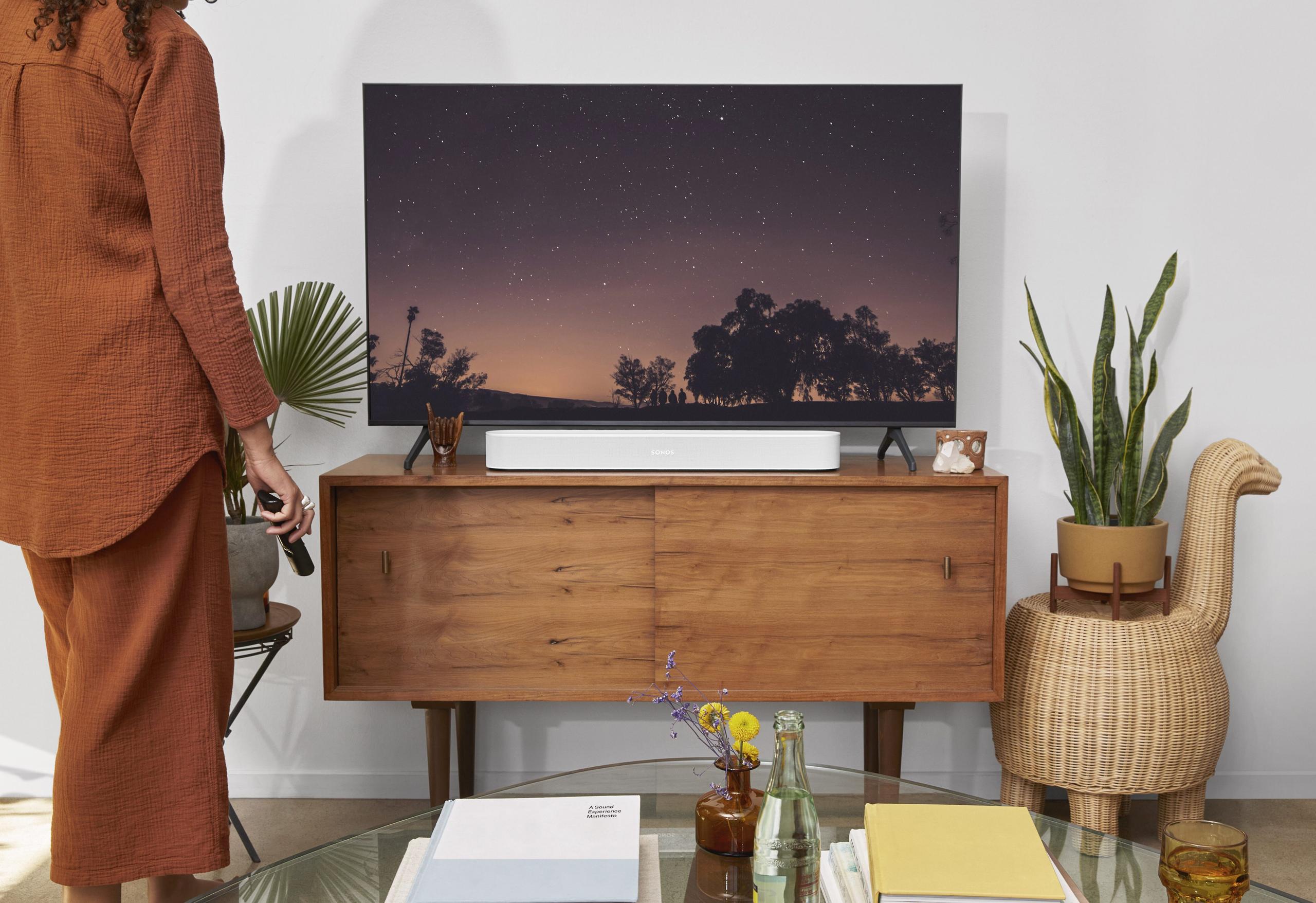
The Beam Gen 2 epitomizes simplicity: one sleek unit measuring about 26 inches wide that sits beneath your TV or mounts on the wall. No additional speakers to place, no wires to hide, no wondering about optimal positioning. It uses Trueplay technology (requires an iOS device) to automatically calibrate sound based on your room's acoustics.
The Sonos Beam Gen 2 clearly wins the style contest. Its minimalist design disappears into modern living spaces, available in black or white to match your decor. The single unit approach maintains clean lines and doesn't dominate your room visually.
The Poseidon D70, while not unattractive, necessarily has more visual impact with multiple speakers around the room. Some people love the "serious home theater" look, while others prefer audio equipment that doesn't advertise its presence.
At the time of writing, these products represent dramatically different value philosophies. The Poseidon D70 delivers a complete 7.1 surround system—soundbar, subwoofer, and four surround speakers—for roughly the same price as many basic 2.1 soundbars from established brands. This is genuinely exceptional value if you want authentic surround sound on a budget.
The Beam Gen 2's premium pricing reflects Sonos's focus on refined engineering, smart features, and ecosystem integration. You're paying for sophisticated audio processing, premium build quality, excellent customer support, and the ability to expand into a full Sonos multi-room system over time.
The Beam Gen 2 benefits from three years of additional development since its 2021 launch, including firmware updates that have improved its Dolby Atmos processing and added new voice control features. Sonos's track record shows they continue supporting products with updates long after release.
The Poseidon D70, being newer to market in 2024, incorporates more recent Bluetooth standards and processing capabilities but lacks the established ecosystem and ongoing development that Sonos provides.
You want authentic surround sound without spending premium prices. The physical surround speakers create genuine directional audio that works with any content, not just specially encoded movies. It's ideal for dedicated home theater spaces or larger living rooms where you can properly position the surround speakers.
The substantial bass from the 6.5-inch subwoofer transforms action movies and music, providing the visceral impact that makes explosions feel real and music sound full. If you prioritize maximum audio impact per dollar and don't mind the additional setup complexity, the Poseidon D70 delivers exceptional value.
It's also the better choice for older TVs lacking eARC support, thanks to its multiple connectivity options including optical and auxiliary inputs.
You prioritize convenience, dialogue clarity, and smart home integration over raw power. Its sophisticated processing makes voices crystal clear even at lower volumes—crucial for late-night viewing or busy households where you need to hear dialogue without cranking the volume.
The single-unit design works perfectly in smaller spaces, apartments, or any situation where multiple speakers aren't practical. Its virtual Dolby Atmos processing, while not matching physical surround speakers, creates surprisingly convincing spatial effects when watching compatible content.
If you value premium build quality, plan to integrate with other Sonos speakers, or want voice control and streaming features, the Beam Gen 2 justifies its higher price through refinement and convenience.
These products succeed at different goals. The Ultimea Poseidon D70 maximizes audio performance per dollar, delivering authentic surround sound that transforms your viewing experience for a fraction of what traditional surround systems cost. The Sonos Beam Gen 2 prioritizes refinement, convenience, and smart features, creating a premium experience that disappears into your lifestyle while delivering exceptional dialogue clarity and sophisticated processing.
Neither approach is inherently better—it depends on your priorities, space, budget, and how you consume entertainment. The Poseidon D70 gives you more bang for your buck if you want maximum audio impact and don't mind the setup complexity. The Beam Gen 2 provides a more polished, convenient experience that excels at what most people actually do: watch TV shows and movies with clear dialogue and reasonable volume levels.
Consider your room size, aesthetic preferences, technical comfort level, and long-term audio goals. Both products deliver on their promises, but for very different types of users and situations.
| Ultimea Poseidon D70 7.1 Channel Soundbar System | Sonos Beam Gen 2 Soundbar |
|---|---|
| Speaker Configuration - Determines authentic vs virtual surround sound | |
| True 7.1 system: Soundbar + 4 physical surround speakers + wireless subwoofer (8 total drivers) | Compact 5.0 system: Single soundbar with 4 woofers + 1 tweeter + 3 passive radiators |
| Power Output - Affects volume levels and dynamic range | |
| 410W peak / 144W RMS across all speakers | Undisclosed (typical premium efficiency focus over raw power) |
| Dolby Atmos Support - Essential for modern movie soundtracks | |
| No Dolby Atmos (uses proprietary SurroundX virtual processing) | Yes, with psychoacoustic processing for height effects |
| Subwoofer - Critical for bass impact in action movies | |
| Dedicated 6.5" wireless subwoofer with BassMX technology | Passive radiators only (no dedicated subwoofer) |
| Connectivity Options - Compatibility with different TV ages and sources | |
| HDMI ARC, Optical, USB, AUX, Bluetooth 5.3 (works with older TVs) | HDMI eARC only (requires newer TVs, supports advanced formats) |
| Smart Features - Voice control and streaming capabilities | |
| Smart app with 10-band EQ and 121 presets (audio-focused) | Built-in Alexa/Google Assistant, AirPlay 2, multi-room Sonos integration |
| Physical Setup - Installation complexity and room requirements | |
| Multi-component: requires surround speaker placement and wire management | Single unit: plug-and-play setup with automatic room calibration |
| Room Size Suitability - Optimal performance based on space | |
| Best for larger rooms where surround speakers can be properly positioned | Ideal for small to medium rooms, apartments, and space-constrained setups |
| Expandability - Future upgrade potential | |
| Complete system as-is (no official expansion options) | Can add Sonos Sub and rear speakers, integrates with other Sonos products |
| Release Year - Technology generation and ongoing support | |
| 2024 (latest connectivity standards, newer to market) | 2021 (established product with ongoing firmware updates and ecosystem) |
The Ultimea Poseidon D70 is better for dedicated home theaters due to its true 7.1 surround sound with physical speakers placed around your room and a powerful 6.5" subwoofer for deep bass. The Sonos Beam Gen 2 excels in smaller spaces with its compact design and excellent dialogue clarity, making it ideal for living rooms where you prioritize convenience over maximum surround impact.
The Ultimea Poseidon D70 uses physical surround sound with actual speakers positioned behind and beside you, creating authentic directional audio from all angles. The Sonos Beam Gen 2 creates virtual surround sound using advanced processing to make audio seem like it's coming from different directions, even though all speakers face forward from one unit.
The Ultimea Poseidon D70 delivers significantly better bass with its dedicated 6.5" wireless subwoofer that can produce deep, room-shaking low frequencies. The Sonos Beam Gen 2 relies on passive radiators for bass extension, which provides adequate low-end for dialogue and moderate content but can't match the impact of a dedicated subwoofer.
The Ultimea Poseidon D70 works with virtually any TV thanks to multiple connection options including HDMI ARC, optical, and auxiliary inputs. The Sonos Beam Gen 2 requires a TV with HDMI eARC support for optimal performance, which typically means TVs from 2019 or newer.
The Sonos Beam Gen 2 wins for simplicity with a single unit that connects with one cable and automatically calibrates to your room. The Ultimea Poseidon D70 requires positioning four surround speakers around your room and managing speaker cables, though setup is still straightforward for most users.
The Sonos Beam Gen 2 excels at dialogue clarity with its dedicated center tweeter and sophisticated processing that makes voices cut through background noise. The Ultimea Poseidon D70 provides clear dialogue but without the same level of vocal optimization and refinement.
The Sonos Beam Gen 2 includes built-in voice assistants (Alexa, Google Assistant), WiFi streaming, AirPlay 2, and integrates with other Sonos speakers for multi-room audio. The Ultimea Poseidon D70 focuses on audio customization through its app with extensive EQ options but lacks smart home integration.
The Ultimea Poseidon D70 performs best in larger rooms where you can properly position the surround speakers for optimal effect. The Sonos Beam Gen 2 is ideal for small to medium rooms, apartments, or any space where a compact, single-unit solution is preferred.
The Ultimea Poseidon D70 offers exceptional value by providing a complete 7.1 surround system with subwoofer at a budget-friendly price point. The Sonos Beam Gen 2 costs significantly more but delivers premium build quality, advanced features, and the convenience of a refined single-unit solution.
The Sonos Beam Gen 2 can be expanded within the Sonos ecosystem by adding a wireless subwoofer and rear surround speakers, plus it integrates with other Sonos products. The Ultimea Poseidon D70 arrives as a complete system with all components included and doesn't offer official expansion options.
The Ultimea Poseidon D70 provides more impactful music playback thanks to its powerful subwoofer and ability to spread stereo content across multiple speakers. The Sonos Beam Gen 2 offers more refined audio quality and better tonal balance, plus it can stream music directly via WiFi and integrate with music services.
Only the Sonos Beam Gen 2 supports Dolby Atmos, using psychoacoustic processing to create height effects from its forward-facing speakers. The Ultimea Poseidon D70 doesn't support Dolby Atmos but uses its own SurroundX technology and physical speaker placement to create immersive surround sound with any content.
We've done our best to create useful and informative comparisons to help you decide what product to buy. Our research uses advanced automated methods to create this comparison and perfection is not possible - please contact us for corrections or questions. These are the sites we've researched in the creation of this article: ultimea.com - provantage.com - ultimea.com - youtube.com - youtube.com - bestbuy.com - the-gadgeteer.com - shopmyexchange.com - youtube.com - youtube.com - youtube.com - ultimea.com - manuals.plus - device.report - images.thdstatic.com - shopmyexchange.com - staples.com - ultimea.de - whathifi.com - en.community.sonos.com - techradar.com - youtube.com - consumerreports.org - bestbuy.com - youtube.com - sonos.com - wave-electronics.com - en.community.sonos.com - epicsystems.tech - tomsguide.com - bestbuy.com

Privacy Policy
Terms and Conditions - Affiliate Policy
Home Security
© Copyright 2008-2026.
11816 Inwood Rd #1211, Dallas, TX 75244