








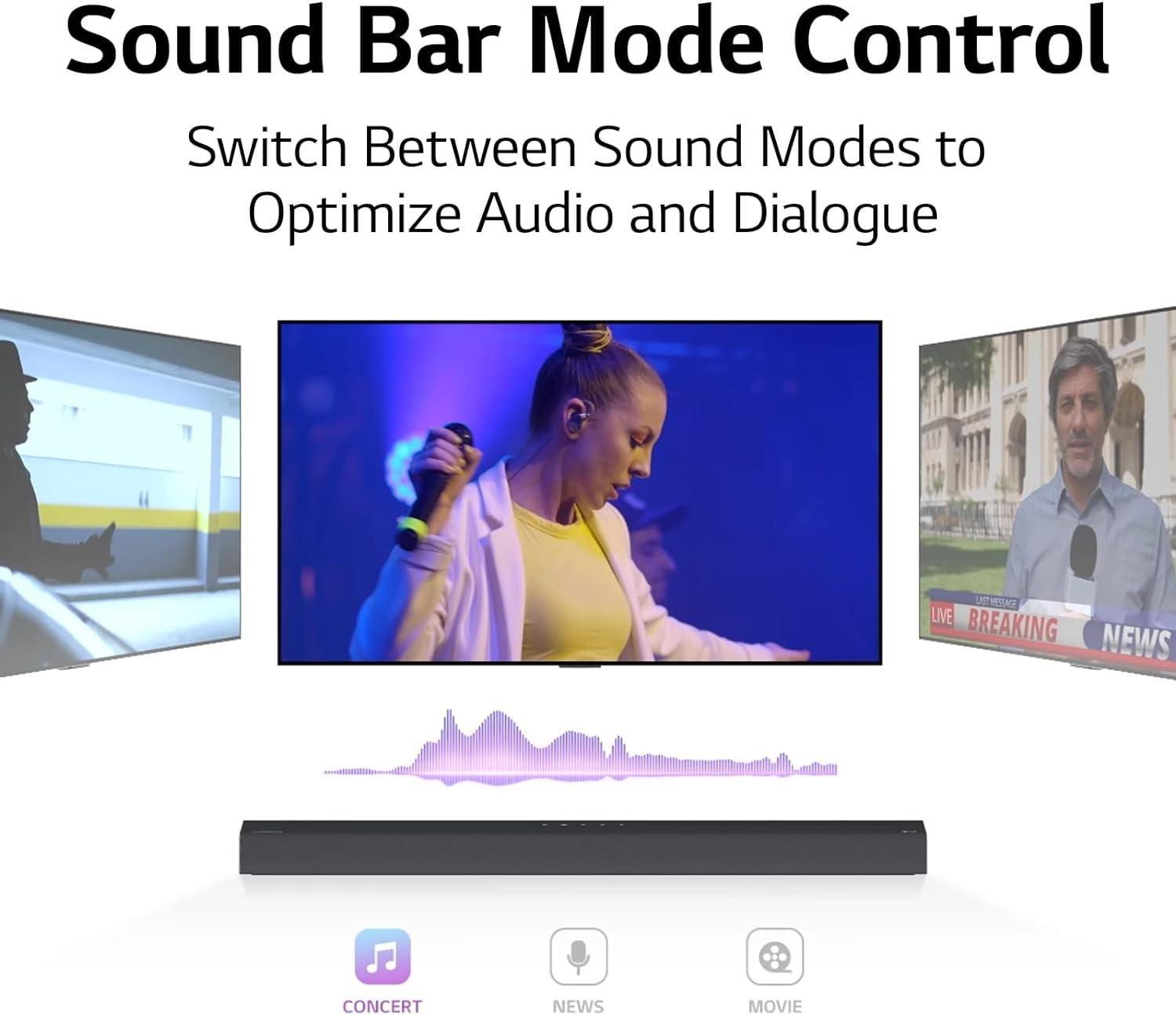

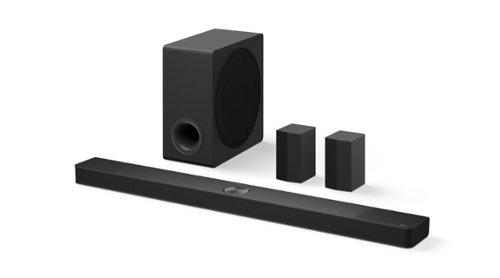
The soundbar market has exploded in recent years, transforming from simple TV speaker replacements into sophisticated home theater systems that promise cinematic audio without the complexity of traditional surround sound setups. But with options ranging from budget-friendly systems to premium powerhouses, choosing the right one can feel overwhelming.
Today we're diving deep into two dramatically different approaches to surround sound: the Ultimea Poseidon D70, a budget-conscious 7.1 system that punches well above its weight class, and the LG S90TR, a premium 7.1.3 system that brings genuine Dolby Atmos to your living room. At the time of writing, these systems are separated by roughly $1,000 in price, but that gap tells only part of the story.
Before we compare these specific models, it's crucial to understand what separates good soundbars from great ones. The most important factor is channel configuration—those numbers like "7.1" or "7.1.3" that manufacturers love to throw around. The first number represents main channels (front left, center, front right, plus side and rear speakers), the second is dedicated subwoofer channels, and that third number? That's where things get interesting.
The ".3" in the LG S90TR's 7.1.3 configuration represents three height channels—upward-firing drivers that bounce sound off your ceiling to create the illusion of audio coming from above. This is essential for Dolby Atmos, an audio format that treats sounds as "objects" that can be precisely positioned in three-dimensional space rather than just assigned to specific channels.
Power output matters significantly, but it's often misunderstood. Many manufacturers advertise "peak" power—the maximum wattage the system can handle for brief moments. What actually matters for daily use is RMS (Root Mean Square) power, which represents the continuous power output the system can maintain without distortion. This distinction becomes crucial when comparing our two contenders.
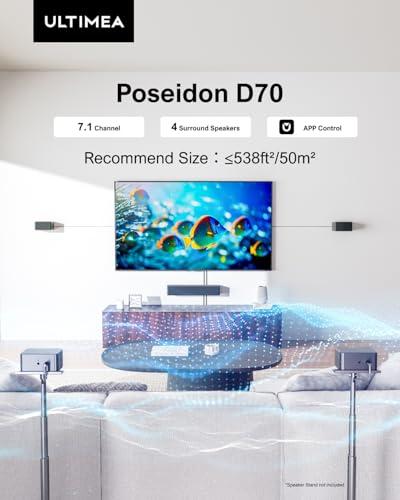
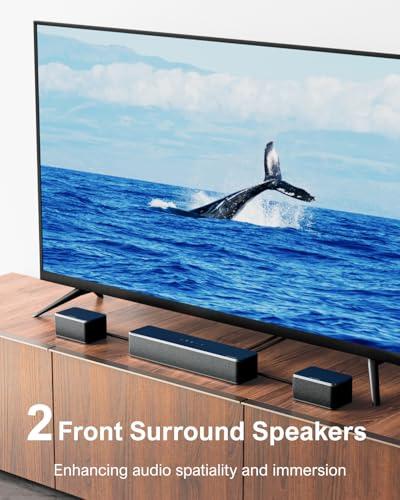
Released in 2024, the Ultimea Poseidon D70 represents something genuinely unusual in the budget soundbar space: a true 7.1 system with four physical surround speakers. Most competitors at this price point rely entirely on digital processing to simulate surround effects—a technique called virtualization that works reasonably well but can't match the precision of actual speakers positioned around your listening area.
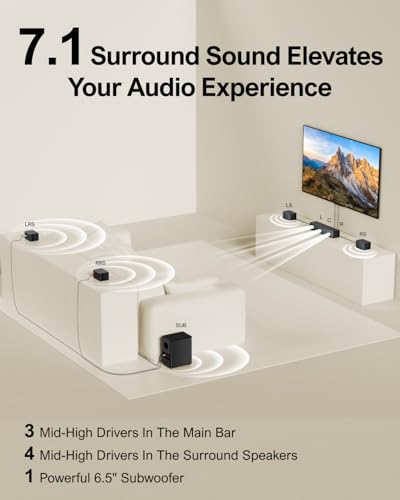
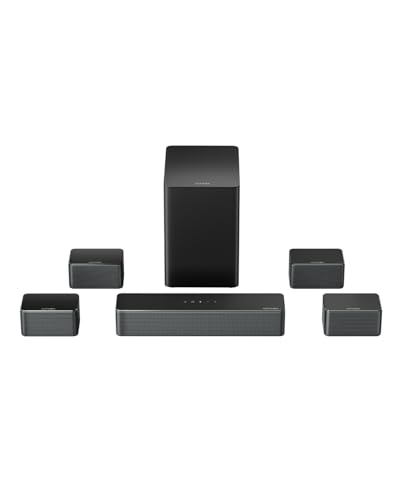
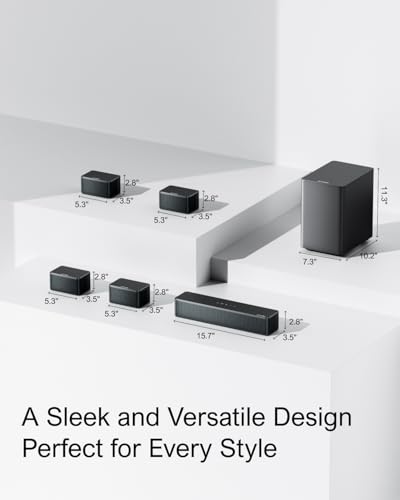
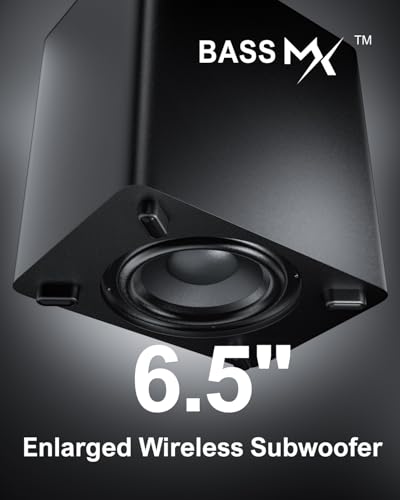
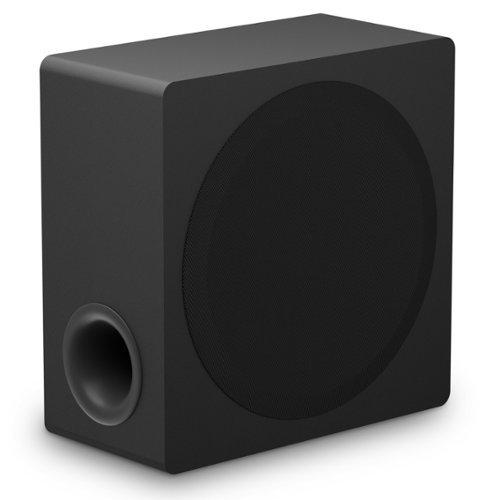
The D70's setup includes a compact 15.7-inch soundbar housing three drivers, four small satellite speakers that wire to the system, and a 6.5-inch wireless subwoofer. That wireless subwoofer connection is particularly smart—it eliminates the need for a power cable running across your room while still maintaining the reliability of a dedicated connection.
The system's proprietary technologies deserve attention. BassMX™ Technology enhances low-frequency response through digital signal processing, essentially analyzing incoming audio and boosting specific frequency ranges to create more impactful bass. SurroundX™ Technology handles the spatial audio processing, using algorithms to create convincing directional effects even with non-surround source material.
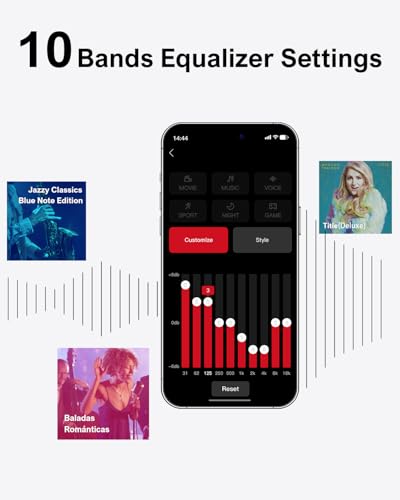
Perhaps most impressively, the Ultimea includes 121 preset EQ matrices—pre-configured audio profiles optimized for different content types and listening preferences. Combined with a 10-band manual equalizer accessible through their smartphone app, this gives users unprecedented control over their audio experience at this price point.
With 410W peak power but only 144W RMS, the Poseidon D70 delivers adequate volume for most living rooms while maintaining reasonable clarity. The 6.5-inch subwoofer handles bass duties down to 35Hz—not quite the earth-shaking low-end of premium systems, but certainly respectable for music and most movie content.
The four satellite speakers, each measuring just over 5 inches wide, won't match the fidelity of larger, more expensive drivers. However, they provide something invaluable: actual directional audio cues. When a car crashes behind you in a movie, you'll genuinely hear it from behind rather than relying on your brain to interpret processed audio signals.
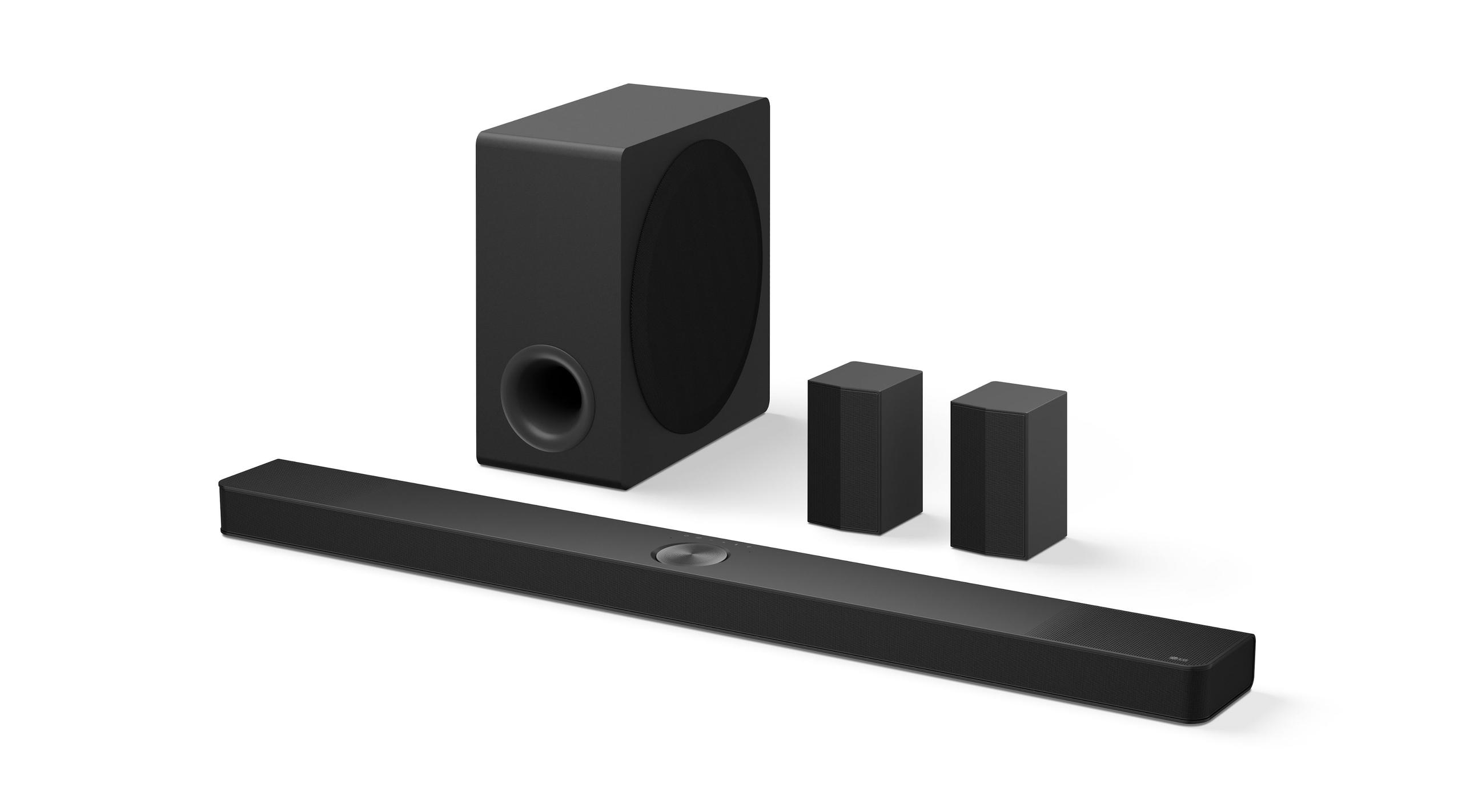
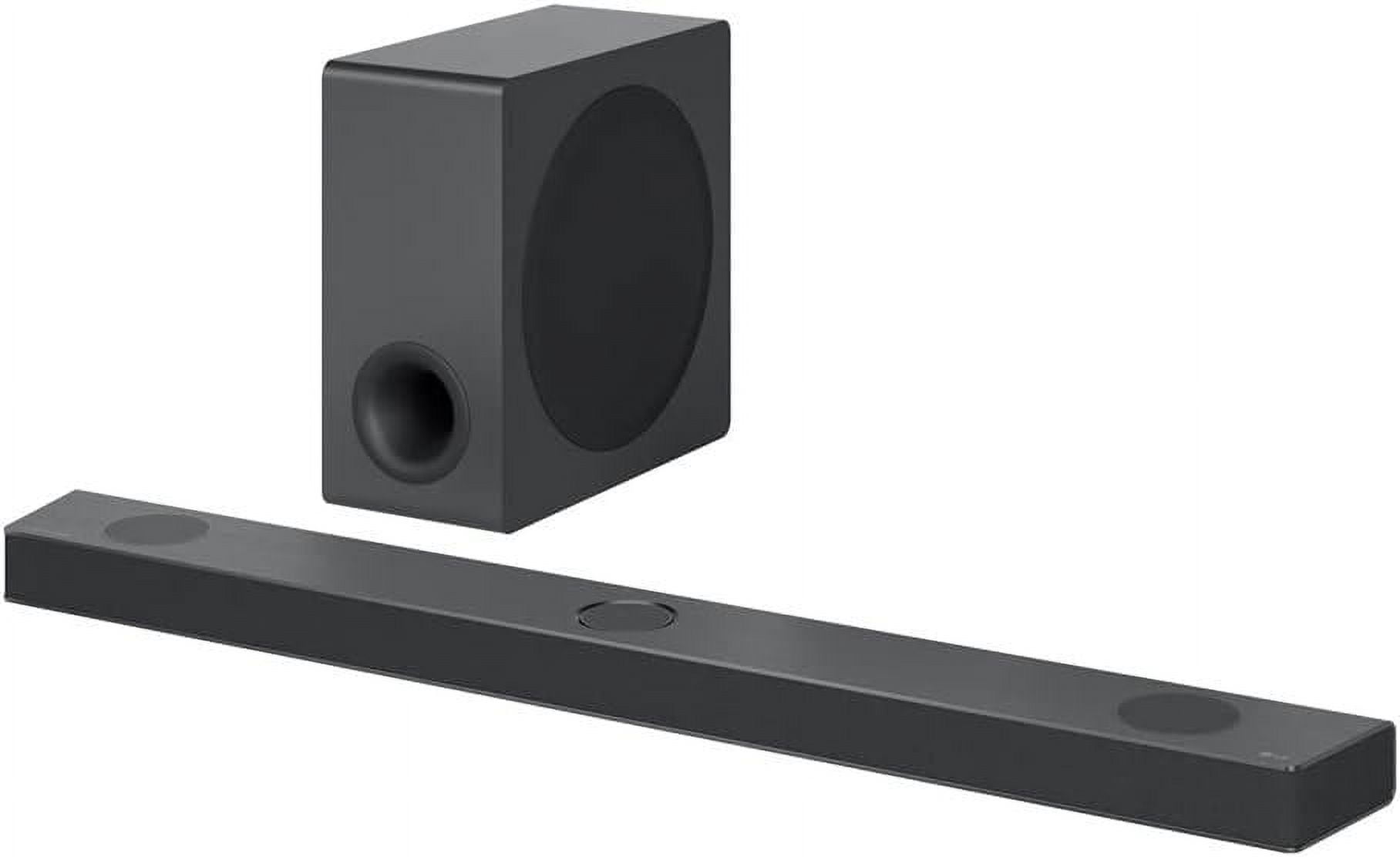
LG released the S90TR in 2024 as part of their strategy to bring flagship features down to mid-range pricing. This 7.1.3 system represents a completely different philosophy—instead of maximizing hardware at a budget price point, LG focused on delivering the full modern home theater experience with genuine Dolby Atmos support.
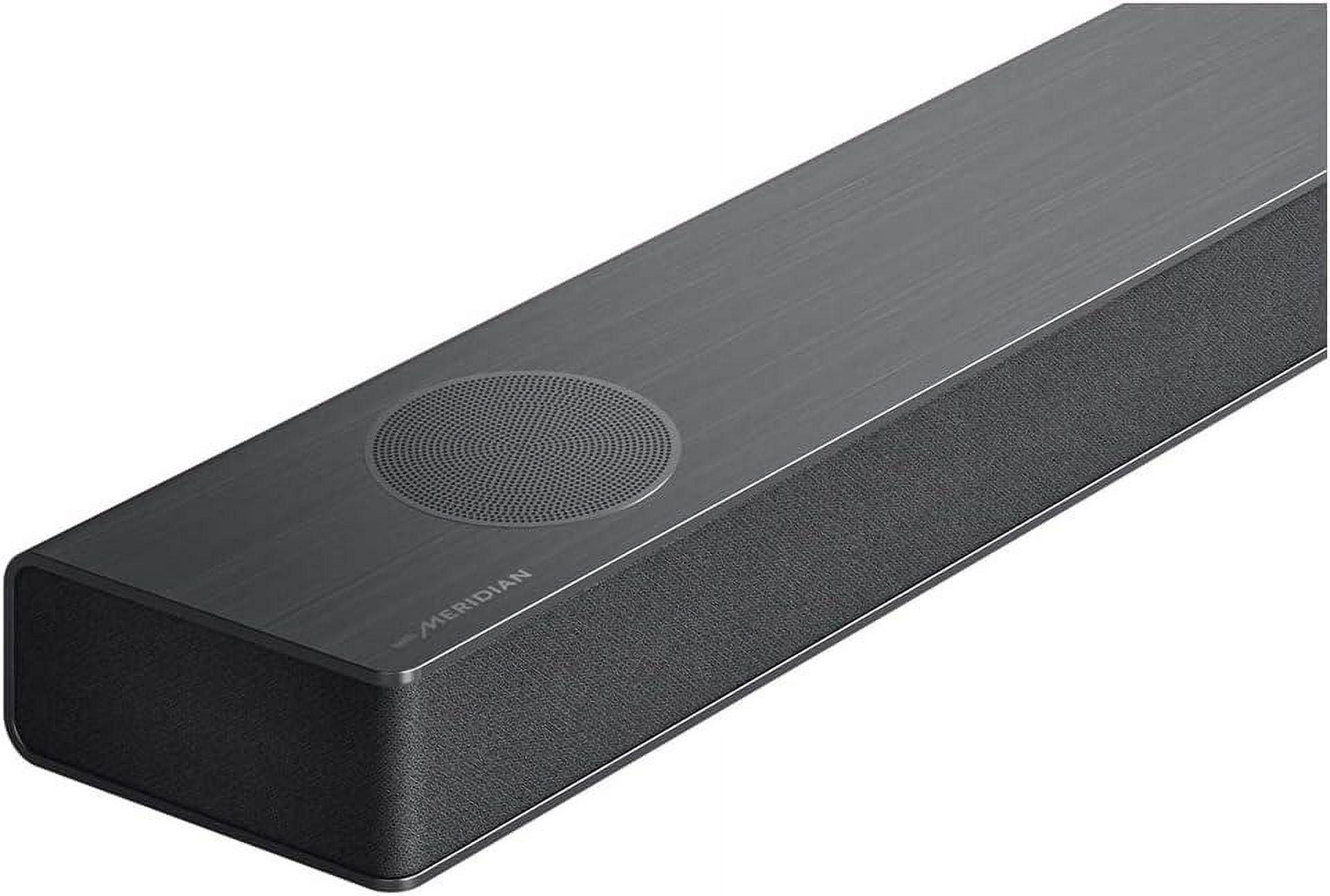
The S90TR's most significant advantage lies in those three height channels. Unlike the Ultimea's virtualized approach, the LG system includes actual upward-firing drivers that physically project sound toward your ceiling. When properly calibrated, this creates convincing overhead effects—helicopters genuinely sound like they're flying above you, rain seems to fall from the sky, and action sequences gain a three-dimensional quality that traditional surround sound simply cannot match.
AI Room Calibration represents another major technological leap. The LG system uses built-in microphones to play test tones and analyze how your room's acoustics affect audio reproduction. It then automatically adjusts frequency response to compensate for reflective surfaces, room size, and furniture placement. This is similar to technology found in high-end car audio systems and professional recording studios—the fact that it's now available in consumer soundbars represents a significant advancement.
WOW Orchestra technology allows the S90TR to coordinate with compatible LG TVs, essentially using your TV's built-in speakers as additional channels in the surround array. This creates an even wider soundstage and can help fill acoustic gaps in larger rooms.
The LG system delivers 670W total power output—nearly five times the Ultimea's RMS rating. This isn't just about getting louder; it's about maintaining audio quality at higher volumes and handling the dynamic range that modern content demands. When a movie transitions from whispered dialogue to explosive action, the S90TR has the headroom to reproduce both cleanly.
The system supports high-resolution audio up to 24-bit/96kHz with automatic upsampling for lower-quality sources. This means even compressed Spotify streams get enhanced through sophisticated digital processing, though the improvements become more noticeable with higher-quality source material.
For modern streaming content from Netflix, Disney+, and Amazon Prime, the LG S90TR holds a decisive advantage. These services increasingly offer Dolby Atmos soundtracks that the Ultimea system simply cannot reproduce properly. You'll still get excellent traditional surround sound from the D70, but you're missing the vertical dimension that filmmakers specifically designed into their audio mixes.
However, for older movies and TV shows without Atmos soundtracks, the gap narrows considerably. The Ultimea's four physical surround speakers often create more convincing spatial effects than budget soundbars that rely entirely on virtualization, even if they can't match the LG's overall refinement.
Both systems handle music well, but with different strengths. The LG S90TR benefits from its AI calibration, which typically results in a more balanced, neutral sound signature that works well across different musical genres. The system's higher power output also means better control over dynamic passages in classical music or the sudden impact of electronic music.
The Ultimea Poseidon D70 takes a more hands-on approach, offering extensive EQ customization that lets users tailor the sound to their preferences. If you enjoy tweaking audio settings and have strong opinions about how music should sound, this flexibility can be more valuable than the LG's automated optimization.
For gaming, both systems offer advantages depending on your priorities. The LG S90TR supports 4K/120Hz passthrough with low latency, making it ideal for next-generation consoles like the PlayStation 5 and Xbox Series X. The Dolby Atmos support also enhances games that utilize spatial audio for competitive advantages.
The Ultimea system's physical surround speakers excel at providing precise directional audio cues crucial for competitive gaming. In first-person shooters, being able to accurately locate enemy footsteps or gunfire can mean the difference between victory and defeat.
Room size significantly affects which system makes more sense. In smaller spaces under 300 square feet, the Ultimea D70 provides excellent coverage without overwhelming the room. Its compact components also fit better aesthetically with smaller TVs.
For larger rooms over 400 square feet, the S90TR's extra power becomes essential. The system maintains clarity and impact at volumes that would cause the Ultimea to strain or distort. The larger soundbar also matches better with 65-inch and larger TVs from a visual proportion standpoint.
The Ultimea D70 specifies frequency response from 35Hz to 18kHz. That 35Hz lower limit means it reproduces most bass content well—typical male voices bottom out around 85Hz, while movie explosions and electronic music can extend down to 20Hz or lower. The 18kHz upper limit covers most audible content, though some people can hear frequencies up to 20kHz.
The LG S90TR doesn't publish detailed frequency specifications, but our research suggests similar bass extension with potentially better high-frequency response due to its more sophisticated drivers and processing.
Both systems include HDMI ARC (Audio Return Channel), which allows your TV to send audio back to the soundbar through the same HDMI cable used for video. The LG system supports the newer eARC (Enhanced Audio Return Channel) standard, which can handle higher-quality audio formats and provides more reliable communication between devices.
Wi-Fi connectivity in the S90TR enables features like direct streaming from music services and automatic firmware updates. The Ultimea system relies on Bluetooth and app-based control, which works well but lacks some of the convenience features.
Based on our evaluation of user reviews and expert opinions, both systems generally perform reliably with minimal technical issues. The Ultimea D70 occasionally experiences connectivity hiccups between the app and soundbar, but these are typically resolved by restarting the connection.
The LG S90TR benefits from a more established support network and regular firmware updates that add features and fix compatibility issues. LG's customer service also has a better reputation for handling warranty claims and technical support.
The Ultimea system requires more physical setup due to its wired surround speakers, but the color-coded cables and clear labeling make the process straightforward for most users. The wireless subwoofer pairs automatically, and the mobile app guides users through basic configuration.
The LG S90TR offers a more streamlined installation experience. The AI calibration process takes about five minutes and automatically optimizes the system for your room. All speakers connect wirelessly, though this means ensuring adequate power outlets for each component.
You're working with a limited budget but refuse to compromise on having actual surround speakers. The D70 delivers genuine 7.1 audio at a price point where most competitors offer only virtual surround processing. It's particularly appealing if you enjoy customizing your audio experience and don't mind spending time with EQ adjustments.
The system works best in smaller to medium-sized rooms with TVs under 65 inches. If you primarily watch older movies, cable TV, or streaming content without Atmos soundtracks, you won't miss the height channels. Gamers who prioritize directional audio cues over cutting-edge format support will also appreciate the four physical surround speakers.
You want the complete modern home theater experience with genuine Dolby Atmos support. The S90TR justifies its premium pricing through significantly more power, sophisticated room calibration, and support for the latest audio formats.
It's particularly valuable in larger rooms over 400 square feet where the extra power becomes necessary. If you have a 65-inch or larger TV, the LG system's proportional sizing will look much better. Users who prefer "set it and forget it" simplicity will appreciate the AI calibration over manual tweaking.
The system also makes sense if you're investing in a long-term setup. With regular firmware updates and support for emerging audio standards, the S90TR offers better future-proofing.
These two systems represent fundamentally different approaches to home audio, and both succeed within their respective market segments. The Ultimea Poseidon D70 proves that impressive surround sound doesn't require a massive investment—it's a legitimately good audio system that happens to be affordable rather than a cheap system trying to sound expensive.
The LG S90TR delivers on the promise of modern home theater audio with genuine Dolby Atmos support and sophisticated room optimization. It represents what soundbars can achieve when manufacturers focus on performance over profit margins.
At the time of writing, the price difference between these systems is substantial—roughly five times more for the LG. Whether that premium is justified depends entirely on your priorities, room size, and how much you value cutting-edge audio technology over raw value.
For most users upgrading from TV speakers, either system will provide a transformative improvement. The choice comes down to whether you want excellent audio at an incredible price or the full modern home theater experience with all the latest technological advances. Both approaches have merit, and both products execute their respective visions exceptionally well.
| Ultimea Poseidon D70 | LG S90TR |
|---|---|
| Channel Configuration - Determines surround sound capability and modern format support | |
| 7.1 channels (no height channels for Dolby Atmos) | 7.1.3 channels (3 dedicated height channels for true Dolby Atmos) |
| Total Power Output - Critical for room filling capability and dynamic range | |
| 144W RMS / 410W peak (adequate for small-medium rooms) | 670W total system power (excellent for large rooms and high volumes) |
| Physical Speaker Setup - Affects installation complexity and audio precision | |
| 4 wired surround speakers + wireless subwoofer | All wireless components (soundbar, subwoofer, rear speakers) |
| Audio Format Support - Determines compatibility with modern streaming content | |
| Traditional surround formats, no Dolby Atmos support | Full Dolby Atmos, DTS:X, and high-resolution audio up to 24-bit/96kHz |
| Room Calibration - How the system optimizes sound for your space | |
| Manual EQ with 121 presets + 10-band equalizer | AI Room Calibration automatically tunes to your room's acoustics |
| Soundbar Size - Must match your TV size for proper aesthetics | |
| Compact 15.7" wide (ideal for TVs under 55") | Large 49.2" wide (designed for 65"+ TVs) |
| Subwoofer Specifications - Determines bass depth and impact | |
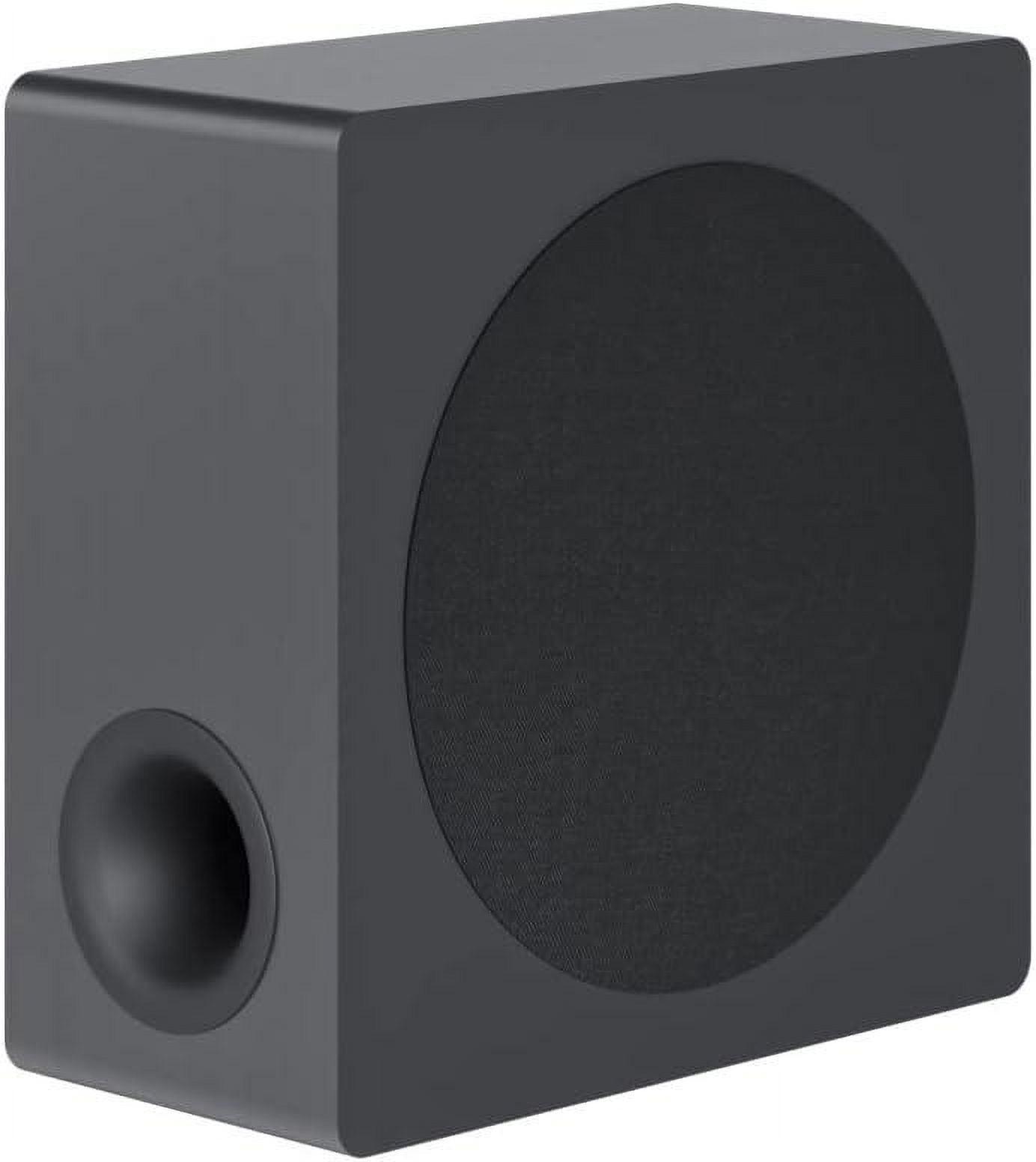
| 6.5" driver, 60W power, 35Hz frequency response | Larger driver with 220W dedicated power for deeper bass |
| Connectivity Options - Affects device compatibility and future-proofing | |
| HDMI ARC, Optical, Bluetooth, USB, AUX | HDMI eARC, Wi-Fi, Bluetooth 5.1, 4K/120Hz passthrough |
| Smart Features - Convenience and integration capabilities | |
| Ultimea smartphone app for EQ and control | WOW Orchestra TV integration, streaming service support, voice feedback |
| Total System Weight - Impacts installation difficulty and build quality | |
| 17.2 lbs (easier handling and wall mounting) | 39.6 lbs (premium build quality, requires sturdy mounting) |
| Best Use Case - Who should choose this system | |
| Budget-conscious users wanting true 7.1 surround in smaller rooms | Home theater enthusiasts with large rooms prioritizing Dolby Atmos |
The biggest difference is Dolby Atmos support. The LG S90TR features a 7.1.3 channel configuration with dedicated height channels that create overhead sound effects, while the Ultimea Poseidon D70 offers 7.1 channels without height capabilities. The LG S90TR also delivers significantly more power at 670W compared to the Ultimea D70's 144W RMS output.
The Ultimea Poseidon D70 is better suited for smaller rooms. Its compact 15.7-inch soundbar pairs well with TVs under 55 inches and provides adequate power for spaces under 300 square feet. The LG S90TR is designed for larger rooms with its 49.2-inch width matching 65-inch or larger TVs.
No, only the LG S90TR supports true Dolby Atmos with its three dedicated height channels. The Ultimea Poseidon D70 cannot reproduce Dolby Atmos content and relies on virtual surround processing instead. If you watch Netflix, Disney+, or other streaming services with Atmos content, the LG S90TR is essential.
The LG S90TR delivers superior bass performance with its larger subwoofer and 220W dedicated bass power. The Ultimea D70 includes a respectable 6.5-inch wireless subwoofer with BassMX technology, but it cannot match the depth and impact of the LG system in larger rooms.
The LG S90TR features completely wireless rear speakers that connect without any cables. The Ultimea Poseidon D70 uses four wired surround speakers that connect to the subwoofer, requiring cable management but ensuring reliable connections.
The LG S90TR offers easier setup with AI Room Calibration that automatically optimizes sound for your space and wireless connections for all components. The Ultimea D70 requires running speaker wires and manual EQ adjustment, though it includes color-coded cables and clear instructions.
Yes, both systems work with gaming consoles. The LG S90TR supports 4K/120Hz passthrough for next-gen consoles and offers Dolby Atmos gaming audio. The Ultimea Poseidon D70 provides excellent directional audio cues for competitive gaming through its four physical surround speakers.
The Ultimea Poseidon D70 provides more manual customization with 121 preset EQ matrices and a 10-band equalizer accessible through their smartphone app. The LG S90TR focuses on automated optimization through AI calibration but offers fewer manual adjustment options.
For most living rooms, the Ultimea D70's 144W RMS is adequate for clear dialogue and moderate volumes. The LG S90TR's 670W total power becomes necessary for larger rooms over 400 square feet, reference-level volumes, and maintaining clarity during dynamic movie scenes.
Both excel at music but differently. The LG S90TR offers balanced, neutral sound through AI calibration that works well across genres. The Ultimea Poseidon D70 provides extensive EQ customization for users who prefer tailoring sound to their musical preferences.
The Ultimea Poseidon D70 includes standard wall mounting hardware and weighs only 17.2 pounds total, making installation straightforward. The LG S90TR weighs 39.6 pounds and requires sturdy mounting due to its larger size, but includes necessary hardware.
For dedicated home theater use, the LG S90TR justifies its premium price through genuine Dolby Atmos support, AI room optimization, and power suitable for larger spaces. The Ultimea Poseidon D70 offers exceptional value for casual users wanting true surround sound without the height channels, making it ideal for upgrading from TV speakers on a budget.
We've done our best to create useful and informative comparisons to help you decide what product to buy. Our research uses advanced automated methods to create this comparison and perfection is not possible - please contact us for corrections or questions. These are the sites we've researched in the creation of this article: ultimea.com - provantage.com - ultimea.com - youtube.com - youtube.com - bestbuy.com - the-gadgeteer.com - shopmyexchange.com - youtube.com - youtube.com - youtube.com - ultimea.com - manuals.plus - device.report - images.thdstatic.com - shopmyexchange.com - staples.com - ultimea.de - rtings.com - abt.com - youtube.com - bestbuy.com - microcenter.com - buydig.com - bestbuy.com - videoandaudiocenter.com - oceanstateappliance.com - youtube.com - avsforum.com - lg.com

Privacy Policy
Terms and Conditions - Affiliate Policy
Home Security
© Copyright 2008-2026.
11816 Inwood Rd #1211, Dallas, TX 75244