






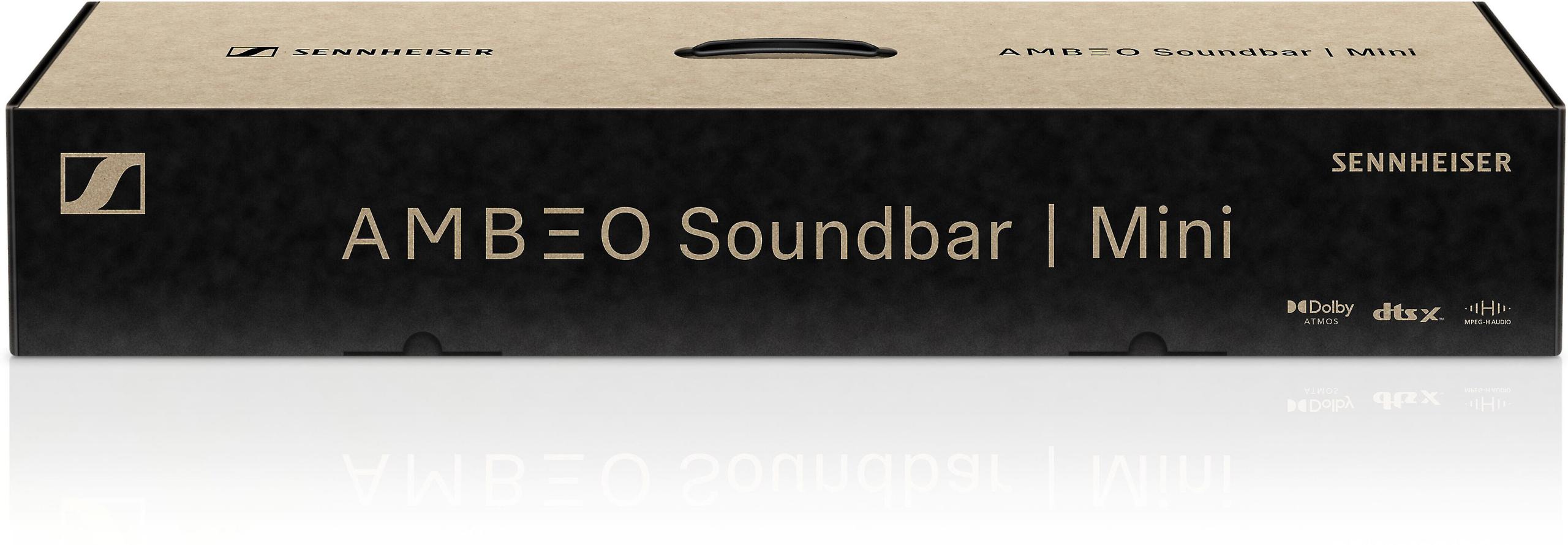
When you're shopping for a soundbar to transform your living room into a home theater, you'll quickly discover there are two completely different philosophies battling for your attention. Some systems like the Ultimea Poseidon D70 believe in the old-school approach: if you want surround sound, you need actual speakers surrounding you. Others, like the Sennheiser AMBEO Mini, are convinced they can trick your brain into hearing speakers that aren't there through sophisticated audio wizardry.
Both approaches have their merits, but they deliver fundamentally different experiences. After diving deep into user reviews, professional evaluations, and technical specifications, we've found that choosing between these systems comes down to understanding what each does well—and what trade-offs you're willing to accept.
The soundbar market has evolved dramatically since both of these systems launched in recent years. The Ultimea Poseidon D70 represents the "more speakers equals better sound" philosophy that dominated home theater for decades. When it arrived, it offered something increasingly rare: true 7.1 surround sound without requiring a complicated AV receiver setup.
The Sennheiser AMBEO Mini, released in 2023, took the opposite approach. Sennheiser, working with Germany's Fraunhofer Institute (the same research organization that helped develop the MP3 format), created what they call "AMBEO 3D" technology. This system uses psychoacoustics—essentially the science of how your brain processes sound—to create the illusion of speakers positioned around and above you.
Psychoacoustics is the study of how we perceive sound. Your brain uses tiny timing differences and volume variations between your ears to determine where sounds come from. Virtual surround systems exploit this by precisely controlling how sound reaches each ear, making you think a helicopter is flying overhead when it's really just clever speaker placement and signal processing.
The key difference? The Poseidon D70 physically places sound where it should be, while the AMBEO Mini convinces your brain that's where it's coming from.
Let's start with the most fundamental question: which system creates a more convincing surround sound experience?
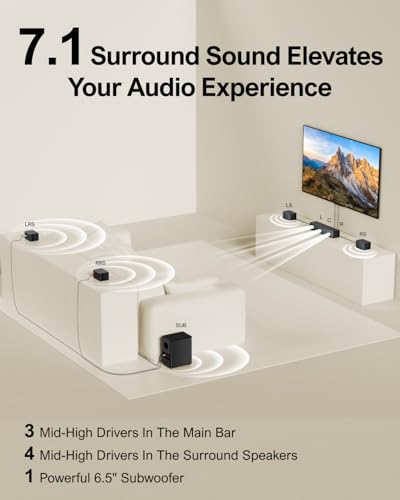
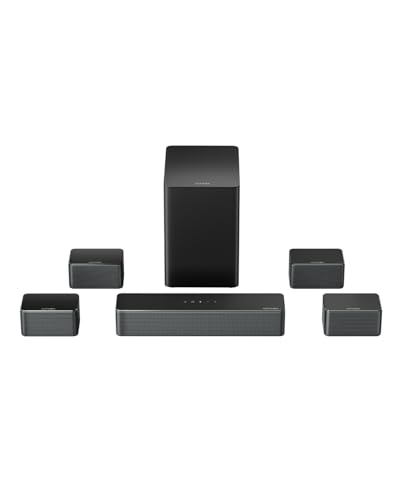
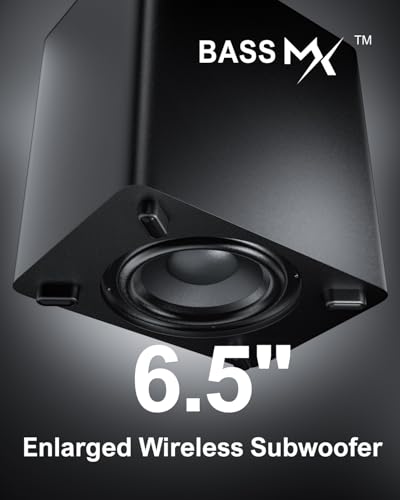
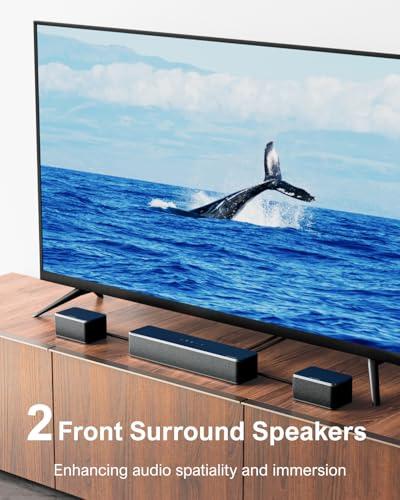
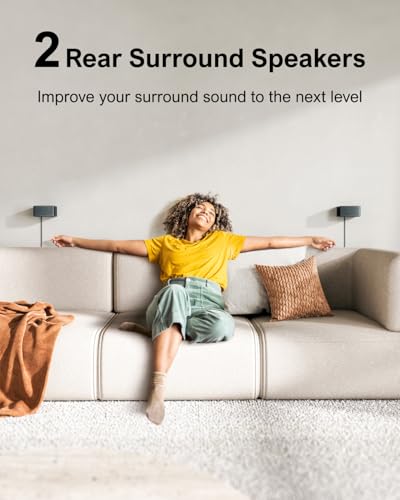
The Ultimea Poseidon D70 doesn't mess around. It gives you eight actual speakers: a three-driver soundbar for the front channels, four separate satellite speakers that you position around your seating area, and a 6.5-inch wireless subwoofer. When an explosion happens behind the main character in a movie, you literally hear it from speakers placed behind you. There's no trickery involved—the sound is physically coming from that direction.
Each satellite speaker houses a 2.25-inch driver, which isn't huge but proves surprisingly capable in practice. User reviews consistently highlight how these physical surrounds create genuine directional effects that you can pinpoint with your eyes closed. When a car races from left to right across the screen, you hear it travel through actual speakers positioned left to right in your room.
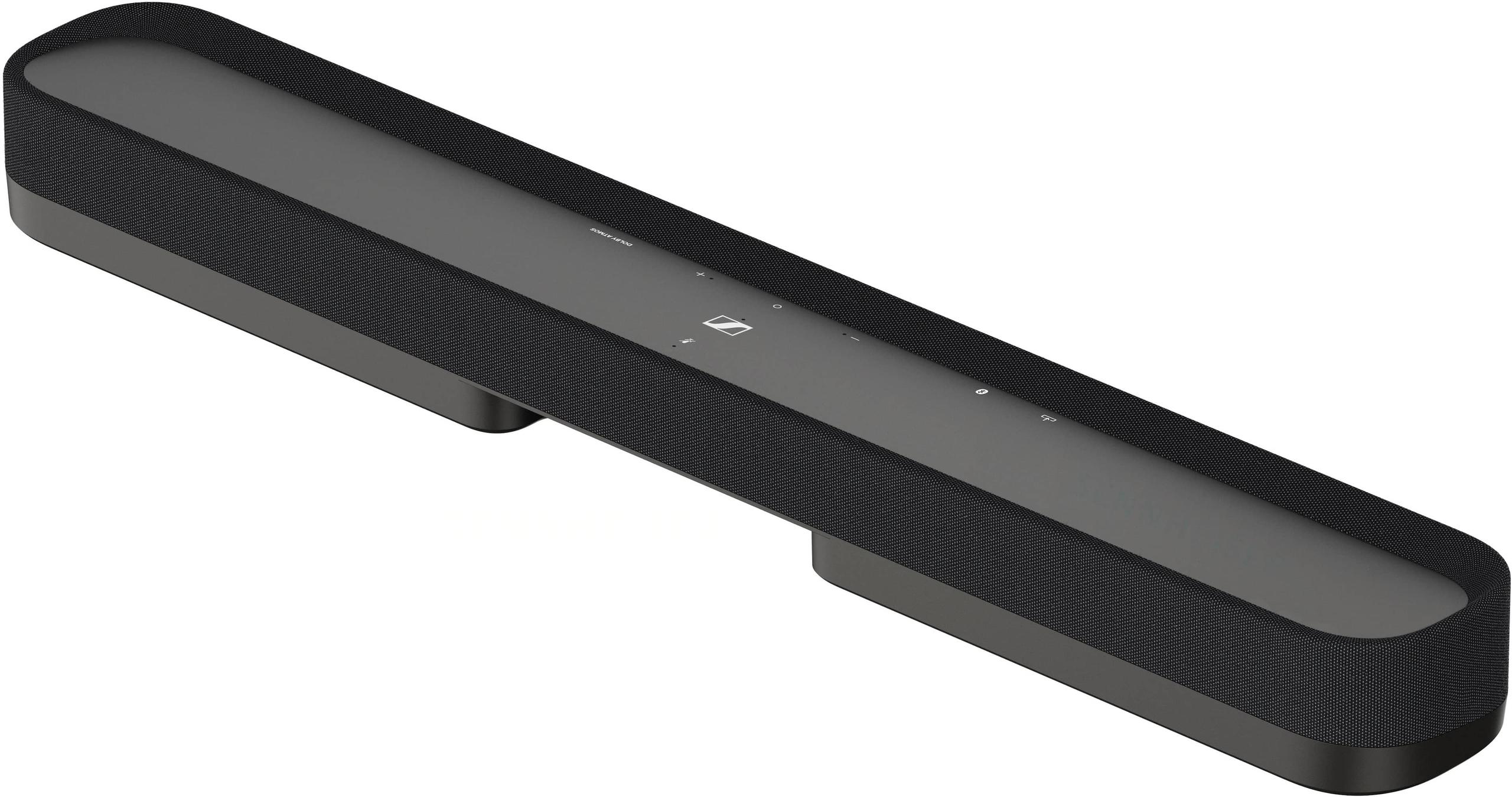
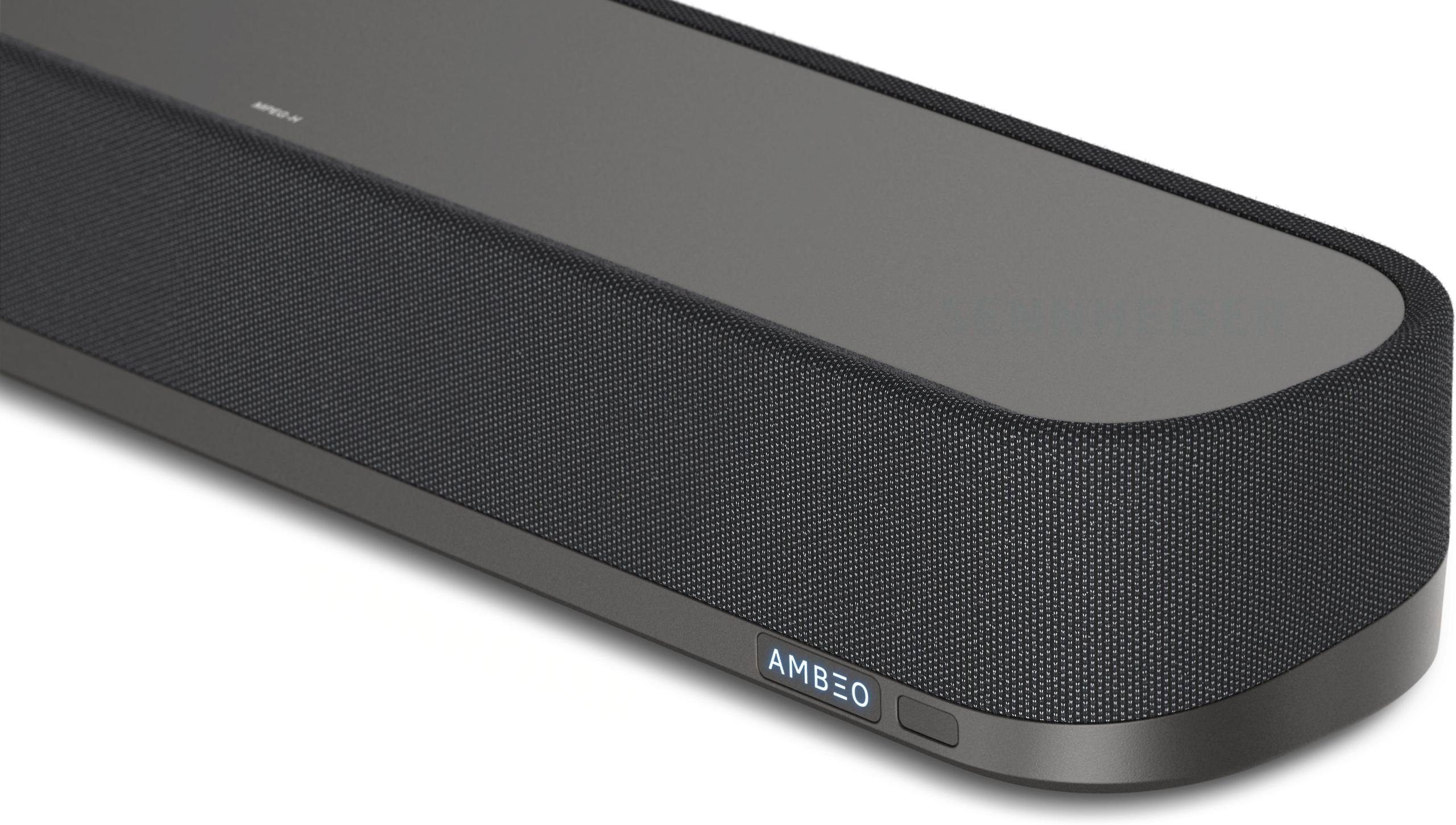
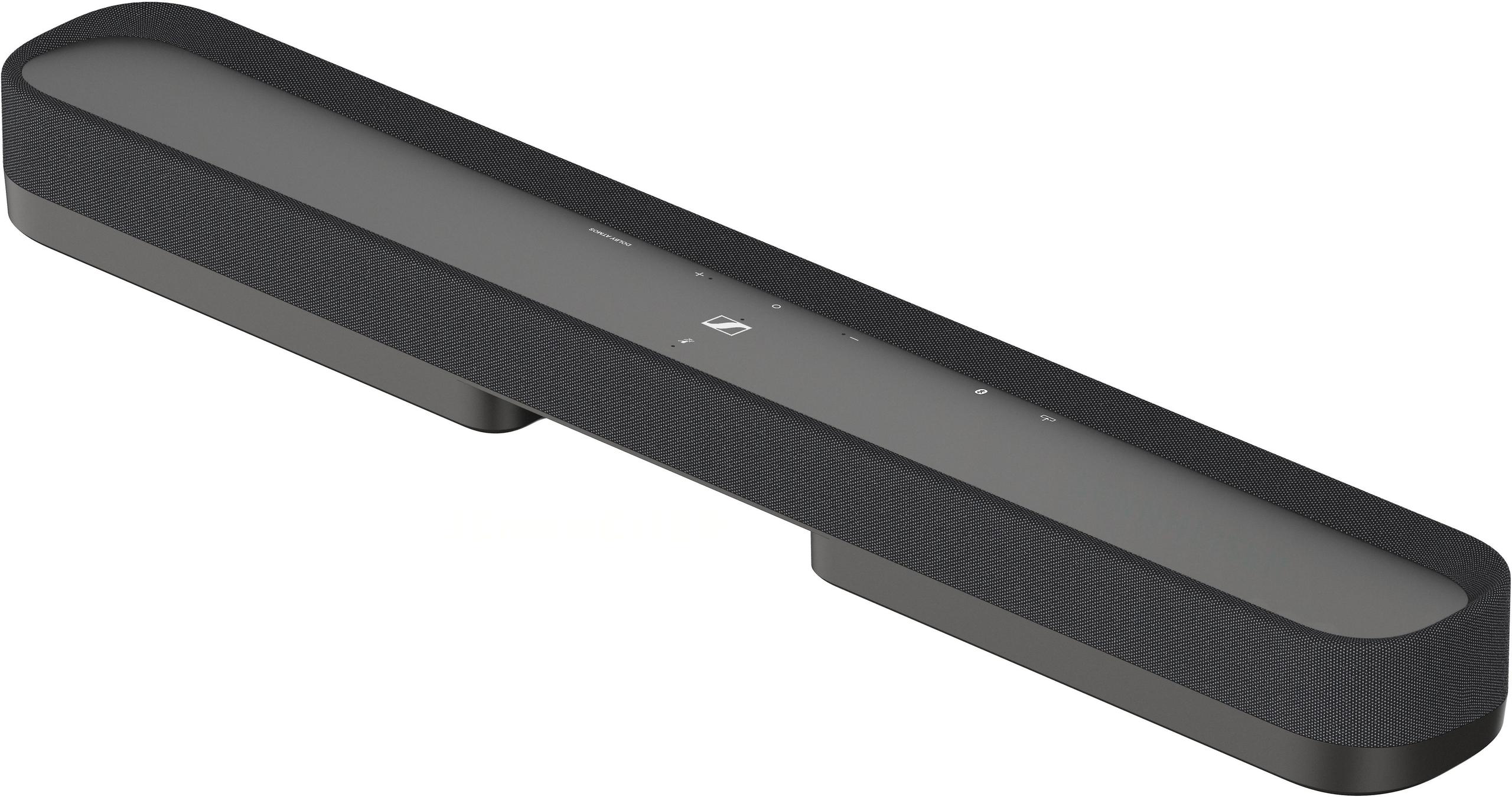
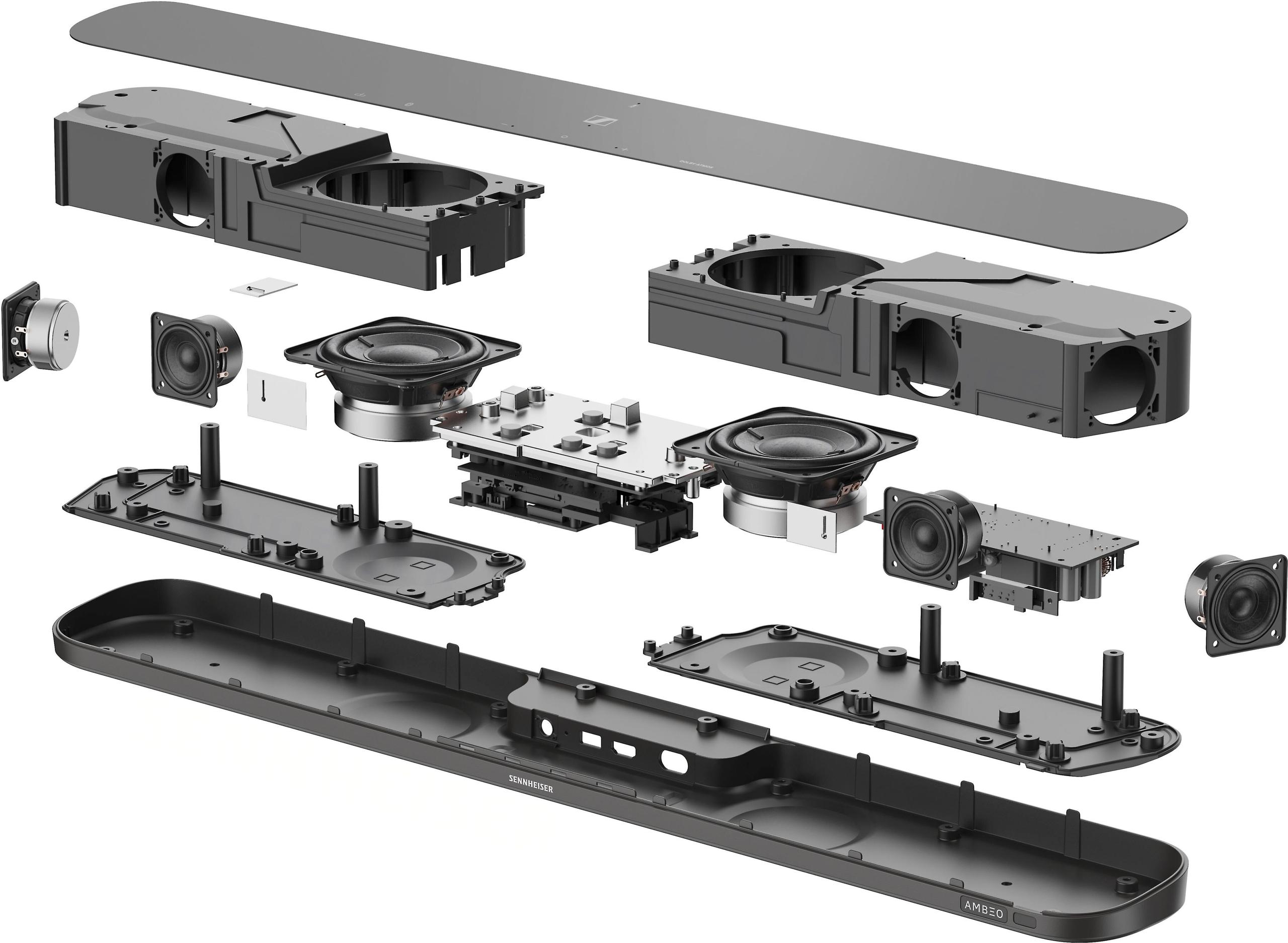
The Sennheiser AMBEO Mini takes a radically different approach with its six-driver array crammed into a single 27.5-inch bar. Two 4-inch drivers fire upward toward your ceiling, two 1.6-inch drivers fire forward, and two more 1.6-inch drivers fire sideways. The magic happens through AMBEO 3D processing, which analyzes your room's acoustics using built-in microphones, then precisely controls how sound reflects off your walls and ceiling.
Here's where it gets interesting: while the AMBEO Mini can't physically place sound behind you like the D70 can, it excels at creating height effects that the Ultimea system simply cannot match. Those upward-firing drivers bounce sound off your ceiling to simulate speakers mounted above your head—crucial for modern Dolby Atmos content.
Dolby Atmos adds a third dimension to surround sound by including height channels. Instead of just having sound come from around you (like traditional 5.1 or 7.1), Atmos places sounds above you too. Think raindrops falling, helicopters flying overhead, or debris falling from an explosion.
Based on our research across professional reviews and user feedback, the D70 wins for authentic left-right and front-rear positioning, especially in larger rooms. However, the AMBEO Mini delivers superior height effects and works better with modern streaming content that includes Atmos encoding.
Bass response reveals another fascinating contrast between these philosophies. The Poseidon D70 dedicates a separate 6.5-inch wireless subwoofer exclusively to low frequencies. This driver can move significantly more air than anything built into a compact soundbar, and having it separate from the main unit means you can position it optimally in your room—usually in a corner where bass naturally amplifies.
The system's BassMX technology lets you manually adjust bass levels beyond simple volume control, essentially providing dedicated low-frequency EQ. Users report that this subwoofer delivers satisfying thump for action movies and enough depth for music listening, though some note the lack of a protective grille makes the exposed driver vulnerable to accidental damage.
What's impressive about the AMBEO Mini is how much bass it generates from just two 4-inch drivers built into the soundbar itself. Despite being significantly smaller than the D70's dedicated subwoofer, the AMBEO achieves bass extension down to 43Hz—actually deeper than the D70's 65Hz specification. This seems counterintuitive until you understand that Sennheiser uses dedicated Class D amplification for each driver, meaning every speaker gets its own optimized power supply rather than sharing amplification.
Class D amplification is a highly efficient amplifier design that generates less heat and provides more precise control over each driver. Traditional amplifiers waste energy as heat; Class D designs convert over 90% of electrical power into acoustic output.
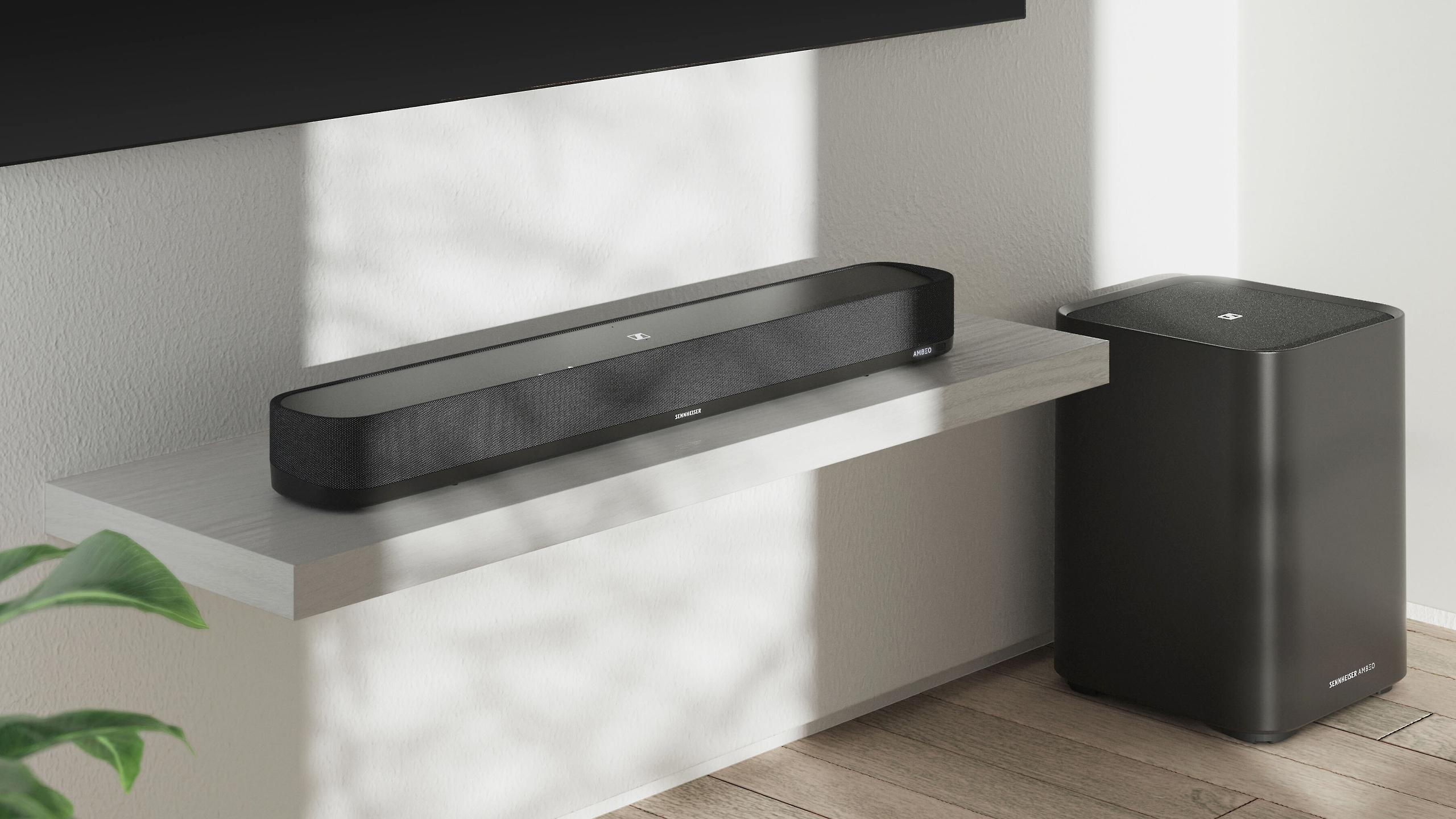
For most living rooms, the AMBEO Mini's integrated bass proves surprisingly adequate. However, Sennheiser offers an optional wireless subwoofer that can be added later, and the system supports up to four subwoofers for those who want house-shaking low-end. The D70 has no such upgrade path—what you get initially is what you're stuck with.
In typical home theater use, the D70 provides more immediate bass impact, while the AMBEO Mini offers more refined low-frequency reproduction with room to grow.
This is where the age difference between these systems becomes critical. The Ultimea Poseidon D70 was designed before Dolby Atmos became standard on streaming services and 4K Blu-rays. It supports traditional 7.1 surround sound processing but cannot decode height channels or modern spatial audio formats.
The Sennheiser AMBEO Mini, launching in 2023, was built specifically for the streaming era. It supports Dolby Atmos, DTS:X (another height-channel format), MPEG-H (used in some broadcast applications), and even 360 Reality Audio from streaming services like Tidal and Amazon Music.
360 Reality Audio is Sony's spatial audio format that places individual instruments and vocals in 3D space around you. Instead of traditional left/right stereo mixing, artists can position sounds anywhere in a sphere around your head.
This format support difference has real-world implications. When you watch Netflix, Disney+, or Amazon Prime Video, much of their premium content now includes Atmos soundtracks. The AMBEO Mini can decode and reproduce these height effects, while the D70 downmixes everything to traditional surround channels.
However, there's a caveat: if most of your content comes from cable TV, DVDs, or older streaming services, you won't miss Atmos support. The D70's traditional surround processing often sounds more expansive than the AMBEO Mini's virtualization on non-Atmos content, particularly in larger rooms.
Amplifier specifications can be misleading, so let's dig into what these numbers actually mean for your listening experience. The Ultimea Poseidon D70 claims 410 watts peak power across its eight drivers, with 144 watts RMS (continuous power). The Sennheiser AMBEO Mini outputs 250 watts RMS through six dedicated amplifiers.
RMS (Root Mean Square) power represents the continuous power an amplifier can deliver, while peak power is the maximum instantaneous output. RMS provides a more realistic picture of sustained performance, which is why the AMBEO's 250W RMS often sounds as powerful as the D70's higher peak numbers.
More importantly, both systems achieve over 100dB SPL (Sound Pressure Level) at reasonable distances, which is loud enough to cause hearing damage with extended exposure. In practical terms, either system can easily fill a typical living room with more volume than most people will ever need.
What matters more than raw power is how efficiently each system uses its amplification. The AMBEO Mini's dedicated amplifiers per driver provide more precise control and less distortion at high volumes. The D70's distributed power across multiple components can create more dynamic impact, particularly in the bass region where its larger subwoofer excels.
Based on user reports, both systems remain clean and distortion-free at normal listening levels. The D70 tends to sound more immediately impressive due to its physical surround placement, while the AMBEO Mini reveals more detail and nuance once your brain adapts to its virtualization.
Installation complexity reveals another fundamental difference in philosophy. The Poseidon D70 requires planning and patience. You need to position four satellite speakers around your seating area, run the included cables (3-meter and 6-meter lengths provided), and find optimal placement for the wireless subwoofer. The cables are color-coded and the subwoofer pairs automatically, but you're still dealing with multiple components and cable management.
The AMBEO Mini represents the opposite extreme: plug in power, connect one HDMI cable, run the automated room calibration, and you're done. The calibration process uses four built-in microphones to measure your room's acoustics, then adjusts the virtualization algorithms accordingly. This process takes about three minutes and genuinely improves performance.
Living with these systems day-to-day reveals different strengths. The D70's physical speakers mean you always know exactly where sound is coming from, but those same speakers become permanent room fixtures that need dusting and can be accidentally bumped. The wireless subwoofer occasionally suffers brief connection dropouts, though these are rare according to user reports.
The AMBEO Mini disappears visually into your entertainment center, but its virtualization quality depends heavily on your room's acoustics and your seating position. Move too far off-axis and the surround illusion weakens. It also has only one HDMI input, which can be limiting if you have multiple sources like a game console, Blu-ray player, and streaming device.
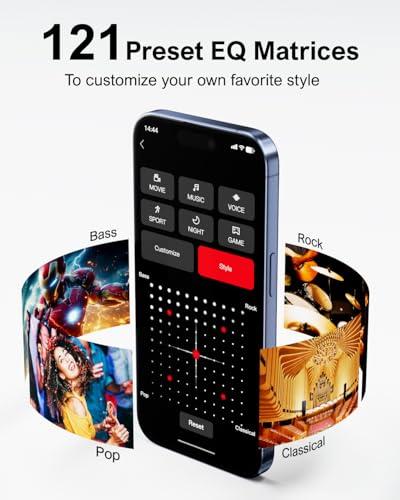
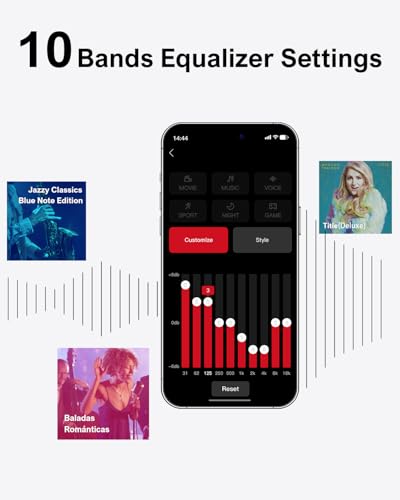
The connectivity comparison highlights how much the audio industry has evolved in recent years. The Ultimea D70 covers the basics with HDMI ARC, optical, USB, and Bluetooth 5.3, plus a 3.5mm auxiliary input. Its smartphone app provides extensive control over EQ settings, including a 10-band equalizer and 121 preset matrices for different content types.
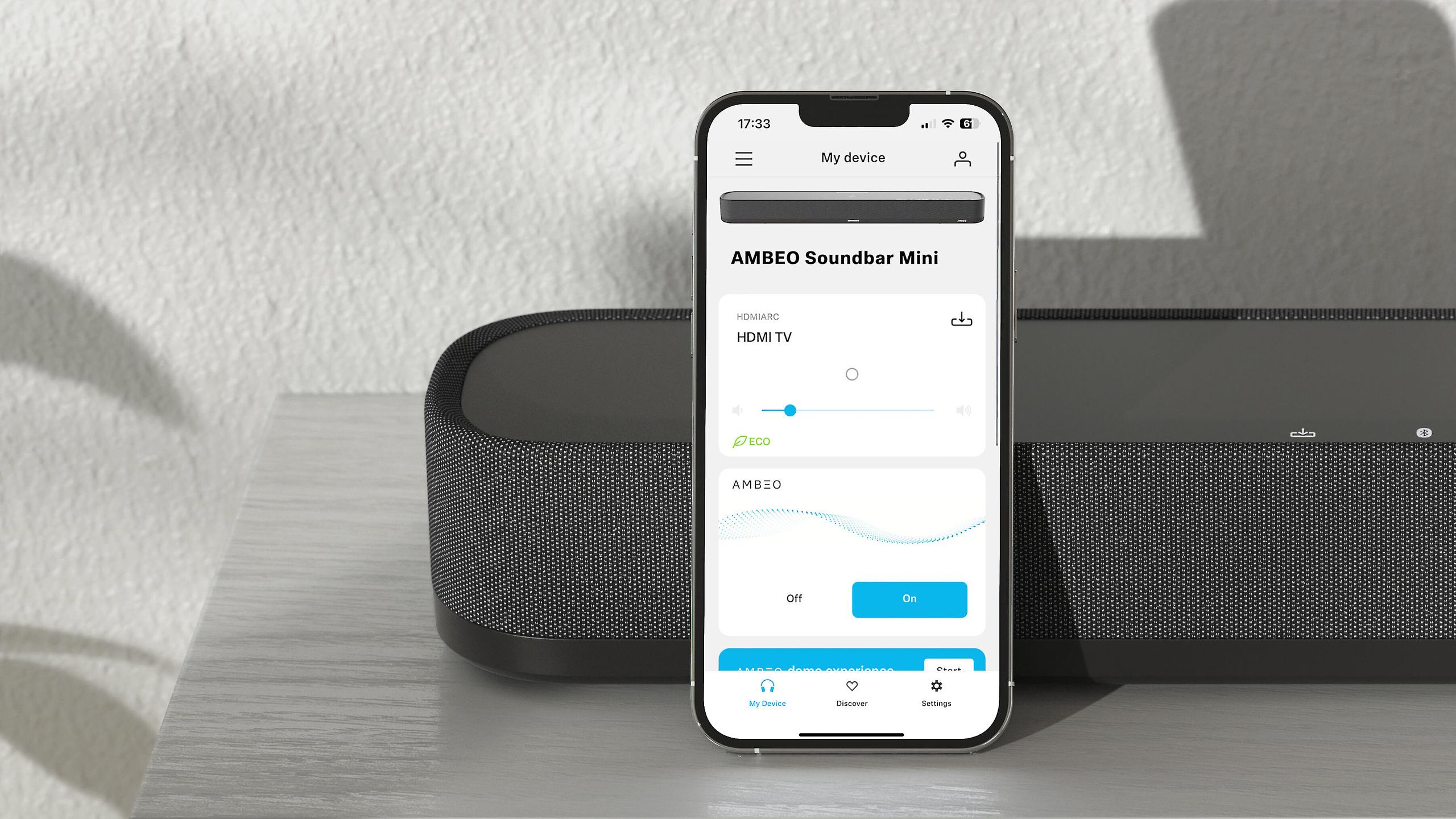
The Sennheiser AMBEO Mini focuses on wireless connectivity and smart home integration. It supports Wi-Fi 802.11ax (Wi-Fi 6), Apple AirPlay 2, Google Cast, and has Alexa built-in with optional Google Assistant support. You can stream directly from Spotify, Tidal, Amazon Music, and other services without needing a separate device.
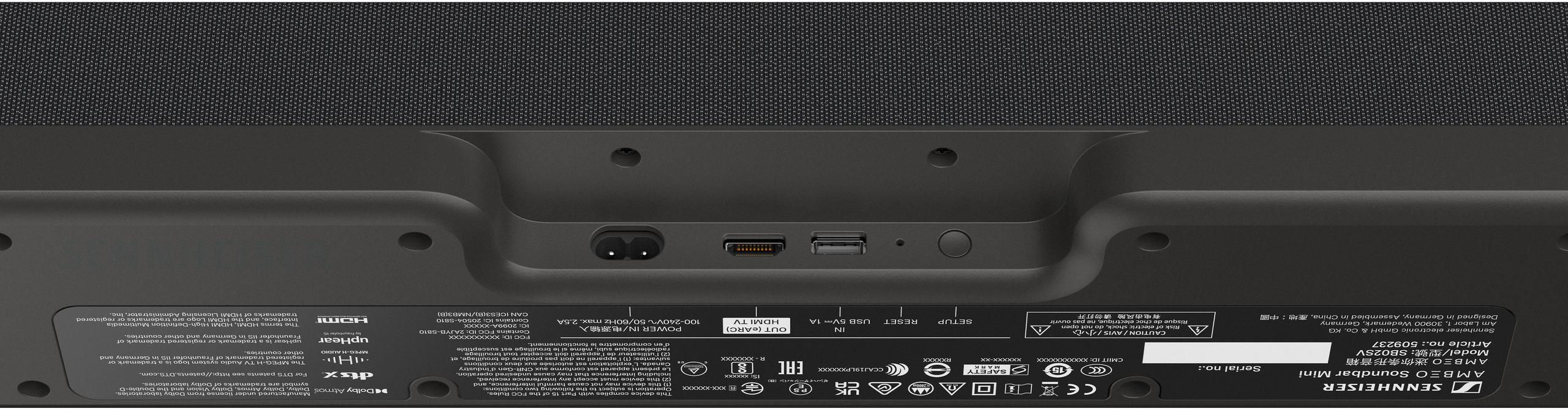
However, the AMBEO Mini has a significant limitation: only one HDMI input and no optical backup. This forces you to rely on your TV's HDMI switching or invest in a separate HDMI switch for multiple sources.
HDMI eARC (enhanced Audio Return Channel) on the AMBEO Mini supports higher bandwidth audio formats than the D70's standard ARC connection, enabling lossless Dolby Atmos and DTS:X passthrough from compatible TVs and sources.
The D70's multiple input options provide more flexibility for older equipment, while the AMBEO Mini's wireless capabilities better suit modern streaming-focused setups.
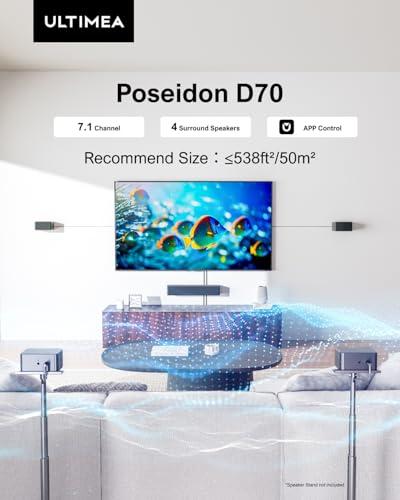
Room size dramatically affects how these systems perform. The Poseidon D70 is officially rated for rooms between 108-270 square feet, but its physical surround speakers can work effectively in larger spaces where virtual processing might struggle. The key is having enough space to properly position the satellite speakers without them overwhelming your decor.
The AMBEO Mini works best in small to medium rooms where its virtualization algorithms can effectively use wall and ceiling reflections. In very large rooms or spaces with high ceilings and minimal furniture, the surround illusion becomes less convincing. However, it excels in apartments, condos, or any space where running speaker wire isn't practical.
Ceiling height affects both systems differently. The D70 doesn't rely on ceiling reflections, so vaulted or very high ceilings don't hurt its performance. The AMBEO Mini's upward-firing drivers need a reasonably low ceiling (8-10 feet ideal) to create effective height effects.
After extensive research into professional reviews and user experiences, clear patterns emerge for when each system excels.
Choose the Ultimea Poseidon D70 if you have a dedicated home theater room or don't mind multiple components in your living space. It's ideal for action movie enthusiasts who prioritize explosive dynamics and clear directional effects over subtle detail. The extensive EQ customization appeals to users who enjoy tweaking their audio setup, and the multiple input options work well for complex entertainment systems with older components.
The D70 particularly shines for gaming, where precise directional audio helps with spatial awareness in competitive titles. Its lack of Dolby Atmos support isn't a dealbreaker if most of your content comes from cable TV, DVDs, or streaming services that don't emphasize height channels.
Choose the Sennheiser AMBEO Mini if you prioritize convenience, modern format support, and smart home integration. It's perfect for apartment dwellers, renters who can't run speaker wire, or anyone who wants premium audio quality without cluttering their living space. The Dolby Atmos support is essential for users who primarily consume modern streaming content or 4K Blu-rays.
The AMBEO Mini particularly appeals to music listeners who want direct streaming access and the nuanced detail that Sennheiser's audiophile heritage provides. Its room calibration and adaptive processing make it more "set and forget" friendly for users who don't want to constantly adjust settings.
At the time of writing, the AMBEO Mini commands a premium price reflecting Sennheiser's brand positioning and advanced processing technology. The Poseidon D70 offers more components and physical hardware for significantly less money, making it appealing for budget-conscious buyers who want true surround sound.
However, value calculations should consider future needs. The AMBEO Mini's Dolby Atmos support and wireless upgrade path provide better long-term compatibility with evolving content formats. The D70's fixed configuration offers no upgrade path beyond replacing the entire system.
Both systems represent solid engineering within their respective philosophies. The D70 delivers authentic surround positioning that virtual systems struggle to match, while the AMBEO Mini provides spatial effects and modern format support that physical systems can't achieve without dedicated height speakers.
Your choice ultimately depends on whether you value authentic surround placement over convenience, and whether Dolby Atmos support justifies the premium pricing and single-input limitation. Either system will dramatically improve your TV's built-in speakers—they just take completely different approaches to getting there.
| Ultimea Poseidon D70 7.1 Channel Soundbar System | Sennheiser AMBEO Soundbar Mini |
|---|---|
| Surround Sound Approach - Determines authenticity vs convenience | |
| True 7.1 with 4 physical surround speakers + soundbar + subwoofer | Virtual 7.1.4 processing through single soundbar with 6 drivers |
| Dolby Atmos Support - Essential for modern streaming content | |
| No Dolby Atmos support (traditional 7.1 only) | Full Dolby Atmos, DTS:X, and 360 Reality Audio support |
| Total Power Output - Affects maximum volume and dynamics | |
| 410W peak / 144W RMS across 8 drivers | 250W RMS through 6 dedicated Class D amplifiers |
| Bass Performance - Critical for movie impact and music fullness | |
| Dedicated 6.5" wireless subwoofer (65Hz-18kHz) | Integrated dual 4" drivers (43Hz-20kHz, deeper extension) |
| Setup Complexity - Time investment and room requirements | |
| Multiple components: 4 surround speakers need positioning and wiring | Single soundbar with automatic room calibration via built-in mics |
| Room Size Optimization - Determines performance in your space | |
| 108-270 sq ft, works well in larger rooms with proper speaker placement | Best for small-medium rooms where virtualization can use wall reflections |
| Connectivity Options - Determines source compatibility | |
| HDMI ARC, Optical, USB, 3.5mm AUX, Bluetooth 5.3 | Single HDMI eARC, Wi-Fi, Bluetooth, AirPlay 2, Google Cast |
| Smart Features - Modern convenience and streaming integration | |
| Basic app with 10-band EQ and 121 presets, IR remote only | Built-in Alexa, direct streaming, voice control, adaptive sound modes |
| Physical Footprint - Space requirements in your room | |
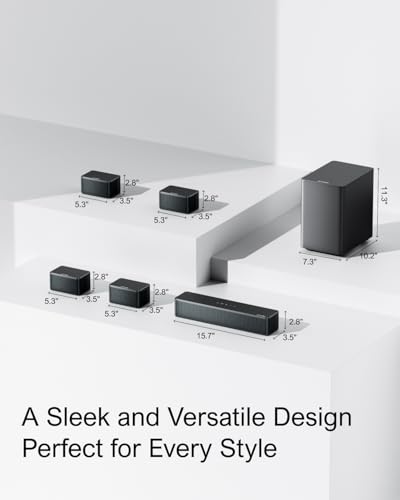
| 8 separate components requiring strategic placement and cable management | Single 27.5" soundbar that can wall-mount or sit on media console |
| Upgrade Path - Future expansion possibilities | |
| Fixed system with no component upgrade options | Optional wireless subwoofers (supports up to 4), modular expansion |
The Ultimea Poseidon D70 delivers authentic 7.1 surround sound through four physical satellite speakers positioned around your room, plus a main soundbar and wireless subwoofer. This creates genuine directional audio where sounds physically come from behind and beside you. The Sennheiser AMBEO Mini uses advanced virtualization technology to simulate 7.1.4 surround sound from a single soundbar, which works well but can't match the spatial accuracy of actual surround speakers in larger rooms.
Yes, the Sennheiser AMBEO Mini fully supports Dolby Atmos, DTS:X, and other modern audio formats with height channels. It uses upward-firing drivers to bounce sound off your ceiling, creating overhead effects. The Ultimea Poseidon D70 does not support Dolby Atmos and is limited to traditional 7.1 surround sound processing, which means you'll miss out on height effects from modern streaming content and 4K movies.
The Sennheiser AMBEO Mini is significantly easier to install - just plug in power, connect one HDMI cable, and run the automatic room calibration. The Ultimea Poseidon D70 requires positioning four satellite speakers around your seating area, running the included cables, and finding optimal placement for the wireless subwoofer. Setup time is about 5 minutes for the AMBEO versus 30-60 minutes for the D70.
The Ultimea Poseidon D70 includes a dedicated 6.5-inch wireless subwoofer that delivers powerful, room-shaking bass with flexible placement options. The Sennheiser AMBEO Mini achieves impressive bass from built-in 4-inch drivers without needing a separate subwoofer, and actually extends deeper (43Hz vs 65Hz). However, the D70's larger dedicated subwoofer provides more physical impact for action movies.
The Sennheiser AMBEO Mini is ideal for small rooms, apartments, and spaces where you can't run speaker wire. Its compact single-bar design and virtualization technology work especially well when sound can reflect off nearby walls and ceilings. The Ultimea Poseidon D70 requires more space to properly position its four satellite speakers and may overwhelm smaller rooms with too many components.
Both systems handle music well, but differently. The Sennheiser AMBEO Mini offers direct streaming from Spotify, Tidal, and other services with built-in Wi-Fi, plus detailed sound reproduction that reflects Sennheiser's audiophile heritage. The Ultimea Poseidon D70 provides extensive EQ customization with 121 preset matrices and a 10-band equalizer, allowing you to fine-tune the sound for different music genres.
The Ultimea Poseidon D70 offers more physical inputs including HDMI ARC, optical, USB, and 3.5mm auxiliary connections, making it compatible with older equipment. The Sennheiser AMBEO Mini focuses on modern wireless connectivity with Wi-Fi, AirPlay 2, Google Cast, and built-in Alexa, but has only one HDMI input which can be limiting for multiple sources.
The Ultimea Poseidon D70 excels for gaming because its physical surround speakers provide precise directional audio that helps with spatial awareness in competitive games. You can pinpoint enemy footsteps and gunfire locations accurately. The Sennheiser AMBEO Mini offers good gaming performance with lower latency and supports modern game audio formats, but its virtualized positioning isn't as precise as physical speakers.
The Ultimea Poseidon D70 works better in larger rooms (up to 270 square feet) because its physical surround speakers maintain their directional effects regardless of room size. The Sennheiser AMBEO Mini relies on room reflections for its virtualization, which becomes less effective in very large spaces or rooms with high ceilings and minimal furniture.
The Sennheiser AMBEO Mini offers more upgrade flexibility - you can add up to four optional wireless subwoofers as your needs grow. The Ultimea Poseidon D70 is a fixed system with no upgrade path beyond replacing the entire setup. However, the D70 comes complete with all components from the start, while AMBEO expansions require additional purchases.
The Sennheiser AMBEO Mini provides comprehensive smart home integration with built-in Alexa, voice control, and direct streaming from major music services. It also includes adaptive sound modes that automatically adjust based on content type. The Ultimea Poseidon D70 has basic smartphone app control with extensive EQ options but lacks voice control and streaming service integration.
Choose the Ultimea Poseidon D70 if you want authentic surround sound with physical speakers and don't mind the extra setup complexity. It's better for larger rooms and dedicated home theater use. Choose the Sennheiser AMBEO Mini if you prioritize convenience, modern format support like Dolby Atmos, and smart features in a single compact unit that's perfect for smaller spaces and apartment living.
We've done our best to create useful and informative comparisons to help you decide what product to buy. Our research uses advanced automated methods to create this comparison and perfection is not possible - please contact us for corrections or questions. These are the sites we've researched in the creation of this article: ultimea.com - provantage.com - ultimea.com - youtube.com - youtube.com - bestbuy.com - the-gadgeteer.com - shopmyexchange.com - youtube.com - youtube.com - youtube.com - ultimea.com - manuals.plus - device.report - images.thdstatic.com - shopmyexchange.com - staples.com - ultimea.de - techradar.com - sennheiser-hearing.com - stereonet.com - rtings.com - youtube.com - youtube.com - newsroom.sennheiser.com - whathifi.com - baybloorradio.com - sennheiser-hearing.com - files.bbystatic.com

Privacy Policy
Terms and Conditions - Affiliate Policy
Home Security
© Copyright 2008-2026.
11816 Inwood Rd #1211, Dallas, TX 75244