




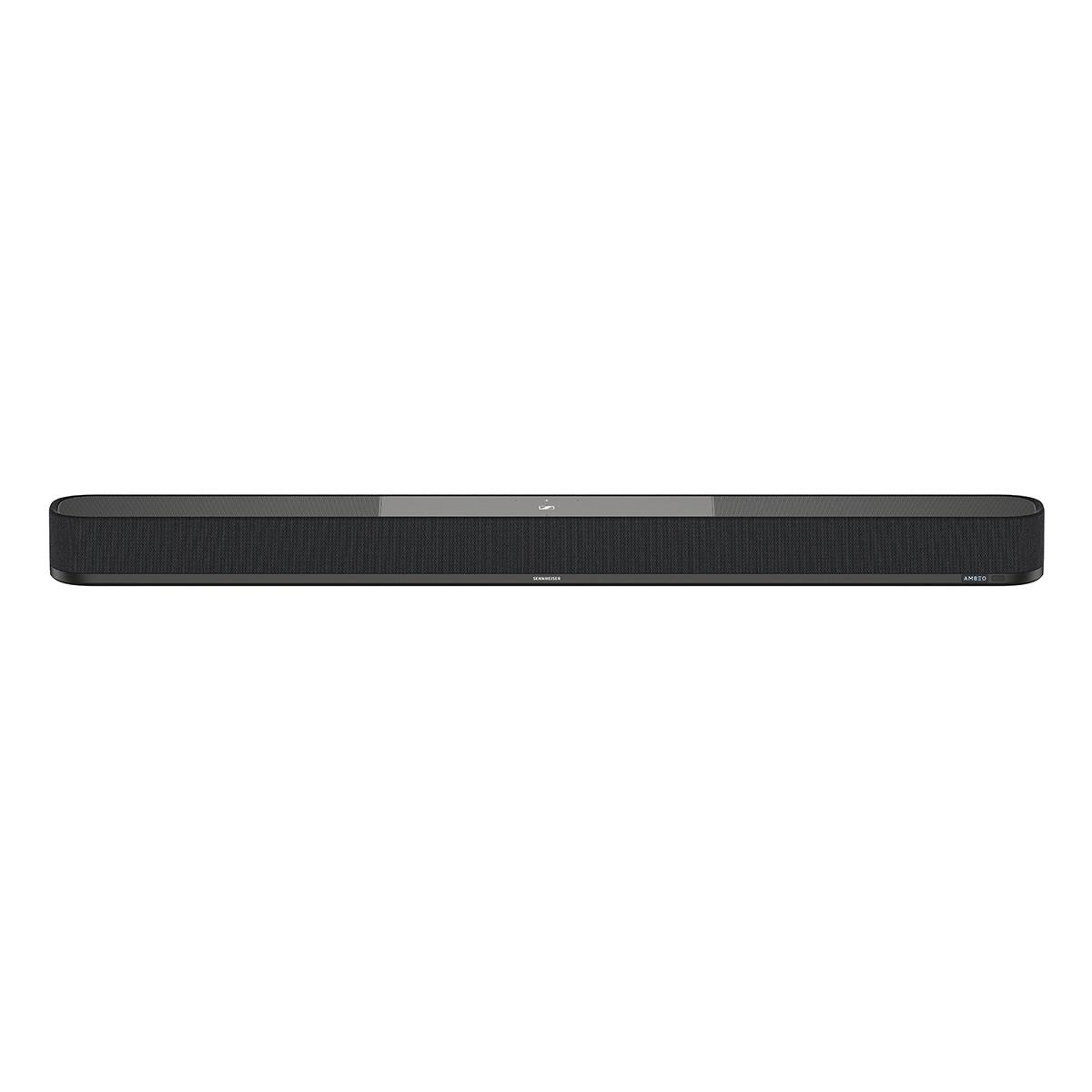
The home theater audio world has split into two fascinating camps. On one side, you have budget-friendly systems like the Ultimea Poseidon D70 that give you actual speakers scattered around your room. On the other, premium brands like Sennheiser have developed sophisticated single-unit solutions like the AMBEO Soundbar Plus that use audio wizardry to trick your brain into hearing surround sound from just one bar.
At the time of writing, these represent dramatically different approaches to solving the same problem: how do you get cinema-quality audio in your living room without the complexity of a full AV receiver setup? The answer depends on whether you value authentic multi-speaker placement or cutting-edge virtualization technology.
When soundbars first appeared in the early 2000s, they were simple solutions to thin TV audio. Fast forward to 2024, and we're dealing with systems that can either physically surround you with speakers or use psychoacoustic processing (manipulating how your brain interprets sound) to create the illusion of speakers that aren't there.
The main considerations haven't changed much: you want better audio than your TV provides, you want it to be relatively simple to set up, and you want it to work well in your specific room. What has changed is how dramatically different these two approaches have become, and how much performance you can get at various price points.
Modern systems need to handle everything from Netflix's compressed audio to 4K Blu-ray discs with Dolby Atmos soundtracks. They need to make dialogue crystal clear while also delivering the chest-thumping bass that makes action movies exciting. Most importantly, they need to work in real rooms with real furniture, not just acoustically perfect laboratories.
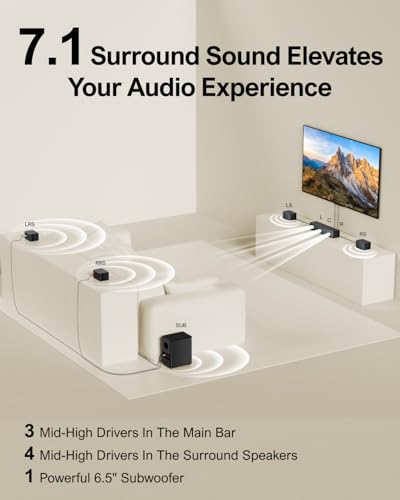
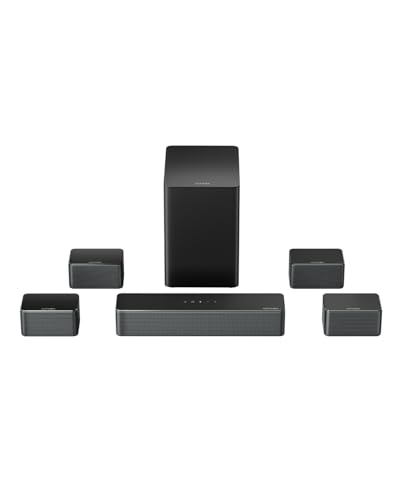
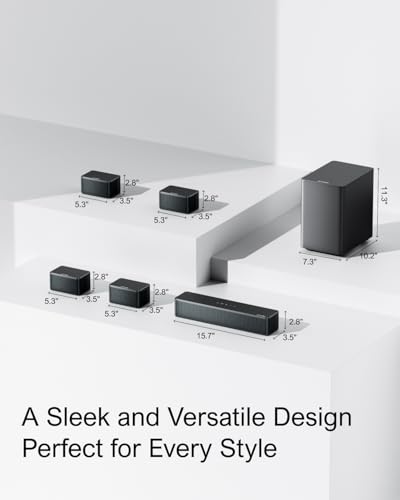
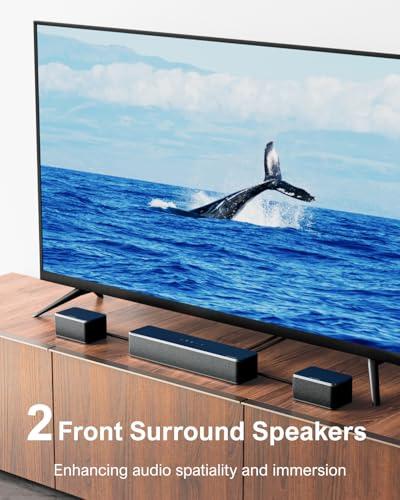
Released in 2024, the Ultimea Poseidon D70 represents the "more speakers equals better surround sound" philosophy. This system gives you eight separate speakers: a compact main soundbar, four satellite speakers that you place around your room, and a wireless subwoofer that handles the deep bass.
The engineering here is straightforward but effective. Each of the four surround speakers contains a 2.25-inch driver, while the main soundbar houses three more drivers of the same size. This creates genuine 7.1-channel separation, meaning sounds can actually come from behind you, beside you, and in front of you from different physical locations.
The wireless subwoofer is where things get interesting. It connects to the main soundbar via Bluetooth, eliminating one cable run, but the four surround speakers still need to be wired. They connect to the subwoofer using RCA cables (the red and white connectors you might remember from older audio equipment), with the subwoofer acting as a hub that distributes both power and audio signals.
Ultimea's proprietary SurroundX technology coordinates all these speakers to create what they call "spatial positioning." This isn't just playing the same audio from multiple speakers – it's actually processing the incoming audio to determine which sounds should come from which directions, then routing them accordingly. Think of it as a traffic controller for audio signals.
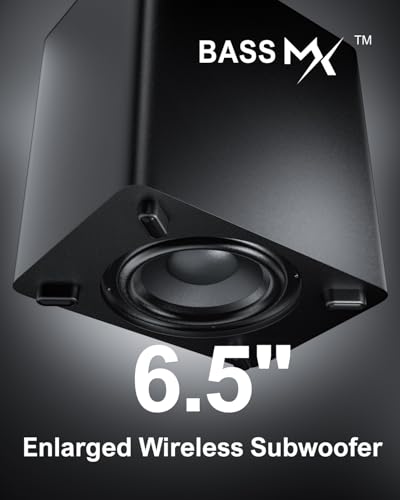
The BassMX technology enhances low-frequency response from that 6.5-inch subwoofer. At 60W RMS (continuous power, not peak marketing numbers), it's not going to shake your house, but our research into user reviews consistently shows it delivers satisfying bass for movies and music without the muddiness that plagues many budget subwoofers.
The Poseidon D70's total power output is 144W RMS across all speakers, with the system capable of peaks up to 410W. These aren't massive numbers, but they're honest ones. The frequency response spans 35Hz to 18kHz, which means it reproduces everything from deep bass notes to the highest harmonics in cymbals and vocals.
What you lose with this approach is support for modern audio formats like Dolby Atmos and DTS:X. These formats encode height information – sounds that should appear to come from above you. The D70's speakers are all at ear level or below, so it can't reproduce true overhead effects. This is a significant limitation for modern movie soundtracks that increasingly rely on these formats.
However, what you gain is authentic directionality. When a helicopter flies across the screen in an action movie, you'll actually hear it move from the front speakers to the side speakers to the rear speakers. This physical sound movement is something that virtual systems, no matter how sophisticated, struggle to replicate with the same convincing accuracy.
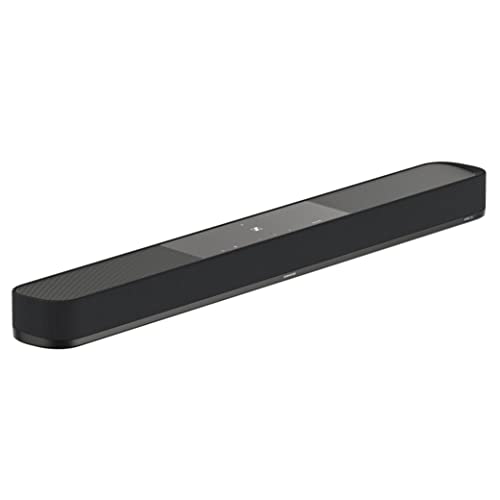
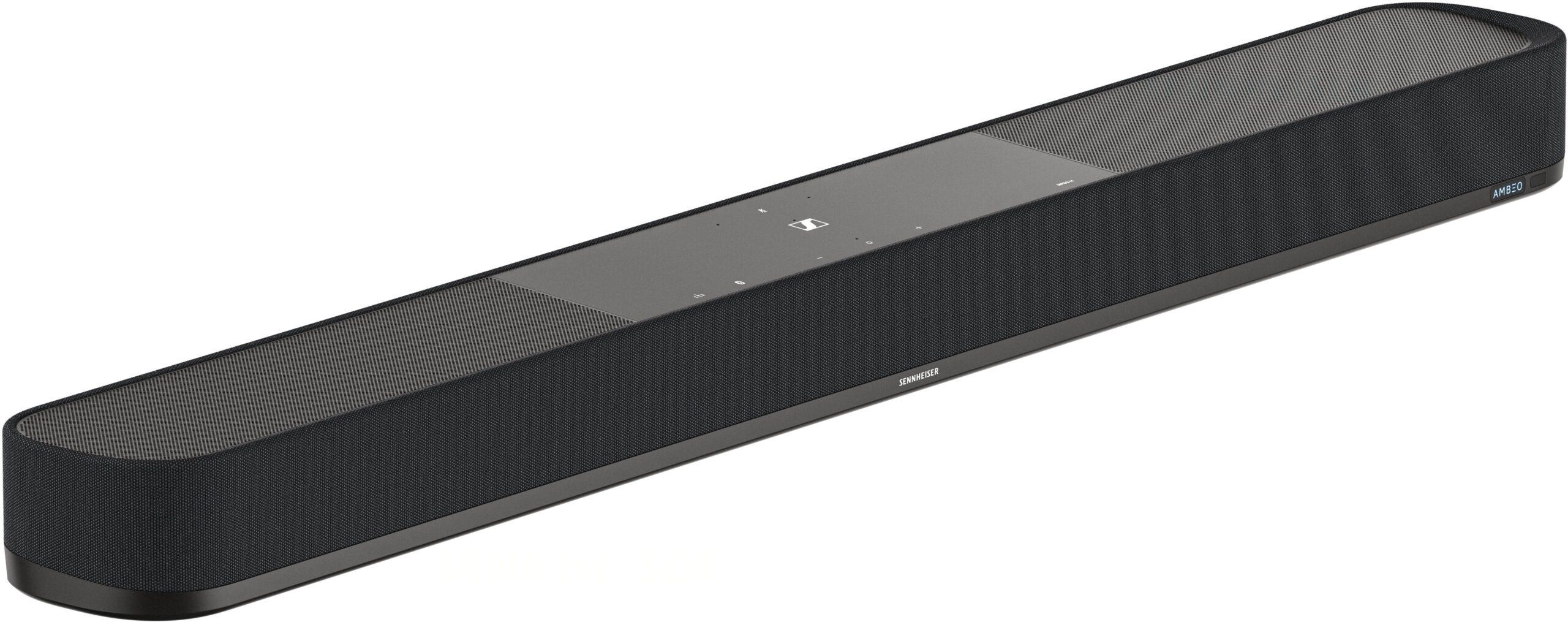
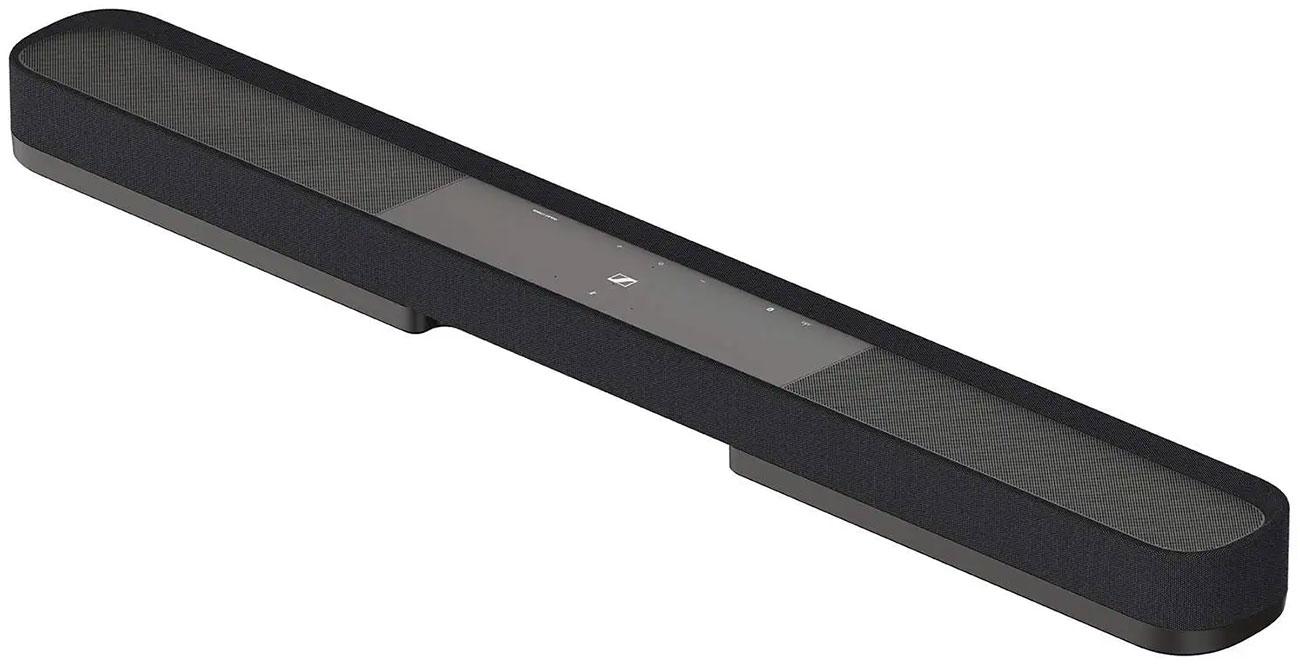
The Sennheiser AMBEO Soundbar Plus, released in 2022, represents two decades of advancement in psychoacoustic research. Instead of placing speakers around your room, it uses a combination of precisely positioned drivers, advanced signal processing, and room calibration to create virtual speaker positions.
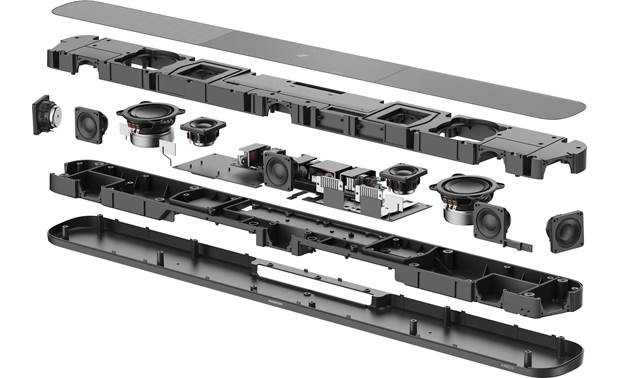
The AMBEO technology was developed in collaboration with the Fraunhofer Institute, the same research organization behind the MP3 audio format. This isn't marketing fluff – it's serious audio science. The soundbar uses upward-firing drivers to bounce sound off your ceiling, side-firing drivers to create width, and forward-firing drivers for direct sound. Your brain interprets these carefully timed reflections as sounds coming from specific locations in three-dimensional space.
The automatic room calibration is perhaps the most impressive technical achievement. Using built-in microphones, the AMBEO Plus sends out test tones, listens to how they bounce around your room, then adjusts its processing accordingly. If you have a couch against the back wall, it compensates. If your room has high ceilings, it adapts. This happens every time you run calibration, so it adjusts to furniture changes or different listening positions.
The processing power required for this is substantial. The soundbar includes a quad-core 1.8 GHz processor – more computing power than many smartphones from just a few years ago. This processor runs complex algorithms in real-time, analyzing every millisecond of audio and applying psychoacoustic principles to create the illusion of surround sound.
Where the AMBEO Plus truly excels is in modern audio format support. It handles Dolby Atmos, DTS:X, and MPEG-H audio with full height channel processing. When you're watching a scene with rain, the system can make it sound like drops are falling from above. When helicopters fly overhead, you'll hear them pass above your head, not just in front of you.
The 400W of total power is distributed through Class D amplifiers (highly efficient digital amplifiers that run cool and waste less electricity than traditional analog amps) to nine individual speakers built into the soundbar. This includes dedicated upward-firing drivers for height effects and side-firing drivers for width.
The frequency response extends from 38Hz to 20kHz, slightly better on the high end than the D70. More importantly, the dual 4-inch long-throw woofers built into the soundbar provide substantial bass without requiring a separate subwoofer for most listeners, though Sennheiser does offer an optional AMBEO Sub for those wanting even deeper low-end extension.
Both systems handle dialogue well, but through different approaches. The Poseidon D70 uses a dedicated center channel (the middle driver in the soundbar) for voices, which is the traditional approach. This works reliably across all content types and makes voices distinct from background music and effects.
The AMBEO Plus uses more sophisticated processing to extract and enhance dialogue dynamically. It can actually analyze the audio stream to identify which parts are dialogue versus music or effects, then adjust the processing accordingly. User reviews consistently praise its ability to maintain clear dialogue even during complex action sequences.
For home theater use, both excel here, but the AMBEO Plus has a slight edge in challenging content like Christopher Nolan films where dialogue is often mixed quietly compared to effects.
This is where the fundamental difference in approaches becomes most apparent. The D70 provides what audio engineers call "discrete channel separation" – each surround channel is played through its own physical speaker. When you hear footsteps moving from left to right behind you in a horror movie, they're actually traveling from your left rear speaker to your right rear speaker.
The AMBEO Plus creates what's called "virtualized surround," using psychoacoustic tricks to make your brain believe sounds are coming from locations where no speakers exist. The sophistication of this processing has improved dramatically since the technology's introduction. Early virtual surround systems were obvious and artificial-sounding. Modern implementations like AMBEO can be remarkably convincing.
Our research into expert reviews and user feedback suggests that for most listeners in most rooms, the AMBEO Plus creates a more consistent surround experience. The D70 can be more convincing when properly set up, but it requires optimal speaker placement and room characteristics to reach its potential.
The bass comparison reveals interesting trade-offs. The D70's dedicated 6.5-inch subwoofer can move more air and reach deeper frequencies than the AMBEO Plus's built-in woofers. For action movies and music genres like hip-hop or electronic, this translates to more physical impact.
However, the AMBEO Plus provides what many listeners prefer: cleaner, more controlled bass that doesn't overwhelm dialogue or detailed effects. The dual 4-inch woofers are precisely tuned and positioned, resulting in bass that supports the overall sound rather than dominating it.
For dedicated home theater rooms where the primary use is movies, the D70's approach may be preferable. For mixed-use living spaces where the system also plays music and TV shows, the AMBEO Plus's more refined approach often works better.
Music reproduction reveals another key difference. The D70 benefits from having separate speakers positioned around the room, which can create excellent stereo imaging for well-recorded music. Jazz recordings, classical music, and acoustic performances often sound more spacious and natural.
The AMBEO Plus approaches music differently, using its virtualization to create what it calls "upmixing" – taking stereo recordings and adding spatial information to make them more immersive. This can be fascinating with some recordings but artificial with others. Fortunately, you can adjust the intensity or turn it off entirely.
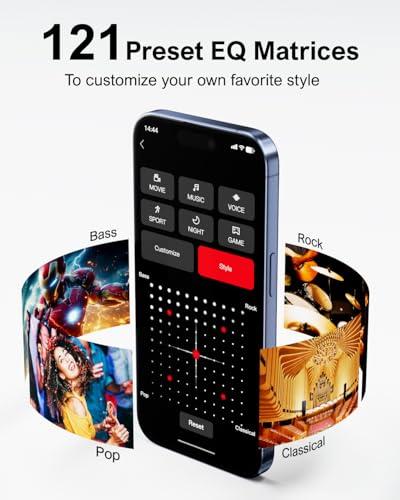
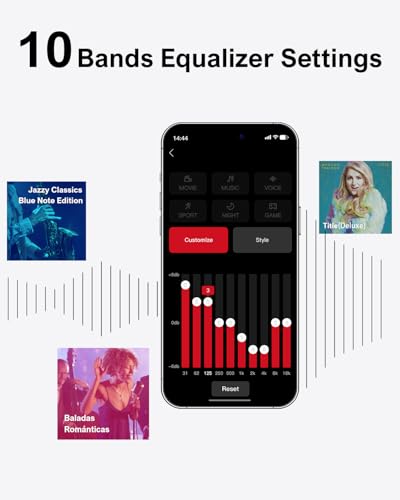
Both systems offer extensive EQ controls, but the D70 goes further with 121 preset matrices covering everything from classical to death metal. The AMBEO Plus focuses on fewer, more refined options that generally sound better out of the box.
The setup experience couldn't be more different between these systems. The Poseidon D70 requires planning and patience. You need to route speaker cables to four different locations in your room, with the rear speakers requiring 6-meter (nearly 20-foot) cable runs in larger rooms. The system includes the cables, but you'll need to manage hiding them under rugs, behind furniture, or through cable management systems.
The reward for this effort is flexibility. You can position each speaker exactly where it sounds best for your seating position and room layout. The wireless subwoofer can go anywhere with power, allowing you to find the spot where it provides the smoothest bass response.
The AMBEO Plus setup is dramatically simpler: connect one HDMI cable, plug it in, run the 5-minute calibration routine, and you're done. The calibration involves playing test tones while you sit in your primary listening position, letting the soundbar learn your room's acoustics automatically.
Since 2022, Sennheiser has refined the calibration process based on user feedback. Early versions were sometimes finicky about background noise during calibration. Current versions are more robust and forgiving.
At the time of writing, these systems occupy completely different price tiers, with the D70 positioned as a budget option offering exceptional value for true surround sound, while the AMBEO Plus sits in premium territory where convenience and refinement command higher prices.
The D70 provides genuine multi-channel surround sound at a price point where most competitors offer only virtual processing. This makes it exceptional value for users who don't mind the installation complexity and can live without modern audio format support.
The AMBEO Plus justifies its premium pricing through sophisticated technology, premium build quality, and the convenience of single-unit installation. For buyers prioritizing simplicity and cutting-edge audio processing, the value proposition remains strong despite the higher cost.
Choose the Ultimea Poseidon D70 if you're setting up a dedicated home theater space where you can properly position surround speakers. It's ideal for movie enthusiasts who want authentic directional audio and are comfortable with speaker installation. The lack of Dolby Atmos support isn't a dealbreaker if your primary content is older movies, TV shows, or music.
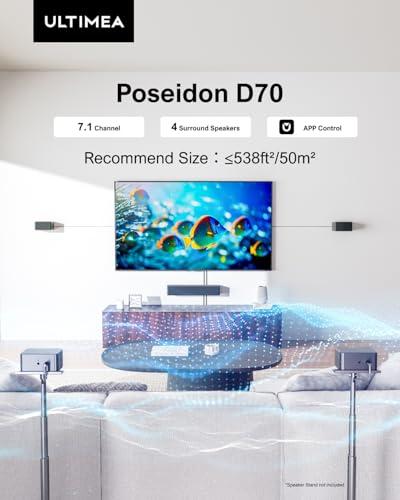
The system shines in medium-sized rooms (roughly 10-25 square meters) where you can achieve proper speaker spacing. It's particularly appealing for users who enjoy tweaking audio settings and want extensive customization options.
Choose the Sennheiser AMBEO Soundbar Plus if you want premium audio quality without installation complexity. It's perfect for living spaces where running speaker cables isn't practical, and for users who primarily consume modern content with Dolby Atmos soundtracks.
The AMBEO Plus works better in challenging room layouts and provides more consistent performance regardless of your seating position. It's also the better choice for users who want their audio system to "just work" without requiring ongoing adjustments.
Both systems represent excellent engineering approaches to the surround sound challenge. Your choice ultimately comes down to whether you value authentic multi-speaker placement or sophisticated single-unit convenience. Either way, you'll get significantly better audio than your TV's built-in speakers – and that's what really matters for your home theater enjoyment.
| Ultimea Poseidon D70 | Sennheiser AMBEO Soundbar Plus |
|---|---|
| System Architecture - Determines setup complexity and audio authenticity | |
| 8 discrete speakers: soundbar + 4 wired surrounds + wireless subwoofer | Single all-in-one soundbar with virtualization technology |
| Audio Format Support - Critical for modern streaming and Blu-ray content | |
| Proprietary SurroundX (no Dolby Atmos/DTS support) | Full Dolby Atmos, DTS:X, and MPEG-H support |
| Power Output - Affects maximum volume and dynamic range | |
| 410W peak / 144W RMS across 8 speakers | 400W with Class D amplification |
| Frequency Response - Determines bass depth and treble clarity | |
| 35Hz - 18kHz (wireless 6.5" subwoofer included) | 38Hz - 20kHz (dual built-in 4" woofers) |
| Installation Requirements - Major factor in purchase decision | |
| Requires routing cables to 4 surround speaker positions | Single HDMI connection with automatic room calibration |
| Room Calibration - Ensures optimal sound in your space | |
| Manual speaker positioning and app-based EQ adjustments | Automatic microphone-based room analysis and correction |
| Customization Options - For users who want to fine-tune their audio | |
| 10-band EQ with 121 preset matrices, extensive manual controls | Professional sound modes with Voice/Night modes and DRC |
| Connectivity Options - Determines device compatibility | |
| HDMI ARC, Optical, Bluetooth 5.3, USB, AUX | Dual HDMI, Optical, Bluetooth, AirPlay 2, Chromecast, Ethernet |
| Smart Features - Modern convenience factors | |
| Ultimea mobile app with firmware updates | Sennheiser app plus Alexa/Google Assistant integration |
| Ideal Room Size - Performance optimization guidance | |
| 108-270 sq ft (10-25 sq meters) with proper speaker placement | Adaptable to various room sizes through automatic calibration |
| Release Timeline - Technology generation and future support | |
| 2024 release with current budget-focused feature set | 2022 release with ongoing firmware improvements since launch |
For dedicated home theater setups, the Ultimea Poseidon D70 provides authentic surround sound with physical speakers positioned around your room, creating genuine directional audio. However, the Sennheiser AMBEO Soundbar Plus offers superior performance with modern Dolby Atmos support and automatic room calibration, making it better for premium home theater experiences despite requiring only a single unit.
The key difference is system architecture: the Ultimea Poseidon D70 uses 8 separate physical speakers (soundbar, 4 surround speakers, and subwoofer) for true 7.1 channel audio, while the Sennheiser AMBEO Soundbar Plus is an all-in-one unit that creates virtual surround sound through advanced processing and precise driver placement.
The Sennheiser AMBEO Soundbar Plus is significantly easier to install, requiring only one HDMI connection and a 5-minute automatic calibration process. The Ultimea Poseidon D70 requires running cables to four surround speaker positions around your room, making installation more complex but providing authentic multi-channel audio placement.
No, only the Sennheiser AMBEO Soundbar Plus supports Dolby Atmos, DTS:X, and other modern audio formats with height channel processing. The Ultimea Poseidon D70 uses proprietary SurroundX technology but lacks support for industry-standard surround formats, which limits compatibility with newer streaming content and Blu-ray discs.
The Ultimea Poseidon D70 includes a dedicated 6.5-inch wireless subwoofer that can produce deeper, more impactful bass for action movies and bass-heavy music. The Sennheiser AMBEO Soundbar Plus has dual built-in 4-inch woofers that provide cleaner, more controlled bass but may require the optional AMBEO Sub for maximum low-end extension.
The Ultimea Poseidon D70 is optimized for rooms between 108-270 square feet and requires space to properly position four surround speakers. The Sennheiser AMBEO Soundbar Plus adapts to various room sizes through automatic calibration and works well in both small and large spaces without requiring additional speaker placement.
The Ultimea Poseidon D70 provides exceptional value by delivering true multi-channel surround sound at a budget-friendly price point where most competitors offer only virtual processing. The Sennheiser AMBEO Soundbar Plus justifies its premium pricing through sophisticated technology, convenience, and support for modern audio formats.
Yes, both systems offer mobile app control. The Ultimea Poseidon D70 includes an app with 10-band EQ, 121 preset sound matrices, and firmware updates. The Sennheiser AMBEO Soundbar Plus provides a more advanced app with professional audio controls, plus voice control through Alexa and Google Assistant integration.
Both excel at music but in different ways. The Ultimea Poseidon D70 benefits from physical speaker separation that can create excellent stereo imaging for acoustic recordings. The Sennheiser AMBEO Soundbar Plus offers superior audio fidelity with high-end components and sophisticated upmixing that can enhance stereo music with spatial effects.
The Ultimea Poseidon D70 offers HDMI ARC, Optical, Bluetooth 5.3, USB, and AUX inputs for basic device connectivity. The Sennheiser AMBEO Soundbar Plus provides more advanced options including dual HDMI ports, AirPlay 2, Chromecast built-in, Ethernet, and multiple streaming service integrations for premium connectivity.
The Ultimea Poseidon D70 delivers 410W peak power with 144W RMS distributed across its 8 speakers, providing substantial output for its price range. The Sennheiser AMBEO Soundbar Plus offers 400W through efficient Class D amplification, focusing on clean, controlled power delivery rather than maximum output numbers.
Choose the Ultimea Poseidon D70 if you want authentic surround sound at a budget price and can manage speaker cable installation. Select the Sennheiser AMBEO Soundbar Plus if you prioritize convenience, modern audio format support, and premium sound quality in a single-unit solution that works well in any living room layout.
We've done our best to create useful and informative comparisons to help you decide what product to buy. Our research uses advanced automated methods to create this comparison and perfection is not possible - please contact us for corrections or questions. These are the sites we've researched in the creation of this article: ultimea.com - provantage.com - ultimea.com - youtube.com - youtube.com - bestbuy.com - the-gadgeteer.com - shopmyexchange.com - youtube.com - youtube.com - youtube.com - ultimea.com - manuals.plus - device.report - images.thdstatic.com - shopmyexchange.com - staples.com - ultimea.de - techradar.com - pocket-lint.com - moon-audio.com - stereonet.com - rtings.com - abt.com - projectorscreen.com - youtube.com - videoandaudiocenter.com - crutchfield.com - sennheiser-hearing.com - newsroom.sennheiser.com

Privacy Policy
Terms and Conditions - Affiliate Policy
Home Security
© Copyright 2008-2026.
11816 Inwood Rd #1211, Dallas, TX 75244