


When your TV's built-in speakers sound like they're coming from inside a tin can, a soundbar becomes essential. But walking into this market can feel overwhelming—do you really need to spend flagship phone money on audio equipment, or can a budget option deliver the goods?
That's exactly the question we're tackling today with two very different approaches to home theater sound: the Ultimea Poseidon D70 and the Samsung HW-Q990F. These systems couldn't be more different in philosophy, price, or performance, yet they both promise to transform your living room audio experience.
Before diving into specifics, let's establish what we're actually comparing here. Soundbars exist to solve a fundamental problem: modern TVs prioritize thin designs over audio quality. The result? Speakers that face backward, downward, or get crammed into impossibly small spaces.
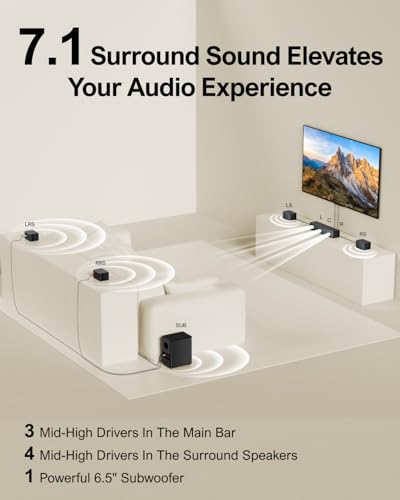
The channel configuration tells you how many distinct audio streams a system can handle. A 7.1 system has seven main speakers (front left, center, front right, side left, side right, rear left, rear right) plus one subwoofer channel. An 11.1.4 system adds four height channels for overhead effects. More channels generally mean more immersive sound, but the quality of implementation matters more than raw numbers.
Audio processing technology separates budget from premium systems. Virtual surround uses digital tricks to simulate surround sound from fewer speakers, while object-based formats like Dolby Atmos actually encode where sounds should appear in three-dimensional space. Think of it like the difference between a painted mural and actual depth perception.
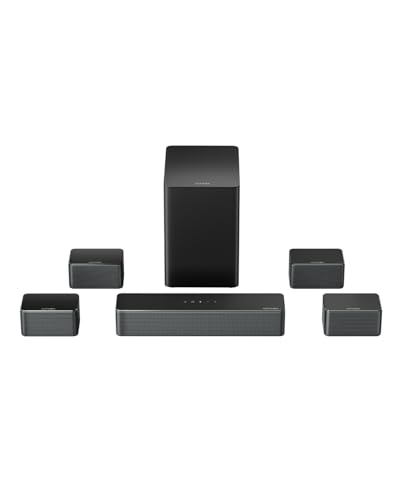
The Ultimea Poseidon D70 represents the budget multi-channel approach. Released in recent years as part of Ultimea's push into affordable surround sound, it packs a surprising amount of hardware for the money: a main soundbar, four physical surround speakers, and a wireless subwoofer. At the time of writing, it typically costs around what you'd spend on a nice dinner for two.
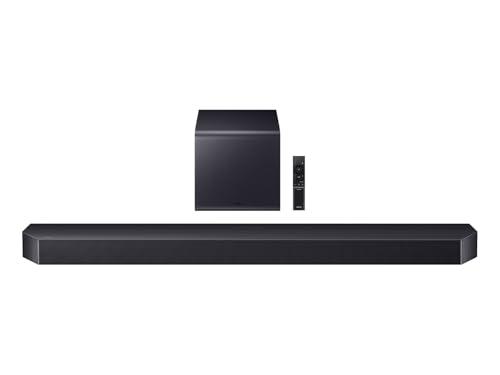
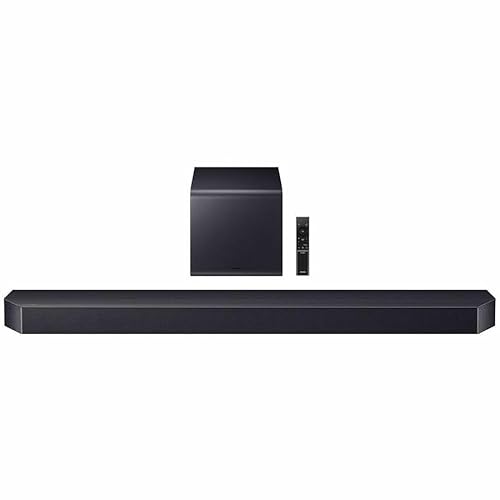
The Samsung HW-Q990F, launched in 2025, sits at the opposite extreme. This flagship system costs roughly four times more than the Ultimea but delivers Samsung's most advanced audio technology, including true Dolby Atmos processing and enough speakers to populate a small orchestra.
This price difference isn't arbitrary—it reflects fundamentally different approaches to solving the same problem.
When evaluating soundbars, immersion matters most. Can the system make you forget you're listening to speakers rather than being present at the action? Here's where the philosophical differences become stark.
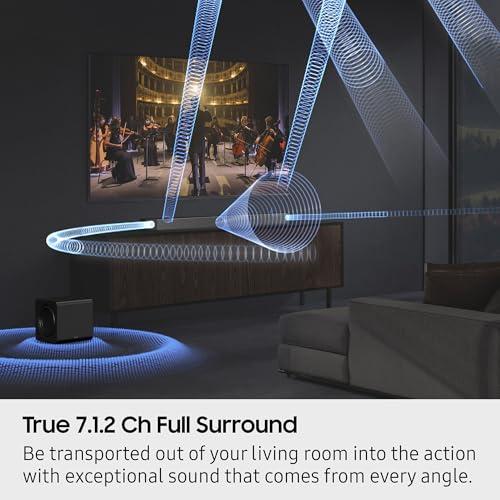
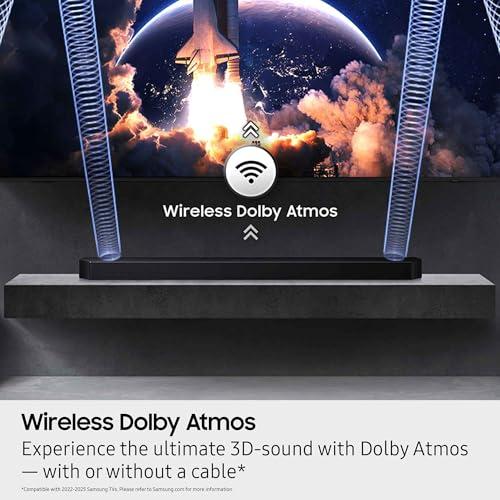
The Samsung HW-Q990F achieves immersion through brute-force sophistication. Its 23 individual speakers include dedicated up-firing drivers that literally bounce sound off your ceiling to create height effects. When a helicopter flies overhead in a movie, you actually hear it above you, not just from the front wall. This isn't simulation—it's physical audio placement in three dimensions.
The system's 11.1.4 configuration means eleven ear-level channels, one subwoofer channel, and four height channels. Dolby Atmos content becomes genuinely three-dimensional, with sounds moving seamlessly around and above the listening area. DTS:X content benefits similarly, creating what reviewers consistently describe as a "bubble of sound" that envelops the listener.
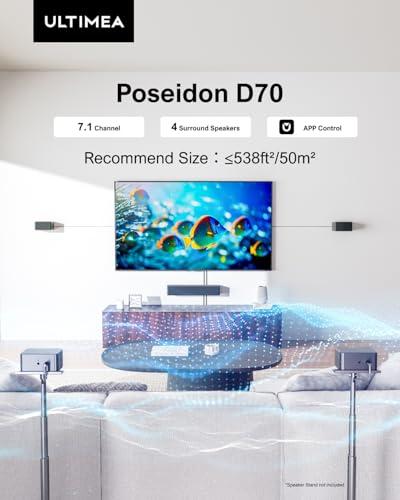
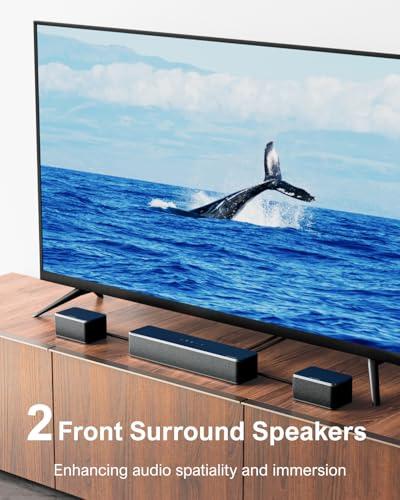
The Ultimea Poseidon D70 takes a different approach. Its 7.1 setup uses four physical surround speakers—two in front, two behind—plus a center channel array in the main soundbar and a dedicated subwoofer. While it lacks true height channels, those four satellite speakers provide actual directional audio that virtual systems can't match.
The Ultimea's SurroundX technology uses spatial positioning algorithms to enhance the surround effect, but it's still fundamentally processing audio rather than creating genuine object-based placement. Think of it as very good stereo enhancement versus the Samsung's true surround sound architecture.
Nothing ruins a movie night faster than constantly asking "What did they say?" Modern film mixes often bury dialogue under effects and music, making clear voice reproduction crucial.
The Samsung HW-Q990F excels here through multiple advantages. Its discrete center channel—a physical speaker dedicated solely to dialogue—provides focused voice reproduction that cuts through complex soundtracks. The Active Voice Amplifier Pro uses AI processing to analyze background noise and dynamically boost dialogue frequencies, ensuring speech remains intelligible even during explosive action sequences.
Professional reviews consistently praise the Samsung's dialogue performance, with many noting that conversations sound natural and present rather than artificially processed. The system's adaptive sound processing adjusts in real-time, maintaining clarity whether you're watching quiet drama or thunderous action.
The Ultimea Poseidon D70 handles dialogue through its soundbar's three-driver array, which includes center channel duties among the front speakers. While adequate for most content, it lacks the Samsung's sophisticated voice processing and dedicated center driver. Users report clear dialogue in normal circumstances, but the system doesn't adapt to challenging content as effectively.
Subwoofer quality dramatically affects perceived audio quality, especially for action movies and music with substantial low-end content. Both systems include wireless subwoofers, but their approaches differ significantly.
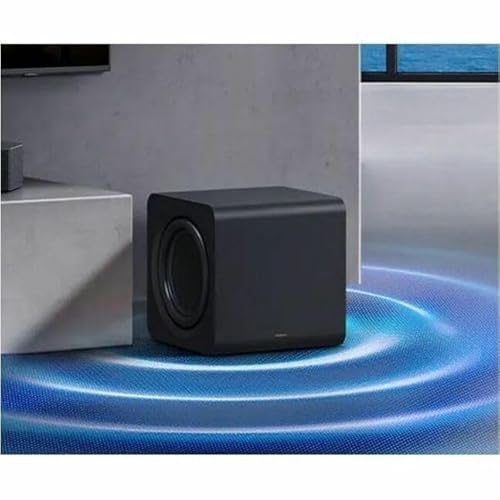
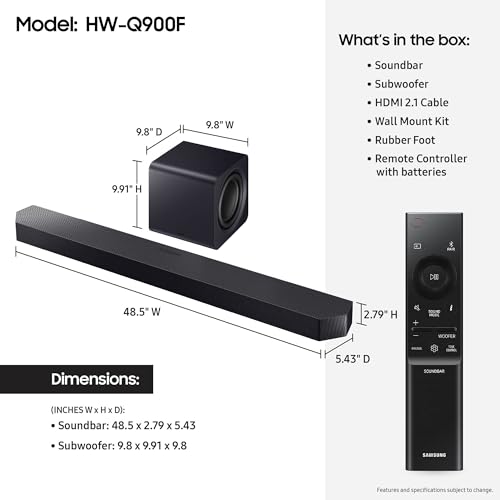
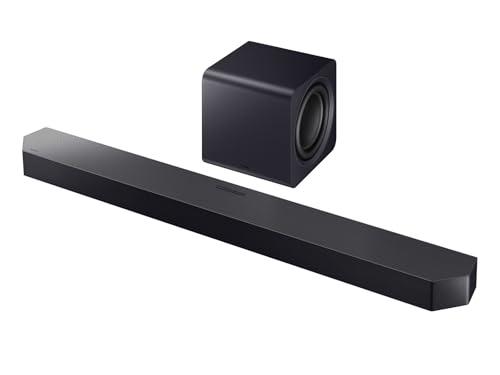
The Samsung's subwoofer features dual 8-inch force-canceling woofers in a bass-reflex enclosure. Force-canceling design means the two drivers face opposite directions, canceling vibrations that would otherwise rattle furniture or walls. The result is clean, powerful bass that remains tight and controlled even at high volumes.
Samsung's AI-powered Dynamic Bass Control analyzes incoming audio and prevents distortion before it occurs, learning your room's characteristics and adjusting accordingly. Professional testing reveals impressive low-frequency extension with minimal compression until very high volume levels.
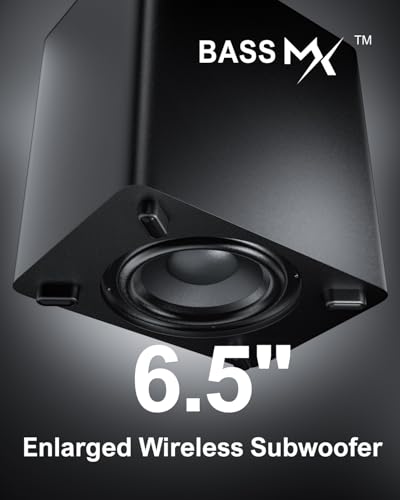
The Ultimea's 6.5-inch subwoofer uses a simpler downward-firing design with BassMX enhancement technology. While it provides adequate bass for most content and rooms, it lacks the headroom and sophistication of the Samsung's dual-driver system. The wireless connection works reliably, but the single driver limits ultimate output and extension.
Connectivity separates contemporary soundbars from basic audio upgrades. The Samsung HW-Q990F provides extensive connection options that reflect its premium positioning.
HDMI 2.1 support enables 4K video passthrough at 120Hz—crucial for modern gaming consoles like PlayStation 5 and Xbox Series X. The system can pass through 8K content at 60Hz, future-proofing for upcoming display technology. HDR10+ support ensures optimal video quality alongside enhanced audio.
Three HDMI inputs allow direct connection of multiple source devices, while eARC (enhanced Audio Return Channel) enables full-bandwidth audio from compatible TVs. This means lossless Dolby Atmos and DTS:X audio streams without compression.
The Samsung also supports comprehensive wireless streaming: Wi-Fi, Bluetooth 5.3, Apple AirPlay 2, Spotify Connect, Google Cast, and Roon Ready certification for audiophile music streaming. Built-in voice assistants (Bixby and Alexa) enable hands-free control.
The Ultimea Poseidon D70 provides essential connectivity without premium features. HDMI ARC handles TV audio return, while optical, USB, and Bluetooth inputs cover most source devices. However, it lacks HDMI 2.1 features, limiting gaming performance and future compatibility.
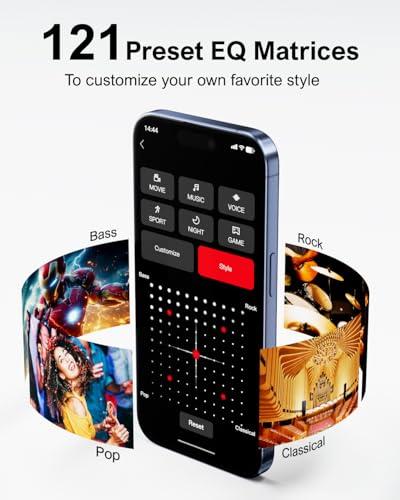
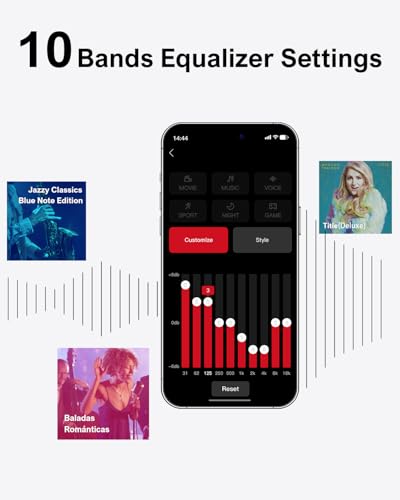
The Ultimea's mobile app deserves mention for providing extensive control over the system's 10-band equalizer and 121 preset EQ matrices. This level of customization exceeds many premium systems, though it requires manual tuning rather than automatic optimization.
Room acoustics dramatically affect audio quality. Hard surfaces create reflections, soft furnishings absorb sound, and room dimensions cause resonances that color the audio. How each system addresses these challenges reveals their sophistication levels.
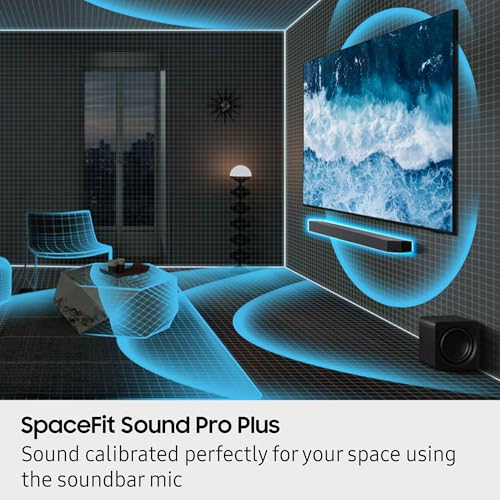
The Samsung HW-Q990F includes SpaceFit Sound Pro automatic room calibration. Built-in microphones analyze your room's acoustic signature and adjust frequency response accordingly. The system compensates for furniture placement, wall materials, and room dimensions without user intervention.
This calibration works continuously, adapting to changes in room configuration or content type. The result is optimized audio that sounds balanced regardless of your specific listening environment.
The Ultimea Poseidon D70 requires manual room tuning through its comprehensive EQ system. While the 10-band graphic equalizer provides extensive adjustment capability, optimization demands acoustic knowledge and time investment. The 121 preset EQ matrices offer shortcuts for different music genres and content types, but they can't account for your specific room characteristics.
Gaming audio demands have evolved dramatically. Modern titles use sophisticated 3D audio engines that provide competitive advantages through precise directional cues. Latency—the delay between controller input and audio output—can affect gameplay in fast-paced titles.
The Samsung HW-Q990F excels in gaming scenarios through multiple advantages. HDMI 2.1 support enables 4K gaming at 120Hz with Variable Refresh Rate, ensuring smooth visuals alongside enhanced audio. Game Pro mode optimizes processing for gaming content, emphasizing directional cues while maintaining low latency.
Professional testing reveals excellent latency performance across all connection types, making the Samsung suitable even for competitive gaming where every millisecond matters. The system's object-based audio processing provides genuine 360-degree positioning, helpful in multiplayer titles where hearing enemy movement provides tactical advantages.
The Ultimea Poseidon D70 offers adequate gaming performance for casual players. While it lacks advanced HDMI features and specialized gaming modes, the physical surround speakers provide better directional audio than basic soundbars. However, serious gamers will miss the precision and low-latency performance that modern consoles can provide through HDMI 2.1 connections.
Physical design affects both aesthetics and functionality. The Samsung HW-Q990F reflects premium positioning through quality materials and thoughtful industrial design. The Titan Black finish complements modern TVs, while the low-profile soundbar integrates visually without dominating smaller entertainment centers.
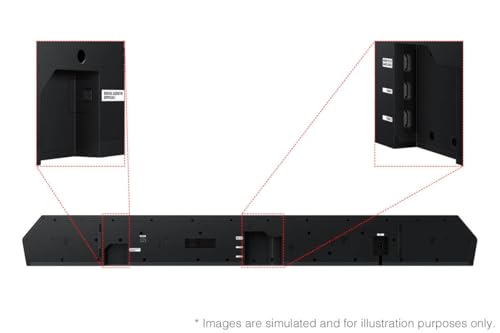
All connections are wireless except power, simplifying installation and reducing cable management. The included wall-mount hardware supports various mounting scenarios, and the wireless rear speakers can be positioned optimally without running cables across the room.
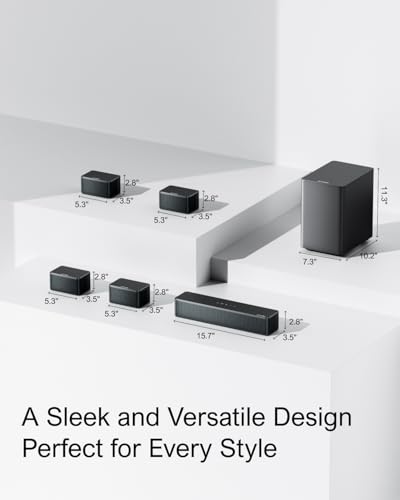
The Ultimea Poseidon D70 prioritizes practicality over premium aesthetics. The compact design suits smaller spaces, but the wired surround speakers require cable management consideration. Color-coded cables simplify connections, though running wires to rear speakers might challenge some installation scenarios.
Both systems include comprehensive accessories and clear setup instructions, though the Samsung's wireless design generally provides easier installation experiences.
These systems serve distinctly different audiences despite sharing the soundbar category. The decision comes down to priorities, budget, and usage patterns.
Choose the Samsung HW-Q990F if you're building a serious home theater system. The investment makes sense for dedicated movie rooms, large living spaces, or situations where audio quality significantly impacts enjoyment. Gamers with modern consoles will appreciate the HDMI 2.1 features, while music enthusiasts benefit from the superior driver quality and room correction.
The Samsung justifies its premium pricing through technological sophistication that competitors struggle to match. True Dolby Atmos processing, automatic room calibration, and comprehensive connectivity provide future-proof capability that maintains relevance as content and display technology evolves.
Choose the Ultimea Poseidon D70 when budget constraints limit options but surround sound remains desirable. This system delivers genuine multi-channel audio improvement over TV speakers at accessible pricing. The four physical surround speakers provide better directional audio than virtual systems, while the comprehensive app control offers customization typically reserved for premium systems.
The Ultimea represents excellent value engineering—maximizing performance per dollar through smart compromises. While it lacks premium features like Dolby Atmos and automatic calibration, it delivers tangible surround sound benefits that transform the viewing experience.
At the time of writing, these systems occupy entirely different market segments despite superficial similarities. The Samsung HW-Q990F represents flagship home theater audio with pricing to match, while the Ultimea Poseidon D70 delivers maximum surround sound capability at budget pricing.
Neither choice is universally correct—success depends on aligning expectations with budget realities. The Samsung excels in every measurable category but costs significantly more, while the Ultimea provides genuine surround sound improvement at exceptional value.
For most buyers, the decision revolves around whether premium audio quality justifies premium pricing. Both systems deliver substantial improvements over TV speakers, but they serve different priorities and expectations within the broader soundbar ecosystem.
| Ultimea Poseidon D70 7.1 Channel Soundbar System | Samsung Q-Series HW-Q990F Soundbar |
|---|---|
| Channel Configuration - Determines surround sound capability and immersion level | |
| 7.1 channels with 8 total speakers | 11.1.4 channels with 23 total speakers |
| Audio Processing - Key difference between virtual and true 3D audio | |
| Virtual surround with SurroundX technology | True Dolby Atmos, DTS:X, and Eclipsa Audio support |
| Speaker Layout - Physical drivers that create the soundstage | |
| Soundbar (3 drivers) + 4 wired surrounds + wireless subwoofer | Main bar (15 drivers) + wireless rear speakers + wireless subwoofer |
| Power Output - Affects volume capability and dynamic range | |
| 410W peak / 144W RMS | 756W RMS (significantly higher continuous power) |
| Height Effects - Overhead audio for movies and games | |
| None (ear-level surround only) | 4 up-firing drivers for true ceiling bounce effects |
| HDMI Features - Critical for modern gaming and 4K/8K content | |
| Basic HDMI ARC only | HDMI 2.1 with 4K/120Hz, 8K/60Hz passthrough |
| Room Calibration - Automatic optimization vs manual tuning | |
| Manual EQ adjustment with 10-band equalizer | SpaceFit Sound Pro automatic room correction |
| Streaming Connectivity - Wireless audio options | |
| Bluetooth only | Wi-Fi, Bluetooth 5.3, AirPlay 2, Spotify Connect, Google Cast |
| Subwoofer Design - Bass performance and placement flexibility | |
| Single 6.5" wireless subwoofer | Dual 8" force-canceling wireless subwoofer |
| Voice Assistants - Smart home integration | |
| None built-in | Built-in Bixby and Alexa support |
| Surround Speaker Connection - Installation flexibility | |
| Wired surrounds (requires cable runs) | Fully wireless rear speakers |
| Target Market - Who each system serves best | |
| Budget-conscious buyers wanting physical surround | Premium home theater enthusiasts and serious gamers |
The Ultimea Poseidon D70 provides exceptional value for budget-conscious buyers, offering true 7.1 surround sound with physical speakers at an entry-level price point. The Samsung HW-Q990F costs significantly more but delivers premium features like Dolby Atmos, automatic room calibration, and HDMI 2.1 connectivity that justify the investment for serious home theater enthusiasts.
The Ultimea Poseidon D70's 7.1 system has seven main speakers plus a subwoofer, providing surround sound around your seating area. The Samsung HW-Q990F's 11.1.4 configuration adds four height channels for overhead effects, creating true three-dimensional audio where sounds can come from above, behind, and all around you.
No, only the Samsung HW-Q990F supports Dolby Atmos and DTS:X object-based audio formats with dedicated up-firing speakers. The Ultimea Poseidon D70 uses virtual surround processing instead, which simulates surround effects but cannot create true overhead audio like Dolby Atmos content requires.
The Samsung HW-Q990F is superior for gaming, especially with modern consoles like PS5 and Xbox Series X. It features HDMI 2.1 support for 4K/120Hz gaming, Game Pro mode, and ultra-low latency. The Ultimea Poseidon D70 offers basic gaming audio through HDMI ARC but lacks advanced gaming features.
The Ultimea Poseidon D70 includes 8 total speakers: 3 in the main soundbar, 4 separate surround speakers, and 1 subwoofer driver. The Samsung HW-Q990F contains 23 individual speakers distributed across the main soundbar, wireless rear speakers, and dual-driver subwoofer for more precise audio placement.
The Samsung HW-Q990F is generally easier to install since all components connect wirelessly except for power cables. The Ultimea Poseidon D70 requires running wired connections to the four surround speakers, which may be challenging depending on your room layout and furniture placement.
Yes, both the Ultimea Poseidon D70 and Samsung HW-Q990F include wireless subwoofers that connect to the main soundbar without cables. However, the Samsung's subwoofer features dual 8-inch drivers with force-canceling technology, while the Ultimea uses a single 6.5-inch driver.
The Samsung HW-Q990F performs better in large spaces due to its higher power output, automatic room calibration, and more comprehensive speaker array. The Ultimea Poseidon D70 works well in small to medium rooms but may lack the power and optimization needed for larger or acoustically challenging spaces.
Yes, both systems offer smartphone app control. The Ultimea Poseidon D70 provides extensive customization through its app, including a 10-band equalizer and 121 preset sound modes. The Samsung HW-Q990F app offers room calibration, streaming control, and integration with Samsung's SmartThings ecosystem.
The Samsung HW-Q990F excels in dialogue reproduction with its dedicated center channel speaker and Active Voice Amplifier Pro technology that automatically enhances speech clarity. The Ultimea Poseidon D70 handles dialogue through its front speaker array, which is adequate but less sophisticated than the Samsung's AI-powered voice processing.
The Samsung HW-Q990F supports extensive streaming options including Spotify Connect, Apple AirPlay 2, Google Cast, and is Roon Ready for high-resolution audio. The Ultimea Poseidon D70 primarily relies on Bluetooth connectivity for wireless streaming, offering fewer built-in streaming protocol options.
Choose the Ultimea Poseidon D70 if you're budget-conscious but want genuine surround sound improvement over TV speakers. Select the Samsung HW-Q990F if you're investing in a serious home theater system and want premium features like Dolby Atmos, automatic calibration, and future-proof connectivity that will grow with your setup.
We've done our best to create useful and informative comparisons to help you decide what product to buy. Our research uses advanced automated methods to create this comparison and perfection is not possible - please contact us for corrections or questions. These are the sites we've researched in the creation of this article: ultimea.com - provantage.com - ultimea.com - youtube.com - youtube.com - bestbuy.com - the-gadgeteer.com - shopmyexchange.com - youtube.com - youtube.com - youtube.com - ultimea.com - manuals.plus - device.report - images.thdstatic.com - shopmyexchange.com - staples.com - ultimea.de - rtings.com - crutchfield.com - sound-advice.online - samsung.com - soundandvision.com - samsung.com - whathifi.com - youtube.com - youtube.com - bestbuy.com - avsforum.com - content.syndigo.com - samsung.com - businessinsider.com - dolby.com - youtube.com - abcwarehouse.com

Privacy Policy
Terms and Conditions - Affiliate Policy
Home Security
© Copyright 2008-2026.
11816 Inwood Rd #1211, Dallas, TX 75244