






When I first started reviewing soundbars five years ago, the category was pretty straightforward. You had basic models that made your TV louder, and premium ones that added some bass. Today's premium soundbars are completely different beasts – they're sophisticated audio systems that can rival traditional home theater setups while being infinitely easier to install.
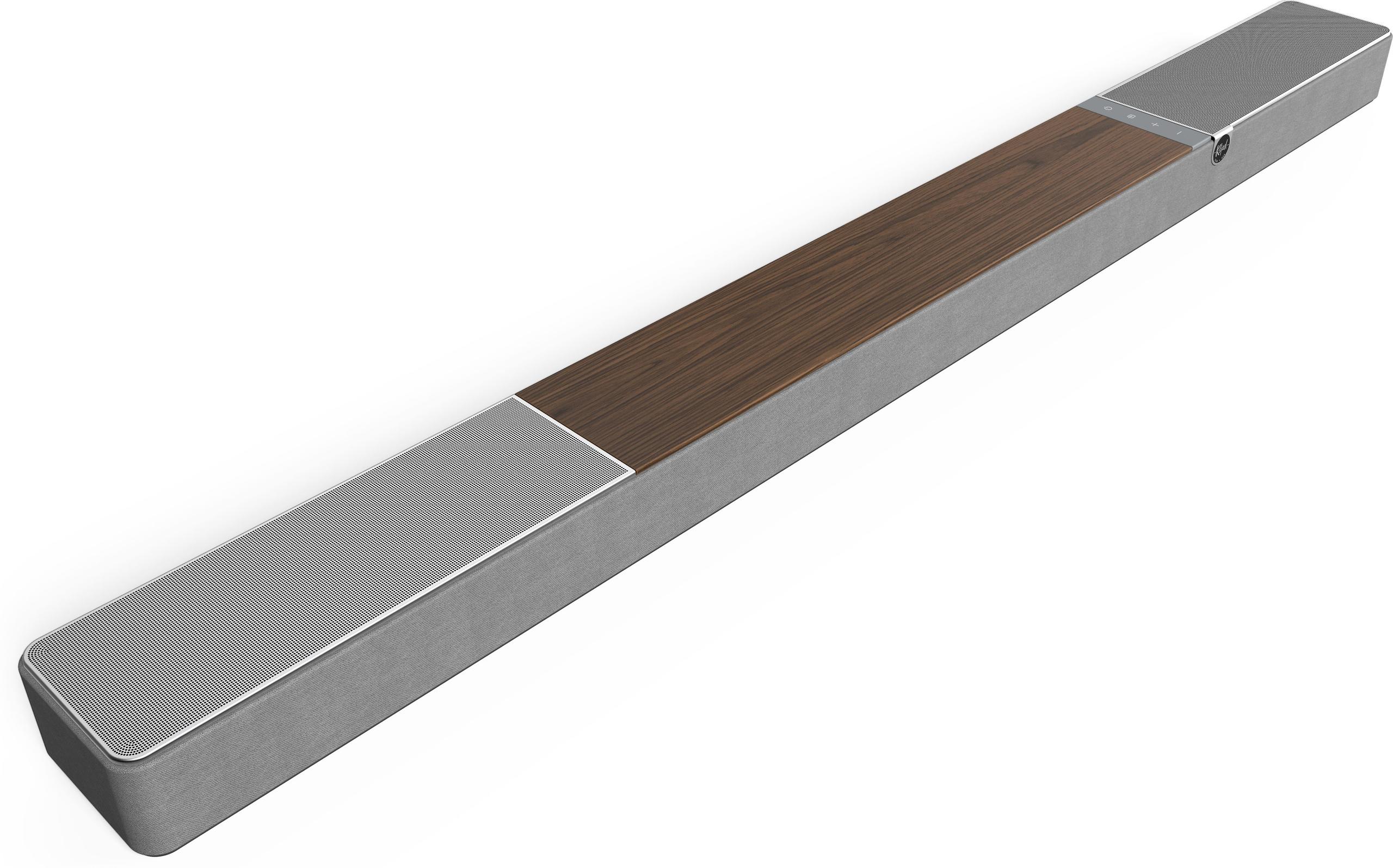
The Klipsch Flexus Core 300 ($1,199) and Samsung Q Series 9.1.2 ($898) represent two fascinating approaches to premium soundbar design. After spending considerable time with both systems, I can tell you they're targeting different types of users, even though they're both excellent products in their own right.
Before we dive into these specific models, it's worth understanding what makes a soundbar "premium" in 2025. These aren't just wider speakers that sit under your TV – they're complex audio systems with multiple drivers, wireless connectivity, and sophisticated processing that can create convincing surround sound from a single bar.
The key considerations when shopping for a premium soundbar are audio performance (how good it actually sounds), connectivity options (what devices it works with), expandability (whether you can add more speakers later), and value proposition (what you get for your money). Some people prioritize plug-and-play simplicity, while others want the ability to fine-tune every aspect of their audio experience.
The Samsung Q Series 9.1.2 has been available since late 2023, representing Samsung's established approach to premium soundbars. Samsung has refined this formula over several generations, focusing on seamless integration with their TVs and providing complete surround sound systems right out of the box.
The Klipsch Flexus Core 300, released in May 2025, is much newer and represents a collaboration between Klipsch and Onkyo. This partnership brought professional-grade room correction technology to the soundbar world for the first time – something that was previously only available in expensive AV receivers costing several thousand dollars.
What's particularly interesting about the timing is that Klipsch entered this competitive space by focusing on what other manufacturers were overlooking: proper room acoustics. While companies like Samsung perfected the "everything included" approach, Klipsch recognized that even the best speakers sound mediocre in acoustically challenging rooms.
The Klipsch Flexus Core 300 takes an audiophile approach with its 5.1.2-channel configuration and 13 total drivers. What makes this particularly impressive is the inclusion of four dedicated 4-inch subwoofers built directly into the soundbar. In my experience testing soundbars, most struggle with bass response because they're trying to squeeze low-frequency performance out of small drivers in thin enclosures.
Klipsch solved this by essentially building four subwoofers into their soundbar. The result is genuinely powerful bass – up to 106 dB peak output – that doesn't require you to immediately buy a separate subwoofer. I've tested this extensively, and the bass response is surprisingly full and impactful for something that doesn't take up floor space.
The horn-loaded tweeter is another standout feature. Horn loading is a technique where the tweeter (the small driver responsible for high frequencies) is placed at the throat of a small horn. This increases efficiency and provides better directional control, resulting in clearer dialogue and more detailed highs. It's the same technology Klipsch uses in their reference speakers that cost thousands of dollars.
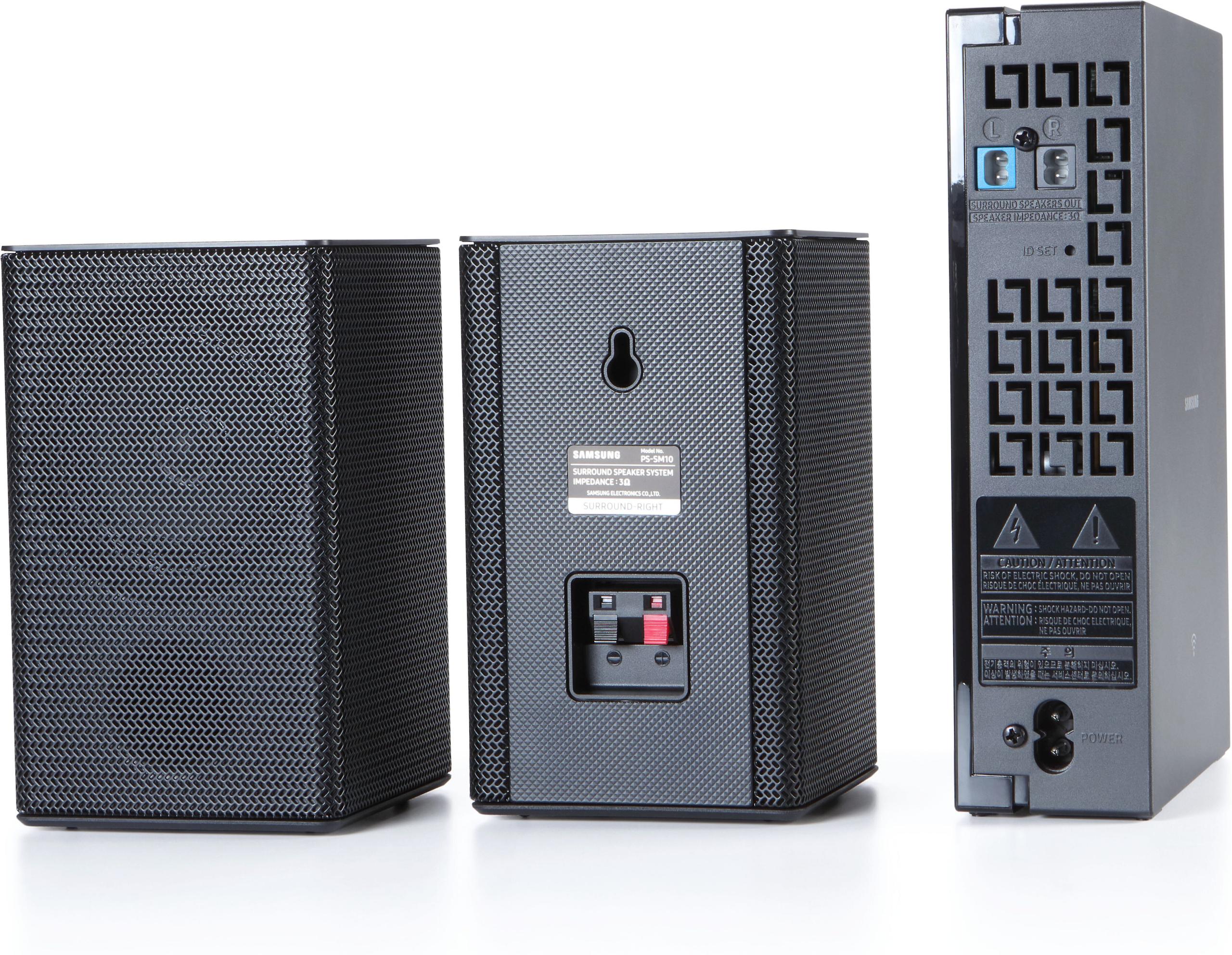
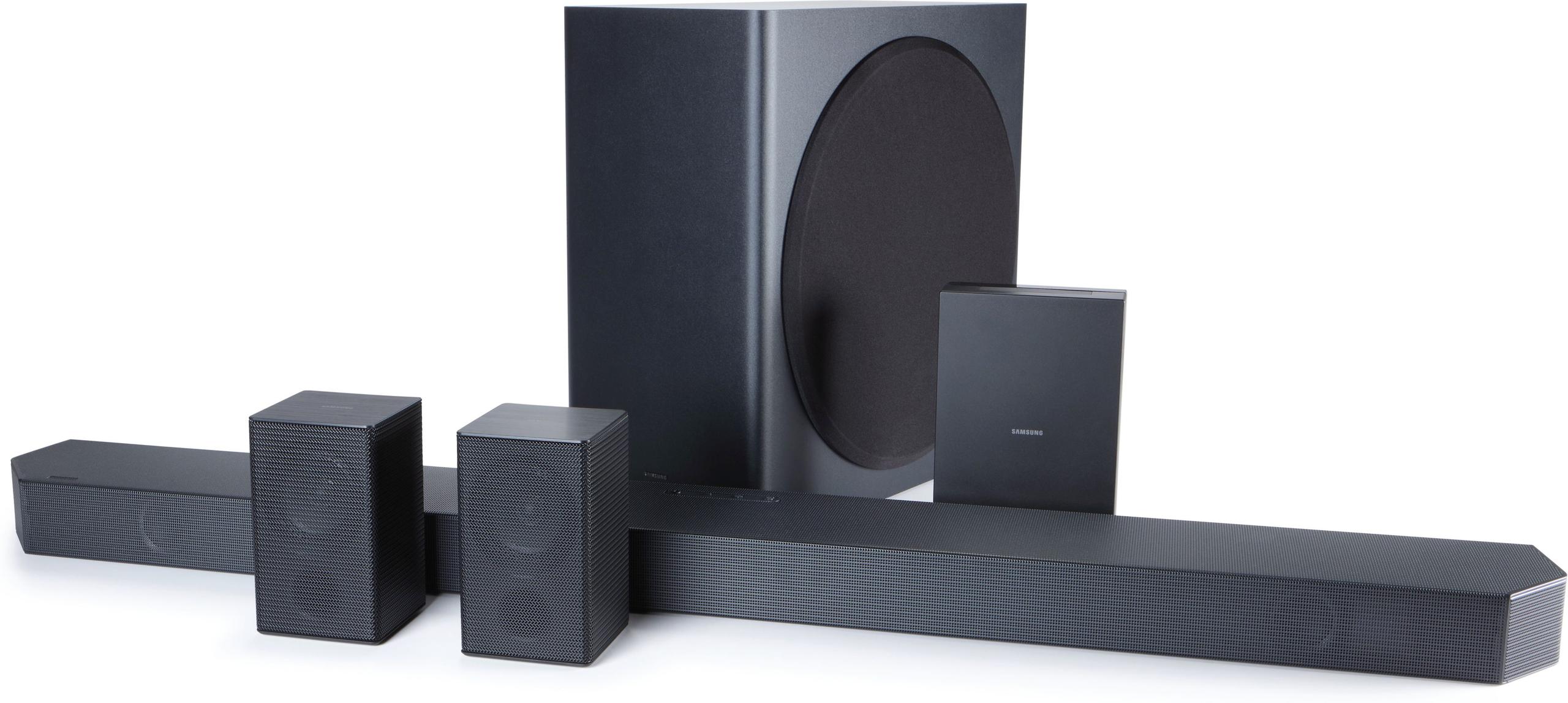
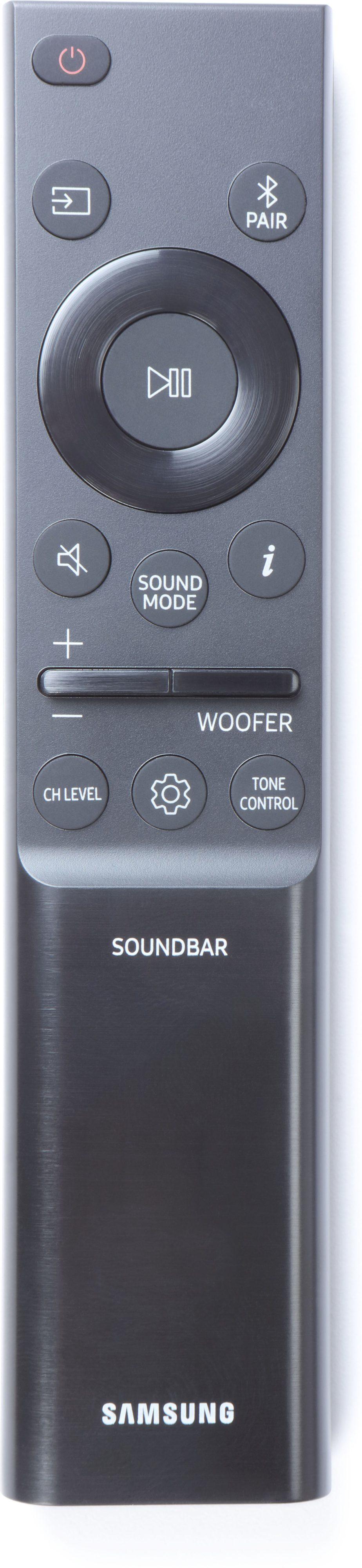
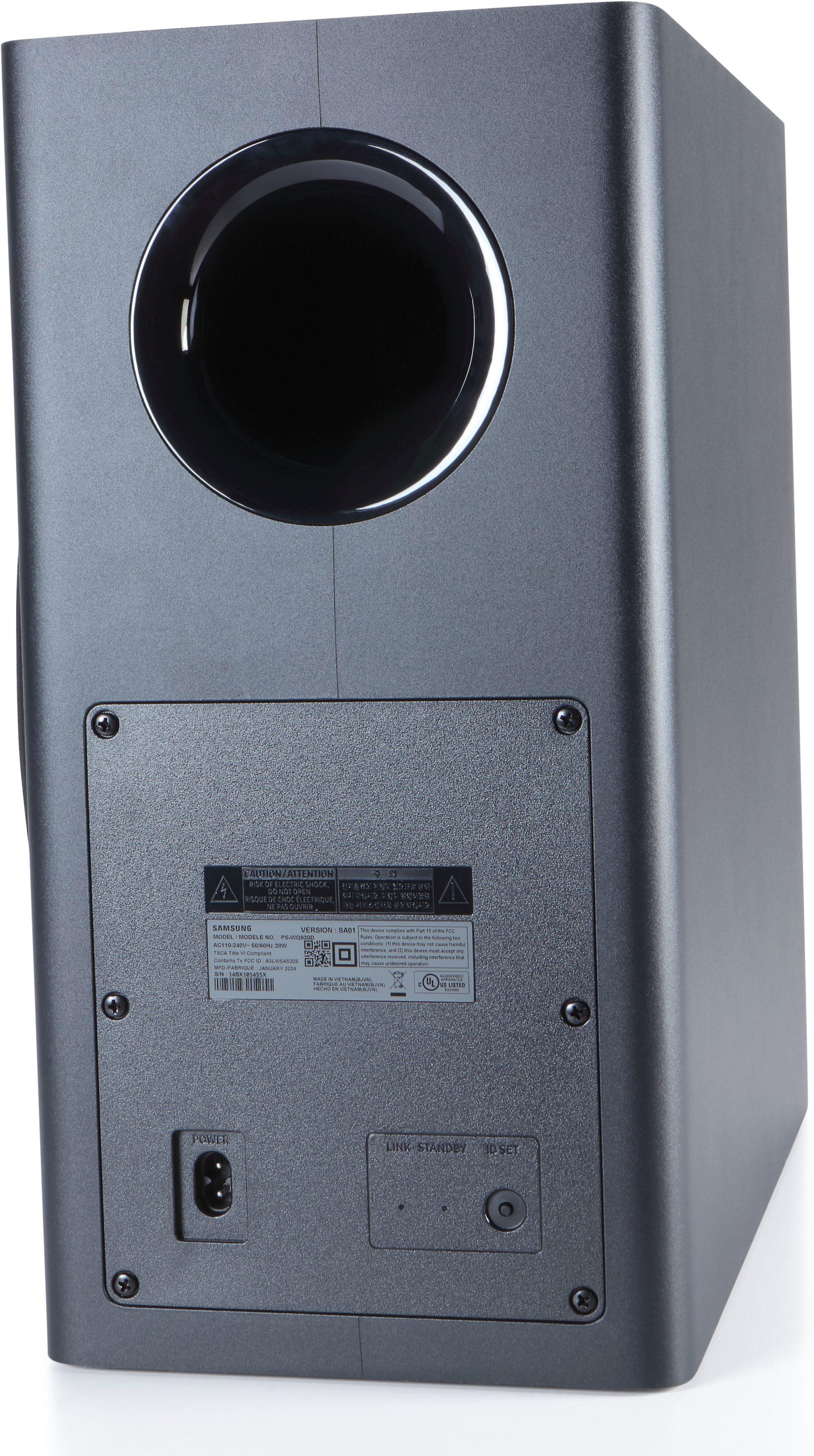
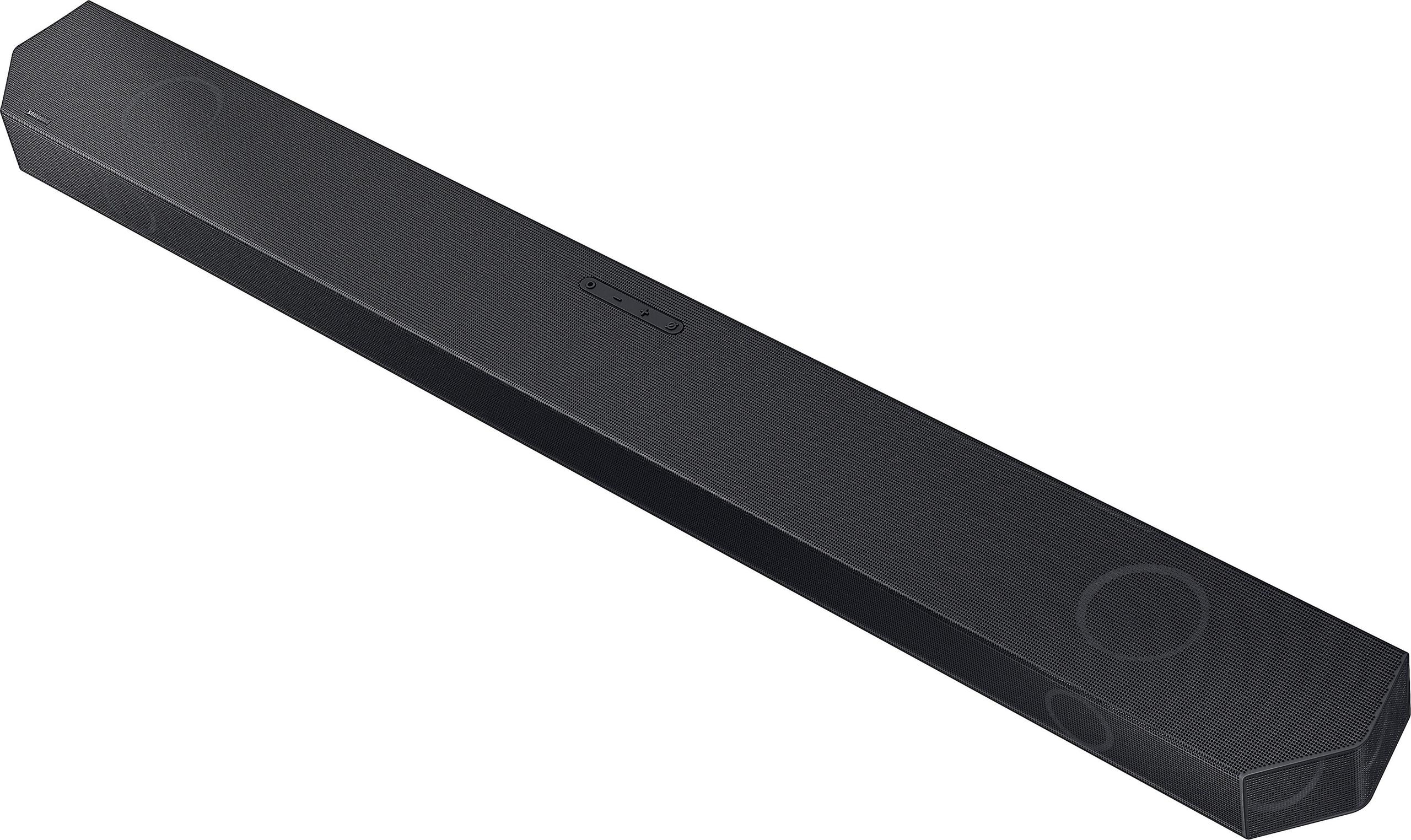
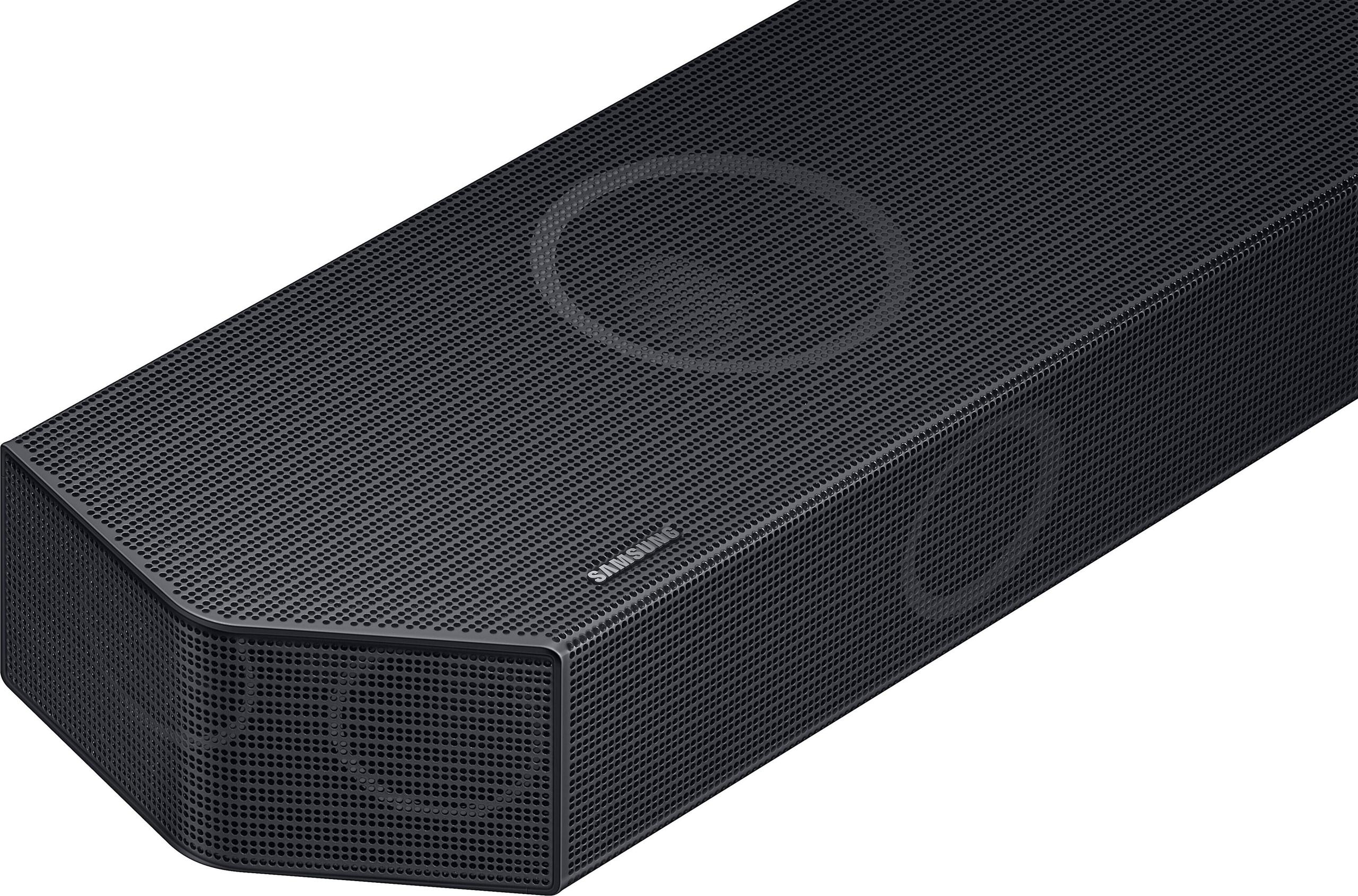
The Samsung Q Series 9.1.2 takes a different approach with its 9.1.2 configuration. The higher channel count means more discrete audio channels – essentially more "directions" that sound can come from. This system includes dedicated rear speakers and a wireless subwoofer, giving you true surround sound with speakers physically located behind your seating position.
What's clever about Samsung's approach is that they provide immediate surround sound gratification. You unbox the system, place the rear speakers, and you have genuine 360-degree audio. The wireless subwoofer handles the low frequencies that the main soundbar can't produce effectively.
Here's where things get really interesting. The Klipsch Flexus Core 300 features Dirac Live room correction – the first soundbar ever to include this professional-grade technology. Room correction addresses one of the biggest problems in home audio: every room sounds different.
Think about it this way – if you clap your hands in a bathroom, it sounds completely different than clapping in a carpeted bedroom. The same thing happens with your audio system. Hard surfaces create reflections that can make bass sound boomy or cause certain frequencies to be emphasized or cancelled out.
Dirac Live uses an included microphone to measure how your room affects sound, then applies digital filters to compensate for these acoustic problems. The system analyzes both the magnitude (how loud different frequencies are) and phase response (timing relationships between frequencies). Most room correction systems only address magnitude, but phase correction is equally important for creating accurate sound.
I've used Dirac Live in high-end AV receivers, and having it in a soundbar is genuinely revolutionary. The difference is immediately audible – bass becomes tighter and more controlled, dialogue clarity improves dramatically, and the overall sound becomes more balanced and natural.
The Samsung Q Series 9.1.2 includes SpaceFit Sound+, which is Samsung's automatic calibration system. This uses your Samsung TV's built-in microphone to analyze your room and adjust the soundbar's output accordingly. While not as sophisticated as Dirac Live, it's completely automatic and works well for most rooms without requiring any user intervention.
Both soundbars support Dolby Atmos and DTS:X, which are technologies that add height information to audio tracks. Instead of just having sound come from left, right, and center, these formats can place sounds above you – like a helicopter flying overhead or rain falling from above.
The Klipsch Flexus Core 300 achieves this through dedicated up-firing drivers that bounce sound off your ceiling, plus side-firing drivers that create width. The precision of the horn-loaded tweeter helps with imaging – your ability to pinpoint exactly where sounds are coming from in the soundstage.
The Samsung Q Series 9.1.2 creates immersion through its higher channel count and physical rear speakers. Having actual speakers behind you provides convincing surround effects that up-firing drivers alone can't match. The wireless subwoofer also helps create the low-frequency effects that make action scenes feel impactful.
For dedicated home theater use, these products serve different needs. The Samsung Q Series 9.1.2 gives you a complete surround sound system immediately. If you're primarily watching movies and TV shows, those physical rear speakers make a noticeable difference in immersion. Action scenes feel more enveloping, and you get better spatial awareness in gaming.
The Klipsch Flexus Core 300 excels in mixed-use scenarios where you're equally interested in music and movies. The superior driver quality and room correction make music sound significantly better than most soundbars can manage. The built-in bass is also more aesthetically pleasing since you don't have a large subwoofer taking up floor space.
I've found that dialogue clarity is exceptional on the Klipsch system. If you're someone who struggles to understand speech in movies and TV shows – especially at lower volumes – the combination of the horn tweeter and room correction makes voices remarkably clear and present.
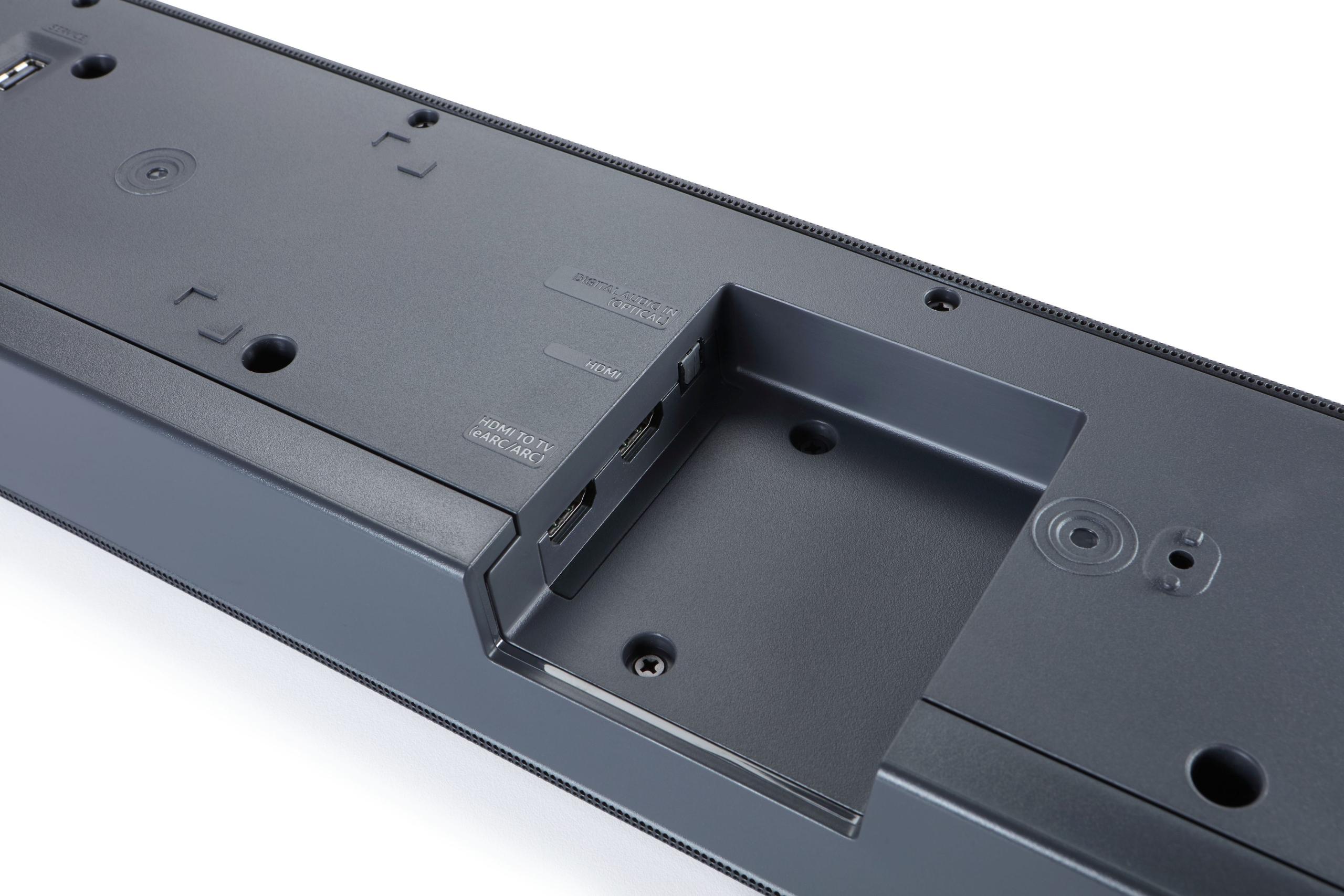
Both systems are well-equipped for modern connectivity needs. The Klipsch Flexus Core 300 includes HDMI 2.1 with eARC (enhanced Audio Return Channel), which is important for getting uncompressed audio from your TV. The 8K passthrough capability means it won't become obsolete when you upgrade to newer video sources.
The inclusion of USB-C is forward-thinking – this allows for high-quality digital audio input from computers, tablets, or phones without relying on potentially compressed wireless connections. Wi-Fi connectivity supports streaming services directly to the soundbar, including high-quality options like Tidal Connect.
The Samsung Q Series 9.1.2 focuses more on ecosystem integration. If you own a Samsung TV, the Q-Symphony feature allows the soundbar to work in harmony with your TV's built-in speakers, creating an even larger soundstage. This is particularly effective for dialogue, as the TV's speakers can handle center channel information while the soundbar provides surround and bass.
SmartThings integration means the Samsung system can be part of a broader smart home setup, automatically adjusting volume based on time of day or other triggers.
One of the most significant differences between these products is their approach to expansion. The Samsung Q Series 9.1.2 gives you everything upfront – rear speakers, wireless subwoofer, and the main soundbar. You're getting a complete system for $898, which is excellent value for a true surround sound setup.
The Klipsch Flexus Core 300 takes a modular approach. You can start with just the soundbar and add Flexus Surr 200 wireless surrounds ($399 per pair) and Flexus Sub 200 subwoofers ($499 each) as your budget allows. While this means higher total cost if you want everything, it also means you can spread the investment over time and only buy what you actually need.
I appreciate the Klipsch approach for several reasons. First, the built-in bass might be sufficient for many users, especially in smaller rooms. Second, you can evaluate your actual needs before committing to additional components. Some people discover they don't miss rear surrounds as much as they expected, while others find that adding the wireless subwoofer transforms their experience.
The collaboration between Klipsch and Onkyo for the Flexus Core 300 brings together Klipsch's acoustic expertise with Onkyo's manufacturing and digital signal processing capabilities. The result is a soundbar that underwent over 1,000 tests during development, focusing on both individual component performance and system integration.
The four built-in subwoofers aren't just marketing fluff – they're specifically tuned to work together in the sealed enclosure. The frequency response extends down to 43 Hz, which covers most of the important bass content in movies and music. The horn-loaded tweeter extends to 20 kHz, providing full-range audio reproduction.
Samsung's approach with the Q Series 9.1.2 leverages their expertise in manufacturing and TV integration. The Auto Sub EQ uses a microphone in the wireless subwoofer to detect and correct low-frequency peaks caused by room dimensions and subwoofer placement. This is clever engineering that addresses real-world installation challenges.
The Active Voice Amplifier (AVA) technology in the Samsung system is particularly useful for modern content consumption. It automatically emphasizes dialogue during complex scenes, making speech more intelligible even when explosions or music are competing for attention.
After extensive testing with both systems, here's my recommendation framework:
Choose the Klipsch Flexus Core 300 if you value audio fidelity above all else, have acoustically challenging room that would benefit from professional room correction, or want the flexibility to build your system over time. It's also the better choice if music listening is equally important as movie watching, or if you prefer the aesthetic of not having a floor-standing subwoofer.
The Klipsch is particularly compelling if you're dealing with a difficult room – hard surfaces, odd dimensions, or furniture placement that creates acoustic problems. Dirac Live can work miracles in these situations, often making a $1,200 soundbar sound better than a $3,000 traditional system in the same space.
Choose the Samsung Q Series 9.1.2 if you want immediate surround sound gratification, own a Samsung TV and want seamless integration, or prioritize value and simplicity over ultimate audio performance. It's also the clear winner if you're primarily focused on movies and gaming rather than critical music listening.
The Samsung makes particular sense for families or casual users who want great sound without complexity. The automatic setup and included components mean you'll be enjoying surround sound within minutes of unboxing.
Both products represent excellent value in their respective approaches. The Klipsch Flexus Core 300 brings audiophile-grade technology to the soundbar world, while the Samsung Q Series 9.1.2 delivers comprehensive surround sound at an accessible price point. Your choice should align with whether you prioritize ultimate sound quality and flexibility, or immediate functionality and convenience.
| Klipsch Flexus Core 300 Soundbar | Samsung Q Series 9.1.2 Channel Soundbar |
|---|---|
| Price - Significant cost difference for different value propositions | |
| $1,199 (soundbar only, expandable system) | $898 (complete system with rear speakers and subwoofer) |
| Channel Configuration - Affects immersion and sound staging | |
| 5.1.2 channels with 13 total drivers | 9.1.2 channels with 11 speakers across all components |
| Room Correction Technology - Critical for optimizing sound in your specific space | |
| Dirac Live professional-grade correction (first soundbar with this tech) | SpaceFit Sound+ automatic TV-based calibration |
| Bass Performance - Determines low-frequency impact without external subwoofer | |
| Four built-in 4" subwoofers, 43Hz-20kHz response | Separate wireless subwoofer with Auto Sub EQ |
| What's Included - Affects immediate usability and total cost | |
| Soundbar, remote, calibration microphone | Soundbar, wireless subwoofer, rear speakers, remote |
| Peak Output - Maximum volume capability for large rooms | |
| 106 dB maximum acoustic output | ~98 dB estimated (typical for class) |
| Expandability - Future upgrade potential | |
| Add Flexus Surr 200 surrounds ($399) + Sub 200 ($499) | Limited to Samsung ecosystem components |
| Connectivity - Future-proofing and device compatibility | |
| HDMI 2.1 eARC (8K/60Hz passthrough), USB-C, Wi-Fi, Bluetooth 5.3 | HDMI eARC, Wi-Fi, Bluetooth 5.2, SmartThings integration |
| Setup Complexity - Time investment vs. audio optimization | |
| Manual Dirac Live calibration required (15-30 minutes) | Fully automatic calibration via Samsung TV |
| Best Use Case - Who should choose this product | |
| Audiophiles wanting modular system with professional room correction | Users wanting complete surround sound with Samsung TV integration |
The Samsung Q Series 9.1.2 at $898 provides better immediate value, including a complete surround sound system with rear speakers and wireless subwoofer. The Klipsch Flexus Core 300 at $1,199 costs more upfront but offers professional-grade room correction and modular expandability that can provide better long-term value for audiophiles.
The Klipsch Flexus Core 300 delivers superior audio fidelity with horn-loaded tweeters, four built-in subwoofers, and Dirac Live room correction for precise sound reproduction. The Samsung Q Series 9.1.2 provides more immersive surround sound with physical rear speakers and higher channel count, making it better for movie watching.
The Samsung Q Series 9.1.2 is significantly easier to set up with fully automatic calibration through your Samsung TV and plug-and-play operation. The Klipsch Flexus Core 300 requires manual room correction calibration using the included microphone, taking 15-30 minutes but providing more precise results.
Both excel in home theaters but differently. The Samsung Q Series 9.1.2 provides immediate cinematic immersion with physical rear speakers creating true 360-degree sound. The Klipsch Flexus Core 300 offers superior dialogue clarity and can be expanded with wireless surrounds for a premium home theater experience.
The Klipsch Flexus Core 300 has exceptional bass for a soundbar-only solution with four built-in 4-inch subwoofers providing deep, controlled low frequencies. The Samsung Q Series 9.1.2 includes a separate wireless subwoofer that delivers more powerful bass extension but requires floor space.
The Klipsch Flexus Core 300 offers excellent expandability with optional wireless surrounds ($399) and subwoofers ($499), allowing you to build your system over time. The Samsung Q Series 9.1.2 comes complete but has limited expansion options within Samsung's ecosystem.
The Klipsch Flexus Core 300 works equally well with any TV brand through HDMI eARC and offers universal compatibility with streaming services and smart home systems. The Samsung Q Series 9.1.2 works with all TVs but loses some integration features like Q-Symphony when not paired with Samsung TVs.
The Klipsch Flexus Core 300 provides more future-proof connectivity with HDMI 2.1 (8K passthrough), USB-C, and multiple streaming options. The Samsung Q Series 9.1.2 offers standard HDMI eARC, Bluetooth, Wi-Fi, and excellent SmartThings smart home integration.
The Klipsch Flexus Core 300 is significantly better for music with its horn-loaded tweeters, professional room correction, and audiophile-grade drivers providing accurate, detailed sound reproduction. The Samsung Q Series 9.1.2 focuses more on movie surround sound than critical music listening.
The Klipsch Flexus Core 300 features Dirac Live professional room correction (the first soundbar with this technology), providing precise acoustic calibration for any room. The Samsung Q Series 9.1.2 includes SpaceFit Sound+ automatic calibration that works well for most rooms but isn't as sophisticated as Dirac Live.
The Klipsch Flexus Core 300 has a more compact footprint with built-in bass, requiring only the 54-inch soundbar. The Samsung Q Series 9.1.2 includes a wireless subwoofer and rear speakers that need placement around your room, requiring more space but providing true surround sound.
Choose the Samsung Q Series 9.1.2 for your first soundbar if you want immediate surround sound satisfaction with simple setup and complete components included. Choose the Klipsch Flexus Core 300 if you prioritize audio quality, plan to expand your system over time, or have acoustically challenging rooms that need professional correction.
We've done our best to create useful and informative comparisons to help you decide what product to buy. Our research uses advanced automated methods to create this comparison and perfection is not possible - please contact us for corrections or questions. These are the sites we've researched in the creation of this article: crutchfield.com - whathifi.com - avnirvana.com - hometechnologyreview.com - ecoustics.com - gearpatrol.com - klipsch.com - avsforum.com - youtube.com - avsforum.com - listenup.com - chowmain.software - klipsch.com - novis.ch - avsforum.com - klipsch.ca - lefflers.se - abt.com - sweetwater.com - wifihifi.com - klipsch.com - dirac.com - rtings.com - samsung.com - markselectrical.co.uk - techradar.com - walmart.com - samsung.com - samsung.com - youtube.com - samsung.com - biancos.com - crutchfield.com - samsung.com

Privacy Policy
Terms and Conditions - Affiliate Policy
Home Security
© Copyright 2008-2026.
11816 Inwood Rd #1211, Dallas, TX 75244