

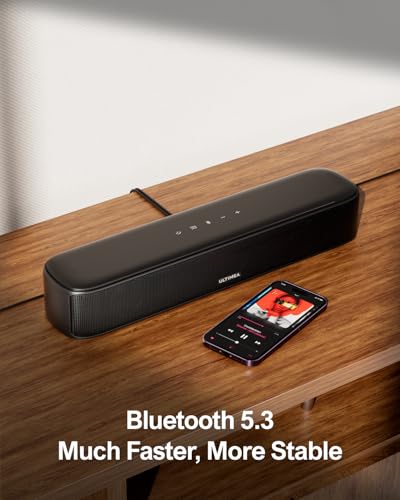





The home theater soundbar market has exploded over the past few years, with manufacturers racing to pack more speakers, channels, and features into increasingly sophisticated systems. At the heart of this competition lies a fundamental question: can budget systems deliver genuinely immersive surround sound, or do you need to invest in premium technology to get the full experience?
This dilemma perfectly captures the battle between the Ultimea Aura A40 and the Samsung Q Series 9.1.2. Released within the past couple of years, these systems represent dramatically different philosophies about home theater audio. The Ultimea takes a "more speakers for less money" approach, while Samsung bets on advanced spatial audio processing and ecosystem integration.
Before diving into these specific products, it's crucial to understand what those numbers like "7.1" and "9.1.2" actually represent. The first number indicates how many main channels surround you horizontally—front left, center, right, side surrounds, and rear surrounds. The second number is always "1" for the subwoofer channel that handles deep bass. The third number (when present) represents height channels that fire sound upward to bounce off your ceiling, creating overhead effects.
Here's where it gets tricky: some systems use "virtual" processing to simulate these channels through fewer physical speakers, while others provide discrete (separate) channels for each position. Think of virtual surround like a magician's trick—impressive when done well, but not quite the same as the real thing.
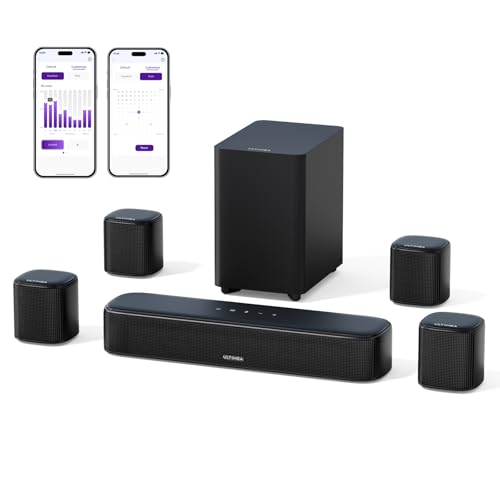
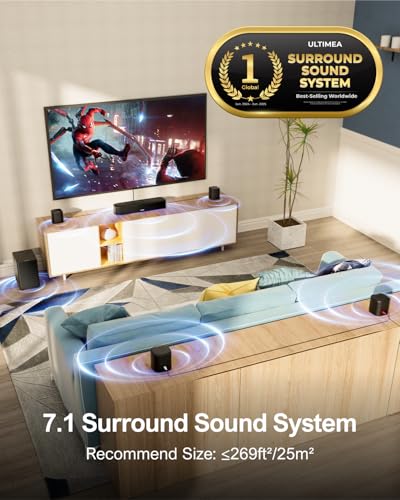
The Ultimea Aura A40 uses 7.1 virtual processing but includes four actual surround speakers positioned around your room. The Samsung Q Series 9.1.2 goes further with true 9.1.2 discrete processing, meaning each of those 12 channels gets its own unique audio signal. The Samsung also supports Dolby Atmos and DTS:X—object-based audio formats that treat sounds as three-dimensional objects moving through space rather than fixed to specific channels.
What makes the Ultimea Aura A40 remarkable isn't its processing power or premium features—it's the sheer audacity of including four physical surround speakers at its price point. Traditionally, getting actual surround speakers meant spending significantly more or buying a complete receiver-based system with separate components.
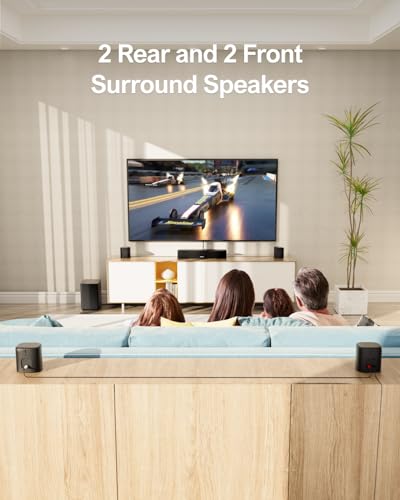
The Ultimea's approach centers on its SurroundX technology, which the company claims delivers 99.99% audio detail accuracy through AI optimization. While that specific percentage sounds like marketing hyperbole, user reviews consistently praise the system's ability to create a convincing 360-degree sound field. The key is those four 2-inch satellite speakers: two mount near your front seating area and two go behind you, creating genuine surround effects that virtual processing simply cannot match.
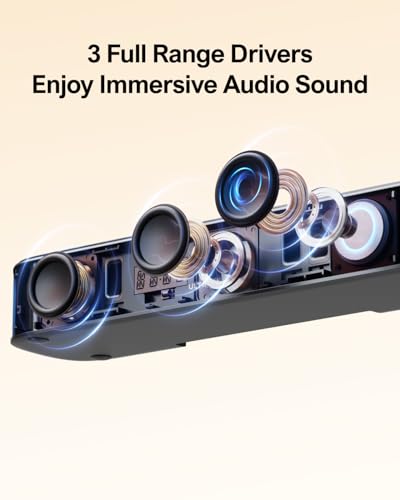
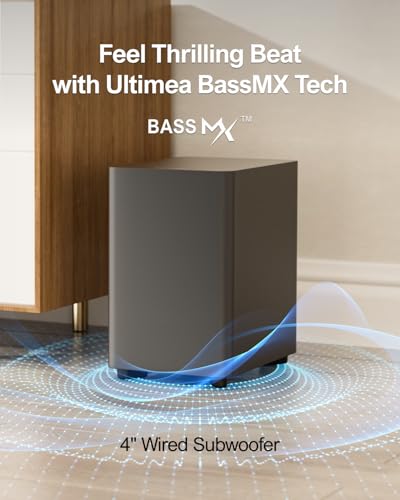
BassMX technology handles the low-frequency duties through a 4-inch wired subwoofer. This isn't going to shake your walls like larger systems, but it extends down to 65Hz—adequate for adding punch to explosions and depth to music. The 330W peak power rating spreads across all eight speakers (three in the main bar, four satellites, plus the subwoofer), providing enough headroom for most room sizes.
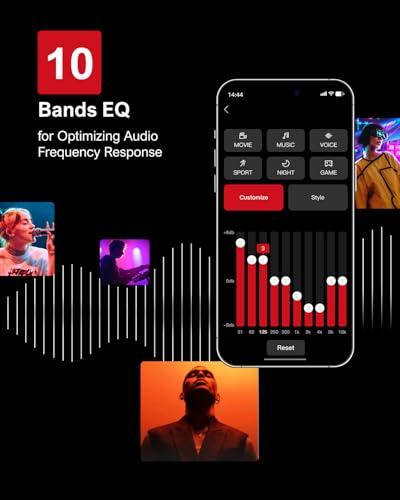
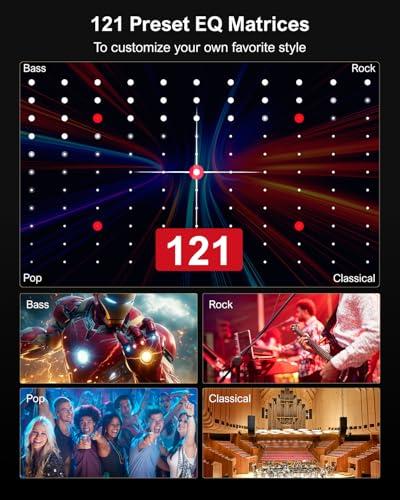
Where the Ultimea Aura A40 truly shines is customization. The system includes 121 preset EQ matrices—essentially pre-tuned sound profiles for different music genres and content types. These range from bass-heavy profiles perfect for electronic music to classical settings that emphasize midrange clarity. On top of that, you get a full 10-band equalizer for manual adjustment, plus six dedicated listening modes (Movie, Music, Voice, Sport, Game, Night) that optimize the sound signature for different activities.
This level of customization typically appears only on audiophile equipment costing much more. The Ultimea Smart App makes accessing these features straightforward, though the sheer number of options can feel overwhelming initially.
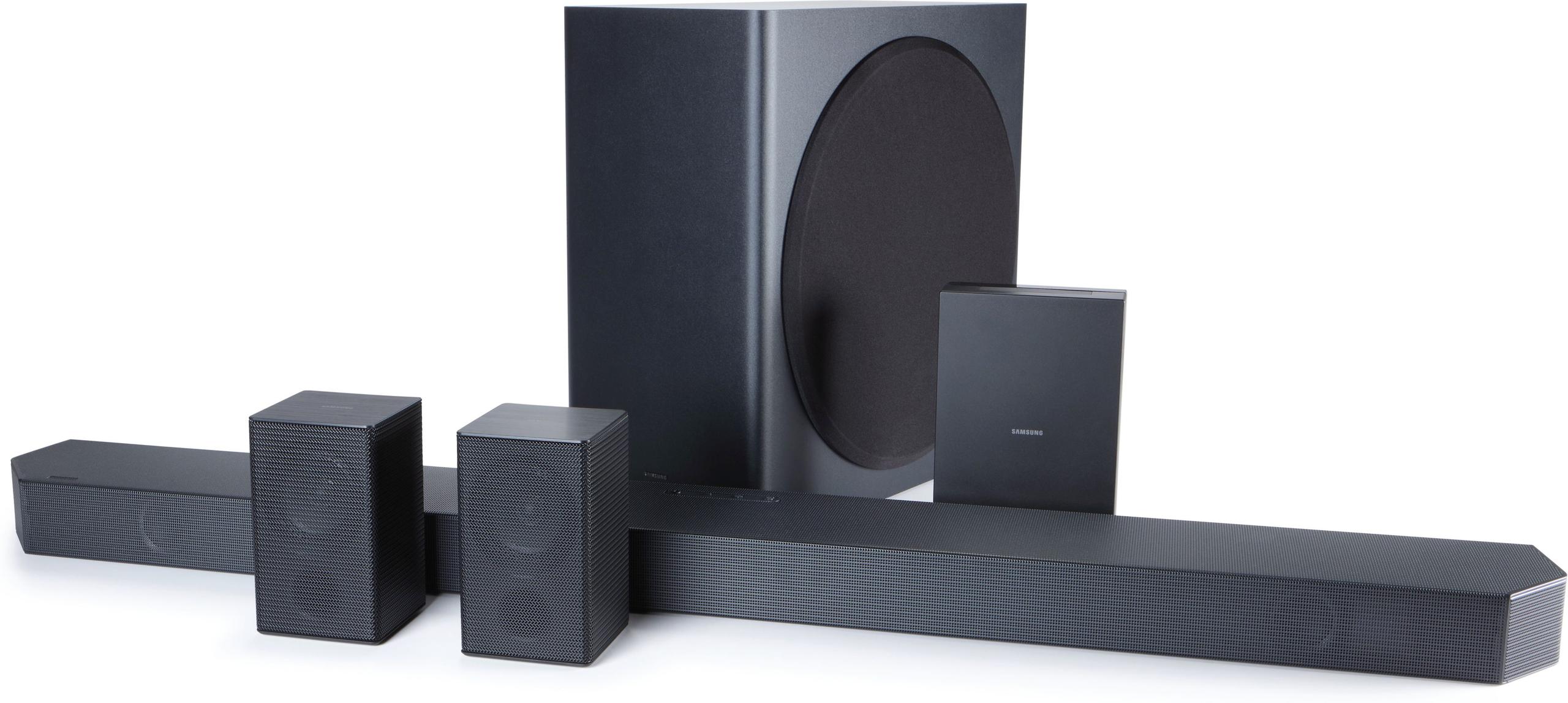
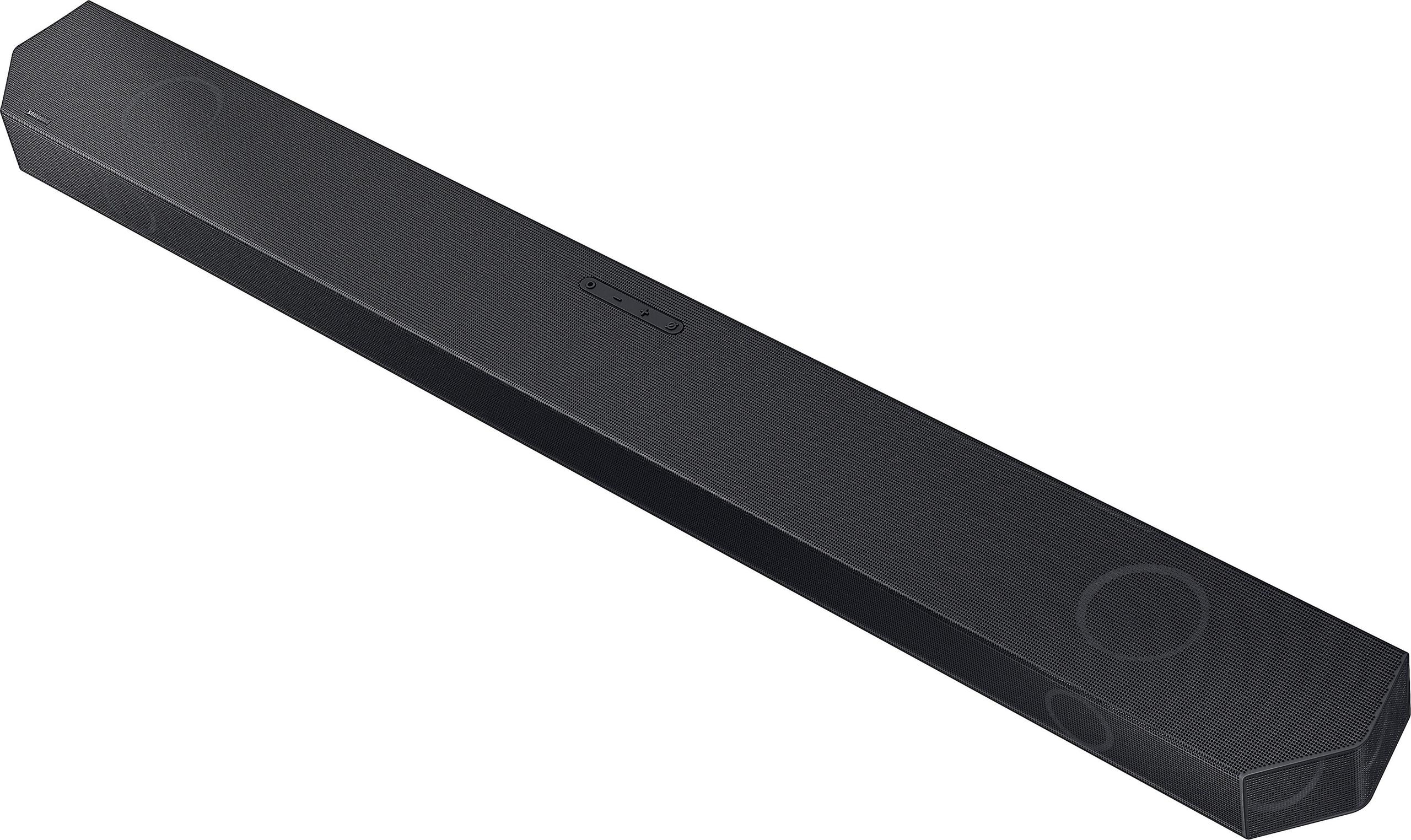
The Samsung Q Series 9.1.2, released in 2024, represents a completely different approach to home theater audio. Rather than maximizing speaker count at a budget price, Samsung focuses on delivering true spatial audio experiences through advanced processing and modern connectivity.
The heart of the system is genuine 9.1.2 channel processing with full Dolby Atmos and DTS:X support. These aren't just marketing buzzwords—they're fundamentally different ways of handling audio. Traditional channel-based systems assign specific sounds to specific speakers. Object-based formats like Dolby Atmos treat sounds as three-dimensional objects that can move smoothly through space, with the processor determining which speakers to use moment by moment.
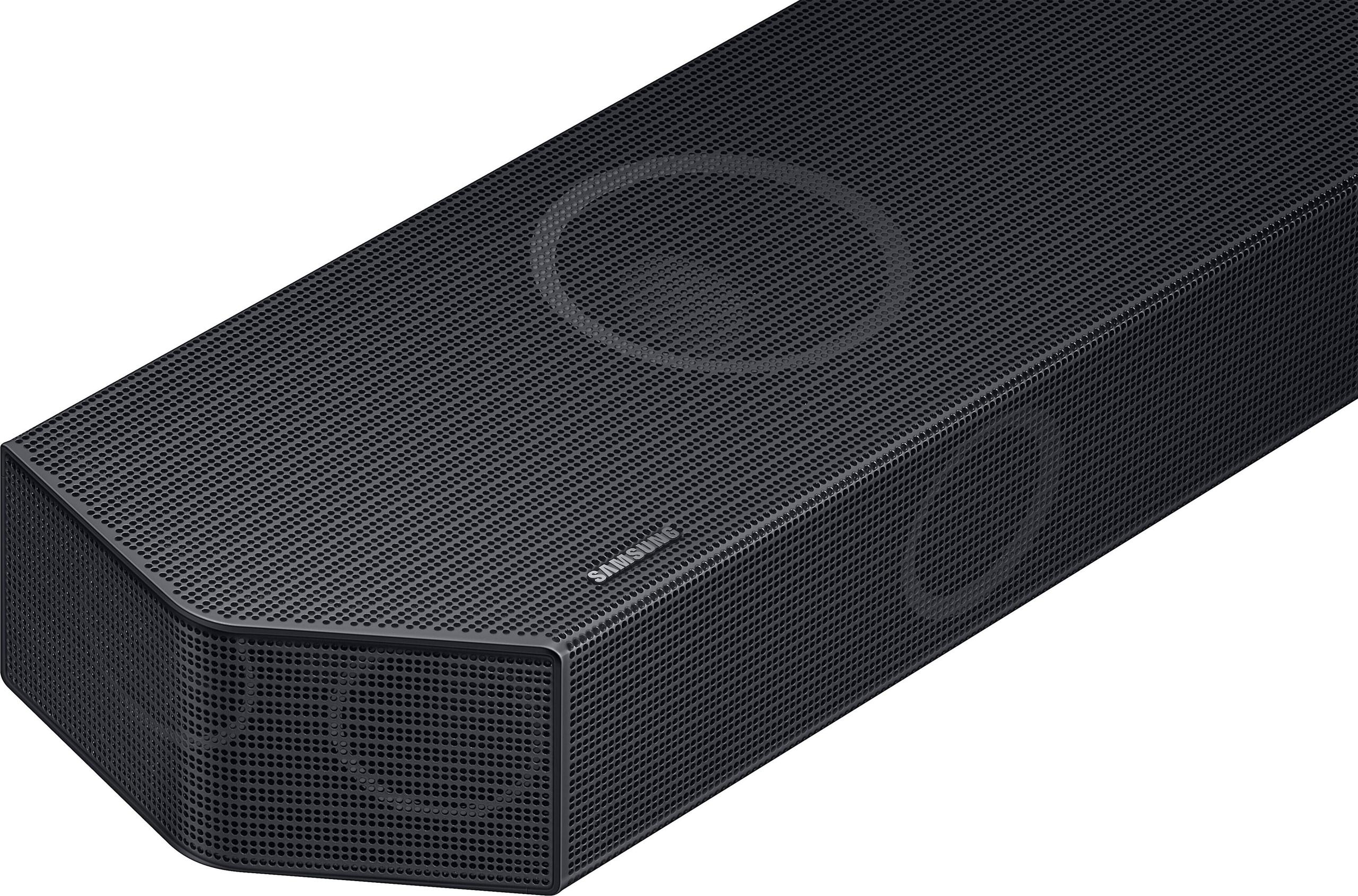
The Samsung's two up-firing drivers bounce sound off your ceiling to create height effects. When a helicopter flies overhead in a movie, you'll hear it move from behind you, over your head, and forward—something the Ultimea Aura A40 simply cannot reproduce due to its lack of height channels and Dolby Atmos processing.
SpaceFit Sound Pro represents another significant advantage. This room correction technology analyzes how sound bounces around your specific space, then adjusts the audio output to compensate for your room's acoustic properties. It's like having a professional audio engineer tune your system for your exact setup, automatically.
The Samsung also includes a discrete center channel—a dedicated speaker solely for dialogue and vocals. This makes an enormous difference for movie watching, as conversations remain clear and focused even during loud action scenes. The Active Voice Amplifier goes further, automatically boosting dialogue levels when it detects loud background noise.
Based on extensive user feedback and professional reviews, these systems create very different surround experiences. The Ultimea Aura A40 excels at lateral surround effects—sounds moving from side to side and front to back. Users consistently report impressive directional audio for gaming, with the ability to pinpoint enemy locations and feel immersed in virtual environments.
However, the Samsung's height channels add a dimension the Ultimea cannot touch. Dolby Atmos content places sounds above you in ways that feel genuinely three-dimensional. Rain falling from above, aircraft passing overhead, or ceiling-mounted speakers in a movie scene create convincing vertical effects. While professional reviews note the Samsung's height performance doesn't match more expensive flagship models, it still provides overhead effects the Ultimea's horizontal-only configuration cannot achieve.
For gaming specifically, both systems offer advantages. The Ultimea Aura A40's four surround speakers create excellent positional awareness for competitive gaming, while the Samsung Q Series 9.1.2's low latency and 4K@120Hz passthrough support make it ideal for next-generation console gaming.
This represents perhaps the largest performance gap between these systems. The Samsung's wireless subwoofer reaches approximately 27.5Hz according to professional measurements, while the Ultimea Aura A40's 4-inch driver bottoms out around 65Hz. That 38Hz difference represents nearly two full octaves of additional bass extension.
In practical terms, this means movie explosions, thunder, deep electronic music, and even male vocals have significantly more weight and impact on the Samsung. The Ultimea's bass is adequate and well-controlled for its size, but it fundamentally cannot produce the physical impact of deep bass that larger subwoofers provide.
Room size becomes crucial here. In smaller spaces, the Ultimea's bass feels more adequate, while larger rooms expose its limitations. The Samsung's deeper bass remains effective across a wider range of room sizes.
Professional reviews consistently highlight the Samsung's discrete center channel as a major advantage for dialogue reproduction. Conversations remain focused and articulate even during complex movie scenes with multiple speakers. The dedicated center channel prevents dialogue from getting lost in the mix—a common problem with soundbar systems that spread center channel information across multiple speakers.
The Ultimea Aura A40 handles dialogue through its three-channel mainbar with a dedicated Voice EQ mode. User reviews indicate good dialogue clarity, but without the pinpoint focus that a discrete center channel provides. For TV viewing and movie watching, this difference becomes increasingly noticeable with dialogue-heavy content.
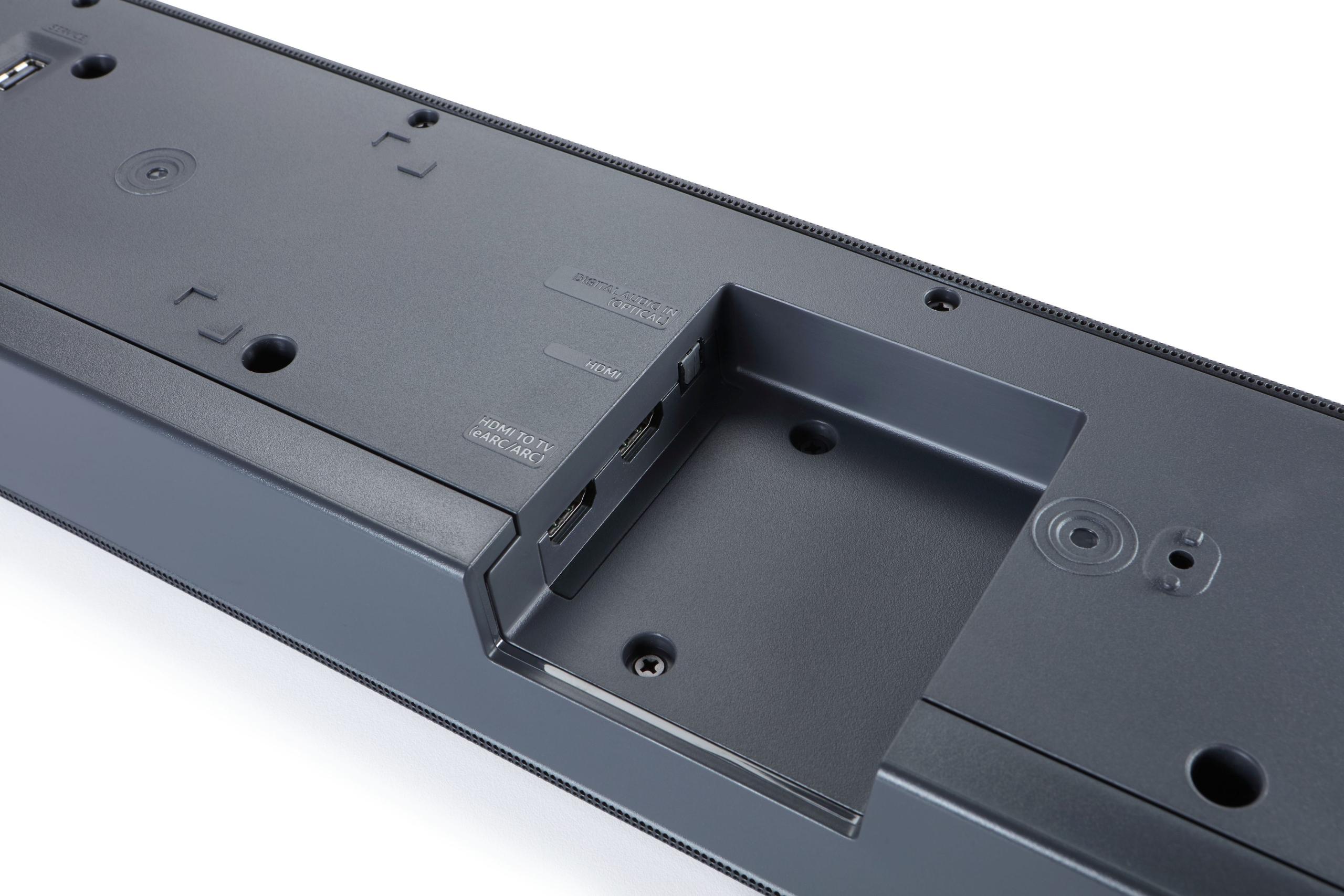
Here's where the fundamental difference in target markets becomes crystal clear. The Samsung Q Series 9.1.2 includes HDMI eARC and HDMI 2.1 input, enabling single-cable connection to your TV with support for all modern audio formats. The 4K@120Hz passthrough (though limited to 8-bit color depth) makes it compatible with PlayStation 5 and Xbox Series X gaming.
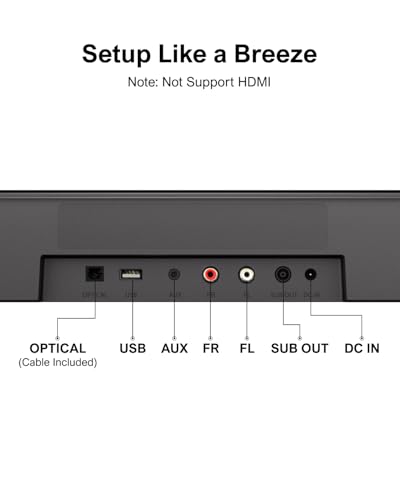
The Ultimea Aura A40 completely lacks HDMI connectivity, relying on optical, AUX, USB, and Bluetooth connections. This works fine for basic TV audio but prevents access to Dolby Atmos from streaming services, gaming consoles, or 4K Blu-ray players. Even if Ultimea added Dolby Atmos processing in a future firmware update, the lack of HDMI input means it couldn't receive those signals.
For users with modern equipment—4K TVs, gaming consoles, streaming devices—this connectivity limitation significantly impacts the Ultimea's long-term viability. However, for users with older equipment or simpler setups, the optical connection works perfectly well for standard audio formats.
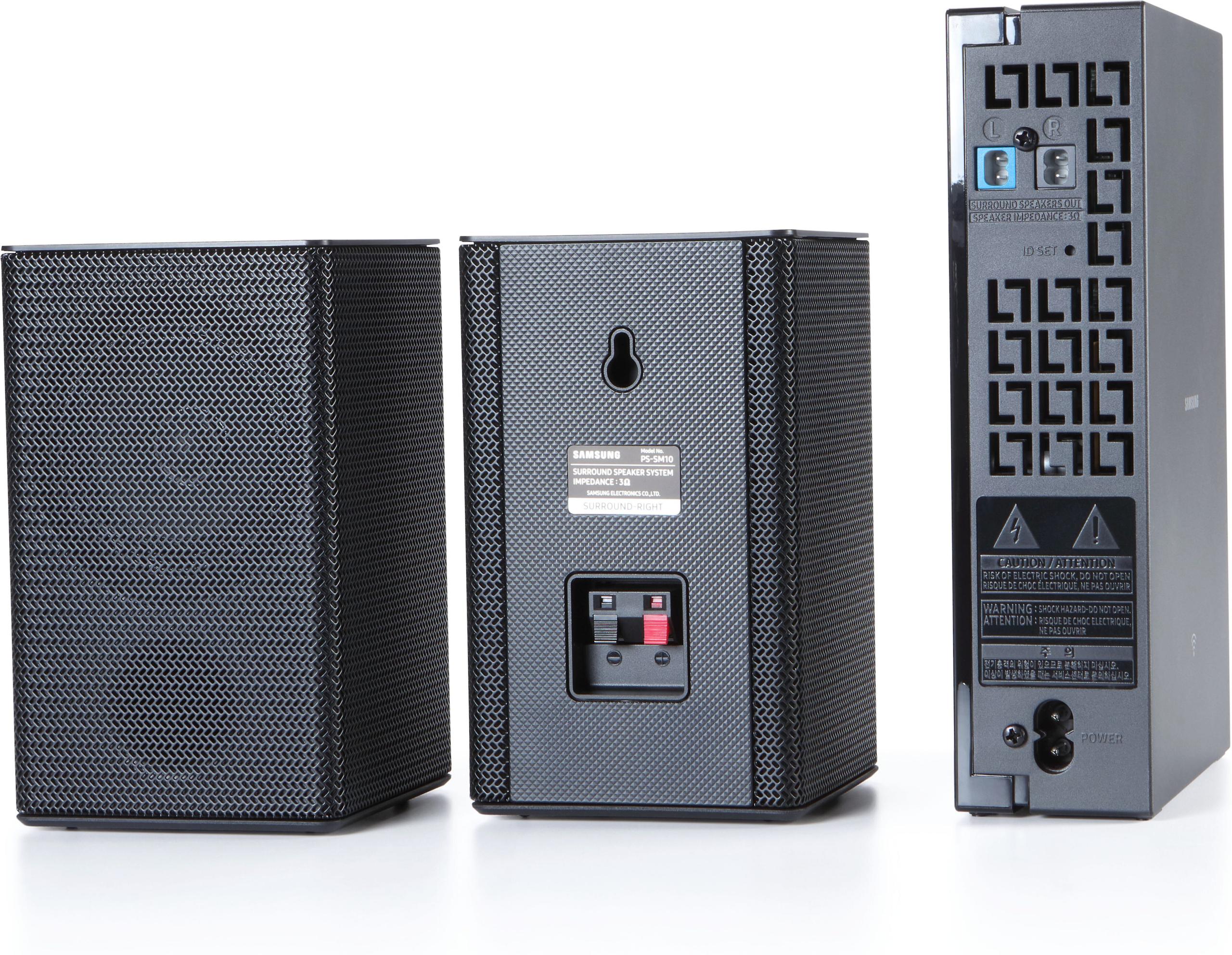
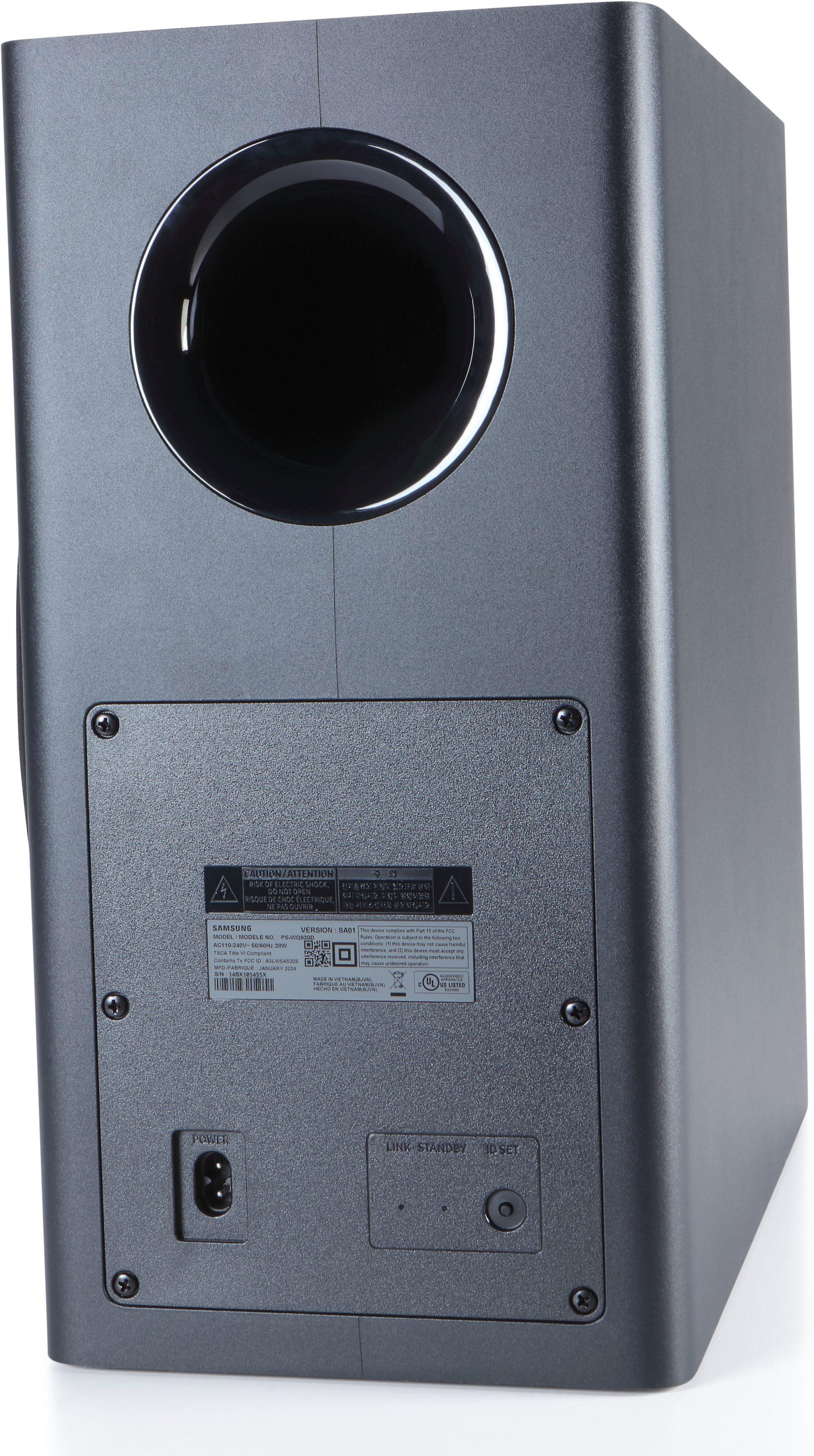
The Samsung Q Series 9.1.2 offers a cleaner installation experience despite having similar speaker counts. The subwoofer connects wirelessly, and the satellite speakers only need to connect to a wireless receiver module, reducing cable runs significantly.
The Ultimea Aura A40 requires wired connections for all four surround speakers, including 6-meter cable runs for the rear speakers. This creates substantial cable management challenges, particularly for the rear surrounds. However, at its price point, this represents a reasonable trade-off for getting physical surround speakers.
The Samsung's SpaceFit Sound Pro automatically optimizes the system for your room, while the Ultimea requires manual adjustment of surround levels to achieve optimal balance. This makes the Samsung more user-friendly out of the box, though the Ultimea's manual controls offer more precise customization for users willing to invest the time.
The Ultimea Aura A40 makes perfect sense for budget-conscious users who understand its limitations and can work within them. If you have an older TV with optical output, modest room size, and the patience to run speaker cables, it delivers an impressive surround experience at its price point.
Music enthusiasts particularly benefit from the extensive EQ customization. The 121 preset matrices and 10-band equalizer provide tuning flexibility that embarrasses many systems costing significantly more. If you listen to varied musical genres requiring different sound signatures, the Ultimea's customization depth becomes genuinely valuable.
The system also works well for users prioritizing lateral surround effects over height channels. Gaming performance receives consistent praise, with the four physical speakers creating convincing directional audio for competitive gaming.
The Samsung Q Series 9.1.2 justifies its premium pricing for users with modern equipment who want a complete home theater solution. The HDMI connectivity, Dolby Atmos support, and room correction make it plug-and-play compatible with current streaming services, gaming consoles, and 4K content.
Samsung TV owners gain additional value through Q-Symphony integration, which uses the TV's speakers as additional channels. While professional reviews suggest this doesn't dramatically improve performance, it demonstrates the ecosystem thinking that makes Samsung systems work better with Samsung TVs.
The automatic room correction proves particularly valuable for users who want optimal performance without manual tuning. The system analyzes your room and adjusts accordingly, delivering better out-of-box performance than systems requiring extensive manual setup.
After evaluating extensive user feedback, professional reviews, and technical specifications, both systems succeed in their respective markets, but they serve fundamentally different needs.
The Ultimea Aura A40 represents exceptional value engineering—delivering physical surround speakers and extensive customization at a price point that typically provides only virtual surround processing. Its limitations are real and significant, but for users who can work within them, it provides an impressive surround experience.
The Samsung Q Series 9.1.2 costs significantly more but delivers modern home theater capabilities that the Ultimea cannot match. The genuine Dolby Atmos processing, HDMI connectivity, and automatic room correction justify the premium for users wanting a complete solution that works seamlessly with current equipment.
Neither system is objectively "better"—they excel in different areas and target different priorities. The Ultimea maximizes surround speaker count and customization at a budget price, while the Samsung provides premium spatial audio processing and modern connectivity.
Your choice should depend primarily on your equipment, room size, and priorities. If you have modern devices and want true spatial audio, the Samsung's advantages are compelling. If you're working with a tight budget but refuse to compromise on having actual surround speakers, the Ultimea delivers remarkable value.
The market has room for both approaches, and competition between budget innovation and premium features ultimately benefits consumers by pushing both categories forward.
| Ultimea Aura A40 7.1 Channel Soundbar System | Samsung Q Series 9.1.2 Channel Soundbar |
|---|---|
| Channel Configuration - Determines immersion and spatial audio capabilities | |
| 7.1 virtual surround with 4 physical satellite speakers | True 9.1.2 discrete channels with Dolby Atmos height effects |
| Audio Format Support - Essential for modern streaming and gaming content | |
| No Dolby Atmos or DTS:X support | Full Dolby Atmos and DTS:X object-based audio |
| HDMI Connectivity - Critical for 4K TVs and gaming consoles | |
| None (optical, AUX, USB, Bluetooth only) | HDMI eARC + HDMI 2.1 In with 4K@120Hz passthrough |
| Subwoofer Configuration - Impacts bass depth and installation flexibility | |
| 4-inch wired subwoofer, 65Hz low frequency response | Larger wireless subwoofer reaching ~27.5Hz (much deeper bass) |
| Physical Surround Speakers - Creates genuine directional audio effects | |
| 4 wired satellite speakers (2 front, 2 rear) | 2 wireless satellite speakers via receiver module |
| EQ and Customization - Controls how much you can tailor the sound | |
| 121 preset EQ matrices + 10-band manual EQ | 4 sound modes + 7-band EQ with Adaptive Sound AI |
| Room Correction Technology - Automatically optimizes sound for your space | |
| Manual surround level adjustment only | SpaceFit Sound Pro with automatic acoustic analysis |
| Center Channel Design - Affects dialogue clarity in movies and TV | |
| Virtual center through 3-channel mainbar | Dedicated discrete center channel speaker |
| Height Channels - Creates overhead sound effects for immersive audio | |
| None (horizontal surround only) | 2 up-firing drivers for ceiling bounce effects |
| Gaming Features - Important for console and PC gaming performance | |
| Good directional audio, no HDMI passthrough | Low latency + 4K@120Hz passthrough for next-gen consoles |
| Smart Home Integration - Connects with TV and ecosystem features | |
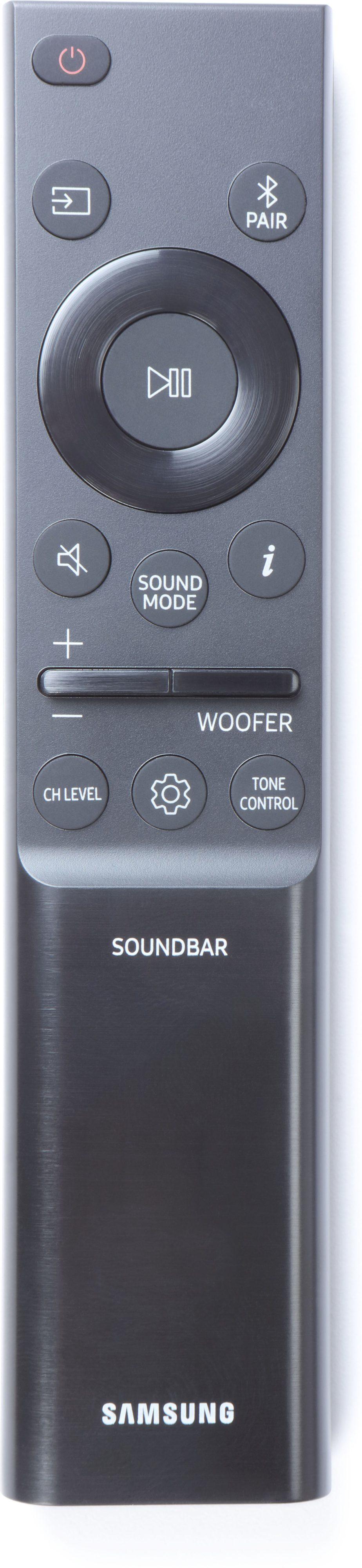
| Ultimea Aura A40 Smart App with OTA updates | Samsung SmartThings + Q-Symphony with Samsung TVs |
| Installation Complexity - Affects setup difficulty and cable management | |
| All 4 surrounds require wired connections (6m rear cables) | Mostly wireless with cleaner cable routing |
The Ultimea Aura A40 provides exceptional value by including four physical surround speakers at a budget-friendly price point, something typically found in much more expensive systems. The Samsung Q Series 9.1.2 costs significantly more but justifies the premium with true Dolby Atmos support, HDMI connectivity, and automatic room correction features that the Ultimea cannot match.
The Ultimea Aura A40 uses 7.1 virtual surround processing with four actual satellite speakers for horizontal sound effects. The Samsung Q Series 9.1.2 features true 9.1.2 discrete channel processing, adding two height channels that fire sound upward to create overhead effects for a more immersive three-dimensional audio experience.
No, only the Samsung Q Series 9.1.2 supports Dolby Atmos and DTS:X object-based audio formats. The Ultimea Aura A40 lacks both the processing capability and HDMI connectivity needed for modern spatial audio formats, limiting it to traditional surround sound processing.
Both excel in different ways. The Ultimea Aura A40 provides excellent directional audio through its four physical surround speakers, making it easy to locate enemies and effects. The Samsung Q Series 9.1.2 offers superior gaming integration with 4K@120Hz passthrough, low latency, and compatibility with next-generation console features.
The Samsung Q Series 9.1.2 delivers significantly deeper bass, reaching approximately 27.5Hz compared to the Ultimea Aura A40's 65Hz limit. This represents nearly two full octaves of additional low-frequency extension, providing much more impactful explosions, thunder, and deep musical content.
The Samsung Q Series 9.1.2 includes essential HDMI eARC and HDMI 2.1 inputs for modern TVs and gaming consoles, plus wireless connectivity features. The Ultimea Aura A40 relies entirely on optical, AUX, USB, and Bluetooth connections, which work with older equipment but limit access to advanced audio formats.
The Samsung Q Series 9.1.2 offers easier installation with a wireless subwoofer and satellite speakers that only connect to a receiver module. The Ultimea Aura A40 requires running cables to all four surround speakers, including 6-meter runs for rear speakers, creating more complex cable management but delivering physical surround at a lower price.
The Samsung Q Series 9.1.2 features a dedicated discrete center channel specifically for dialogue, plus Active Voice Amplifier technology that automatically enhances speech during loud scenes. The Ultimea Aura A40 handles dialogue through its three-channel mainbar with a Voice EQ mode, which is effective but not as focused as a dedicated center speaker.
The Ultimea Aura A40 offers extensive customization with 121 preset EQ matrices, a 10-band equalizer, and six listening modes through its smart app. The Samsung Q Series 9.1.2 provides a more streamlined approach with four sound modes, seven-band EQ, and automatic Adaptive Sound that adjusts to content type.
The Samsung Q Series 9.1.2 performs better in larger spaces due to its deeper bass extension, higher maximum output, and automatic room correction technology. The Ultimea Aura A40 works well in smaller to medium rooms but may struggle to fill larger spaces with adequate bass and volume.
Yes, both systems include dedicated apps. The Ultimea Aura A40 uses the Ultimea Smart App for extensive EQ control and OTA firmware updates. The Samsung Q Series 9.1.2 integrates with Samsung SmartThings for system control, room correction, and smart home connectivity features.
For modern home theater setups, the Samsung Q Series 9.1.2 is superior due to its Dolby Atmos support, HDMI connectivity, discrete center channel, and deeper bass response. The Ultimea Aura A40 can create an engaging home theater experience at a lower price point, but lacks the advanced features and connectivity needed for premium home theater applications.
We've done our best to create useful and informative comparisons to help you decide what product to buy. Our research uses advanced automated methods to create this comparison and perfection is not possible - please contact us for corrections or questions. These are the sites we've researched in the creation of this article: youtube.com - walmart.com - youtube.com - ultimea.com - homestudiobasics.com - ultimea.co - youtube.com - eu.ultimea.com - walmart.com - device.report - bestbuy.com - manuals.plus - community.ultimea.com - judge.me - support.ultimea.com - geekmaxi.com - provantage.com - bestbuy.com - youtube.com - uk.whatgeek.com - rtings.com - samsung.com - markselectrical.co.uk - techradar.com - walmart.com - samsung.com - samsung.com - youtube.com - samsung.com - biancos.com - crutchfield.com - samsung.com

Privacy Policy
Terms and Conditions - Affiliate Policy
Home Security
© Copyright 2008-2026.
11816 Inwood Rd #1211, Dallas, TX 75244