

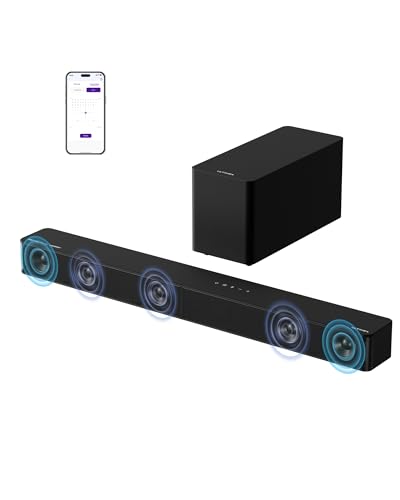



When shopping for a soundbar, you're essentially choosing between two philosophies: maximum bang for your buck or cutting-edge audio technology. The Ultimea Poseidon M60 Boom and Klipsch Flexus Core 300 represent these opposing approaches perfectly. Released in 2024 and 2025 respectively, both soundbars pack 5.1-channel surround sound into sleek packages, but they take dramatically different paths to get there.
Understanding soundbars means grasping what they're trying to replace: traditional surround sound systems with multiple speakers scattered around your room. Modern soundbars use clever engineering and digital processing to simulate that experience from a single bar-shaped speaker. The best ones make you forget you're not hearing sound from behind you, even though all the speakers face forward.
Before diving into these specific models, let's establish what separates good soundbars from great ones. First, there's dialogue clarity – arguably the most important feature since muddy dialogue ruins any movie experience. Then comes bass response, because weak bass makes action scenes feel hollow and music sound thin. Surround sound effectiveness determines whether you'll actually feel immersed in what you're watching, while room adaptation affects whether the soundbar will sound good in your specific space.
Power output matters, but not in the way you might think. A 300-watt soundbar doesn't automatically sound better than a 200-watt one – it's about how efficiently that power gets used. Dynamic range (the difference between the quietest and loudest sounds) often matters more than raw volume, especially for late-night viewing when you need clear dialogue without explosive sound effects waking the neighbors.
The technology landscape has evolved rapidly since 2020. Dolby Atmos support has moved from premium feature to standard expectation, while room correction technology – previously found only in expensive AV receivers – has started trickling down to soundbars. Wireless connectivity has improved dramatically, with Bluetooth 5.3 and 5.4 offering better range and lower latency than earlier versions.
The Ultimea Poseidon M60 Boom arrived in 2024 with an ambitious goal: deliver premium soundbar features at a fraction of the typical cost. At the time of writing, it costs roughly one-third what you'd pay for comparable premium models, yet it packs some genuinely impressive technology.
The M60 Boom's 340 watts of peak power immediately catches attention, but the real story lies in its triple-core DSP (Digital Signal Processing) system. Two cores run at 800MHz while a third operates at 600MHz, delivering over 2000 MIPS (Million Instructions Per Second) of processing power. In practical terms, this means the soundbar can perform real-time audio analysis and adjustment faster than many systems costing twice as much.
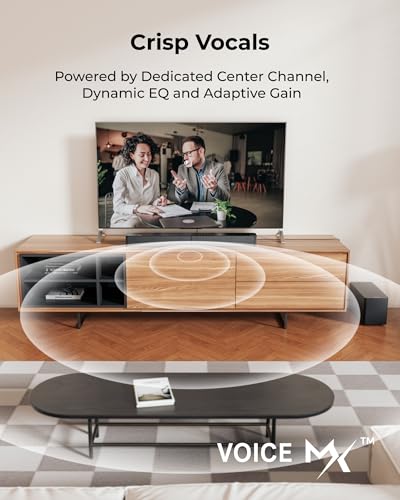
This processing power enables VoiceMX technology, which specifically targets the 300Hz to 3kHz frequency range where human voices live. The system dynamically adjusts this range using adaptive EQ and gain control, ensuring dialogue stays clear even when explosions are happening simultaneously. From our research into user experiences, this feature consistently receives praise – people notice the difference immediately when switching from their TV's built-in speakers.
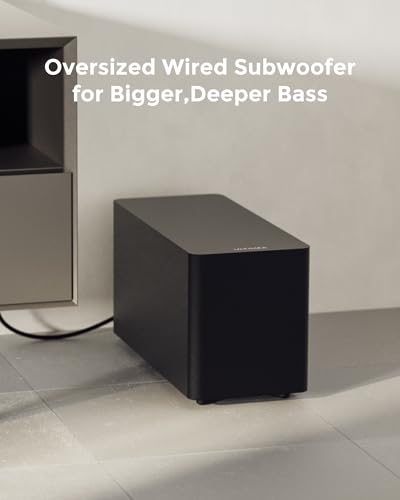
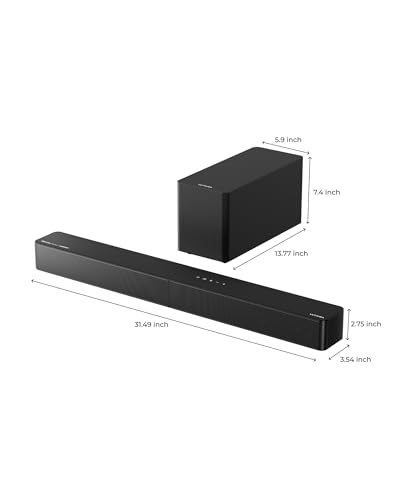
The BassMX technology deserves special attention. The included 5.25-inch subwoofer uses a 16mm excursion driver (that's how far the speaker cone can move back and forth) housed in what Ultimea calls an "upgraded cabinet." While marketing language often oversells minor improvements, the consensus from both professional reviewers and users suggests this subwoofer genuinely outperforms expectations for its size and price point.
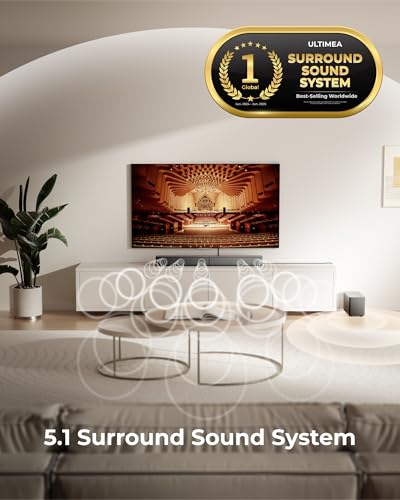
Here's where the Ultimea M60 Boom faces its biggest limitation. Its 5.1 Dolby Atmos implementation is entirely virtual, meaning all five channels come from drivers within the main soundbar. The system uses psychoacoustic processing – essentially tricking your brain into hearing sounds from directions they're not actually coming from.
This approach works better than you might expect, especially for the price. The five full-range drivers create a convincing sense of width, and the processing does manage to place some effects convincingly to your sides. However, it can't truly replicate the experience of having actual speakers behind or above you. For casual viewing and music, this limitation rarely matters. For serious movie watching, especially action films that rely heavily on surround effects, it becomes more noticeable.
The Ultimea M60 Boom includes Bluetooth 5.4, the latest version as of 2024, which offers improved range and significantly lower latency compared to older Bluetooth versions. Latency refers to the delay between when audio is sent and when you hear it – crucial for keeping dialogue synchronized with actors' lip movements.
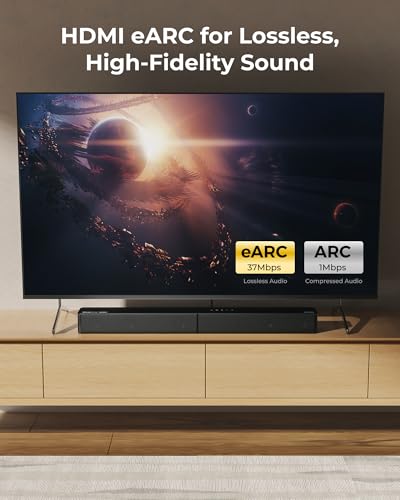
The HDMI eARC (enhanced Audio Return Channel) connection ensures the soundbar receives uncompressed audio from your TV, preserving the original quality of streaming content and Blu-ray audio tracks. The included CEC (Consumer Electronics Control) support means you can control the soundbar with your TV remote – a small convenience that makes daily use much more pleasant.
The smartphone app provides extensive control, including a 10-band equalizer and multiple preset modes. Unlike many budget soundbars that offer only basic app functionality, the M60 Boom's app includes genuinely useful customization options that let you tailor the sound to your preferences and room characteristics.
Released in 2025, the Klipsch Flexus Core 300 represents a different philosophy entirely. Rather than maximizing features for the dollar, Klipsch focused on implementing technologies typically found in much more expensive systems. At the time of writing, it costs roughly three times more than the Ultimea, but brings some genuinely groundbreaking features to justify that premium.
The Flexus Core 300's standout feature is Dirac Live Room Correction – making it the world's first soundbar to include this professional-grade technology. Previously, you'd only find Dirac Live in high-end AV receivers costing thousands of dollars.
Room correction addresses a fundamental problem: every room affects how speakers sound. Frequency response (how loud different frequencies sound) gets altered by room size, furniture placement, wall materials, and dozens of other factors. Traditional soundbars either ignore this problem or offer basic EQ adjustments that require users to guess at solutions.
Dirac Live uses the included calibration microphone to measure how your room affects sound, then creates custom filters to correct problems automatically. It addresses both magnitude response (making sure all frequencies play at the right volume) and phase response (ensuring sound waves arrive at your ears at the right time). The result is more accurate bass, clearer dialogue, and better stereo imaging – regardless of your room's acoustics.
The included Limited Bandwidth license corrects frequencies up to 500Hz, covering the critical bass and lower midrange where room problems are most audible. For users wanting full-range correction, Klipsch offers a Full Bandwidth upgrade that corrects across the entire frequency spectrum.
While the Ultimea M60 Boom simulates surround sound, the Klipsch Flexus Core 300 implements it physically. Its 5.1.2 configuration includes dedicated upfiring drivers that bounce sound off your ceiling to create genuine height effects. This true Dolby Atmos approach provides more convincing object-based audio, where sounds can be precisely placed in three-dimensional space around you.
The soundbar houses 13 total drivers: four front-firing, two side-firing, two upfiring, four built-in subwoofers, and a center channel with Klipsch's signature horn-loaded tweeter. This driver array allows for genuine channel separation rather than relying on processing tricks.
Horn-loaded tweeters represent classic Klipsch technology dating back decades. The horn shape increases efficiency and provides more controlled directivity, resulting in clearer highs and better dialogue intelligibility. Combined with the dedicated center channel, this ensures voices stay locked to the screen even during complex action sequences.
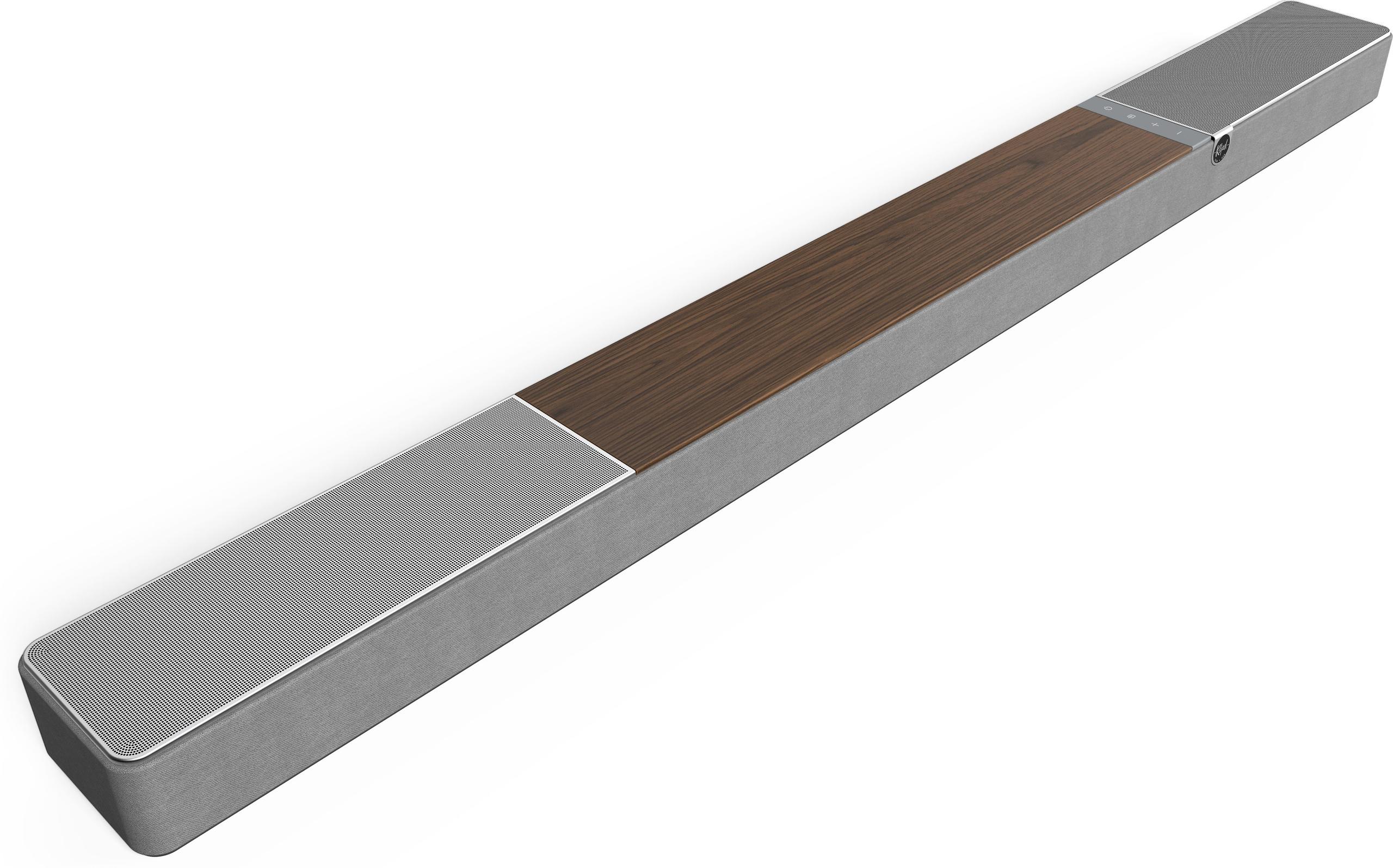
The Flexus Core 300 measures 54 inches wide but only 3 inches tall, requiring careful engineering to fit so many drivers into such a slim profile. At 35 pounds, it's substantially heavier than typical soundbars, reflecting the quality of internal components and robust construction.
The four 4-inch built-in subwoofers eliminate the need for a separate subwoofer in many rooms, though the system can connect to external subs when needed. This integration represents a significant engineering achievement – getting meaningful bass from drivers built into such a slim enclosure typically requires compromises that Klipsch appears to have avoided.
Perhaps the Klipsch Flexus Core 300's most compelling long-term advantage is its expandability. The Flexus ecosystem allows adding wireless surround speakers and wireless subwoofers as your needs or budget grow. The system uses proprietary wireless technology to maintain low-latency, high-fidelity connections between components.
This modular approach means you can start with just the soundbar and gradually build toward a complete multichannel system. For many users, this represents better value than purchasing a complete system upfront, especially given how audio preferences and room requirements change over time.
Both soundbars prioritize dialogue clarity, but they achieve it differently. The Ultimea M60 Boom uses VoiceMX processing to dynamically boost the vocal frequency range, effectively turning down background effects when dialogue is present. User reports consistently praise this feature, noting immediate improvements over TV speakers and many competing soundbars.
The Klipsch Flexus Core 300 takes a more fundamental approach through its dedicated center channel and horn-loaded tweeter. Rather than processing existing audio, it physically reproduces dialogue through components specifically designed for vocal clarity. Professional reviews consistently note superior dialogue performance, especially at higher volumes where the Ultimea's processing might struggle.
For home theater use, dialogue clarity trumps almost every other consideration. Muddy dialogue forces you to use subtitles or constantly adjust volume, destroying the immersive experience both soundbars promise to deliver.
The Ultimea M60 Boom's 5.25-inch wired subwoofer with BassMX technology provides impressive low-end extension for its price point. The 16mm driver excursion allows for meaningful bass output from a relatively compact enclosure. User feedback suggests the bass is both punchy and controlled – avoiding the boomy, one-note bass that plagues many budget systems.
However, physics imposes limits on what any single 5.25-inch driver can achieve. The Ultimea handles most content well but might struggle with the deepest bass frequencies in action movies or electronic music.
The Flexus Core 300's four 4-inch built-in subwoofers represent a different approach. Rather than relying on a single larger driver, Klipsch uses multiple smaller drivers working together. This design can provide more even bass distribution and potentially better integration with the main speakers, though it might not reach the absolute deepest frequencies that a dedicated large subwoofer could achieve.
For most users and most content, both approaches work well. The choice comes down to room size, listening preferences, and whether you're willing to add external subwoofers later.
This represents the most significant performance difference between these soundbars. The Ultimea M60 Boom's virtual surround processing works better than expected, creating a surprisingly wide soundstage and placing some effects convincingly to your sides. However, it can't overcome the fundamental limitation of having all speakers in front of you.
The Klipsch Flexus Core 300's physical upfiring and side-firing drivers create genuinely three-dimensional sound placement. Object-based audio in Dolby Atmos content can move smoothly around and above you, creating the immersive experience that makes modern action movies so compelling.
For casual viewing – news, talk shows, basic TV content – this difference matters little. For movie enthusiasts and gamers who want maximum immersion, the Klipsch's true Dolby Atmos implementation provides a meaningfully superior experience.
The Ultimea M60 Boom works well in small to medium rooms but might struggle to fill larger spaces convincingly. Its 99dB maximum SPL (Sound Pressure Level) provides adequate volume for most situations, but larger rooms might expose the limitations of its virtual surround processing.
The Klipsch Flexus Core 300's 106dB maximum output and more comprehensive driver array handle larger rooms more effectively. More importantly, the Dirac Live room correction adapts to your specific space, optimizing performance regardless of room characteristics.
The Ultimea M60 Boom shines in its simplicity. The two-piece design connects easily, and the system sounds good immediately with minimal adjustment needed. The smartphone app provides useful customization options without overwhelming casual users.
The Klipsch Flexus Core 300 requires more initial setup time due to the Dirac Live calibration process. However, this investment pays dividends in optimized performance. The calibration takes about 15 minutes and dramatically improves sound quality in most rooms.
The Ultimea M60 Boom represents excellent immediate value but limited upgrade potential. You get impressive performance for the money, but the system is essentially complete as purchased.
The Klipsch Flexus Core 300's modular ecosystem provides better long-term value for users who might want to expand their system over time. Starting with the soundbar and adding wireless surrounds and subwoofers as needs or budget allow represents a more flexible approach to building a home theater system.
The decision between these soundbars ultimately depends on your priorities and expectations. The Ultimea Poseidon M60 Boom delivers genuinely impressive performance at an accessible price point. Its 340W power output, advanced DSP processing, and comprehensive app control provide features typically found in much more expensive systems. For users seeking maximum immediate impact per dollar spent, it's difficult to find better value.
However, the Klipsch Flexus Core 300 justifies its premium pricing through genuinely advanced technology. Dirac Live room correction addresses fundamental acoustic problems that no amount of manual EQ adjustment can solve. True Dolby Atmos implementation with physical height speakers provides immersion that virtual processing cannot match. The expandable ecosystem protects your investment while allowing system growth over time.
For most users in smaller rooms who prioritize dialogue clarity and solid bass performance, the Ultimea M60 Boom provides excellent satisfaction. Its combination of power, features, and simplicity makes it ideal for upgrading from TV speakers or replacing aging sound systems.
For home theater enthusiasts, larger rooms, or users planning to build a complete multichannel system over time, the Klipsch Flexus Core 300 offers technology and expandability that justify its higher cost. The room correction alone provides benefits that improve every piece of content you'll ever play through it.
Both soundbars represent significant improvements over TV speakers and deliver compelling experiences within their intended markets. The choice comes down to whether you prioritize immediate value or long-term performance potential – and either choice will dramatically improve your audio experience compared to typical TV speakers.
| Ultimea Poseidon M60 Boom 5.1 Soundbar | Klipsch Flexus Core 300 Soundbar |
|---|---|
| Audio Channels - Determines surround sound immersion quality | |
| 5.1 Virtual Dolby Atmos (all drivers in main bar) | 5.1.2 True Dolby Atmos/DTS:X (physical upfiring speakers) |
| Maximum Power Output - Controls volume levels and dynamic range | |
| 340W peak power, 99dB max SPL | 106dB max acoustic output (higher volume capability) |
| Driver Configuration - Affects sound quality and channel separation | |
| 5 full-range drivers + 5.25" wired subwoofer | 13 total drivers including 4 built-in 4" subwoofers |
| Room Correction Technology - Optimizes sound for your specific space | |
| Manual EQ via app with presets | Dirac Live auto-calibration with included microphone |
| Connectivity Options - Determines device compatibility and streaming quality | |
| HDMI eARC, Bluetooth 5.4, Optical, USB, AUX | HDMI 2.1 eARC (8K), Wi-Fi, Bluetooth 5.3, Ethernet, multiple streaming protocols |
| Expandability - Future upgrade potential without replacing entire system | |
| Limited (wired subwoofer only) | Full Klipsch Flexus ecosystem with wireless surrounds and subwoofers |
| Setup Complexity - Time and effort required for optimal performance | |
| Simple plug-and-play with optional app tuning | Requires Dirac Live calibration for best results |
| Frequency Response - Range of sounds the system can reproduce | |
| 45Hz-18kHz | 43Hz-20kHz (slightly extended bass and treble) |
| Smart Features - App control and customization options | |
| Ultimea app with 10-band EQ and preset modes | Klipsch Connect Plus app with streaming control and advanced calibration |
| Build Quality - Construction materials and long-term durability | |
| Two-piece modular design, plastic construction | Premium sealed enclosure, 35 lbs, metal/wood construction |
The Ultimea Poseidon M60 Boom provides exceptional value, delivering 340W of power and advanced DSP processing at a budget-friendly price point. The Klipsch Flexus Core 300 costs significantly more but includes premium features like Dirac Live room correction and true Dolby Atmos with physical upfiring speakers. For most users, the Ultimea offers better immediate value, while the Klipsch provides better long-term investment potential.
The Ultimea Poseidon M60 Boom uses virtual Dolby Atmos, creating surround effects through digital processing with all drivers facing forward. The Klipsch Flexus Core 300 features true 5.1.2 Dolby Atmos with dedicated upfiring speakers that bounce sound off your ceiling for authentic height effects. True Dolby Atmos provides more convincing surround immersion, especially for action movies and gaming.
Both soundbars work well in small rooms, but the Ultimea M60 Boom offers simpler setup and immediate good performance. The Klipsch Flexus Core 300 includes Dirac Live room correction that automatically optimizes sound for any room size, potentially providing better results in challenging acoustic spaces. For basic small room use, the Ultimea is sufficient and more affordable.
The Ultimea Poseidon M60 Boom includes a dedicated 5.25-inch wired subwoofer in the package. The Klipsch Flexus Core 300 has four built-in 4-inch subwoofers integrated into the main soundbar, eliminating the need for a separate subwoofer in most rooms. Both provide adequate bass for typical viewing, though the Klipsch can add wireless subwoofers if desired.
Both soundbars excel at dialogue clarity but use different approaches. The Ultimea M60 Boom features VoiceMX technology that dynamically enhances the vocal frequency range. The Klipsch Flexus Core 300 uses a dedicated center channel with horn-loaded tweeter technology for natural voice reproduction. Professional reviews consistently favor the Klipsch for superior dialogue performance at all volume levels.
The Ultimea Poseidon M60 Boom has limited expansion options, functioning primarily as a complete standalone system. The Klipsch Flexus Core 300 is part of a modular ecosystem, allowing you to add wireless surround speakers and subwoofers over time. For users planning to build a complete home theater system gradually, the Klipsch offers much better expansion potential.
The Ultimea M60 Boom offers simpler plug-and-play setup with its two-piece design that connects easily. The Klipsch Flexus Core 300 requires additional setup time for Dirac Live room correction calibration using the included microphone. While the Ultimea gets you up and running faster, the Klipsch calibration process significantly improves long-term performance.
The Ultimea Poseidon M60 Boom includes HDMI eARC, Bluetooth 5.4, optical, USB, and AUX inputs for solid connectivity. The Klipsch Flexus Core 300 offers more comprehensive options including HDMI 2.1 with 8K passthrough, Wi-Fi, Ethernet, and multiple streaming protocols like AirPlay 2 and Google Cast. The Klipsch provides better future-proofing and streaming flexibility.
The Ultimea M60 Boom uses a dedicated 5.25-inch subwoofer with BassMX technology and 16mm driver excursion for impactful bass. The Klipsch Flexus Core 300 employs four 4-inch built-in subwoofers working together for more distributed bass response. Both provide satisfying low-end performance, with the Ultimea potentially reaching deeper frequencies and the Klipsch offering more controlled integration.
Both soundbars handle music well beyond their movie-focused design. The Ultimea M60 Boom includes dedicated music EQ modes and 10-band equalizer control via its smartphone app. The Klipsch Flexus Core 300 offers superior stereo imaging and frequency accuracy, especially after Dirac Live calibration. For serious music listening, the Klipsch provides noticeably better performance and streaming options.
The Klipsch Flexus Core 300 handles large rooms more effectively with its 106dB maximum output and comprehensive 13-driver array. The Ultimea Poseidon M60 Boom reaches 99dB maximum SPL, which may struggle to fill very large spaces convincingly. The Klipsch also benefits from room correction that adapts to larger room acoustics, making it the better choice for spacious living areas.
Choose the Ultimea Poseidon M60 Boom if you want maximum performance per dollar with 340W power output and advanced features at a budget price. Choose the Klipsch Flexus Core 300 if you prioritize cutting-edge technology like Dirac Live room correction, true Dolby Atmos, and long-term expandability. The Ultimea maximizes immediate value, while the Klipsch provides premium performance and future-proofing.
We've done our best to create useful and informative comparisons to help you decide what product to buy. Our research uses advanced automated methods to create this comparison and perfection is not possible - please contact us for corrections or questions. These are the sites we've researched in the creation of this article: ultimea.com - ultimea.com - youtube.com - bestbuy.com - youtube.com - avsforum.com - youtube.com - manuals.plus - youtube.com - device.report - ultimea.com - ultimea.de - community.ultimea.com - ultimea.com - community.ultimea.com - ultimea.com - youtube.com - aliexpress.com - ultimea.com - crutchfield.com - whathifi.com - avnirvana.com - hometechnologyreview.com - ecoustics.com - gearpatrol.com - klipsch.com - avsforum.com - youtube.com - avsforum.com - listenup.com - chowmain.software - klipsch.com - novis.ch - avsforum.com - klipsch.ca - lefflers.se - abt.com - sweetwater.com - wifihifi.com - klipsch.com - dirac.com

Privacy Policy
Terms and Conditions - Affiliate Policy
Home Security
© Copyright 2008-2026.
11816 Inwood Rd #1211, Dallas, TX 75244