

When it comes to upgrading your TV's audio, the soundbar market can feel overwhelming. You've got everything from basic $100 bars that barely improve on built-in TV speakers to $2,000+ flagship models that rival full surround sound systems. Today, we're comparing two soundbars that represent completely different philosophies: the budget-friendly Samsung HW-C450 and the premium Klipsch Flexus Core 300.
These aren't just different price points—they're fundamentally different approaches to home audio. One prioritizes immediate satisfaction at an accessible price, while the other brings professional-grade technology to the living room. Let's dive into what makes each tick and help you figure out which approach suits your needs.
Before we get into specifics, it's worth understanding what we're dealing with. Soundbars have evolved dramatically since their early days as simple speaker arrays. Today's models range from basic stereo enhancers to sophisticated audio processors that can simulate full surround sound systems.
The key specifications you'll encounter include channel configuration (like 2.1 or 5.1.2), which tells you how many discrete audio channels the system handles. A 2.1 system has left and right channels plus a subwoofer for bass, while a 5.1.2 system adds center, surround, and height channels for true three-dimensional audio. You'll also see terms like "virtual surround," which uses digital processing to simulate additional channels, versus "physical drivers," which are actual speakers pointing in different directions.
Audio codecs like Dolby Atmos and DTS:X represent different ways of encoding surround sound information, with Atmos being particularly important for creating overhead sound effects. Room correction technology, meanwhile, uses microphones and software to analyze your space and adjust the sound accordingly—think of it as auto-tune for your room's acoustics.
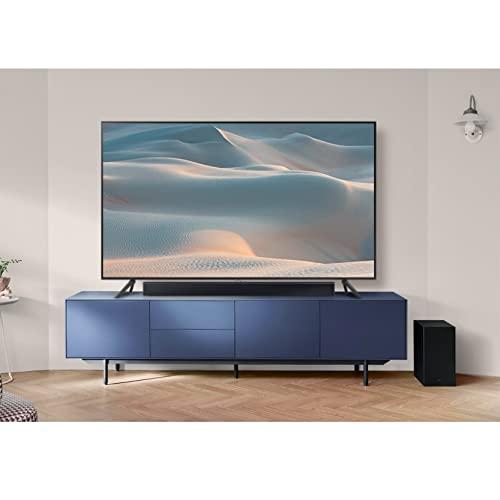
The Samsung HW-C450 launched in 2023 as part of Samsung's entry-level C-series lineup. It represents Samsung's response to the growing demand for affordable soundbars that still deliver meaningful improvements over TV speakers. Since its release, it's become a popular choice for first-time soundbar buyers, particularly those already invested in Samsung's ecosystem.
The Klipsch Flexus Core 300, which debuted in 2024, took a radically different approach. It marked Klipsch's collaboration with Onkyo and introduced the first-ever soundbar with Dirac Live room correction—technology previously reserved for high-end AV receivers costing thousands of dollars. This represents a significant leap forward in soundbar sophistication, bringing professional-grade audio processing to a more accessible format.
Since their respective launches, both have maintained their positions: the Samsung continues to dominate budget recommendations, while the Klipsch has garnered praise from audio enthusiasts for its technical innovations.
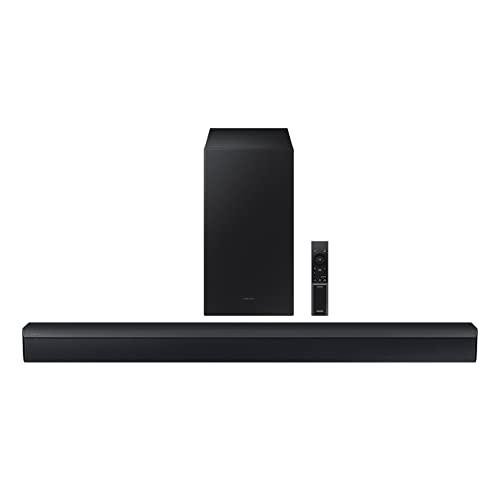
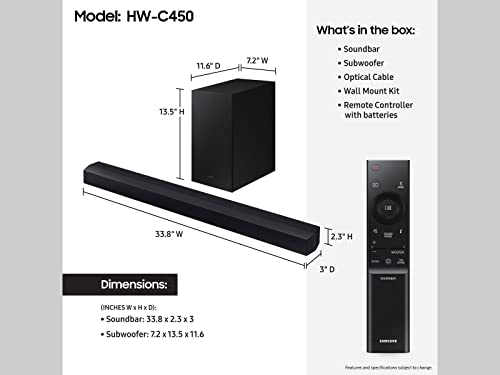
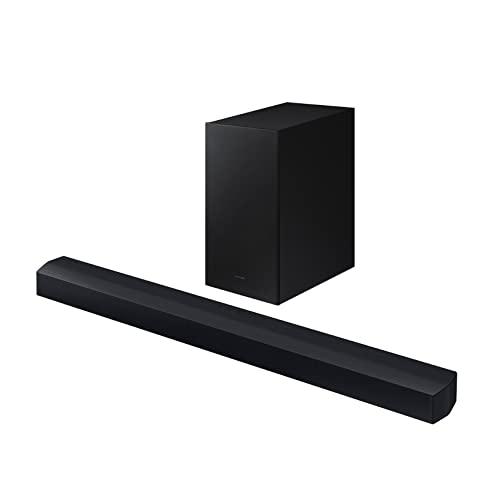
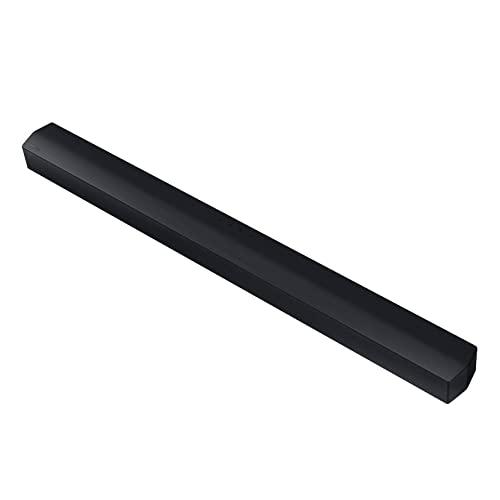
The fundamental difference between these soundbars lies in their basic design philosophy. The Samsung HW-C450 follows the traditional 2.1-channel approach: a slim soundbar containing left and right speakers, paired with a separate wireless subwoofer for bass duties. This setup keeps the main unit compact while delegating the space-hungry low-frequency reproduction to a dedicated box you can hide elsewhere in the room.
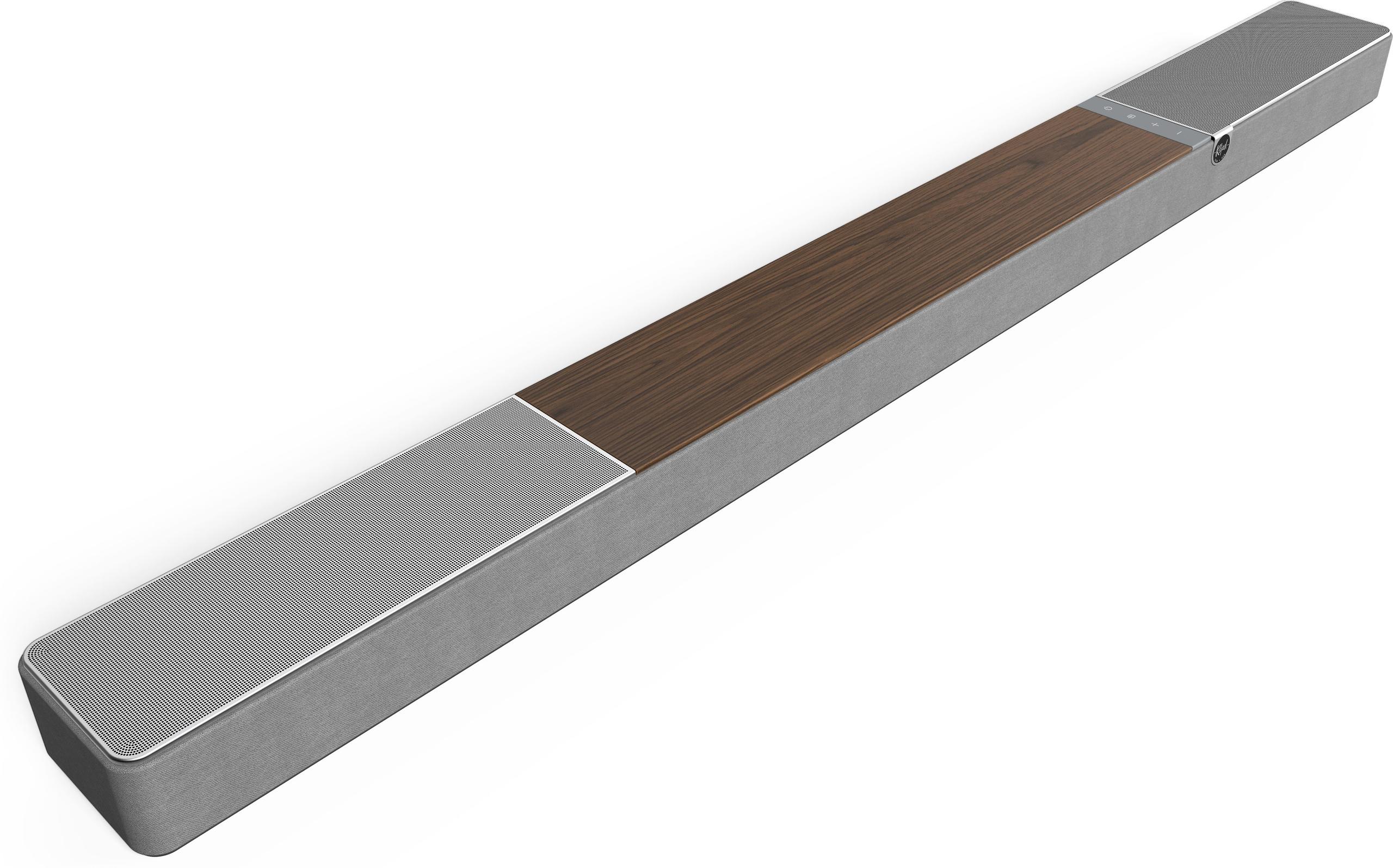
The Klipsch Flexus Core 300, by contrast, packs an impressive 13 speakers into its 54-inch chassis, creating a true 5.1.2-channel system. Instead of a separate subwoofer, it integrates four 4-inch bass drivers directly into the soundbar. More importantly, it includes up-firing speakers that bounce sound off your ceiling to create height effects, and side-firing drivers that reflect off walls for width effects.
This architectural difference fundamentally shapes how each system performs. The Samsung's approach prioritizes simplicity and dedicated bass impact, while the Klipsch aims for spatial immersion and integration.
When it comes to basic sound quality, these two soundbars serve different masters. The Samsung HW-C450 focuses on delivering clear dialogue and punchy bass—the two things most people notice immediately when upgrading from TV speakers. Its tuning emphasizes midrange clarity, making voices easy to understand, while the separate subwoofer provides the kind of chest-thumping bass that makes action movies feel more engaging.
However, the Samsung's soundstage remains fundamentally limited by its 2.1 configuration. While DTS Virtual:X processing attempts to create spatial effects through digital manipulation, it can't overcome the physical reality of having just two main speakers. The result is sound that's clearly better than TV audio but still feels front-heavy and somewhat flat compared to true surround systems.
The Klipsch Flexus Core 300 operates in a different league entirely. Its horn-loaded tweeter technology—a Klipsch signature—delivers exceptional clarity and detail that remains consistent even at high volumes. Where the Samsung might start to sound harsh or compressed when pushed, the Klipsch maintains its composure thanks to superior driver quality and amplification.
More significantly, the Klipsch's 13-driver array creates a genuinely three-dimensional soundfield. Up-firing speakers bounce audio off your ceiling to create convincing overhead effects, while side-firing drivers expand the apparent width of the soundstage well beyond the physical boundaries of the bar itself. This isn't just processing trickery—these are real speakers creating real reflections that your ears can locate in space.
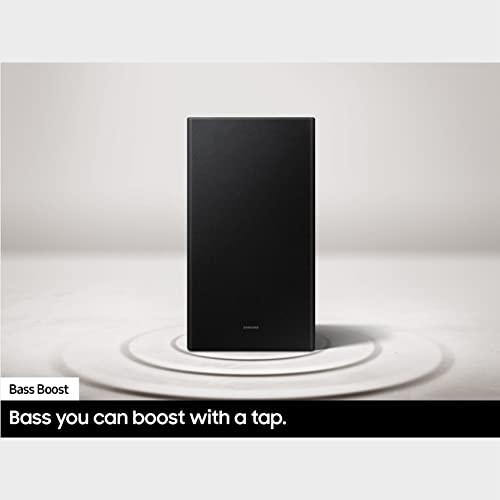
Bass reproduction reveals another fundamental difference in approach. The Samsung HW-C450's separate 8-inch subwoofer delivers substantial low-end impact that you can feel in your chest during explosive action sequences. This dedicated approach allows the subwoofer to be optimally positioned in your room and provides the kind of visceral bass response that immediately impresses.
The trade-off comes in integration and timing. Even with wireless connectivity, separate subwoofers can introduce subtle timing delays between the bass and mid-range frequencies. The Samsung also tends to emphasize bass quantity over quality—it's tuned to provide immediate impact rather than nuanced, musical bass reproduction.
The Klipsch Flexus Core 300's integrated approach sacrifices some raw power for precision and timing. Its four 4-inch subwoofers can't match the Samsung's deep-bass impact during the most explosive movie scenes, but they provide tighter, more controlled bass that integrates seamlessly with the rest of the frequency spectrum. For music listening, this approach is clearly superior, offering bass that serves the music rather than overwhelming it.
This is where the fundamental difference between these soundbars becomes most apparent. The Samsung HW-C450 relies entirely on digital processing to create surround effects. DTS Virtual:X uses psychoacoustic principles—essentially tricks that exploit how your brain processes sound—to create the impression of audio coming from directions where no speakers exist.
While Virtual:X can be effective for certain types of content, it's inherently limited. The effect works best when you're sitting in the optimal listening position and with content specifically mixed to take advantage of the processing. Move around the room or play less-than-ideal source material, and the surround illusion quickly falls apart.
The Klipsch Flexus Core 300 uses physical speakers to create real surround effects. Its up-firing drivers bounce sound off your ceiling to create height channels, while side-firing speakers reflect off walls to expand the soundstage horizontally. This approach creates more convincing and consistent surround effects that work across a wider variety of listening positions and room configurations.
When watching Dolby Atmos content like helicopter scenes in action movies or rain effects in atmospheric dramas, the difference is immediately apparent. The Klipsch creates a genuine sense of three-dimensional space where sounds can be precisely located above, beside, and around you. The Samsung, despite its best digital efforts, keeps most effects anchored to the front of the room.
Perhaps the most significant technological difference between these soundbars is the Klipsch Flexus Core 300's inclusion of Dirac Live room correction. This technology represents a genuine breakthrough in soundbar design—no other soundbar manufacturer has implemented professional-grade room correction at this level.
Room correction addresses a fundamental problem in home audio: every room sounds different due to its size, shape, furniture, and acoustic properties. What sounds perfect in a dealer's showroom might sound boomy or thin in your living room. Traditional soundbars either ignore this problem entirely or offer basic preset adjustments that make broad assumptions about your space.
Dirac Live takes a scientific approach. Using the included calibration microphone, it measures your room's acoustic response at multiple listening positions, then applies precise digital filtering to compensate for problems. The system corrects both frequency response (making sure all notes play at the right volume) and phase response (ensuring all frequencies arrive at your ears at the right time).
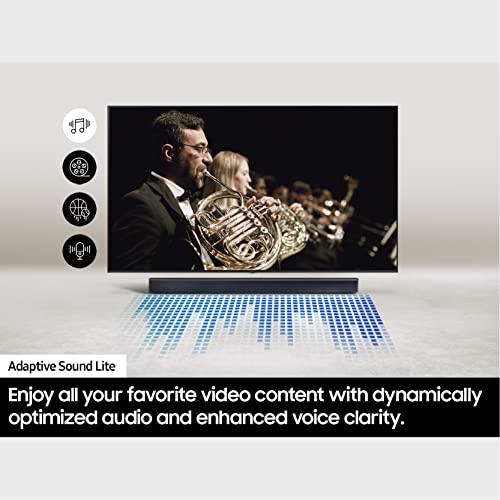
The Samsung HW-C450 offers Adaptive Sound Lite, which automatically adjusts settings based on content type, but this is far more basic than true room correction. It's the difference between a thermostat that adjusts based on outside temperature versus one that actually measures and responds to your room's specific heating characteristics.
Modern soundbars need to connect to an increasingly complex ecosystem of devices, and here the differences are significant. The Samsung HW-C450 covers the basics with HDMI eARC, optical input, and Bluetooth connectivity. For most users, this is adequate—you can connect your TV via HDMI or optical and stream music from your phone via Bluetooth.
The Klipsch Flexus Core 300 offers significantly more comprehensive connectivity. Its HDMI 2.1 support includes 8K/60Hz and 4K/120Hz passthrough, crucial for next-generation gaming consoles like the PlayStation 5 and Xbox Series X. It also supports a wider range of streaming protocols including AirPlay 2, Google Cast, Spotify Connect, and Tidal Connect, making it easier to integrate with different streaming services and smart home ecosystems.
The Klipsch also includes Ethernet connectivity, which provides a more stable connection than Wi-Fi for streaming high-resolution audio and reduces the likelihood of dropouts during critical listening sessions.
One area where these soundbars differ dramatically is their potential for system growth. The Samsung HW-C450 is what you might call a "closed ecosystem"—what you buy is what you get. There's no option to add rear surround speakers, upgrade the subwoofer, or expand the system in any way. This simplicity has advantages (no complex setup, no additional purchases required), but it also means you're limited to the system's initial capabilities forever.
The Klipsch Flexus Core 300 takes a modular approach that allows significant expansion. You can add wireless rear surround speakers to create a true 5.1.2 system, or even add an additional external subwoofer for users who want more bass impact than the integrated drivers provide. This modularity means you can start with just the soundbar and expand your system over time as your budget and needs grow.
This expandability also addresses one of the Klipsch's few weaknesses—its integrated bass, while precise and well-integrated, can't match a dedicated large subwoofer for pure impact. The option to add a separate sub later gives users the best of both worlds: integrated precision for most content, with additional impact available when desired.
In typical apartment or smaller home environments, both soundbars perform competently, but for different reasons. The Samsung HW-C450 excels here because its limitations are less apparent in smaller spaces. The separate subwoofer provides plenty of bass impact without overwhelming the room, and the virtual surround processing works reasonably well when you're sitting close to the optimal listening position.
The Klipsch Flexus Core 300 might actually be somewhat overpowered for very small spaces, though its room correction capabilities help it adapt. Its real advantages—expansive soundstage and precise imaging—are less critical when you're sitting just a few feet from the soundbar.
This is where the differences become dramatic. The Samsung HW-C450 struggles in large spaces, simply lacking the output and driver array needed to fill expansive rooms with convincing sound. Its 300-watt total output and basic driver complement feel inadequate when trying to project sound across large distances.
The Klipsch Flexus Core 300 truly shines in large rooms. Its 106dB maximum output and sophisticated driver array create a convincing bubble of sound that extends well beyond the physical soundbar. The discrete up-firing and side-firing speakers work more effectively in larger spaces, where there's more ceiling and wall area for sound reflection.
For movie watching, both soundbars serve their intended purposes well within their respective price classes. The Samsung HW-C450 delivers clear dialogue and impactful effects that make action movies more engaging than TV speakers ever could. The Klipsch Flexus Core 300 provides cinematic immersion with true surround effects and precise spatial imaging.
For music listening, the differences become more pronounced. The Samsung's tuning prioritizes bass impact over nuance, making it better suited for casual background listening than critical music appreciation. The Klipsch's superior driver quality, room correction, and more neutral tuning make it genuinely enjoyable for serious music listening—something that can't be said for many soundbars at any price.
Gaming represents an interesting use case where both soundbars offer specific advantages. The Samsung HW-C450 includes a dedicated Game Mode that reduces latency and emphasizes directional cues, helpful for competitive gaming where hearing enemy positions is crucial.
The Klipsch Flexus Core 300's HDMI 2.1 support and superior spatial processing make it better suited for immersive single-player games where audio atmosphere is important. Its ability to create convincing overhead effects enhances games with vertical audio elements, while its room correction ensures consistent performance regardless of where you're sitting.
At the time of writing, these soundbars occupy completely different value propositions. The Samsung HW-C450 typically retails for under $200, representing exceptional value for users seeking basic surround sound enhancement. When you consider that it includes a wireless subwoofer at this price point, it's genuinely difficult to find comparable value elsewhere in the market.
The Klipsch Flexus Core 300, priced in the premium tier around $1,000, competes with high-end soundbars from brands like Sonos, Bose, and JBL. Its unique Dirac Live implementation and expandability justify the premium for users who value advanced technology and future-proofing.
The value equation isn't just about initial purchase price, though. The Samsung represents a complete system with no additional purchases required, while the Klipsch's expandability means potential additional costs for users who want the full surround experience. However, the modular approach also means you can spread those costs over time and only buy what you actually need.
You're taking your first step beyond TV speakers and want immediate gratification without complexity. The Samsung is perfect for apartment dwellers, college students, or anyone who needs a significant audio upgrade on a tight budget. It's also ideal if you value simplicity over features—there's no complex setup, no room correction to configure, and no decisions about expansion components.
The Samsung makes particular sense if you primarily watch TV shows, news, and action movies where clear dialogue and impactful bass are more important than nuanced surround effects. It's also a good choice for Samsung TV owners who can take advantage of Q-Symphony integration for enhanced performance.
You're serious about audio quality and want a soundbar that can serve as the foundation for a long-term home theater system. The Klipsch is ideal for users with larger rooms who need the output and sophisticated processing to fill expansive spaces with convincing sound.
It's particularly compelling for music lovers who want a soundbar that can handle critical listening sessions, not just background audio. The room correction technology alone makes it worthwhile for users who care about accurate sound reproduction and are willing to invest time in proper setup.
The expandability makes it perfect for users who want to start with a soundbar but may add surround speakers or additional bass later. It's also the clear choice for gaming enthusiasts who need HDMI 2.1 support and want the most immersive audio experience possible.
These soundbars represent two valid but completely different approaches to home audio. The Samsung HW-C450 prioritizes immediate satisfaction and accessibility, delivering meaningful improvements over TV speakers at a price most people can justify. It's the soundbar equivalent of a reliable, efficient car—it gets you where you need to go without fuss or complexity.
The Klipsch Flexus Core 300 is more like a high-performance vehicle—it offers capabilities and refinement that most users will never fully exploit, but when you need that performance, nothing else will do. Its advanced technology and expandability make it a long-term investment in audio quality rather than a simple quick fix.
Your choice should ultimately align with your audio priorities, room size, and long-term plans. If you want immediate improvement at minimum cost and complexity, the Samsung delivers exceptional value. If you want cutting-edge technology and the best possible sound quality with room to grow, the Klipsch justifies its premium pricing through superior performance and innovation.
Both soundbars succeed at their intended purposes—the key is choosing the one whose purpose aligns with your needs and expectations.
| Samsung HW-C450 | Klipsch Flexus Core 300 |
|---|---|
| Channel Configuration - Determines surround sound capabilities and immersion | |
| 2.1 channels (stereo + subwoofer) | 5.1.2 channels (true surround + height effects) |
| Driver Array - More drivers generally mean better sound distribution | |
| 3 total speakers (2 in bar + separate subwoofer) | 13 speakers integrated into soundbar |
| Room Correction Technology - Optimizes sound for your specific space | |
| Adaptive Sound Lite (basic content optimization) | Dirac Live (professional-grade room correction with included microphone) |
| Bass Configuration - Affects placement flexibility and impact | |
| Separate 8-inch wireless subwoofer | 4 integrated 4-inch subwoofers built into soundbar |
| Maximum Output - Critical for large rooms and high volume listening | |
| 300W total power | 106 dB maximum output (significantly more powerful) |
| Audio Format Support - Determines compatibility with premium content | |
| DTS Virtual:X, Dolby 2-channel | Native Dolby Atmos, DTS:X with physical height drivers |
| HDMI Connectivity - Important for gaming and future-proofing | |
| HDMI eARC only | HDMI 2.1 with 8K/60Hz and 4K/120Hz passthrough |
| Expandability - Ability to grow your system over time | |
| No expansion options (complete system as-is) | Modular design: add wireless surrounds and external subwoofer |
| Streaming Capabilities - Affects music playback convenience | |
| Bluetooth 5.2, basic Samsung TV integration | AirPlay 2, Google Cast, Spotify Connect, Tidal Connect, Ethernet |
| Physical Size - Space requirements and room compatibility | |
| Compact: 34" soundbar + separate subwoofer placement | Large: 54" soundbar with all drivers integrated |
| Setup Complexity - Time and effort required for optimal performance | |
| Plug-and-play with automatic subwoofer pairing | Advanced setup with room calibration process (15-30 minutes) |
| Ideal Room Size - Where each performs best | |
| Small to medium rooms (under 15 feet) | Medium to large rooms (15+ feet) with high ceilings |
| Price Category - Budget tier determines target audience | |
| Budget-friendly entry-level (under $200) | Premium tier (around $1,000) with professional features |
The Samsung HW-C450 is better suited for small rooms due to its compact design and appropriate power output. Its 2.1-channel system with separate wireless subwoofer provides excellent bass impact without overwhelming smaller spaces. The Klipsch Flexus Core 300 might be overpowered for very small rooms, though its room correction technology helps it adapt to any space.
The main difference is channel configuration and technology level. The Samsung HW-C450 is a basic 2.1-channel system focused on clear dialogue and bass impact, while the Klipsch Flexus Core 300 is a premium 5.1.2-channel system with true Dolby Atmos support, physical height speakers, and professional-grade room correction technology.
For pure bass impact, the Samsung HW-C450 wins with its dedicated 8-inch wireless subwoofer that delivers chest-thumping low-end for action movies. The Klipsch Flexus Core 300 has four integrated 4-inch subwoofers that provide tighter, more precise bass but can't match the Samsung's raw power during explosive scenes.
The Klipsch Flexus Core 300 is worth the investment if you have a large room, want true surround sound with height effects, and plan to expand your system over time. For basic home theater improvements in smaller spaces, the Samsung HW-C450 provides excellent value with clear dialogue and impactful bass at a fraction of the cost.
The Samsung HW-C450 is much easier to set up with plug-and-play operation and automatic wireless subwoofer pairing. The Klipsch Flexus Core 300 requires a 15-30 minute room calibration process using an included microphone, though this extra effort results in optimized sound for your specific space.
Both soundbars work with any TV brand. The Samsung HW-C450 connects via HDMI eARC or optical input and offers enhanced integration with Samsung TVs. The Klipsch Flexus Core 300 provides more connection options including HDMI 2.1, optical, and various wireless streaming protocols for broader compatibility.
The Klipsch Flexus Core 300 is significantly better for music with its horn-loaded tweeters, room correction technology, and neutral tuning that serves the music rather than emphasizing bass. The Samsung HW-C450 is tuned more for movie impact and casual listening rather than critical music appreciation.
Only the Klipsch Flexus Core 300 has true Dolby Atmos support with physical up-firing speakers that bounce sound off your ceiling for height effects. The Samsung HW-C450 uses DTS Virtual:X processing to simulate surround effects but cannot match the immersive experience of actual Atmos with dedicated height channels.
For competitive gaming, the Samsung HW-C450 offers a dedicated Game Mode that reduces latency and emphasizes directional audio cues. For immersive single-player gaming, the Klipsch Flexus Core 300 is superior with HDMI 2.1 support for next-gen consoles and convincing spatial audio that enhances atmospheric game soundtracks.
The Samsung HW-C450 cannot be expanded - what you buy is your complete system. The Klipsch Flexus Core 300 is fully modular, allowing you to add wireless rear surround speakers and an additional external subwoofer to create a complete 5.1.4 home theater system over time.
Value depends on your needs and budget. The Samsung HW-C450 offers exceptional value for budget-conscious buyers wanting immediate improvement over TV speakers with a complete system including subwoofer. The Klipsch Flexus Core 300 provides better long-term value for audio enthusiasts due to its advanced technology, expandability, and superior sound quality.
The Klipsch Flexus Core 300 is clearly superior for large rooms with its 106dB maximum output, 13-driver array, and sophisticated spatial processing that fills expansive spaces effectively. The Samsung HW-C450 struggles in large rooms, lacking the power and driver configuration needed to project convincing sound across significant distances.
We've done our best to create useful and informative comparisons to help you decide what product to buy. Our research uses advanced automated methods to create this comparison and perfection is not possible - please contact us for corrections or questions. These are the sites we've researched in the creation of this article: e-catalog.com - alibaba.com - smart.dhgate.com - greentoe.com - requiremints.com - versus.com - bhphotovideo.com - rtings.com - soundmachine.com.mt - samsung.com - samsung.com - youtube.com - bhphotovideo.com - newegg.com - images.samsung.com - bestbuy.com - samsung.com - youtube.com - jsappliance.com - gadgetsleo.com - youtube.com - saraappliance.com - walmart.com - crutchfield.com - whathifi.com - avnirvana.com - hometechnologyreview.com - ecoustics.com - gearpatrol.com - klipsch.com - avsforum.com - youtube.com - avsforum.com - listenup.com - chowmain.software - klipsch.com - novis.ch - avsforum.com - klipsch.ca - lefflers.se - abt.com - sweetwater.com - wifihifi.com - klipsch.com - dirac.com

Privacy Policy
Terms and Conditions - Affiliate Policy
Home Security
© Copyright 2008-2026.
11816 Inwood Rd #1211, Dallas, TX 75244