






When you're tired of squinting to hear dialogue or missing the rumbling bass in your favorite action scenes, a quality soundbar becomes essential. But with options ranging from under $300 to well over $800 (at the time of writing), choosing between budget excellence and premium sophistication requires understanding what actually makes a difference in your living room.
The Ultimea Poseidon M60 Boom and Sennheiser AMBEO Mini represent two fundamentally different approaches to solving the same problem: delivering cinema-quality audio without the complexity of traditional surround sound systems. One maximizes performance per dollar spent, while the other pushes technological boundaries into the smallest possible package.
Before diving into specifics, it's crucial to understand what separates today's premium soundbars from basic models. Modern soundbars are essentially specialized computers that process audio in real-time, using Digital Signal Processing (DSP) – think of it as the brain that analyzes incoming sound and decides how to distribute it across multiple speakers for the most realistic experience.
The key battleground centers around spatial audio processing – the technology that creates the illusion of sound coming from all directions, even overhead, using clever acoustic tricks rather than dozens of physical speakers scattered around your room. Both the M60 Boom and AMBEO Mini achieve this through different methods, and understanding these differences is crucial for making the right choice.
Bass extension – how deep the low frequencies go – remains equally important. True cinematic impact requires reproducing those 40-60 Hz frequencies that make explosions feel visceral rather than just loud. Dialogue clarity in the 300-3000 Hz range determines whether you'll need subtitles for every movie, while connectivity options future-proof your investment as streaming standards evolve.
Released in 2023, the Ultimea Poseidon M60 Boom represents a fascinating evolution in budget-conscious engineering. Rather than cutting corners on essential features, Ultimea chose to maximize hardware advantages while keeping costs reasonable through efficient manufacturing.
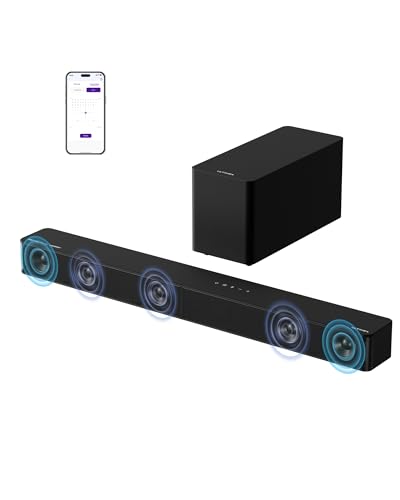
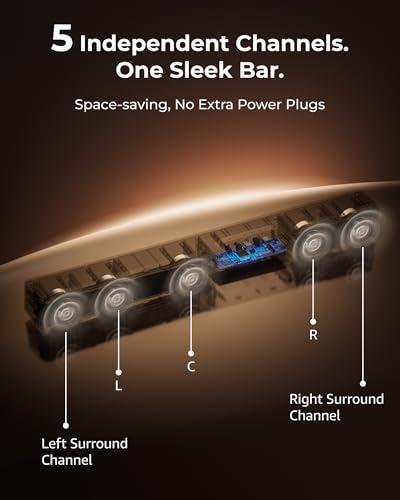
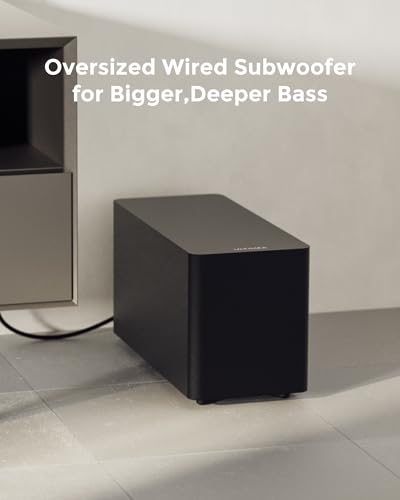
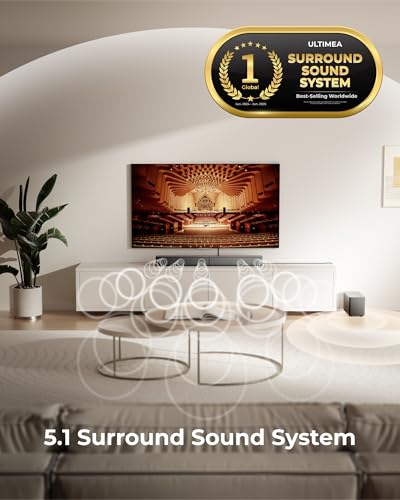
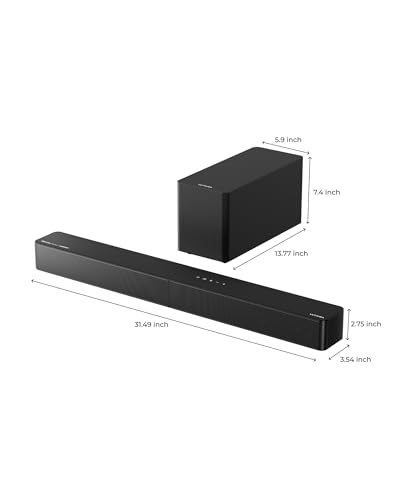
The M60 Boom takes a straightforward approach: five discrete full-range drivers housed in the main soundbar, paired with a dedicated 5.25-inch subwoofer. This physical separation provides real advantages that software alone cannot replicate. When an explosion happens on screen, the subwoofer handles those deep 45 Hz frequencies independently, while the main drivers focus on mid-range and high-frequency detail without distortion from competing low-end signals.
The BassMX Technology underlying the subwoofer design incorporates a high-excursion driver capable of 16mm movement – that's the physical distance the speaker cone travels back and forth. For context, most compact soundbar drivers manage only 5-8mm of excursion, severely limiting their bass impact. This physical capability translates directly into the visceral rumble that makes movie scenes feel real rather than just loud.
The M60 Boom incorporates triple-core DSP technology running over 2000 MIPS (Million Instructions Per Second) of processing power. While these numbers sound technical, they translate into real-world benefits: the system can perform real-time channel separation, meaning it actively analyzes incoming 5.1 or Dolby Atmos signals and routes specific sounds to appropriate drivers with minimal delay.
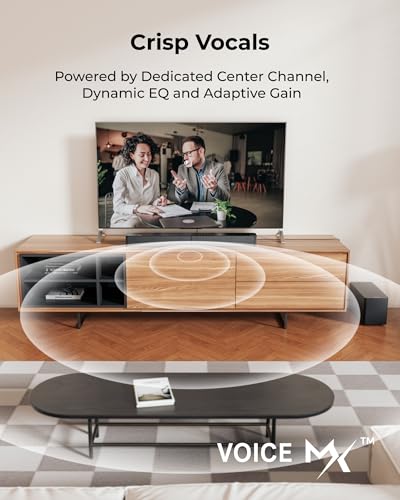
This processing power enables VoiceMX technology, which dynamically monitors the 300-3000 Hz frequency range where human speech exists and applies adaptive equalization. When dialogue becomes buried under music or sound effects, the system automatically adjusts the balance, ensuring voices remain intelligible without requiring manual volume adjustments.
The M60 Boom includes Bluetooth 5.4 – the latest wireless standard offering significantly improved connection stability and reduced latency compared to older versions. This might seem like a minor detail, but anyone who's experienced audio lag during gaming or streaming knows how crucial proper synchronization becomes.
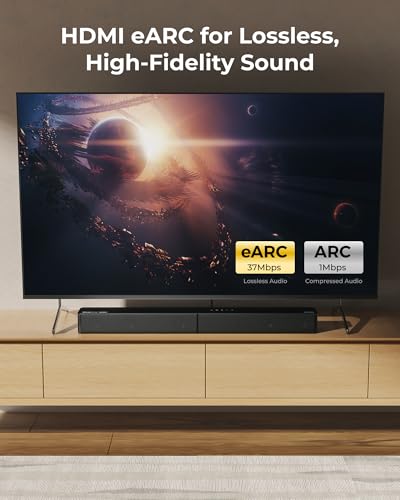
HDMI eARC (Enhanced Audio Return Channel) support ensures the soundbar can receive high-quality, uncompressed audio directly from compatible TVs, preserving the full dynamic range of Dolby Atmos soundtracks without quality loss through optical connections.
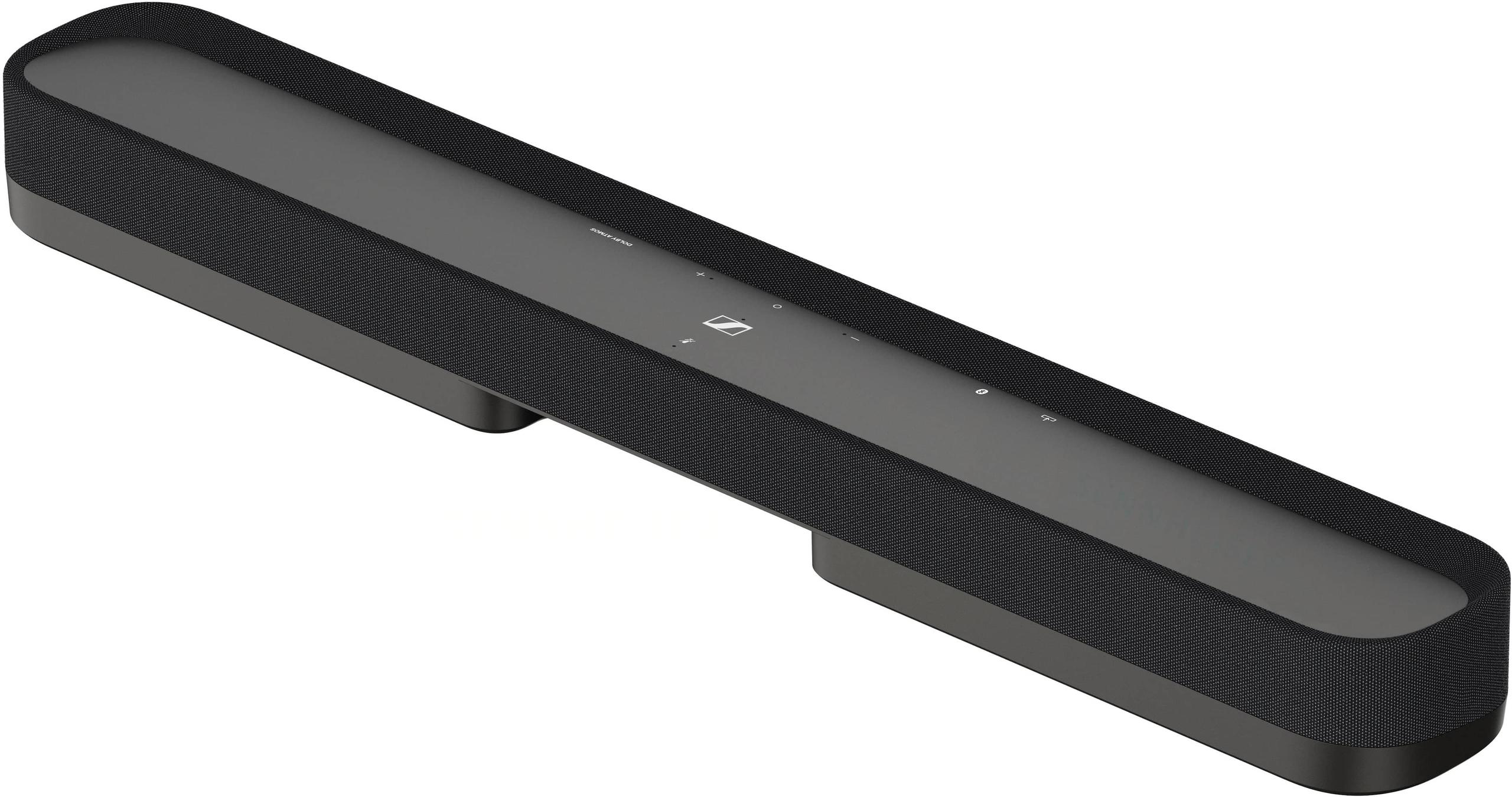
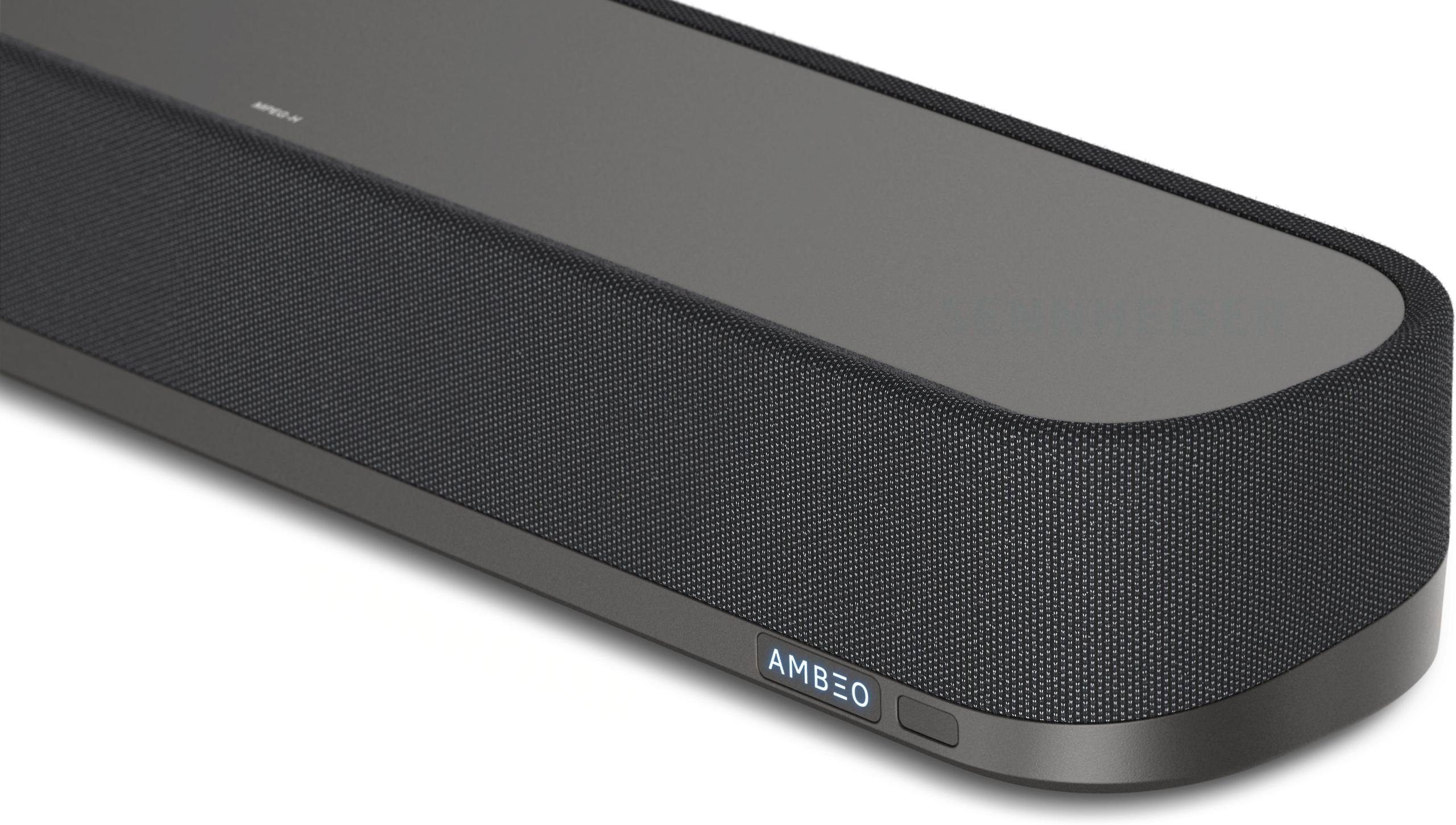
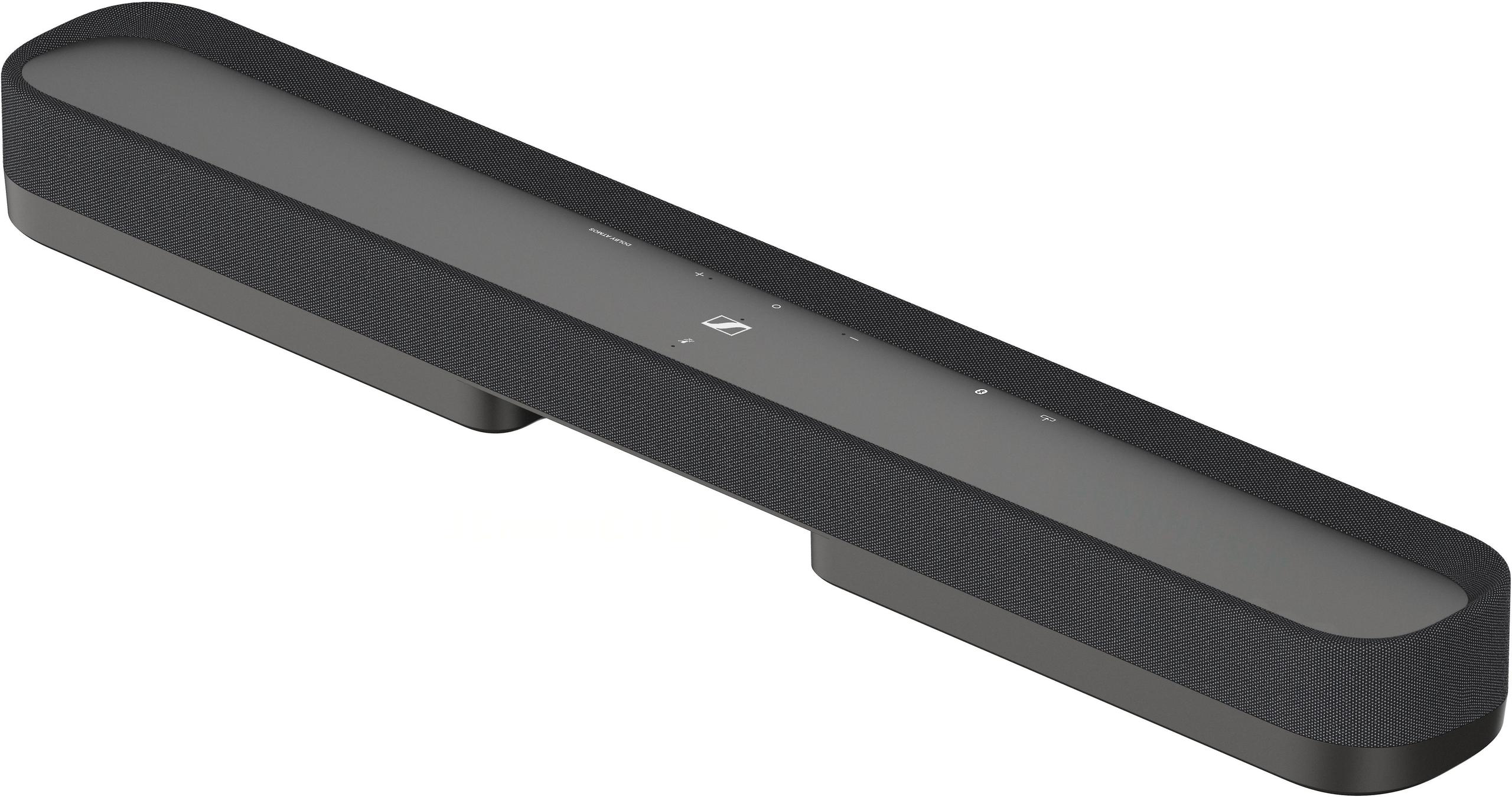
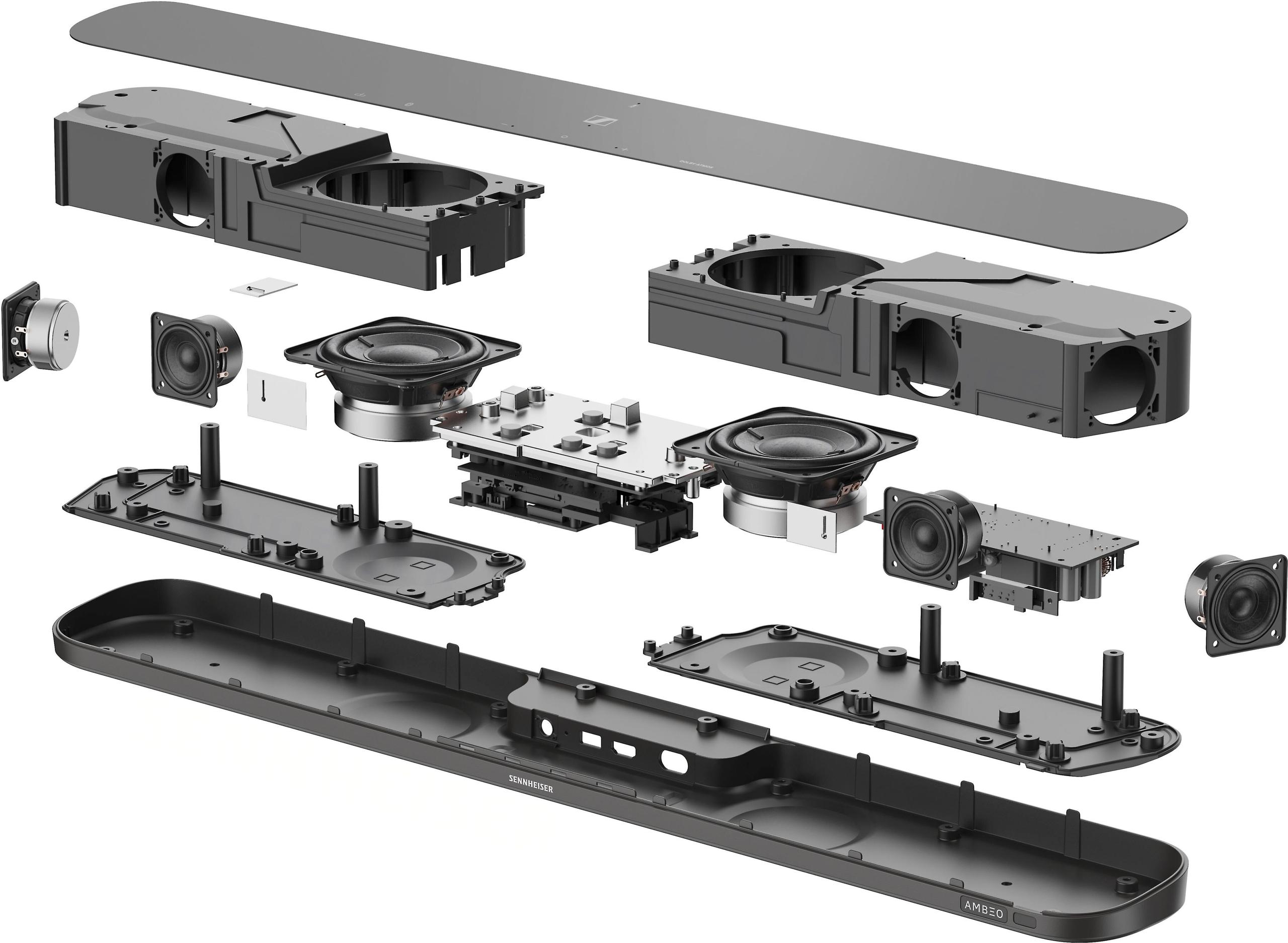
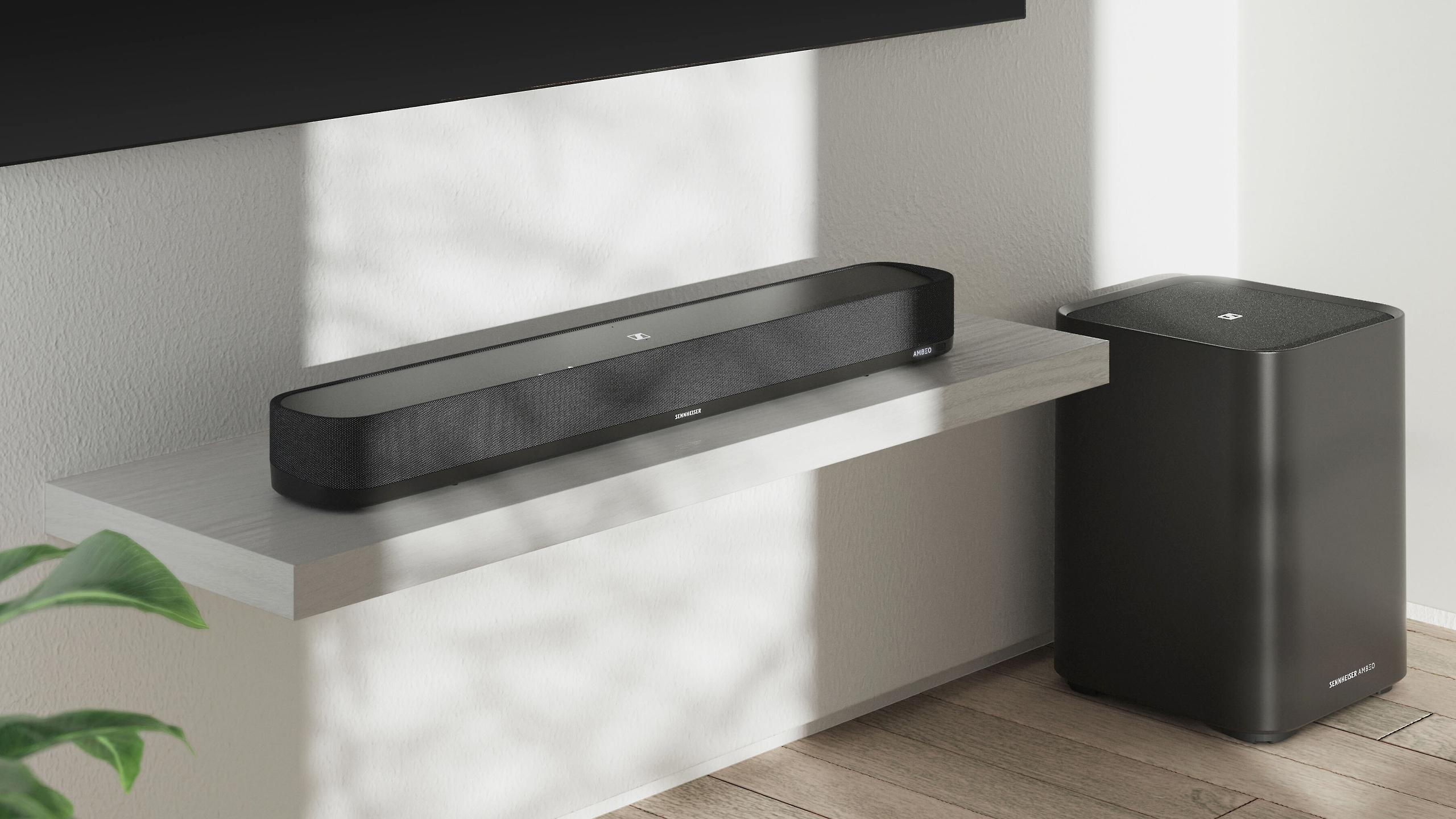
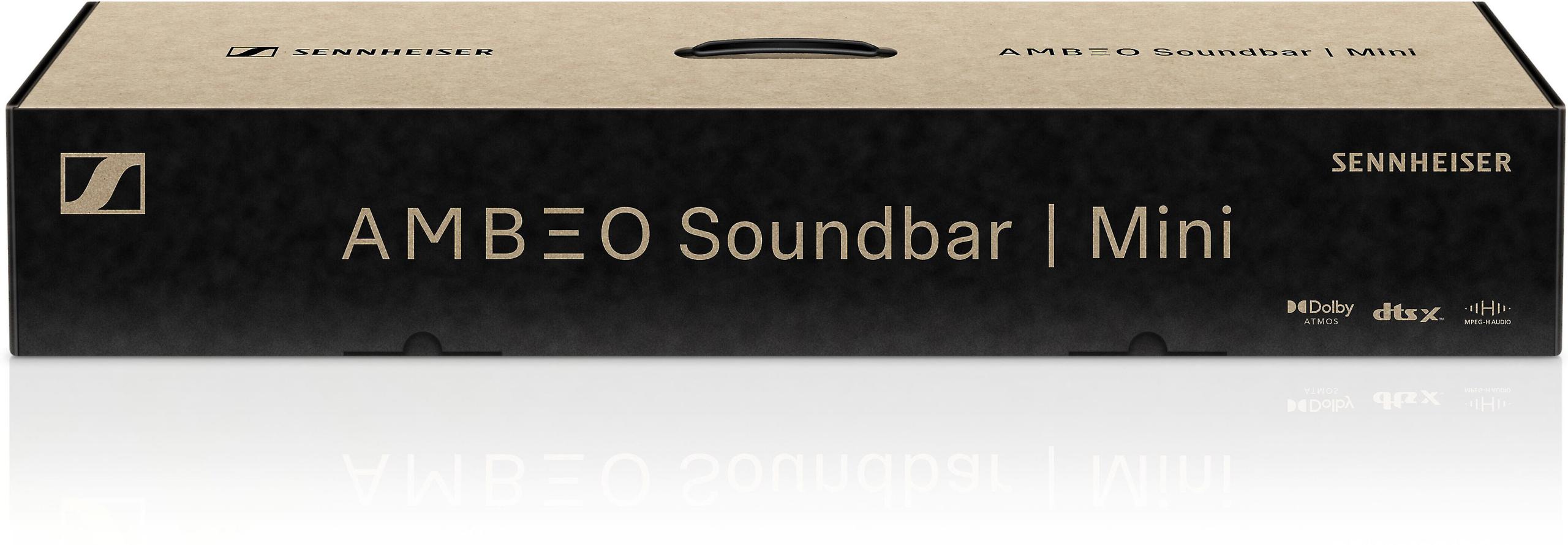
The AMBEO Mini, launched in 2023, represents Sennheiser's attempt to compress decades of professional audio expertise into an impossibly compact package. Measuring just 700mm wide and 65mm tall, it challenges conventional wisdom about what's physically possible in soundbar design.
Where the M60 Boom relies on physical driver placement, the AMBEO Mini achieves its 7.1.4 channel surround through advanced virtualization technology developed in partnership with Fraunhofer IIS – Germany's leading audio research institute. This collaboration produced algorithms that analyze your room's acoustics and create psychoacoustic illusions, tricking your brain into perceiving sounds from locations where no speakers exist.
The system supports not just Dolby Atmos, but also DTS:X, MPEG-H, and Sony's 360 Reality Audio – a breadth of format compatibility that ensures optimal performance regardless of your content source. Each format requires different processing approaches, and the AMBEO Mini's dedicated audio processing handles these conversions in real-time.
Perhaps the AMBEO Mini's most impressive feature is its automated room calibration system. Four built-in microphones constantly monitor your listening environment, adjusting frequency response, timing, and virtualization parameters to optimize performance for your specific space. This isn't a one-time setup process – the system continuously adapts as furniture moves or room conditions change.
This intelligence extends to content adaptation. The soundbar automatically detects whether you're watching dialogue-heavy content, action sequences, or listening to music, then adjusts its processing accordingly without manual intervention.
In practical terms, the M60 Boom's dedicated subwoofer provides a significant advantage for bass-heavy content. During action sequences, the physical separation allows the subwoofer to reproduce those crucial 40-60 Hz frequencies with authority while preventing the main drivers from distorting under the strain of simultaneous bass and mid-range reproduction.
The AMBEO Mini achieves impressive bass extension to 43 Hz through dual 4-inch integrated subwoofers, but physics imposes limitations. While the engineering is remarkable – producing meaningful bass from such a compact enclosure requires significant expertise – it cannot match the raw impact of a dedicated 5.25-inch subwoofer in a properly sized cabinet.
For movie nights where you want to feel explosions and car crashes, the M60 Boom delivers more visceral impact. For late-night listening or apartment living where overwhelming bass would be problematic, the AMBEO Mini's controlled approach might actually be preferable.
Both soundbars excel at dialogue reproduction, but through different approaches. The M60 Boom's VoiceMX technology actively monitors speech frequencies and applies dynamic processing to ensure voices remain prominent. This aggressive approach works exceptionally well for challenging content like Christopher Nolan films, where dialogue often gets buried in complex soundtracks.
The AMBEO Mini takes a more subtle approach, using its virtualization technology to create precise dialogue positioning. Rather than boosting speech frequencies, it uses psychoacoustic processing to make voices appear to originate from your TV screen's center, creating a more natural presentation that doesn't sound artificially enhanced.
Based on user feedback and professional reviews, both approaches succeed admirably, with the choice often coming down to personal preference: enhanced clarity versus natural reproduction.
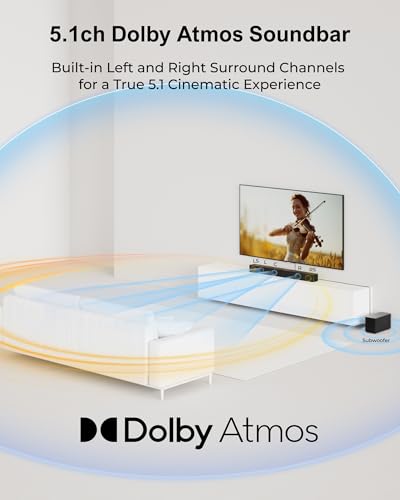
This category reveals the most significant philosophical difference between these soundbars. The M60 Boom creates its 5.1 surround effect using five discrete drivers positioned along the soundbar's length, creating genuine channel separation. While it cannot produce true rear surround effects without physical rear speakers, the left and right channel separation is authentic and immediately noticeable.
The AMBEO Mini uses sophisticated virtualization to simulate a full 7.1.4 speaker arrangement, including height channels for overhead effects. When calibrated properly in an appropriate room, this virtualization can create genuinely convincing spatial effects that seem to place sounds behind and above the listening position.
However, virtualization effectiveness depends heavily on room acoustics, listening position, and individual hearing characteristics. Some listeners find the AMBEO Mini's effects remarkably convincing, while others prefer the M60 Boom's more straightforward but reliable channel separation.
At the time of writing, these soundbars occupy different price tiers, with the AMBEO Mini commanding roughly two to three times the M60 Boom's asking price. This price difference reflects more than just brand premium – it represents fundamentally different engineering approaches and target markets.
The M60 Boom maximizes hardware value, providing physical advantages (dedicated subwoofer, multiple drivers, substantial processing power) that would typically cost significantly more from established audio brands. Its approach prioritizes measurable performance metrics: frequency response, power output, and feature completeness.
The AMBEO Mini invests heavily in sophisticated processing technology, premium materials, and extensive research and development. You're paying for German engineering precision, Fraunhofer research institute collaboration, and algorithms that took years to perfect.
You prioritize maximum performance per dollar spent. The M60 Boom delivers flagship features – Dolby Atmos processing, app control, modern connectivity, substantial bass impact – at a fraction of typical premium pricing. For families building their first serious home theater setup, this represents exceptional value.
Physical bass impact matters more than compact design. If you have space for a subwoofer and want to feel action sequences rather than just hear them, the M60 Boom's dedicated bass driver provides advantages that miniaturization cannot overcome.
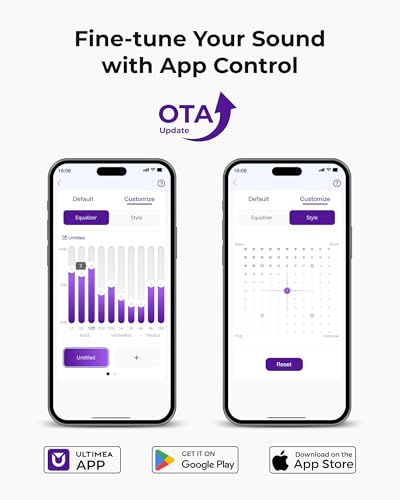
You prefer direct control over automated optimization. The comprehensive app control and manual EQ adjustment appeal to enthusiasts who enjoy tweaking settings for different content types or personal preferences.
Your primary content is movies and gaming. The M60 Boom's emphasis on dynamic range and impact excels with blockbuster films and games where dramatic audio swings enhance the experience.
Space constraints are non-negotiable, but audio quality cannot be compromised. For urban dwellers, minimalist setups, or entertainment centers where even a modest subwoofer won't fit, the AMBEO Mini achieves remarkable performance from its compact footprint.
You value sophisticated processing over raw power. The automated room calibration, advanced virtualization, and continuous acoustic adaptation represent technology that simply isn't available at lower price points.
Music listening equals movie watching in importance. The AMBEO Mini's audiophile tuning and natural frequency response excel with all content types, while the M60 Boom clearly prioritizes dramatic movie and gaming performance.
Premium build quality and brand heritage justify the price premium. Sennheiser's professional audio reputation and the AMBEO Mini's premium materials and construction appeal to buyers who view audio equipment as long-term investments.
You prefer "set and forget" operation. The intelligent automation eliminates the need for manual adjustment, making it ideal for users who want optimal performance without ongoing tweaking.
Both soundbars represent exceptional achievement within their respective price categories. The Ultimea M60 Boom succeeds by providing premium features and genuine performance advantages at accessible pricing, while the Sennheiser AMBEO Mini demonstrates how advanced processing can overcome physical limitations through engineering excellence.
Your choice ultimately depends on whether you prioritize maximum performance per dollar or maximum technology per cubic inch. The M60 Boom delivers more dramatic improvement over TV speakers for less money, while the AMBEO Mini provides more sophisticated processing and placement flexibility for buyers who can justify the premium.
Neither choice will disappoint – both represent significant upgrades over television speakers and basic soundbars. The M60 Boom offers better value for home theater enthusiasts, while the AMBEO Mini provides superior technology for space-constrained audiophiles. Understanding which category describes your priorities makes the decision straightforward.
| Ultimea Poseidon M60 Boom | Sennheiser AMBEO Mini |
|---|---|
| Channel Configuration - Determines surround sound capability | |
| 5.1 channels with physical driver separation | 7.1.4 channels through virtualization technology |
| Bass Extension - Critical for movie impact and music fullness | |
| 45Hz with dedicated 5.25" subwoofer | 43Hz with dual integrated 4" subwoofers |
| Power Output - Affects maximum volume and dynamic range | |
| 340W peak power | 250W total power |
| Processing Technology - Enables advanced audio features | |
| Triple-core DSP with 2000+ MIPS processing | AMBEO virtualization with Fraunhofer IIS algorithms |
| Room Calibration - Optimizes sound for your specific space | |
| Manual EQ adjustment via app | Automated self-calibration with 4 built-in microphones |
| Physical Design - Impacts placement flexibility | |
| Main bar + separate wired subwoofer | Single compact unit (700 x 65 x 100mm) |
| Connectivity Options - Future-proofs your setup | |
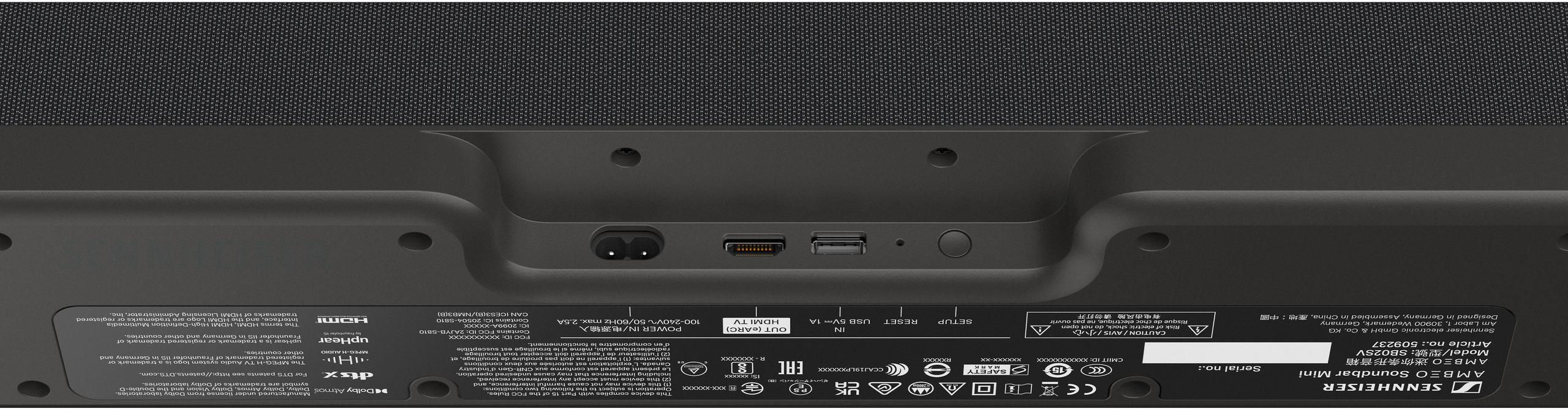
| HDMI eARC, Bluetooth 5.4, Optical, USB | HDMI eARC, Wi-Fi, Bluetooth 5.0, USB-A |
| Supported Audio Formats - Compatibility with streaming content | |
| Dolby Atmos, DTS processing | Dolby Atmos, DTS:X, MPEG-H, 360 Reality Audio |
| Voice Enhancement - Improves dialogue clarity | |
| VoiceMX technology with adaptive EQ | Voice Enhancement with natural positioning |
| Smart Features - Modern convenience capabilities | |
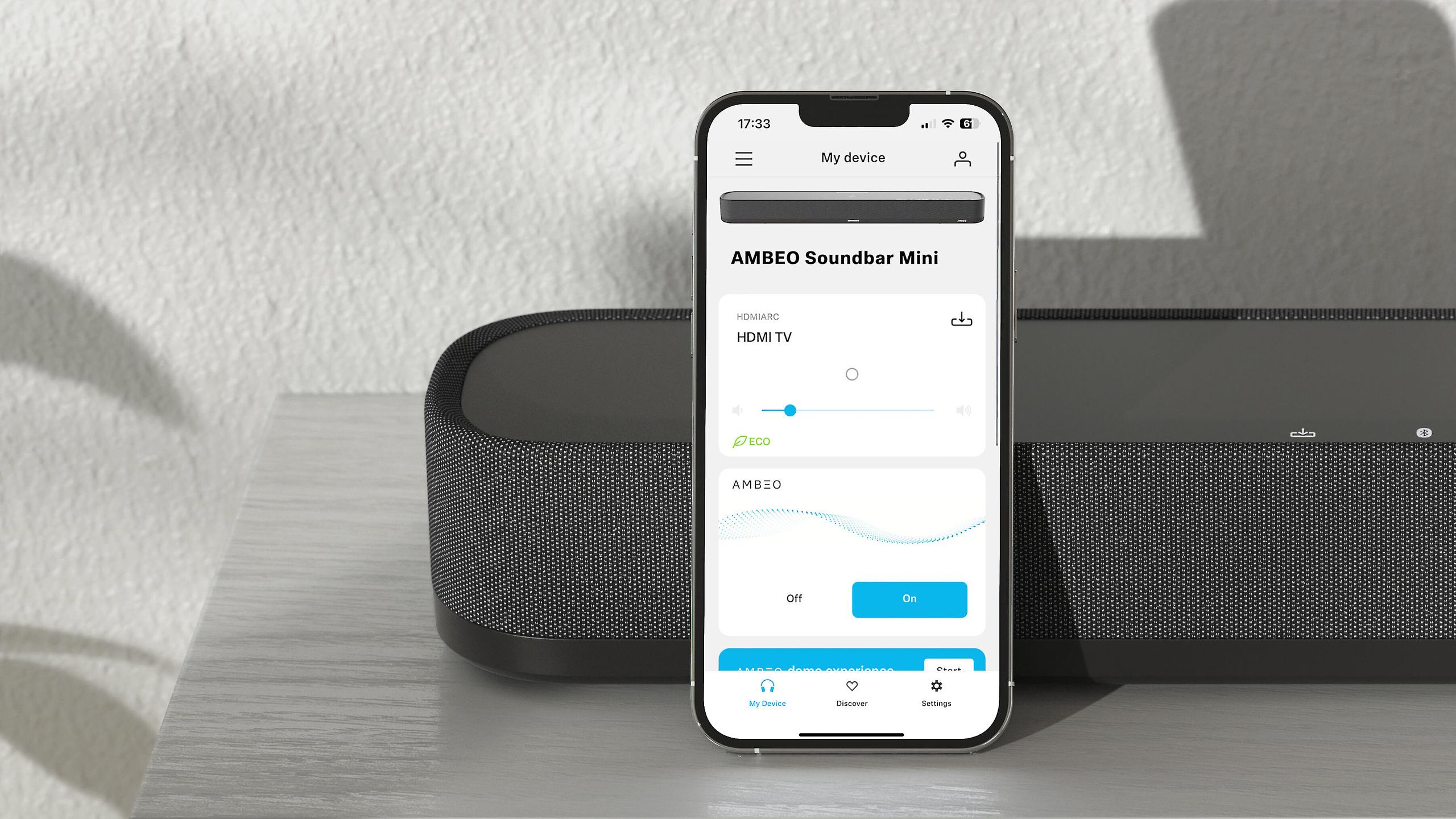
| Smart app control, CEC integration | AMBEO|OS, Alexa/Google built-in, AirPlay 2 |
| Setup Complexity - Time and effort required | |
| Simple setup with manual tuning options | Automated setup with continuous adaptation |
| Best Use Case - Where each excels most | |
| Home theater with space for subwoofer | Compact spaces requiring premium audio |
The Sennheiser AMBEO Mini is ideal for small rooms due to its compact single-unit design measuring just 700mm wide. It doesn't require a separate subwoofer, making it perfect for tight spaces. The Ultimea Poseidon M60 Boom needs space for both the main bar and a wired subwoofer, which may be challenging in smaller rooms.
The Ultimea Poseidon M60 Boom offers true 5.1 channels with five physical drivers in the main bar plus a dedicated subwoofer. The Sennheiser AMBEO Mini creates virtual 7.1.4 surround sound using advanced processing to simulate overhead and surround channels without physical rear speakers. Both provide immersive audio, but through different approaches.
The Ultimea Poseidon M60 Boom delivers more powerful bass with its dedicated 5.25-inch subwoofer that extends down to 45Hz. While the Sennheiser AMBEO Mini achieves impressive bass to 43Hz from its built-in dual 4-inch subwoofers, the physical separation of the M60 Boom's subwoofer provides more impactful low-frequency performance.
Yes, both the Ultimea Poseidon M60 Boom and Sennheiser AMBEO Mini support Dolby Atmos. The M60 Boom processes Atmos through its five-driver array, while the AMBEO Mini uses sophisticated virtualization technology to create overhead sound effects. The AMBEO Mini also supports additional formats like DTS:X and 360 Reality Audio.
The Sennheiser AMBEO Mini offers the simplest setup with automated room calibration that adjusts settings automatically using built-in microphones. The Ultimea Poseidon M60 Boom requires manual positioning of the subwoofer and manual EQ adjustments through the app, though it provides more control over the final sound.
Both soundbars offer smartphone control. The Ultimea Poseidon M60 Boom includes a comprehensive smart app for EQ adjustments, sound modes, and system settings. The Sennheiser AMBEO Mini features the AMBEO|OS platform with app control plus built-in Alexa and Google Assistant for voice commands.
Both excel at dialogue reproduction but use different approaches. The Ultimea Poseidon M60 Boom uses VoiceMX technology with adaptive EQ to actively enhance speech frequencies. The Sennheiser AMBEO Mini employs voice enhancement through precise virtual positioning, creating natural-sounding dialogue without artificial boosting.
The Ultimea Poseidon M60 Boom provides HDMI eARC, Bluetooth 5.4, optical, and USB connections. The Sennheiser AMBEO Mini offers HDMI eARC, Wi-Fi, Bluetooth 5.0, USB-A, plus advanced streaming support including AirPlay 2, Spotify Connect, and Tidal Connect for seamless music streaming.
The Ultimea Poseidon M60 Boom provides exceptional value with flagship features like Dolby Atmos, dedicated subwoofer, and smart app control at a budget-friendly price point. The Sennheiser AMBEO Mini costs significantly more but offers premium German engineering, advanced virtualization technology, and automated room calibration.
The Sennheiser AMBEO Mini excels for music with its audiophile tuning, natural frequency response, and support for high-quality streaming services. The Ultimea Poseidon M60 Boom performs well for music but is optimized more for movies and gaming with emphasis on dynamic range and bass impact.
The Ultimea Poseidon M60 Boom is excellent for gaming due to its Bluetooth 5.4 ultra-low latency connection and powerful bass response that enhances game effects. The Sennheiser AMBEO Mini also works well for gaming with its sophisticated surround processing, though the M60 Boom's physical bass advantage makes action games more immersive.
Neither the Ultimea Poseidon M60 Boom nor Sennheiser AMBEO Mini requires additional speakers for a complete surround sound experience. The M60 Boom includes everything needed with its five-driver bar and subwoofer, while the AMBEO Mini creates virtual surround effects from a single compact unit, making both complete audio solutions.
We've done our best to create useful and informative comparisons to help you decide what product to buy. Our research uses advanced automated methods to create this comparison and perfection is not possible - please contact us for corrections or questions. These are the sites we've researched in the creation of this article: ultimea.com - ultimea.com - youtube.com - bestbuy.com - youtube.com - avsforum.com - youtube.com - manuals.plus - youtube.com - device.report - ultimea.com - ultimea.de - community.ultimea.com - ultimea.com - community.ultimea.com - ultimea.com - youtube.com - aliexpress.com - ultimea.com - techradar.com - sennheiser-hearing.com - stereonet.com - rtings.com - youtube.com - youtube.com - newsroom.sennheiser.com - whathifi.com - baybloorradio.com - sennheiser-hearing.com - files.bbystatic.com

Privacy Policy
Terms and Conditions - Affiliate Policy
Home Security
© Copyright 2008-2026.
11816 Inwood Rd #1211, Dallas, TX 75244