


When your TV's built-in speakers make dialogue sound like it's coming from underwater and action scenes lack any punch, it's time to consider a soundbar upgrade. But the soundbar world has evolved into two distinct camps: traditional systems with multiple physical speakers scattered around your room, and sleek single-bar units that use clever processing to simulate surround sound. The Ultimea Aura A40 U2601 and Ultimea Poseidon M60 Boom perfectly represent this divide, each taking a fundamentally different approach to delivering better TV audio.
Released in different eras of soundbar evolution, these two systems showcase how the industry has shifted. The Aura A40 represents the traditional approach that dominated the early-to-mid 2010s, when manufacturers believed the only way to get true surround sound was through discrete speakers positioned around your listening space. The Poseidon M60 Boom, launched in 2023, embodies the modern philosophy that advanced digital signal processing (DSP) can create convincing surround effects without cluttering your room with additional speakers.
The core difference between these systems isn't just about speaker count—it's about two completely different approaches to creating immersive audio. The Ultimea Aura A40 uses what audio engineers call "discrete channels," meaning each surround speaker receives its own unique audio signal. When a helicopter flies overhead in a movie, that sound literally travels from your front speakers to your rear speakers because they're processing separate audio channels. This creates what purists consider "true" surround sound.
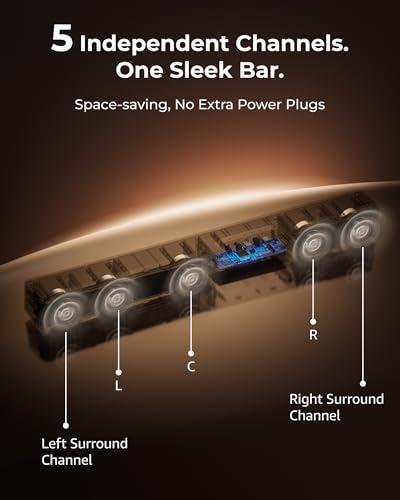
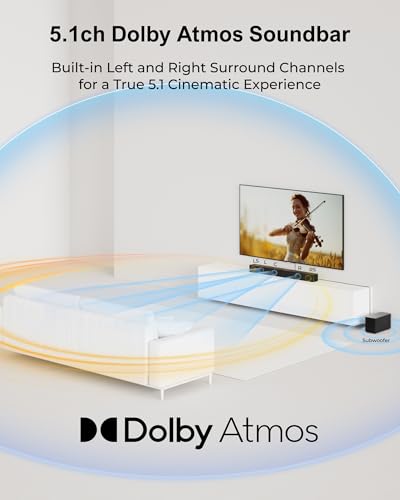
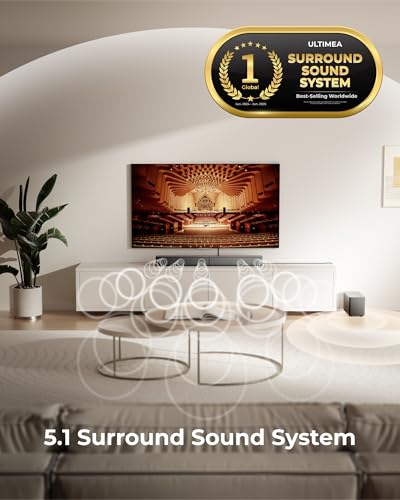
In contrast, the Poseidon M60 Boom uses virtual surround processing, where sophisticated computer algorithms analyze the incoming audio and redirect it through strategically positioned drivers within the main soundbar. The system uses psychoacoustic principles—basically, tricks that exploit how our brains process directional sound—to make audio seem like it's coming from places where there are no actual speakers.
Both approaches have merit, but they excel in different scenarios and appeal to different types of users. The key is understanding which philosophy aligns with your priorities, room constraints, and expectations.
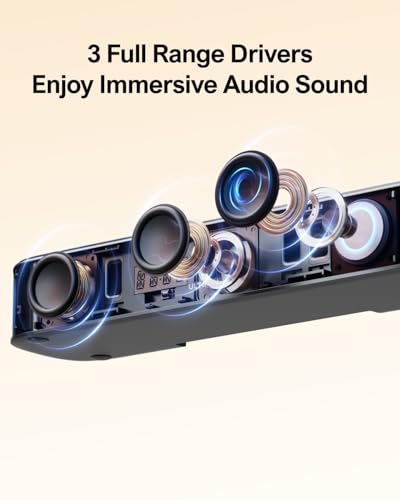
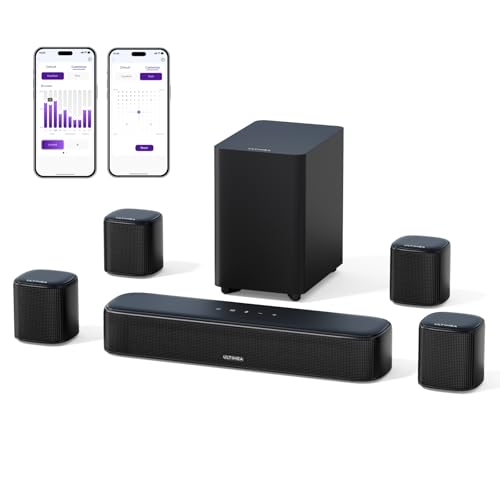
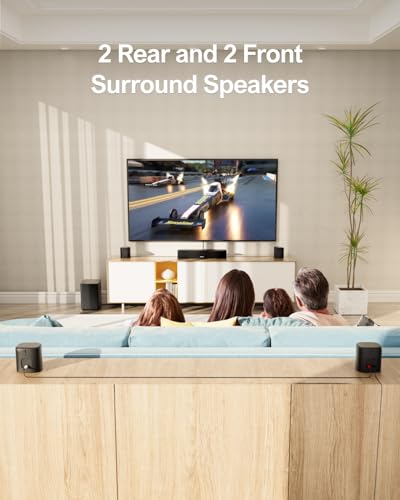
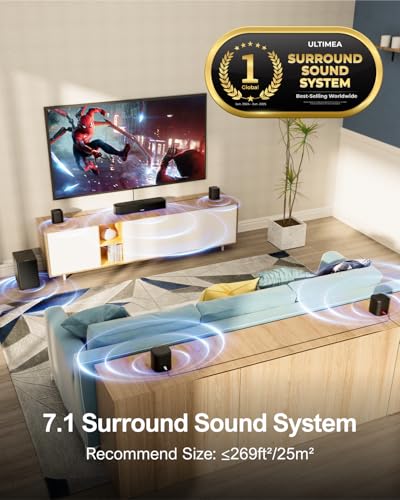
Let's dive into the technical specifications that actually matter for sound quality. The Aura A40 deploys eight drivers across its entire system: three in the main soundbar, four in the surround speakers, and one in the subwoofer. This creates a true 7.1 channel configuration, though it's worth noting that "virtual 7.1" means the system processes seven discrete channels plus a dedicated low-frequency effects channel for the subwoofer.
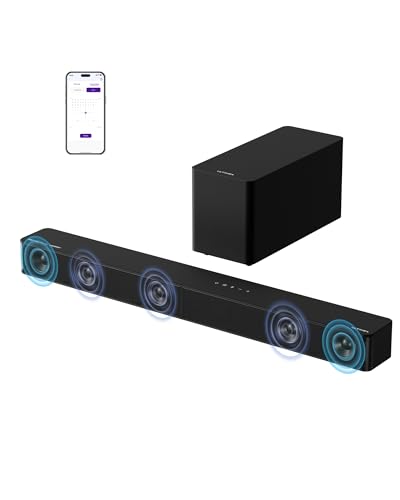
The M60 Boom takes a more concentrated approach with six drivers total—five built into the main soundbar unit and one in the subwoofer. However, it compensates for fewer drivers with significantly more processing power. The system features what Ultimea calls "Triple-Core DSP Technology," which includes two processors running at 800MHz and another at 600MHz. To put this in perspective, that's over 2000 MIPS (millions of instructions per second) of dedicated audio processing power, allowing for real-time manipulation of sound waves to create surround effects.
Power output tells an interesting story about these systems' design priorities. The M60 Boom delivers 340W peak power compared to the A40's 330W, but power ratings in soundbars can be misleading. What matters more is how that power is distributed and controlled. The A40 spreads its power across eight separate drivers, while the M60 concentrates most of its amplification in the main unit, allowing for more dynamic control over the sound field.
The frequency response specifications reveal another crucial difference. The M60 Boom can reproduce sounds down to 45Hz, while the A40 bottoms out at 65Hz. In practical terms, this 20Hz difference means the M60's subwoofer can reproduce deeper bass notes—the kind you feel in your chest during action movies or the lowest notes in electronic music. Both systems top out around 18kHz, which covers the full range of human hearing.
This is where the philosophical differences become most apparent in actual use. Our research into user reviews and expert opinions reveals consistent patterns in how these systems perform in real-world scenarios.
The Aura A40 excels at creating what audio enthusiasts call "speaker localization"—the ability to pinpoint exactly where sounds are coming from. When you're playing a first-person shooter game and need to identify which direction enemy footsteps are approaching from, the A40's discrete rear speakers provide genuine directional cues. Movie scenes with helicopters, passing cars, or ambient environmental sounds benefit from this physical speaker separation in ways that virtual processing simply cannot replicate.
However, the Poseidon M60 Boom brings something the A40 cannot: true Dolby Atmos processing. Dolby Atmos represents a fundamental shift in how audio is encoded and played back. Instead of traditional channel-based surround sound (left, right, center, rear left, rear right), Atmos uses "object-based" audio. This means sound engineers can position individual audio elements anywhere in a three-dimensional space, including overhead. The M60's processing can decode these object-based soundtracks and use its drivers to create the illusion of overhead sound, even without upward-firing speakers.
The trade-off becomes clear when comparing user experiences. A40 owners consistently report more convincing rear-channel effects—sounds that genuinely seem to come from behind them. M60 Boom users praise the system's ability to create a wider soundstage (the apparent width of the audio field) and appreciate the overhead effects in Dolby Atmos content, but note that rear surround effects feel more like "enhanced stereo" than true rear-channel audio.
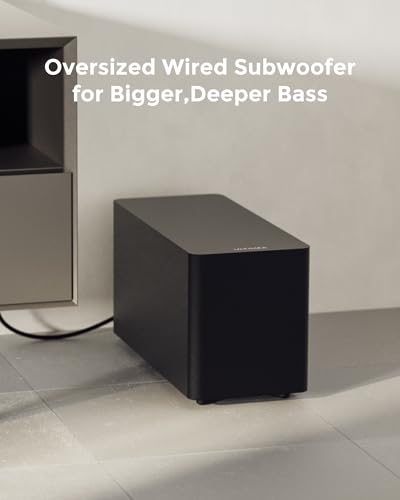
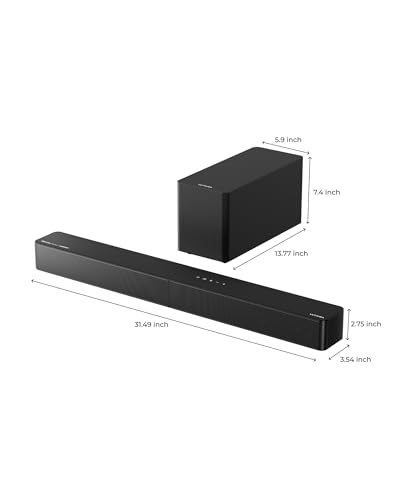
Both systems use Ultimea's BassMX technology, but implement it differently due to their subwoofer designs. The A40 uses a 4-inch driver in a wired subwoofer, while the M60 Boom features a larger 5.25-inch driver in a wireless subwoofer with up to 18mm of excursion (how far the driver can move back and forth).
The larger driver in the M60 provides several advantages. More driver surface area means more air displacement, resulting in deeper, more impactful bass. The additional excursion capability allows the driver to reproduce low frequencies with less distortion, maintaining clarity even at high volumes. User reviews consistently note that the M60's bass feels more substantial and room-filling compared to the A40's more controlled, tighter bass response.
However, the A40's wired subwoofer connection offers one significant advantage: signal integrity. Wireless subwoofers, while convenient, can occasionally experience latency issues or signal dropouts, particularly in environments with heavy Wi-Fi traffic. The wired connection ensures perfect synchronization between the main unit and subwoofer, which is crucial for maintaining the illusion of cohesive surround sound.
Poor dialogue clarity is the number one complaint about TV audio, making this performance characteristic crucial for any soundbar evaluation. Both systems address this challenge but use different approaches.
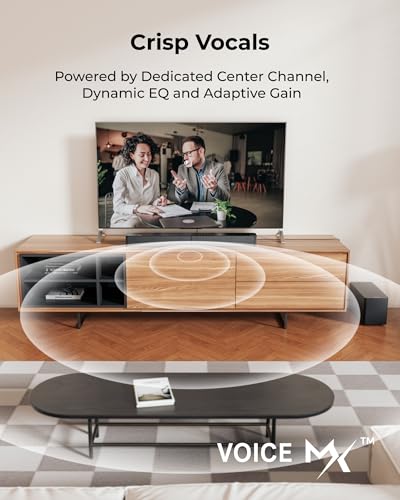
The M60 Boom incorporates VoiceMX technology, which specifically targets the 300Hz to 3kHz frequency range where most human speech occurs. The system uses adaptive EQ and gain control to dynamically enhance dialogue without making it sound artificially boosted. During complex movie scenes with layered audio—think explosions happening while characters are speaking—the VoiceMX processing can temporarily reduce background effects to maintain speech intelligibility.
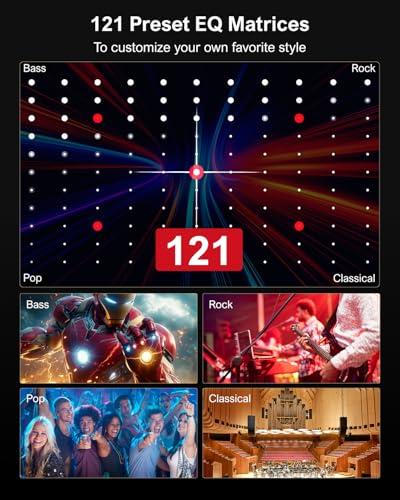
The Aura A40 takes a more traditional approach with extensive manual EQ controls. The system offers 121 preset EQ matrices designed for different content types and listening preferences, plus a 10-band parametric equalizer for fine-tuning. While this requires more user involvement, it provides unprecedented control over how dialogue sits in the overall mix. Users who invest time in properly calibrating the A40 often achieve superior dialogue clarity compared to systems with automatic processing.
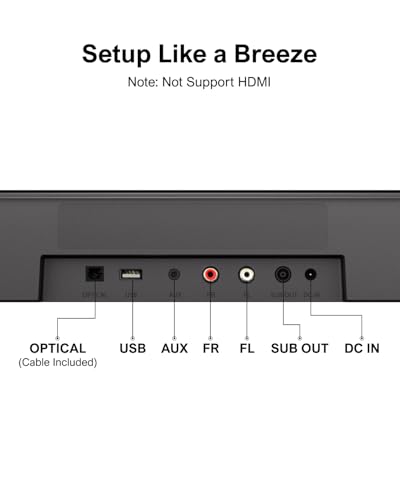
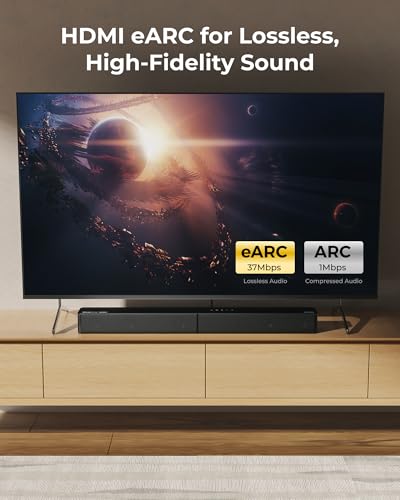
Perhaps the most significant practical difference between these systems is connectivity, specifically HDMI eARC support. The Poseidon M60 Boom includes HDMI eARC (Enhanced Audio Return Channel), while the Aura A40 relies on optical, AUX, and USB connections.
HDMI eARC represents a major advancement in how soundbars connect to modern TVs. Unlike optical connections, which can only carry compressed audio formats like standard Dolby Digital, eARC can transmit uncompressed, full-resolution audio including Dolby Atmos, DTS:X, and high-resolution PCM. This means the M60 Boom can receive the full quality audio track from streaming services like Netflix, Disney+, and Apple TV+, which increasingly offer Dolby Atmos soundtracks.
Equally important is eARC's support for Consumer Electronics Control (CEC). This allows the soundbar to integrate seamlessly with your TV's remote control and power management. When you adjust volume on your TV remote, the soundbar responds. When you turn off your TV, the soundbar automatically goes into standby mode. This level of integration simply isn't possible with optical connections.
The A40's reliance on optical connectivity isn't necessarily a deal-breaker, particularly for users with older TVs or those who primarily watch standard broadcast content. However, it does limit the system's ability to take full advantage of modern streaming content and creates a less seamless user experience.
The installation process reveals each system's core philosophy most clearly. Setting up the Aura A40 requires careful planning and significant cable management. The system includes a 6-meter cable for the rear surround speakers, plus shorter cables for the front surrounds. You'll need to route these cables through your room—either along baseboards, under carpets, or through walls—which can be challenging in rental properties or rooms where drilling isn't practical.
However, this complexity pays dividends in flexibility and performance. Once properly installed, the A40 provides the most authentic surround experience possible at this price point. The physical speaker separation creates genuinely immersive audio that virtual processing cannot fully replicate.
The M60 Boom represents the opposite approach: minimal setup complexity for maximum convenience. The wireless subwoofer pairs automatically, and the entire system can be operational within minutes of unboxing. There are no speaker placement decisions to make, no cables to route, and no sweet spots to optimize for. This convenience comes with some performance compromises, but for many users, the trade-off strongly favors simplicity.
At the time of writing, both systems occupy competitive price points in the budget-to-mid-range soundbar market, but they offer different value propositions. The Poseidon M60 Boom provides features typically found in soundbars costing significantly more—Dolby Atmos processing, HDMI eARC, and sophisticated DSP technology—at an accessible price point. For users seeking modern features and convenience, it represents exceptional value.
The Aura A40 offers something increasingly rare in the soundbar market: true discrete surround sound with extensive customization options. Comparable systems from established brands often cost two to three times more, making the A40 an attractive option for users willing to invest in proper setup for maximum audio performance.
Both systems have evolved since their respective releases, receiving firmware updates that improve performance and add features. The M60 Boom's support for over-the-air updates ensures continued improvements, while the A40 benefits from ongoing refinements to its SurroundX processing algorithms.
For dedicated home theater setups, room acoustics play a crucial role in system performance. The Aura A40 works best in medium-sized rooms (roughly 150-300 square feet) where the physical speakers can be optimally positioned. Larger rooms benefit from the system's ability to fill space with discrete audio channels, while smaller rooms might feel overwhelmed by four additional speakers.
The M60 Boom adapts more readily to various room sizes and layouts. Its virtual surround processing algorithms can compensate for different acoustic environments, though performance varies depending on room shape and furnishing. Highly reflective rooms (lots of hard surfaces) tend to enhance the virtual surround effect, while heavily furnished rooms with sound-absorbing materials may limit the system's ability to create convincing spatial audio.
After extensive research into user experiences and expert evaluations, clear usage scenarios emerge for each system. The Poseidon M60 Boom represents the best choice for users who prioritize convenience, modern features, and future compatibility. If you have a recent TV with HDMI eARC, regularly stream content from services offering Dolby Atmos, and want excellent sound quality without room modification, the M60 delivers exceptional value.
The system particularly excels for apartment dwellers, renters who cannot modify their living spaces, and users who frequently rearrange their rooms. The wireless subwoofer provides placement flexibility that wired systems cannot match, and the lack of additional speakers means furniture arrangement doesn't affect performance.
Conversely, the Ultimea Aura A40 serves users who prioritize maximum audio immersion and don't mind investing time in proper setup. Gaming enthusiasts particularly benefit from the discrete channel separation, which provides competitive advantages in multiplayer games where directional audio cues are crucial. Movie buffs seeking the most authentic surround experience will appreciate the physical speaker positioning, even if it means accepting the complexity of proper installation.
The A40 also appeals to audio customization enthusiasts who enjoy fine-tuning their systems. The extensive EQ options and preset matrices provide control that virtual processing systems cannot match, allowing users to optimize performance for specific content types and personal preferences.
For most users, the decision comes down to priorities: convenience and modern features versus maximum authenticity and customization. The M60 Boom delivers 85% of the surround experience with 15% of the complexity, while the A40 provides 100% authentic positioning but demands 100% commitment to proper setup and optimization.
Both systems represent significant upgrades over TV speakers and basic soundbars, but they serve different audiences with distinct priorities. Consider your room constraints, setup willingness, and feature priorities to determine which philosophy aligns with your needs and expectations.
| Ultimea Aura A40 U2601 Soundbar System | Ultimea Poseidon M60 Boom 5.1 Soundbar |
|---|---|
| Channel Configuration - Determines surround sound authenticity | |
| 7.1 Virtual Surround with 4 physical wired speakers | 5.1 Dolby Atmos virtual surround in single bar |
| Total Speakers - More drivers can mean better sound separation | |
| 8 drivers (3 soundbar + 4 surround + 1 sub) | 6 drivers (5 soundbar + 1 sub) |
| Peak Power Output - Higher wattage enables louder, more dynamic sound | |
| 330W peak power | 340W peak power |
| Frequency Response - Lower bass extension provides more impactful effects | |
| 65Hz–18kHz (adequate bass depth) | 45Hz–18kHz (deeper, more powerful bass) |
| Subwoofer Size - Larger drivers produce deeper, more room-filling bass | |
| 4" wired subwoofer | 5.25" wireless subwoofer |
| HDMI eARC Support - Essential for modern TV compatibility and high-quality audio | |
| No HDMI support (optical/AUX only) | Yes, full HDMI eARC with CEC control |
| Dolby Atmos - Object-based surround creates overhead sound effects | |
| Not supported (traditional channel-based processing) | Full Dolby Atmos 5.1 support |
| Bluetooth Version - Newer versions offer better stability and lower latency | |
| Bluetooth 5.3 | Bluetooth 5.4 (ultra-low latency) |
| Setup Complexity - Affects installation time and room compatibility | |
| Complex: 4 wired speakers require cable routing | Simple: Wireless subwoofer, no additional speakers |
| App Control Features - More customization enables better sound tuning | |
| 121 preset EQ matrices + 10-band equalizer | Smart app with real-time DSP tuning |
| Room Size Recommendation - Optimal performance depends on space | |
| 108–270 ft² (benefits from speaker placement flexibility) | Adaptable to most room sizes (virtual processing adjusts) |
| Best Use Cases - Different strengths serve different priorities | |
| Gaming, discrete surround enthusiasts, customization lovers | Convenience seekers, modern TV owners, Atmos content viewers |
The Ultimea Aura A40 U2601 Soundbar System provides more authentic surround sound with four physical wired speakers positioned around your room, creating true 7.1 channel separation. The Ultimea Poseidon M60 Boom 5.1 Soundbar uses virtual surround processing and Dolby Atmos to simulate surround effects from a single bar. For the most realistic directional audio, the Aura A40 wins, but the M60 Boom offers more convenience with nearly comparable results.
The Ultimea Poseidon M60 Boom 5.1 Soundbar is significantly easier to install, requiring only a wireless subwoofer connection and taking less than 5 minutes. The Ultimea Aura A40 U2601 Soundbar System requires running cables to four surround speakers throughout your room, which can take 30-45 minutes and may require drilling or creative cable management. For renters or those wanting quick setup, the M60 Boom is the clear winner.
The Ultimea Poseidon M60 Boom 5.1 Soundbar includes HDMI eARC for seamless connection to modern TVs, supporting high-quality audio formats and unified remote control. The Ultimea Aura A40 U2601 Soundbar System only offers optical, AUX, and USB connections, lacking HDMI entirely. If you have a newer TV and want the best audio quality from streaming services, the M60 Boom is essential.
The Ultimea Poseidon M60 Boom 5.1 Soundbar features a larger 5.25-inch wireless subwoofer that can reproduce frequencies down to 45Hz, providing deeper and more impactful bass. The Ultimea Aura A40 U2601 Soundbar System uses a smaller 4-inch wired subwoofer with a 65Hz low-end extension. For action movies and music with heavy bass, the M60 Boom delivers superior low-frequency performance.
Only the Ultimea Poseidon M60 Boom 5.1 Soundbar supports Dolby Atmos, which creates overhead sound effects from streaming services like Netflix and Disney+. The Ultimea Aura A40 U2601 Soundbar System uses traditional channel-based processing without Atmos support. If you frequently watch modern streaming content with Atmos soundtracks, the M60 Boom provides a more immersive experience.
The Ultimea Aura A40 U2601 Soundbar System provides extensive customization with 121 preset EQ matrices for different content types and a 10-band parametric equalizer for precise tuning. The Ultimea Poseidon M60 Boom 5.1 Soundbar offers smart app control with real-time DSP adjustments but fewer manual options. Audio enthusiasts who enjoy fine-tuning their sound will prefer the Aura A40's comprehensive controls.
The Ultimea Aura A40 U2601 Soundbar System excels for gaming with discrete surround speakers that provide accurate directional audio cues, helping identify enemy positions in competitive games. The Ultimea Poseidon M60 Boom 5.1 Soundbar offers Bluetooth 5.4 with ultra-low latency and virtual surround effects. For serious gaming where positional audio matters, the Aura A40 provides superior spatial accuracy.
The Ultimea Poseidon M60 Boom 5.1 Soundbar is ideal for apartments since it requires no additional speakers or cable routing, and the wireless subwoofer can be placed flexibly. The Ultimea Aura A40 U2601 Soundbar System needs four speakers positioned around the room with cables, which can be challenging in rentals. For apartment living, the M60 Boom offers excellent sound without installation complications.
The Ultimea Poseidon M60 Boom 5.1 Soundbar delivers 340W peak power, slightly higher than the Ultimea Aura A40 U2601 Soundbar System's 330W output. However, the Aura A40 distributes power across eight separate drivers, while the M60 Boom concentrates most amplification in the main unit. Both provide ample volume for most rooms, with the M60 Boom having a slight edge in raw power.
Both soundbars excel at dialogue reproduction but use different approaches. The Ultimea Poseidon M60 Boom 5.1 Soundbar uses VoiceMX technology that automatically enhances speech frequencies, while the Ultimea Aura A40 U2601 Soundbar System relies on manual EQ adjustments for dialogue optimization. The M60 Boom provides effortless dialogue clarity, while the Aura A40 offers more control for perfectionist tuning.
Yes, both soundbars offer smartphone app control. The Ultimea Aura A40 U2601 Soundbar System uses the ULTIMEA Smart App with access to all 121 EQ presets and detailed customization options. The Ultimea Poseidon M60 Boom 5.1 Soundbar also features smart app control with streamlined interface and real-time adjustments. Both apps support over-the-air updates, but the Aura A40's app provides more granular control options.
Both soundbars offer excellent value in their respective categories. The Ultimea Poseidon M60 Boom 5.1 Soundbar provides premium features like Dolby Atmos and HDMI eARC typically found in much more expensive systems. The Ultimea Aura A40 U2601 Soundbar System delivers authentic discrete surround sound that usually costs significantly more from other brands. Choose the M60 Boom for modern convenience or the Aura A40 for maximum surround authenticity.
We've done our best to create useful and informative comparisons to help you decide what product to buy. Our research uses advanced automated methods to create this comparison and perfection is not possible - please contact us for corrections or questions. These are the sites we've researched in the creation of this article: walmart.com - newegg.com - youtube.com - ultimea.com - youtube.com - device.report - ultimea.co - manuals.plus - homestudiobasics.com - youtube.com - bestbuy.com - community.ultimea.com - manuals.plus - eu.ultimea.com - navesapeugeot.com.br - bestbuy.com - images.thdstatic.com - provantage.com - ultimea.com - bestbuy.com - ultimea.com - ultimea.com - youtube.com - bestbuy.com - youtube.com - avsforum.com - youtube.com - manuals.plus - youtube.com - device.report - ultimea.com - ultimea.de - community.ultimea.com - ultimea.com - community.ultimea.com - ultimea.com - youtube.com - aliexpress.com - ultimea.com

Privacy Policy
Terms and Conditions - Affiliate Policy
Home Security
© Copyright 2008-2026.
11816 Inwood Rd #1211, Dallas, TX 75244