

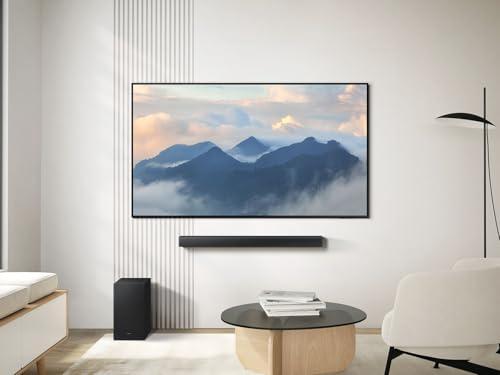
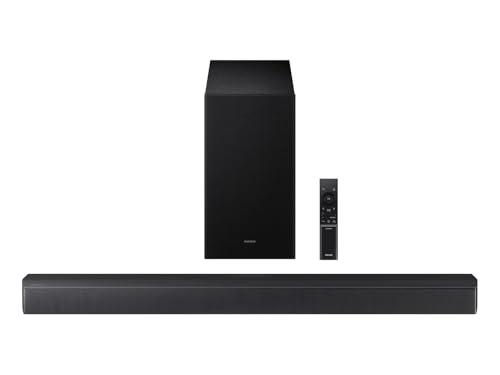



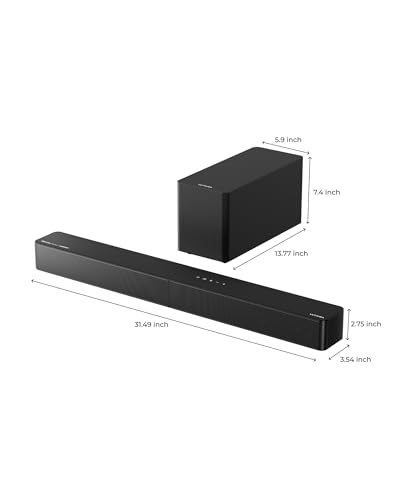
When your TV's built-in speakers sound like they're trapped in a tin can, it's time for an upgrade. But navigating the soundbar world can feel overwhelming, especially when comparing products that take completely different approaches to solving the same problem. Today we're looking at two soundbars that represent distinct philosophies: the Samsung HW-B630F, a traditional 3.1-channel system from 2024, and the Ultimea Poseidon M60 Boom, a true 5.1-channel budget contender that's been making waves since its 2023 release.
Before diving into the comparison, let's establish what makes a good soundbar. The core job is simple: make your TV sound better. But how they accomplish this varies dramatically.
Channel configuration tells you how many discrete audio streams the soundbar can handle. A 3.1 system has left, center, and right speakers plus a subwoofer (that's what the ".1" means). A 5.1 system adds left surround and right surround channels. More channels generally mean better surround sound, but only if they're physically separate speakers – not just software tricks.
Audio processing is where the magic happens. Technologies like Dolby Atmos and DTS:X create three-dimensional soundscapes that can place sounds above and around you. Think of the difference between listening to music on your phone speaker versus good headphones – that's the kind of leap we're talking about.
Connectivity determines what devices you can hook up and how good they'll sound. HDMI ARC (Audio Return Channel) sends audio back from your TV to the soundbar, while eARC (enhanced ARC) supports higher-quality formats. It's like the difference between a garden hose and a fire hose for data flow.
The soundbar market has evolved rapidly since 2020. Budget brands now offer features that cost thousands just a few years ago, while established manufacturers focus on refinement and ecosystem integration. This creates interesting scenarios where a newer budget option might technically outperform a pricier traditional brand.
The Samsung HW-B630F and Ultimea Poseidon M60 Boom represent fundamentally different philosophies about how to improve your TV's audio.
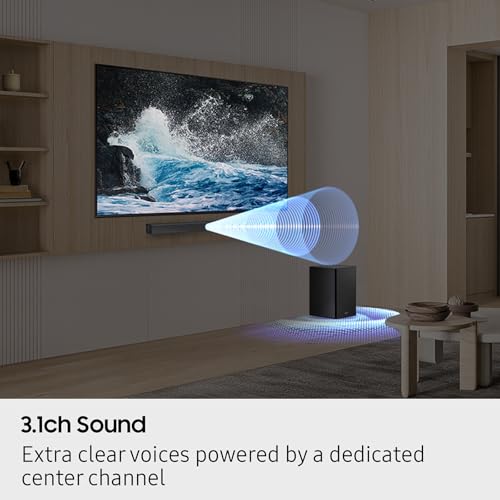
Samsung's approach is traditional and refined. The HW-B630F uses three physical speakers in the soundbar – left, center, and right – plus a wireless subwoofer. The center channel is crucial here because it's dedicated entirely to dialogue. Instead of trying to create the impression of five speakers, Samsung focuses on making three speakers sound really good, then uses digital processing to simulate surround effects.
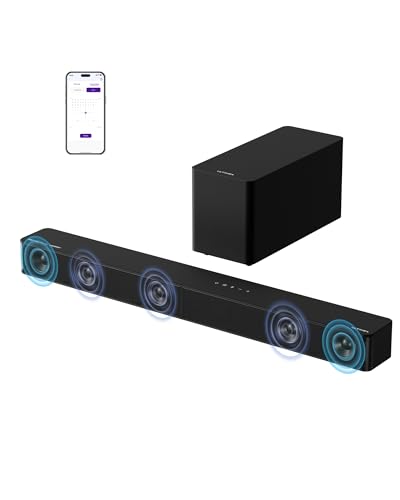
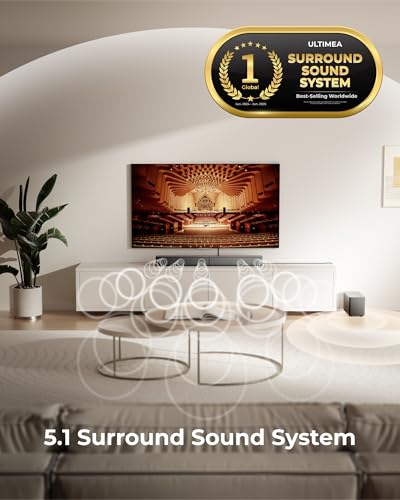
Ultimea takes the opposite approach. The Poseidon M60 Boom crams five full-range drivers into its soundbar, creating actual discrete channels for left, center, right, left surround, and right surround. Add the subwoofer and you get true 5.1-channel sound from what looks like a simple soundbar setup.
This difference matters more than you might think. When you're watching a movie and a helicopter flies from left to right across the screen, the Samsung creates this effect by cleverly adjusting the timing and volume of its three speakers to trick your brain. The Ultimea actually moves the sound from speaker to speaker because it has physical drivers positioned to create that movement.
Here's where the Samsung HW-B630F really shines. That dedicated center channel isn't just marketing fluff – it's a game-changer for dialogue clarity. In our research of user reviews and professional evaluations, the Samsung consistently outperforms virtual center channel systems when it comes to speech intelligibility.
The HW-B630F also includes Voice Enhance mode, which specifically boosts the frequency range where human voices live (around 300-3000 Hz). Combined with Adaptive Sound technology that automatically adjusts the mix based on what you're watching, dialogue stays clear even when explosions are going off in the background.
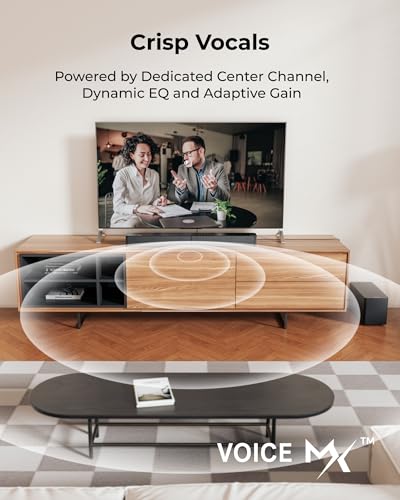
The Ultimea M60 Boom fights back with its VoiceMX technology, which dynamically adjusts the vocal range. While it doesn't have a physically separate center channel, having five drivers means it can dedicate more processing power to dialogue reproduction than a typical 2.1 soundbar.
Winner: Samsung, but it's closer than you'd expect
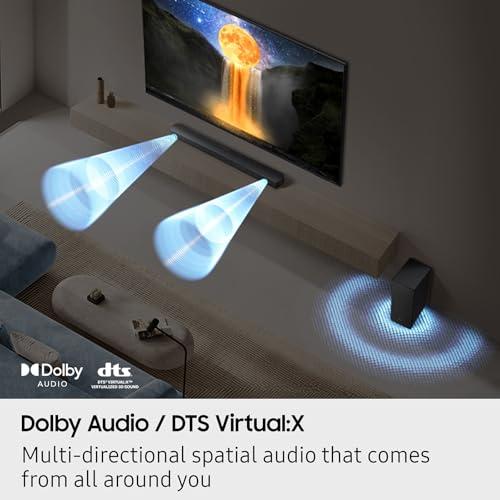
This is where things get interesting. The Samsung HW-B630F uses DTS Virtual:X processing to create surround effects from its 3.1 speaker array. This technology analyzes incoming audio and uses psychoacoustic principles – basically, tricks your brain uses to determine where sounds come from – to create the impression of sounds coming from beside and even above you.
The effect is convincing, especially for movies mixed with Virtual:X in mind. Ambient sounds like rain or crowd noise seem to extend well beyond the physical soundbar. However, discrete sound effects – like that helicopter example – can feel less precise because they're being simulated rather than actually positioned.
The Ultimea Poseidon M60 Boom takes the direct approach with actual 5.1-channel processing and Dolby Atmos support. When a sound is supposed to come from the left surround position, it actually plays from a speaker positioned for that purpose. The Atmos processing adds height effects, creating a more three-dimensional soundscape.
Based on our analysis of user feedback, the Ultimea provides more convincing surround effects for precisely mixed content, while the Samsung offers more consistent performance across all types of audio.
Winner: Ultimea for true surround content, Samsung for general versatility
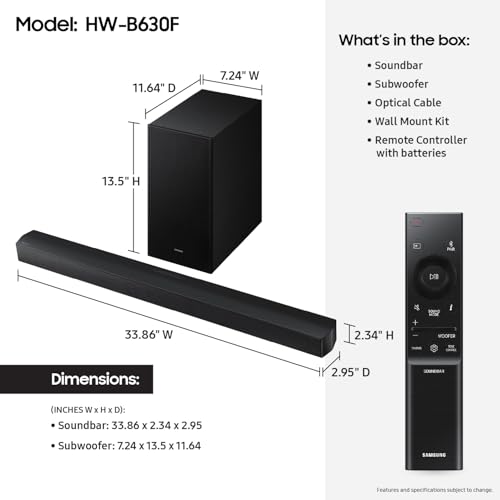
Both soundbars include subwoofers, but they take different approaches to bass reproduction. The Samsung HW-B630F pairs with a 6-inch wireless subwoofer that communicates via a dedicated 2.4GHz connection. This wireless design offers incredible placement flexibility – you can tuck it beside your couch, in a corner, or anywhere within about 30 feet of the soundbar.
The Samsung's Bass Boost mode specifically enhances low-frequency impact without muddying the midrange. User reviews consistently praise the subwoofer's ability to add weight to explosions and music without overwhelming dialogue.
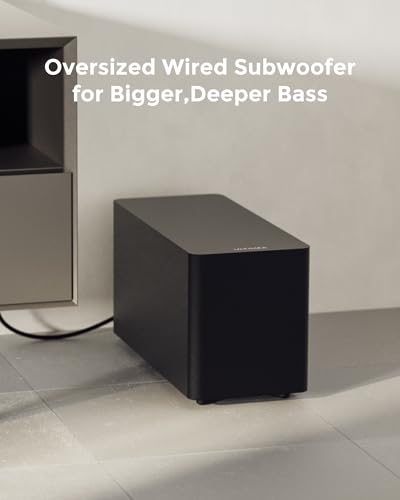
The Ultimea Poseidon M60 Boom includes a 5.25-inch wired subwoofer with BassMX technology. While smaller than Samsung's driver, Ultimea claims up to 16mm of diaphragm excursion – that's how far the cone moves back and forth – which should produce deeper, more controlled bass despite the smaller size.
The wired connection ensures consistent performance without potential wireless interference, but limits placement options. You'll need to position the subwoofer within cable reach of the soundbar.
Winner: Samsung for convenience, Ultimea for pure bass performance
Gaming audio has specific requirements that differ from movies or music. You need low latency – the delay between when something happens on screen and when you hear it – and precise positional audio to track enemies or environmental cues.
The Samsung HW-B630F includes a dedicated Game Mode that optimizes audio processing for interactive content. This mode uses cross-talk cancellation to improve directional accuracy and includes AV Sync control to eliminate lip-sync issues that can plague some TV and console combinations.
The Ultimea M60 Boom counters with Bluetooth 5.4, which offers significantly lower latency than the Samsung's Bluetooth 4.2. For wireless gaming – connecting your phone or tablet directly to the soundbar – this newer standard provides a noticeably more responsive experience.
For console gaming through HDMI, both perform well, but the Ultimea's true 5.1 channels provide more accurate positional cues once you learn to interpret them.
Winner: Samsung for console gaming, Ultimea for wireless gaming
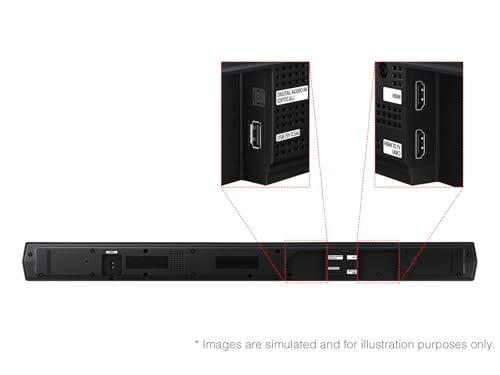
This is where the generational difference between these products becomes most apparent. The Samsung HW-B630F, released in 2024, feels surprisingly conservative in its connectivity options. It includes HDMI 1.4 with ARC support, but lacks eARC capability that's become standard on modern TVs.
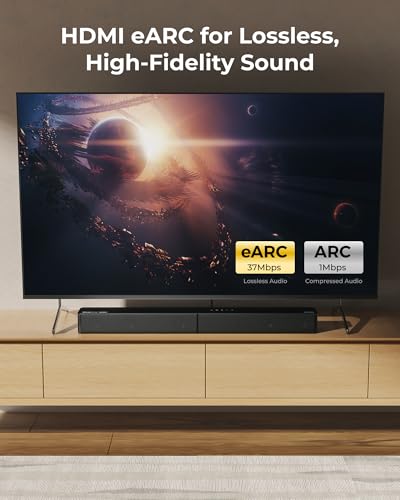
This limitation means the Samsung can only receive compressed audio formats like Dolby Digital, not the lossless formats that streaming services and Blu-ray discs increasingly offer. It's also limited to 1080p video pass-through, so you'll need to connect 4K sources directly to your TV rather than routing them through the soundbar.
The Ultimea Poseidon M60 Boom includes HDMI eARC support, enabling higher-bandwidth audio transmission. This means better sound quality from compatible sources and future-proofing as more content adopts advanced audio formats.
The Ultimea also includes Bluetooth 5.4 versus Samsung's 4.2. The newer standard offers faster pairing, more stable connections, and better range. If you frequently stream music from your phone, this difference is immediately noticeable.
Perhaps most significantly, the Ultimea M60 Boom includes smartphone app control with custom EQ adjustment. You can fine-tune bass, midrange, and treble to your exact preferences, something the Samsung HW-B630F doesn't offer beyond basic presets.
At the time of writing, these soundbars occupy very different price tiers, making the value comparison particularly interesting. The Samsung HW-B630F positions itself in the mid-range budget category, while the Ultimea M60 Boom aggressively undercuts established brands.
From a pure features-per-dollar perspective, the Ultimea offers remarkable value. You're getting true 5.1 channels, Dolby Atmos processing, modern connectivity, and app-based customization at a price point where most competitors offer basic 2.1 configurations.
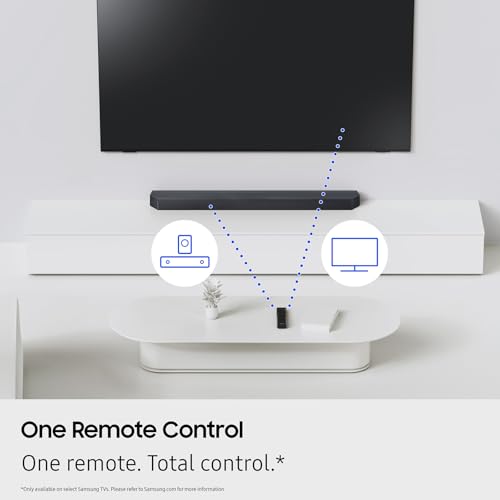
The Samsung commands a premium for its brand reputation, wireless subwoofer convenience, and refined audio processing. Samsung's Adaptive Sound technology and One Remote Control integration with Samsung TVs provide a more polished, ecosystem-focused experience.
The value equation ultimately depends on your priorities. If you want maximum audio performance and modern features regardless of brand prestige, the Ultimea represents exceptional value. If you prefer proven reliability and seamless integration with your existing setup, Samsung's premium makes sense.
Both soundbars are designed for modern flat-panel TVs, but their physical characteristics affect placement and aesthetics differently.
The Samsung HW-B630F measures about 34 inches wide, making it suitable for TVs of 40 inches and larger without visual overhang. The wireless subwoofer offers tremendous placement flexibility – crucial in smaller rooms or apartments where furniture arrangement is constrained.
The Ultimea M60 Boom is slightly more compact but requires planning for the wired subwoofer connection. This constraint isn't necessarily negative – wired connections avoid potential interference – but it limits your room layout options.
For home theater integration, both soundbars support HDMI CEC for basic control integration. The Samsung offers better ecosystem integration if you already own Samsung devices, while the Ultimea's app control provides more granular adjustment options for enthusiasts who like to tweak their setup.
The soundbar market has evolved dramatically since 2020, with budget manufacturers adopting technologies that were previously exclusive to premium brands. The Ultimea M60 Boom exemplifies this trend – offering Dolby Atmos and 5.1 channels at prices that would have bought you basic stereo just a few years ago.
Samsung's approach with the HW-B630F represents refinement of traditional soundbar design rather than revolutionary features. This isn't necessarily negative – sometimes mature, well-executed technology outperforms cutting-edge features that aren't properly implemented.
From a future-proofing perspective, the Ultimea's eARC support and newer Bluetooth standard provide better compatibility with evolving content and device standards. The Samsung's HDMI 1.4 limitation could become more restrictive as content quality continues advancing.
After extensive research into user experiences and professional evaluations, clear use-case scenarios emerge for each soundbar.
Choose the Samsung HW-B630F if you:
Choose the Ultimea Poseidon M60 Boom if you:
These soundbars succeed in different ways, making direct comparison challenging but ultimately enlightening. The Samsung HW-B630F represents traditional soundbar values: refined dialogue reproduction, wireless convenience, and ecosystem integration. It does fewer things but executes them with polish.
The Ultimea Poseidon M60 Boom embodies the new budget paradigm: maximum features and technical capability at aggressive pricing. It offers genuinely impressive performance that challenges assumptions about budget audio equipment.
For most users seeking their first significant TV audio upgrade, the Ultimea provides more capability and future-proofing at a remarkable price point. However, users who prioritize dialogue clarity, wireless convenience, or brand ecosystem integration will find the Samsung's premium worthwhile.
The broader lesson here is that the soundbar market has democratized good audio. Whether you spend more for refinement or less for raw capability, both options deliver substantial improvements over built-in TV speakers. Your specific needs and preferences should drive the decision more than absolute performance metrics.
In an ideal world, you'd audition both in your actual listening environment. Since that's rarely practical, understanding these fundamental differences in approach and execution should help you choose the soundbar that best matches your priorities and expectations.
| Samsung HW-B630F B-Series 3.1ch Soundbar System | Ultimea Poseidon M60 Boom 5.1 Soundbar |
|---|---|
| Channel Configuration - Determines surround sound capability and dialogue clarity | |
| 3.1 channels (3 physical speakers + wireless subwoofer) | 5.1 channels (5 physical drivers + wired subwoofer) |
| Dolby Atmos Support - Essential for immersive 3D audio from modern content | |
| No Dolby Atmos (DTS Virtual:X only) | Yes, full Dolby Atmos 5.1 surround sound |
| Subwoofer Connection - Affects placement flexibility and bass consistency | |
| 6" wireless subwoofer (32+ foot range) | 5.25" wired subwoofer (BassMX technology) |
| HDMI Connectivity - Critical for audio quality from modern TVs and devices | |
| HDMI 1.4 with ARC only (compressed audio formats) | HDMI with eARC (lossless audio formats) |
| Bluetooth Version - Impacts connection stability and audio latency | |
| Bluetooth 4.2 (older standard, higher latency) | Bluetooth 5.4 (faster pairing, lower latency) |
| App Control - Determines customization options beyond basic presets | |
| No smartphone app (remote control only) | Smart app with custom EQ (bass, mid, treble adjustment) |
| Peak Power Output - Affects maximum volume and dynamic range | |
| Not specified by manufacturer | 340W peak power output |
| Dialogue Enhancement - Key for clear speech in movies and TV shows | |
| Dedicated center channel + Voice Enhance mode | VoiceMX technology with 5-driver array |
| Gaming Features - Important for console and wireless gaming performance | |
| Game Mode with cross-talk cancellation | Ultra-low latency Bluetooth 5.4 + Game EQ mode |
| TV Integration - Simplifies daily use and setup complexity | |
| One Remote Control with Samsung TVs, HDMI CEC | CEC device sync, universal remote compatibility |
| Sound Processing - Creates virtual surround effects and optimizes audio | |
| Adaptive Sound, DTS Virtual:X, multiple preset modes | Triple-core DSP, Dolby Atmos processing, 6 EQ presets |
| Physical Dimensions - Affects TV compatibility and room placement | |
| 33.86" wide soundbar, suitable for 40"+ TVs | 31.5" wide soundbar, more compact design |
The Ultimea Poseidon M60 Boom 5.1 Soundbar offers significantly better value, providing true 5.1 channels, Dolby Atmos support, and modern connectivity features at a much lower price point than the Samsung HW-B630F B-Series 3.1ch Soundbar System. While Samsung offers brand reliability and wireless convenience, Ultimea delivers more advanced audio technology for less money.
The Samsung HW-B630F has superior dialogue clarity thanks to its dedicated physical center channel and Voice Enhance mode. While the Ultimea Poseidon M60 Boom uses VoiceMX technology across its five drivers, Samsung's approach of having a speaker dedicated solely to dialogue reproduction typically results in clearer speech, especially in complex audio mixes.
Only the Ultimea Poseidon M60 Boom 5.1 Soundbar supports Dolby Atmos for immersive 3D audio. The Samsung HW-B630F does not support Dolby Atmos and instead relies on DTS Virtual:X processing to simulate surround effects from its 3.1 speaker configuration.
The Samsung HW-B630F has 3.1 channels (left, center, right speakers plus subwoofer) while the Ultimea M60 Boom has true 5.1 channels (left, center, right, left surround, right surround plus subwoofer). The 5.1 configuration provides more precise surround sound positioning, while 3.1 focuses on front soundstage clarity with virtual surround effects.
For console gaming, the Samsung HW-B630F offers a dedicated Game Mode with cross-talk cancellation. For wireless gaming from phones or tablets, the Ultimea Poseidon M60 Boom is better due to its Bluetooth 5.4 with ultra-low latency. The Ultimea also provides more accurate positional audio with its true 5.1 channel setup.
The Samsung HW-B630F includes a 6-inch wireless subwoofer that can be placed up to 30+ feet away from the soundbar. The Ultimea Poseidon M60 Boom has a 5.25-inch wired subwoofer with BassMX technology that must be connected via cable, limiting placement flexibility but ensuring consistent bass performance.
The Ultimea Poseidon M60 Boom has superior connectivity with HDMI eARC support for lossless audio, Bluetooth 5.4, and multiple input options. The Samsung HW-B630F is limited to HDMI 1.4 with basic ARC, Bluetooth 4.2, and lacks eARC support, restricting it to compressed audio formats from modern TVs and streaming devices.
Only the Ultimea Poseidon M60 Boom offers smartphone app control with custom EQ settings for bass, midrange, and treble adjustment. The Samsung HW-B630F relies on its included remote control and preset sound modes, though it does integrate with Samsung TV remotes through One Remote Control functionality.
For home theater use, the Ultimea Poseidon M60 Boom provides a more immersive experience with true 5.1 channels and Dolby Atmos support, making it ideal for action movies and surround sound content. The Samsung HW-B630F excels at dialogue-heavy content like dramas but uses virtual processing for surround effects rather than discrete channel separation.
The Samsung HW-B630F features Adaptive Sound technology that automatically optimizes audio based on content type, plus DTS Virtual:X for surround simulation. The Ultimea M60 Boom uses triple-core DSP processing with actual Dolby Atmos decoding and offers six EQ presets including movie, music, voice, sport, game, and night modes.
The Samsung HW-B630F offers better integration with Samsung TVs through One Remote Control functionality and optimized CEC support. However, the Ultimea Poseidon M60 Boom will work with any TV brand and actually provides better audio quality from Samsung TVs that support eARC through its advanced HDMI connectivity.
Choose the Samsung HW-B630F if you prioritize dialogue clarity, need wireless subwoofer placement flexibility, own Samsung devices, or prefer established brand reliability. Choose the Ultimea Poseidon M60 Boom if you want maximum features per dollar, enjoy action movies and gaming, have a modern TV with eARC, or can accommodate a wired subwoofer setup.
We've done our best to create useful and informative comparisons to help you decide what product to buy. Our research uses advanced automated methods to create this comparison and perfection is not possible - please contact us for corrections or questions. These are the sites we've researched in the creation of this article: samsung.com - bhphotovideo.com - crutchfield.com - youtube.com - bestproducts.com - videoandaudiocenter.com - pcrichard.com - bhphotovideo.com - samsung.com - youtube.com - requiremints.com - karlsonline.com - crutchfield.com - youtube.com - donstv.com - samsung.com - bhphotovideo.com - youtube.com - youtube.com - crutchfield.com - costco.ca - rtings.com - crutchfield.com - accio.com - bhphotovideo.com - manuals.plus - samsung.com - saraappliance.com - ultimea.com - ultimea.com - youtube.com - bestbuy.com - youtube.com - avsforum.com - youtube.com - manuals.plus - youtube.com - device.report - ultimea.com - ultimea.de - community.ultimea.com - ultimea.com - community.ultimea.com - ultimea.com - youtube.com - aliexpress.com - ultimea.com

Privacy Policy
Terms and Conditions - Affiliate Policy
Home Security
© Copyright 2008-2026.
11816 Inwood Rd #1211, Dallas, TX 75244