


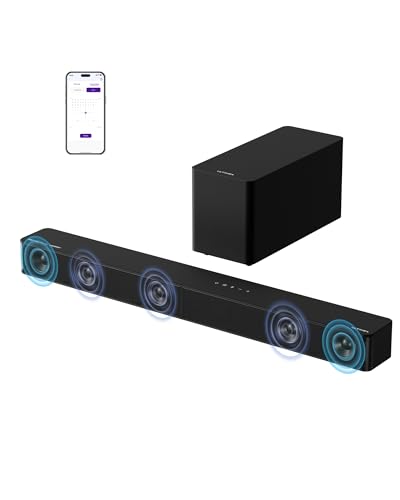

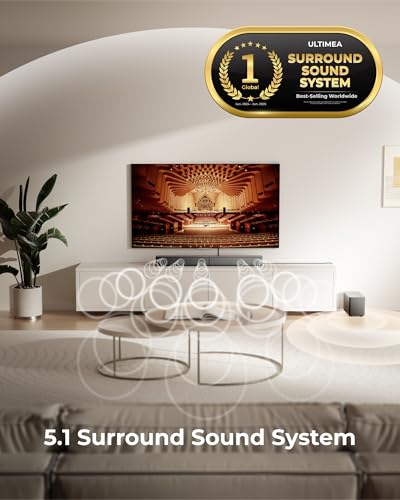
When your TV's tiny speakers leave dialogue muddy and action scenes flat, it's time for a soundbar upgrade. But not all soundbars are created equal, and two recent offerings from Ultimea showcase dramatically different philosophies for delivering cinematic audio. The Ultimea Aura A40 7.1 Channel Soundbar System takes the traditional route with actual speakers placed around your room, while the Ultimea Poseidon M60 Boom 5.1 Soundbar relies on sophisticated virtual processing to simulate surround sound from a single bar.
Both systems launched in 2023, representing Ultimea's push into more advanced home theater audio during a period when soundbar technology has rapidly evolved. The intervening years have seen major improvements in digital signal processing (DSP)—the computer chips that handle audio manipulation—and wireless connectivity standards. These advances make today's soundbars far more capable than models from just a few years ago.
Understanding which approach works better for your situation requires diving into how each system creates its audio experience and what trade-offs you'll accept along the way.
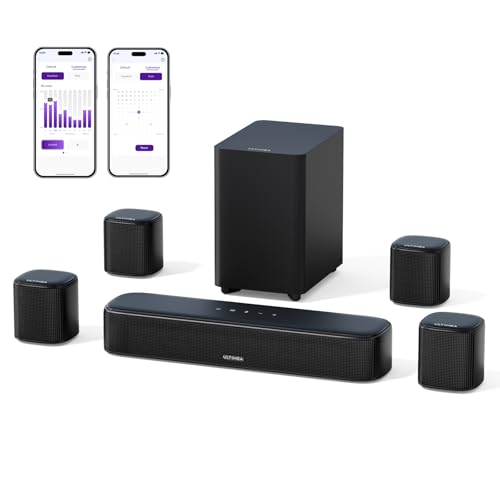
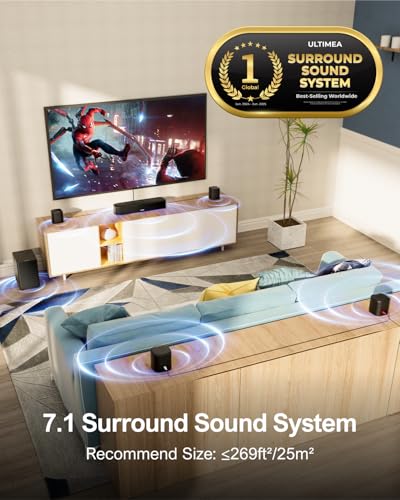
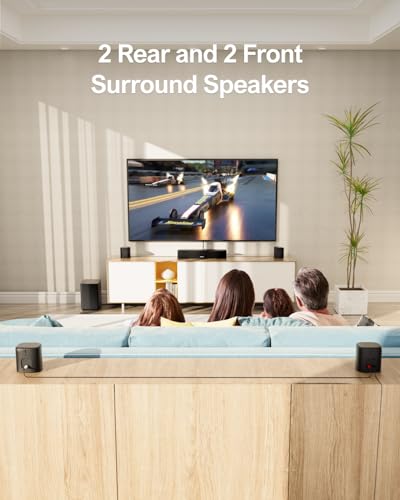
The fundamental difference between these systems comes down to how they create surround sound—that immersive audio experience where you hear helicopters circling overhead and footsteps creeping up behind you. Traditional surround sound uses multiple speakers physically positioned around your room, creating authentic directional audio. This is what the Aura A40 delivers with its eight separate speakers: three in the main soundbar, four surround speakers you place around your room, and a dedicated subwoofer for deep bass.
Virtual surround, used by the M60 Boom, takes a completely different approach. It uses advanced computer processing to manipulate audio signals, creating the illusion of surround sound from speakers all facing forward. Think of it like audio sleight-of-hand—sophisticated algorithms analyze the original surround sound mix and reshape it to trick your ears into perceiving sounds coming from directions where no speakers actually exist.
The key considerations when choosing between these approaches include setup complexity, audio authenticity, room requirements, and future compatibility with newer audio formats. Neither approach is inherently superior; they serve different priorities and lifestyles.
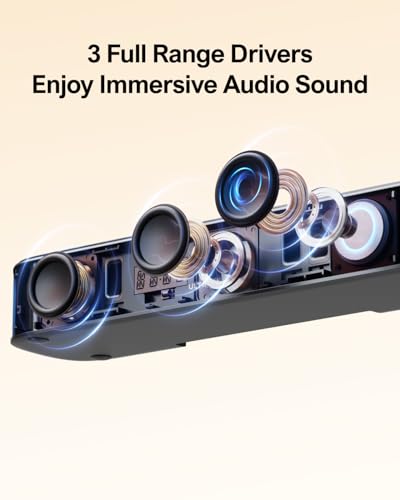
Released in 2023, the Aura A40 represents what many audio enthusiasts consider "proper" surround sound. Its eight-speaker configuration includes three drivers in the main soundbar (each 2 inches in diameter), four separate surround speakers (also with 2-inch drivers), and a 4-inch subwoofer. This distributed approach means sound actually originates from multiple locations around your room, creating authentic spatial audio that virtual processing struggles to match.
The system's SurroundX technology coordinates all eight speakers using AI optimization, which essentially means smart software ensures each speaker plays its part at precisely the right moment and volume level. Ultimea claims this delivers 99.99% detail accuracy—a marketing figure that's impossible to verify, but the underlying concept of coordinated speaker management is sound audio engineering.
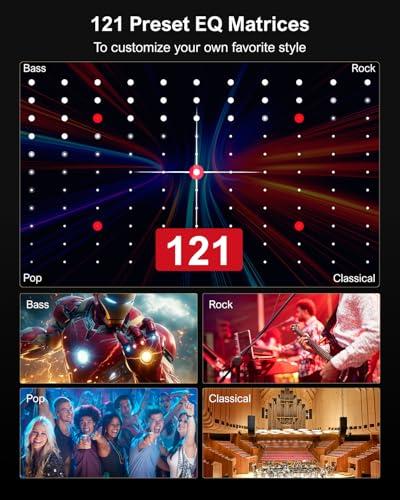
What sets the A40 apart is its obsessive focus on customization. The system offers 121 preset equalizer matrices—pre-configured sound profiles optimized for different music genres and content types. Whether you're listening to classical music, watching action movies, or playing competitive games, there's likely a preset that enhances that specific content. Beyond presets, you get a full 10-band equalizer for manual frequency adjustment and 13 different surround speaker volume levels to fine-tune the rear speaker balance for your room's acoustics.
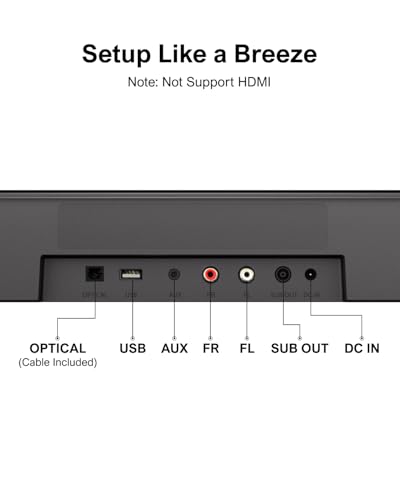
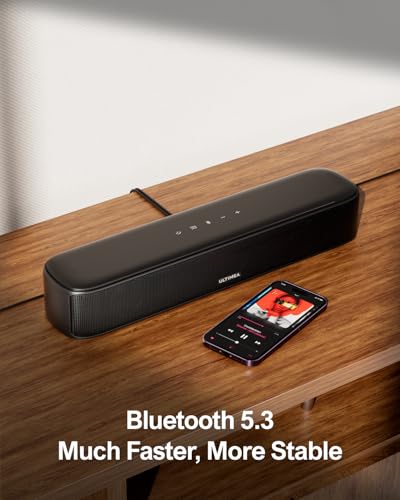
However, the A40's old-school approach shows in its connectivity options. There's no HDMI input at all—just optical digital, analog AUX, USB for music files, and Bluetooth 5.3 for wireless streaming. This limits compatibility with newer audio formats and makes integration with modern TVs more complicated.
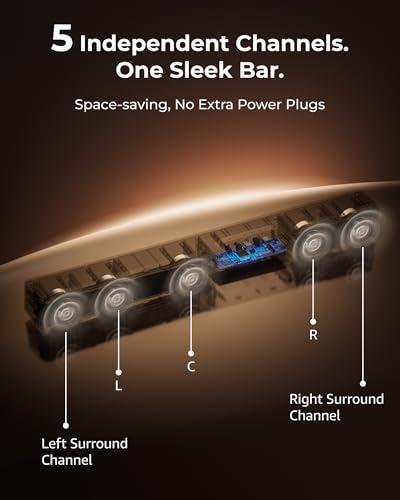
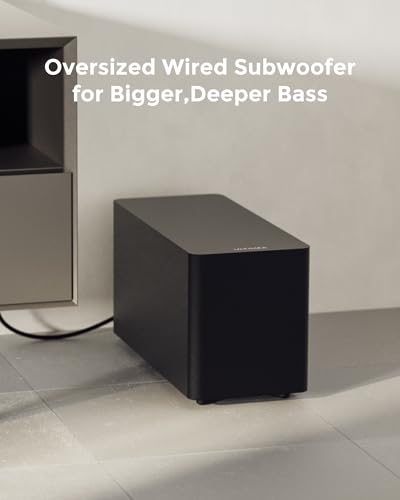
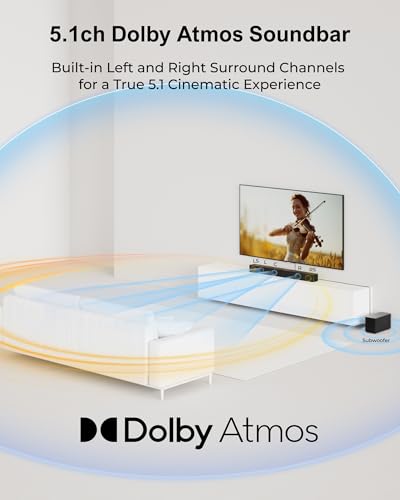
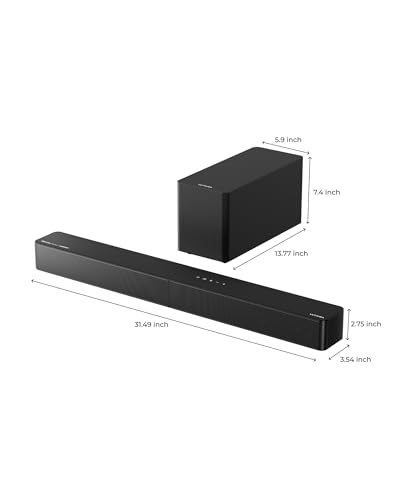
The M60 Boom, also launched in 2023, takes the opposite approach. Instead of distributing speakers around your room, it packs five full-range drivers into a single soundbar unit, including two side-firing speakers that bounce sound off your walls to create width and depth. The 5.25-inch wireless subwoofer handles deep bass, and the entire system supports Dolby Atmos—the premium surround sound format that adds height dimension to create truly three-dimensional audio.
The processing power behind the M60 Boom is impressive for a budget system. It uses triple-core DSP technology with two processors running at 800MHz and another at 600MHz, delivering over 2000 MIPS (Million Instructions Per Second) of computing power. This allows real-time audio manipulation, including parametric EQ adjustments and dynamic range compression that keeps dialogue audible during loud action sequences.
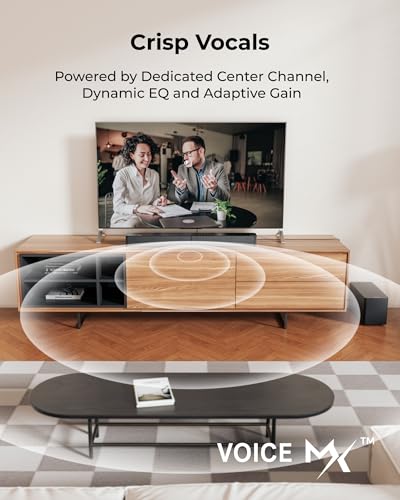
One standout feature is VoiceMX technology, which specifically targets the 300Hz to 3kHz frequency range where most human speech occurs. This isn't just a simple volume boost—it uses adaptive equalization and gain control to ensure dialogue remains intelligible even when explosions and music compete for your attention.
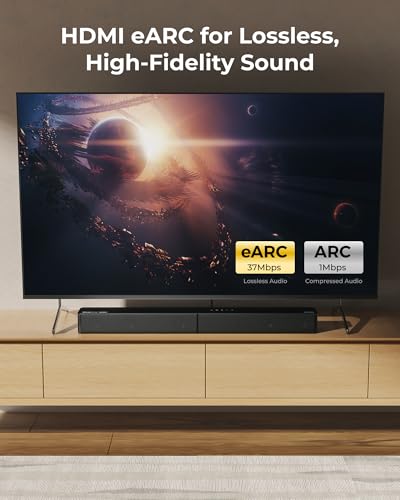
The M60 Boom's modern connectivity reflects current home theater standards. HDMI eARC (enhanced Audio Return Channel) supports lossless audio formats and allows two-way communication between your TV and soundbar. This means your TV remote can control soundbar volume, and the soundbar can automatically switch inputs when you change sources. Bluetooth 5.4 provides faster, more stable wireless connections with lower latency than older Bluetooth versions.
The most critical performance difference lies in how convincingly each system creates surround sound. Our research into professional reviews and user feedback reveals a clear pattern: the Aura A40 delivers more authentic spatial audio because sound actually originates from multiple locations. When a helicopter flies across the screen, you genuinely hear it move from your left surround speaker to your right surround speaker. This creates what audio engineers call "discrete channel separation"—each audio channel remains distinct and localized.
The M60 Boom's virtual processing is sophisticated but ultimately limited by physics. No amount of clever signal processing can fully replicate the experience of having actual speakers behind you. However, the Dolby Atmos support provides something the A40 cannot: height dimension. Overhead effects like rain, aircraft, or falling debris gain vertical positioning that creates a more enveloping soundscape, even if the left-right surround effect isn't as precise.
For critical listening, the A40's distributed speakers create a wider, more expansive soundstage. Music reproduction benefits from having tweeters and mid-range drivers positioned at different angles around your room, creating natural stereo imaging that single-bar systems struggle to achieve.
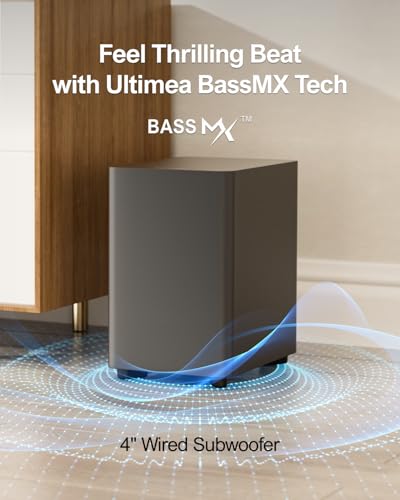
Low-frequency reproduction shows a clear winner. The M60 Boom's 5.25-inch subwoofer with 18mm excursion capability significantly outperforms the A40's 4-inch driver. The larger cone area moves more air, creating deeper, more impactful bass that extends down to 50Hz compared to the A40's 65Hz lower limit.
This difference becomes immediately apparent with action movies and music with substantial low-end content. The M60 Boom delivers the kind of chest-thumping bass that makes explosions feel physical, while the A40 provides adequate but less impressive low-frequency impact. Both systems use BassMX technology—Ultimea's proprietary bass enhancement—but the M60's larger driver and wireless subwoofer placement flexibility give it a substantial advantage.
Modern home theater integration strongly favors the M60 Boom. HDMI eARC isn't just convenient—it's becoming essential for accessing high-quality audio formats from streaming services and UHD Blu-ray discs. Many newer audio codecs, including lossless Dolby TrueHD and DTS-HD Master Audio, require HDMI bandwidth to maintain their quality.
The A40's optical-only connection forces audio compression, limiting you to standard Dolby Digital and DTS rather than their high-resolution variants. This might not matter for cable TV or basic streaming, but it definitely impacts premium content quality.
Bluetooth performance also favors the M60 Boom. Version 5.4 offers improved connection stability, faster pairing, and lower latency compared to the A40's Bluetooth 5.3. For gaming or streaming video from mobile devices, this translates to better audio-video synchronization and fewer dropouts.
Perhaps the starkest difference between these systems lies in installation complexity. Setting up the Aura A40 requires running speaker cables throughout your room—a 6-meter cable for rear surround speakers and 2-meter cables for front surrounds. You'll need multiple power outlets positioned around your room, and the rear right speaker requires manual wireless pairing after initial power-up.
This installation process typically takes 45-60 minutes and results in cables running along baseboards or behind furniture. For renters or those who frequently rearrange their living spaces, this represents a significant commitment. However, the payoff is authentic surround sound that virtual processing cannot replicate.
The M60 Boom setup takes 10-15 minutes. Connect the soundbar to your TV via HDMI eARC, plug in the wireless subwoofer, and you're finished. The subwoofer automatically pairs, and CEC (Consumer Electronics Control) integration means your TV remote controls soundbar volume without additional programming.
Room acoustics play differently with each system. The A40 works best in rectangular rooms between 108-270 square feet where you can position surround speakers at proper angles from your listening position. Larger rooms dilute the effect, while smaller rooms can create overwhelming near-field effects from closely positioned speakers.
The M60 Boom adapts more easily to varied room shapes and sizes. Its side-firing drivers use wall reflections to create width, so it performs better in irregularly shaped spaces or open floor plans where traditional surround speaker placement proves challenging.
However, wall material affects the M60 Boom's performance more than the A40. Rooms with soft furnishings, heavy curtains, or sound-absorbing materials reduce reflection effectiveness, limiting the virtual surround effect. Hard surfaces like drywall, wood, or tile enhance the system's ability to create convincing width and depth.
For gaming, the Aura A40 provides distinct advantages in competitive scenarios. Physical rear speakers deliver precise directional audio cues that help identify enemy positions in first-person shooters or racing games. The discrete channel separation means footsteps, gunfire, and environmental sounds maintain their spatial accuracy even during chaotic gameplay.
The M60 Boom's lower latency Bluetooth and HDMI connectivity better support modern gaming consoles, but the virtual surround processing can blur precise directional information. However, its Dolby Atmos support enhances single-player cinematic games with impressive overhead effects and atmospheric audio.
At the time of writing, both systems occupy similar price points in the budget surround sound category, making value comparison particularly relevant. The A40 offers more total speakers and extensive customization options, essentially providing eight-piece surround sound system pricing that would cost significantly more from traditional audio manufacturers.
The M60 Boom delivers premium features typically found in much more expensive systems—Dolby Atmos support, advanced DSP processing, and modern connectivity—at an entry-level price point. This represents exceptional value for users prioritizing convenience and modern features over absolute audio authenticity.
Long-term value considerations favor the M60 Boom due to its HDMI eARC connectivity and modern audio format support. As streaming services and physical media adopt newer audio technologies, the A40's optical-only connection becomes increasingly limiting.
After extensive research into professional reviews, user feedback, and technical specifications, clear usage patterns emerge for each system.
Choose the Ultimea Aura A40 if you're an audio enthusiast who values authentic surround sound over convenience. This system works best in dedicated home theater rooms where you can properly position multiple speakers and don't mind managing several cables. The extensive customization options reward users who enjoy fine-tuning their audio experience, and the true spatial audio provides gaming advantages that virtual processing cannot match.
The A40 also makes sense for users with older TVs lacking HDMI eARC, since the optical connection works with virtually any television manufactured in the last 15 years. If you prioritize audio authenticity and have the space and patience for proper installation, the A40 delivers genuine surround sound at a remarkable price point.
Select the Ultimea Poseidon M60 Boom if you want modern home theater features without installation complexity. This system excels in apartments, rentals, or frequently rearranged living spaces where running speaker cables isn't practical. The Dolby Atmos support and HDMI eARC connectivity future-proof your investment, while the superior bass performance and dialogue clarity enhance everyday TV watching.
The M60 Boom is particularly appealing for users who prioritize convenience and modern features over absolute audio authenticity. Its single-bar design maintains clean aesthetics while delivering impressive audio improvement over TV speakers.
Ultimately, both systems represent excellent value in their respective categories. Your choice depends on whether you prioritize authentic surround sound with setup complexity, or modern convenience with virtual processing trade-offs. Either way, you'll gain a significant audio upgrade that transforms your home entertainment experience.
| Ultimea Aura A40 7.1 Channel Soundbar System | Ultimea Poseidon M60 Boom 5.1 Soundbar |
|---|---|
| Channel Configuration - Determines authenticity of surround sound experience | |
| True 7.1 with 8 physical speakers (3 soundbar + 4 surround + subwoofer) | Virtual 5.1 with 6 drivers (5 in soundbar + wireless subwoofer) |
| Surround Sound Approach - Key difference in audio immersion | |
| Physical speakers placed around room for authentic spatial audio | Virtual processing using side-firing drivers and wall reflections |
| Setup Complexity - Major factor in user experience | |
| Complex: 4 wired surround speakers, multiple cables, 45-60 min setup | Simple: Single soundbar + wireless subwoofer, 10-15 min setup |
| HDMI Connectivity - Critical for modern TV integration | |
| None (optical, AUX, USB, Bluetooth 5.3 only) | HDMI eARC with lossless audio support |
| Premium Audio Format Support - Affects content quality | |
| Limited to compressed Dolby Digital/DTS via optical | Dolby Atmos with height dimension effects |
| Subwoofer Size - Directly impacts bass depth and power | |
| 4-inch wired subwoofer (65Hz low frequency) | 5.25-inch wireless subwoofer (50Hz low frequency) |
| Audio Customization - Important for fine-tuning sound | |
| Extensive: 121 EQ presets, 10-band EQ, 13 surround levels | Basic: 6 EQ modes, app-based bass/mid/treble adjustment |
| Peak Power Output - Affects maximum volume and dynamics | |
| 330W total system power | 340W total system power |
| Room Requirements - Determines installation feasibility | |
| Requires wall space for 4 speakers, multiple power outlets | Flexible placement, single power connection |
| Future-Proofing - Long-term compatibility considerations | |
| Limited by optical-only connection to legacy audio formats | HDMI eARC and Bluetooth 5.4 support newest standards |
| Best For - Target user scenarios | |
| Audio enthusiasts wanting authentic surround in dedicated theater rooms | Users prioritizing convenience and modern features in any room type |
The Ultimea Aura A40 7.1 Channel Soundbar System uses actual physical speakers placed around your room to create true surround sound, while the Ultimea Poseidon M60 Boom 5.1 Soundbar uses virtual processing to simulate surround sound from a single soundbar unit. The A40 gives you authentic spatial audio but requires complex setup, whereas the M60 Boom offers convenience with modern features like Dolby Atmos.
The Poseidon M60 Boom is significantly easier to install, taking only 10-15 minutes with just a single HDMI connection to your TV and a wireless subwoofer that pairs automatically. The Aura A40 requires 45-60 minutes to set up because you need to connect four separate surround speakers with cables running around your room and multiple power outlets.
The Ultimea Poseidon M60 Boom delivers superior bass with its larger 5.25-inch wireless subwoofer that extends down to 50Hz frequency response. The Ultimea Aura A40 uses a smaller 4-inch wired subwoofer with 65Hz response, providing adequate but less impactful low-frequency performance for movies and music.
The Poseidon M60 Boom offers better modern TV compatibility with HDMI eARC connection, supporting lossless audio formats and allowing your TV remote to control the soundbar. The Aura A40 lacks HDMI entirely, relying on optical, AUX, and Bluetooth connections, which limits compatibility with newer audio formats but still works with most TVs.
The Ultimea Aura A40 provides better gaming performance for competitive players because its physical rear speakers deliver precise directional audio cues that help locate enemies and environmental sounds. The M60 Boom offers lower latency connections but virtual surround processing can blur precise spatial information needed for competitive gaming.
Only the Ultimea Poseidon M60 Boom supports Dolby Atmos, which adds height dimension to create overhead sound effects like aircraft or rain. The Aura A40 doesn't support Dolby Atmos but compensates with authentic 7.1 channel surround sound from its physical speaker placement around your room.
The Ultimea Aura A40 provides extensive customization with 121 preset EQ matrices for different music genres, a 10-band manual equalizer, and 13 adjustable surround speaker levels. The Poseidon M60 Boom offers simpler controls with 6 EQ modes and basic bass, mid, treble adjustments through its smartphone app.
The Ultimea Poseidon M60 Boom works better in small apartments because it doesn't require running speaker cables around your room or multiple power outlets. Its single-bar design with wireless subwoofer is ideal for renters or frequently rearranged spaces. The Aura A40 requires permanent speaker placement that may not suit apartment living.
For dedicated home theater rooms, the Ultimea Aura A40 delivers more authentic surround sound with discrete speakers creating genuine spatial audio that virtual processing cannot match. However, the Poseidon M60 Boom offers better home theater integration with HDMI eARC connectivity and Dolby Atmos support for modern streaming content and UHD Blu-rays.
The Poseidon M60 Boom features newer Bluetooth 5.4 with faster pairing, more stable connections, and lower latency compared to the Aura A40's Bluetooth 5.3. The M60 Boom also includes CEC support for seamless TV remote control integration, while the A40 relies on its included IR remote for all functions.
The Ultimea Poseidon M60 Boom provides better future-proofing with HDMI eARC support for evolving audio formats and streaming service compatibility. The Ultimea Aura A40 offers more speakers and customization features for the investment but may become limited by its optical-only connection as newer audio technologies emerge.
We've done our best to create useful and informative comparisons to help you decide what product to buy. Our research uses advanced automated methods to create this comparison and perfection is not possible - please contact us for corrections or questions. These are the sites we've researched in the creation of this article: youtube.com - walmart.com - youtube.com - ultimea.com - homestudiobasics.com - ultimea.co - youtube.com - eu.ultimea.com - walmart.com - device.report - bestbuy.com - manuals.plus - community.ultimea.com - judge.me - support.ultimea.com - geekmaxi.com - provantage.com - bestbuy.com - youtube.com - uk.whatgeek.com - ultimea.com - ultimea.com - youtube.com - bestbuy.com - youtube.com - avsforum.com - youtube.com - manuals.plus - youtube.com - device.report - ultimea.com - ultimea.de - community.ultimea.com - ultimea.com - community.ultimea.com - ultimea.com - youtube.com - aliexpress.com - ultimea.com

Privacy Policy
Terms and Conditions - Affiliate Policy
Home Security
© Copyright 2008-2026.
11816 Inwood Rd #1211, Dallas, TX 75244