









When your TV's built-in speakers sound like they're stuck in a cardboard box, you're probably ready for a soundbar upgrade. The question isn't whether you need better audio—it's which type of soundbar will transform your living room into the entertainment space you actually want.
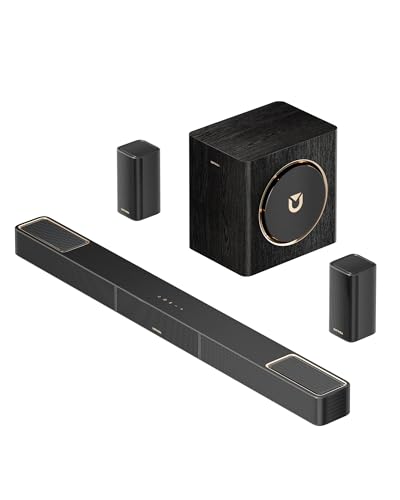
ULTIMEA released two compelling options in 2024 that represent fundamentally different philosophies in soundbar design. The Skywave X40 5.1.2 Soundbar System brings true wireless surround sound with dedicated rear speakers and overhead height channels. Meanwhile, the Poseidon M60 Boom 5.1 Soundbar packs all its audio magic into a single bar, using clever processing to simulate surround effects without additional speakers cluttering your room.
Both systems support Dolby Atmos—that's the audio format that makes helicopter sounds whoosh overhead and rain seem to fall from your ceiling—but they achieve these effects through completely different approaches. Understanding these differences will help you pick the right system for your space, budget, and audio expectations.
Before diving into specifics, let's talk about what makes a soundbar worth buying. The most critical factors are channel configuration, power output, and how the system handles different types of content.
Channel configuration tells you how many distinct audio streams the soundbar can process. A 5.1 system has five main channels (left, center, right, left surround, right surround) plus one subwoofer channel for bass. The Skywave X40 goes further with 5.1.2—those two extra channels are "height" channels that fire sound upward to bounce off your ceiling, creating overhead effects.
Power output determines how loud and dynamic your audio can get. More watts generally mean better performance in larger rooms, but the quality of that power matters too. A well-designed 200-watt system can outperform a poorly executed 400-watt setup.
Room compatibility is crucial but often overlooked. A massive surround system in a small apartment can be overkill, while a compact soundbar might disappear in a large living room. The sweet spot is matching your system's capabilities to your actual space and listening habits.
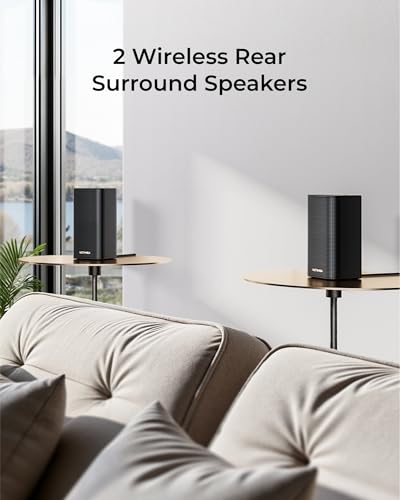
The Skywave X40 doesn't compromise on authentic surround sound. It includes wireless rear speakers that you position behind your seating area, creating genuine 360-degree audio. When a car crashes on screen, you'll hear the impact in front and the debris scattering behind you through dedicated drivers positioned around your room.
The system's 530W peak power output comes from eight total speakers: five in the main bar, two wireless rear speakers, and a substantial 6.5-inch subwoofer. This distribution allows for precise channel separation—dialogue stays anchored to the screen while ambient sounds and effects spread naturally throughout your space.
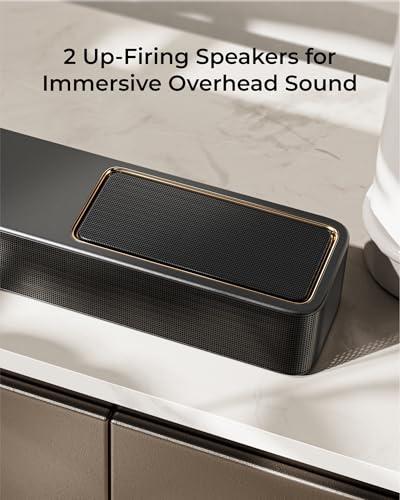
What sets the Skywave X40 apart is its upward-firing speakers. These drivers shoot sound toward your ceiling, where it reflects down to create height effects. When properly set up, explosions don't just boom—they seem to burst overhead while debris crashes around you. This is true Dolby Atmos, not a simulation.
The system uses ULTIMEA's CineMesh wireless technology, which operates on dual 5GHz frequencies to minimize interference. Unlike some wireless surround systems that suffer from audio dropouts or sync issues, the Skywave X40 maintains stable connections with less than 20 milliseconds of latency—imperceptible to human ears.
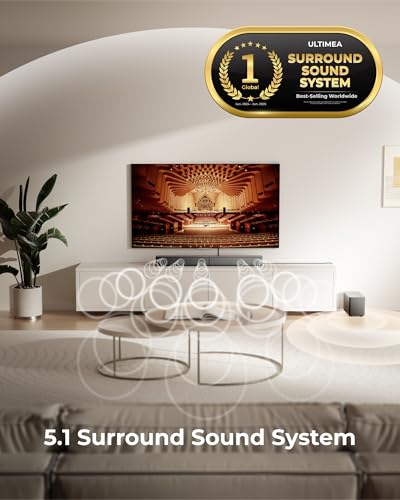
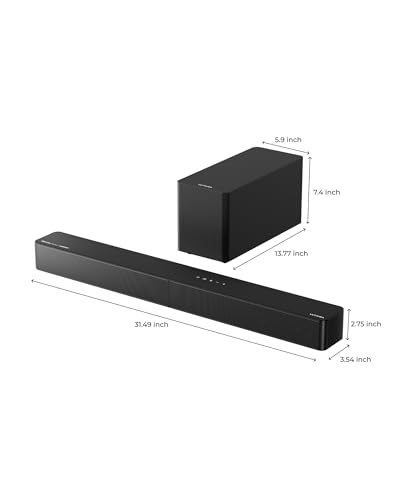
The Poseidon M60 Boom takes a radically different approach. Instead of spreading speakers around your room, it houses everything in the main soundbar and uses sophisticated digital signal processing to create surround effects virtually.
This system relies on psychoacoustics—how your brain interprets sound. By carefully controlling the timing, phase, and frequency response of different drivers, the M60 Boom can trick your ears into perceiving sounds coming from locations where no speakers exist. Side-firing drivers within the main bar bounce audio off your walls to create width, while processing algorithms simulate rear and overhead effects.
The trade-off is authenticity versus convenience. Virtual surround can be convincingly immersive, especially for dialogue and music, but it can't match the precise localization of physical speakers positioned around your room. However, for many users, the convenience of a single-bar setup outweighs this limitation.
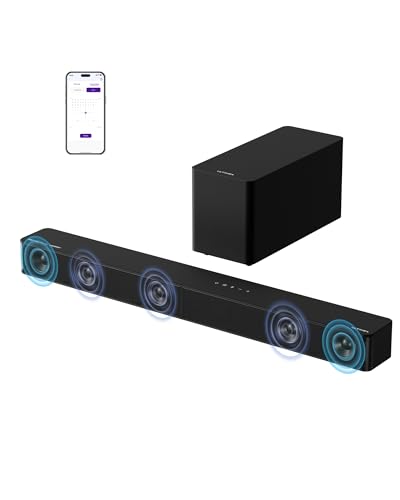
At 340W peak power with a 5.25-inch subwoofer, the M60 Boom packs impressive punch into its streamlined design. The BassMX technology uses an 18mm high-excursion driver—that means the cone moves back and forth much farther than typical drivers, pushing more air for deeper bass impact.
The Skywave X40's 530W output advantage becomes most apparent in larger rooms. Based on expert reviews and user feedback, this system can comfortably fill spaces over 300 square feet without strain. The distributed power across multiple speakers means each driver works less hard, reducing distortion even at high volumes.
The system's GaN (Gallium Nitride) amplifier technology deserves special mention. Unlike traditional silicon amplifiers, GaN operates at 98% efficiency while generating 50% less heat. This translates to more reliable performance during long movie marathons and better sound quality at peak volumes—the amplifier doesn't struggle or distort when you crank up that action sequence.
The Poseidon M60 Boom targets medium-sized rooms more effectively. Its 340W rating might seem modest compared to the Skywave X40, but the concentrated power delivery works well in spaces up to 250 square feet. Users consistently report that dialogue remains clear and bass stays tight even when pushed to higher volumes.
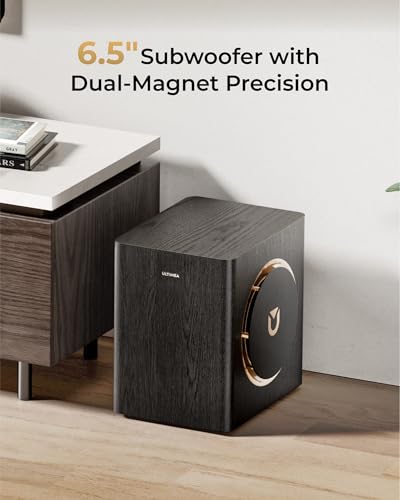
Low-frequency performance reveals another key difference between these systems. The Skywave X40's 6.5-inch subwoofer with Gravus Ultra-Linear Bass technology extends down to 35Hz—deep enough to reproduce the lowest notes in most music and the rumbling bass effects in movies. This extra depth makes action scenes more visceral and music more full-bodied.
The M60 Boom's 5.25-inch subwoofer reaches down to about 50Hz, which covers most important bass content but lacks the deepest octave. However, the BassMX technology focuses on control and accuracy rather than pure extension. The result is bass that sounds tight and punchy, complementing dialogue and music without overwhelming them.
For home theater use, the Skywave X40 provides more cinematic impact. You'll feel helicopter rotors in your chest and explosion shockwaves through the floor. The M60 Boom delivers satisfying bass for most content but won't shake your room during intense scenes.
Both systems excel at dialogue reproduction, but through different methods. The Skywave X40 uses its NEURACORE processing engine—a sophisticated computer brain with 2,000 MIPS (Million Instructions Per Second) of processing power—to separate and enhance vocal frequencies in real time. This ensures that dialogue stays clear even during complex scenes with multiple audio elements.
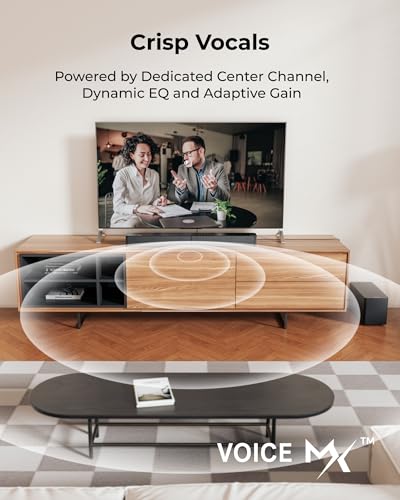
The M60 Boom employs VoiceMX technology, which specifically targets the 300Hz to 3kHz frequency range where most speech occurs. This system dynamically adjusts these frequencies based on the content, ensuring that whispered conversations are audible while preventing shouty dialogue from becoming harsh.
In practical terms, both systems make it easier to follow conversations in movies without constantly adjusting volume. However, the Skywave X40's dedicated center channel provides more precise dialogue anchoring—voices stay locked to the screen even when you're not sitting perfectly centered.
The biggest performance difference lies in how each system handles Dolby Atmos content. The Skywave X40 includes dedicated upward-firing speakers that physically direct sound toward your ceiling. When properly positioned (ideally 8-10 feet ceiling height with reflective surfaces), these speakers create genuine overhead effects.
Watching "Top Gun: Maverick" on the Skywave X40, jet engines scream overhead as planes pass by, and you can track their movement through three-dimensional space. The effect is startling the first time you experience it properly—sounds genuinely seem to move above and around you.
The M60 Boom simulates height effects through processing algorithms. While the virtual Dolby Atmos can create an impressive sense of spaciousness and some overhead impression, it can't match the precision and realism of dedicated height speakers. The trade-off is significant for movie enthusiasts but less important for casual viewing.
Setting up the Skywave X40 requires more planning than a traditional soundbar. You'll need to position the wireless rear speakers optimally—typically 2-3 feet behind your seating area and slightly above ear level. Each wireless component needs a power outlet, so you'll want to ensure adequate electrical access.
The reward for this effort is flexibility. Unlike wired surround systems, you can adjust speaker placement as needed without running cables through walls or under carpets. The factory pre-pairing means components connect automatically when powered on—no complicated wireless setup procedures.
Room acoustics play a bigger role with the Skywave X40. Hard surfaces like tile floors and bare walls can make the system sound harsh, while heavily carpeted and furnished rooms might sound too muffled. The included app provides extensive EQ controls to dial in the perfect sound for your space.
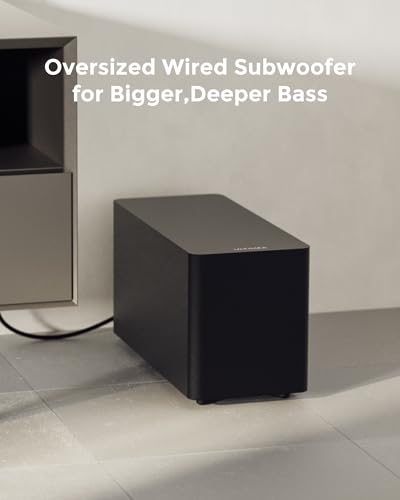
The M60 Boom essentially plugs in and works. Place the soundbar below your TV, position the subwoofer somewhere nearby (it's connected by cable), and you're ready to go. The entire setup process takes minutes rather than the hour or more you might spend optimizing the Skywave X40.
This simplicity comes with placement limitations. The subwoofer's wired connection restricts where you can position it, and the single-bar design means you can't optimize speaker positioning for your room's acoustics. However, for most living rooms, the M60 Boom's virtual surround processing adapts reasonably well to different environments.
Both systems represent significant advances in soundbar technology compared to products available just a few years ago. The Skywave X40 incorporates several cutting-edge technologies that were expensive rarities in 2022 but became more accessible by 2024.
GaN amplifier technology, for instance, was primarily found in high-end audio equipment before trickling down to mainstream soundbars. This advancement allows the Skywave X40 to deliver more power with better efficiency and reliability than previous generation systems.
The wireless surround technology has also matured dramatically. Early wireless soundbar systems suffered from connection drops, sync issues, and limited range. The Skywave X40's dual 5GHz CineMesh technology represents a significant improvement in reliability and latency performance.
Virtual surround processing in systems like the M60 Boom has become increasingly sophisticated. Modern DSP (Digital Signal Processing) chips can perform complex calculations in real time, creating more convincing spatial effects than earlier systems that relied on simple delay and reverb tricks.
At the time of writing, these systems occupy different price tiers that reflect their feature sets and target audiences. The Skywave X40 commands a premium price that's justified by its advanced technology and true surround capability, while the M60 Boom delivers remarkable performance at a budget-friendly price point.
Value isn't just about initial cost—it's about long-term satisfaction and utility. The Skywave X40 offers room to grow with your audio expectations and will likely remain satisfying longer for serious movie watchers and music listeners. The M60 Boom provides immediate gratification and significant improvement over TV speakers without breaking the bank or complicating your living space.
Consider your usage patterns honestly. If you primarily watch streaming TV shows and casual movies, the M60 Boom's virtual surround might be perfectly adequate. If you're building a dedicated home theater space or frequently watch action movies and play games, the Skywave X40's authentic surround sound becomes much more valuable.
You have a large living room or dedicated media space where the rear speakers won't interfere with foot traffic. The system shines in rooms over 250 square feet where its power advantage and surround positioning create truly immersive experiences.
Your primary entertainment involves action movies, games, or music where spatial audio enhances the experience. The overhead height effects and precise surround positioning make dialogue scenes more engaging and action sequences more thrilling.
You're willing to invest time in proper setup and room optimization. The Skywave X40 rewards careful positioning and EQ tuning with exceptional performance that rivals much more expensive systems.
Your living space is medium-sized or you prefer minimal equipment complexity. The single-bar design with attached subwoofer fits seamlessly into most entertainment centers without requiring additional furniture or outlet planning.
You prioritize dialogue clarity and overall sound improvement over authentic surround effects. The virtual processing creates a more spacious soundscape than TV speakers while keeping everything simple and reliable.
Budget is a primary concern, but you still want meaningful audio improvement. The M60 Boom delivers impressive performance per dollar, making it an excellent stepping stone for users upgrading from basic TV audio.
Both systems represent solid choices within their respective categories, but they serve different needs and preferences. The Skywave X40 is for users who want the full home theater experience, while the M60 Boom is for those who want great sound without the complexity. Choose based on your space, budget, and how seriously you take your entertainment audio—both will dramatically improve your daily viewing experience compared to TV speakers alone.
| ULTIMEA Skywave X40 5.1.2 Soundbar System | Ultimea Poseidon M60 Boom 5.1 Soundbar |
|---|---|
| Channel Configuration - Determines surround sound authenticity | |
| True 5.1.2 with physical rear speakers and height channels | Virtual 5.1 with all drivers in main bar |
| Peak Power Output - Critical for room filling and dynamic range | |
| 530W (excellent for large rooms 300+ sq ft) | 340W (ideal for medium rooms up to 250 sq ft) |
| Subwoofer Size & Bass Extension - Impacts movie impact and music depth | |
| 6.5" wireless subwoofer, extends to 35Hz | 5.25" wired subwoofer, extends to 50Hz |
| Dolby Atmos Implementation - Affects overhead sound realism | |
| Dedicated upward-firing speakers for true height effects | Virtual height processing through algorithms |
| Setup Complexity - Influences daily convenience | |
| Moderate: requires positioning wireless rear speakers | Minimal: single bar plus wired subwoofer |
| Wireless Technology - Impacts reliability and placement flexibility | |
| Dual 5GHz CineMesh with <20ms latency | Standard Bluetooth 5.4 connectivity |
| Amplifier Technology - Affects efficiency and heat management | |
| Advanced GaN amplifier (98% efficiency, reduced heat) | Standard amplification design |
| Audio Processing Power - Determines real-time sound optimization | |
| NEURACORE with 2,000 MIPS triple-core DSP | Triple-core DSP with 2,000+ MIPS |
| Total Speaker Count - Influences soundstage width and separation | |
| 8 drivers across main bar, rears, and subwoofer | 6 drivers in main bar and subwoofer |
| Maximum Sound Pressure Level - Shows volume capability | |
| >98dB (theater-level dynamics) | 99dB (excellent for most home use) |
| Ideal Room Size - Most important for matching system to space | |
| Large rooms 300+ sq ft, home theaters | Medium rooms 150-300 sq ft, apartments |
| Primary Strengths - Key advantages for different users | |
| Authentic surround, powerful bass, true Dolby Atmos | Simple setup, great dialogue, excellent value |
The ULTIMEA Skywave X40 5.1.2 Soundbar System is significantly better for large rooms due to its 530W peak power output and distributed speaker design. The wireless rear speakers and 6.5-inch subwoofer can effectively fill spaces over 300 square feet. The Ultimea Poseidon M60 Boom 5.1 Soundbar works best in medium-sized rooms up to 250 square feet with its 340W output.
The key difference is surround sound approach. The ULTIMEA Skywave X40 uses physical wireless rear speakers positioned around your room for authentic 5.1.2 surround sound. The Poseidon M60 Boom creates virtual surround effects using advanced processing with all speakers built into the main bar, offering convenience over authenticity.
Yes, both support Dolby Atmos but differently. The Skywave X40 has dedicated upward-firing speakers that bounce sound off your ceiling for true overhead effects. The M60 Boom uses virtual processing to simulate height effects without physical upward-firing drivers, which is less immersive but still effective.
The Ultimea Poseidon M60 Boom is much easier to set up - just place the main bar and connect the wired subwoofer. The ULTIMEA Skywave X40 requires positioning wireless rear speakers around your room and ensuring adequate power outlets, though all components are pre-paired for automatic connection.
The Skywave X40 delivers deeper bass with its 6.5-inch subwoofer extending down to 35Hz, providing more cinematic impact for movies. The Poseidon M60 Boom has a 5.25-inch subwoofer reaching 50Hz, offering tight, controlled bass that's excellent for dialogue and music but less powerful for action scenes.
The Ultimea Poseidon M60 Boom typically offers better value for budget-conscious buyers, delivering impressive sound improvement over TV speakers with minimal complexity. The ULTIMEA Skywave X40 provides premium value for those wanting authentic surround sound and home theater features at a competitive price compared to similar systems from major brands.
Both excel at music, but differently. The Skywave X40 creates a wider soundstage with better stereo separation thanks to its distributed speakers, making it ideal for critical music listening. The M60 Boom delivers excellent music reproduction in a simpler package, perfect for casual listening and background music.
The ULTIMEA Skywave X40 is superior for gaming due to its true surround positioning and low-latency wireless technology (<20ms), providing precise directional audio for competitive gaming. The Poseidon M60 Boom works well for casual gaming with good dialogue clarity and virtual surround effects.
Yes, both feature HDMI eARC, optical, and Bluetooth connectivity for compatibility with virtually all modern TVs. Both Skywave X40 and M60 Boom also support 4K HDR passthrough, so you can connect gaming consoles or streaming devices directly to the soundbar without losing video quality.
The Poseidon M60 Boom requires minimal space - just room for the main bar under your TV and subwoofer placement nearby. The ULTIMEA Skywave X40 needs additional space for rear speaker placement, typically 2-3 feet behind your seating area, making it better suited for larger, more flexible room layouts.
Both excel at dialogue, but through different approaches. The Skywave X40 uses a dedicated center channel and NEURACORE processing for precise voice reproduction. The M60 Boom employs VoiceMX technology specifically targeting speech frequencies. Both make conversations much clearer than TV speakers, with the Skywave X40 offering slightly better performance due to its dedicated center channel.
Yes, the ULTIMEA Skywave X40 uses advanced CineMesh dual 5GHz wireless technology that's specifically designed to minimize dropouts and interference. User reviews consistently praise the stable connection with less than 20ms latency, making it much more reliable than older wireless surround systems that often suffered from sync issues.
We've done our best to create useful and informative comparisons to help you decide what product to buy. Our research uses advanced automated methods to create this comparison and perfection is not possible - please contact us for corrections or questions. These are the sites we've researched in the creation of this article: bestbuy.com - shopabunda.com - youtube.com - youtube.com - youtube.com - youtube.com - ultimea.com - walmart.com - youtube.com - hometechnologyreview.com - community.ultimea.com - avsforum.com - youtube.com - youtube.com - youtube.com - bestbuy.com - hometechnologyreview.com - ultimea.com - ultimea.com - youtube.com - bestbuy.com - youtube.com - avsforum.com - youtube.com - manuals.plus - youtube.com - device.report - ultimea.com - ultimea.de - community.ultimea.com - ultimea.com - community.ultimea.com - ultimea.com - youtube.com - aliexpress.com - ultimea.com

Privacy Policy
Terms and Conditions - Affiliate Policy
Home Security
© Copyright 2008-2026.
11816 Inwood Rd #1211, Dallas, TX 75244