


If you've ever found yourself cranking up your TV volume just to understand what characters are saying, then frantically scrambling for the remote when an explosion rattles your windows, you're experiencing the classic problem of built-in TV speakers. Modern televisions, despite their impressive picture quality, often sacrifice audio performance for sleek designs. That's where soundbars come in—they're designed to solve this exact problem without requiring you to install a full surround sound system with speakers mounted all over your room.
Amazon entered the budget soundbar market in 2023 with two distinct approaches: the compact Amazon Fire TV Soundbar and the more feature-rich Amazon Fire TV Soundbar Plus with Subwoofer. At the time of writing, these products represent very different philosophies about what a budget audio upgrade should accomplish, with price points that reflect their distinct target audiences.
Before diving into these specific products, it's worth understanding what budget soundbars are trying to achieve. Unlike premium systems that can cost well over a thousand dollars, budget soundbars focus on delivering the biggest improvement over TV speakers at the lowest possible cost. The main battlegrounds are dialogue clarity (making voices easier to understand), basic stereo separation (creating a wider sound than your TV's cramped internal speakers), and some form of bass response (adding weight to music and sound effects).
The trade-offs in this price range usually involve choosing between simplicity and features. Some manufacturers focus on getting the basics absolutely right, while others pack in as many features as possible at the expense of refined audio performance. This fundamental choice shapes everything from the physical design to the internal audio processing.
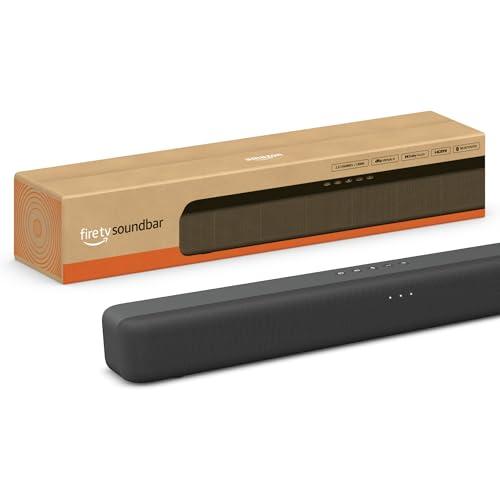
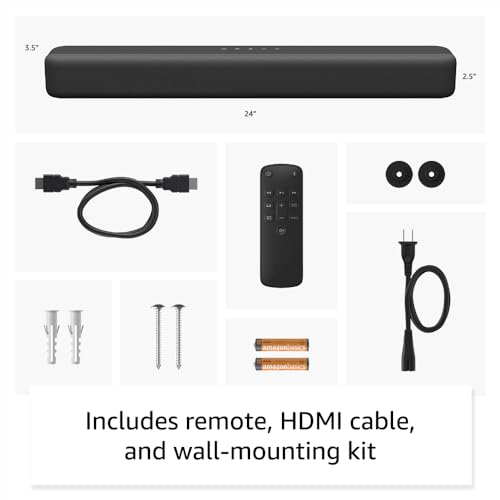
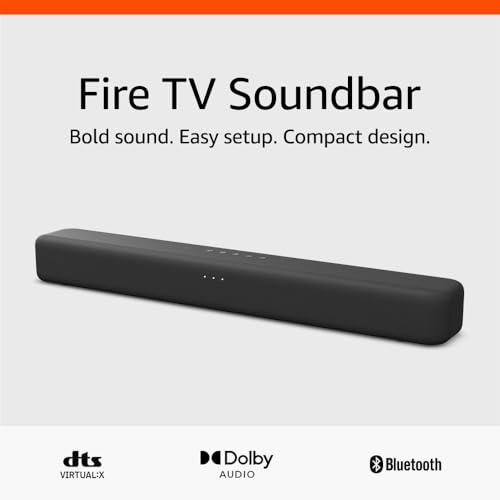
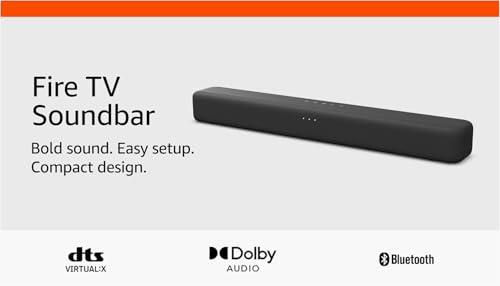
The Amazon Fire TV Soundbar represents the "do one thing well" philosophy. It's a compact, 2.0 channel system—meaning it has two separate audio channels (left and right) without a dedicated center channel or subwoofer. At roughly 24 inches long, it's designed to sit unobtrusively under smaller TVs without dominating your entertainment center.
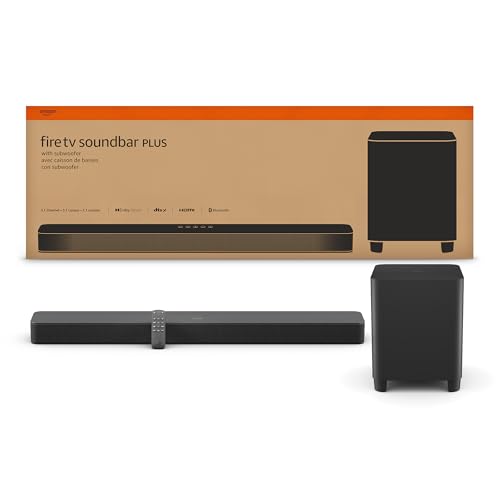
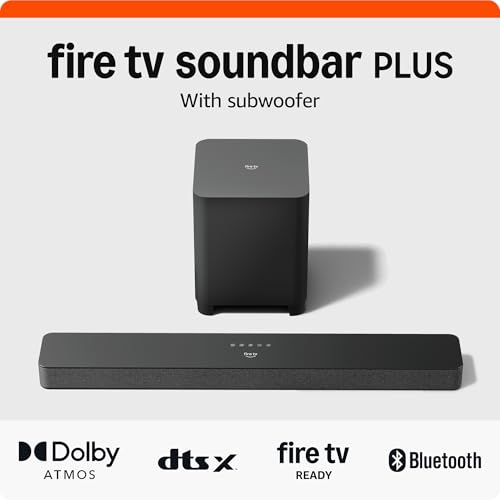
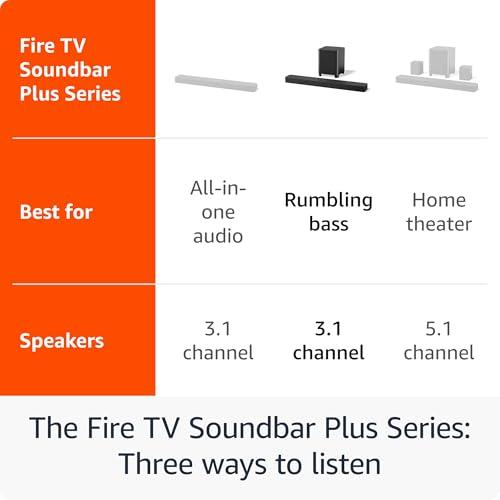
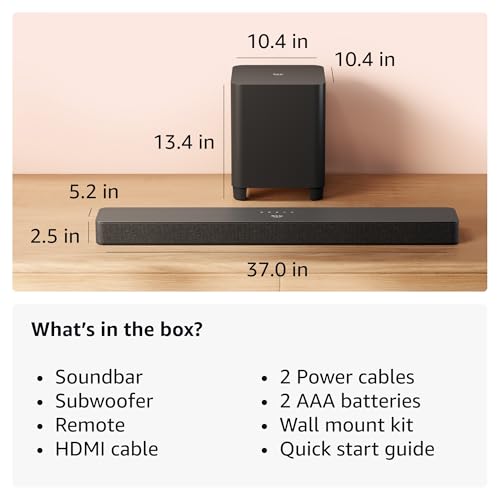
The Amazon Fire TV Soundbar Plus with Subwoofer, by contrast, takes the "foundation for growth" approach. It's a 3.1 channel system, which means it has left, right, and center channels plus a separate subwoofer (that's what the ".1" represents). At about 37 inches long, it's designed for larger TVs and can expand into a full 5.1 surround sound system by adding rear satellite speakers.
This size difference isn't just about fitting under your TV—it directly impacts audio performance. Longer soundbars can spread their drivers (the individual speakers inside) further apart, creating a wider soundstage that makes audio feel like it's coming from a broader area rather than a single point source.
Since most people buy soundbars primarily to improve dialogue clarity, this is arguably the most important performance metric. Both products approach this challenge differently, and the results reveal important insights about audio engineering trade-offs.
The Amazon Fire TV Soundbar uses its two full-range drivers to create what's called a "phantom center"—your brain perceives voices as coming from between the left and right speakers rather than from a dedicated center channel. Our research into user and expert reviews consistently highlights the original Fire TV Soundbar's natural vocal reproduction. The sound signature remains balanced across different volume levels, and voices maintain their natural character without the artificial enhancement that sometimes makes dialogue sound processed or robotic.
The Amazon Fire TV Soundbar Plus, with its dedicated center channel, should theoretically provide superior dialogue performance. Center channels are specifically designed to handle vocal frequencies and ensure that dialogue remains anchored to the screen even when other sounds are happening around it. The Plus model also includes a dialogue enhancement feature with five adjustable levels, allowing you to boost voice clarity when needed.
However, our analysis of professional reviews reveals a surprising twist: the Plus model's dialogue performance is more problematic than its technical specifications would suggest. Multiple reviews describe voices as sounding "thin" and occasionally "robotic," particularly for deeper male voices. The issue appears to stem from an elevated upper midrange frequency response that can make the overall sound harsh at higher volumes.
This illustrates an important principle in audio engineering: more features don't automatically mean better performance. Sometimes simpler designs execute their core mission more effectively than complex systems that try to do everything.
Bass performance represents the most dramatic difference between these two products, and it's where physics plays a decisive role. The compact Amazon Fire TV Soundbar is limited by its small internal volume and driver size. While it includes bass reflex tuning (a port that helps extend low-frequency response), it simply cannot move enough air to produce impactful bass. This doesn't make it bad—just limited to what's physically possible in such a small enclosure.
The Amazon Fire TV Soundbar Plus with Subwoofer takes a completely different approach by including a separate wireless subwoofer. Subwoofers are specialized speakers designed specifically for low frequencies, typically handling everything below about 80-100 Hz. This means the soundbar's main drivers can focus on mid-range and high frequencies while the subwoofer handles the heavy lifting for bass-heavy content like action movies or music.
Based on our evaluation of user feedback, the subwoofer makes a substantial difference for content with significant low-end content. Movie explosions have actual impact rather than just being louder mid-range sounds, and music gains the foundation that makes instruments like bass guitars and kick drums feel present rather than implied.
However, reviews also note that the subwoofer's performance is somewhat limited compared to higher-end alternatives. It's described as providing "one-note" bass without the nuanced low-mid emphasis that premium subwoofers deliver. This means while you get more bass quantity, the quality may not satisfy listeners accustomed to high-end audio systems.
Soundstage refers to how wide and spacious audio feels—whether sound seems to come from a narrow point or spreads across your room. This is where the size difference between these soundbars becomes crucial.
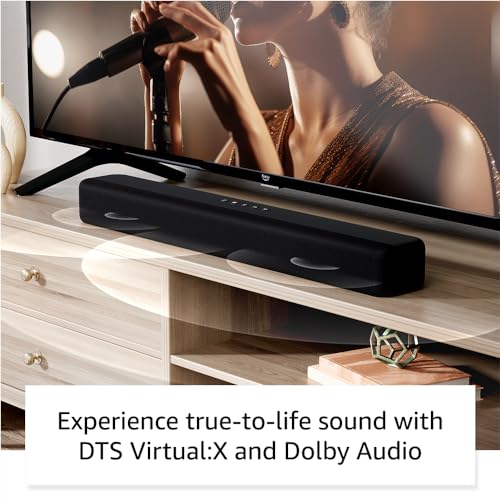
The Amazon Fire TV Soundbar, despite its compact size, creates a surprisingly wide stereo image according to expert reviews. The DTS Virtual:X processing (a technology that uses psychoacoustic tricks to make stereo speakers sound more three-dimensional) helps create some sense of surround sound, though it's limited compared to systems with actual surround speakers.
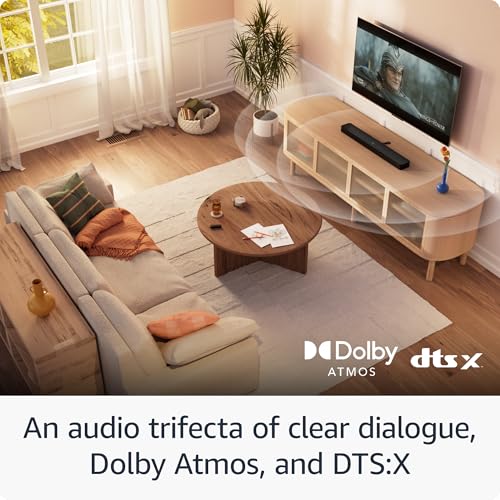
The Amazon Fire TV Soundbar Plus benefits from its longer form factor and additional drivers. With three full-range speakers and three tweeters spread across 37 inches, it can create a genuinely wider soundstage. The system supports virtual Dolby Atmos and DTS:X—these are audio processing technologies that attempt to create height and surround effects from a soundbar's forward-facing speakers.
It's important to understand what "virtual" means in this context. True Dolby Atmos systems use speakers positioned around and above your listening position to create genuine three-dimensional audio. Virtual Dolby Atmos uses sophisticated signal processing to trick your brain into perceiving height and surround effects from speakers positioned only in front of you. It works, but it's not the same experience as a true Atmos system with ceiling or upward-firing speakers.
The expandability of the Plus model is where it truly differentiates itself. By adding rear satellite speakers, you can transform it into a genuine 5.1 surround system with discrete rear channels. This provides a fundamentally different experience from virtual surround processing—sounds actually do come from behind you rather than being psychoacoustically simulated.
Both soundbars share identical connectivity options, which is worth understanding since the "Fire TV" branding might suggest streaming capabilities. Neither product actually includes Fire TV streaming functionality or built-in Alexa voice control. The branding primarily refers to enhanced integration with Amazon's Fire TV devices rather than standalone smart features.
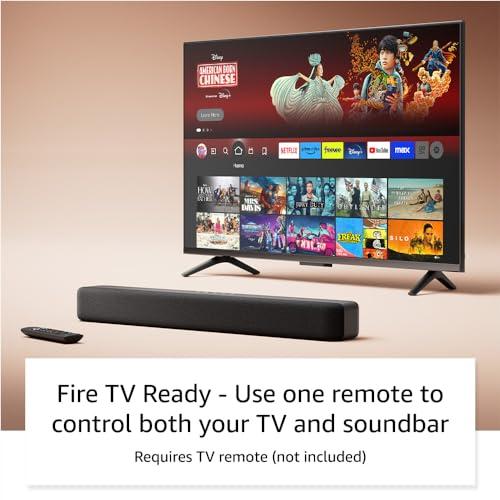
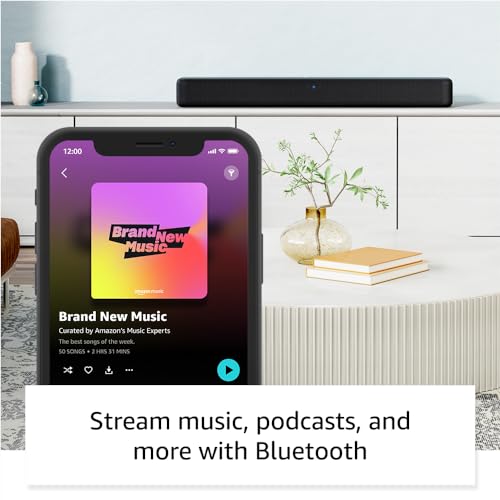
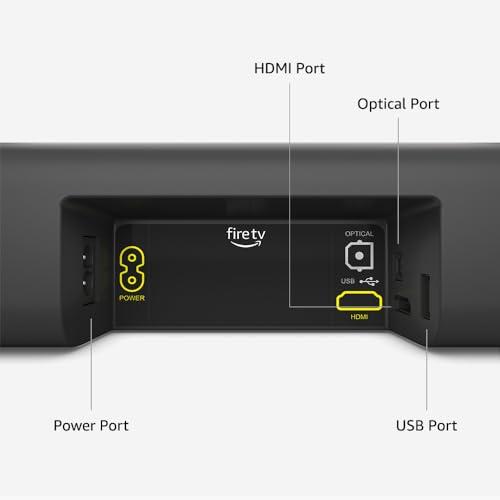
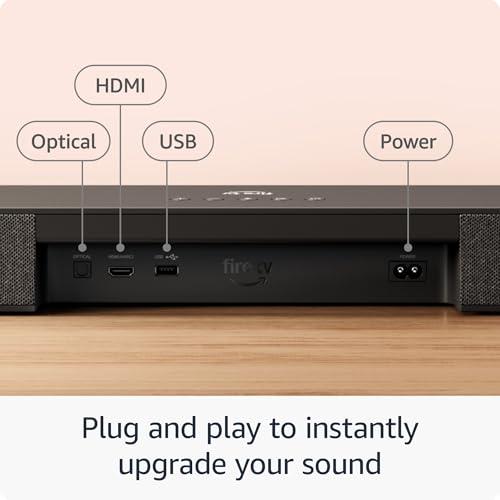
Both models include HDMI ARC/eARC (Audio Return Channel/Enhanced Audio Return Channel), which allows your TV to send audio back to the soundbar through the same HDMI cable used for video. This simplifies setup and often allows you to control the soundbar's volume using your TV remote. They also include optical digital inputs for older TVs that don't support HDMI ARC, and Bluetooth for wireless music streaming from phones and tablets.
The lack of built-in streaming might disappoint some users expecting Alexa integration or direct music streaming capabilities. However, this omission also means fewer components to fail and simpler operation—you control these soundbars primarily through your TV or their included remotes rather than through smartphone apps or voice commands.
How a soundbar performs at different volume levels reveals important information about its internal design and target use cases. The Amazon Fire TV Soundbar maintains its balanced sound signature at moderate volumes, making it excellent for apartment living or late-night viewing when you need clear dialogue without disturbing neighbors.
However, it has limited headroom before distortion becomes noticeable. This isn't necessarily a flaw—it's designed for reasonable listening levels rather than party-volume playback.
The Amazon Fire TV Soundbar Plus includes DTS TruVolume technology, which automatically adjusts volume levels to maintain consistent loudness across different types of content. This addresses the common problem of action scenes being dramatically louder than dialogue scenes, reducing the need to constantly adjust your remote.
Unfortunately, professional reviews consistently note that the Plus model becomes harsh and unpleasant at higher volumes, with the upper frequencies becoming overly aggressive. This suggests that while it has more raw power than the standard model, the frequency response isn't well-balanced across its entire volume range.
The physical requirements for these soundbars differ significantly and impact their suitability for different living situations. The compact Fire TV Soundbar works well in smaller rooms and with TVs ranging from 32 to 50 inches. Its integrated design means you only need to find space for a single component, and its bass reflex construction allows it to be placed directly against a wall without acoustic compromises.
The Fire TV Soundbar Plus with Subwoofer is designed for larger rooms and TVs from 55 inches and up. However, the separate subwoofer introduces placement complexity. Subwoofers need to be positioned where they can effectively couple with your room's acoustics, which often means experimenting with different locations to find the spot where bass sounds even and natural rather than boomy or thin.
For apartment dwellers, the subwoofer's wireless connectivity is both a blessing and a potential curse. You can place it away from your entertainment center, but bass frequencies travel through walls and floors more readily than higher frequencies, potentially disturbing neighbors.
At the time of writing, these products occupy different value propositions within the budget soundbar market. The standard Fire TV Soundbar represents exceptional value for users seeking maximum improvement per dollar spent. Expert consensus consistently describes it as "punching above its price class" with balanced audio performance that significantly outperforms built-in TV speakers without major compromises.
The Fire TV Soundbar Plus with Subwoofer, priced at roughly three times the cost of the standard model, faces more complex value calculations. While it offers substantially more bass response and expandability options, professional reviews suggest that the execution doesn't always justify the premium pricing. The harsh upper frequencies and mixed dialogue performance mean that the substantial price increase doesn't necessarily translate to proportionally better audio quality.
This price-performance relationship reflects broader trends in budget audio. Sometimes manufacturers achieve better results by focusing resources on executing basics exceptionally well rather than spreading development across numerous features that may not integrate seamlessly.
The decision between these soundbars ultimately depends on your specific priorities, room characteristics, and future plans.
Choose the Amazon Fire TV Soundbar if you're looking for the most balanced audio improvement at the lowest cost. It's ideal for smaller TVs and rooms, apartment living situations where excessive bass isn't appropriate, and users who prioritize natural dialogue reproduction over features. If you primarily watch dialogue-heavy content like news, sitcoms, or dramas, and you value simplicity over customization options, this is the better choice.
The Fire TV Soundbar Plus with Subwoofer makes sense for users with larger rooms and TVs who plan to expand their audio system over time. If you regularly watch action movies or listen to music through your TV setup, the additional bass response justifies the higher cost despite the model's vocal reproduction issues. The expandability to 5.1 surround makes it a reasonable foundation for building a more comprehensive home theater system.
However, be prepared for the Plus model's limitations. If you're sensitive to harsh upper frequencies or if natural dialogue reproduction is your primary concern, the standard model might actually provide a more satisfying experience despite its lower cost and simpler feature set.
These two soundbars illustrate important principles about budget audio design. The compact Fire TV Soundbar succeeds by focusing on its core mission—improving dialogue clarity and basic stereo performance—without overreaching. The Plus model attempts to offer more comprehensive features but struggles with execution in some key areas.
This doesn't make either product inherently superior; rather, it demonstrates how different design philosophies serve different user needs. Sometimes the simpler, more focused product delivers greater overall satisfaction than the feature-rich alternative.
Since their 2023 release, both products have remained largely unchanged, which reflects Amazon's positioning of these as value-oriented rather than cutting-edge products. The budget soundbar market continues evolving, but these models represent solid examples of their respective approaches to affordable audio improvement.
For most users, either soundbar will provide a meaningful upgrade over built-in TV speakers. The key is matching your choice to your specific needs, room characteristics, and tolerance for the compromises that any budget audio product must make.
| Amazon Fire TV Soundbar | Amazon Fire TV Soundbar Plus with Subwoofer |
|---|---|
| Channel Configuration - Determines audio separation and bass capability | |
| 2.0 channel stereo (no dedicated center or subwoofer) | 3.1 channel with dedicated center channel and wireless subwoofer |
| Physical Size - Must fit your TV and entertainment center | |
| 61cm × 9cm × 6.5cm (compact, fits smaller TVs 32-50") | 94cm × 6.4cm × 13.2cm (longer design for 55"+ TVs) |
| Audio Format Support - Affects compatibility with streaming content | |
| Dolby Audio, DTS Virtual:X (basic surround simulation) | Dolby Atmos (virtual), DTS:X, DTS TruVolume (advanced processing) |
| Bass Response - Critical for action movies and music | |
| Limited by compact drivers, adequate for dialogue | Dedicated wireless subwoofer provides substantial low-end impact |
| Expandability - Future upgrade potential | |
| None - standalone system only | Can expand to full 5.1 surround with rear satellite speakers |
| Sound Customization - How much control you have over audio | |
| 3 basic EQ presets (Dialogue, Music, Film) | 5 EQ modes plus independent bass/treble controls (1-9 scale) |
| Setup Complexity - Installation and placement requirements | |
| Single unit plug-and-play, wall-mountable | Requires subwoofer placement and wireless pairing setup |
| Dialogue Performance - Most important for TV viewing | |
| Natural, balanced vocal reproduction at all volumes | Dedicated center channel but can sound thin/harsh at higher volumes |
| Target Room Size - Where each performs best | |
| Small to medium rooms, apartment-friendly | Medium to large rooms, house with dedicated entertainment space |
| Value Proposition - Cost versus performance delivered | |
| Exceptional improvement per dollar, balanced execution | 3x price premium with mixed execution, better for expandable systems |
The Amazon Fire TV Soundbar is better suited for small rooms and apartments. Its compact 61cm design fits perfectly under smaller TVs (32-50 inches) without overwhelming the space. The integrated bass response won't disturb neighbors, and its balanced sound signature works well in close listening environments where you don't need room-filling volume.
Yes, if you watch action movies or content with significant bass, the Amazon Fire TV Soundbar Plus with Subwoofer makes a substantial difference. The dedicated subwoofer provides real impact for explosions, music, and sound effects that the standard Fire TV Soundbar simply cannot match due to its compact size limitations.
Surprisingly, the Amazon Fire TV Soundbar delivers more natural dialogue despite lacking a dedicated center channel. Reviews consistently praise its balanced vocal reproduction, while the Fire TV Soundbar Plus can make voices sound thin or harsh, particularly at higher volumes, despite having a dedicated center channel.
Only the Amazon Fire TV Soundbar Plus with Subwoofer can expand to a full 5.1 surround system by adding rear satellite speakers. The standard Fire TV Soundbar is a standalone system with no expansion options, though it does offer virtual surround processing through DTS Virtual:X.
The Amazon Fire TV Soundbar offers exceptional value, with expert reviews consistently noting it "punches above its price class." The Fire TV Soundbar Plus costs roughly three times more but doesn't deliver proportionally better performance, making it harder to justify unless you specifically need the subwoofer or expandability.
Both the Amazon Fire TV Soundbar and Fire TV Soundbar Plus offer identical connectivity: HDMI ARC/eARC, optical digital input, and Bluetooth. Neither has built-in streaming despite the "Fire TV" name - they're designed to enhance your existing TV's audio rather than replace streaming devices.
The Amazon Fire TV Soundbar is ideal for apartment living. Its compact design, balanced bass response, and single-unit setup won't disturb neighbors. The Fire TV Soundbar Plus with Subwoofer may be too powerful for thin walls and requires more complex placement considerations.
Only the Amazon Fire TV Soundbar Plus supports Dolby Atmos, though it's virtual Atmos without physical height speakers. The standard Fire TV Soundbar supports DTS Virtual:X for simulated surround effects. Neither provides true overhead audio like dedicated Atmos systems with ceiling speakers.
The Amazon Fire TV Soundbar requires minimal space - just room under your TV. The Fire TV Soundbar Plus with Subwoofer needs additional floor space for subwoofer placement and experimentation to find the optimal bass response location in your room.
The Amazon Fire TV Soundbar Plus with Subwoofer handles dynamic content better thanks to its dedicated subwoofer and DTS TruVolume technology that maintains consistent volume levels. However, it can become harsh at high volumes, while the Fire TV Soundbar maintains better tonal balance but has limited maximum output.
Yes, both the Amazon Fire TV Soundbar and Fire TV Soundbar Plus support HDMI ARC, allowing control through your TV remote. They also integrate enhanced features when paired with Amazon Fire TV devices, though neither includes built-in Alexa or streaming capabilities.
For a 65-inch TV, the Amazon Fire TV Soundbar Plus with Subwoofer is the better match. Its 94cm length better proportions with larger screens, and the additional drivers create a wider soundstage appropriate for bigger viewing distances. The compact Fire TV Soundbar would look undersized and may not fill larger rooms effectively.
We've done our best to create useful and informative comparisons to help you decide what product to buy. Our research uses advanced automated methods to create this comparison and perfection is not possible - please contact us for corrections or questions. These are the sites we've researched in the creation of this article: rtings.com - developer.amazon.com - stereoguide.com - developer.amazon.com - techradar.com - hometechnologyreview.com - whathifi.com - youtube.com - whathifi.com - wirelessplace.com - hometechnologyreview.com - dolby.com - aboutamazon.com - developer.amazon.com - community.anker.com - youtube.com - cordbusters.co.uk - youtube.com - t3.com - manuals.plus

Privacy Policy
Terms and Conditions - Affiliate Policy
Home Security
© Copyright 2008-2026.
11816 Inwood Rd #1211, Dallas, TX 75244