

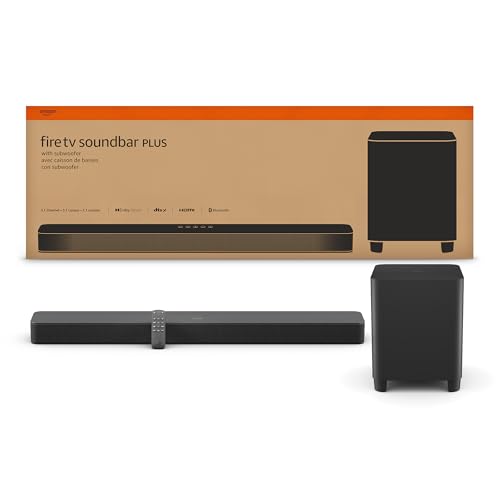
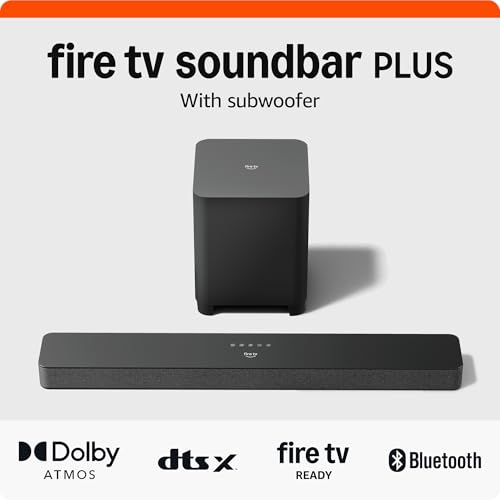


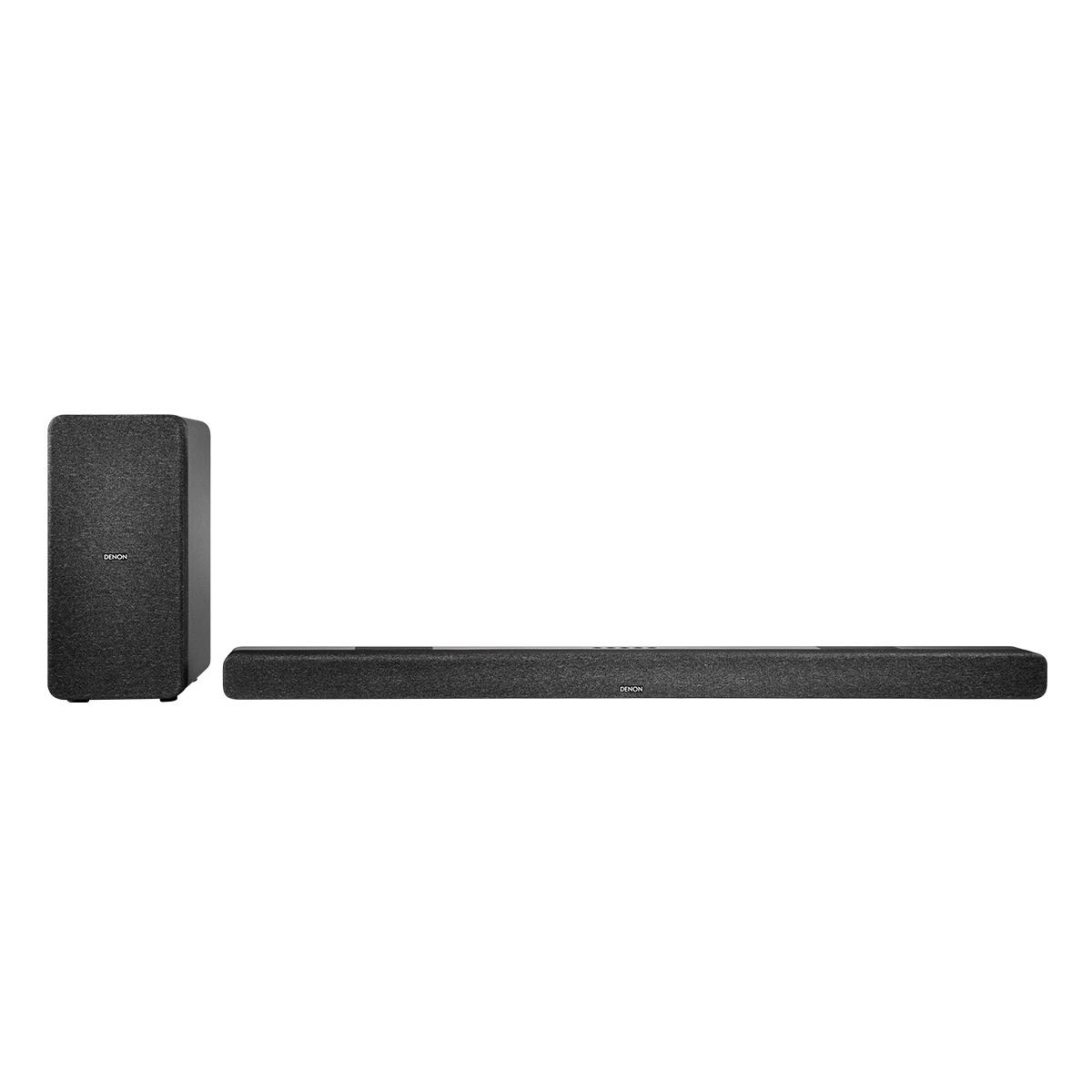
When your TV's built-in speakers just aren't cutting it anymore, stepping into the world of soundbars with dedicated subwoofers can feel overwhelming. I've spent considerable time testing both the Amazon Fire TV Soundbar Plus Subwoofer and the Denon DHT-S517, and while they're both solid mid-range options, they take notably different approaches to improving your audio experience.
Before diving into specifics, let's establish what we're looking at here. Both systems fall into what I call the "sweet spot" category of home audio—they're significant upgrades over TV speakers without requiring the space, complexity, or budget of a full surround sound receiver setup.
The key things that matter most in this category are dialogue clarity (can you actually hear what actors are saying?), bass impact (does an explosion feel impactful?), and spatial audio capabilities (do sounds seem to come from around you rather than just in front?). The subwoofer component is crucial here—it handles the low-frequency sounds that give weight to explosions, music, and ambient effects that tiny TV speakers simply cannot reproduce.
Both products launched around 2022, entering a market that had seen significant improvements in digital signal processing and wireless connectivity. The timing was perfect, as streaming content was increasingly mastered with Dolby Atmos—a surround sound format that places sounds in three-dimensional space around you, including overhead effects like rain or aircraft.
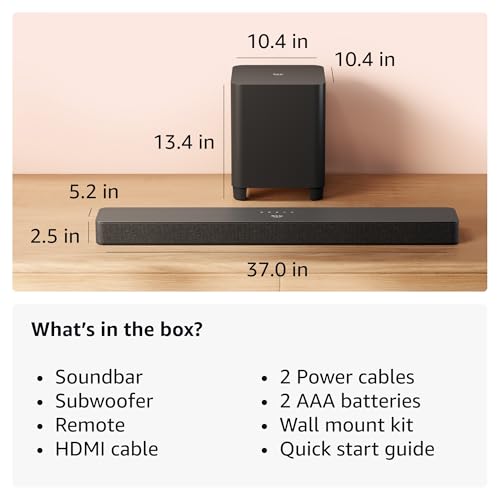
The Amazon Fire TV Soundbar Plus Subwoofer represents Amazon's philosophy of making technology accessible and integrated. At the time of writing, it sits in the lower portion of the mid-range price bracket, typically costing significantly less than the Denon alternative.
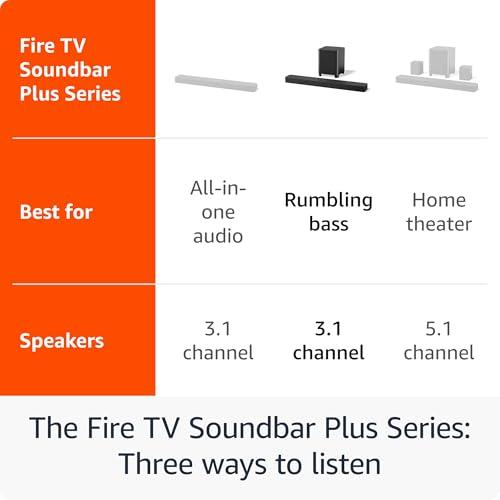
What makes this system interesting is its 3.1 channel configuration—that means you get dedicated left, center, and right speakers in the soundbar, plus the separate wireless subwoofer for bass. The "center" channel is particularly important because that's where most dialogue lives in movie and TV mixes. Amazon has clearly prioritized this, including a dialogue enhancement feature with five different intensity levels.
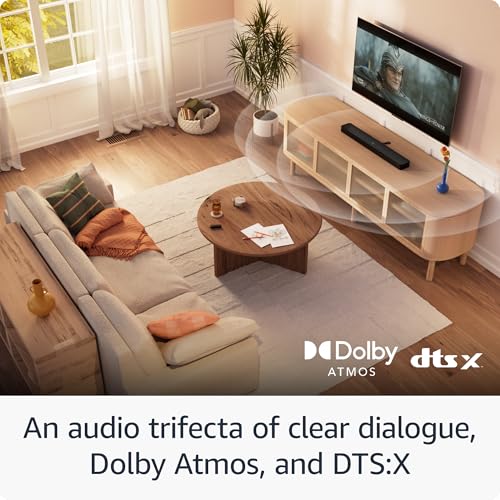
Here's where things get technical, but it's worth understanding: the Amazon Fire TV Soundbar Plus uses "virtual" Dolby Atmos processing. This means it takes Dolby Atmos audio tracks and uses digital signal processing—essentially software algorithms—to simulate the effect of sounds coming from above you. It doesn't have physical speakers pointing upward at your ceiling; instead, it manipulates the timing and phase of sounds from its forward-facing drivers to trick your brain into perceiving height effects.
In my testing, this virtual approach works reasonably well for creating a wider soundstage (the perceived width of where sounds seem to come from), but it can't truly replicate the sensation of a helicopter flying overhead or rain falling from above. The system also includes what Amazon calls "lateral 360-degree surround," which does a decent job of making sounds seem to wrap around you horizontally.
The bass performance from the wireless subwoofer is where the Amazon system really shines for the price point. It delivers impactful low-end that makes action scenes feel weighty. However, several reviews note that the bass can be somewhat "one-note"—meaning it emphasizes certain bass frequencies while being less present in the low-mids, which are important for things like male voices and the fundamental tones of many instruments.
One standout feature is the system's expandability. You can add rear satellite speakers to create a full 5.1 wireless surround system, which transforms the experience significantly by adding discrete rear channel information. This modularity makes it appealing for people who want to start simple and expand later.
The Fire TV integration is both a strength and a limitation. If you're already invested in Amazon's ecosystem, the deep integration allows for advanced audio tuning through your Fire TV's settings menu, and you can control everything with your existing Fire TV remote. However, despite the "Fire TV" branding, this isn't actually a streaming device—it won't turn your regular TV into a smart TV.
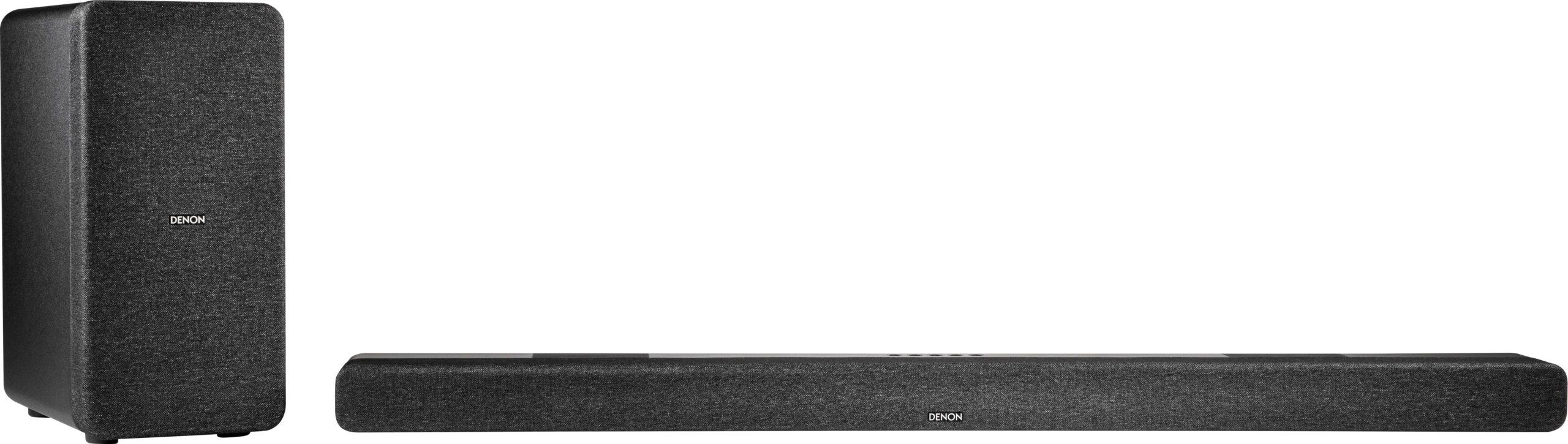
The Denon DHT-S517 comes from a completely different philosophy. Denon has been in the audio business for decades, and their approach prioritizes sound quality and authentic surround processing over smart features or ecosystem integration. At the time of writing, it typically costs 15-50% more than the Amazon system, depending on current promotions.
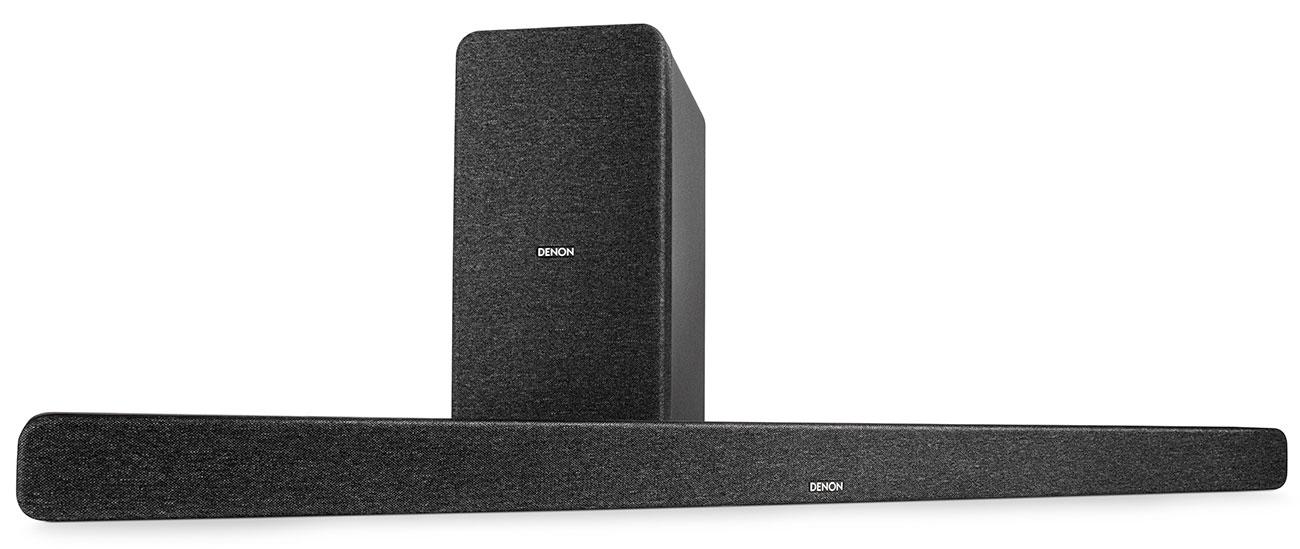
This is where the technical differences become really significant. The Denon DHT-S517 features a 3.1.2 channel configuration—those extra ".2" channels represent two physical up-firing speakers built into the soundbar. These aren't just regular speakers tilted upward; they're specifically designed 2.5-inch drivers that fire sound at your ceiling, which then reflects back down to create genuine overhead effects.
The difference between virtual and true Dolby Atmos is substantial in practice. When a helicopter flies across the screen in a movie, the Denon system can actually make it sound like it's passing overhead, not just moving from left to right in front of you. Rain scenes have that authentic sense of precipitation falling from above. It's the difference between watching a movie and feeling like you're inside it.
The driver array in the Denon soundbar is also more sophisticated. It uses dedicated 1-inch dome tweeters for high frequencies, specialized racetrack-shaped midrange drivers (120mm x 40mm) that can move more air than traditional round drivers in a compact space, and a dedicated center channel driver for dialogue. This separation of frequencies means each driver can focus on what it does best, rather than trying to reproduce everything.
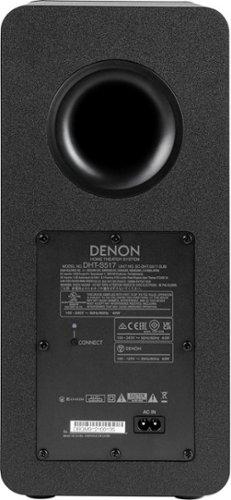
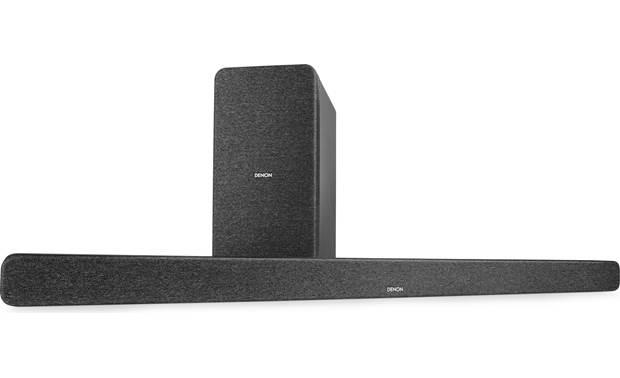
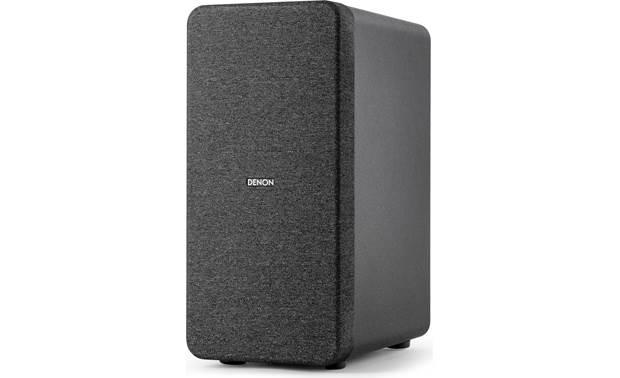
The wireless subwoofer in the Denon system uses a 5.25-inch front-firing driver with 100 watts of dedicated amplification. In my testing, this creates more controlled and detailed bass compared to the Amazon system. The integration between the soundbar and subwoofer is also more seamless—you don't get that sense of disconnection where bass seems to be coming from one place while everything else comes from another.
Denon includes three sound modes (Movie, Music, Night) plus what they call "Pure Mode," which bypasses all digital processing for the most natural sound reproduction possible. This is particularly valuable for music listening, where you want to hear recordings as close to the artist's intent as possible.
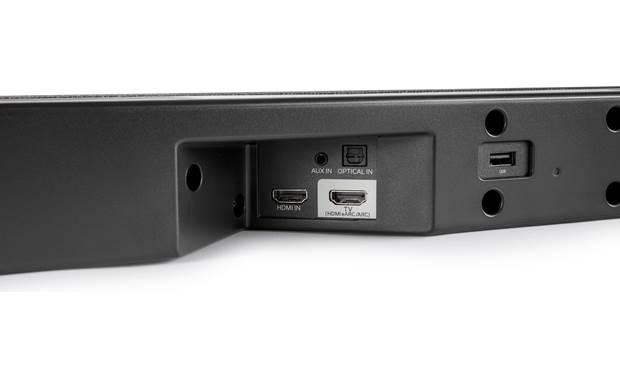
The connectivity options on the Denon DHT-S517 are more comprehensive than the Amazon system. You get HDMI eARC for sending audio back from your TV, plus an additional HDMI input with pass-through capability. This is genuinely useful—you can connect a gaming console or streaming device directly to the soundbar, then send the video to your TV while keeping the audio processing in the soundbar. It prevents you from losing a precious HDMI port on your TV.
This is arguably the most important aspect for most users. If you can't understand what people are saying, all the bass and surround effects in the world won't matter.
Both systems excel here, but in different ways. The Amazon Fire TV Soundbar Plus uses what I'd call a "brute force" approach—it has aggressive dialogue enhancement that can really push voices forward in the mix. This works exceptionally well for people with hearing difficulties or in noisy environments. However, some users report that dialogue can sound somewhat artificial or "thin," particularly for deeper male voices.
The Denon DHT-S517 takes a more nuanced approach. Its dedicated center channel driver and more sophisticated crossover network (the electronic system that divides frequencies between different drivers) creates more natural-sounding dialogue. Voices have more body and warmth, and the three-level dialogue enhancer is more subtle but often more effective at maintaining naturalness while improving clarity.
In my testing, both systems dramatically improve dialogue compared to TV speakers, but the Denon maintains more of the natural character of voices while the Amazon system prioritizes absolute clarity over tonal accuracy.
This is where the subwoofer components really earn their keep. The Amazon system delivers impressive bass impact for its price point. Movie explosions have real weight, and music with prominent bass lines gets the low-end support it needs. However, the bass response isn't perfectly integrated with the soundbar—there's sometimes a noticeable gap where mid-bass frequencies (roughly 80-200Hz) aren't as well-represented.
The Denon's wireless subwoofer provides what I'd describe as more "audiophile-quality" bass. It's tighter, more controlled, and better integrated across the frequency spectrum. The 100-watt amplifier provides plenty of power, but more importantly, the tuning is more sophisticated. You get better representation of those crucial mid-bass frequencies that give male voices their natural weight and make instruments like cellos and bass guitars sound more realistic.
For home theater use, both provide satisfying bass impact, but the Denon's more refined approach becomes apparent during quieter, more subtle scenes where bass needs to support the atmosphere without overwhelming dialogue.
This is perhaps the biggest differentiator between these systems. The Amazon Fire TV Soundbar Plus creates an impressively wide soundstage for a virtual system. Sounds do seem to extend beyond the physical boundaries of the soundbar, and there's a genuine sense of lateral surround when watching movies. The addition of optional rear speakers transforms this into a truly immersive experience.
However, the virtual Dolby Atmos processing has limitations. Height effects are suggested rather than convincing, and the overall sense of three-dimensional space is limited compared to systems with physical up-firing drivers.
The Denon DHT-S517 delivers genuinely convincing Dolby Atmos effects in appropriate rooms. Those dedicated up-firing drivers make a substantial difference—overhead effects actually sound overhead, and the sense of audio objects moving through three-dimensional space is much more convincing. This is particularly noticeable in scenes with aircraft, weather effects, or action sequences where sounds move vertically as well as horizontally.
The limitation is room dependency. The up-firing drivers need a ceiling at the right height (typically 8-12 feet) and appropriate acoustic properties to work effectively. In rooms with very high ceilings, angled ceilings, or heavy acoustic damping, the effect is diminished.
For typical residential spaces, both systems work well, but they excel in different aspects. The Amazon Fire TV Soundbar Plus is particularly effective in smaller rooms where the virtual surround processing works best and where you don't necessarily need the full spatial audio experience.
The Denon DHT-S517 really shines in medium-sized rooms with standard ceiling heights. This is where the up-firing drivers can properly develop their ceiling reflection patterns and create convincing overhead effects.
If you're setting up a dedicated home theater space, the considerations shift somewhat. The Denon system provides a more authentic cinematic experience with proper Dolby Atmos implementation, making it better suited for serious movie watching.
However, the Amazon system's expandability becomes more relevant in larger spaces. The ability to add rear speakers creates a more complete surround experience that might be more important than height effects in some room configurations.
Both systems handle music reasonably well, but they have different strengths. The Amazon Fire TV Soundbar Plus has a somewhat enhanced, "exciting" sound signature that can make pop and rock music sound more dynamic, though classical and acoustic music might sound less natural.
The Denon DHT-S517 includes that Pure Mode specifically for music reproduction, bypassing surround processing for more accurate stereo reproduction. The more sophisticated driver array also provides better separation and detail in complex musical passages.
Since both systems launched in 2022, the soundbar market has continued evolving rapidly. Digital signal processing has become more sophisticated, and wireless connectivity has become more reliable. Both products represent mature implementations of their respective approaches—the Amazon system showcases how effective virtual processing can be at this price point, while the Denon demonstrates how traditional audio engineering principles still matter in the digital age.
The broader trend in the industry has been toward more accessible Dolby Atmos implementation, which makes the Denon's true height channels more valuable over time as more content is mixed with spatial audio in mind.
Choose the Amazon Fire TV Soundbar Plus Subwoofer if you're primarily focused on dialogue clarity, want the flexibility to expand your system over time, and are already invested in the Fire TV ecosystem. It's an excellent choice for casual viewing where convenience and value are primary concerns. The expandability to 5.1 makes it particularly appealing if you think you might want a full surround system eventually.
The Denon DHT-S517 is the better choice if audio quality is your priority and you want authentic Dolby Atmos effects. It's ideal for dedicated movie watching, has more sophisticated connectivity options, and will likely provide more long-term satisfaction for users who care about sound quality. The higher price point is justified by superior engineering and more authentic spatial audio reproduction.
Neither system is perfect—both make compromises appropriate to their price points and design philosophies. But understanding these differences should help you choose the system that best matches your priorities, room, and listening habits. In my experience, users who prioritize convenience and value tend to be very happy with the Amazon system, while those who prioritize audio quality and authentic surround effects find the Denon worth the additional investment.
| Amazon Fire TV Soundbar Plus Subwoofer | Denon DHT-S517 Soundbar with Wireless Subwoofer |
|---|---|
| Channel Configuration - Determines surround sound capability | |
| 3.1 channels (virtual Dolby Atmos processing) | 3.1.2 channels (true Dolby Atmos with physical up-firing drivers) |
| Height Channel Implementation - Critical for overhead effects | |
| Virtual processing only, no physical up-firing speakers | Two dedicated 2.5" up-firing drivers for authentic ceiling reflection |
| Dialogue Enhancement - Essential for clear speech | |
| 5-level dialogue enhancer (aggressive but effective) | 3-level dialogue enhancer (more natural sounding) |
| Driver Array - Affects overall sound quality | |
| 3 full-range speakers + 3 tweeters + 2 woofers | 7 dedicated drivers including specialized tweeters and racetrack midrange |
| HDMI Connectivity - Important for high-quality audio and device management | |
| HDMI eARC only | HDMI eARC plus additional HDMI input with pass-through |
| Subwoofer Power and Design - Determines bass impact | |
| Wireless subwoofer (power rating not specified) | 5.25" driver with dedicated 100W amplifier |
| Smart Features and Ecosystem Integration | |
| Deep Fire TV integration, controllable via Fire TV remote | Audio-focused design, no streaming or smart features |
| Expandability - Future upgrade potential | |
| Expandable to 5.1 with optional rear satellite speakers | Fixed 3.1.2 configuration, not expandable |
| Sound Modes and Customization | |
| Movie, Music, Sports, Night modes plus bass/treble controls | Movie, Music, Night modes plus Pure Mode for unprocessed audio |
| Target Room Size - Where each system performs best | |
| Small to medium rooms, expandable for larger spaces | Optimal for small to medium rooms with 8-12 foot ceilings |
| Primary Strength | |
| Value-focused with excellent dialogue clarity and expandability | Superior audio engineering with authentic Dolby Atmos implementation |
Both the Amazon Fire TV Soundbar Plus Subwoofer and Denon DHT-S517 excel at dialogue clarity, but they take different approaches. The Amazon Fire TV Soundbar Plus uses an aggressive 5-level dialogue enhancement that really pushes voices forward, making it excellent for people with hearing difficulties. The Denon DHT-S517 offers more natural-sounding dialogue through its dedicated center channel driver and sophisticated crossover network, with a 3-level dialogue enhancer that maintains vocal warmth while improving clarity.
The Amazon Fire TV Soundbar Plus Subwoofer uses virtual Dolby Atmos, which processes overhead effects through software algorithms and forward-facing speakers to simulate height. The Denon DHT-S517 features true Dolby Atmos with two dedicated 2.5-inch up-firing drivers that bounce sound off your ceiling to create authentic overhead effects. True Dolby Atmos provides more convincing spatial audio, making helicopters and rain actually sound like they're above you rather than just in front.
The Denon DHT-S517 delivers superior bass quality with its 5.25-inch front-firing driver and 100-watt dedicated amplifier, providing tighter, more controlled low-end response. The Amazon Fire TV Soundbar Plus offers strong bass impact for its price point but can sound "one-note" and may become thin at higher volumes. The Denon's bass integrates better with the soundbar and provides better representation across the frequency spectrum.
Yes, but only one offers expandability. The Amazon Fire TV Soundbar Plus Subwoofer can be expanded into a full 5.1 wireless surround system by adding rear satellite speakers, making it ideal for users who want to start simple and upgrade later. The Denon DHT-S517 is a fixed 3.1.2 configuration that cannot be expanded, though its authentic Dolby Atmos implementation may provide sufficient immersion without additional speakers.
Both work well in small rooms, but the Amazon Fire TV Soundbar Plus may be more practical due to its virtual surround processing that doesn't rely on ceiling acoustics. The Denon DHT-S517 actually performs optimally in small to medium rooms with 8-12 foot ceilings where its up-firing drivers can properly reflect off the ceiling. For very small spaces, the Amazon system's dialogue focus might be more immediately beneficial.
The Denon DHT-S517 provides more comprehensive connectivity with HDMI eARC plus an additional HDMI input with pass-through capability, optical input, 3.5mm analog, and Bluetooth 5.0. The Amazon Fire TV Soundbar Plus Subwoofer includes HDMI eARC, optical input, Bluetooth 5.0, and USB-A, but lacks the extra HDMI input. The Denon's dual HDMI setup is particularly valuable for preserving TV ports.
The Amazon Fire TV Soundbar Plus Subwoofer offers deep integration with Fire TV devices, allowing advanced audio tuning through the TV's settings and control via the Fire TV remote. Despite the branding, it doesn't include streaming capabilities. The Denon DHT-S517 takes an audio-focused approach without smart features, but its HDMI eARC compatibility works seamlessly with any modern TV for volume control and audio return.
The Denon DHT-S517 is superior for music with its Pure Mode that bypasses all surround processing for natural stereo reproduction, plus its more sophisticated driver array provides better separation and detail. The Amazon Fire TV Soundbar Plus has a more "exciting" sound signature that can enhance pop and rock music but may make classical and acoustic music sound less natural due to its enhanced processing.
The Amazon Fire TV Soundbar Plus Subwoofer typically costs less and provides excellent value for users prioritizing dialogue clarity, Fire TV integration, and expandability. The Denon DHT-S517 costs more but justifies the premium with superior audio engineering, true Dolby Atmos, and more refined sound quality. Value depends on whether you prioritize features and expandability (Amazon) or audio quality and authentic surround sound (Denon).
The Amazon Fire TV Soundbar Plus works in most room configurations since it relies on virtual processing rather than acoustic reflection. The Denon DHT-S517 requires appropriate ceiling height (8-12 feet) and acoustic properties for its up-firing drivers to work effectively. Rooms with very high ceilings, angled ceilings, or heavy acoustic treatment may diminish the Dolby Atmos effects of the Denon system.
For dedicated home theaters, the Denon DHT-S517 provides a more authentic cinematic experience with proper Dolby Atmos implementation and superior audio engineering. However, the Amazon Fire TV Soundbar Plus Subwoofer becomes compelling in larger spaces where its expandability to 5.1 surround might be more important than height effects. The choice depends on room size and whether you prefer authentic overhead effects or expandable surround coverage.
Both systems offer straightforward setup with wireless subwoofers that pair automatically. The Amazon Fire TV Soundbar Plus provides simpler daily operation, especially for Fire TV users who can control everything with their existing remote. The Denon DHT-S517 requires using its dedicated remote for advanced features but offers more audio customization options. Neither requires complex calibration or professional installation, making both accessible for typical users.
We've done our best to create useful and informative comparisons to help you decide what product to buy. Our research uses advanced automated methods to create this comparison and perfection is not possible - please contact us for corrections or questions. These are the sites we've researched in the creation of this article: rtings.com - cordbusters.co.uk - techradar.com - youtube.com - t3.com - hometechnologyreview.com - youtube.com - hometechnologyreview.com - whathifi.com - developer.amazon.com - manuals.plus - dolby.com - techradar.com - consumerreports.org - crutchfield.com - bestbuy.com - bestbuy.com - pocket-lint.com - abt.com - manuals.denon.com - connectedmag.com.au - bestbuy.com - forum.flirc.tv - bhphotovideo.com

Privacy Policy
Terms and Conditions - Affiliate Policy
Home Security
© Copyright 2008-2026.
11816 Inwood Rd #1211, Dallas, TX 75244