





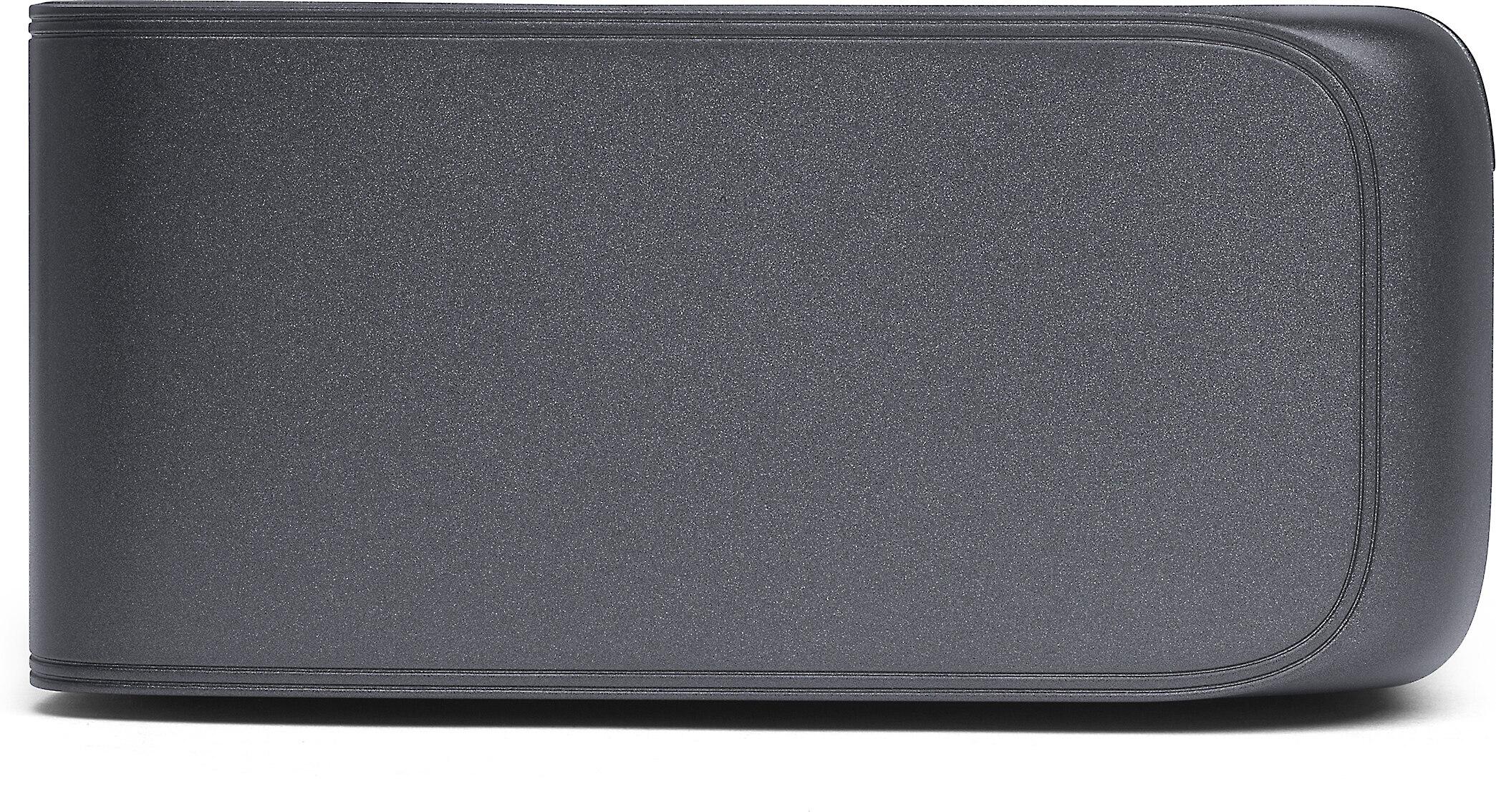
When you're staring at your TV's tiny built-in speakers and dreaming of cinematic sound, the world of soundbars can feel overwhelming. Should you go budget-friendly and practical, or save up for premium features that might transform your living room into a proper home theater? That's exactly the choice between the Ultimea Aura A40 and the JBL Bar 1000—two systems that take completely different approaches to solving the same problem.
The soundbar market has exploded over the past decade, evolving from simple TV audio boosters to sophisticated surround sound systems that can rival traditional home theater setups. At the heart of this evolution is a fundamental question: how much are you willing to spend for truly immersive audio, and what compromises make sense for your budget?
Before diving into these specific products, let's establish what separates basic soundbars from advanced home theater systems. Traditional surround sound required multiple speakers placed around your room, connected by yards of speaker wire. Modern soundbars use several approaches to create that surround effect without the installation nightmare.
Virtual surround sound uses clever audio processing to simulate the effect of speakers placed around you, even though the sound is coming from fewer physical locations. It's like audio sleight of hand—your brain is tricked into thinking sounds are coming from directions where no speakers exist.
True surround sound uses actual speakers placed in different locations to create genuine directional audio. When a helicopter flies overhead in a movie, you'll hear it move from your left side to directly overhead to your right side because there are real speakers in those positions.
Height channels add a vertical dimension to sound by bouncing audio off your ceiling or using upward-firing drivers (special speakers that shoot sound upward instead of straight at you). This creates the sensation of sounds coming from above—rain falling, planes flying overhead, or the rumble of thunder across the sky.
The most important performance metrics in soundbars are frequency response (how low the bass goes and how clear the highs are), total power output (how loud and dynamic the system can get), and soundstage width (how well it fills your room with sound). Dialog clarity is crucial since most TV content relies heavily on spoken words, while bass extension determines how much you'll feel explosions and music in your chest rather than just hearing them.
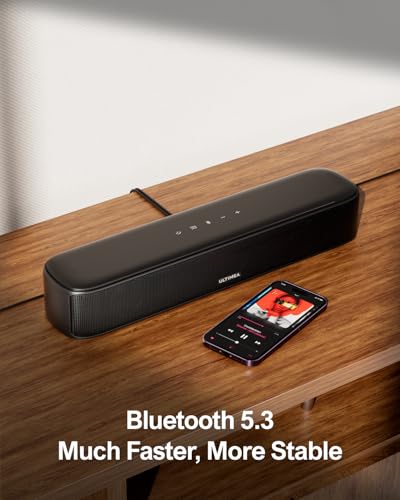
Released in 2023, the Ultimea Aura A40 represents what happens when a newer audio company decides to pack maximum features into a budget-friendly package. At roughly one-third the cost of premium competitors at the time of writing, it takes an aggressive approach to delivering surround sound without breaking the bank.
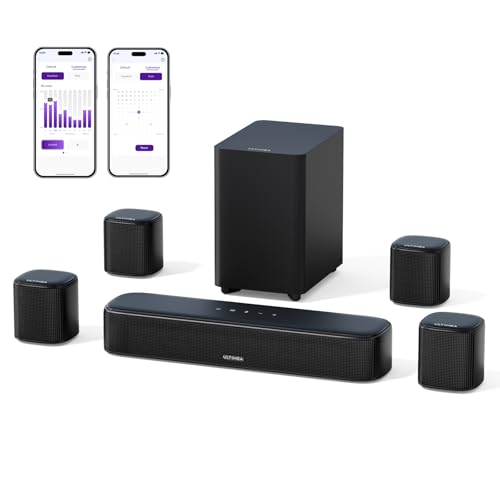
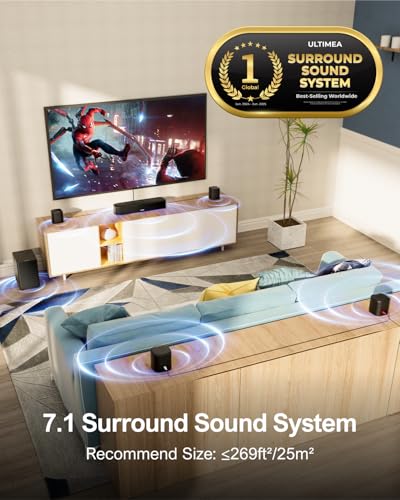
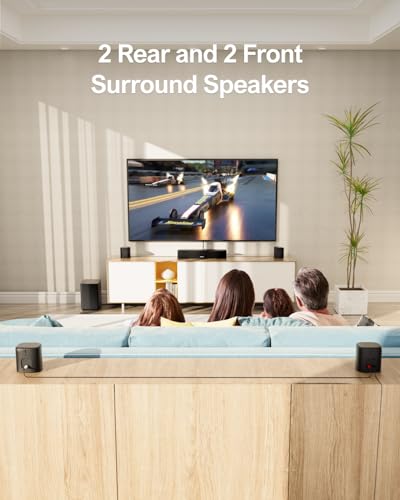
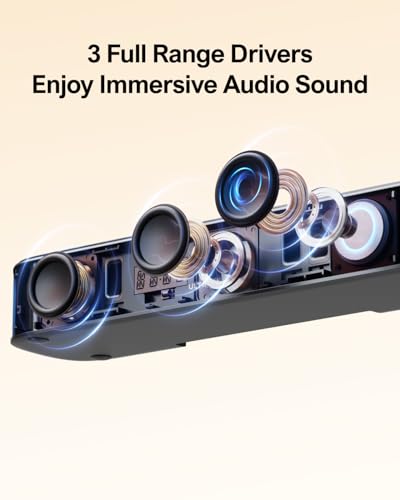
The Aura A40 creates its 7.1 surround effect using eight physical speakers: three drivers in the main soundbar, four separate surround speakers that you place around your room, and a dedicated subwoofer for bass. This is more hardware than many systems twice the price include, which explains much of its appeal.
The system uses something called SurroundX technology, which Ultimea claims provides "99.99% detail accuracy" in sound positioning. While that specific number is marketing speak, the underlying concept is solid—the system coordinates all eight speakers to create the illusion that sounds are moving around your room in three-dimensional space. When a car races across the screen, you'll hear it travel from your left surround speaker to your right, even though there are no height speakers to complete the full 3D effect.
The four surround speakers connect via physical cables—two shorter ones for the front surrounds and a lengthy 6-meter cable for the rear speakers. The rear right speaker has a clever twist: after connecting via cable for power, it pairs wirelessly with the main bar to reduce cable clutter slightly. It's a hybrid approach that acknowledges the reality of living room layouts while trying to minimize visible wires.
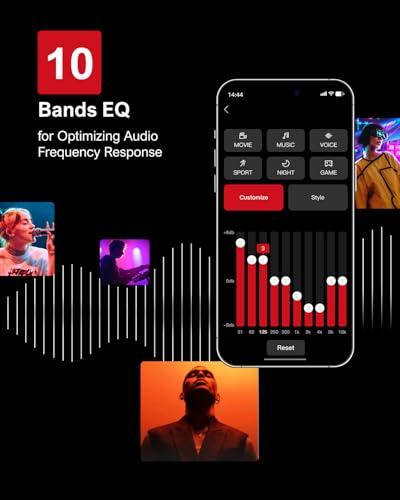
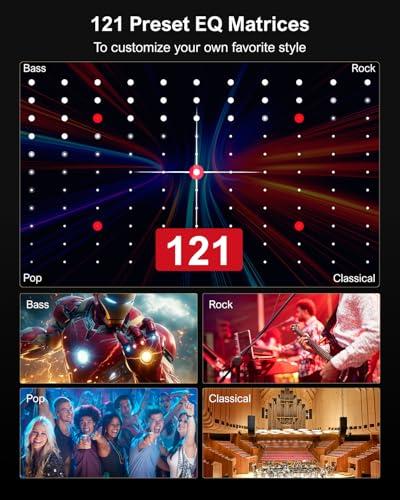
Where the Aura A40 truly shines is in its Ultimea Smart App, which offers customization options that would make audiophiles jealous. The system includes 121 preset equalizer matrices—essentially pre-tuned sound profiles for different types of content like action movies, classical music, or hip-hop. You can also manually adjust a 10-band equalizer, giving you precise control over specific frequency ranges.
Six listening modes (Movie, Music, Voice, Sport, Game, Night) adapt the sound signature for different content types. Night mode, for instance, compresses the dynamic range so explosions won't wake the neighbors while keeping dialog audible. This level of customization is remarkable at this price point and shows that budget doesn't have to mean basic.
The app also lets you adjust surround speaker levels independently, with 13 different intensity settings. This means you can fine-tune how immersive the surround effect feels based on your room size and personal preference—something even expensive systems sometimes handle poorly.
Based on our research into user experiences and professional reviews, the Aura A40 delivers on its surround sound promise but with notable limitations. Multiple reviewers describe the overall sound as "tinny, boxy, and metallic," particularly when compared to higher-end systems. The frequency response extends down to 65Hz, which means you'll miss the deepest bass frequencies that make action movies truly visceral.
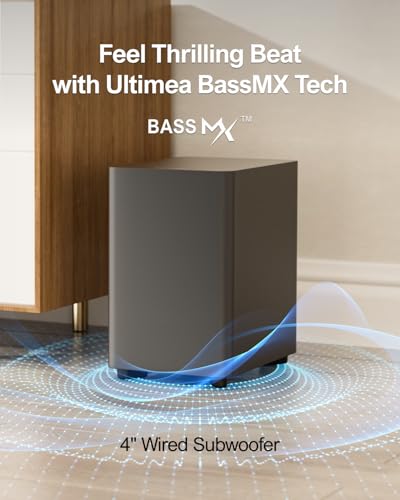
The 4-inch subwoofer provides adequate bass for most TV content, but users report needing to max out both subwoofer and surround levels to compensate for the somewhat thin overall sound signature. Dialog clarity receives consistent praise, which matters enormously since most of your TV watching involves people talking.
For gaming, the directional audio works well—you can locate enemies by sound and feel more immersed in virtual environments. For movies, the surround effect is convincing enough to enhance the experience significantly over TV speakers or basic soundbars, though it won't match the refinement of premium systems.
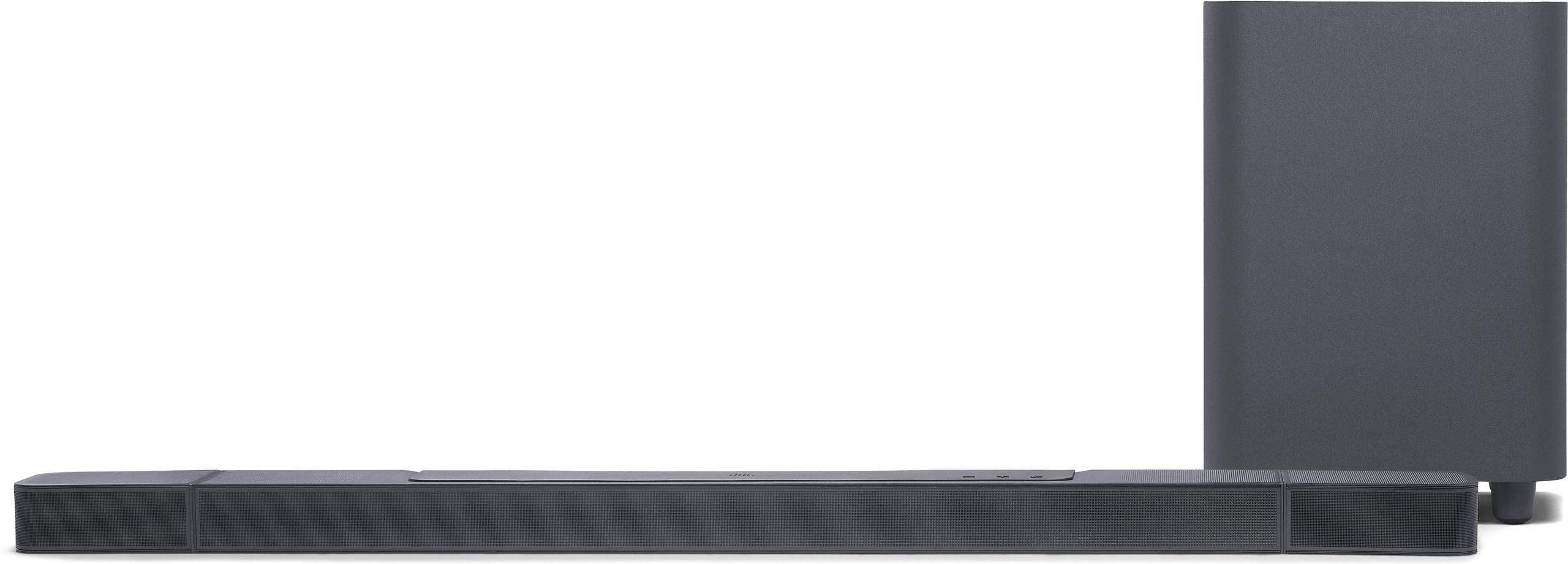
The JBL Bar 1000 launched in 2022 as part of JBL's push into high-end home theater audio, bringing decades of professional audio expertise to living rooms. At roughly three to four times the cost of the Aura A40 at the time of writing, it represents a fundamentally different philosophy: deliver reference-quality audio with cutting-edge features, regardless of cost constraints.
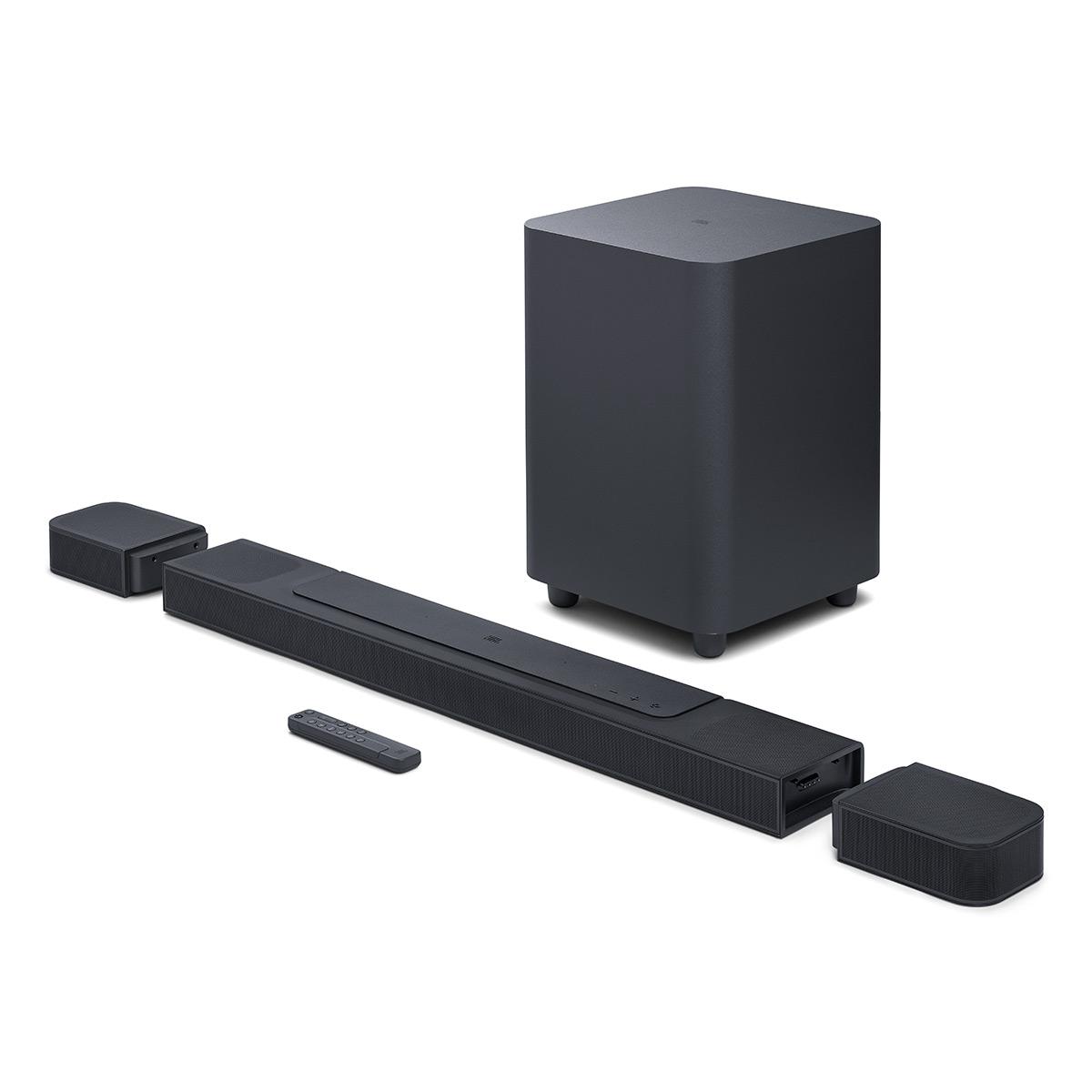
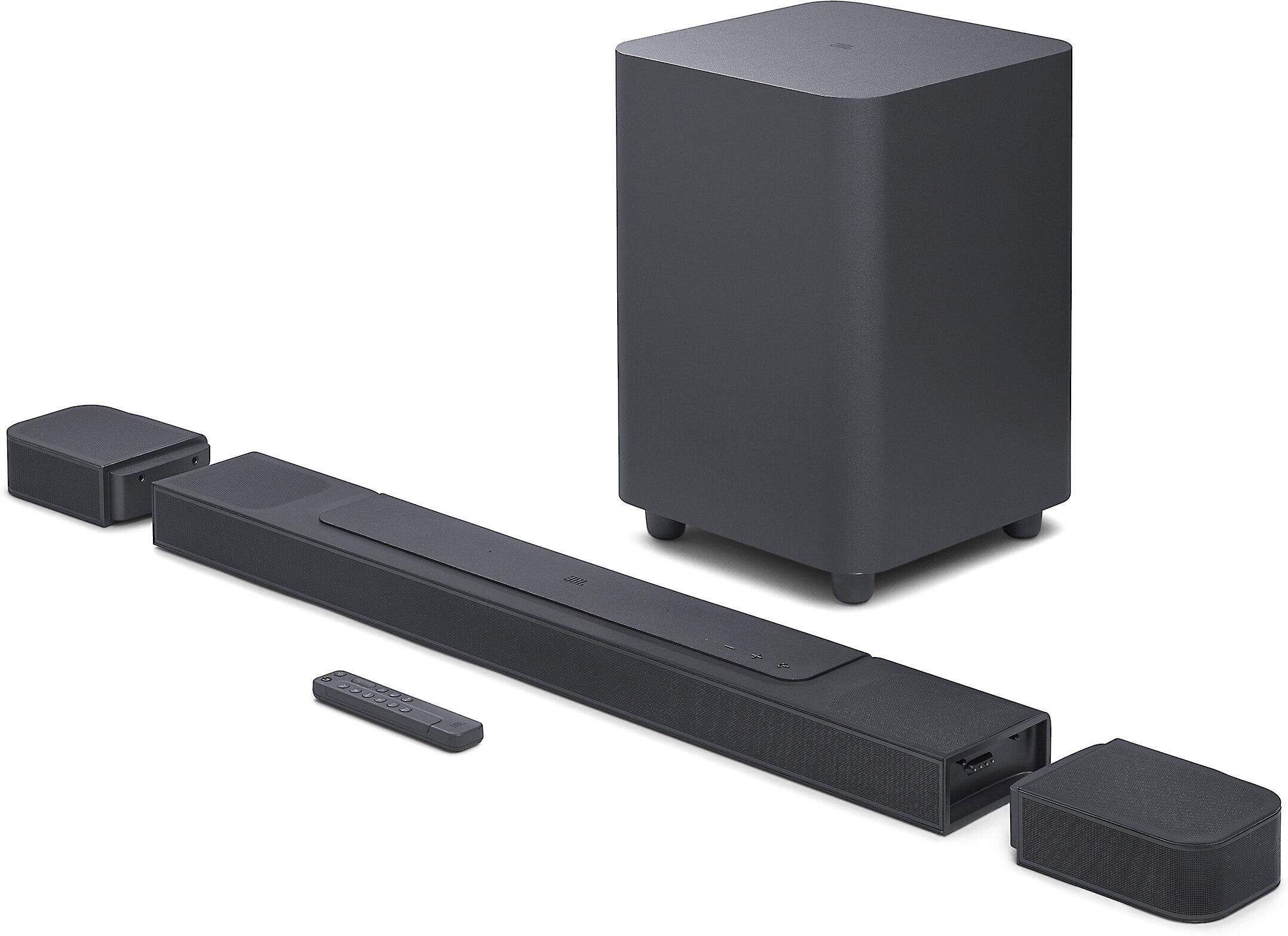
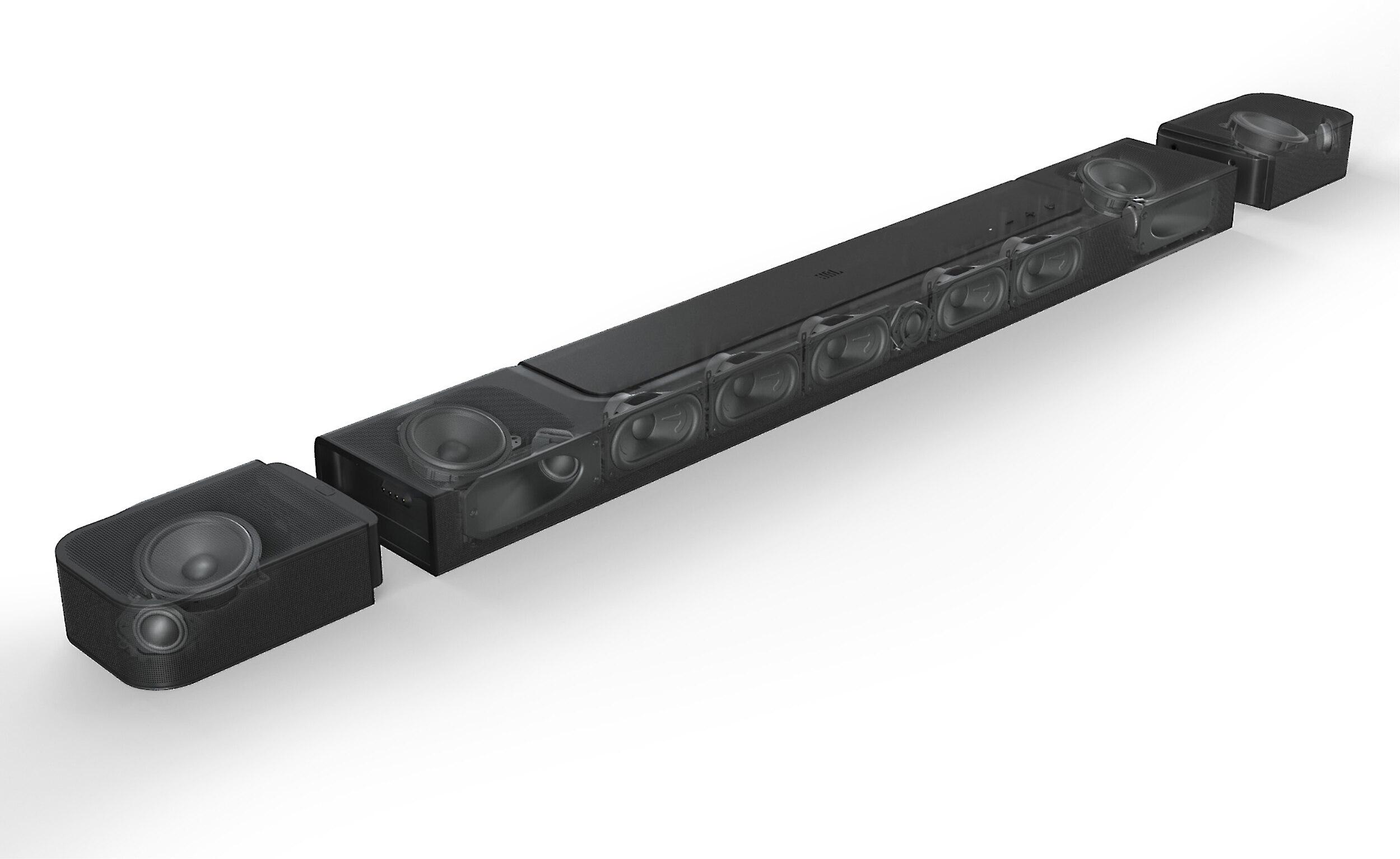
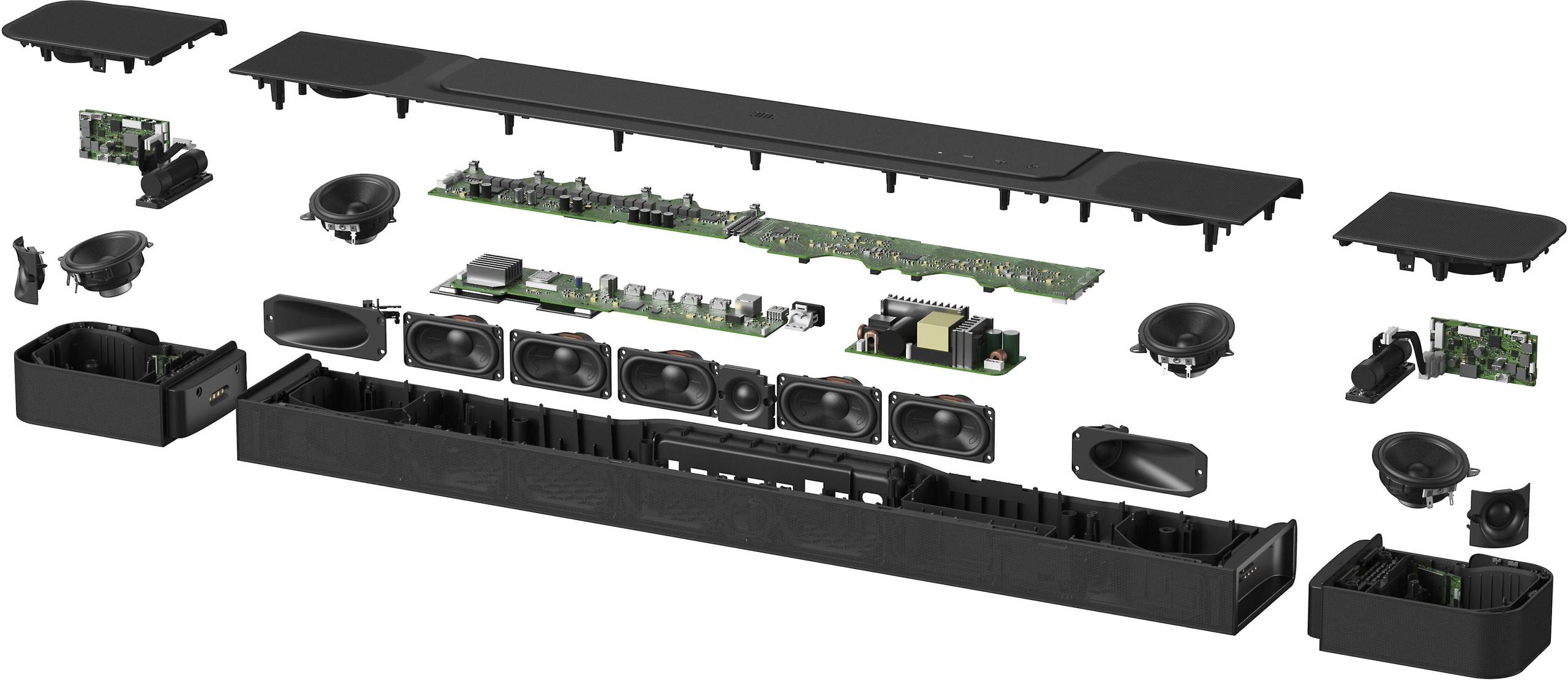
The key difference between these systems lies in those numbers: 7.1 versus 7.1.4. That ".4" represents four height channels that create genuine three-dimensional audio through Dolby Atmos and DTS:X support. The JBL Bar 1000 includes four upward-firing drivers—two in the main soundbar and two in the detachable surround speakers—that bounce sound off your ceiling to create overhead effects.
This isn't virtual processing trying to fool your brain; it's actual sound coming from above. When it rains in a movie, you'll hear individual droplets falling from the ceiling. When a helicopter flies overhead, the sound literally moves across the sky above you rather than just left to right at ear level.
The detachable surround speakers represent another technological leap. These battery-powered units charge by sitting on the main soundbar like a wireless phone in its cradle. When you want to watch a movie, you simply carry them to their positions behind your seating area—no cables, no power outlets needed. After about 10 hours of playback, they return to the soundbar to recharge.
JBL's MultiBeam technology works differently from traditional virtual surround. Instead of processing tricks, it uses precise driver placement and advanced crossover networks (the electronic components that split audio frequencies between different speakers) to create an exceptionally wide soundstage. The result is audio that seems to extend well beyond the physical boundaries of the soundbar itself.
The 10-inch wireless subwoofer provides the kind of deep, controlled bass that you feel in your chest during action sequences. While we don't have exact frequency response specs from our research, user reports consistently mention bass that's both powerful and precise—none of the "flabby" character that some reviews noted with the Aura A40.
Total system power reaches 880 watts, distributed across the main bar (440W), surround speakers (140W combined), and subwoofer (300W). This isn't just about maximum volume—it's about having enough clean power to reproduce the full dynamic range of movie soundtracks without distortion during peak moments.
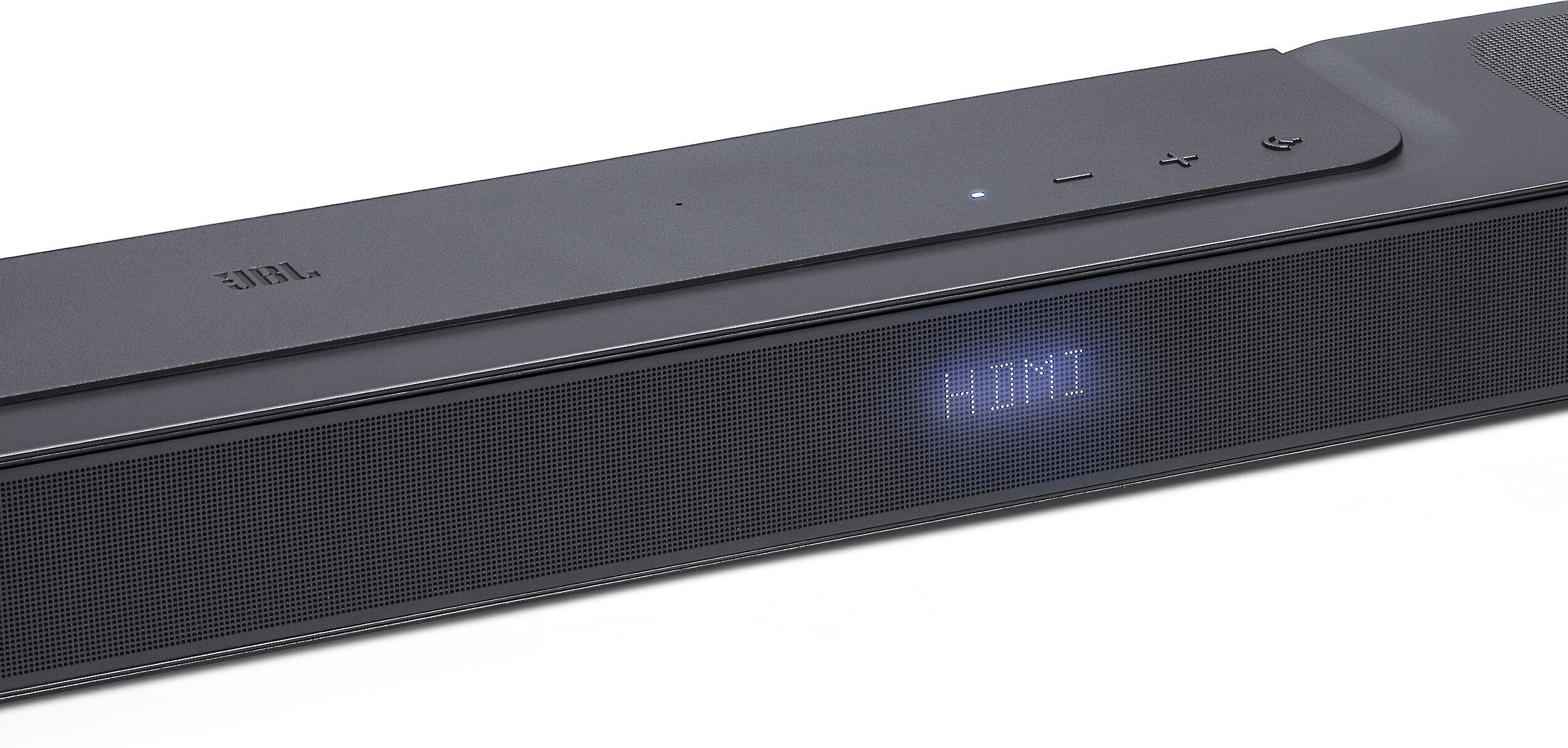
The JBL Bar 1000 includes built-in Wi-Fi with support for AirPlay, Chromecast, and access to over 300 streaming music services. This transforms it from just a TV audio upgrade into a whole-home audio system that can play music throughout your house if you have other compatible JBL speakers.
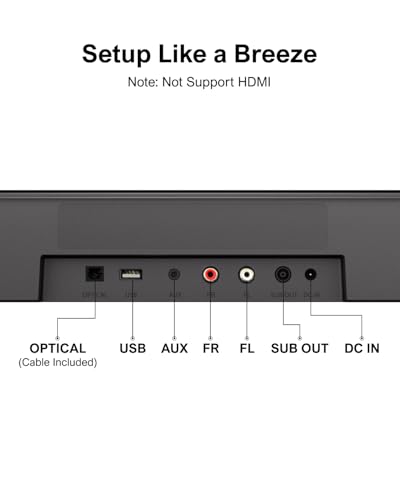
HDMI eARC (Enhanced Audio Return Channel) support means the system can receive uncompressed audio signals from your TV via a single HDMI cable, including full-resolution Dolby Atmos soundtracks from streaming services like Netflix and Disney+. The Aura A40 lacks HDMI entirely, relying on optical or analog connections that can't carry the same high-quality audio signals.
Room calibration happens automatically with the press of a button. The system plays test tones and uses internal microphones to analyze your room's acoustics, then adjusts its output to optimize performance for your specific space. It's the kind of feature that used to require expensive professional installation.
The performance gap between these systems is substantial and immediately noticeable. Based on aggregated reviews and user feedback, the JBL Bar 1000 delivers what multiple users describe as "the cleanest, clearest, most dynamic sound" they've heard in home systems without spending "multiple thousands of dollars." Professional reviews consistently praise its voice clarity as "unmatched" and bass response as "perfection."
In contrast, the Aura A40 receives more mixed audio quality assessments. While dialog clarity earns praise and the surround effect is convincing, the overall tonal balance skews thin and metallic. Multiple reviewers note that music playback, in particular, lacks the warmth and detail that makes extended listening enjoyable.
This difference comes down to driver quality, amplifier design, and acoustic engineering. JBL's decades of professional audio experience show in the Bar 1000's sophisticated crossover networks, premium driver materials, and carefully tuned acoustic chambers. The Aura A40 prioritizes feature count and value over pure audio refinement, which is a reasonable compromise at its price point but results in audible differences.
The subwoofer comparison illustrates why specifications matter. The Aura A40's 4-inch driver in a compact enclosure simply cannot move the air volume needed for truly deep bass. Its 65Hz lower limit means you're missing the bottom octave of bass frequencies—the difference between hearing an explosion and feeling it.
The JBL Bar 1000's 10-inch wireless subwoofer operates in a different league entirely. The larger driver can reproduce frequencies well below what the human ear can distinguish as individual notes, creating the physical impact that makes action movies exciting and music emotionally engaging. Multiple reviews specifically mention bass that "shakes the entire house" while remaining clean and controlled.
The surround sound comparison reveals the fundamental technological gap between these systems. The Aura A40 creates impressive left-right-rear surround effects that significantly enhance movie watching over TV speakers or basic soundbars. When positioned correctly, users report convincing directional effects that help with gaming and movie immersion.
However, without height channels, the Aura A40 cannot reproduce the overhead sound effects that modern movie soundtracks increasingly rely on. Dolby Atmos soundtracks on Netflix, Disney+, and 4K Blu-rays include specific audio elements designed to come from above—effects that remain anchored at ear level with the Aura A40.
The JBL Bar 1000's true 7.1.4 configuration with four up-firing drivers creates what users describe as being "enveloped in a sphere of sound." Rain falls from above, helicopters track across the ceiling, and ambient effects place you inside the movie scene rather than just in front of it. This represents a qualitative difference in immersion that virtual processing cannot match.
The setup experience reveals another key differentiator. The Aura A40 requires thoughtful cable management—you'll need to run the 6-meter cable to your rear speakers, likely along baseboards or under rugs. The wired subwoofer adds another cable to manage. While not difficult, it requires commitment to speaker placement and may not work well for renters or those who frequently rearrange furniture.
The JBL Bar 1000's wireless approach eliminates installation complexity. The battery-powered surrounds go wherever you want them, and the wireless subwoofer can hide in any convenient location. Setup becomes almost trivial: connect one HDMI cable, press the calibration button, and you're done.
This convenience factor matters more than specifications suggest. Many people buy surround sound systems but never achieve optimal speaker placement due to installation challenges. The JBL Bar 1000 removes those barriers entirely.
At the time of writing, the price difference between these systems ranges from roughly 3:1 to 4:1, representing a significant budget decision for most households. The Aura A40 delivers legitimate surround sound enhancement at an accessible price point, making it an excellent entry point for families wanting better TV audio without major financial commitment.
The extensive EQ customization and app control mean the Aura A40 can adapt to different preferences and room acoustics better than many competitors at any price. For users who enjoy tweaking settings and don't mind the tonal limitations, it provides remarkable value.
The JBL Bar 1000 justifies its premium through technological capabilities the Aura A40 simply cannot match. Height channels, wireless convenience, superior driver quality, and professional-level acoustic engineering represent genuine advances that improve the daily user experience substantially.
From a future-proofing perspective, streaming services continue expanding Dolby Atmos content libraries. Netflix, Disney+, Apple TV+, and others increasingly offer Atmos soundtracks that the JBL Bar 1000 can fully reproduce while the Aura A40 plays only the base 5.1 or 7.1 layers.
Choose the Ultimea Aura A40 if you're working with a strict budget under $300, have a smaller room where bass extension matters less, and primarily watch standard TV content rather than premium streaming movies. The extensive customization options and genuine surround effect make it an excellent value for users willing to accept some audio compromises in exchange for significant cost savings.
The Aura A40 also makes sense if you enjoy tweaking audio settings—its app-based EQ system provides more adjustment options than systems costing twice as much. For gamers, the directional audio enhancement over TV speakers is substantial and worthwhile.
Choose the JBL Bar 1000 if you can budget for premium home audio and want the full Dolby Atmos experience with current streaming content. The wireless surrounds and superior bass response work particularly well in larger rooms or for users who prioritize audio quality refinement over cost considerations.
The JBL Bar 1000 represents the better long-term investment for serious movie watchers, especially those with 4K TVs and premium streaming subscriptions. Its HDMI connectivity and Atmos support ensure compatibility with current and future audio formats, while the premium build quality suggests years of reliable performance.
Ultimately, both systems solve the TV audio problem effectively, but they target different priorities and budgets. The Aura A40 maximizes features per dollar, while the JBL Bar 1000 maximizes performance regardless of cost. Your choice depends on whether "good enough" sound enhancement fits your needs, or whether you're seeking the transformative audio experience that only premium systems can deliver.
| Ultimea Aura A40 7.1 Channel Soundbar System | JBL Bar 1000 Surround Sound System |
|---|---|
| Channel Configuration - Determines immersion level and 3D audio capability | |
| 7.1 Virtual Surround (no height channels) | 7.1.4 True Dolby Atmos (4 height channels for overhead effects) |
| Total System Power - Affects maximum volume and dynamic range | |
| 330W Peak Power | 880W Total System Power |
| Subwoofer Size and Connection - Impacts bass depth and installation flexibility | |
| 4" Wired Subwoofer (limited bass extension to 65Hz) | 10" Wireless Subwoofer (deeper bass, flexible placement) |
| Surround Speaker Design - Affects installation complexity and placement options | |
| 4 Wired Speakers (cables up to 6m, rear right pairs wirelessly) | 2 Battery-Powered Detachable Speakers (true wireless, charge on soundbar) |
| Height Channel Support - Critical for modern streaming content with Dolby Atmos | |
| None (virtual processing only) | 4 Up-firing Drivers (true overhead sound effects) |
| HDMI Connectivity - Essential for high-quality audio from modern TVs | |
| No HDMI (Optical, AUX, USB, Bluetooth 5.3 only) | HDMI eARC with 4K Dolby Vision pass-through |
| App Control and Customization - Determines how much you can fine-tune the sound | |
| Ultimea Smart App (121 EQ presets, 10-band equalizer, 13 surround levels) | JBL One App (basic control, automatic room calibration) |
| Streaming and Smart Features - Affects versatility beyond TV audio | |
| Basic Bluetooth connectivity only | Built-in Wi-Fi, AirPlay, Chromecast, 300+ streaming services |
| Room Calibration - Important for optimal sound in your specific space | |
| Manual EQ adjustment through app | Automatic one-button room calibration |
| Price Category - Represents significant budget difference | |
| Budget-focused (under $300 typically) | Premium tier ($700-$1,150 range) |
The Ultimea Aura A40 offers exceptional value for budget-conscious buyers, delivering genuine 7.1 surround sound with extensive customization options at a fraction of the cost. The JBL Bar 1000 provides premium performance with true Dolby Atmos and superior build quality that justifies its higher price for serious home theater enthusiasts.
The key difference is immersion technology: the Ultimea Aura A40 creates 7.1 virtual surround sound using processing tricks, while the JBL Bar 1000 delivers true 7.1.4 Dolby Atmos with actual height channels that produce overhead sound effects for a three-dimensional audio experience.
While not essential, Dolby Atmos significantly enhances the viewing experience. The JBL Bar 1000 can fully decode Atmos soundtracks from Netflix, Disney+, and other streaming services, creating overhead effects like rain and helicopters. The Ultimea Aura A40 plays these soundtracks but without the height dimension.
The JBL Bar 1000 is much easier to install with its wireless subwoofer and battery-powered detachable surround speakers that require no cables. The Ultimea Aura A40 requires running cables up to 6 meters for its four surround speakers, which may be challenging in some room layouts.
The JBL Bar 1000 delivers significantly deeper and more powerful bass with its 10-inch wireless subwoofer, providing the chest-thumping impact needed for action movies. The Ultimea Aura A40 has a smaller 4-inch subwoofer that handles most TV content adequately but lacks the deep bass extension for truly cinematic experiences.
Yes, but differently. The Ultimea Aura A40 excels in customization with 121 preset EQ settings, a 10-band equalizer, and adjustable surround levels through its smart app. The JBL Bar 1000 focuses more on automatic optimization with one-button room calibration and basic app controls.
Both systems enhance gaming audio significantly. The Ultimea Aura A40 provides good directional audio for locating enemies and environmental sounds. However, the JBL Bar 1000 offers superior spatial awareness with its height channels, making games with Atmos support more immersive.
The Ultimea Aura A40 connects via optical, AUX, or Bluetooth, making it compatible with virtually any TV. The JBL Bar 1000 also offers these connections but performs best with newer TVs that have HDMI eARC for full Atmos support.
The JBL Bar 1000 delivers 880 watts of total power, providing room-filling volume that can easily handle large spaces without distortion. The Ultimea Aura A40 produces 330 watts, which is adequate for most rooms but may struggle at reference levels in larger spaces.
The JBL Bar 1000 offers superior music reproduction with cleaner, more detailed sound and better frequency response. While the Ultimea Aura A40 handles music adequately and offers extensive EQ customization, some users report a "tinny" quality that affects musical enjoyment.
Neither system supports additional speaker expansion. The Ultimea Aura A40 comes with its full complement of eight speakers, while the JBL Bar 1000 is designed as a complete 7.1.4 system. However, the JBL Bar 1000 can integrate with other JBL wireless speakers for whole-home audio.
The JBL Bar 1000 is more future-proof with HDMI eARC, built-in streaming capabilities, and support for current Dolby Atmos standards. The Ultimea Aura A40 lacks HDMI connectivity and height channel support, which may limit compatibility with future audio formats, though it does receive firmware updates through its app.
We've done our best to create useful and informative comparisons to help you decide what product to buy. Our research uses advanced automated methods to create this comparison and perfection is not possible - please contact us for corrections or questions. These are the sites we've researched in the creation of this article: youtube.com - walmart.com - youtube.com - ultimea.com - homestudiobasics.com - ultimea.co - youtube.com - eu.ultimea.com - walmart.com - device.report - bestbuy.com - manuals.plus - community.ultimea.com - judge.me - support.ultimea.com - geekmaxi.com - provantage.com - bestbuy.com - youtube.com - uk.whatgeek.com - zdnet.com - jbl.com - jbl.com - pcrichard.com - rtings.com - d21buns5ku92am.cloudfront.net - ro.harmanaudio.com - target.com - harmanaudio.com - dell.com - mm.jbl.com - dolby.com - jbl.com.my - videoandaudiocenter.com

Privacy Policy
Terms and Conditions - Affiliate Policy
Home Security
© Copyright 2008-2026.
11816 Inwood Rd #1211, Dallas, TX 75244