





When you're tired of cranking the TV volume just to understand what actors are saying, or when explosions sound more like gentle puffs than earth-shattering chaos, it's time for a soundbar upgrade. But here's where things get interesting: not all soundbars take the same approach to improving your audio experience.
Today we're comparing two fundamentally different philosophies in home theater audio. The Ultimea Aura A40 believes in surrounding you with actual speakers placed around your room, while the Sony BRAVIA Theater Bar 6 relies on sophisticated audio processing to create the illusion of surround sound from a single bar. Both were released around 2023-2024, representing the latest thinking in their respective approaches.
Before diving into specifics, let's establish what we're dealing with. Soundbars have evolved dramatically since their early days as simple left-right stereo upgrades. Modern systems can create truly immersive experiences that rival traditional surround sound setups that once required five or more speakers strategically placed around your room.
The key consideration is how they achieve this immersion. Some systems, like the Ultimea Aura A40, stick with the traditional approach: place actual speakers where surround sound should come from. Others, like the Sony BRAVIA Theater Bar 6, use advanced digital signal processing (DSP) to trick your brain into hearing sounds from directions where no speakers actually exist.
At the time of writing, the Ultimea Aura A40 represents exceptional value in the budget tier, while the Sony Theater Bar 6 sits in the premium category at roughly double the price. This price difference reflects not just features, but entirely different engineering approaches to solving the same problem: making your movies, shows, and games sound dramatically better than your TV's built-in speakers ever could.
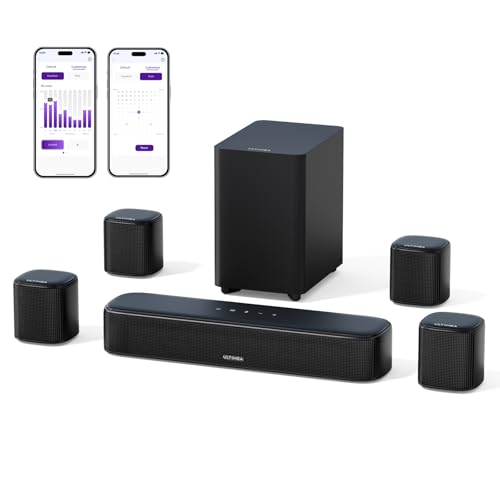
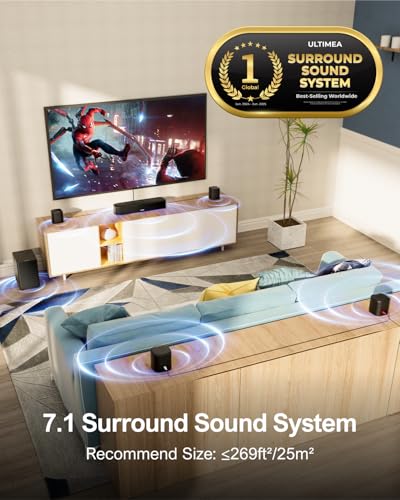
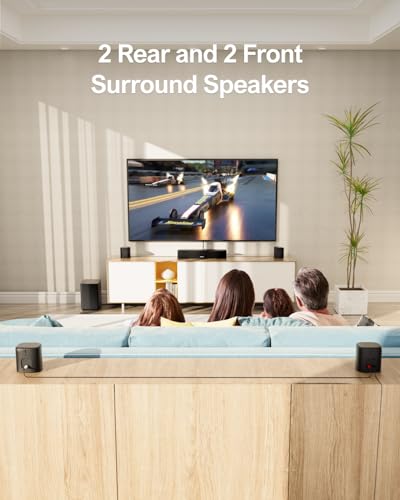
The Ultimea Aura A40 takes what purists consider the "honest" approach to surround sound. Instead of relying on audio tricks, it gives you four actual surround speakers that you place around your listening area. This creates what's called a 7.1 channel system – that's seven speakers plus one subwoofer (the ".1" refers to the dedicated bass speaker).
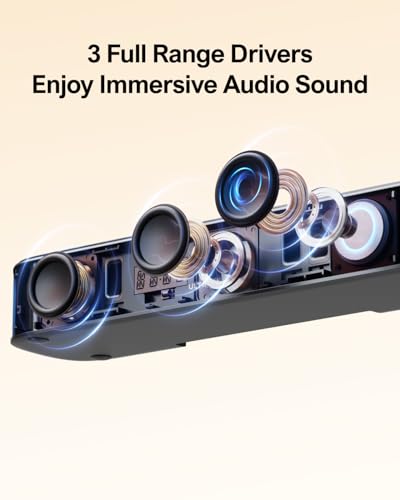
Here's how it breaks down: three speakers sit in the main soundbar (left, center, right), four separate surround speakers go around your room (front-left, front-right, rear-left, rear-right), and one subwoofer handles the deep bass. When a helicopter flies overhead in a movie, you hear it move through actual speakers positioned where that helicopter would be in real space.
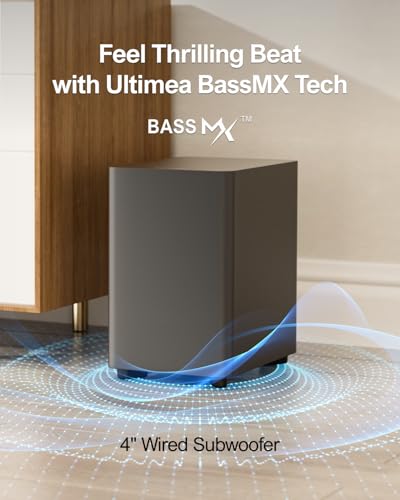
The system uses what Ultimea calls SurroundX technology, which coordinates all eight speakers to create precise audio positioning. When combined with their BassMX technology for enhanced bass response, the goal is delivering room-filling sound that matches what audio engineers intended when they mixed the soundtrack.
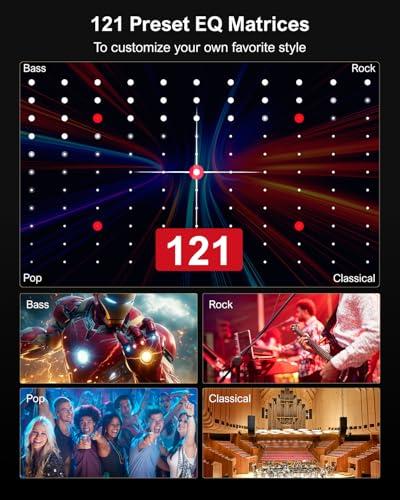
The Aura A40 shines in its customization capabilities. Through the Ultimea Smart App, you get access to 121 preset equalizer (EQ) matrices – these are pre-configured sound profiles for different music genres and content types. Whether you're listening to classical music, watching action movies, or playing competitive games, there's likely a preset that optimizes the sound for that specific content.
Beyond presets, the system offers a 10-band equalizer, letting you manually adjust different frequency ranges. Think of this like the bass and treble controls on old stereos, but with much finer control. You can boost the frequencies that make dialogue clearer, reduce harsh sounds, or emphasize the rumbling bass that makes action scenes more impactful.
The app also provides 13 different surround level adjustments, meaning you can make the surround speakers louder or quieter relative to the front speakers. This is crucial because room acoustics vary dramatically – a carpeted room with soft furniture absorbs sound differently than a hardwood-floored space with minimal furnishings.
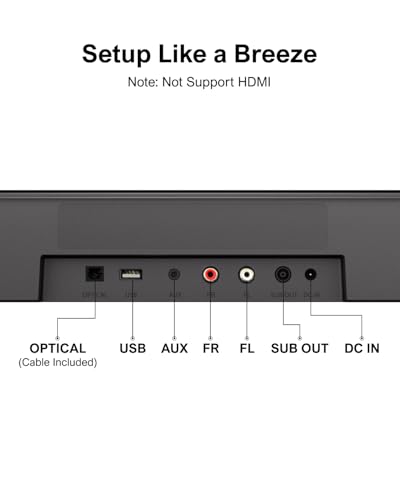
However, the Ultimea system has some notable limitations. It lacks HDMI connectivity entirely, relying instead on optical, auxiliary, and USB connections. HDMI has become the standard for high-quality audio because it can carry uncompressed, lossless audio signals and enables advanced features like automatic format switching. The absence of HDMI means you're limited to compressed audio formats and miss out on some modern conveniences.
The physical setup also requires more effort. You need to strategically place four speakers around your room and manage the cables connecting them. Ultimea uses a hybrid approach where the rear speakers connect partially through wires and partially through wireless pairing, which can complicate troubleshooting if connections fail.
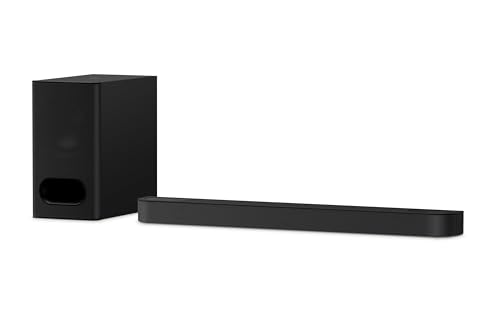
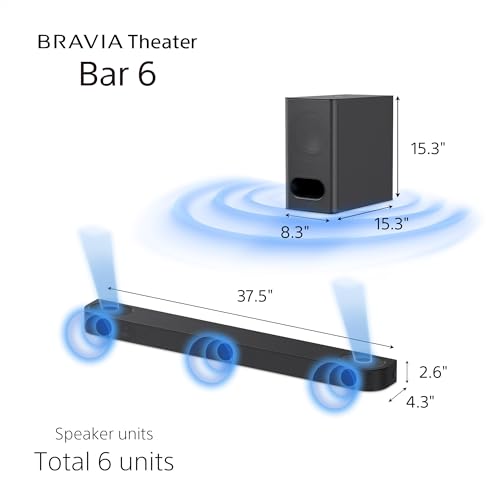
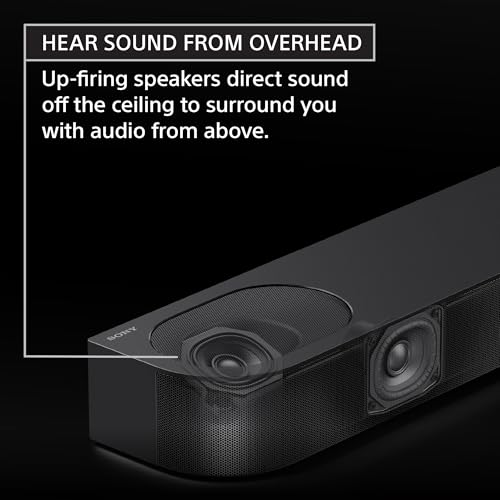
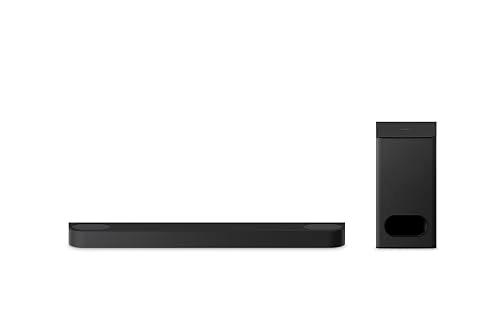
The Sony BRAVIA Theater Bar 6 represents the opposite philosophy: achieve surround sound through sophisticated audio processing rather than physical speaker placement. This 3.1.2 system uses three front-facing speakers (left, center, right), one wireless subwoofer, and two up-firing speakers that bounce sound off your ceiling to create height effects.
The "3.1.2" designation tells you exactly what you're getting: three main channels across the front, one subwoofer for bass (the ".1"), and two height channels (the ".2") for overhead effects. This configuration enables support for Dolby Atmos and DTS:X, which are object-based audio formats that place sounds in three-dimensional space rather than just traditional left-right-front-back channels.
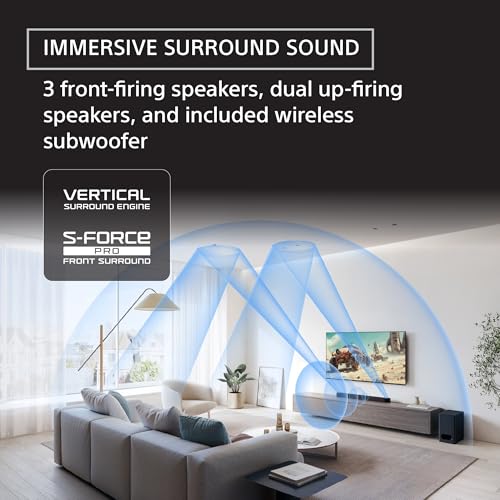
Sony's approach relies heavily on their proprietary technologies. S-Force PRO Front Surround creates the illusion of surround speakers using psychoacoustic processing – essentially, it manipulates phase relationships and timing to make your brain think sounds are coming from behind you when they're actually originating from the front soundbar.
The Vertical Surround Engine handles height effects by using those up-firing speakers to bounce audio off your ceiling. When a scene calls for rain, helicopters, or overhead explosions, these drivers fire sound upward so it reflects down to your ears, creating the sensation of audio coming from above.
This virtual processing approach has significant advantages. There's no need to place speakers around your room or run cables across doorways. The entire system consists of just the main soundbar and a wireless subwoofer, maintaining clean aesthetics while delivering immersive audio.
The Sony system also supports modern audio formats that the Ultimea cannot handle. Dolby Atmos and DTS:X are increasingly common on streaming services, Ultra HD Blu-rays, and even some TV broadcasts. These formats encode not just which speakers should play which sounds, but where those sounds should appear in three-dimensional space. A helicopter doesn't just move left-to-right; it can move up, down, forward, and backward through your listening space.
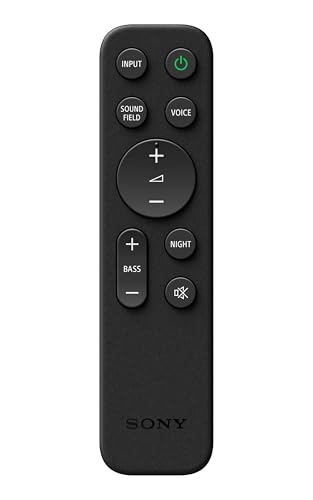
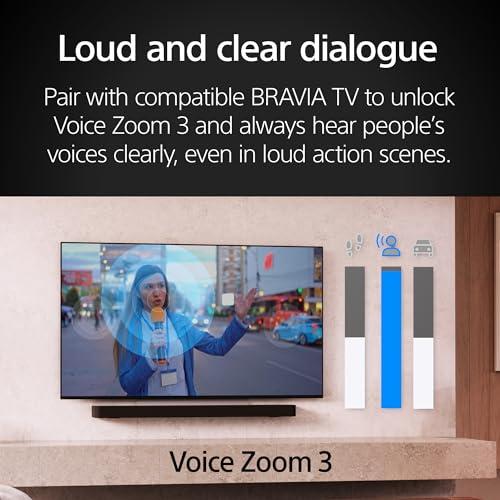
Sony's Voice Zoom technology deserves special mention for home theater use. This feature uses artificial intelligence to analyze audio content and boost dialogue frequencies while reducing competing sounds. If you've ever struggled to hear conversations during action scenes, this addresses that exact problem. When paired with compatible Sony BRAVIA TVs, Voice Zoom 3.0 can even coordinate with the TV's built-in speakers to further enhance dialogue clarity.
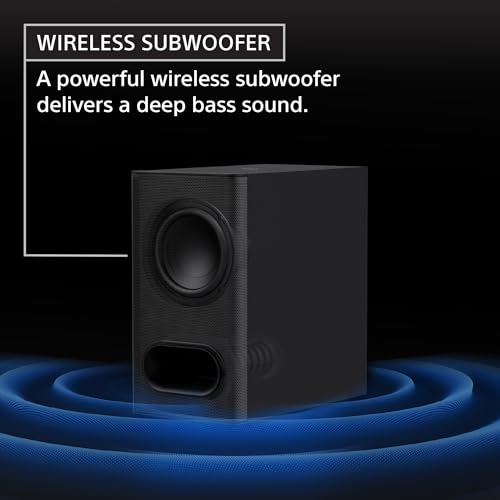
The wireless subwoofer in the Sony system is substantially larger than the Ultimea's offering, featuring a 6-inch driver compared to the Aura A40's 4-inch unit. This size difference translates directly to bass performance – larger drivers can move more air, creating deeper, more powerful low-frequency response. Based on user feedback and professional reviews, the Sony's bass is notably more impactful and room-filling.
For pure surround sound accuracy, the Ultimea Aura A40 has an inherent advantage: when sounds are supposed to come from behind you, they actually do. There's no processing delay, no dependence on room acoustics, and no guesswork about whether the effect is working properly. You hear sounds exactly where they were intended to be placed in the mix.
However, this advantage comes with caveats. The surround speakers need proper placement to work optimally, and room layout can severely impact performance. If you can't position the rear speakers appropriately due to furniture or room constraints, you lose much of the system's benefit.
The Sony Theater Bar 6 creates surprisingly convincing surround effects considering all the sound originates from the front of your room. The virtual processing works well for most content, though the effectiveness varies based on your room's acoustics, ceiling height, and seating position. Rooms with vaulted ceilings or excessive soft furnishings may not reflect the up-firing speakers effectively, reducing the height effect.
Where Sony clearly wins is in height effects. The Ultimea system has no height capability at all – it's limited to horizontal surround placement. Modern movie soundtracks increasingly use overhead effects for rain, aircraft, falling debris, and atmospheric enhancement. These effects simply don't exist on traditional 7.1 systems without dedicated height speakers.
This category shows the clearest performance gap between the systems. The Sony's 6-inch subwoofer in a ported enclosure delivers substantially more powerful and deeper bass than the Ultimea's 4-inch sealed unit. The difference is immediately apparent in action movies, where explosions, crashes, and rumbling effects carry much more physical impact through the Sony system.
Bass extension – how deep into the low frequencies a system can reproduce – matters significantly for home theater applications. Movie soundtracks often contain information below 40Hz, frequencies you feel as much as hear. Larger subwoofer drivers and ported enclosures (which use a carefully tuned opening to enhance low-frequency output) typically handle these demanding passages more effectively.
The Ultimea's BassMX technology helps optimize performance from its smaller subwoofer, but physics ultimately limits what a 4-inch driver can accomplish. For smaller rooms or listeners who don't prioritize thunderous bass, it may be adequate. For larger spaces or bass enthusiasts, the Sony provides a more satisfying low-end experience.
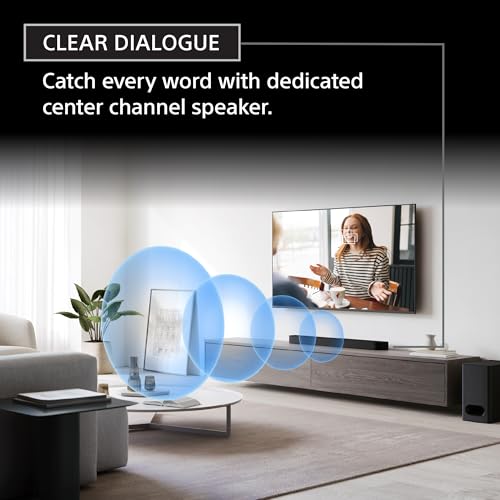
Both systems feature dedicated center channels, which is crucial for clear dialogue reproduction. The center channel handles most spoken content in movies and TV shows, making it arguably the most important speaker in any surround system.
The Sony system has a clear advantage here due to its advanced voice processing technologies. Clear Voice algorithms and Voice Zoom functionality specifically target dialogue intelligibility, using AI to identify and enhance speech frequencies while suppressing competing elements. This becomes particularly valuable during complex soundtracks where music, effects, and dialogue compete for attention.
The Ultimea system provides solid center channel performance but relies on more basic processing. While its dedicated center driver ensures focused dialogue placement, it lacks the sophisticated enhancement algorithms that help the Sony cut through dense audio mixes.
The format support difference between these systems represents a significant long-term consideration. The Sony Theater Bar 6 fully supports Dolby Atmos and DTS:X, the latest standards in immersive audio. These object-based formats are increasingly common on streaming services like Netflix, Disney+, and Amazon Prime Video, as well as Ultra HD Blu-ray releases.
Object-based audio differs from traditional channel-based systems by encoding individual sound elements rather than fixed speaker channels. Instead of saying "play this sound from the rear left speaker," the audio contains metadata describing where a sound should appear in three-dimensional space. The playback system then determines how to reproduce that positioning using available speakers.
The Ultimea Aura A40 processes only traditional channel-based audio, meaning it cannot fully utilize the spatial information in Dolby Atmos or DTS:X content. While it will still play these formats by downmixing them to standard surround sound, you lose the intended three-dimensional positioning effects.
Given that streaming services and content creators are rapidly adopting these newer formats, the Sony system offers better long-term compatibility with emerging content.
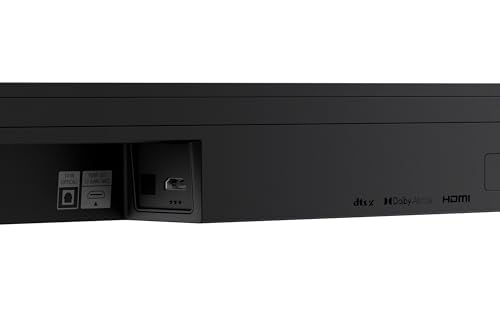
The connectivity differences between these systems reflect their different target audiences and design philosophies. The Sony BRAVIA Theater Bar 6 includes HDMI eARC (enhanced Audio Return Channel), which has become the preferred connection method for modern home theater setups.
HDMI eARC enables several important capabilities. It can carry uncompressed, lossless audio formats that optical connections cannot handle due to bandwidth limitations. It also enables automatic format switching – when you start playing Dolby Atmos content, the TV automatically signals the soundbar to switch to the appropriate mode. Additionally, HDMI eARC allows for two-way communication between devices, enabling features like unified volume control using your TV remote.
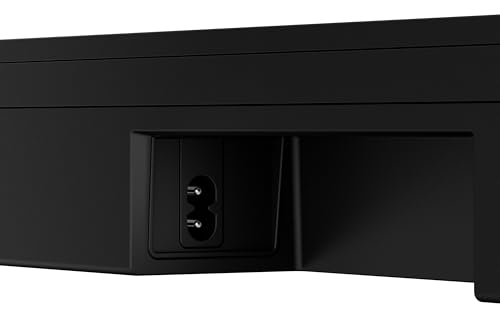
The Ultimea system relies entirely on optical, auxiliary, and USB connections. While optical can handle compressed surround sound formats adequately, it cannot carry the full bandwidth of lossless audio or enable the advanced integration features that HDMI provides.
For Sony TV owners, the Theater Bar 6 offers particularly seamless integration through BRAVIA SYNC technology. This allows control of both TV and soundbar functions through a single remote, automatic power on/off coordination, and access to soundbar settings directly through the TV's interface.
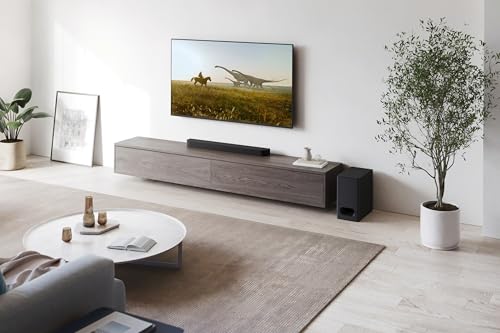
The physical requirements of these systems differ dramatically, affecting their suitability for various living situations. The Sony Theater Bar 6 maintains what many consider an ideal modern aesthetic: a single sleek bar under your TV and a subwoofer that can be placed discretely in a corner or behind furniture.
The Ultimea Aura A40 requires strategic placement of four additional speakers around your listening area. This immediately raises questions about room layout, cable management, and aesthetic impact. The system uses a hybrid connection approach where rear speakers connect partially through wires and partially through wireless pairing, which can complicate troubleshooting but reduces cable runs.
For renters or those who frequently rearrange furniture, the additional speakers may prove problematic. However, for dedicated home theater spaces where optimal audio takes priority over aesthetic minimalism, the physical speaker placement can provide superior spatial accuracy.
The Sony's wireless subwoofer offers more placement flexibility than wired alternatives, though its substantial size (approximately 17 pounds) requires dedicated floor space. The subwoofer's ported design means placement near walls can boost bass output, but corner placement might create excessive boom in some rooms.
At the time of writing, these systems occupy very different price tiers, with the Ultimea Aura A40 positioned as an exceptional value option while the Sony Theater Bar 6 commands a premium price reflecting its advanced features and brand positioning.
The Ultimea system delivers genuine 7.1 surround sound at a price point where most competitors offer only basic 2.1 or 3.1 configurations. For budget-conscious buyers wanting authentic spatial audio, this represents remarkable value. The inclusion of four physical surround speakers and comprehensive app-based customization at this price point was virtually unprecedented when the system launched.
However, the value calculation must consider limitations. The lack of HDMI connectivity, absence of modern format support, and more basic build quality may impact long-term satisfaction. The system excels at its primary mission – delivering true surround sound affordably – but offers limited growth potential as your needs evolve.
The Sony Theater Bar 6 justifies its premium pricing through superior bass performance, Dolby Atmos support, advanced voice processing, and seamless integration capabilities. The higher cost reflects not just additional features, but measurably better component quality and more sophisticated engineering.
For buyers prioritizing long-term satisfaction and compatibility with modern content, the Sony's additional cost provides tangible benefits. The question becomes whether those benefits justify the price difference for your specific needs and usage patterns.
The decision between these systems ultimately depends on your priorities, room constraints, and budget considerations.
Choose the Ultimea Aura A40 if authentic surround sound positioning matters more to you than cutting-edge features. This system excels for gaming, where precise directional audio can provide competitive advantages, and for movie enthusiasts who appreciate traditional surround sound presentation. The extensive customization options make it particularly appealing for users who enjoy fine-tuning their audio experience.
The physical speaker requirement isn't necessarily a drawback if you have a dedicated media room or don't mind additional speakers as part of your décor. For apartments, condos, or rooms where you frequently rearrange furniture, the installation complexity may prove problematic.
Choose the Sony BRAVIA Theater Bar 6 if you prioritize modern features, powerful bass, and clean aesthetics. The Dolby Atmos support ensures compatibility with current and future content, while the substantial subwoofer provides the low-end impact that makes action movies truly engaging.
The virtual surround processing, while not as spatially accurate as physical speakers, proves surprisingly effective for most content. Combined with the simplified installation and attractive design, it offers an optimal balance of performance and practicality for most living situations.
Sony TV owners should strongly consider this system due to the enhanced integration features, though the soundbar works well with any brand of television.
Both systems succeed at their intended goals, but they're solving different problems. The Ultimea Aura A40 delivers authentic surround sound at an unprecedented price point, making true 7.1 audio accessible to budget-conscious buyers. The Sony BRAVIA Theater Bar 6 provides sophisticated virtual processing, powerful bass, and modern format support for users willing to invest in premium home theater technology.
Consider your room layout, aesthetic preferences, budget constraints, and feature priorities carefully. Neither system is objectively superior – they represent different approaches to enhancing your entertainment experience, each with distinct advantages for different users and situations.
The surround sound revolution has made impressive home theater audio more accessible than ever, regardless of which philosophy appeals to you most.
| Ultimea Aura A40 7.1 Channel Soundbar System | Sony BRAVIA Theater Bar 6 Soundbar |
|---|---|
| Surround Sound Approach - Determines authenticity vs convenience of spatial audio | |
| Physical 7.1 with 4 discrete surround speakers | Virtual 3.1.2 with advanced processing |
| Modern Audio Format Support - Critical for streaming services and future content | |
| Traditional channel-based only (no Atmos/DTS:X) | Dolby Atmos and DTS:X object-based audio |
| Total Speaker Count - More drivers generally mean better sound dispersion | |
| 8 speakers (3 in bar + 4 surround + 1 subwoofer) | 6 speakers (5 in bar + 1 subwoofer) |
| Subwoofer Size and Type - Larger drivers produce deeper, more powerful bass | |
| 4-inch wired subwoofer with BassMX technology | 6-inch wireless subwoofer with ported design |
| HDMI Connectivity - Essential for lossless audio and modern TV integration | |
| None (optical, AUX, USB only) | HDMI eARC plus optical |
| Audio Customization Options - Important for fine-tuning sound to your room | |
| 121 EQ presets + 10-band equalizer + 13 surround levels | Sound Field modes + bass/height/sub adjustments |
| Height Channel Support - Adds overhead effects for immersive experiences | |
| No height channels | 2 up-firing speakers for ceiling reflection |
| Installation Complexity - Affects setup time and room aesthetics | |
| Requires placement of 4 surround speakers around room | Single soundbar plus wireless subwoofer only |
| Smart TV Integration - Enhances convenience with unified controls | |
| Basic app control via Ultimea Smart App | BRAVIA SYNC with Sony TVs + BRAVIA Connect app |
| Voice Enhancement Technology - Crucial for dialogue clarity | |
| Dedicated center channel with Voice mode | Clear Voice algorithms + Voice Zoom 3.0 |
| Frequency Response Range - Indicates audio spectrum coverage | |
| 65Hz - 18kHz | Not specified (typically broader with larger subwoofer) |
| Maximum Power Output - Determines maximum volume and dynamic range | |
| 330W peak power | 350W total system power |
| Wireless Connectivity - Affects streaming and device pairing options | |
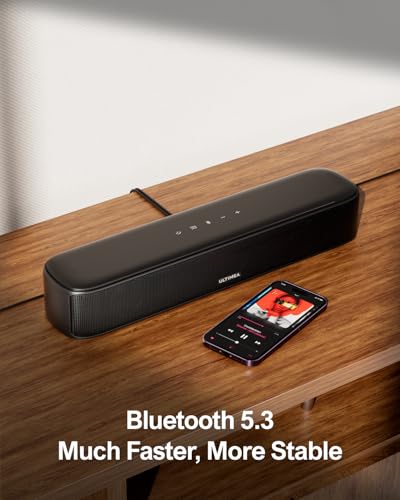
| Bluetooth 5.3 only | Bluetooth 5.3 (no Wi-Fi multi-room features) |
The Sony BRAVIA Theater Bar 6 is generally better for home theater due to its Dolby Atmos support, more powerful 6-inch subwoofer, and advanced voice processing for clearer dialogue. However, the Ultimea Aura A40 provides more authentic surround sound with its four physical surround speakers placed around your room. For movie enthusiasts who prioritize true spatial positioning and have space for additional speakers, the Ultimea system delivers exceptional value.
Physical surround speakers like those in the Ultimea Aura A40 provide more accurate directional audio since sounds actually come from behind you. Virtual surround from the Sony Theater Bar 6 is surprisingly effective and much more convenient, requiring no additional speakers around your room. Choose physical if you have a dedicated media room and want maximum authenticity; choose virtual if you prioritize clean aesthetics and easy setup.
The Sony BRAVIA Theater Bar 6 has significantly better bass with its 6-inch wireless subwoofer compared to the Ultimea's 4-inch wired subwoofer. The Sony's larger driver and ported design deliver deeper, more powerful low-end that you can feel during action scenes. The Ultimea system provides adequate bass for its price range but cannot match the room-filling impact of the Sony's subwoofer.
The Ultimea Aura A40 uses 7.1 channels with seven speakers plus a subwoofer in traditional horizontal placement. The Sony Theater Bar 6 uses 3.1.2 channels - three front speakers, one subwoofer, and two height channels for overhead effects. The Sony's configuration supports modern Dolby Atmos content with three-dimensional audio, while the Ultimea excels at traditional surround sound positioning.
The Sony BRAVIA Theater Bar 6 is much easier to install, requiring only the main soundbar and wireless subwoofer placement. The Ultimea Aura A40 requires strategic placement of four surround speakers around your room plus cable management. If you want plug-and-play simplicity, choose the Sony system. If you don't mind the extra setup work for authentic surround sound, the Ultimea is worth the effort.
Only the Sony BRAVIA Theater Bar 6 supports Dolby Atmos and DTS:X formats, which are increasingly common on streaming services and modern content. The Ultimea Aura A40 only supports traditional channel-based audio formats. For future-proofing and compatibility with Netflix, Disney+, and other streaming platforms using Atmos, the Sony system is the better choice.
The Ultimea Aura A40 provides extensive customization with 121 EQ presets, a 10-band equalizer, and 13 adjustable surround levels through its smart app. The Sony Theater Bar 6 offers fewer granular controls but includes intelligent features like Voice Zoom for dialogue enhancement. Audio enthusiasts who enjoy fine-tuning their sound will prefer the Ultimea's comprehensive adjustment options.
The Sony BRAVIA Theater Bar 6 includes modern HDMI eARC connectivity plus optical and Bluetooth, enabling lossless audio and advanced TV integration. The Ultimea Aura A40 lacks HDMI entirely, using optical, auxiliary, and USB connections. For modern TVs and devices, the Sony's HDMI eARC provides better audio quality and convenience features.
The Ultimea Aura A40 excels for gaming due to its physical surround speakers providing precise directional audio - crucial for competitive gaming where you need to locate enemies by sound. The Sony Theater Bar 6 offers good gaming performance with lower latency through HDMI connections. Serious gamers will appreciate the Ultimea's authentic spatial positioning, while casual gamers may prefer the Sony's convenience.
The Ultimea Aura A40 is positioned as a budget-friendly option offering exceptional value for true 7.1 surround sound. The Sony BRAVIA Theater Bar 6 commands a premium price reflecting its advanced features, superior bass, and brand quality. The Sony costs roughly twice as much but delivers measurably better performance in most areas except spatial accuracy.
Both soundbars work well in small rooms, but for different reasons. The Sony Theater Bar 6 maintains clean aesthetics with just the soundbar and subwoofer, ideal for apartments or condos. The Ultimea Aura A40 can work in small spaces but requires room for four additional speakers. For space-constrained environments, the Sony system is more practical while still delivering impressive sound quality.
For first-time soundbar buyers, the Sony BRAVIA Theater Bar 6 offers the best balance of performance, convenience, and future-proofing with its Dolby Atmos support and easy setup. The Ultimea Aura A40 provides incredible value if you're willing to manage additional speakers and don't need modern audio format support. Choose the Sony for simplicity and long-term satisfaction, or the Ultimea for maximum surround authenticity on a budget.
We've done our best to create useful and informative comparisons to help you decide what product to buy. Our research uses advanced automated methods to create this comparison and perfection is not possible - please contact us for corrections or questions. These are the sites we've researched in the creation of this article: youtube.com - walmart.com - youtube.com - ultimea.com - homestudiobasics.com - ultimea.co - youtube.com - eu.ultimea.com - walmart.com - device.report - bestbuy.com - manuals.plus - community.ultimea.com - judge.me - support.ultimea.com - geekmaxi.com - provantage.com - bestbuy.com - youtube.com - uk.whatgeek.com - rtings.com - bestbuy.com - whathifi.com - youtube.com - youtube.com - sony.com - galaxus.at - helpguide.sony.net - audioadvice.com - electronics.sony.com - youtube.com - youtube.com - electronics.sony.com - helpguide.sony.net - whatgear.net - consumerreports.org

Privacy Policy
Terms and Conditions - Affiliate Policy
Home Security
© Copyright 2008-2026.
11816 Inwood Rd #1211, Dallas, TX 75244