


If you've ever tried watching an action movie on your TV's built-in speakers, you know the struggle. Explosions sound like popcorn popping, dialogue gets lost in the mix, and forget about feeling like you're actually in the middle of the action. That's where soundbars come in—they're designed to transform your living room into a mini theater without the complexity of traditional surround sound systems.
But here's where it gets tricky: the soundbar market spans from budget-friendly options around $250 to premium flagship systems pushing well over $1,000. Today we're comparing two very different approaches to home theater audio—the Samsung Q990F, Samsung's 2025 flagship that represents the absolute pinnacle of soundbar technology, and the Ultimea Aura A40, a budget-focused system that tries to deliver surround sound without the premium price tag.
Before diving into specifics, let's establish what actually matters when choosing a soundbar. The most important consideration is audio processing capability—specifically, whether a system can handle advanced formats like Dolby Atmos and DTS:X. These aren't just marketing buzzwords; they're object-based audio formats that encode where sounds should appear in three-dimensional space rather than just sending audio to specific speakers.
Channel configuration is equally crucial. When you see numbers like "11.1.4" or "7.1," the first number represents main channels (front left, center, front right, surrounds), the second is dedicated subwoofer channels, and the third (when present) indicates height channels for overhead effects. True discrete channels mean each has its own amplifier and speaker, while virtual channels use digital processing to simulate directional audio through fewer physical drivers.
Physical considerations matter too—room size, aesthetics, and installation complexity can make or break your experience. A massive soundbar might deliver incredible audio but overwhelm a small apartment, while a compact system might get lost in a large living room.
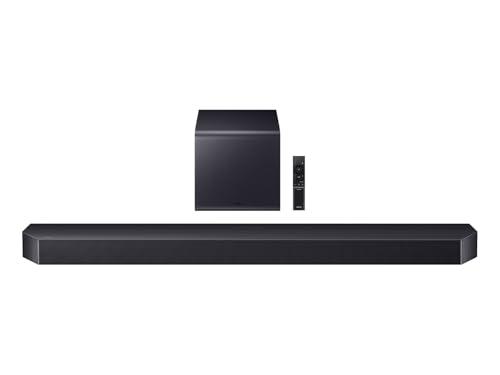
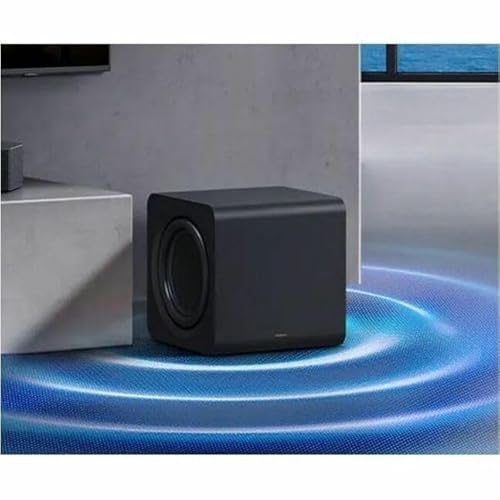
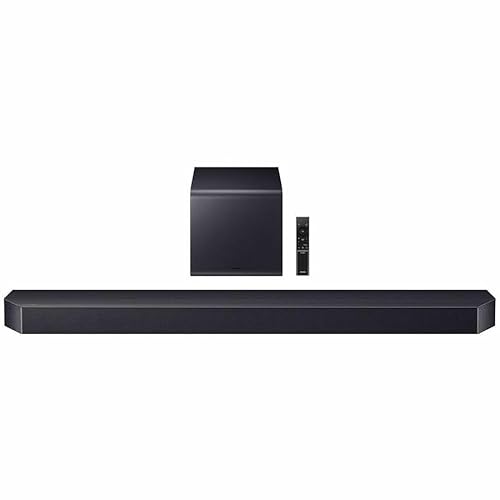
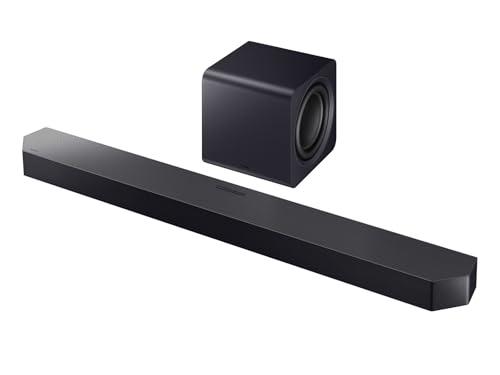
The Samsung Q990F launched in 2025 as Samsung's response to criticism of their previous generation's bass performance. Where the Q990D used a ported subwoofer design that some users found boomy, the Q990F switched to a sealed enclosure with dual 8-inch force-canceling woofers. This change delivers tighter, more controlled bass that integrates better with the rest of the system.
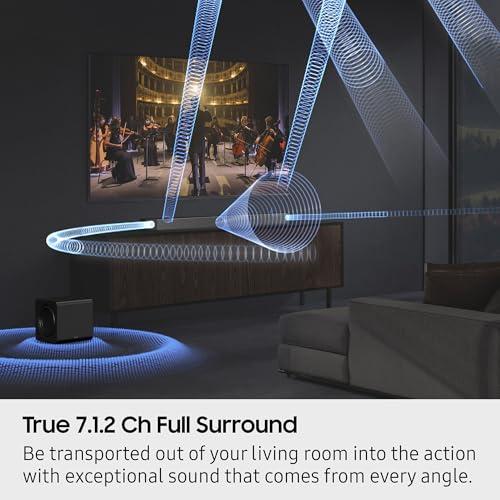
What sets the Samsung Q990F apart is its genuine 11.1.4-channel configuration powered by 23 individual speakers. That's 15 drivers in the soundbar alone—including up-firing speakers that bounce sound off your ceiling to create overhead effects, and side-firing drivers that expand the soundstage beyond the physical width of the bar. The wireless subwoofer handles the low-end, while each rear speaker contains three drivers: front-firing, side-firing, and up-firing elements that work together to create seamless surround effects.
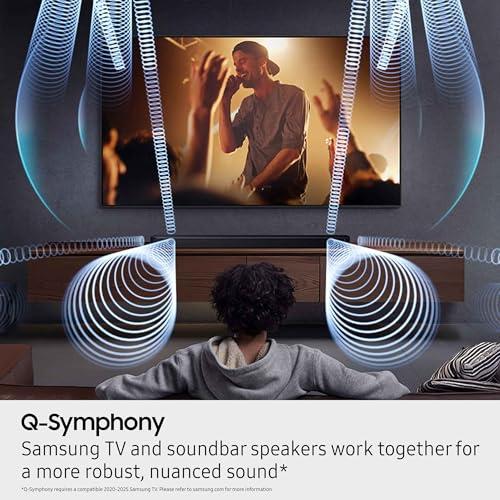
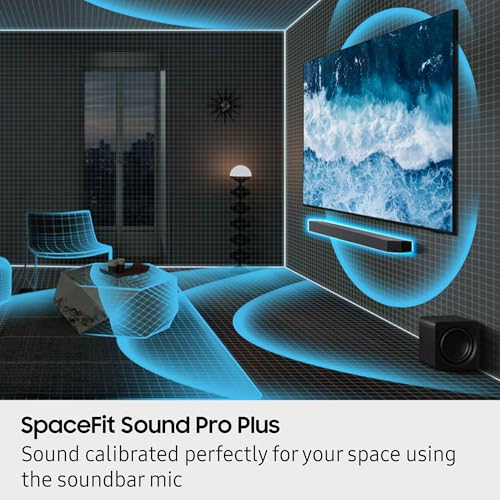
The technical sophistication here is remarkable. SpaceFit Sound Pro Plus uses built-in microphones to analyze your room's acoustics and automatically calibrate the system's output. The Active Voice Amplifier Pro monitors ambient noise and dynamically boosts dialogue frequencies to keep speech clear even when the neighbors are mowing their lawn. Q-Symphony technology can sync with compatible Samsung TVs, combining the soundbar's speakers with your TV's built-in audio for an even fuller soundstage.
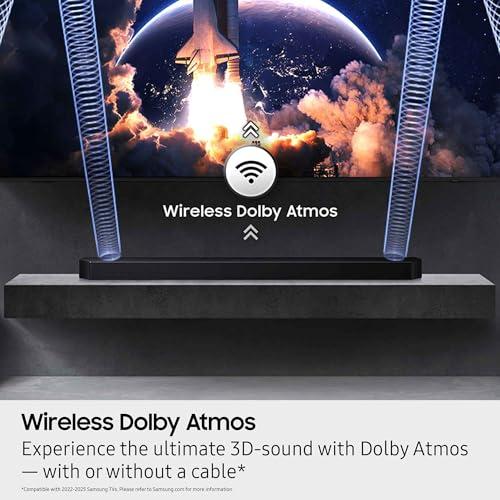
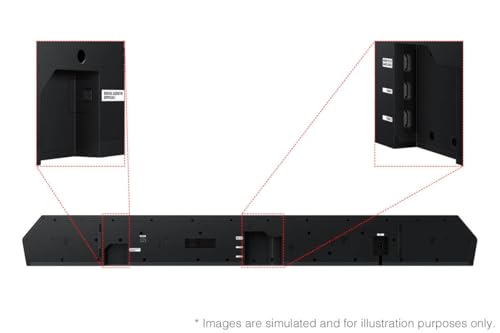
Connectivity reflects the system's premium positioning. Three HDMI 2.1 inputs support 4K video at 120Hz—essential for PlayStation 5 or Xbox Series X gaming where you want both pristine visuals and lag-free audio. The eARC (enhanced Audio Return Channel) connection sends full-resolution audio back from your TV, including uncompressed Dolby Atmos from streaming services.
The Ultimea Aura A40 takes a fundamentally different approach. Rather than trying to miniaturize premium technology, it accepts certain limitations to hit an aggressive price point while still delivering physical surround speakers—something many competitors skip entirely at this level.
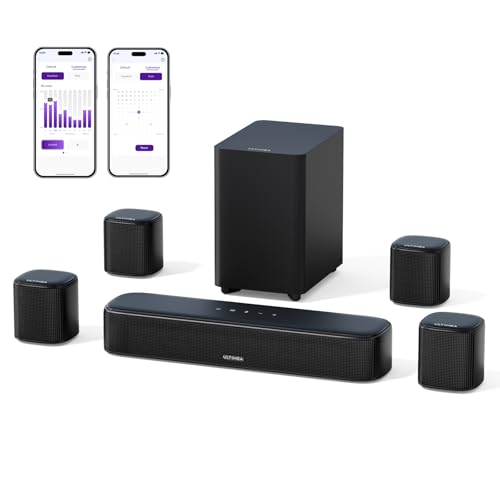
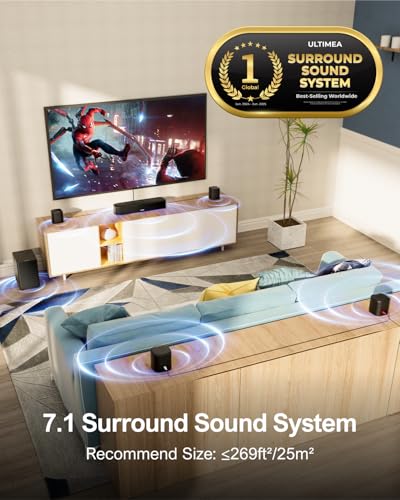
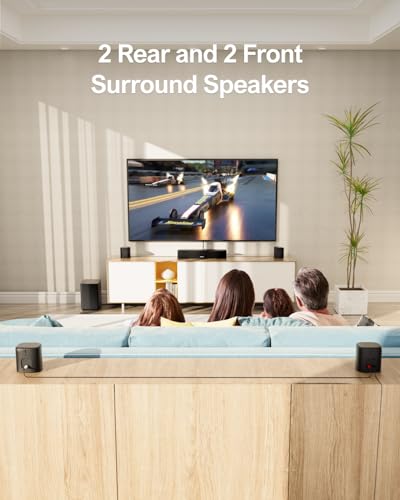
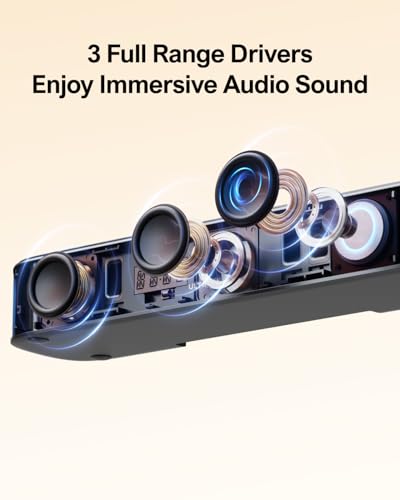
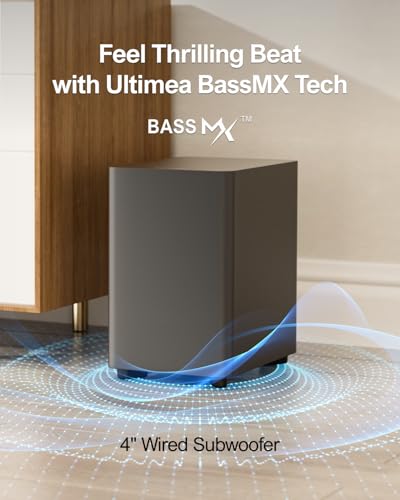
The system's 7.1 configuration uses eight total speakers: three in the main soundbar, four discrete surround speakers (two front, two rear), and a compact 4-inch subwoofer. While this sounds impressive on paper, the reality is more nuanced. The Ultimea Aura A40 doesn't decode Dolby Atmos or DTS:X at all. Instead, it relies on SurroundX technology—proprietary digital processing that analyzes stereo or basic surround audio and uses psychoacoustic techniques to create the illusion of directional sound.
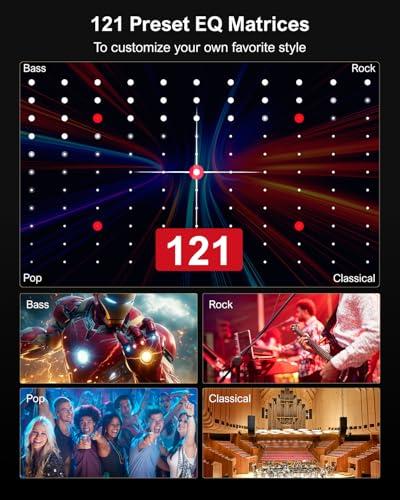
What the Ultimea Aura A40 lacks in format support, it tries to make up for in customization. The Ultimea Home app provides genuinely impressive control options: a 10-band equalizer, 121 preset audio profiles organized by genre (Bass, Pop, Classical, Rock), and 13 adjustable surround levels to fine-tune the speaker balance. Over-the-air firmware updates keep the system current, which is unusual at this price point.
The physical design reflects budget constraints. The main soundbar measures just 15.7 inches wide—compact enough for smaller TVs and apartments. However, the four surround speakers require wired connections, with cables up to 20 feet long for rear placement. One clever touch: the rear-right speaker can pair wirelessly to the soundbar, reducing cable runs somewhat.
This is where the philosophical differences between these systems become most apparent. The Samsung Q990F handles Dolby Atmos the way it was intended—as genuine object-based audio where sounds can be precisely placed anywhere in three-dimensional space. When a helicopter flies overhead in a movie, you hear it move across your ceiling because dedicated up-firing speakers actually bounce that audio off the surface above you.
The Ultimea Aura A40 can't do this. Without Dolby Atmos decoding, it's limited to whatever virtual processing can accomplish through its eight speakers. While SurroundX technology creates a wider soundstage than TV speakers alone, it can't replicate the precision of true height channels. The difference is immediately obvious with content like Top Gun: Maverick or Dune, where overhead jet engines and atmospheric effects are core to the experience.
Based on our research into professional reviews and user feedback, this format limitation is the Ultimea Aura A40's most significant constraint. Modern streaming services increasingly offer Dolby Atmos content, and if you're investing in a surround sound system, future-proofing for these formats makes sense even if you're not watching much Atmos content today.
Nothing ruins a movie night like constantly reaching for the remote to turn dialogue up during quiet scenes and back down when the action starts. Both systems address this challenge, but with very different sophistication levels.
The Samsung Q990F uses multiple technologies working together. Its discrete center channel—a dedicated speaker solely for dialogue—provides the foundation. Active Voice Amplifier Pro then monitors your room's ambient noise in real-time and dynamically adjusts dialogue frequencies to maintain clarity. Professional reviewers consistently highlight this as one of the Q990F's strongest features, with several noting that dialogue remains perfectly intelligible even during explosive action sequences.
The Ultimea Aura A40 includes a Voice EQ mode among its six presets, which boosts midrange frequencies where most speech occurs. While this helps, it's a static solution that can't adapt to changing content or room conditions. User reviews suggest dialogue clarity is adequate for most content but doesn't match the sophistication of premium systems.
Low-frequency reproduction reveals another significant performance gap. The Samsung Q990F's dual 8-inch subwoofer design delivers bass that's both deep and controlled. The sealed enclosure (a change from Samsung's previous ported designs) provides tighter, more accurate bass response that integrates seamlessly with the main speakers. Professional measurements show clean output down to about 35Hz—low enough to reproduce the rumbling engines in Mad Max: Fury Road or the otherworldly sounds in Blade Runner 2049 with proper impact.
The Ultimea Aura A40's 4-inch subwoofer faces physics limitations that no amount of digital processing can overcome. While BassMX technology helps optimize what's possible from the small driver, the system's 65Hz lower frequency limit means you'll miss the deepest movie effects and bass-heavy music passages. User reviews consistently note that while bass is present and adequate for dialogue-driven content, action movies and music with significant low-end content expose the system's limitations.
This is where having physical surround speakers should give the Ultimea Aura A40 an advantage over soundbar-only systems, and to some extent, it does. The four discrete surround speakers create a more convincing 360-degree sound field than virtual processing alone. Effects like footsteps behind you or ambient environmental sounds feel more natural than what any soundbar-only system can achieve.
However, the Samsung Q990F operates on another level entirely. Its rear speakers each contain three drivers working in harmony—front-firing for direct surround effects, side-firing for width, and up-firing for height. Combined with the soundbar's own up-firing and side-firing drivers, this creates what reviewers describe as a "seamless hemisphere of sound" where effects move organically through space without obvious transitions between speakers.
The difference becomes especially apparent with height effects. Rain falling from above, aircraft passing overhead, or the spatial positioning in Dolby Atmos music recordings showcase capabilities that virtual processing simply cannot match. Based on professional reviews, users consistently report that the Samsung Q990F delivers the most convincing home theater experience available in a soundbar package.
Here's where the Samsung Q990F's premium positioning really shows. Three HDMI 2.1 inputs mean you can connect multiple high-end sources directly—perhaps a PlayStation 5, Xbox Series X, and 4K Blu-ray player—without needing additional switching equipment. The 4K/120Hz video passthrough ensures you get the full benefit of modern gaming consoles and streaming devices.
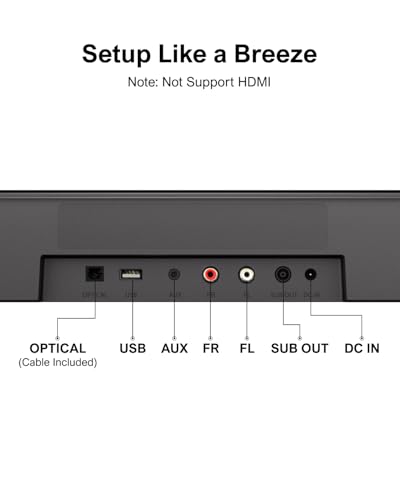
The Ultimea Aura A40 completely lacks HDMI inputs, offering only optical, auxiliary, USB, and Bluetooth connections. This forces you to rely on your TV's processing and limits compatibility with devices that need high-bandwidth audio connections. While this keeps costs down, it also means you can't take full advantage of lossless audio formats from premium sources.
Smart home integration further separates these systems. The Samsung Q990F works with Alexa, Google Assistant, and Samsung's SmartThings ecosystem. It can be controlled through Samsung TV remotes via HDMI CEC, and the Q-Symphony feature creates interesting possibilities for users with compatible Samsung TVs.
The Ultimea Aura A40 offers more basic smart features through its mobile app, though the extensive EQ customization options are genuinely useful. The 121 preset profiles and detailed adjustments let you fine-tune the system's sound signature to match your preferences—something that's increasingly rare even on more expensive systems.
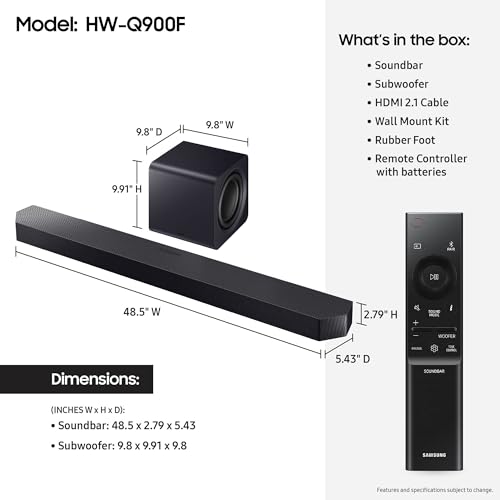
The Samsung Q990F's wireless design creates a cleaner installation but demands more space. The 48.5-inch soundbar works best with 55-inch or larger TVs, and the substantial rear speakers need appropriate placement to avoid overwhelming smaller rooms. Professional reviewers noted that while the components aren't particularly decorative, the wireless convenience significantly simplifies setup.
The Ultimea Aura A40 requires more planning due to cable routing, but its compact size suits smaller spaces better. The 15.7-inch soundbar works with TVs as small as 32 inches, and the lightweight surround speakers can be easily repositioned. However, running cables to optimal surround positions requires more effort and may impact room aesthetics.
At the time of writing, these systems occupy completely different market segments. The Samsung Q990F commands flagship pricing that puts it in competition with traditional component systems, while the Ultimea Aura A40 costs roughly one-fifth as much, targeting buyers who want surround speakers without premium investment.
The Samsung Q990F justifies its premium through comprehensive format support, wireless convenience, superior driver quality, and advanced room optimization. For serious home theater enthusiasts with appropriate budgets and room sizes, it delivers performance that would be difficult to match with separate components at similar cost.
The Ultimea Aura A40 offers remarkable value for budget-conscious buyers who understand its limitations. Having four physical surround speakers at this price point is unusual, and the extensive customization options help optimize performance for different content and preferences. However, the lack of modern audio format support and HDMI connectivity may limit long-term satisfaction as content and device standards evolve.
Choose the Samsung Q990F if you're building a serious home theater setup around a large TV (55 inches or bigger) in a spacious room. The investment makes sense if you regularly watch movies with advanced audio formats, game on modern consoles, or simply want the best possible soundbar performance regardless of cost. The wireless convenience and smart features add significant value for users with compatible Samsung displays or complex entertainment setups.
The Ultimea Aura A40 works best for smaller spaces, secondary viewing areas, or situations where budget constraints are paramount. It's ideal for apartments, bedrooms, or family rooms where having some surround sound is more important than having perfect surround sound. The extensive app-based customization helps maximize performance within the system's limitations.
From our analysis of professional reviews and user feedback, both systems deliver on their respective promises. The Samsung Q990F provides flagship performance that pushes soundbar technology to its current limits, while the Ultimea Aura A40 makes surround sound accessible to buyers who might otherwise settle for basic soundbar solutions.
The key is honestly assessing your priorities: premium performance and future-proofing versus immediate value and space constraints. Neither approach is wrong, but understanding the fundamental differences ensures you'll be satisfied with your investment for years to come.
| Samsung Q-Series HW-Q990F Soundbar | Ultimea Aura A40 7.1 Channel Soundbar System |
|---|---|
| Audio Channels - Determines surround sound immersion quality | |
| True 11.1.4 channels with 23 discrete speakers | Virtual 7.1 channels with 8 total speakers |
| Dolby Atmos Support - Essential for modern movie and streaming content | |
| Full Dolby Atmos, DTS:X, and TrueHD decoding | No Dolby Atmos support, virtual surround processing only |
| Subwoofer Design - Controls bass depth and room impact | |
| Dual 8" wireless subwoofer, sealed design for tight bass | Single 4" wired subwoofer, limited to 65Hz frequency response |
| HDMI Connectivity - Critical for gaming consoles and 4K devices | |
| 3x HDMI 2.1 inputs with 4K/120Hz passthrough and eARC | No HDMI inputs (optical, AUX, USB, Bluetooth only) |
| Wireless Setup - Affects installation complexity and cable management | |
| Fully wireless subwoofer and rear speakers | Wired subwoofer and surround speakers (cables up to 20 feet) |
| Room Calibration - Optimizes sound for your specific space | |
| SpaceFit Sound Pro Plus with automatic room analysis | Manual EQ adjustment via app, no automatic calibration |
| Smart Features - Voice control and ecosystem integration | |
| Built-in Alexa, Q-Symphony with Samsung TVs, SmartThings integration | Basic app control with 10-band EQ and 121 preset profiles |
| Physical Size - Important for TV matching and room aesthetics | |
| 48.5" wide soundbar (best for 55"+ TVs), substantial rear speakers | 15.7" wide soundbar (works with smaller TVs), compact components |
| Voice Enhancement - Keeps dialogue clear during action scenes | |
| Active Voice Amplifier Pro with real-time ambient noise adjustment | Static Voice EQ mode, no adaptive processing |
| Power Output - Determines maximum volume and dynamic range | |
| 756W RMS across 23 speakers with clean high-volume performance | 330W peak power with compression at maximum levels |
The Samsung Q-Series HW-Q990F Soundbar is significantly better for movies and TV shows due to its true Dolby Atmos and DTS:X support, which creates genuine 3D surround sound with overhead effects. The Ultimea Aura A40 7.1 Channel Soundbar System offers virtual surround processing that works well for basic content but cannot match the immersive experience of object-based audio formats found in modern movies and streaming services.
The primary difference is audio processing capability. The Samsung Q-Series HW-Q990F Soundbar delivers true 11.1.4-channel surround sound with 23 discrete speakers and full Dolby Atmos decoding, while the Ultimea Aura A40 7.1 Channel Soundbar System uses virtual 7.1 processing through 8 speakers without advanced audio format support. This translates to a much more immersive and precise surround sound experience with the Samsung system.
Value depends on your budget and expectations. The Ultimea Aura A40 7.1 Channel Soundbar System provides exceptional value for budget-conscious buyers who want physical surround speakers and extensive customization options. The Samsung Q-Series HW-Q990F Soundbar offers premium value for serious home theater enthusiasts who want flagship performance and future-proof connectivity.
The Samsung Q-Series HW-Q990F Soundbar is excellent for gaming with three HDMI 2.1 inputs supporting 4K/120Hz passthrough, making it perfect for PlayStation 5 and Xbox Series X. The Ultimea Aura A40 7.1 Channel Soundbar System lacks HDMI inputs entirely, requiring connection through your TV's optical output, which limits audio quality and format support for gaming.
The Samsung Q-Series HW-Q990F Soundbar is much easier to install thanks to its wireless subwoofer and rear speakers that only need power connections. The Ultimea Aura A40 7.1 Channel Soundbar System requires running cables up to 20 feet long for the subwoofer and surround speakers, making installation more complex but keeping costs lower.
The Samsung Q-Series HW-Q990F Soundbar excels at dialogue with its discrete center channel and Active Voice Amplifier Pro technology that automatically adjusts speech clarity based on ambient noise. The Ultimea Aura A40 7.1 Channel Soundbar System includes a Voice EQ mode that helps with dialogue but doesn't offer the same level of sophisticated voice enhancement.
The Ultimea Aura A40 7.1 Channel Soundbar System is better suited for small rooms with its compact 15.7-inch soundbar and lightweight components designed for spaces up to 270 square feet. The Samsung Q-Series HW-Q990F Soundbar is designed for larger rooms with its 48.5-inch soundbar that works best with 55-inch or larger TVs.
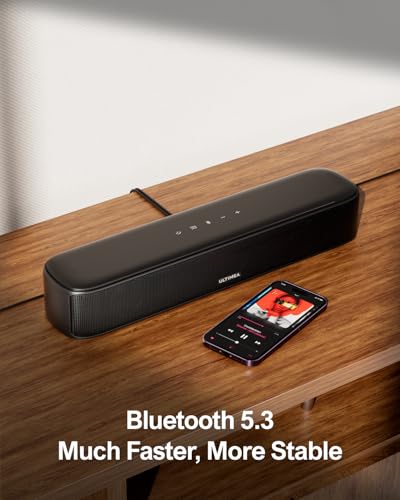
Yes, both support wireless streaming but at different levels. The Samsung Q-Series HW-Q990F Soundbar offers comprehensive streaming with Wi-Fi, Bluetooth 5.3, Apple AirPlay 2, Google Cast, Spotify Connect, and built-in voice assistants. The Ultimea Aura A40 7.1 Channel Soundbar System provides Bluetooth 5.3 connectivity and app-based control with extensive EQ customization options.
The Samsung Q-Series HW-Q990F Soundbar delivers significantly better bass with its dual 8-inch wireless subwoofer that extends down to about 35Hz for deep, controlled low-frequency response. The Ultimea Aura A40 7.1 Channel Soundbar System uses a compact 4-inch subwoofer limited to 65Hz, which provides adequate bass for dialogue-driven content but lacks the depth needed for action movies and music.
The Samsung Q-Series HW-Q990F Soundbar integrates extensively with smart home ecosystems including SmartThings, built-in Alexa, Google Assistant compatibility, and Q-Symphony with Samsung TVs. The Ultimea Aura A40 7.1 Channel Soundbar System offers basic smart features through its mobile app but doesn't integrate with major smart home platforms.
The Samsung Q-Series HW-Q990F Soundbar provides superior music performance with its balanced sound signature, wide stereo imaging, detailed instrument separation, and support for high-resolution audio formats including Dolby Atmos Music. The Ultimea Aura A40 7.1 Channel Soundbar System offers 121 music-focused EQ presets and customization options but cannot match the audio fidelity and refinement of the premium system.
Consider your room size, budget, and audio priorities. Choose the Samsung Q-Series HW-Q990F Soundbar if you have a large room, want the best possible performance, need HDMI 2.1 connectivity for gaming, and prioritize Dolby Atmos content. Select the Ultimea Aura A40 7.1 Channel Soundbar System if you have budget constraints, a smaller space, can manage cable installation, and want physical surround speakers at an accessible price point.
We've done our best to create useful and informative comparisons to help you decide what product to buy. Our research uses advanced automated methods to create this comparison and perfection is not possible - please contact us for corrections or questions. These are the sites we've researched in the creation of this article: rtings.com - crutchfield.com - sound-advice.online - samsung.com - soundandvision.com - samsung.com - whathifi.com - youtube.com - youtube.com - bestbuy.com - avsforum.com - content.syndigo.com - samsung.com - businessinsider.com - dolby.com - youtube.com - abcwarehouse.com - youtube.com - walmart.com - youtube.com - ultimea.com - homestudiobasics.com - ultimea.co - youtube.com - eu.ultimea.com - walmart.com - device.report - bestbuy.com - manuals.plus - community.ultimea.com - judge.me - support.ultimea.com - geekmaxi.com - provantage.com - bestbuy.com - youtube.com - uk.whatgeek.com

Privacy Policy
Terms and Conditions - Affiliate Policy
Home Security
© Copyright 2008-2026.
11816 Inwood Rd #1211, Dallas, TX 75244