





















When shopping for a home theater upgrade, you'll quickly discover that soundbars have evolved far beyond simple TV speaker replacements. Today's market offers everything from basic two-channel bars to sophisticated systems that rival full surround sound setups. Two products that perfectly illustrate this evolution are the Ultimea Aura A40 7.1 Channel Soundbar System and the Sonos Arc Wireless Sound Bar – each taking a completely different approach to solving the same problem of lackluster TV audio.
The Ultimea Aura A40 represents the "maximum speakers for minimum money" philosophy, delivering a complete 7.1 surround system with physical speakers and a subwoofer at a budget-friendly price point. The Sonos Arc, released in 2020, embodies the premium single-unit approach, using advanced signal processing and Dolby Atmos technology to create immersive audio from one sleek soundbar.
Understanding these different approaches – and their trade-offs – is crucial for making the right choice for your home theater setup.
The soundbar landscape has transformed dramatically over the past decade. Early soundbars were essentially wide speakers that improved dialogue clarity but offered little else. Today's systems use sophisticated digital signal processing (DSP) – computer algorithms that manipulate audio signals – to create convincing surround sound effects from various speaker configurations.
Virtual surround technology, like what the Sonos Arc uses, employs psychoacoustic tricks to fool your brain into hearing sounds from directions where no speakers exist. This works by carefully timing and filtering audio signals, creating phase differences that your ears interpret as directional cues. Dolby Atmos takes this further by adding height information, bouncing sound off your ceiling to create the illusion of aircraft flying overhead or rain falling from above.
Physical surround systems like the Ultimea Aura A40 take the traditional approach – placing actual speakers around your room to create genuine directional audio. This method is more straightforward but requires more space and cable management.
The key performance metrics that matter most for any soundbar system include frequency response (how well it reproduces different pitches), dynamic range (the difference between quiet and loud sounds), dialogue clarity, and spatial accuracy (how convincingly it places sounds in specific locations).
The Ultimea Aura A40, released in recent years as budget audio technology improved, takes an ambitious approach to affordable surround sound. Instead of trying to simulate surround effects, it gives you the real thing with eight physical speakers strategically placed around your room.
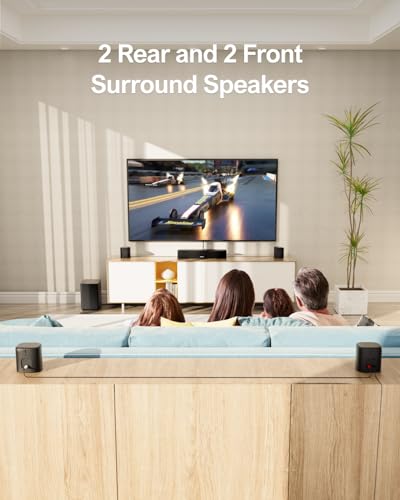
The system includes a main soundbar housing three 2-inch drivers, four separate surround speakers (each with their own 2-inch driver), and a dedicated 4-inch subwoofer. This configuration creates what's called a 7.1 channel system – seven main speakers plus one subwoofer channel. The "7.1" designation comes from traditional home theater terminology, where the first number represents main speakers and the second represents subwoofers.
The Aura A40's strength lies in its authentic directional audio. When a helicopter flies from left to right in a movie, you hear it moving through actual speakers positioned around your room. This creates a more convincing spatial experience than virtual processing can achieve, especially for movie soundtracks mixed for discrete surround channels.
The system's frequency response spans 65Hz to 18kHz, which covers most audible content well. However, that 65Hz low-end limit means it misses the deepest bass frequencies that really make action scenes impact your chest. For context, a typical male voice fundamental frequency sits around 85-180Hz, while movie explosions and thunder often contain energy down to 20-30Hz.
The 4-inch subwoofer uses Ultimea's BassMX technology – essentially optimized driver design and amplifier tuning – to maximize impact from a relatively small enclosure. At 330 watts peak power, the system can reach over 98 decibels of volume, which is loud enough to fill most living rooms without strain.
One standout feature is the Ultimea Smart App, which provides extensive audio customization. The app offers 121 preset EQ matrices (pre-configured sound profiles) tailored for different music genres and content types, plus a 10-band equalizer for manual adjustments. This level of control typically appears in much more expensive systems.
The Aura A40's biggest challenge is installation complexity. You'll need to run cables to four speaker positions around your room – two front surrounds require 2-meter cables, while the rear surrounds use a 6-meter cable. The system cleverly reduces some cable clutter by allowing the rear right speaker to pair wirelessly with the soundbar after being initially connected and powered.
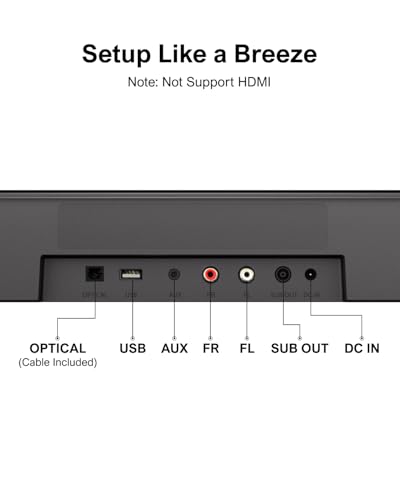
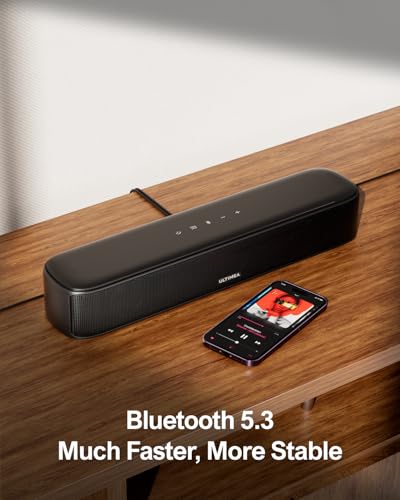
Connectivity options feel dated by 2024 standards. The system lacks HDMI input entirely, relying on optical, auxiliary, USB, and Bluetooth 5.3 connections. This means you can't take advantage of advanced audio formats that require HDMI's higher bandwidth, and you'll need to use your TV's optical output or Bluetooth for audio.
The absence of HDMI eARC (enhanced Audio Return Channel) support is particularly limiting. eARC allows your TV to send high-quality audio back to your soundbar, including lossless formats and advanced surround codecs. Without it, you're restricted to compressed audio formats that don't fully showcase the system's capabilities.
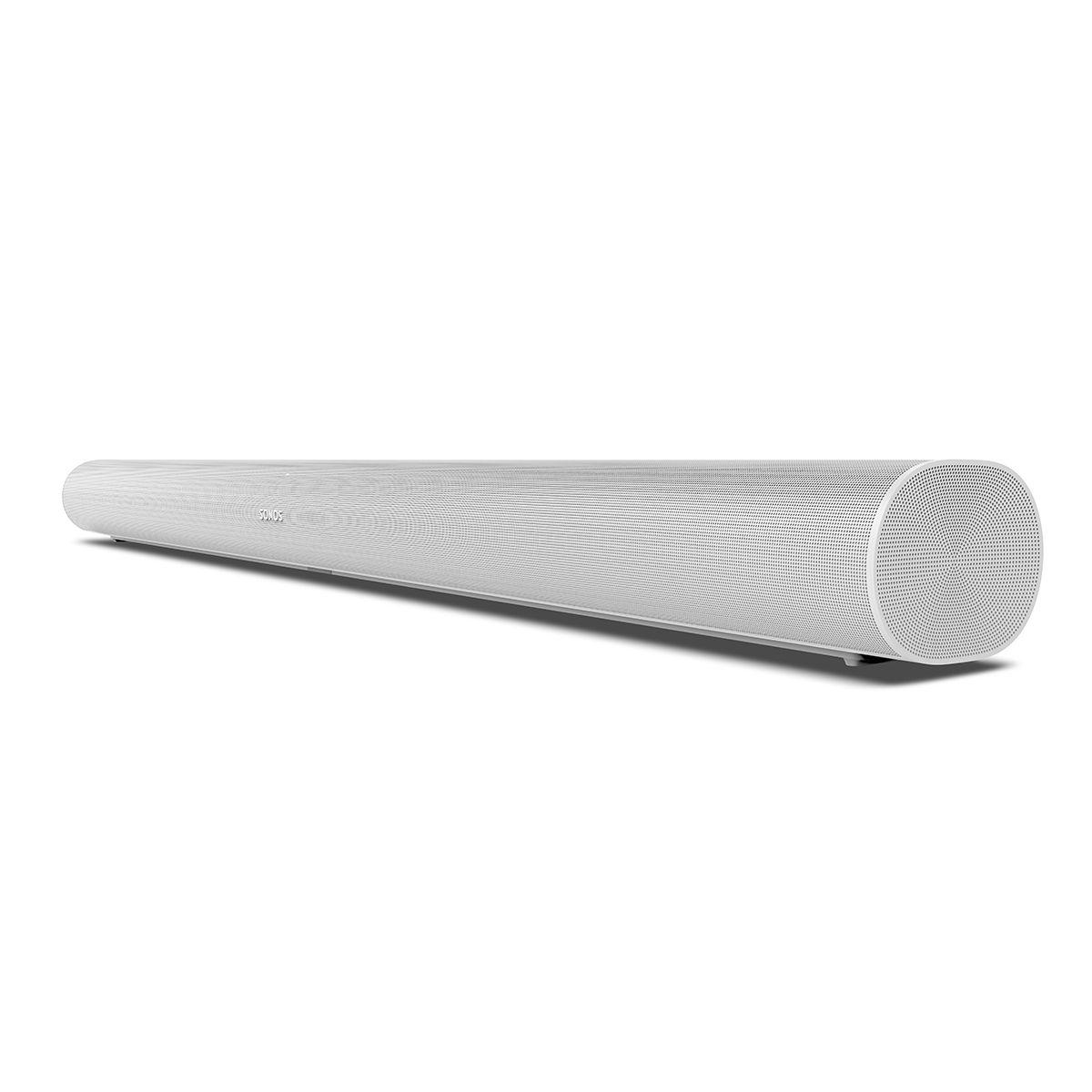
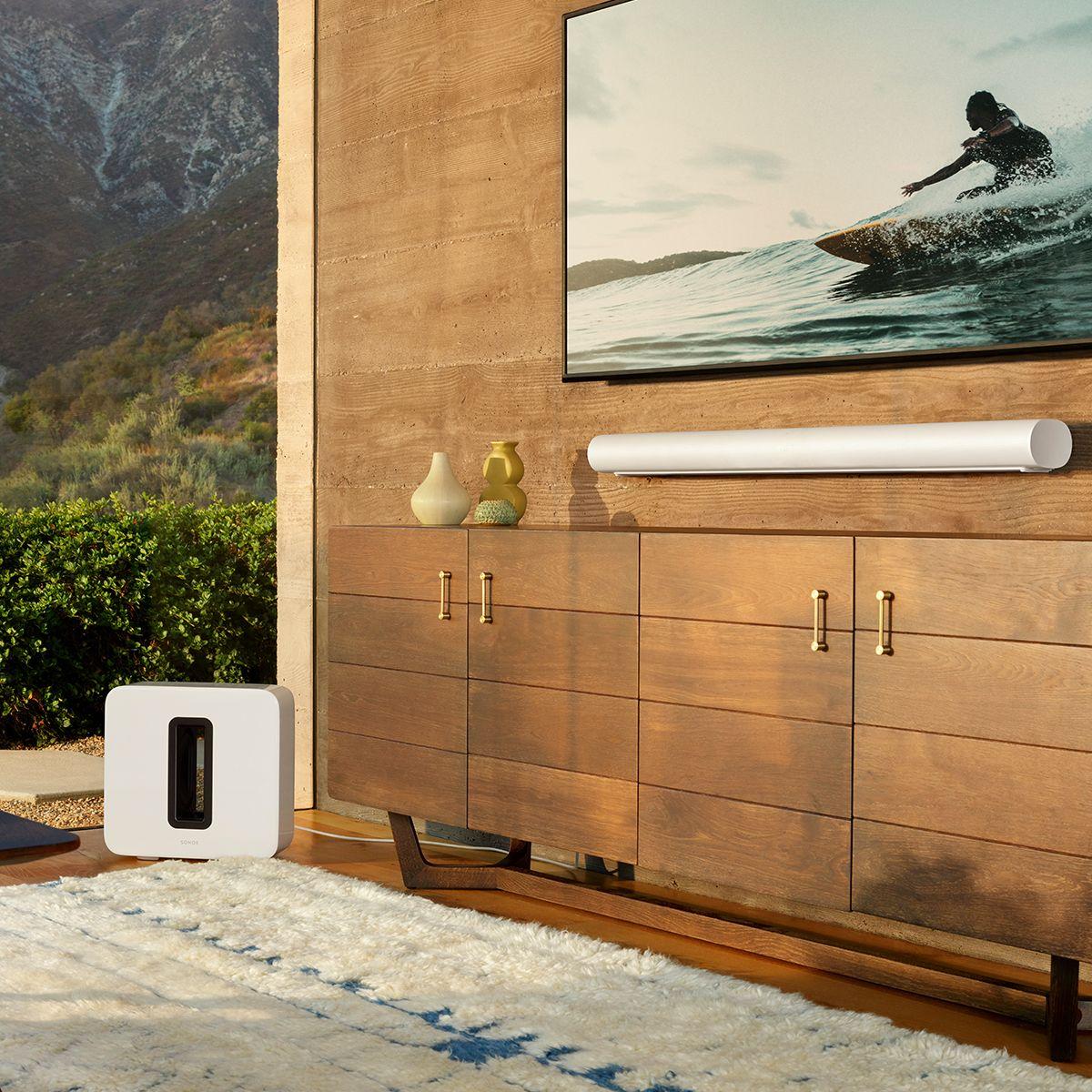
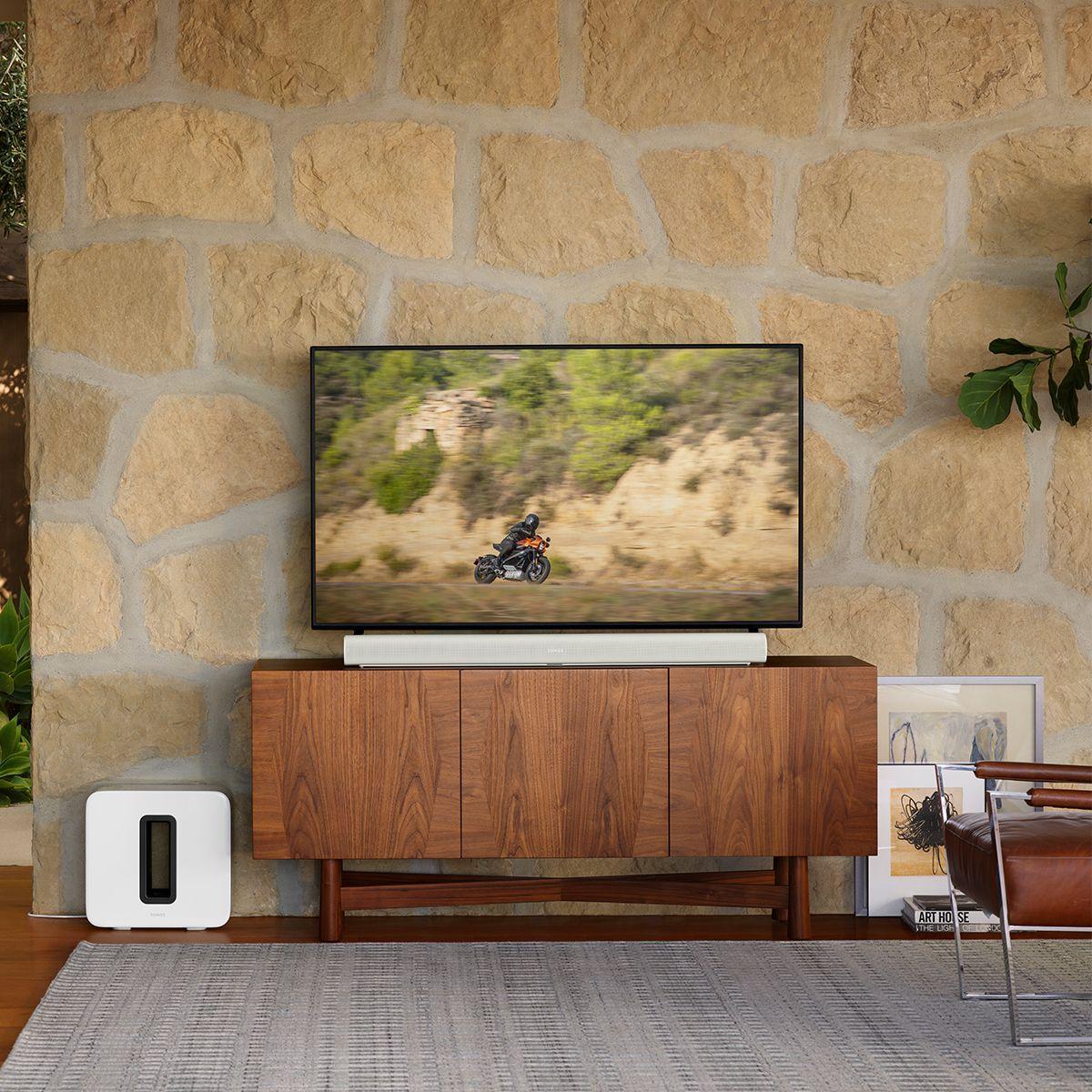
The Sonos Arc, launched in May 2020, represents Sonos's flagship approach to home theater audio. Rather than surrounding you with speakers, it uses sophisticated processing and 11 carefully positioned drivers within a single 45-inch soundbar to create immersive audio.
The Arc's driver array includes three silk-dome tweeters for crisp highs and clear dialogue, plus eight elliptical woofers that handle mid-range and bass frequencies. This driver configuration, combined with advanced DSP, creates what Sonos calls a 5.0.2 channel experience – five main channels plus two height channels for Dolby Atmos effects.
The Sonos Arc's most impressive feature is its Dolby Atmos implementation. Traditional surround sound moves audio left-to-right and front-to-back, but Atmos adds a vertical dimension by including height information in the audio mix. The Arc achieves this through upward-firing drivers that bounce sound off your ceiling, creating the perception of audio coming from above.
This technology works best in rooms with 8-10 foot ceilings and minimal acoustic treatment. If your room has vaulted ceilings, heavy carpeting, or sound-absorbing furniture, the height effects become less pronounced since the reflected sound gets diminished.
The Arc supports multiple Atmos formats including Dolby Digital Plus (used by Netflix and streaming services) and Dolby TrueHD (found on 4K Blu-rays). Having HDMI eARC connectivity means it can handle these high-bandwidth formats that preserve the original audio quality intended by content creators.
Where the Sonos Arc truly differentiates itself is in smart functionality. Built-in Google Assistant and Amazon Alexa support turn it into a voice-controlled hub for your entertainment system. You can adjust volume, change inputs, ask about weather, control smart home devices, and stream music using only voice commands.
Apple AirPlay 2 support enables seamless streaming from iPhones, iPads, and Macs. This integration feels particularly natural if you're already invested in Apple's ecosystem – you can easily hand off music from your phone to the soundbar or use it as part of a multi-room audio setup.
The Trueplay room correction technology, available through the Sonos app on iOS devices, automatically optimizes the Arc's sound for your specific room. By playing test tones and measuring how they bounce around your space, Trueplay adjusts the soundbar's output to compensate for room acoustics. This can dramatically improve performance, especially in challenging acoustic environments.
The Sonos Arc exhibits premium construction throughout. Its matte finish resists fingerprints, the touch controls respond consistently, and the overall build feels substantial without being heavy. At under 14 pounds, it's manageable for wall mounting while feeling solid enough to inspire confidence in long-term durability.
The minimalist design philosophy extends to setup simplicity. One HDMI cable connects the Arc to your TV, and the Sonos app handles the rest wirelessly. This contrasts sharply with the Aura A40's cable management requirements.
Based on extensive research into professional reviews and user experiences, clear performance differences emerge between these systems.
For pure surround sound immersion during movies, the Ultimea Aura A40 has an inherent advantage. Physical speakers positioned around your room create more convincing directional effects than any virtual processing can achieve. When reviewing user feedback and professional assessments, the consensus indicates that discrete surround speakers provide superior spatial accuracy for action movies and shows mixed for traditional 5.1 or 7.1 audio.
However, the Sonos Arc's Dolby Atmos processing receives consistently high praise from audio experts. Professional reviews describe its height channel implementation as "stunning" and note that it delivers "one of the most immersive Dolby Atmos experiences from a soundbar." For content specifically mixed for Atmos – which includes most modern streaming movies and shows – the Arc can provide a more sophisticated audio experience than traditional surround systems.
This is where the philosophical differences become most apparent. The Sonos Arc was designed as both a home theater system and a high-quality music speaker. Professional reviews consistently praise its musical performance, noting excellent tonal balance and detail retrieval that makes it suitable for critical listening.
The Aura A40, based on user reports and our research, shows its budget origins when playing music. Users describe the sound as "tinny, boxy, and metallic" with bass that can sound "flabby and loose." While adequate for background music or casual listening, it lacks the refinement needed for serious music enjoyment.
Both systems handle dialogue well, but through different approaches. The Aura A40 uses a traditional center channel configuration in its main soundbar, which anchors dialogue to the screen effectively. Users report clear speech even during loud action sequences.
The Sonos Arc employs sophisticated signal processing to enhance dialogue clarity. Its Speech Enhancement feature intelligently boosts voice frequencies, while Night Sound mode compresses dynamic range for late-night viewing without losing dialogue clarity. Professional reviewers consistently note the Arc's exceptional mid-range performance and voice reproduction.
At the time of writing, these products occupy completely different price tiers. The Ultimea Aura A40 positions itself as a budget-friendly complete solution, while the Sonos Arc commands a premium price that's approximately double the Aura A40's cost.
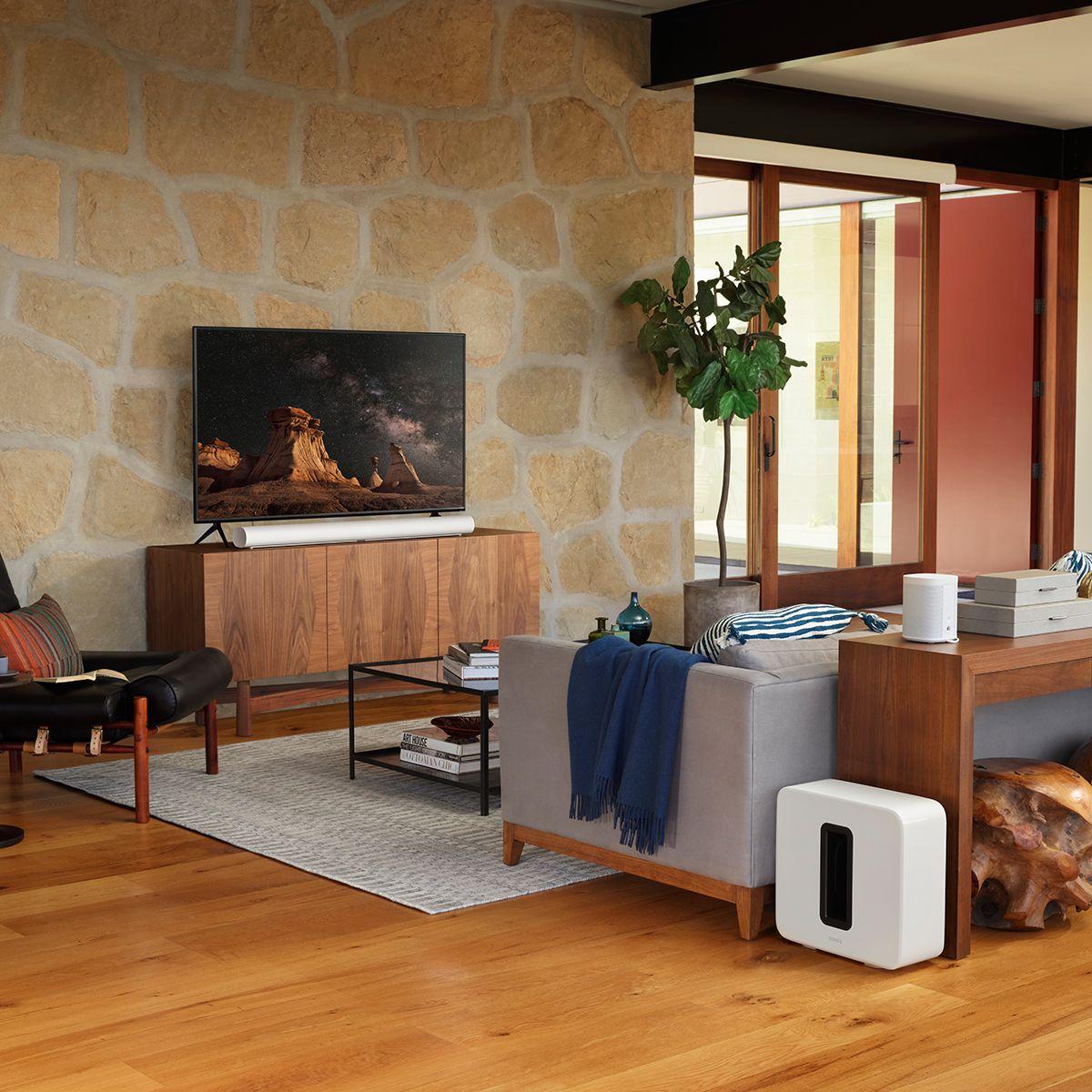
However, value calculations become complex when considering expandability. The Aura A40 includes everything needed for surround sound out of the box – you get eight speakers and a subwoofer for one price. The Sonos Arc represents a starting point that can be enhanced with a dedicated Sonos Sub (adding significant cost) and rear surround speakers for a complete 5.1.4 Atmos system.
The premium you pay for the Sonos Arc covers several intangible benefits: superior build quality, advanced smart features, seamless setup, and integration with Sonos's multi-room ecosystem. These features provide long-term value that extends beyond pure audio performance.
For dedicated home theater rooms, the Ultimea Aura A40's physical surround approach aligns better with traditional home theater design principles. The ability to position speakers optimally around seating areas creates more consistent surround effects for multiple viewers.
The Sonos Arc's single-unit design works better in multi-purpose living spaces where running speaker cables isn't practical. Its room correction and adaptive processing help maintain good performance even in acoustically challenging environments like open-concept homes.
Since the Sonos Arc's 2020 launch, Sonos has continued refining its software through regular updates. The platform's foundation on modern connectivity standards (HDMI eARC, WiFi 6, advanced codecs) positions it well for future audio format developments.
The Aura A40's more recent entry into the market incorporates lessons learned from early budget surround systems, but its reliance on older connectivity standards limits long-term compatibility with evolving TV and streaming technologies.
Choose the Ultimea Aura A40 if you prioritize authentic surround sound placement over convenience, operate on a strict budget, and primarily watch movies and TV shows. It's ideal for dedicated home theater spaces where you can properly position all speakers and don't mind managing cables. The system works best for users who value maximum audio hardware per dollar and don't require smart features or premium build quality.
Select the Sonos Arc if you want premium audio quality with sophisticated features, prefer simple setup, listen to music regularly, or need smart home integration. It's perfect for modern living spaces where aesthetics matter and cable management is impractical. The Arc suits users willing to invest more upfront for superior long-term value, build quality, and ecosystem integration.
The fundamental choice comes down to your priorities: authentic surround sound hardware at a budget price (Aura A40) versus premium convenience with advanced processing (Sonos Arc). Both approaches have merit, but they serve different users with different needs and expectations.
For most people in typical living room setups, the Sonos Arc's combination of performance, features, and convenience provides better long-term satisfaction. However, if you're building a dedicated home theater on a budget and can accommodate the setup complexity, the Aura A40 delivers impressive surround sound hardware for the money.
| Ultimea Aura A40 7.1 Channel Soundbar System | Sonos Arc Wireless Sound Bar with Dolby Atmos |
|---|---|
| Speaker Configuration - Determines surround sound authenticity | |
| 8 physical speakers: 3 in soundbar + 4 surround speakers + 1 subwoofer | 11 drivers in single soundbar: 3 tweeters + 8 woofers with upward-firing for Atmos |
| Surround Sound Technology - Core approach to immersive audio | |
| True 7.1 with physical speakers positioned around room | Virtual 5.0.2 Dolby Atmos using advanced signal processing |
| Setup Complexity - Time and effort required for installation | |
| Complex: Requires running cables to 4 surround speaker positions | Simple: Single HDMI connection to TV, wireless app setup |
| Connectivity Options - Determines compatibility with modern TVs | |
| Optical, AUX, USB, Bluetooth 5.3 (No HDMI support) | HDMI eARC/ARC, WiFi, Apple AirPlay 2, optical adapter included |
| Smart Features - Voice control and streaming capabilities | |
| Ultimea Smart App with extensive EQ control, no voice assistant | Built-in Google Assistant & Alexa, streaming services, multi-room audio |
| Frequency Response - How well it reproduces bass and treble | |
| 65Hz - 18kHz (misses deepest bass frequencies) | Not specified, but professional reviews praise full-range performance |
| Maximum Volume - Room-filling capability | |
| >98dB with 330W peak power (adequate for most rooms) | Mid-90dB range (sufficient but may need Sub for larger spaces) |
| EQ Customization - Audio tuning flexibility | |
| 121 preset matrices + 10-band manual EQ + 6 listening modes | Trueplay room correction + basic treble/bass adjustment |
| Bass Performance - Low-frequency impact and depth | |
| Dedicated 4" wired subwoofer with BassMX technology included | Built-in woofers only (optional Sonos Sub sold separately) |
| Music Listening Quality - Performance beyond movies/TV | |
| Adequate but "metallic" sound character limits musical enjoyment | Excellent tonal balance suitable for critical music listening |
| Expandability - Future upgrade options | |
| Complete system, no official expansion options | Compatible with Sonos Sub and rear speakers for full 5.1.4 system |
| Build Quality - Long-term durability and premium feel | |
| Budget construction appropriate for price point | Premium materials with matte finish and solid construction |
| Room Size Compatibility - Optimal performance space | |
| 108-270 sq ft recommended with adjustable surround levels | Works in various room sizes with automatic room correction |
For movies, the Ultimea Aura A40 provides more authentic surround sound since it uses four physical speakers positioned around your room to create genuine directional effects. However, the Sonos Arc delivers superior Dolby Atmos performance with height channels that add overhead sound effects. If you watch mostly traditional surround content, the Aura A40 offers better spatial accuracy. For modern streaming movies with Atmos soundtracks, the Sonos Arc provides a more sophisticated experience.
The Ultimea Aura A40 includes a dedicated 4-inch subwoofer in the box, so you get complete bass coverage immediately. The Sonos Arc relies on built-in woofers for bass, which may sound thin for action movies or bass-heavy music. Many Sonos Arc users eventually add the optional Sonos Sub for deeper bass response, though this significantly increases the total cost.
The Sonos Arc is much easier to install - just connect one HDMI cable to your TV and complete wireless setup through the app in about 10 minutes. The Ultimea Aura A40 requires running cables to four surround speaker positions around your room, which can take 30-45 minutes and involves significant cable management.
The Sonos Arc has built-in Google Assistant and Amazon Alexa, letting you control volume, playback, and smart home devices with voice commands. The Ultimea Aura A40 doesn't support voice control - you'll need to use the included remote or the Ultimea mobile app for adjustments.
The Sonos Arc significantly outperforms the Ultimea Aura A40 for music. Professional reviews praise the Arc's tonal balance and detail, making it suitable for serious music listening. Users describe the Aura A40 as having a "metallic" sound character that works fine for movies but lacks the refinement needed for quality music reproduction.
Both soundbars can connect to older TVs, but with limitations. The Ultimea Aura A40 connects via optical, AUX, or Bluetooth, making it compatible with most TVs from the past 15 years. The Sonos Arc works best with newer TVs that have HDMI ARC/eARC ports, though it includes an optical adapter for older models. However, you'll miss advanced audio formats without HDMI.
The Ultimea Aura A40 provides exceptional value by including eight speakers and a subwoofer at a budget-friendly price point. The Sonos Arc costs significantly more but offers premium build quality, advanced features, and superior audio processing. The Aura A40 wins on pure hardware per dollar, while the Sonos Arc provides better long-term value through durability and smart features.
The Ultimea Aura A40 is a complete system with no official expansion options - you get everything included from day one. The Sonos Arc can be expanded with a Sonos Sub for deeper bass and rear surround speakers for full 5.1.4 Atmos surround. It also integrates with other Sonos speakers for multi-room audio throughout your home.
Both work well in small rooms, but for different reasons. The Ultimea Aura A40 might be challenging in very small spaces since you need room for four surround speakers. The Sonos Arc works excellently in small rooms with its single-unit design and room correction technology that automatically optimizes sound for your space size and acoustics.
The Sonos Arc excels at wireless streaming with built-in WiFi, Apple AirPlay 2, and direct access to music services through the app. The Ultimea Aura A40 offers Bluetooth 5.3 connectivity for wireless audio from phones and tablets, but lacks WiFi streaming and smart platform integration.
Both soundbars handle dialogue well through different approaches. The Ultimea Aura A40 uses a traditional center channel in the main soundbar to anchor voices to the screen. The Sonos Arc employs advanced processing with a dedicated Speech Enhancement mode that intelligently boosts voice frequencies. Professional reviews consistently praise the Sonos Arc for exceptional dialogue clarity and mid-range performance.
The fundamental difference is philosophy: the Ultimea Aura A40 gives you authentic surround sound through physical speakers positioned around your room at a budget price. The Sonos Arc uses sophisticated signal processing and premium drivers in a single elegant unit to create virtual surround effects with advanced smart features. Choose the Aura A40 for maximum hardware per dollar, or the Sonos Arc for premium convenience and long-term value.
We've done our best to create useful and informative comparisons to help you decide what product to buy. Our research uses advanced automated methods to create this comparison and perfection is not possible - please contact us for corrections or questions. These are the sites we've researched in the creation of this article: youtube.com - walmart.com - youtube.com - ultimea.com - homestudiobasics.com - ultimea.co - youtube.com - eu.ultimea.com - walmart.com - device.report - bestbuy.com - manuals.plus - community.ultimea.com - judge.me - support.ultimea.com - geekmaxi.com - provantage.com - bestbuy.com - youtube.com - uk.whatgeek.com - whathifi.com - soundandvision.com - en.community.sonos.com - cnet.com - worldwidestereo.com - abt.com - creativeaudio.net - target.com - sonos.com - worldwidestereo.com - businessinsider.com - en.community.sonos.com - youtube.com

Privacy Policy
Terms and Conditions - Affiliate Policy
Home Security
© Copyright 2008-2026.
11816 Inwood Rd #1211, Dallas, TX 75244