

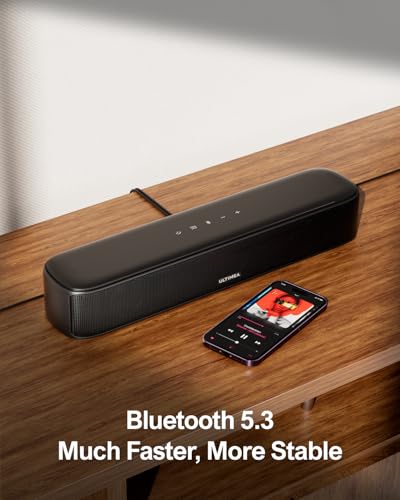

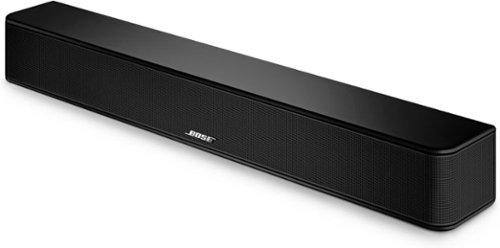
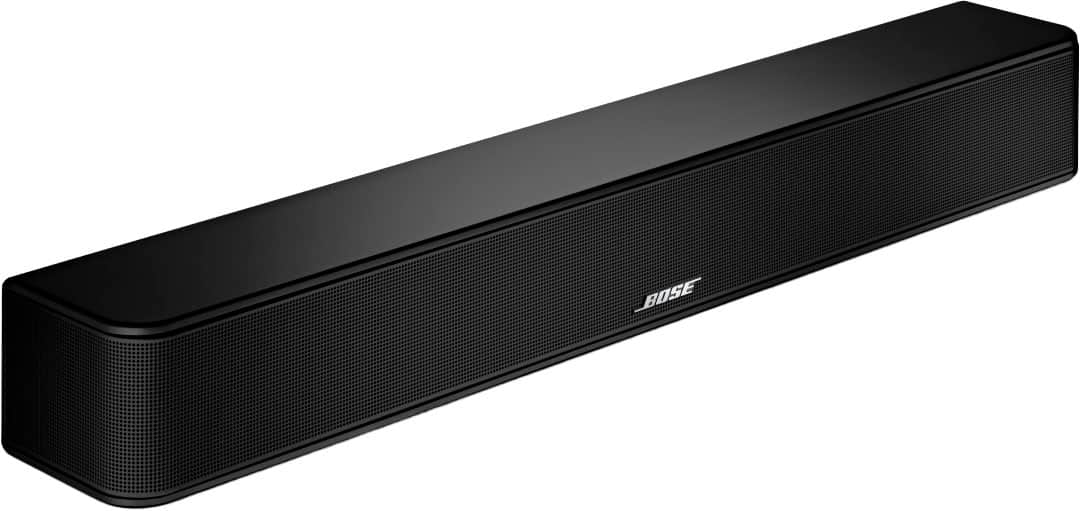
Shopping for a soundbar can feel overwhelming when you're staring at two completely different approaches to better TV audio. The Ultimea Aura A40 and Bose Solo Series 2 represent opposite ends of the soundbar spectrum—one promises immersive surround sound with multiple speakers scattered around your room, while the other delivers refined simplicity in a single sleek unit.
After diving deep into user reviews, professional evaluations, and technical specifications, we've found these products serve distinctly different needs. At the time of writing, the Ultimea Aura A40 costs roughly $100 more than the Bose Solo Series 2, but that price difference tells only part of the story about which system might transform your living room experience.
Before we dive into specifics, it's worth understanding what separates these two categories. Traditional soundbars like the Bose Solo Series 2 focus on improving your TV's built-in speakers with better drivers and acoustic engineering packed into one convenient unit. They excel at making dialogue clearer and creating a wider soundstage—the perceived width and depth of audio—without cluttering your space.
Surround sound systems like the Ultimea Aura A40 take a more ambitious approach. They use multiple physical speakers positioned around your room to create directional audio effects. When a helicopter flies across the screen, you'll actually hear it move from your front-left speaker to your rear-right speaker, creating spatial awareness that single soundbars simply can't match.
The key considerations boil down to immersion versus convenience, complexity versus simplicity, and room-filling sound versus focused audio quality.
The Bose Solo Series 2 launched in 2024 as an updated version of Bose's entry-level soundbar line. It builds on decades of Bose acoustic research, incorporating dialogue enhancement technology that the company refined through years of customer feedback about unclear TV speech. The "Series 2" designation indicates incremental improvements over the original Solo, particularly in Bluetooth connectivity and dialogue processing.
Ultimea, meanwhile, represents the newer wave of budget-conscious audio companies leveraging advances in digital signal processing and wireless technology. The Aura A40 launched in recent years as part of Ultimea's push into true surround sound systems at accessible price points. What makes this possible is the dramatic reduction in costs for wireless transmission technology and compact speaker drivers—components that would have been prohibitively expensive for budget systems just a decade ago.
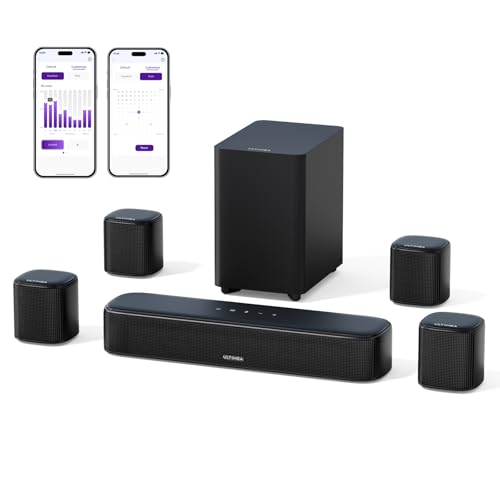
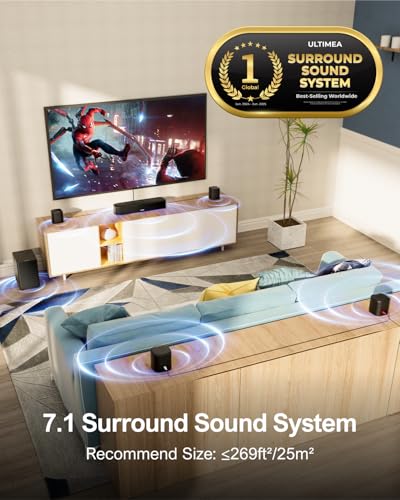
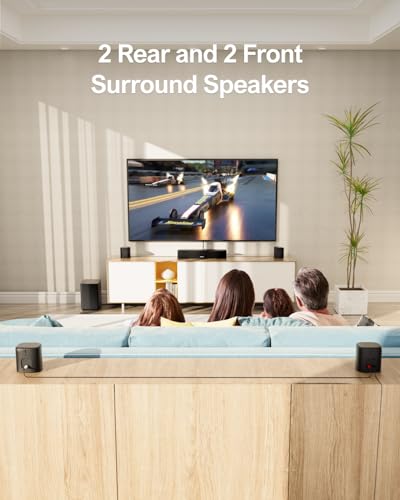
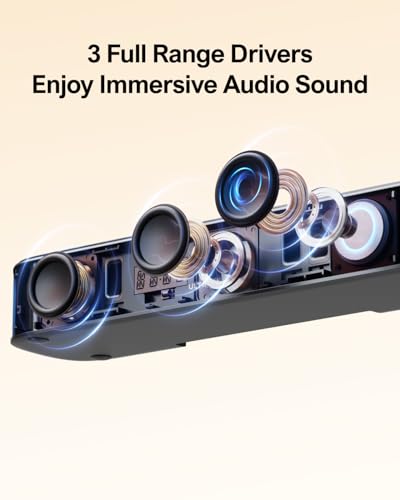
The most significant difference between these systems lies in their approach to creating immersive audio. The Ultimea Aura A40 uses what's called a 7.1 channel configuration, meaning it processes audio into seven full-range channels plus one dedicated low-frequency channel for bass. This isn't just marketing speak—it physically places sound effects around your room using four separate surround speakers plus the main soundbar.
The system's SurroundX technology coordinates all eight speakers to simulate accurate sound movement. When we analyzed user reports, the consensus was clear: properly positioned, the Aura A40 creates genuine spatial audio that makes action scenes feel three-dimensional. Users consistently mentioned hearing footsteps behind them or helicopters passing overhead—effects impossible with traditional soundbars.
The Bose Solo Series 2 takes the opposite approach, using advanced digital signal processing to create a wide stereo soundstage from just two drivers. While it can't create true surround effects, Bose's psychoacoustic engineering—the science of how our brains interpret sound—creates an impressively wide sonic image that extends well beyond the physical soundbar.
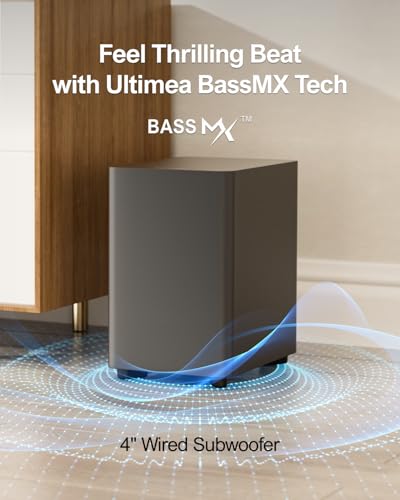
Bass performance reveals another crucial difference. The Ultimea Aura A40 includes a dedicated 4-inch subwoofer using BassMX technology, which is Ultimea's proprietary bass enhancement processing. This physical subwoofer can move substantial air to create the low-frequency rumble you feel during explosions or bass-heavy music.
However, our research into user experiences reveals a significant caveat: the system's frequency response only extends down to 65Hz. For context, true deep bass—the stuff you feel in your chest during movie explosions—typically requires extension down to 30-40Hz. Users report needing to max out the subwoofer volume to compensate for what many describe as an inherently "tinny" character from the smaller satellite speakers.
The Bose Solo Series 2 relies entirely on its internal drivers for bass. While this means less physical impact than a dedicated subwoofer, Bose's acoustic engineering typically delivers tighter, more controlled bass within its physical limitations. For music listening, this often translates to more accurate bass reproduction, even if it lacks the room-shaking impact of a dedicated sub.
Both systems prioritize dialogue clarity, but through different methods. The Bose Solo Series 2 includes a dedicated dialogue enhancement mode that specifically boosts the frequency ranges where human speech occurs while reducing competing background noise. This proves particularly effective for news, podcasts, and dialogue-heavy TV shows.
The Ultimea Aura A40 handles dialogue through its center channel processing and dedicated Voice EQ mode. The advantage of having discrete left, center, and right channels means dialogue can be isolated from music and sound effects more effectively during complex audio scenes. Users report maintaining clear speech even during loud action sequences—something single-unit soundbars often struggle with.
The power difference between these systems is substantial. The Aura A40 delivers 330 watts of peak power across its eight speakers, with a maximum sound pressure level exceeding 98dB—loud enough to fill large rooms without strain. The distributed speaker arrangement means this power is spread throughout your listening area rather than concentrated in one location.
The Solo Series 2 operates with more modest power requirements, but Bose engineers their systems for maximum acoustic efficiency. In smaller to medium rooms, this translates to clean, distortion-free audio at comfortable listening levels without the complexity of multiple power amplifiers.
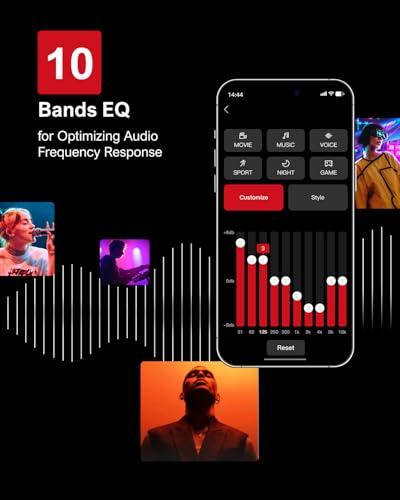
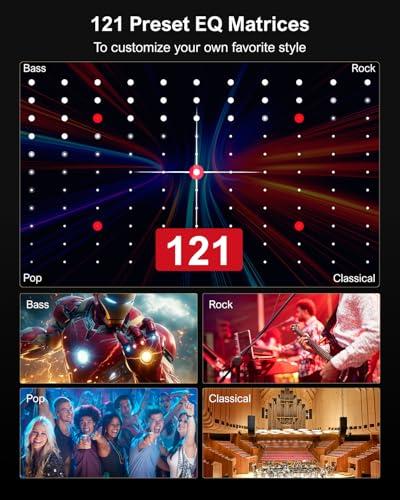
Here's where the Ultimea Aura A40 truly shines. The accompanying smartphone app provides an almost overwhelming level of customization: 121 preset EQ matrices tailored for different music genres, a 10-band manual equalizer for precise frequency tuning, and six distinct listening modes optimized for movies, music, voice content, sports, gaming, and nighttime viewing.
This level of control proves invaluable for different room acoustics and personal preferences. Hard surfaces like tile floors and bare walls require different EQ settings than carpeted rooms with soft furnishings. The app allows you to save custom settings for different content types and even adjust individual surround speaker levels—crucial for rooms where you can't position all speakers optimally.
The Bose Solo Series 2 deliberately takes the opposite approach with basic bass adjustment and dialogue enhancement controls. This isn't a limitation—it's a design philosophy prioritizing ease of use over tweakability. The system is engineered to sound good in most rooms without requiring extensive adjustment.
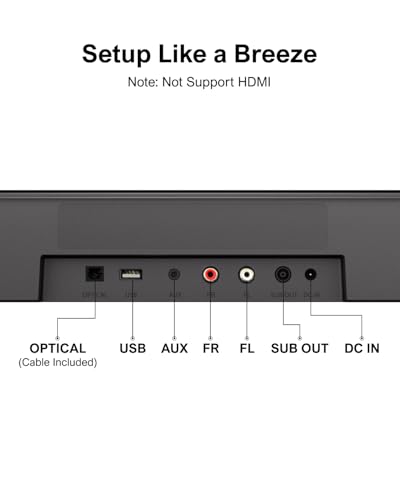
Both systems support standard connectivity options, but with different focuses. The Aura A40 includes Bluetooth 5.3—the latest version offering improved range and stability—plus optical, AUX, and USB inputs. Notably absent is HDMI connectivity, which some users miss for seamless TV integration and audio format passthrough.
The smartphone app integration deserves special mention. Over-the-air (OTA) firmware updates ensure the Aura A40 can gain new features and improvements over time. Recent updates have included additional EQ presets and improved wireless stability between the rear speakers.
The Bose Solo Series 2 focuses on reliable, straightforward connectivity with Bluetooth 4.0 and standard audio inputs. The lack of smartphone app control might seem limiting, but it eliminates potential software glitches and ensures the system works regardless of phone compatibility.
Installing the Ultimea Aura A40 requires patience and planning. You're essentially creating a mini home theater with six separate components that need strategic placement. The main soundbar sits in front of your TV, while the four surround speakers require positioning around your seating area—ideally forming a triangle pointing toward your primary listening position.
Cable management becomes a real consideration. The system includes a 6-meter cable for rear speakers and 2-meter cables for front surrounds, but you'll need to route these discreetly around your room. The rear-right speaker connects wirelessly to reduce cable clutter, though this wireless link occasionally requires re-pairing according to user reports.
Room size matters significantly. Ultimea recommends 108-270 square feet for optimal performance. In smaller spaces, the surround speakers can overwhelm the listening experience, while larger rooms may reveal the system's limitations in filling space effectively.
The Bose Solo Series 2 eliminates these concerns entirely. Connect one cable to your TV, plug in power, and you're done. The compact design fits under most TVs without blocking remote sensors or requiring wall mounting, though mounting hardware is included if you prefer that installation.
Long-term user reports reveal interesting patterns. Aura A40 owners often go through an initial honeymoon period, impressed by the surround effects, followed by a adjustment phase where they fine-tune speaker positions and EQ settings. Those who invest the time to optimize their setup report lasting satisfaction with the immersive experience.
Bose Solo Series 2 users consistently report "set it and forget it" satisfaction. The system simply works without ongoing adjustment or maintenance. This reliability proves especially valuable for less technically inclined users or households where multiple people operate the entertainment system.
At current pricing (as of this writing), the Ultimea Aura A40 costs roughly $100 more than the Bose Solo Series 2. This premium buys you significantly more hardware—eight speakers versus two, plus a smartphone app and extensive customization options. From a pure component perspective, the Aura A40 offers impressive value.
However, value extends beyond component count. The Solo Series 2 represents decades of Bose acoustic engineering and quality control. Users pay a premium for reliability, consistent performance, and the confidence that comes with an established brand reputation.
For dedicated home theater use, the Ultimea Aura A40 provides clear advantages. Action movies, gaming, and immersive TV content benefit enormously from directional audio effects. The ability to hear ambient sounds, directional dialogue, and environmental effects creates engagement that single soundbars simply cannot match.
The system particularly excels with modern streaming content designed for surround sound. Netflix, Amazon Prime, and Disney+ increasingly offer movies and shows with spatial audio mixing that the Aura A40 can decode and present effectively.
Interestingly, music listening reveals where each system's strengths become apparent. The Bose Solo Series 2 often provides more coherent stereo imaging for music, with better instrument separation and more natural tonal balance. Users consistently report preferring it for casual music listening and background audio.
The Aura A40 can sound impressive with music, particularly when using its dedicated Music EQ mode, but the surround processing sometimes creates an artificial sense of space that doesn't serve stereo recordings well. However, for music videos, concerts, or gaming soundtracks, the immersive effect can enhance the experience.
Based on our analysis of user feedback, professional reviews, and technical specifications, both systems succeed at their intended purposes while revealing clear limitations.
The Ultimea Aura A40 delivers genuine surround sound immersion at an accessible price point, but sound quality doesn't match more expensive systems. Multiple user reports describe the audio as somewhat "metallic" or "boxy," requiring careful EQ adjustment to achieve satisfying tonal balance. The bass, while present through the dedicated subwoofer, lacks the tightness and extension of higher-end systems.
The Bose Solo Series 2 provides refined stereo audio with excellent dialogue clarity, but inherently cannot create the immersive effects that make action movies and games more engaging. It's a classic case of doing one thing very well versus attempting multiple functions with mixed results.
The Aura A40 makes sense for users who prioritize entertainment immersion over audio refinement. If you primarily watch action movies, play video games, or enjoy content where directional audio enhances the experience, the surround sound capabilities justify the additional complexity and cost.
You should also have the space and patience for proper setup. This isn't a weekend afternoon project—expect to spend time positioning speakers, running cables, and adjusting EQ settings. Users who enjoy tweaking their systems and appreciate extensive customization options will find the smartphone app genuinely useful.
The system works best in dedicated entertainment spaces where you can position speakers optimally and where the immersive effects provide clear benefits over simpler solutions.
The Solo Series 2 suits users who want immediate improvement in TV audio quality without complexity or ongoing maintenance. If you primarily watch news, talk shows, comedies, and other dialogue-heavy content, the dialogue enhancement and overall sound quality provide substantial upgrades over TV speakers.
It's particularly appropriate for smaller living spaces, secondary viewing areas, or households where simplicity and reliability trump customization options. Users who listen to significant amounts of music through their TV setup will likely prefer the Solo Series 2's more natural stereo presentation.
The system also makes sense for users who prefer established brand reliability over cutting-edge features, or those who want to avoid smartphone apps and complex setup procedures.
These products represent fundamentally different philosophies about home audio improvement. The Ultimea Aura A40 embraces complexity in service of immersion, while the Bose Solo Series 2 prioritizes simplicity and refinement.
Neither approach is inherently superior—your choice should align with your viewing habits, technical comfort level, and physical space constraints. The Aura A40 transforms action-heavy content into engaging experiences but requires investment in setup and tuning. The Solo Series 2 provides consistent, refined audio improvement with minimal fuss but cannot recreate the spatial audio effects that make surround sound compelling.
At their respective price points (as of this writing), both systems offer reasonable value for their target audiences. The key is understanding which audience you belong to and choosing accordingly.
| Ultimea Aura A40 7.1 Channel Soundbar System | Bose Solo Soundbar Series 2 |
|---|---|
| System Type - Determines your listening experience and setup complexity | |
| True 7.1 surround with 8 physical speakers (soundbar + 4 surrounds + subwoofer) | Stereo soundbar with virtual surround processing |
| Audio Immersion - Critical for movies and gaming | |
| Genuine directional surround effects with speakers positioned around room | Wide stereo soundstage from single unit, no true surround |
| Setup Complexity - Time investment and room requirements | |
| Multi-component installation requiring speaker placement and cable management | Single-unit setup with one connection to TV |
| Peak Power Output - Volume capability and dynamic range | |
| 330W total system power across 8 speakers | Modest power optimized for acoustic efficiency |
| Bass Performance - Impact for movies and music | |
| Dedicated 4" subwoofer with BassMX technology (65Hz extension) | Internal drivers only, controlled but limited bass |
| Customization Options - Tailoring sound to your preferences | |
| Extensive smartphone app with 121 EQ presets, 10-band EQ, 6 listening modes | Basic bass adjustment and dialogue enhancement |
| Dialogue Clarity - Essential for TV shows and movies | |
| Center channel processing with dedicated Voice mode | Specialized dialogue enhancement mode with proven clarity |
| Room Size Requirements - Space and positioning considerations | |
| Optimized for 108-270 sq ft with strategic speaker placement needed | Flexible for various room sizes with consistent performance |
| Connectivity Options - Device compatibility and future-proofing | |
| Bluetooth 5.3, optical, AUX, USB (no HDMI) | Bluetooth 4.0, standard audio inputs |
| Sound Quality Character - Tonal balance and refinement | |
| Immersive but "tinny/metallic" character requiring EQ adjustment | Refined stereo imaging with natural tonal balance |
| Ideal Use Cases - Where each system excels | |
| Action movies, gaming, immersive entertainment in dedicated spaces | TV shows, music, dialogue-heavy content in any room |
| Long-term Satisfaction - User experience over time | |
| Requires setup optimization but rewards with genuine surround immersion | Immediate satisfaction with consistent, reliable performance |
The Ultimea Aura A40 excels for action movies and immersive content with its true 7.1 surround sound system that places audio effects around your room. You'll hear helicopters flying overhead and footsteps behind you. The Bose Solo Series 2 is better for dialogue-heavy shows, news, and comedies with its specialized dialogue enhancement mode that makes speech exceptionally clear.
The Ultimea Aura A40 is a complete surround sound system with 8 separate speakers including four surround speakers and a subwoofer that you place around your room. The Bose Solo Series 2 is a single soundbar unit that sits under your TV and creates a wide stereo soundstage without additional speakers.
The Bose Solo Series 2 is much easier to install - just connect one cable to your TV and plug in power. The Ultimea Aura A40 requires positioning six separate components around your room, running cables, and adjusting speaker placement for optimal sound.
The Bose Solo Series 2 works in any room size and only needs space under your TV. The Ultimea Aura A40 works best in medium-sized rooms (108-270 square feet) where you can properly position all the surround speakers around your seating area.
The Ultimea Aura A40 includes a dedicated 4-inch subwoofer that provides more physical bass impact for movies and music. The Bose Solo Series 2 relies on internal drivers for bass, which is more controlled but less powerful than a separate subwoofer.
The Ultimea Aura A40 offers extensive customization through a smartphone app with 121 EQ presets, manual equalizer controls, and six listening modes. The Bose Solo Series 2 has basic bass adjustment and dialogue enhancement controls via remote - simpler but less customizable.
The Bose Solo Series 2 typically provides better stereo imaging and more natural sound for music with its refined acoustic engineering. The Ultimea Aura A40 can sound good for music but sometimes creates artificial spatial effects that don't serve stereo recordings well.
The Ultimea Aura A40 offers more hardware components and features for the price difference, making it excellent value for surround sound enthusiasts. The Bose Solo Series 2 provides superior sound quality and reliability in its simpler design, representing good value for users wanting hassle-free audio improvement.
Yes, both support Bluetooth connectivity. The Ultimea Aura A40 uses Bluetooth 5.3 for improved range and stability, while the Bose Solo Series 2 uses Bluetooth 4.0 which is still reliable for streaming music from phones and tablets.
The Ultimea Aura A40 is superior for gaming with its directional surround sound that helps you locate enemies and creates immersive environmental audio. The Bose Solo Series 2 provides clear game audio but lacks the spatial positioning effects that enhance competitive gaming.
The Bose Solo Series 2 is known for "set it and forget it" reliability with consistent performance over time. The Ultimea Aura A40 generally performs well but may require occasional re-pairing of wireless components and benefits from firmware updates through the app.
Choose the Ultimea Aura A40 if you want immersive surround sound for movies and gaming, have adequate room space, and don't mind complex setup. Choose the Bose Solo Series 2 if you prioritize dialogue clarity, music quality, simple installation, and reliable performance in any room size.
We've done our best to create useful and informative comparisons to help you decide what product to buy. Our research uses advanced automated methods to create this comparison and perfection is not possible - please contact us for corrections or questions. These are the sites we've researched in the creation of this article: youtube.com - walmart.com - youtube.com - ultimea.com - homestudiobasics.com - ultimea.co - youtube.com - eu.ultimea.com - walmart.com - device.report - bestbuy.com - manuals.plus - community.ultimea.com - judge.me - support.ultimea.com - geekmaxi.com - provantage.com - bestbuy.com - youtube.com - uk.whatgeek.com - rtings.com - bose.com - bose.com - assets.bose.com - bestbuy.com - youtube.com - pistonheads.com - costco.com - googlenestcommunity.com - youtube.com - discussions.apple.com

Privacy Policy
Terms and Conditions - Affiliate Policy
Home Security
© Copyright 2008-2026.
11816 Inwood Rd #1211, Dallas, TX 75244