






Premium soundbars have become the sweet spot for home theater audio—delivering cinema-quality sound without the complexity of traditional surround systems. But choosing between different approaches can be confusing, especially when comparing products as different as the Samsung HW-Q990F and Sennheiser AMBEO Mini.
These two soundbars represent fundamentally different philosophies. The Samsung Q990F takes the traditional multi-component route with separate speakers placed around your room, while the Sennheiser AMBEO Mini uses cutting-edge audio processing to create surround sound from a single compact unit. Both launched in the early 2020s and represent the current state-of-the-art in their respective approaches.
Before diving into specifics, it helps to understand what makes premium soundbars different from basic models. Basic soundbars simply make TV dialogue louder and clearer. Premium models aim to create immersive, three-dimensional audio experiences that transport you into movies and music.
The key technology here is spatial audio—formats like Dolby Atmos and DTS:X that encode not just left and right channels, but also overhead and surround information. Think of it as audio that moves around and above you, rather than just coming from in front. A helicopter in a movie should sound like it's actually flying overhead, not just louder on the left or right side.
Premium soundbars achieve this through two main approaches: physical surround sound using multiple separate speakers, or virtualization technology that uses psychoacoustic processing (fancy term for tricking your brain into hearing sounds that aren't really there) to create the illusion of surround sound from fewer speakers.
The other major consideration is bass performance. Deep, powerful low frequencies require moving a lot of air, which typically means larger speakers or dedicated subwoofers. This is where the physics of sound reproduction becomes important—you simply can't get room-shaking bass from tiny drivers, no matter how clever the engineering.
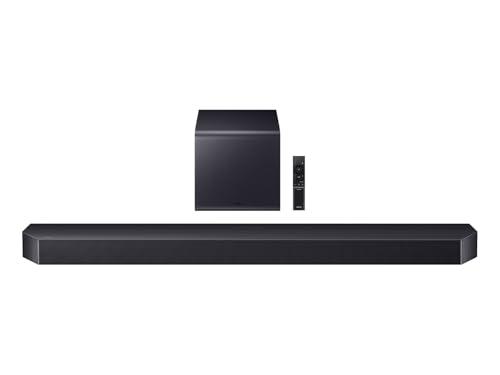
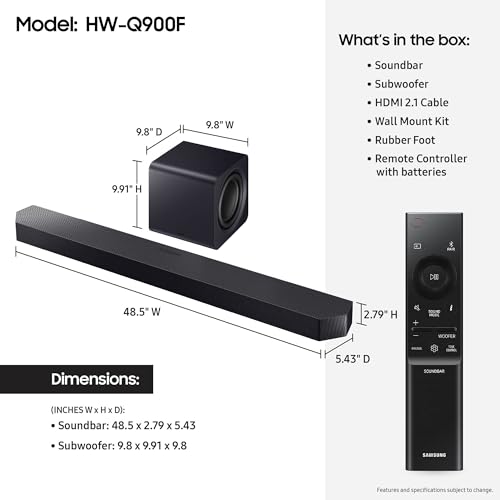
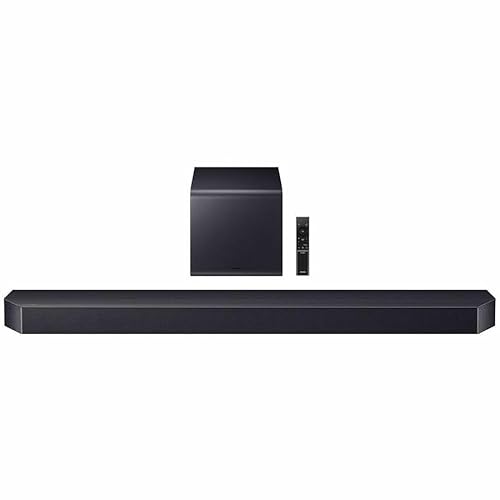
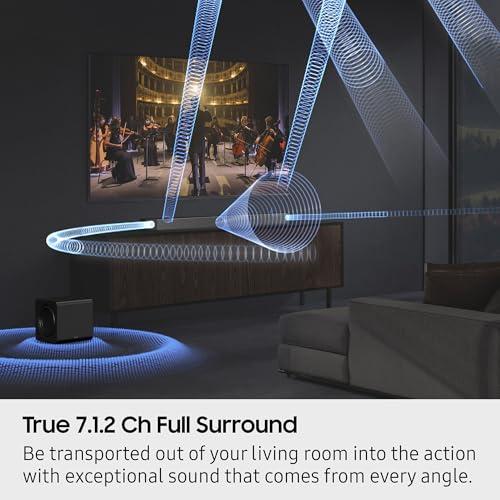
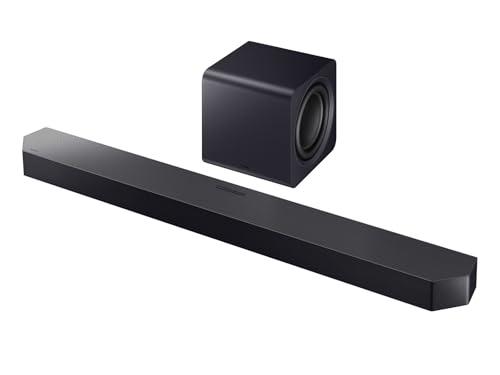
The Samsung Q990F, released in 2024, represents Samsung's flagship approach to home theater audio. At its core, it's actually four separate products working together: a main soundbar, a wireless subwoofer, and two wireless rear speakers. This system deploys 23 individual speakers across these components to create what Samsung calls 11.1.4-channel surround sound.
Let me break down what those numbers mean. The "11" represents eleven main channels—front left, center, right, side left, side right, wide left, wide right, surround left, surround right, and rear left and right. The "1" is the dedicated subwoofer channel handling deep bass. The "4" represents four height channels that create overhead effects by bouncing sound off your ceiling.
This physical approach has clear advantages. When a sound effect moves from front to rear in a movie, it's actually traveling between real speakers positioned around your room. There's no processing trickery—your ears hear genuine positional audio. The rear speakers, in particular, make a huge difference for immersion. Having actual speakers behind you creates that enveloping sensation you get in movie theaters.
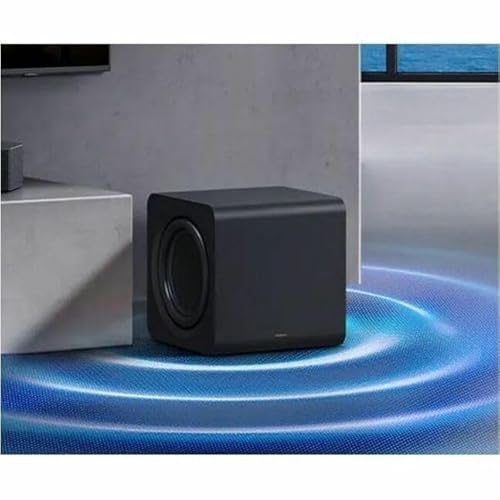
The Samsung Q990F also includes several technological improvements over earlier Samsung models. The subwoofer now uses dual force-canceling woofers, which means two drivers working in opposition to minimize vibration and cabinet resonance. This results in cleaner, tighter bass that doesn't rattle your furniture.
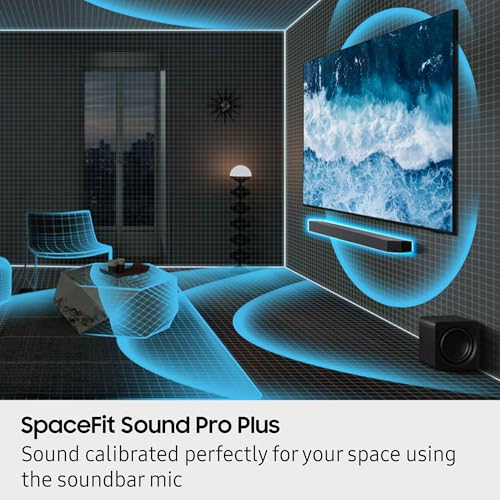
Samsung's SpaceFit Sound Pro technology automatically analyzes your room's acoustics and adjusts the sound accordingly. The system uses built-in microphones to measure how sound reflects off your walls and furniture, then optimizes the audio output for your specific space. This kind of room correction was once limited to expensive AV receivers, but Samsung has integrated it seamlessly into their soundbar ecosystem.
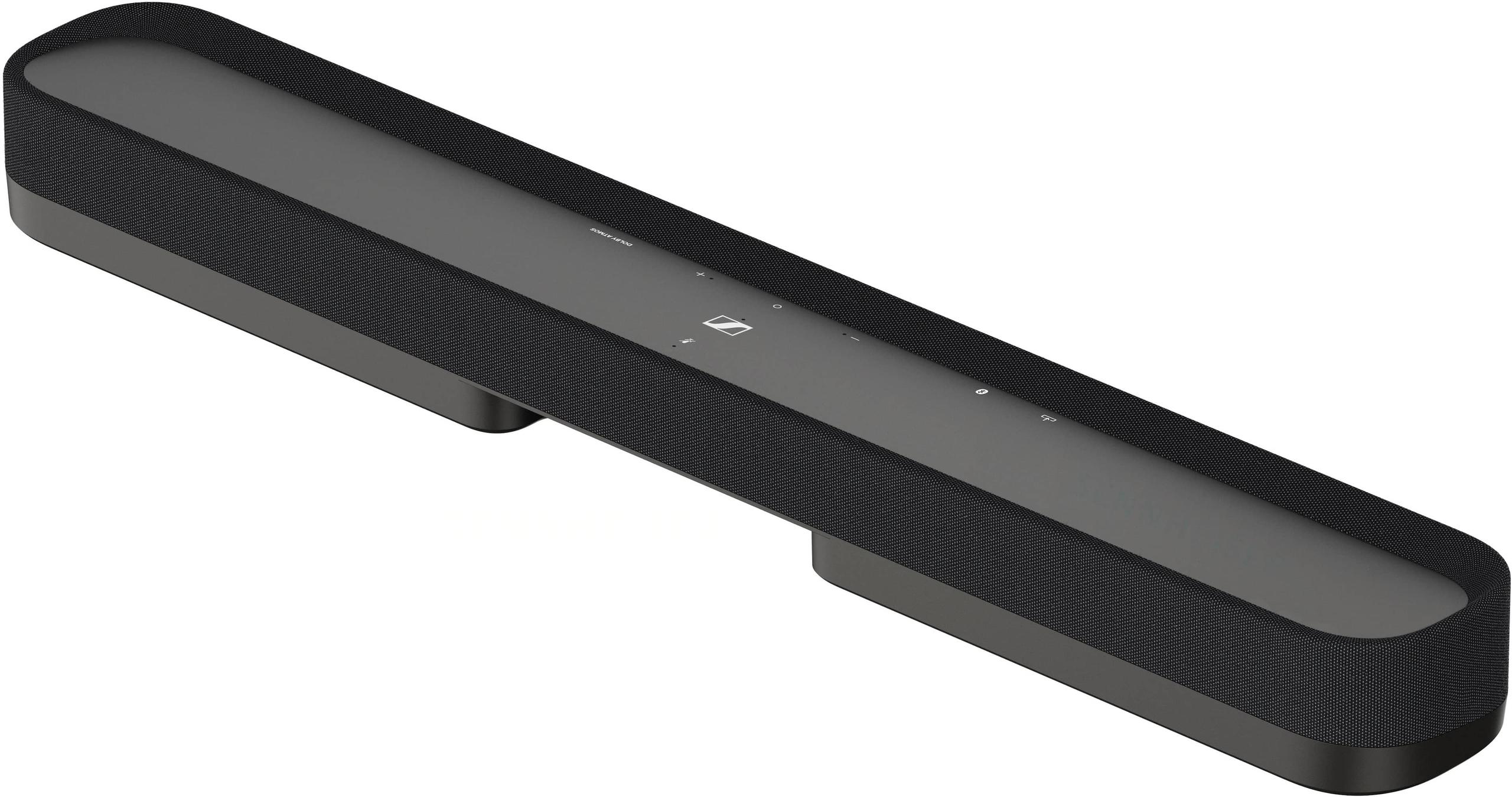
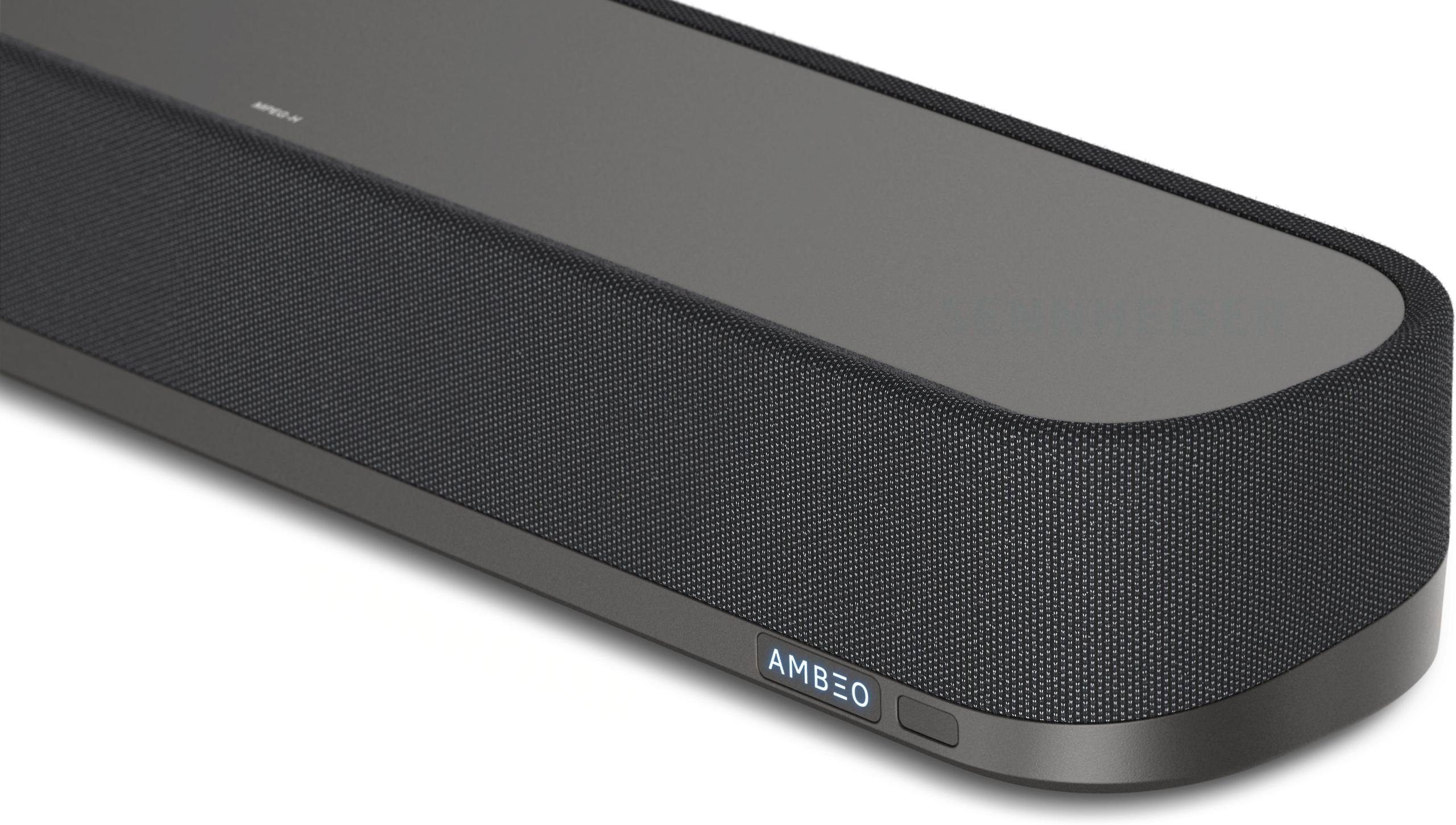
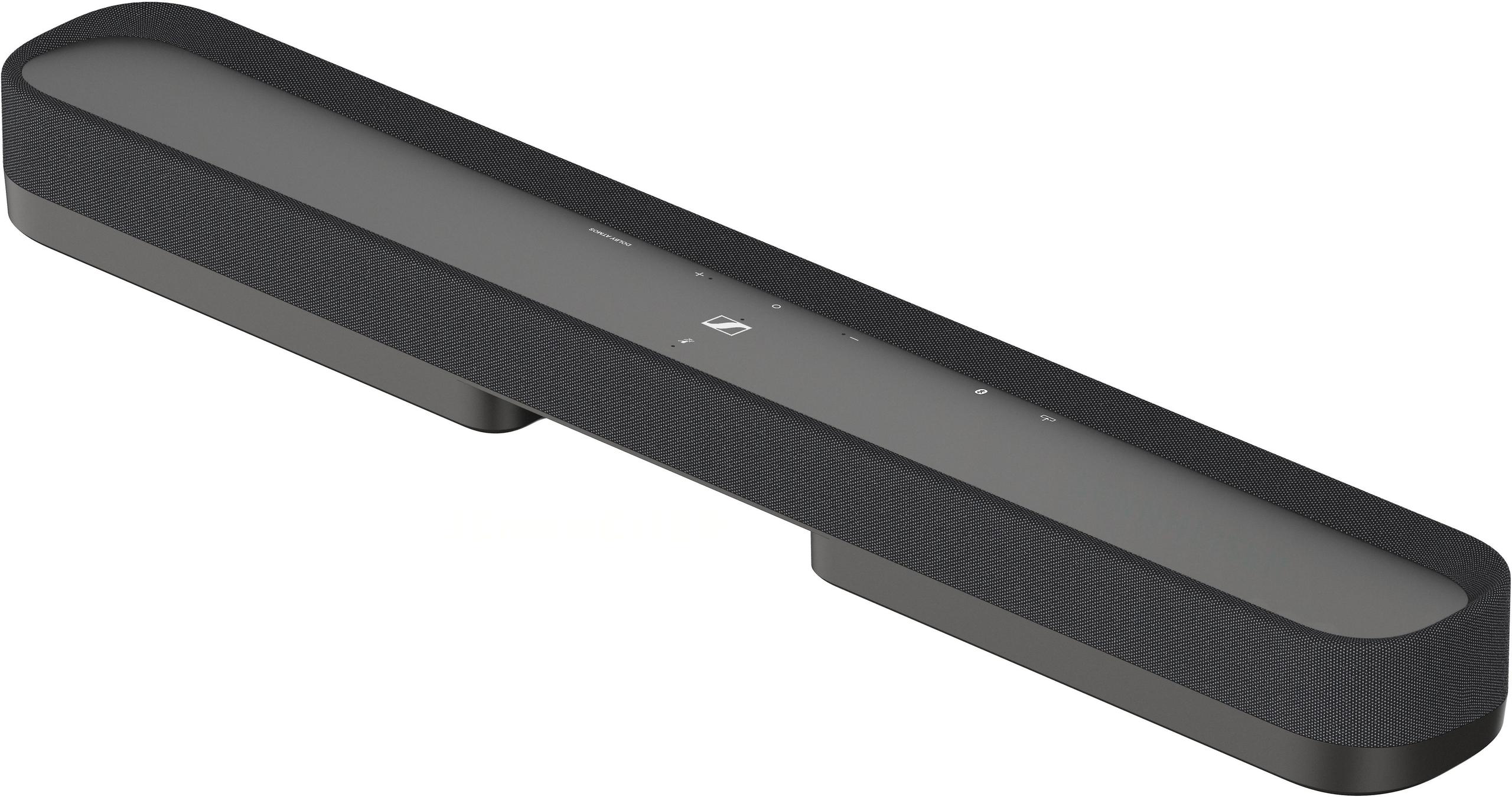
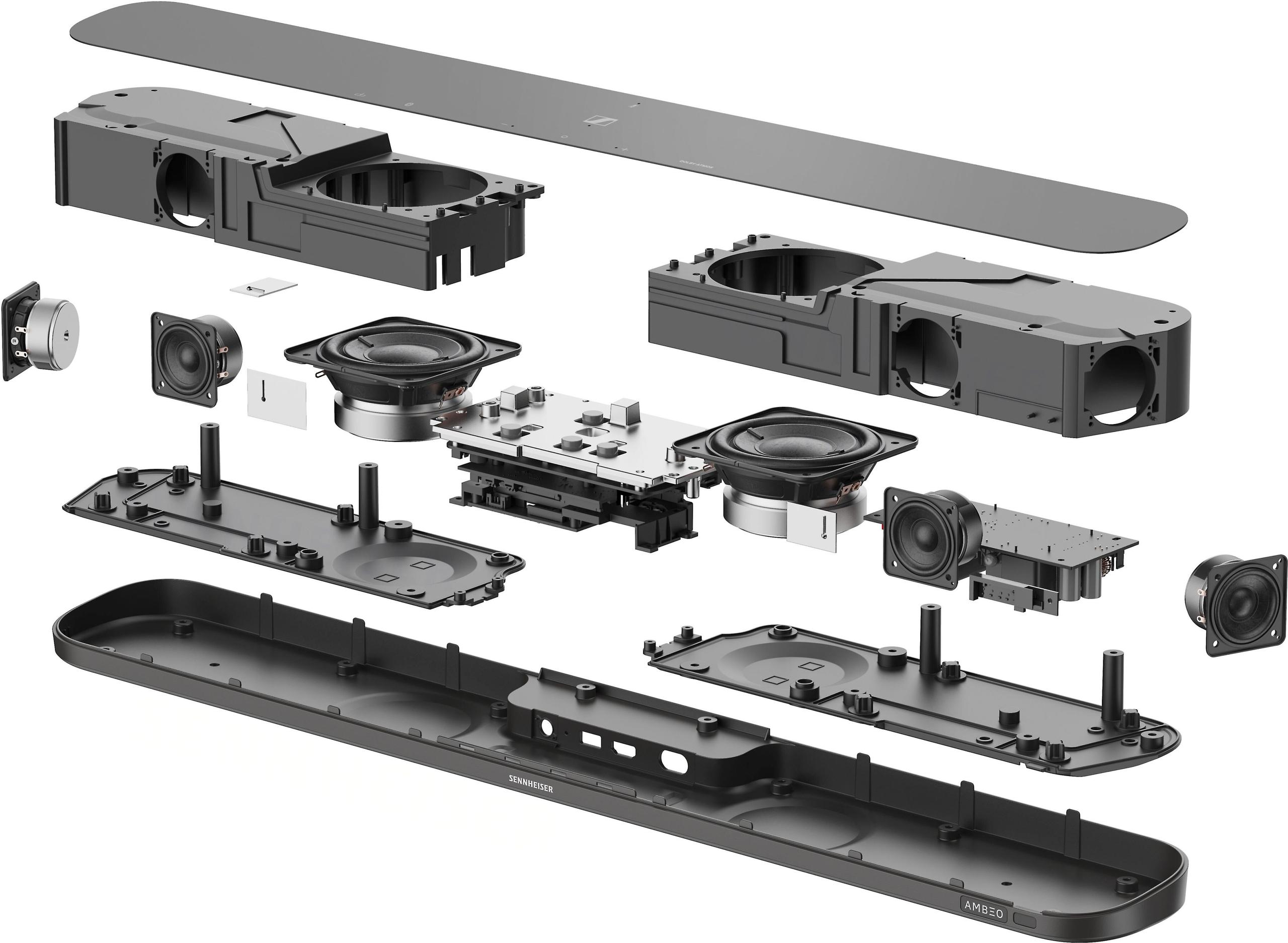
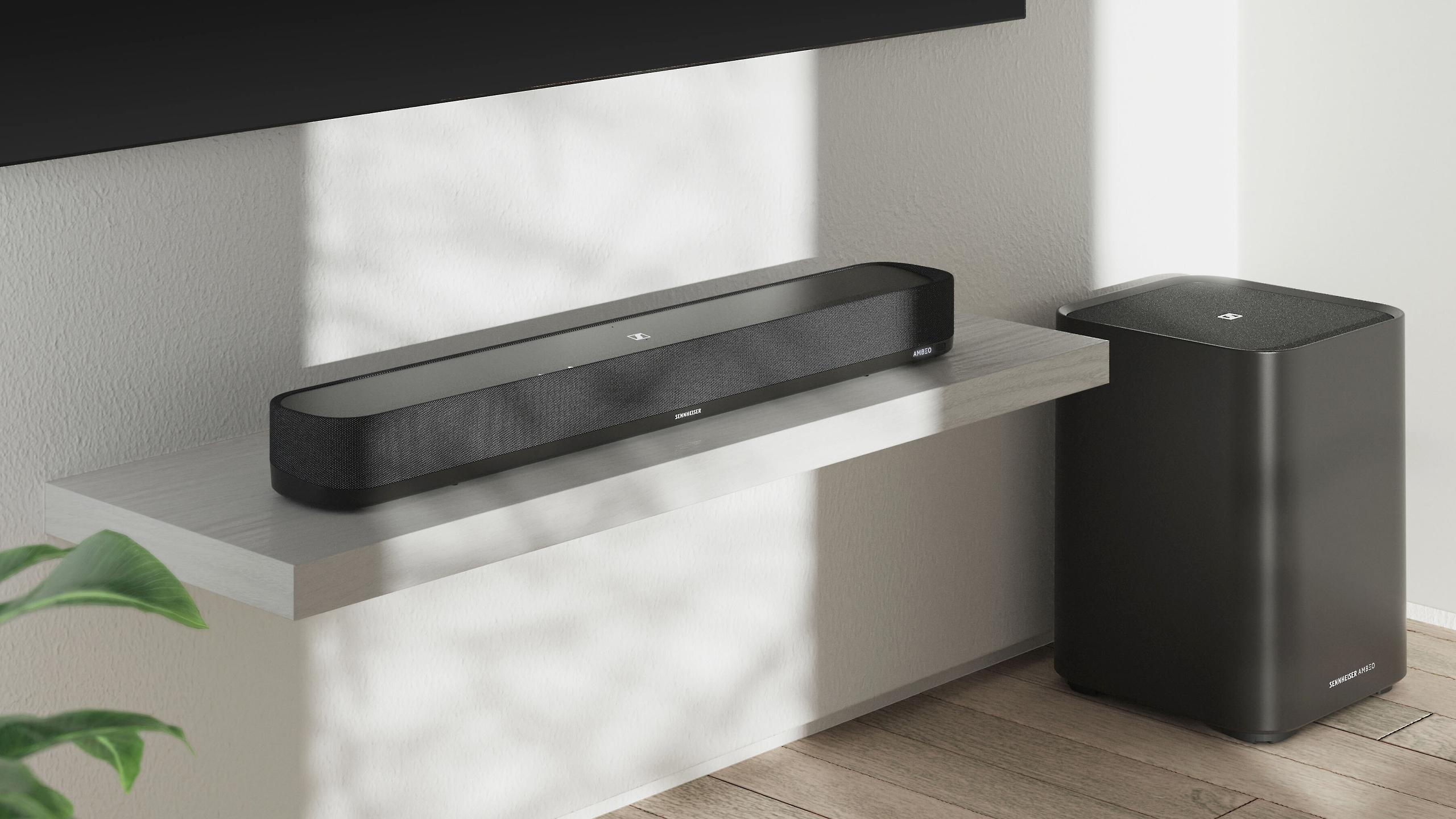
The Sennheiser AMBEO Mini, launched in 2023, takes a completely different approach. Rather than multiple physical speakers, it uses advanced signal processing developed with Germany's Fraunhofer Institute (the same organization that created the MP3 format) to create virtual surround sound from just six drivers in a single compact soundbar.
This AMBEO Virtualization Technology works by analyzing incoming audio and applying precise timing delays, phase adjustments, and frequency filtering to create phantom sound sources. Your brain interprets these carefully crafted audio cues as sounds coming from locations where no speakers actually exist. It sounds like science fiction, but the psychoacoustic principles are well-established.
The Sennheiser AMBEO Mini measures just 27.6 inches wide and weighs under 8 pounds, making it dramatically more compact than the Samsung system. Despite its size, it creates a virtual 7.1.4-channel soundstage—seven main channels plus four height channels, all from those six physical drivers.
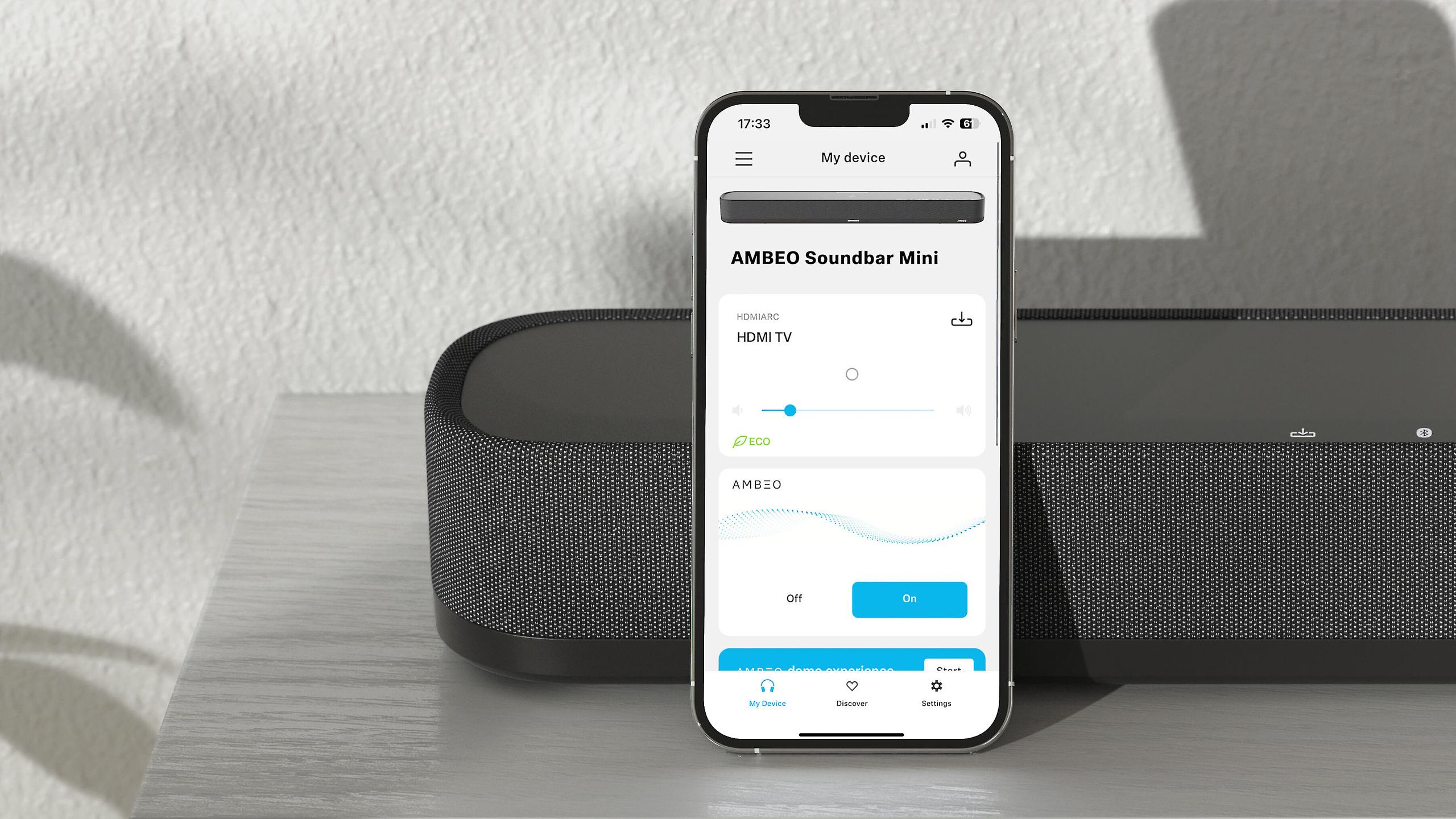
What's particularly clever is how Sennheiser handles different types of content. The system includes four AMBEO modes: Light, Regular, Boost, and Off. These adjust the intensity of the virtualization processing depending on your preferences and room acoustics. Some people prefer subtle surround effects, while others want maximum spatial processing.
The AMBEO Mini also excels at upmixing, which means taking regular stereo music or older 5.1 movie soundtracks and expanding them into immersive surround sound. This processing analyzes the stereo information and intelligently places different musical elements around the virtual soundstage. Vocals typically stay centered while instruments spread out across the room.
This is where the fundamental differences between these approaches become most apparent. The Samsung Q990F includes a dedicated wireless subwoofer with dual 8-inch drivers. This subwoofer can move serious air and produce deep, room-filling bass that you feel as much as hear. When an explosion happens in an action movie, you get that chest-thumping impact that makes the experience visceral.
The Sennheiser AMBEO Mini relies on two built-in 4-inch woofers for bass. While impressive for their size and capable of extending down to 43Hz (which is respectable), they simply cannot match the physical impact of a dedicated subwoofer. Physics wins here—larger drivers moving more air will always produce deeper, more powerful bass.
However, Sennheiser offers an optional separate subwoofer that transforms the system's bass performance. Adding this component brings the AMBEO Mini much closer to the Samsung's capabilities, though at additional cost.
From our research into user experiences, bass response becomes the deciding factor for many buyers. Those who listen to a lot of action movies, electronic music, or hip-hop consistently prefer systems with dedicated subwoofers. The physical sensation of deep bass adds to the emotional impact of content in ways that processing cannot replicate.
Your room size significantly influences which approach works better. The Samsung Q990F really shines in larger spaces—rooms over 300 square feet where the rear speakers can be properly positioned behind the seating area. The physical separation between components creates a genuine surround field that envelops the entire listening area.
However, this multi-component setup requires careful planning. You need suitable locations for the subwoofer (typically in a corner or along a wall) and the rear speakers (behind and slightly above ear level). While all components except the main soundbar are wireless, they still need power outlets. For some room layouts, this becomes challenging.
The Sennheiser AMBEO Mini excels in smaller spaces—apartments, bedrooms, or compact living rooms under 200 square feet. Its virtualization technology works particularly well when you're sitting relatively close to the soundbar. The single-unit design eliminates placement challenges and cable management concerns.
Setup complexity differs dramatically between these systems. The Samsung Q990F requires positioning four separate components and running through room calibration, typically taking 20-30 minutes. The AMBEO Mini completes its automatic room calibration in about 2 minutes using built-in microphones.
For gaming enthusiasts, spatial audio accuracy becomes crucial. In competitive shooters, hearing footsteps from the correct direction can mean the difference between victory and defeat. The Samsung Q990F's physical rear speakers provide genuine positional audio that gamers consistently praise in reviews.
The Samsung system also includes Game Pro Mode, which optimizes audio processing for lower latency and enhanced directional cues. Its HDMI 2.1 inputs support 4K gaming at 120Hz with HDR, making it ideal for PlayStation 5 and Xbox Series X owners.
The Sennheiser AMBEO Mini handles casual gaming well, but its virtual surround positioning proves less precise for competitive scenarios. Additionally, its single HDMI connection means all gaming devices must connect through your TV, potentially introducing latency.
Music reproduction reveals interesting differences between these systems. The Samsung Q990F provides a fuller, more dynamic presentation thanks to its dedicated subwoofer, making it excellent for genres that rely on deep bass. However, some users find Samsung's processing occasionally overshadows subtle musical details.
The Sennheiser AMBEO Mini takes a more purist approach to music. Its midrange clarity is exceptional, making it particularly good for vocal-focused content like jazz, acoustic, or folk music. The system's extensive streaming connectivity—including Spotify Connect, Tidal Connect, and AirPlay 2—makes it more convenient for music-focused users.
Sennheiser's upmixing technology works surprisingly well with stereo music, creating an expansive soundstage without sounding artificial. Classical music, in particular, benefits from this processing, with instruments spreading naturally across the virtual space.
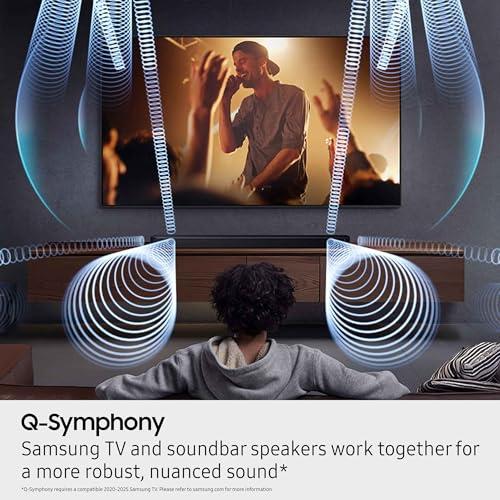
The Samsung Q990F includes multiple HDMI inputs, allowing direct connection of gaming consoles, Blu-ray players, or streaming devices. This is particularly valuable if your TV lacks sufficient HDMI ports. The system also features Q-Symphony technology, which synchronizes the soundbar with compatible Samsung TV speakers for an even fuller soundstage.
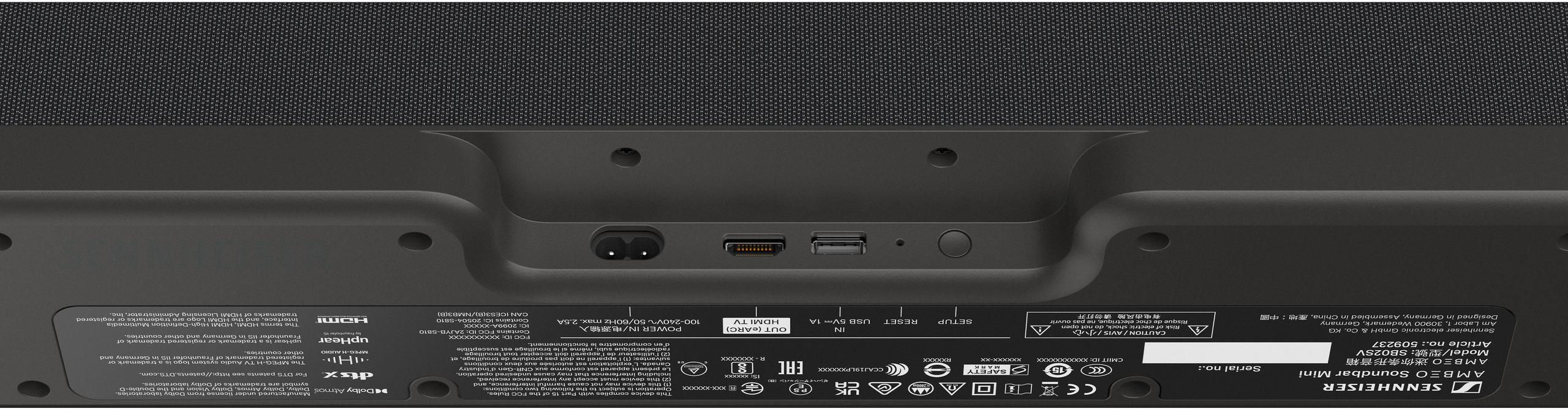
The Sennheiser AMBEO Mini takes a more streamlined approach with just one HDMI connection, requiring all devices to connect through your TV. However, it compensates with superior wireless connectivity, including Wi-Fi 6 support and extensive streaming service integration.
Both systems include voice control through Alexa, though the Samsung integrates more seamlessly with Samsung's SmartThings ecosystem.
At the time of writing, the Samsung Q990F commands a significant price premium—roughly 2.5 times the cost of the Sennheiser AMBEO Mini. However, this comparison becomes more nuanced when considering what's included.
The Samsung system includes four separate components that would cost considerably more if purchased individually from other manufacturers. Building a comparable 11.1.4 system with separate receivers and speakers typically costs 50-100% more than the Samsung package.
The Sennheiser AMBEO Mini offers exceptional value for its compact design and advanced processing technology. However, adding Sennheiser's optional subwoofer increases the total investment significantly, though still remaining less expensive than the Samsung package.
From our analysis of user feedback, buyers rarely regret spending more for the Samsung system if they have the room and budget for it. Conversely, AMBEO Mini owners consistently appreciate its convenience and are often surprised by its performance capabilities.
The Samsung HW-Q990F is the clear choice for serious home theater enthusiasts with larger rooms and generous budgets. Its physical surround implementation provides the most convincing spatial audio experience available in the soundbar category. If you watch a lot of action movies, play games competitively, or want maximum bass impact, the Samsung system justifies its premium pricing.
The Sennheiser AMBEO Mini makes more sense for space-conscious users who prioritize convenience without completely sacrificing performance. Its virtualization technology is genuinely impressive, and the single-unit design eliminates the complexity of multi-component systems. If you live in an apartment, prioritize music listening, or simply want excellent sound without the hassle, the AMBEO Mini delivers exceptional value.
Consider your specific situation carefully. Larger rooms benefit from the Samsung's physical separation and powerful bass. Smaller spaces often work better with the Sennheiser's compact design and room-adaptive processing. Your content preferences matter too—action movie fans typically prefer the Samsung, while music lovers often gravitate toward the Sennheiser.
Both represent the current state-of-the-art in their respective approaches, and either will dramatically improve your audio experience over basic TV speakers or entry-level soundbars. The choice ultimately comes down to matching the technology approach to your space, preferences, and priorities.
| Samsung HW-Q990F | Sennheiser AMBEO Mini |
|---|---|
| Physical Design - Determines setup complexity and room requirements | |
| Multi-component system: main soundbar + wireless subwoofer + 2 rear speakers | Single compact soundbar (27.6" wide, 2.6" tall) |
| Audio Channels - More channels mean better surround positioning | |
| True 11.1.4 channels with 23 physical speakers | Virtual 7.1.4 channels with 6 physical drivers |
| Bass Performance - Critical for action movies and music with deep low-end | |
| Dedicated wireless subwoofer with dual force-canceling woofers | Built-in dual 4" woofers (43Hz response), optional separate sub available |
| Surround Sound Method - Affects immersion quality and room coverage | |
| Physical rear speakers for authentic surround positioning | AMBEO virtualization technology creates phantom surround speakers |
| Room Size Optimization - Match your space for best performance | |
| Best for rooms 300+ sq ft with proper speaker placement | Optimized for compact spaces under 200 sq ft |
| Setup Time - Consider installation complexity | |
| 20-30 minutes with multiple component positioning | 2 minutes with automatic room calibration |
| HDMI Connectivity - Important for gaming and multiple devices | |
| 2 HDMI inputs + 1 eARC output with 4K/120Hz pass-through | 1 HDMI eARC only (all devices connect through TV) |
| Gaming Features - Matters for competitive and console gaming | |
| Game Pro Mode, physical rear speakers for precise positioning | Virtual surround adequate for casual gaming only |
| Music Streaming - Convenience for wireless music playback | |
| Basic wireless support (AirPlay 2, Google Cast) | Extensive native support (Spotify Connect, Tidal Connect, AirPlay 2, Chromecast) |
| Smart TV Integration - Added value if you own compatible TVs | |
| Q-Symphony with Samsung TVs for enhanced soundstage | Works with any TV brand via HDMI eARC |
| Calibration Technology - Automatically optimizes sound for your room | |
| SpaceFit Sound Pro with embedded sensors | Built-in microphones with AMBEO room analysis |
| Price Category - Value proposition differs significantly | |
| Premium tier (roughly 2.5x more than Sennheiser) | Mid-premium tier with optional subwoofer upgrade available |
The Sennheiser AMBEO Mini is specifically designed for compact spaces under 200 square feet. Its single-unit design and virtualization technology work best when you're sitting closer to the soundbar. The Samsung HW-Q990F requires more space for its subwoofer and rear speakers to be properly positioned.
The Samsung HW-Q990F includes physical rear speakers that provide authentic surround positioning, making it ideal for true home theater experiences. The Sennheiser AMBEO Mini creates virtual surround sound from a single bar, which is impressive but less precise than physical speakers placed behind you.
The Samsung HW-Q990F delivers significantly better bass with its dedicated wireless subwoofer featuring dual force-canceling woofers. The Sennheiser AMBEO Mini has built-in bass drivers that are good for its size but cannot match the depth and impact of a dedicated subwoofer.
The Sennheiser AMBEO Mini is much easier to set up, requiring just 2 minutes for automatic room calibration as a single unit. The Samsung HW-Q990F takes 20-30 minutes to position four separate components (soundbar, subwoofer, and two rear speakers) and complete calibration.
The Samsung HW-Q990F is superior for gaming, especially competitive play, thanks to its physical rear speakers providing precise directional audio. It also includes Game Pro Mode and supports 4K/120Hz pass-through. The Sennheiser AMBEO Mini works fine for casual gaming but lacks the positioning accuracy serious gamers prefer.
Yes, both the Samsung HW-Q990F and Sennheiser AMBEO Mini work with any TV that has HDMI eARC. However, the Samsung offers additional Q-Symphony features when paired with Samsung TVs, allowing the TV and soundbar speakers to work together.
The Sennheiser AMBEO Mini excels at music with superior streaming connectivity (Spotify Connect, Tidal Connect) and more natural sound reproduction. The Samsung HW-Q990F provides fuller sound with deeper bass but can sometimes over-process musical content.
The Samsung HW-Q990F includes 2 HDMI inputs plus 1 eARC output, allowing direct connection of gaming consoles and other devices. The Sennheiser AMBEO Mini has only 1 HDMI eARC connection, requiring all devices to connect through your TV.
Value depends on your needs. The Sennheiser AMBEO Mini offers excellent performance for its compact design and lower price point. The Samsung HW-Q990F costs significantly more but includes a complete surround system that would cost much more if purchased as separate components.
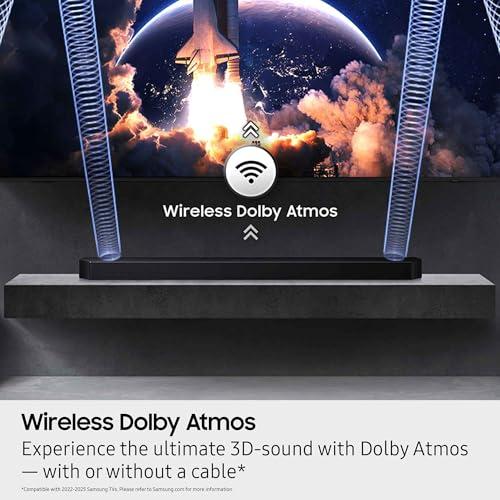
Yes, both the Samsung HW-Q990F and Sennheiser AMBEO Mini support Dolby Atmos. The Samsung uses physical upward-firing drivers to bounce sound off your ceiling, while the Sennheiser creates virtual height effects through advanced processing.
The Samsung HW-Q990F is designed for larger spaces over 300 square feet. Its separate components can be properly positioned throughout the room for optimal surround sound. The Sennheiser AMBEO Mini works best in smaller, more intimate spaces where its virtualization technology is most effective.
Yes, Sennheiser offers an optional separate subwoofer that can be added to the AMBEO Mini system. This upgrade significantly improves bass performance, though it increases the total cost and adds another component to your setup, somewhat reducing the single-unit convenience advantage.
We've done our best to create useful and informative comparisons to help you decide what product to buy. Our research uses advanced automated methods to create this comparison and perfection is not possible - please contact us for corrections or questions. These are the sites we've researched in the creation of this article: rtings.com - crutchfield.com - sound-advice.online - samsung.com - soundandvision.com - samsung.com - whathifi.com - youtube.com - youtube.com - bestbuy.com - avsforum.com - content.syndigo.com - samsung.com - businessinsider.com - dolby.com - youtube.com - abcwarehouse.com - techradar.com - sennheiser-hearing.com - stereonet.com - rtings.com - youtube.com - youtube.com - newsroom.sennheiser.com - whathifi.com - baybloorradio.com - sennheiser-hearing.com - files.bbystatic.com

Privacy Policy
Terms and Conditions - Affiliate Policy
Home Security
© Copyright 2008-2026.
11816 Inwood Rd #1211, Dallas, TX 75244