



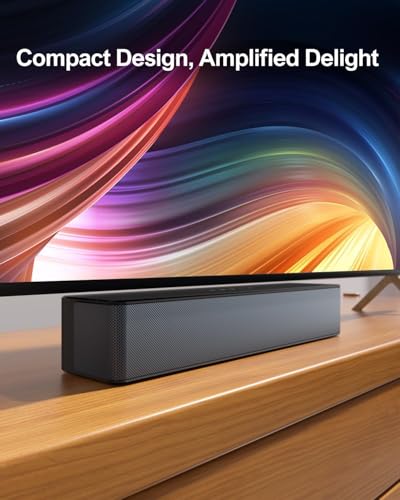
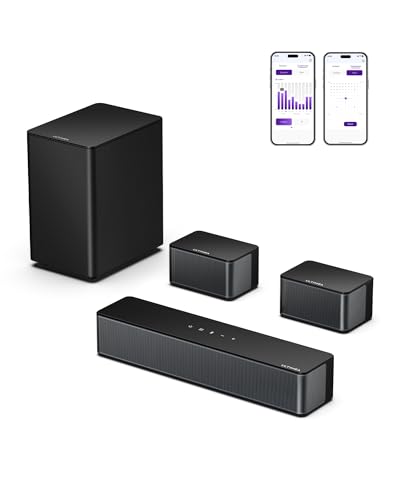



Shopping for a soundbar can feel overwhelming, especially when you're trying to squeeze the most value from a tight budget. Two products that consistently pop up in budget soundbar discussions are the Hisense HS2100 and the Ultimea Poseidon D50, both offering compelling but very different approaches to upgrading your TV's audio. At the time of writing, these systems compete directly on price while delivering fundamentally different experiences.
Before diving into specifics, it's worth understanding what soundbars actually solve. Modern TVs prioritize thin designs over audio quality, often cramming tiny speakers into spaces where physics simply doesn't allow for good sound. A soundbar essentially gives your TV the larger speakers it needs, but the approach matters enormously.
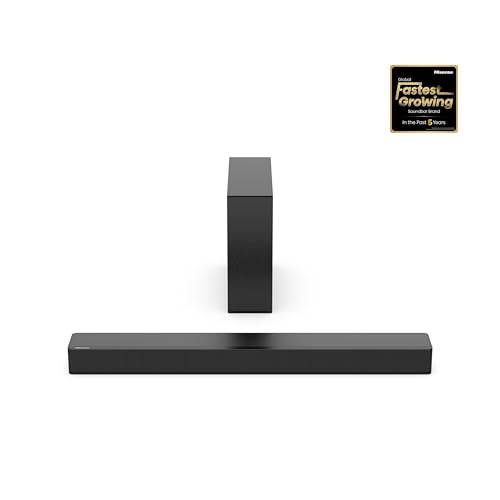
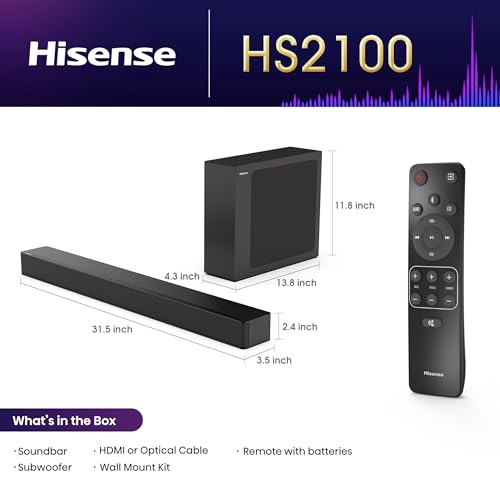
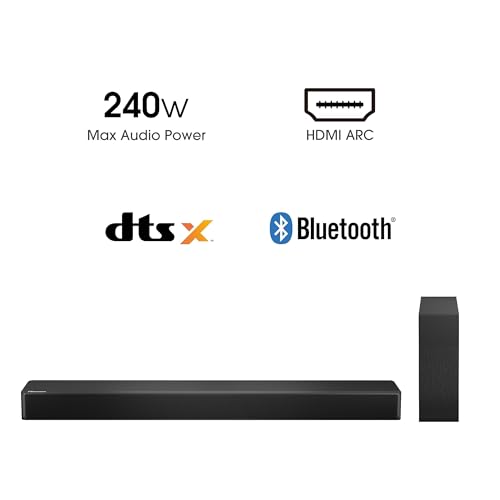
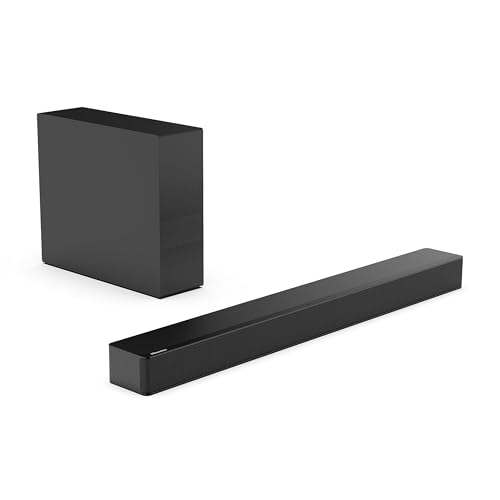
The Hisense HS2100, released in 2023, represents the "keep it simple" philosophy. It's a 2.1 system, meaning it has two main speakers (left and right channels) plus a separate subwoofer (the ".1") dedicated to bass frequencies below around 80-120 Hz. This setup focuses on making TV dialogue clearer and adding some bass punch without complicating your living room setup.
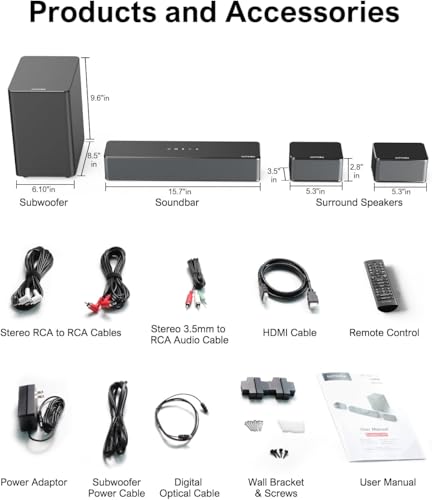
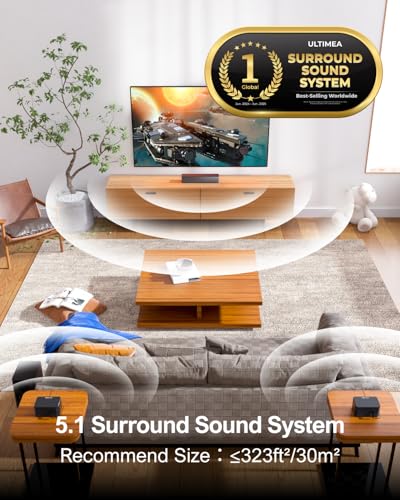
The Ultimea Poseidon D50, launched in 2025, takes the opposite approach. It's a true 5.1 system with five main speakers plus that subwoofer. The "5" includes front left, center, and right speakers in the main bar, plus two separate rear speakers that you physically place behind your seating area. This creates what's called "surround sound" – audio that can move around the room to match what's happening on screen.
When manufacturers throw around power numbers, they're often talking about "peak watts" – the maximum the system can handle for brief moments during explosive movie scenes. Real-world performance is more nuanced. The Hisense HS2100 claims 240W total power, while the Ultimea Poseidon D50 advertises 320W. But watts alone don't tell the whole story.
Based on professional measurements and user feedback, the Hisense HS2100 delivers what I'd call "refined adequacy." Its frequency response – how evenly it reproduces different pitches – measures fairly flat from about 45 Hz to 20 kHz. This means it won't drastically boost or cut certain frequencies, resulting in dialogue that sounds natural and music that doesn't feel overly colored. The system gets loud enough for most living rooms without the compression and distortion that plague many budget options.
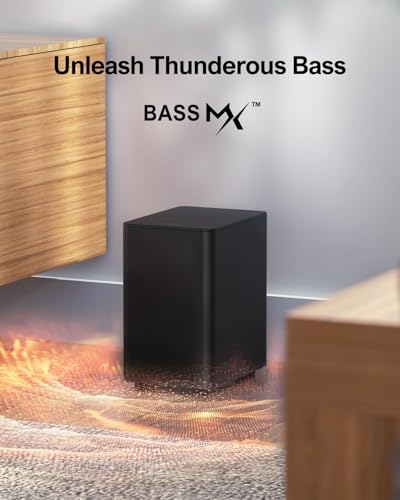
The Ultimea Poseidon D50 takes a more aggressive approach. Its 5.25-inch subwoofer with "BassMX" technology (essentially optimized magnet placement and enclosure tuning) digs deeper into bass frequencies and hits harder during action sequences. The additional power isn't just marketing fluff – you genuinely feel the difference during movie explosions or bass-heavy music. However, this comes with trade-offs in refinement, particularly when listening to acoustic music at higher volumes.
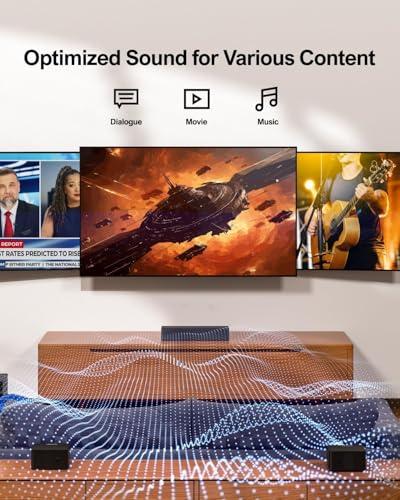
Here's where things get interesting. The fundamental difference between these systems isn't just power – it's spatial audio processing, or how they create the illusion of sound coming from different directions.
The Hisense HS2100 uses DTS Virtual:X, a digital signal processing (DSP) technology that analyzes stereo or surround sound content and tries to make it seem wider than the physical soundbar. Think of it as audio trickery – the system delays and phases certain frequencies to fool your brain into perceiving a wider soundstage. It works, but the effect is subtle and the sound still clearly comes from the front of the room.
The Ultimea Poseidon D50 sidesteps these limitations entirely. When a helicopter flies from front to back in a movie, you actually hear it move from the front speakers to the rear ones positioned behind you. This isn't virtual processing – it's real sound placement. The system's "SurroundX" algorithm can even take regular stereo content and intelligently distribute it across all speakers, creating a more enveloping experience even with non-surround content.
From a technical standpoint, this difference is huge for movie watching and gaming. Games with directional audio cues – footsteps behind you, gunfire from specific angles – become more immersive and tactically useful. Movie soundtracks mixed for surround sound (most modern films) finally work as the sound engineers intended.
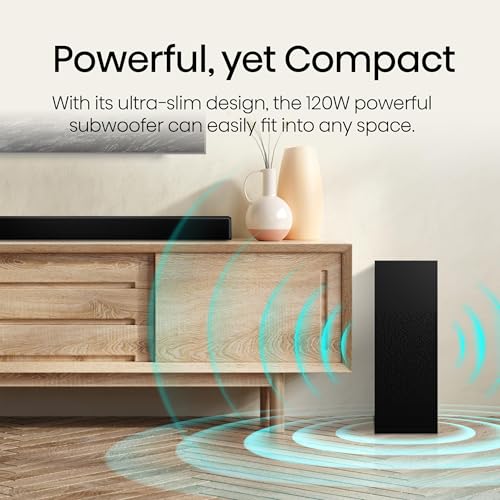
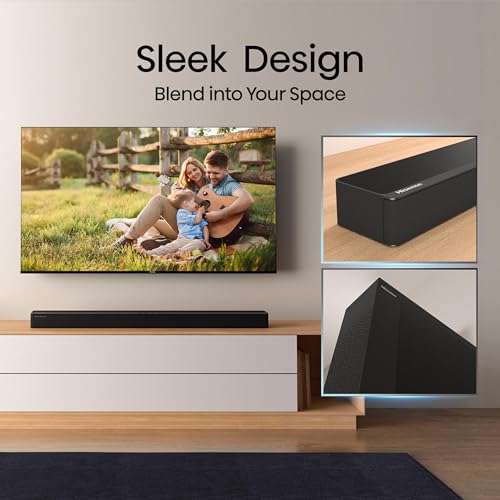
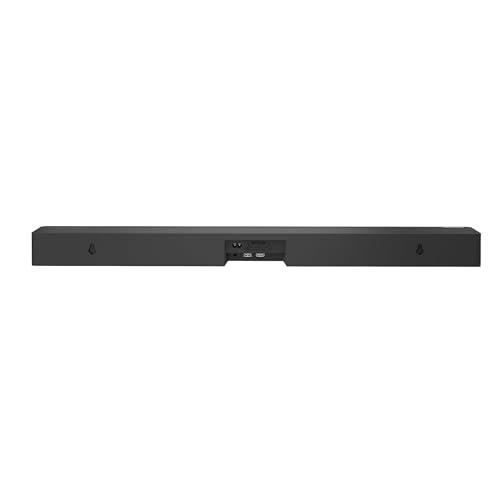
This is where personal preference and living situation become crucial. The Hisense HS2100 exemplifies plug-and-play simplicity. The wireless subwoofer automatically pairs with the soundbar, requiring just two power outlets and one audio cable to your TV. The whole system can be set up in under 15 minutes, and the ultra-slim soundbar fits under virtually any TV without blocking the screen or remote sensors.
The Ultimea Poseidon D50 demands more commitment. Those rear speakers need to connect via 19.6-foot cables (no wireless option), which means planning cable routes through your room. You'll need to position speakers behind your seating area, either on stands or wall-mounted. The setup process takes longer and requires more thought about speaker placement for optimal surround effects.
I've found that this setup complexity often determines satisfaction more than sound quality differences. People who embrace the Poseidon D50's installation requirements typically love the results. Those who just want better TV audio without the fuss gravitate toward systems like the Hisense HS2100.
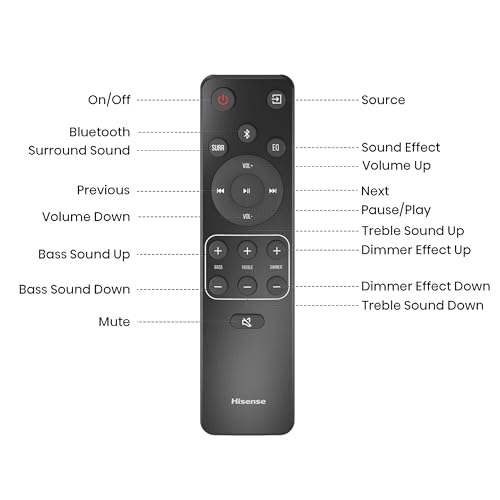
The three-year gap between these products' releases becomes apparent in their smart features. The Hisense HS2100 includes six preset sound modes (Movie, Music, Sports, etc.) and basic bass/treble adjustment, which covers most users' needs. Its Roku TV Ready certification means seamless integration with Roku TVs, allowing control via the TV remote through HDMI-CEC (Consumer Electronics Control) – a protocol that lets devices communicate basic commands.
The Ultimea Poseidon D50 showcases how much smartphone integration has advanced. Its dedicated app provides access to a 10-band equalizer with 121 preset sound profiles – an almost overwhelming level of customization for a budget system. More importantly, you can independently adjust the rear speaker volume to fine-tune the surround effect for your room's acoustics. This granular control was typically reserved for much more expensive systems just a few years ago.
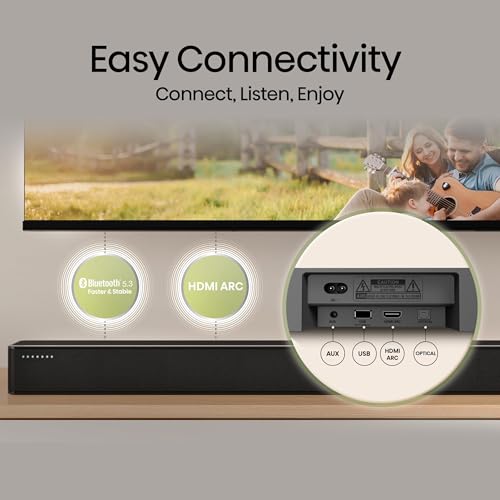
Both systems support Bluetooth 5.3, which offers improved connection stability and lower latency compared to older Bluetooth versions. This matters for wireless music streaming and ensures lip-sync accuracy when watching video content from your phone or tablet.
While both systems excel with movie and TV content, their music performance reveals interesting character differences. The Hisense HS2100 maintains a more neutral tonal balance that works well across music genres. Its controlled bass response doesn't overwhelm vocals, and the treble remains smooth enough for extended listening without fatigue.
The Ultimea Poseidon D50 faces the common challenge of multi-channel systems: stereo music wasn't designed for surround processing. While the bass impact is more exciting for electronic and rock music, the system can sound harsh with acoustic content, particularly at higher volumes. The surround processing sometimes creates an artificial sense of spaciousness that works better for movies than music.
Based on extensive user feedback, people who prioritize music listening alongside TV content tend to prefer the Hisense HS2100's more natural presentation. Those focused primarily on home theater experiences accept the Poseidon D50's music limitations in exchange for superior movie immersion.
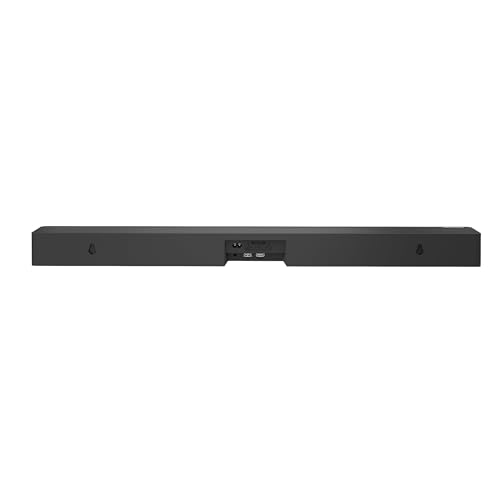
For dedicated home theater setups, connectivity options matter significantly. Both systems include HDMI ARC (Audio Return Channel), which allows your TV to send audio back to the soundbar through the same cable that carries video to the TV. The Poseidon D50 adds eARC (enhanced ARC) support, which can handle higher-quality audio formats and offers more reliable communication between devices.
Neither system supports Dolby Atmos or DTS:X – the latest surround sound formats that add height channels for overhead effects. This omission keeps costs down but limits future compatibility with premium streaming content. However, both handle standard Dolby Digital and DTS formats that comprise the majority of current content.
The Ultimea Poseidon D50's true 5.1 configuration provides a genuine foundation for home theater growth. You could eventually upgrade components or add additional speakers more easily than expanding a 2.1 system. The Hisense HS2100 represents more of an endpoint – a refined solution that does what it does very well without much upgrade potential.
Room acoustics play a massive role in soundbar performance, and these systems target different environments. The Hisense HS2100 works brilliantly in smaller spaces – apartments, bedrooms, or modest living rooms where the compact design and controlled sound don't overwhelm the space. Its 240W output provides plenty of volume for rooms up to about 200 square feet without strain.
The Ultimea Poseidon D50 needs more room to breathe. Those rear speakers require adequate distance from the listening position to create proper surround effects, making it better suited for dedicated living rooms or basement entertainment areas. The system's 320W output and more dynamic range handling make it capable of filling larger spaces that would leave the Hisense struggling.
At the time of writing, these systems compete directly on price, making the value comparison fascinating. The Hisense HS2100 represents exceptional refinement for a 2.1 system at this price point. You're paying for thoughtful tuning, reliable build quality, and the convenience of a premium manufacturer's support network.
The Ultimea Poseidon D50 offers potentially triple the hardware value – true 5.1 surround systems typically cost significantly more from established brands. You're essentially getting a complete home theater audio foundation at a 2.1 system price, albeit with some compromises in build materials and brand recognition.
From a pure capability standpoint, the Poseidon D50 delivers more dramatic improvement over TV speakers. However, the Hisense HS2100 provides a more polished, user-friendly experience that many find perfectly satisfying for their needs.
After researching extensive user feedback and professional reviews, clear usage patterns emerge. Choose the Hisense HS2100 if you primarily watch TV shows, news, and streaming content in a smaller space where setup simplicity matters most. Its balanced sound signature and hassle-free installation make it ideal for bedrooms, apartments, or as a secondary system. The refined audio quality works particularly well for dialogue-heavy content and background music listening.
Go with the Ultimea Poseidon D50 if you're serious about movie watching, gaming, or want to experience genuine surround sound on a budget. Accept that setup requires more effort and that music performance isn't quite as polished. The dramatic improvement in spatial audio and bass impact makes action movies and games significantly more engaging.
Consider your living situation carefully. Renters who move frequently might prefer the Hisense's simpler setup. Homeowners with dedicated entertainment spaces will likely appreciate the Poseidon D50's more immersive capabilities despite the installation complexity.
Both systems represent exceptional value in their respective approaches, proving that budget audio equipment has improved dramatically in recent years. The choice ultimately comes down to whether you want a refined upgrade to your TV's audio or a complete transformation of your entertainment experience.
| Hisense HS2100 2.1 Channel 240W Soundbar System | Ultimea Poseidon D50 5.1 Soundbar Home Theater (2025) |
|---|---|
| Channel Configuration - Determines whether you get true surround sound | |
| 2.1 channels (soundbar + wireless subwoofer) | 5.1 channels (soundbar + 2 rear speakers + wireless subwoofer) |
| Total Power Output - Affects maximum volume and dynamic range | |
| 240W total (soundbar 120W + subwoofer 120W) | 320W peak across 6 drivers |
| Surround Sound Technology - How spatial audio is created | |
| DTS Virtual:X (simulated surround from front speakers) | True 5.1 with physical rear speakers + SurroundX algorithm |
| Setup Complexity - Time and effort required for installation | |
| Completely wireless (auto-pairing subwoofer) | Requires 19.6ft cables to rear speakers |
| Room Coverage - Optimal space size for best performance | |
| Up to 200 sq ft (smaller rooms, apartments) | 250-380 sq ft (larger living rooms, home theaters) |
| Audio Customization - How much you can tune the sound | |
| 6 preset modes + basic bass/treble adjustment | 10-band EQ + 121 preset matrices + app control |
| Connectivity Options - Available input methods | |
| HDMI ARC, Optical, AUX, Bluetooth 5.3 | HDMI eARC, Optical, AUX, USB, Bluetooth 5.3 |
| Subwoofer Driver Size - Affects bass depth and impact | |
| 5.25" driver (standard performance) | 5.25" driver with BassMX technology (enhanced bass) |
| Smart Features - Modern convenience capabilities | |
| Roku TV Ready, basic remote control | Dedicated smartphone app with full control |
| Physical Footprint - Space requirements in your room | |
| Ultra-slim bar + compact wireless sub | Standard bar + 2 rear speakers + wireless sub |
| Best Use Cases - Who should choose each system | |
| TV shows, casual movies, music, simple setup priority | Action movies, gaming, home theater enthusiasts |
| Music Performance - How well each handles stereo content | |
| Balanced, natural sound across genres | More impactful bass but can be harsh at high volumes |
| Dialogue Clarity - Critical for TV and movie watching | |
| Excellent midrange clarity, warm tone | Clear dialogue but optimized more for surround content |
The key difference is channel configuration. The Hisense HS2100 is a 2.1 system with just a soundbar and wireless subwoofer, while the Ultimea Poseidon D50 is a true 5.1 surround sound system with rear speakers. This means the Poseidon D50 delivers genuine surround sound effects, while the HS2100 relies on virtual surround processing.
The Ultimea Poseidon D50 is significantly better for home theater use. Its true 5.1 surround sound with physical rear speakers creates immersive movie experiences where sound actually moves around the room. The Hisense HS2100 is good for basic movie watching but can't match the cinematic immersion of real surround sound.
The Hisense HS2100 is much easier to install. It's completely wireless with an auto-pairing subwoofer, requiring just two power outlets and one audio cable. The Ultimea Poseidon D50 requires running 19.6-foot cables to the rear speakers and more complex placement planning.
The Hisense HS2100 offers more natural, balanced music reproduction across different genres. The Ultimea Poseidon D50 provides more powerful bass but can sound harsh with acoustic music at higher volumes, as it's optimized more for movie content than stereo music.
The Ultimea Poseidon D50 produces higher maximum volume with its 320W power output compared to the Hisense HS2100's 240W. The Poseidon D50 also handles dynamic movie scenes better and fills larger rooms more effectively.
The Hisense HS2100 is ideal for smaller spaces up to 200 square feet, including apartments and bedrooms. The Ultimea Poseidon D50 works best in larger rooms between 250-380 square feet where there's adequate space for proper rear speaker placement.
Yes, both the Hisense HS2100 and Ultimea Poseidon D50 feature Bluetooth 5.3 for wireless music streaming from phones and tablets. Both offer stable connections and low latency for video content.
The Ultimea Poseidon D50 provides significantly more customization with its smartphone app, 10-band equalizer, and 121 preset sound profiles. The Hisense HS2100 offers basic controls with 6 preset modes and simple bass/treble adjustment via remote.
The Ultimea Poseidon D50 is excellent for gaming due to its true surround sound that provides directional audio cues. The Hisense HS2100 works fine for casual gaming but lacks the spatial audio benefits that enhance competitive gaming experiences.
The Ultimea Poseidon D50 delivers more powerful, impactful bass with its BassMX technology and higher power output. While both use 5.25-inch subwoofers, the Poseidon D50 digs deeper and hits harder during action scenes and bass-heavy music.
Neither the Hisense HS2100 nor the Ultimea Poseidon D50 supports Dolby Atmos. Both handle standard Dolby Digital and DTS formats, with the HS2100 featuring DTS Virtual:X processing and the Poseidon D50 using SurroundX algorithm for enhanced spatial audio.
This depends on your needs. The Hisense HS2100 offers excellent value for users wanting simple, refined TV audio improvement. The Ultimea Poseidon D50 provides exceptional value for those seeking true surround sound, as complete 5.1 systems typically cost much more from other brands.
We've done our best to create useful and informative comparisons to help you decide what product to buy. Our research uses advanced automated methods to create this comparison and perfection is not possible - please contact us for corrections or questions. These are the sites we've researched in the creation of this article: rtings.com - shop.hisense-usa.com - bestbuy.com - content.syndigo.com - bestbuy.com - hisensedealers.co.ke - stuff.co.za - dtc-aus-api.hisense.com - youtube.com - manuals.plus - youtube.com - bestbuy.com - youtube.com - gallifurniture.com - hisense-usa.com - manuals.plus - uk.hisense.com - device.report - youtube.com - costco.ca - elmcreekwsa.com - gallifurniture.com - youtube.com - eu.ultimea.com - newegg.com - tvsbook.com - youtube.com - provantage.com - ultimea.com - techradar.com - community.ultimea.com - homedepot.com - community.ultimea.com - ultimea.com - ultimea.de - youtube.com - medisamhealthcenter.com - ultimea.com - youtube.com - walmart.com

Privacy Policy
Terms and Conditions - Affiliate Policy
Home Security
© Copyright 2008-2026.
11816 Inwood Rd #1211, Dallas, TX 75244