



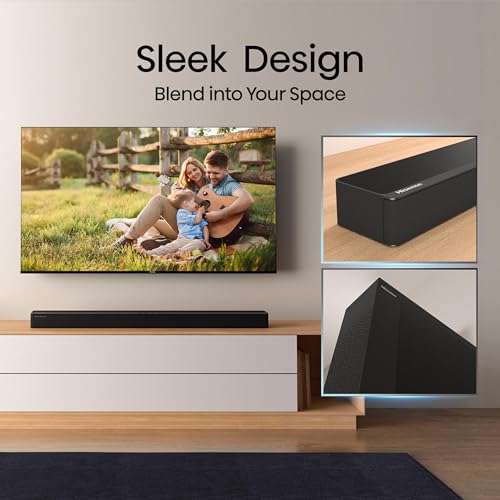

If you're tired of constantly asking "what did they say?" during your favorite TV shows or cranking the volume to hear movie dialogue over explosions, you're probably considering a soundbar upgrade. The budget soundbar market has evolved significantly since 2020, with manufacturers focusing on two distinct approaches: maximizing audio hardware for the money, or perfecting specific aspects like speech clarity.
Two products that perfectly illustrate this divide are the Hisense HS2100 and the Bose Solo Series 2, both released in 2024. At the time of writing, these soundbars represent fundamentally different philosophies about what budget audio should prioritize, with a substantial price gap that makes the decision even more interesting.
Before diving into specifics, it's helpful to understand what separates soundbars in the budget category. The main technical distinction is channel configuration—essentially, how many speakers and where they're located. A 2.0 system has two channels (left and right), while a 2.1 system adds a ".1" subwoofer specifically for bass frequencies below about 120 Hz.
This seemingly simple difference creates a cascade of performance implications. Bass frequencies are what you feel during explosions, the rumble of thunder, or the low notes in your favorite songs. Without dedicated bass reproduction, soundbars rely on digital processing tricks called "bass boost" or "virtual bass," which can enhance the perception of low frequencies but can't recreate actual deep bass.
Another crucial factor is total power output, measured in watts. While wattage isn't everything, it generally correlates with how loud a system can get and how well it can fill larger rooms without distortion. The relationship between drivers (individual speakers), power, and room size determines whether a soundbar will sound effortless or strained in your specific space.
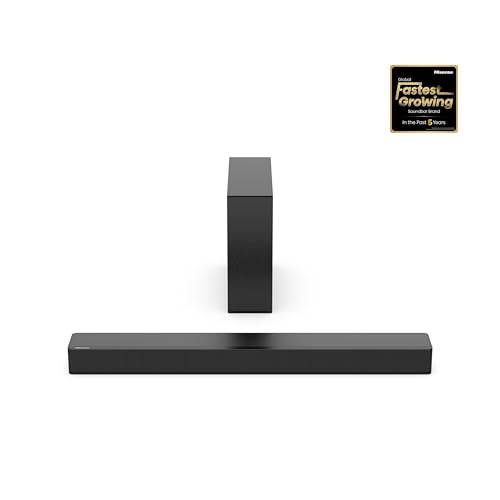
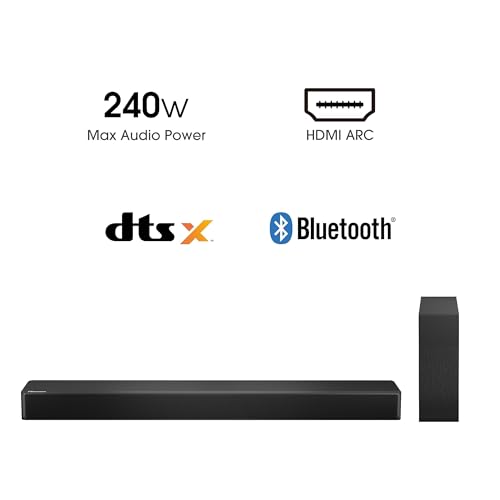
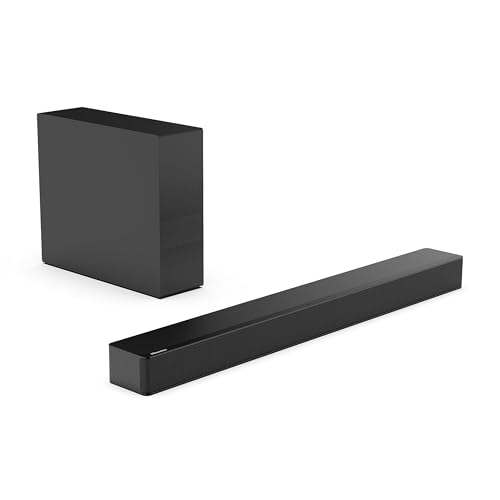
The Hisense HS2100 represents what you might call the "maximalist" approach to budget audio. Released in 2024, it packages a full 2.1 channel system with a wireless subwoofer for significantly less than most competitors. This isn't just about having more components—the inclusion of a dedicated subwoofer fundamentally changes what the system can accomplish.
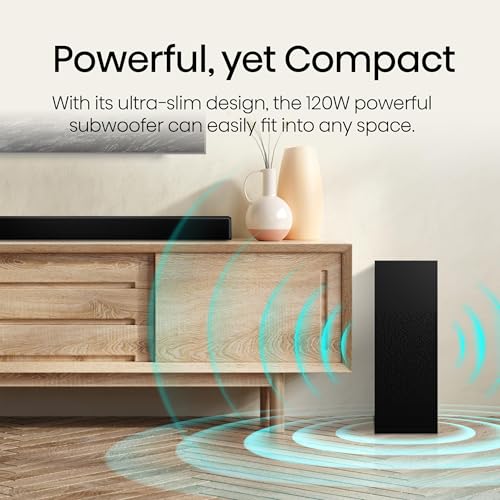
The wireless subwoofer in the HS2100 uses a 5.25-inch driver capable of 120 watts of power. For context, this means it can reproduce frequencies down to about 40 Hz—not audiophile territory, but low enough to add genuine impact to movie soundtracks and make music more engaging. When you're watching an action scene, you'll feel the difference between this setup and a standard 2.0 soundbar.
The "wireless" aspect matters more than you might think. Traditional subwoofers require running a cable across your room, which often determines where you can place the sub rather than where it sounds best. The HS2100's wireless connection gives you flexibility to position the subwoofer for optimal bass response, whether that's in a corner to amplify low frequencies or tucked under furniture for discretion.
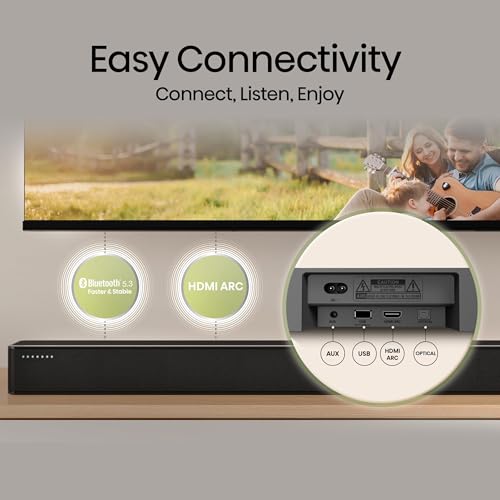
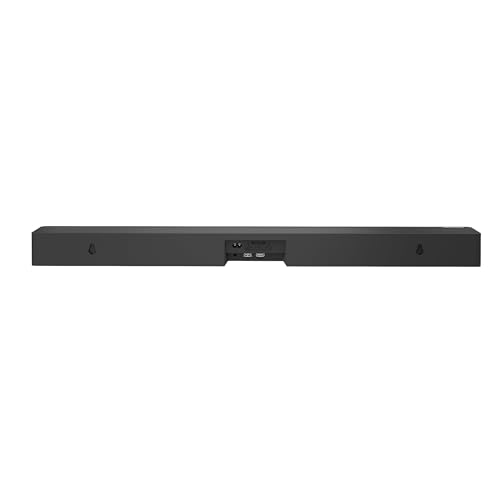
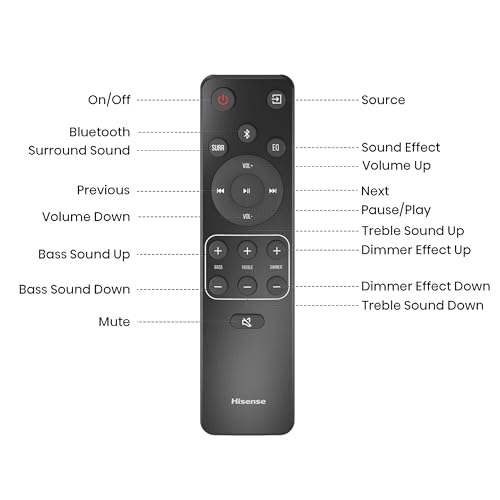
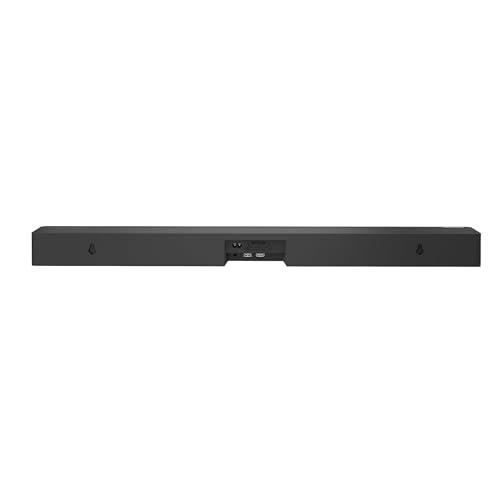
One area where the HS2100 shows its 2024 design is connectivity. The HDMI ARC (Audio Return Channel) connection is particularly significant because it allows your TV remote to control the soundbar's volume directly. This might seem like a small convenience, but it eliminates the frustration of managing multiple remotes and ensures the soundbar powers on and off with your TV.
The system also includes optical input, USB for direct media playback, a 3.5mm auxiliary input, and Bluetooth 5.3. That last specification is noteworthy—Bluetooth 5.3 offers improved stability and lower latency compared to earlier versions, making it more reliable for wireless music streaming from phones or tablets.
The HS2100 supports Dolby Digital and DTS audio formats, which are standard for most streaming content and Blu-ray discs. While it downmixes surround sound to stereo (meaning rear channel effects play through the front speakers), the DTS Virtual:X processing attempts to create a wider soundstage than the physical speaker placement would suggest.
More practically useful are the six EQ presets: Movie, Music, News, Sport, Night, and Game. These aren't just marketing features—they represent different frequency response curves optimized for specific content. The Night mode, for example, compresses dynamic range so loud explosions won't wake sleeping family members while still maintaining dialogue clarity.
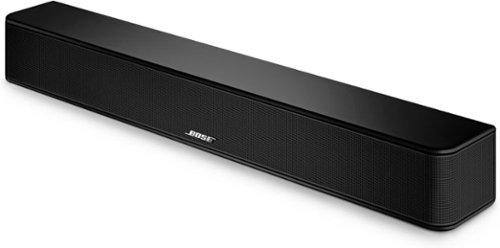
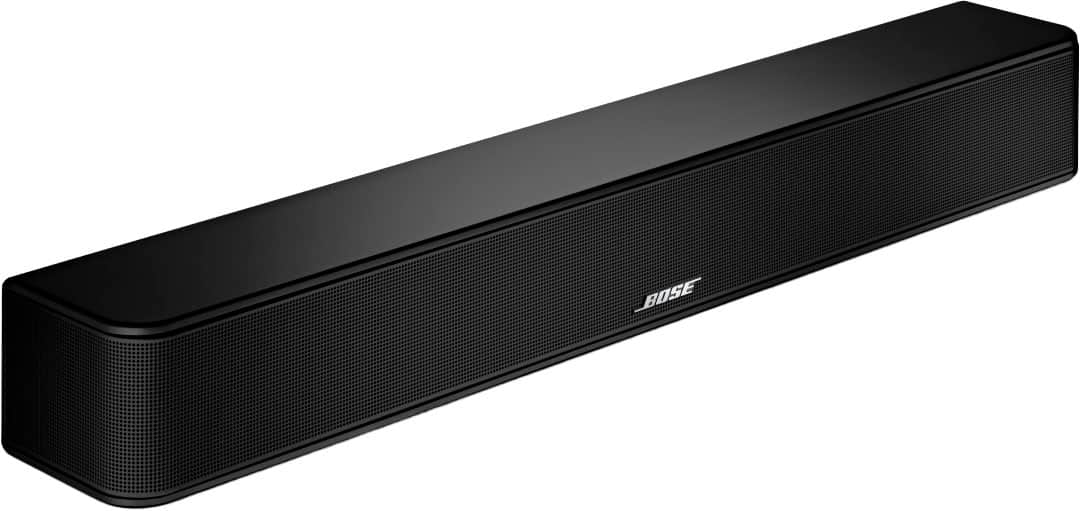
The Bose Solo Series 2, also released in 2024, takes a completely different approach. Rather than maximizing hardware, Bose focused on perfecting dialogue reproduction and creating an ultra-simple user experience. This represents Bose's traditional strength in audio processing and their understanding that many people buy soundbars primarily to hear TV dialogue better.
The standout feature of the Solo Series 2 is its dedicated Dialogue Mode. This isn't just an EQ preset—it's sophisticated audio processing that analyzes incoming audio and emphasizes the frequency ranges where human speech occurs (roughly 300 Hz to 3000 Hz). The system also reduces competing frequencies, making voices more prominent in the mix.
For people who struggle with hearing dialogue in movies or TV shows, especially when music or sound effects compete for attention, this processing can be transformative. The Solo Series 2 essentially acts like a hearing aid for your entertainment, making conversations clearer without simply making everything louder.
At roughly 22 inches wide and under 3 inches tall, the Solo Series 2 is designed to fit discretely under most TVs without blocking sensors or looking obtrusive. The 2.0 configuration means everything is contained in one unit—no separate subwoofer to place or connect.
However, this compact design comes with physics-based limitations. Without a dedicated subwoofer, the Solo Series 2 cannot reproduce true low frequencies. The "Base Boost" feature attempts to enhance the perception of bass through digital processing, but it's working with small drivers that simply cannot move enough air to create actual deep bass.
The Solo Series 2 offers optical and Bluetooth connectivity but notably lacks HDMI ARC. This means you'll need to use your TV's optical output and won't get the convenience of unified remote control. For some users, this isn't a significant limitation, but it does feel like a step backward in 2024 when most TVs and soundbars support HDMI ARC as standard.
This is where the hardware difference becomes most apparent. The HS2100's dedicated subwoofer provides bass that you can actually feel, making movie explosions more impactful and music more engaging. Based on user reviews and technical measurements, the system can reproduce frequencies down to about 45 Hz with meaningful output.
The Solo Series 2, constrained by its compact 2.0 design, simply cannot match this performance. While the Base Boost processing helps, you're still working within the physical limitations of small drivers in a confined space. For bass-heavy content like action movies or electronic music, this difference is immediately noticeable.
The HS2100's 240-watt total power output (120W from the soundbar plus 120W from the subwoofer) gives it a significant advantage in larger rooms. User reports consistently mention its ability to fill medium to large living rooms with clear, dynamic sound without strain or distortion.
The Solo Series 2 is designed for smaller spaces and excels in bedrooms, small apartments, or near-field listening situations. Push it too hard in a large room, and you'll encounter the limitations of its more modest power output.
This is where the Solo Series 2 fights back. Bose's Dialogue Mode is genuinely effective at making speech more intelligible, especially for users with hearing difficulties or in acoustically challenging rooms. The processing is sophisticated enough to maintain naturalness while enhancing clarity.
The HS2100 handles dialogue competently through its News mode and generally balanced frequency response, but it doesn't match the specialized vocal enhancement of the Bose system.
For music listening, the HS2100 is clearly superior. The dedicated subwoofer allows it to reproduce the full frequency range of most musical content, from the attack of a kick drum to the resonance of a bass guitar. While not audiophile-grade, it's competent across genres and engaging for casual listening.
The Solo Series 2 struggles with music, particularly bass-heavy genres. Multiple reviews specifically recommend against using it as a primary music speaker, as the lack of low-end extension makes most music sound thin and incomplete.
If you're building a basic home theater setup, several technical factors become crucial. First is audio format support—both systems handle standard Dolby Digital from streaming services and cable/satellite TV, but neither supports advanced formats like Dolby Atmos or DTS:X that create immersive surround sound.
The HS2100's HDMI ARC connectivity is particularly valuable in home theater contexts because it integrates seamlessly with your TV's audio output and allows unified control. The multiple input options also mean you can connect game consoles, streaming devices, or other sources directly to the soundbar if your TV lacks sufficient inputs.
Latency—the delay between video and audio—is crucial for movies and gaming. Both systems perform well here, but the HS2100's wired and wireless connections show consistently low latency across different sources based on user testing.
At the time of writing, these products are priced substantially differently, with the Bose Solo Series 2 commanding a significant premium over the HS2100. This price gap raises important questions about value and what you're actually paying for.
The HS2100 delivers considerably more hardware: a soundbar plus a separate subwoofer with its own amplifier and wireless connection. You also get more connectivity options, more customization features, and broader content versatility. From a pure hardware perspective, it offers exceptional value.
The Solo Series 2 asks you to pay a premium primarily for brand reputation, specialized dialogue processing, and ultra-simple setup. Whether this premium is justified depends entirely on your priorities and how much you value Bose's specific strengths.
Choose the Hisense HS2100 if you want maximum audio improvement across all types of content. It's particularly well-suited for people who watch a variety of content—movies, TV shows, music, gaming—and want a system that can handle everything competently. The bass impact makes action movies more engaging, the power output can fill larger rooms, and the connectivity options provide flexibility for different setups.
This soundbar is also the clear choice if you're budget-conscious but don't want to sacrifice performance. The combination of dedicated bass reproduction and modern features at this price point is genuinely impressive.
Choose the Bose Solo Series 2 if dialogue clarity is your absolute top priority and you're willing to pay more for that specialization. It's ideal for people who primarily watch news, documentaries, dramas, or other dialogue-heavy content and struggle with speech intelligibility.
The Bose is also better for smaller spaces where bass response isn't crucial and where its compact design provides aesthetic advantages. If you strongly prefer brand name reliability and don't mind paying extra for it, the Solo Series 2 delivers on Bose's reputation for audio processing excellence.
These two soundbars represent fundamentally different approaches to solving the same problem: improving TV audio on a budget. The HS2100 maximizes hardware and features to provide the most comprehensive upgrade possible, while the Solo Series 2 focuses intensively on one specific strength—dialogue clarity—at a premium price.
For most people seeking their first soundbar upgrade, the HS2100 provides better overall value and more versatility. The dedicated subwoofer alone makes it superior for movies, music, and gaming, while still handling dialogue competently. The Solo Series 2 makes sense for a smaller subset of users who have specific needs around speech clarity and prefer paying more for specialized performance.
The choice ultimately comes down to whether you want maximum bang for your buck or are willing to pay extra for a focused solution to dialogue problems. Both represent solid options in 2024's competitive budget soundbar market, but they're aimed at distinctly different users and use cases.
| Hisense HS2100 | Bose Solo Series 2 |
|---|---|
| Channel Configuration - Determines bass capability and overall sound fullness | |
| 2.1 channel with wireless subwoofer | 2.0 channel (soundbar only, no subwoofer) |
| Total Power Output - Affects maximum volume and room-filling ability | |
| 240W (120W soundbar + 120W subwoofer) | Not specified (significantly lower than HS2100) |
| Bass Performance - Critical for movies, music, and immersive experience | |
| Dedicated 5.25" wireless subwoofer (40-120 Hz) | Base Boost processing only (no true bass extension) |
| HDMI ARC Connectivity - Enables TV remote control and simplified setup | |
| Yes (single cable setup with TV remote control) | No (optical connection only, separate remote required) |
| Dialogue Enhancement - Important for speech clarity in TV and movies | |
| News mode and balanced midrange | Dedicated Dialogue Mode with advanced processing |
| Audio Format Support - Compatibility with streaming and disc content | |
| Dolby Digital, DTS, PCM, DTS Virtual:X | Dolby Digital (downmixed to stereo) |
| Connectivity Options - Flexibility for different devices and setups | |
| HDMI ARC, Optical, USB, Bluetooth 5.3, 3.5mm AUX | Optical, Bluetooth 4.0 only |
| EQ Customization - Ability to tailor sound for different content types | |
| 6 presets (Movie, Music, News, Sport, Night, Game) + bass/treble controls | Limited adjustment options |
| Physical Dimensions - Space requirements and aesthetic impact | |
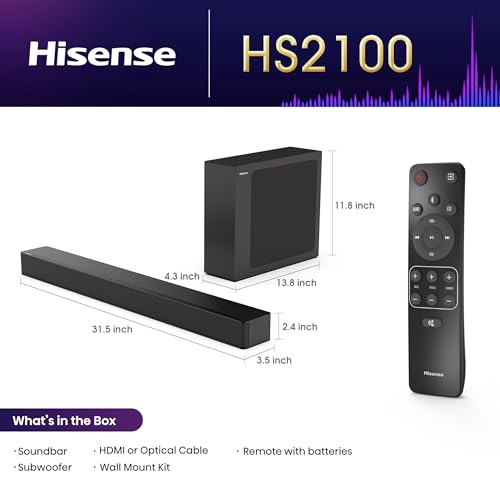
| 31.5" x 2.4" x 3.5" + separate subwoofer | 21.6" x 2.8" x 3.4" (compact single unit) |
| Music Performance - Quality for wireless streaming and USB playback | |
| Good across genres with dedicated bass | Poor (not recommended for music listening) |
| Room Size Suitability - Maximum effective coverage area | |
| Medium to large living rooms | Small to medium rooms only |
| Value Proposition - What you get for the price difference | |
| Maximum hardware and features for budget-conscious buyers | Premium brand with specialized dialogue focus |
The Hisense HS2100 is significantly better for movies due to its dedicated wireless subwoofer that provides real bass impact during action scenes and explosions. While the Bose Solo Series 2 excels at dialogue clarity with its specialized Dialogue Mode, it lacks the low-frequency response needed for an immersive movie experience. For general TV viewing, both perform well, but the HS2100 offers more dynamic range.
A subwoofer makes a substantial difference for bass-heavy content like movies, music, and gaming. The Hisense HS2100 includes a wireless subwoofer that reproduces frequencies down to 40 Hz, providing genuine bass impact you can feel. The Bose Solo Series 2 uses digital bass processing instead, which enhances the perception of bass but cannot replicate true low-frequency reproduction.
Both soundbars are relatively easy to set up, but the Hisense HS2100 has a slight advantage with HDMI ARC connectivity that allows single-cable connection and TV remote control. The Bose Solo Series 2 requires optical cable connection and doesn't support HDMI ARC, meaning you'll need to use a separate remote for volume control.
The Bose Solo Series 2 is a 2.0 system with left and right channels only, while the Hisense HS2100 is a 2.1 system that adds a dedicated subwoofer (the ".1"). This means the HS2100 can reproduce a much wider frequency range and provide bass impact that the compact Solo Series 2 simply cannot match due to physical limitations.
The Hisense HS2100 is significantly better for music due to its dedicated subwoofer and broader frequency response. It handles various music genres competently, from rock to electronic music. The Bose Solo Series 2 is not recommended for music listening, as multiple reviews note poor performance with musical content due to limited bass extension.
Dialogue clarity is crucial for TV and movie enjoyment. The Bose Solo Series 2 excels here with its dedicated Dialogue Mode that uses advanced processing to enhance speech intelligibility. The Hisense HS2100 provides good dialogue reproduction through its News mode and balanced frequency response, but doesn't match the specialized vocal enhancement of the Solo Series 2.
The Hisense HS2100 is better suited for large rooms due to its 240W total power output and dedicated subwoofer that can fill larger spaces with dynamic sound. The Bose Solo Series 2 is designed for smaller rooms and may struggle to provide adequate volume and presence in larger living spaces without distortion.
Both soundbars support Dolby Digital from streaming services and cable TV. The Hisense HS2100 also supports DTS and features DTS Virtual:X processing for enhanced surround effects. However, neither supports advanced formats like Dolby Atmos. The HS2100 offers more comprehensive format support overall.
The Hisense HS2100 provides more connectivity options including HDMI ARC, optical, USB, Bluetooth 5.3, and 3.5mm auxiliary input. The Bose Solo Series 2 is limited to optical and Bluetooth 4.0 connections. The HS2100 also allows direct media playback via USB and offers more flexibility for connecting various devices.
The wireless subwoofer in the Hisense HS2100 adds significant value without much complexity. It pairs automatically and eliminates the need for long cables across your room, giving you flexibility in subwoofer placement for optimal bass response. This is a major advantage over the Bose Solo Series 2's single-unit design when bass performance matters.
The Hisense HS2100 is better for gaming due to its low latency across connections, dedicated Game mode, and bass impact that enhances explosions and sound effects. The subwoofer adds immersion to action games. While the Bose Solo Series 2 also has low latency, it lacks the dynamic range and bass response that make gaming more engaging.
Choose the Hisense HS2100 if you want maximum audio improvement across movies, music, and gaming, need to fill a larger room, or prioritize value and features. Choose the Bose Solo Series 2 if dialogue clarity is your top priority, you have a smaller space, primarily watch talk shows or news, and prefer brand reputation over comprehensive features. The HS2100 offers better overall value for most users.
We've done our best to create useful and informative comparisons to help you decide what product to buy. Our research uses advanced automated methods to create this comparison and perfection is not possible - please contact us for corrections or questions. These are the sites we've researched in the creation of this article: rtings.com - shop.hisense-usa.com - bestbuy.com - content.syndigo.com - bestbuy.com - hisensedealers.co.ke - stuff.co.za - dtc-aus-api.hisense.com - youtube.com - manuals.plus - youtube.com - bestbuy.com - youtube.com - gallifurniture.com - hisense-usa.com - manuals.plus - uk.hisense.com - device.report - youtube.com - costco.ca - elmcreekwsa.com - gallifurniture.com - rtings.com - bose.com - bose.com - assets.bose.com - bestbuy.com - youtube.com - pistonheads.com - costco.com - googlenestcommunity.com - youtube.com - discussions.apple.com

Privacy Policy
Terms and Conditions - Affiliate Policy
Home Security
© Copyright 2008-2026.
11816 Inwood Rd #1211, Dallas, TX 75244