








The world of home audio has changed dramatically over the past decade. Gone are the days when you needed a massive receiver, speaker wire running through your walls, and a dedicated equipment rack to get decent surround sound. Today's soundbars promise theater-quality audio in sleek, space-saving packages—but they achieve this goal through two completely different approaches.
The Ultimea Poseidon D50 5.1 Soundbar represents the traditional path: give you real speakers placed around your room for authentic surround sound. Meanwhile, the Sennheiser AMBEO Soundbar Mini takes a more modern approach, using advanced processing to trick your brain into hearing surround effects from a single compact unit.
Both methods have their merits, but choosing between them isn't just about sound quality—it's about your living space, lifestyle, and what you prioritize in your home entertainment setup.
Before diving into these specific models, it's worth understanding what makes soundbars so appealing. Most TV speakers are terrible because they're tiny drivers crammed into impossibly thin displays, often firing downward or backward. Even expensive TVs usually have mediocre audio that can't match the visual spectacle on screen.
Soundbars solve this by dedicating proper space to audio components while maintaining the clean aesthetics modern homes demand. But here's where it gets interesting: there are fundamentally different philosophies about how to create that immersive surround sound experience you'd get in a movie theater.
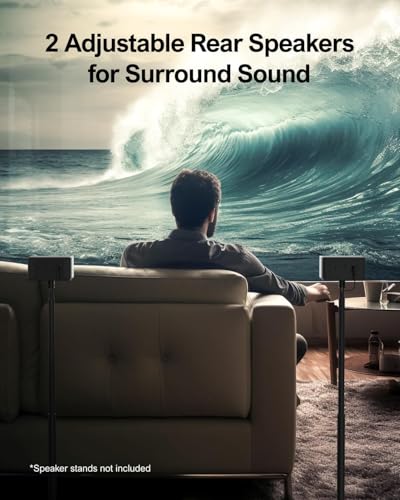
The first approach, exemplified by the Ultimea Poseidon D50, says "let's do this the traditional way"—place actual speakers around your room where surround effects should come from. When a helicopter flies overhead in a movie, you hear it from actual speakers positioned behind and beside you.
The second approach, represented by the Sennheiser AMBEO Mini, relies on psychoacoustic processing—essentially using science to understand how your brain interprets sound reflections and directional cues, then manipulating these to create the illusion of surround sound from speakers all in one location.
Both methods work, but they excel in different scenarios and appeal to different types of users.
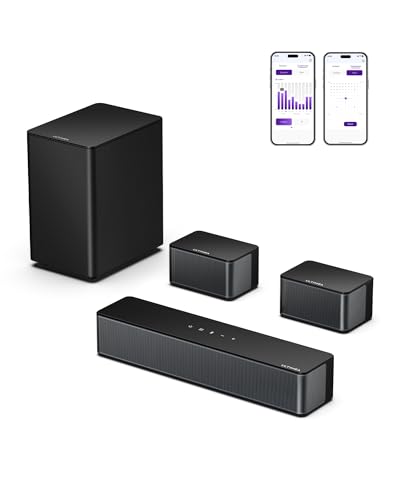
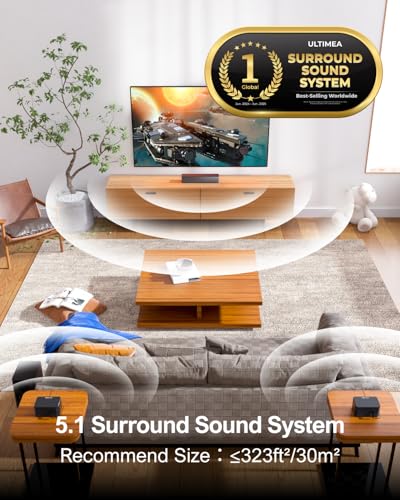
Released in 2025, the Ultimea Poseidon D50 represents an evolution of traditional home theater thinking. Unlike many budget soundbars that only simulate surround sound, this system gives you actual rear speakers that you place behind your seating area, plus a dedicated wireless subwoofer for deep bass.
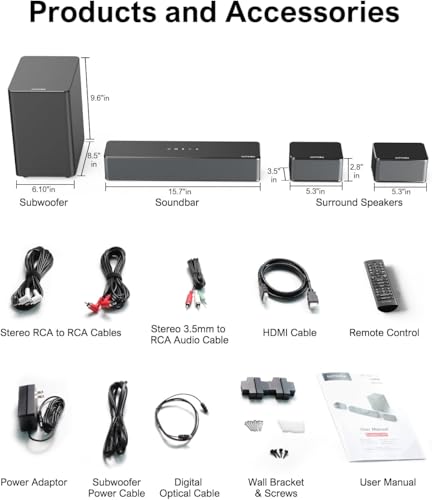
When you unbox the Poseidon D50, you're getting a complete 5.1 system: a main soundbar, two satellite speakers for rear channels, and a wireless subwoofer. The satellite speakers connect to the main unit with 19.6-foot cables, giving you flexibility in placement while ensuring reliable connections.
This physical separation is crucial for authentic surround sound. When an explosion happens behind the main character in an action movie, you actually hear it from speakers positioned behind you. There's no processing trickery involved—it's genuine directional audio that creates a convincing bubble of sound around your listening position.
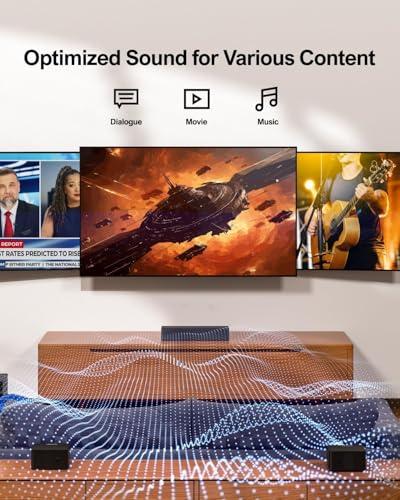
The system's SurroundX technology deserves special attention. This proprietary algorithm uses an integrated DSP (digital signal processor) chip to convert standard stereo audio into true 5.1 multichannel signals. This means even older movies or TV shows originally mixed in stereo can benefit from the surround speaker placement, creating a more immersive experience than the original content was designed to deliver.
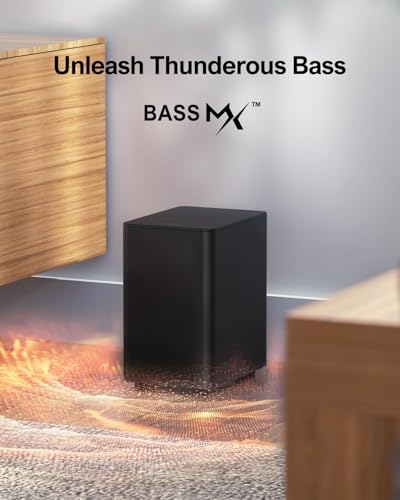
One of the Ultimea's strongest selling points is its dedicated 5.25-inch wireless subwoofer. The BassMX technology optimizes the magnetic circuit and allows for 15mm of diaphragm excursion—that's how far the speaker cone can move back and forth. More excursion generally means deeper, more impactful bass without distortion.
This separate subwoofer approach has significant advantages over integrated bass drivers. You can position it anywhere in your room for optimal bass response, and because it's a larger, dedicated driver, it can reproduce low frequencies that smaller integrated speakers simply cannot match. When you're watching action movies or listening to music with deep electronic beats, this difference becomes immediately apparent.
The 2025 model introduces comprehensive smartphone app control, which is relatively uncommon in this price segment. The app provides access to a 10-band equalizer with 121 preset matrices—essentially pre-configured sound profiles optimized for different content types and room acoustics.
More importantly, you get independent volume control for the satellite speakers. This is incredibly useful because rear speaker levels often need fine-tuning based on your room layout, seating distance, and personal preferences. Some people prefer subtle surround effects, while others want more aggressive spatial audio that puts you in the middle of the action.
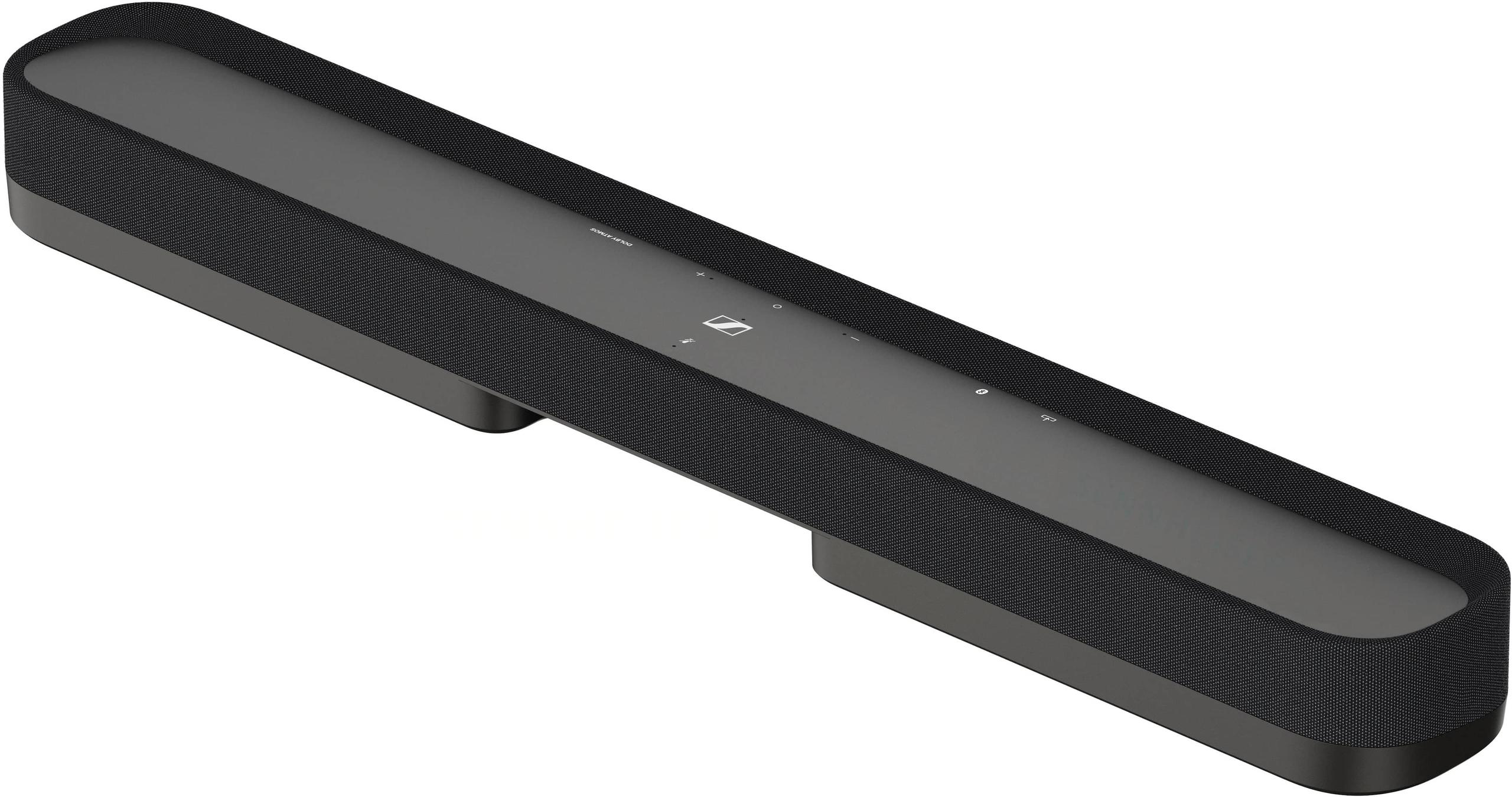
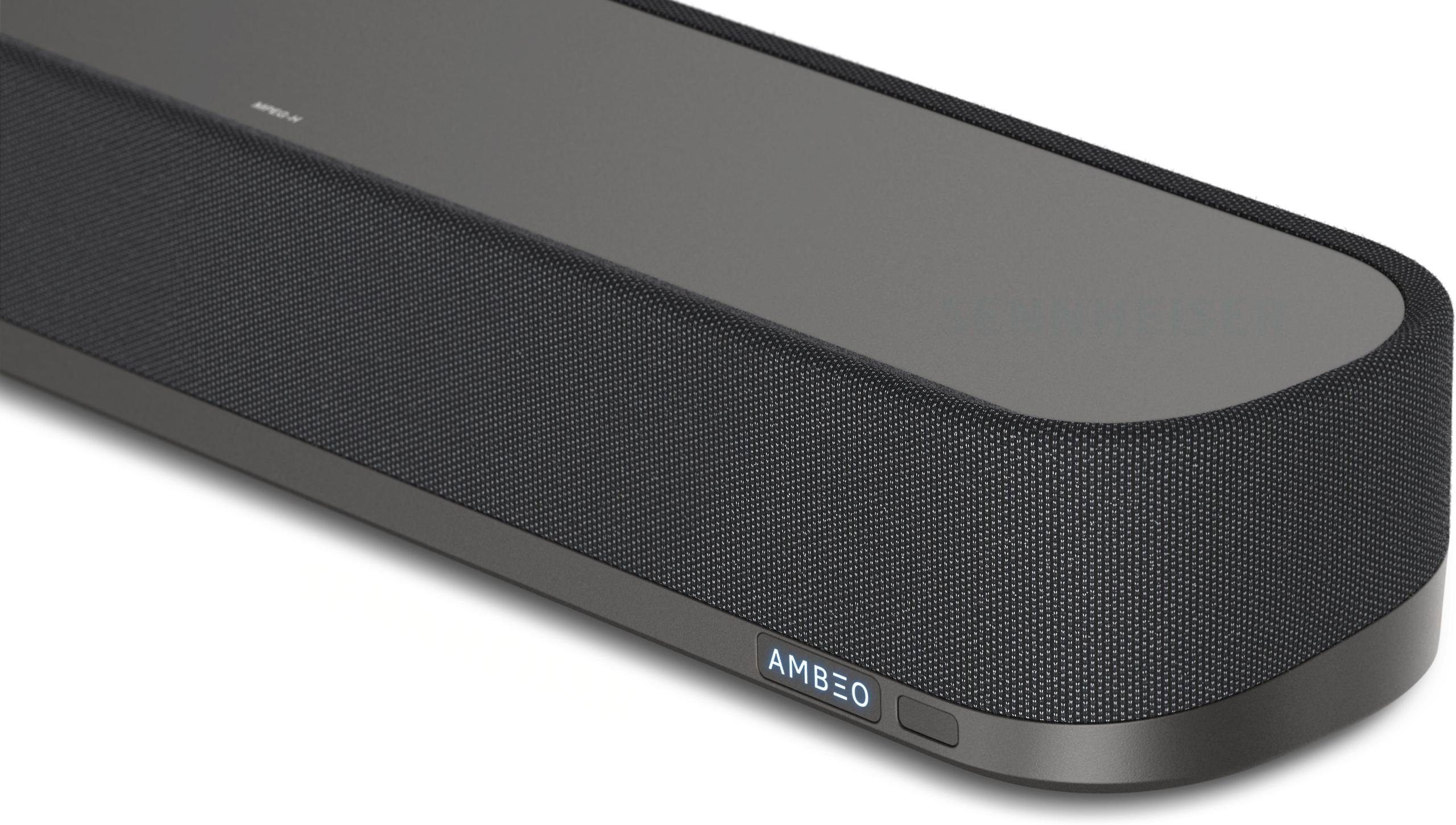
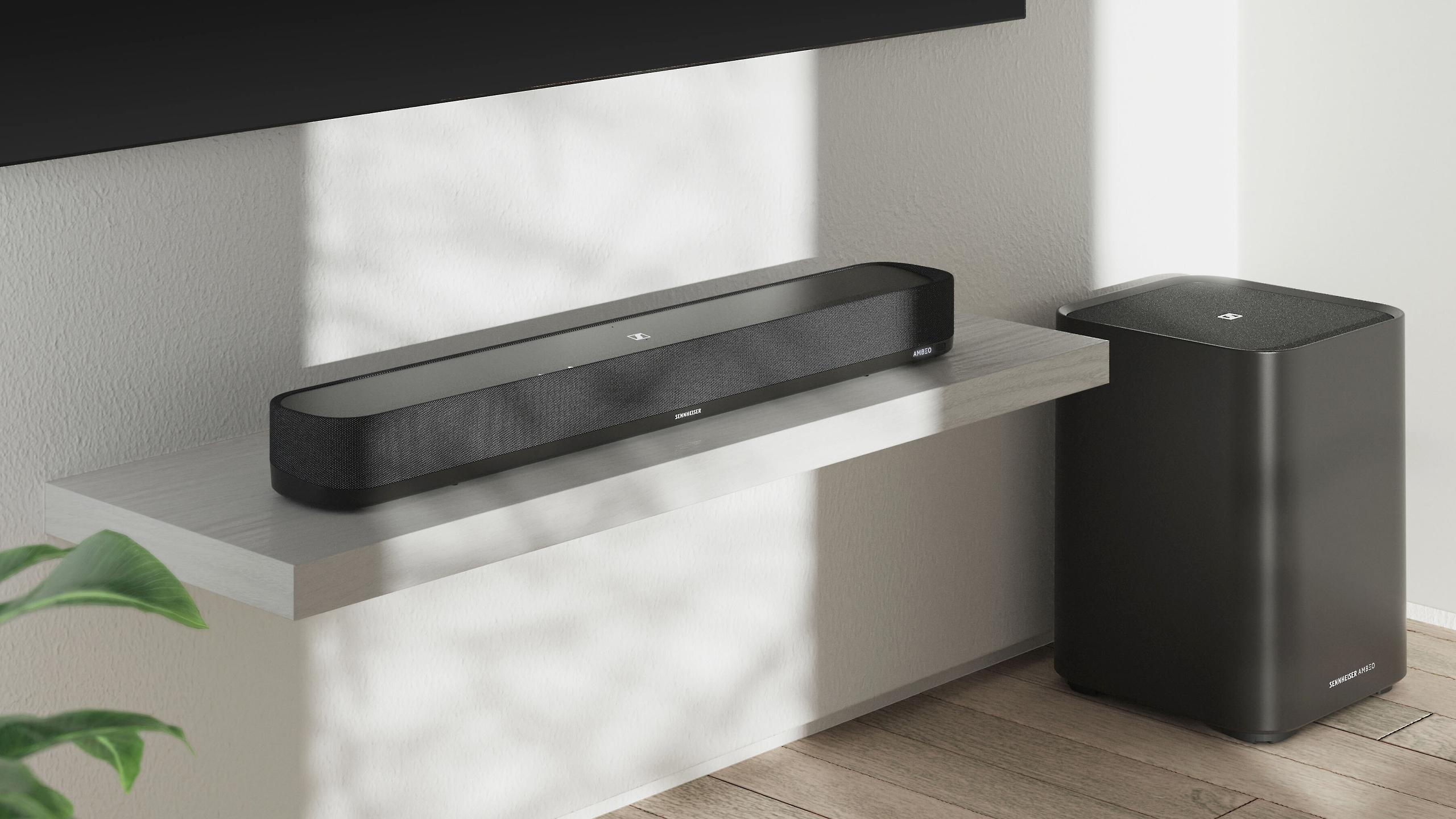
The Sennheiser AMBEO Mini, released in 2023, represents a completely different philosophy. Rather than using multiple speakers, it relies on advanced virtualization technology developed in collaboration with the Fraunhofer Institute—the same German research organization that helped create the MP3 format.
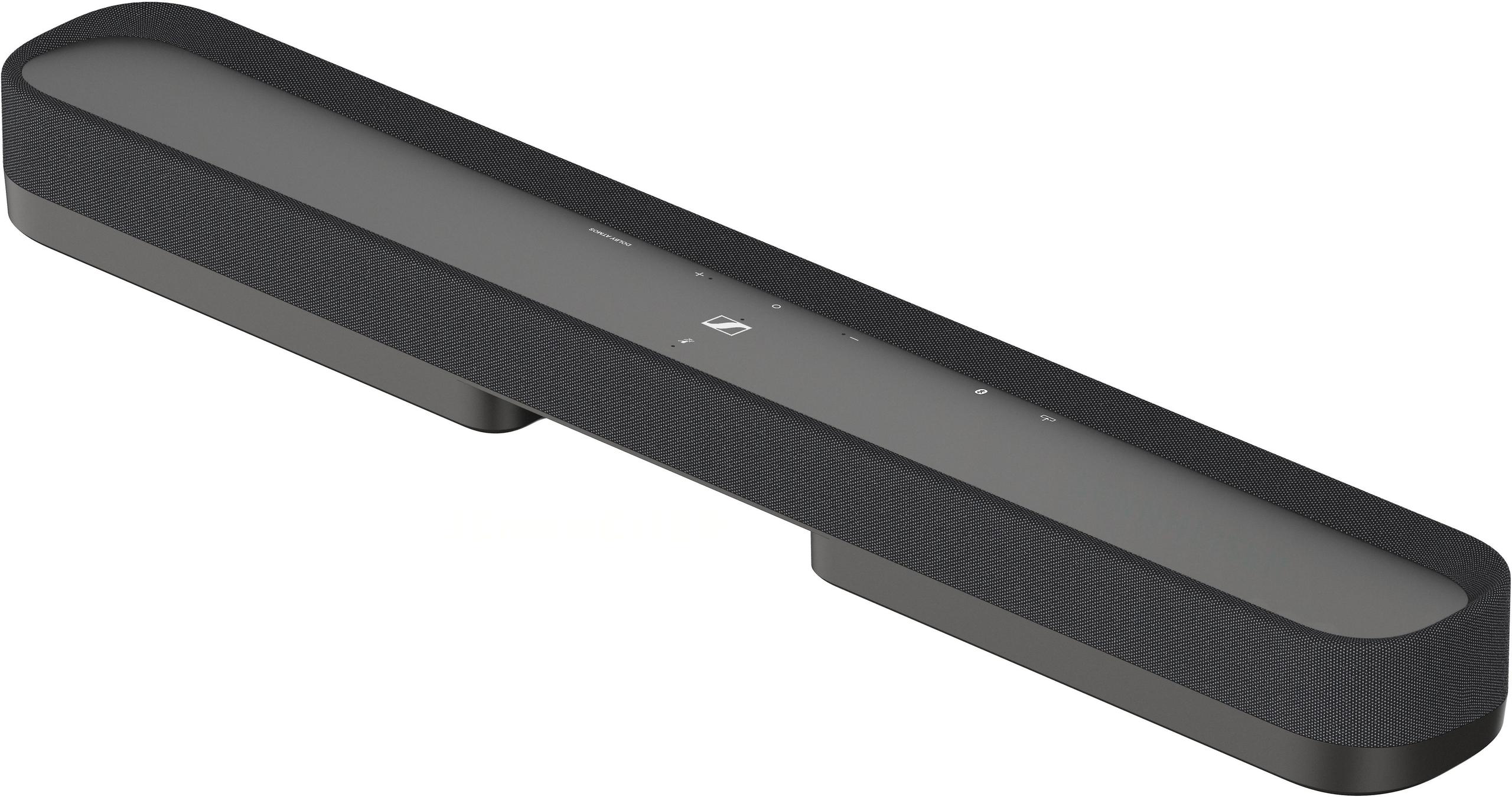
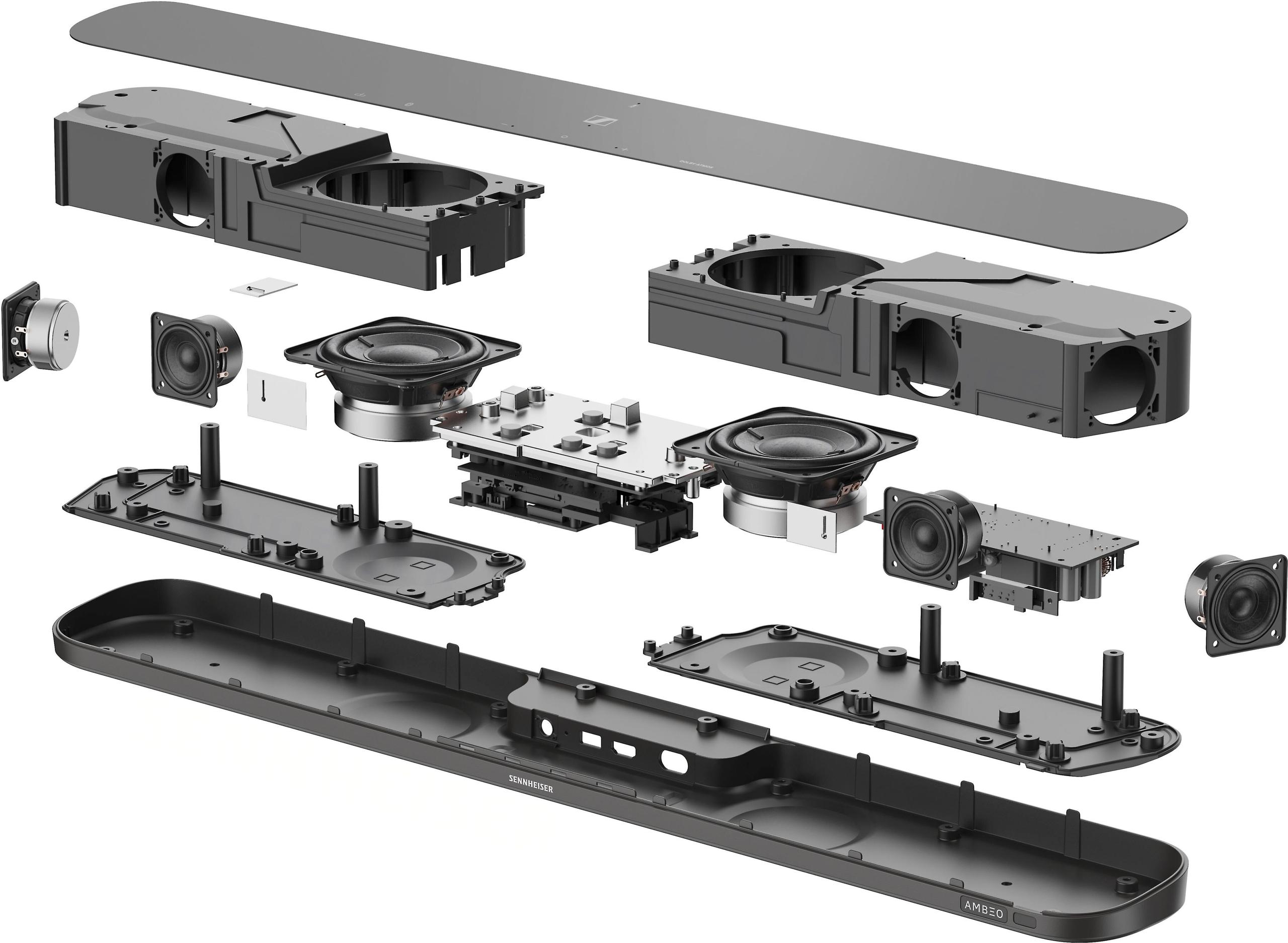
The AMBEO Mini's virtualization technology is genuinely impressive. Using six carefully positioned drivers—including upward-firing elements—it creates sound reflections off your walls and ceiling that your brain interprets as coming from speakers that aren't actually there.
This 7.1.4 virtualization means it's simulating the effect of seven speakers at ear level, one subwoofer, and four height speakers above you. The "7.1.4" format is actually more advanced than the Ultimea's true 5.1 setup, at least on paper.
The key to making this work is the automated room calibration system. Four built-in microphones analyze your room's acoustics, measuring how sound bounces off surfaces and adjusting the processing accordingly. This happens automatically during setup, and the system continuously optimizes itself for your specific environment.
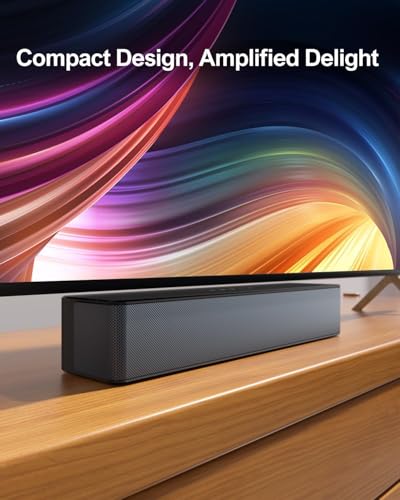
At just 27.6 inches wide, the AMBEO Mini fits under most TVs without dominating your entertainment center. There are no satellite speakers to position, no subwoofer to hide, and no cables to run across your room. For apartment dwellers, minimalists, or anyone who values clean aesthetics, this is a significant advantage.
Despite its compact size, the AMBEO Mini manages impressive bass response down to 43Hz using dual 4-inch integrated subwoofers. While this won't match a dedicated 5.25-inch subwoofer for pure depth and impact, it's remarkably effective for most content and eliminates the need for a separate component.
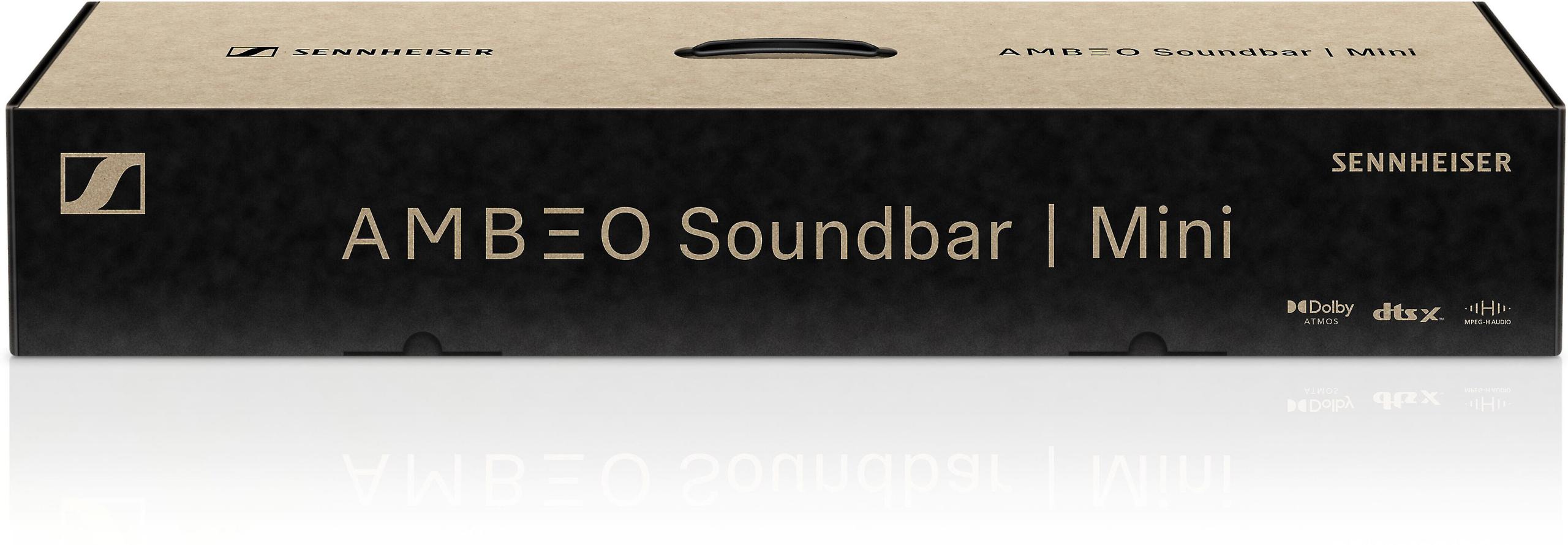
The Sennheiser supports advanced audio formats including Dolby Atmos, DTS:X, MPEG-H, and 360 Reality Audio. These formats contain spatial audio information that tells the soundbar exactly where sounds should be positioned in three-dimensional space.
When processing regular stereo content, the system's upmixing algorithms create convincing surround effects by analyzing the audio and intelligently distributing elements across the virtual soundstage. This works particularly well with music, creating an almost concert-hall-like experience from stereo recordings.
This is where the philosophical difference becomes most apparent. The Ultimea Poseidon D50 provides undeniably authentic surround sound because the effects actually come from speakers positioned around you. When a car passes from left to right in a movie scene, you hear it move through real physical space.
The Sennheiser AMBEO Mini creates remarkably convincing surround effects, but they're ultimately illusions created by clever processing. In optimal conditions—the right room size, proper placement, good source material—these illusions can be genuinely impressive. However, the effectiveness varies based on your room acoustics and seating position.
For home theater enthusiasts who want the most convincing surround experience possible, the Ultimea has a fundamental advantage. But for users who prioritize convenience and don't want to deal with multiple speakers, the Sennheiser's virtualization is often "good enough" and sometimes surprisingly convincing.
This comparison reveals another clear difference. The Ultimea's dedicated subwoofer produces deeper, more impactful bass that you can actually feel during explosion scenes or electronic music passages. The separate enclosure and larger driver simply move more air than integrated solutions can manage.
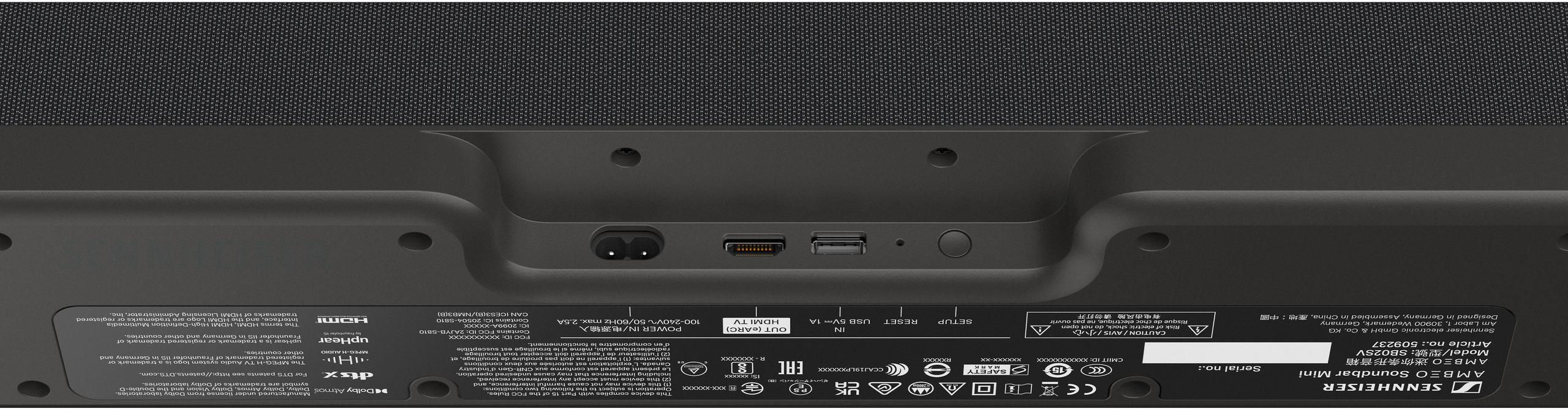
The AMBEO Mini produces respectable bass for its size, but it can't match the physical impact of a dedicated subwoofer. Sennheiser acknowledges this limitation by including a subwoofer output, allowing you to add an external sub if desired—though this defeats some of the single-unit convenience.
For content where bass matters—action movies, gaming, certain music genres—the Ultimea provides a more visceral experience. The Sennheiser works well for dialogue-heavy content, documentaries, and music where extreme bass isn't essential.
Here's where the Sennheiser AMBEO Mini shows its audiophile heritage. The high-quality drivers and sophisticated processing create excellent tonal balance for music reproduction. The soundstage extends convincingly beyond the physical width of the unit, and the frequency response remains even across the spectrum.
The Ultimea Poseidon D50 is optimized more for movie and TV content. While it includes multiple EQ modes for music, its tuning prioritizes the dynamic range and impact that make movies exciting rather than the refined tonal balance that makes music sound natural.
If you listen to music as much as you watch movies, the Sennheiser provides a more satisfying experience. If movies and gaming are your primary focus, the Ultimea's more dramatic presentation works better.
The convenience factor strongly favors the Sennheiser AMBEO Mini. Unbox it, connect one HDMI cable, let it calibrate itself, and you're done. The automated room optimization happens without user intervention, and the results are immediately apparent.
Setting up the Ultimea Poseidon D50 requires more thought and effort. You need to position the satellite speakers properly, run cables (though they're quite long), find a good spot for the subwoofer, and potentially spend time tweaking levels through the app to get everything balanced.
This setup difference matters more than you might think. Many people buy surround sound systems with good intentions but never optimize them properly. The Sennheiser's automated approach ensures you get most of the available performance without any technical knowledge or time investment.
Both systems handle modern connectivity well, but with different strengths. The Ultimea Poseidon D50 includes Bluetooth 5.3, HDMI eARC, optical, AUX, and USB connections, covering virtually any device you might want to connect.
The Sennheiser AMBEO Mini focuses more on wireless connectivity with Wi-Fi, Apple AirPlay 2, Spotify Connect, and Chromecast integration. This makes it easier to stream music directly from your phone or use voice commands through integrated smart assistants.
For users who primarily watch TV and movies through their main entertainment system, either approach works fine. But if you frequently stream music from various services or use smart home features, the Sennheiser's more comprehensive wireless capabilities provide better long-term convenience.
At the time of writing, these products target different market segments with distinct value propositions. The Ultimea Poseidon D50 positions itself as an accessible entry point into true surround sound, offering authentic multi-channel audio at a budget-friendly price point.
The Sennheiser AMBEO Mini commands premium pricing that reflects its advanced processing, automated features, and brand heritage. You're paying significantly more for the convenience, sophistication, and German engineering.
This price difference is substantial enough to affect the decision for many buyers. The Ultimea offers exceptional value if you have the space and don't mind the setup complexity. The Sennheiser justifies its premium pricing through convenience, build quality, and advanced features, but you need to value those benefits enough to pay the difference.
The decision between these soundbars ultimately depends on your specific situation and priorities.
Choose the Ultimea Poseidon D50 if you have a dedicated home theater room or a living space where you can properly position satellite speakers. If deep, impactful bass is important for your viewing habits, and if you don't mind spending time optimizing the setup, this system provides authentic surround sound that's hard to match at any price point.
The Ultimea also makes sense if your primary use case is movies and gaming rather than music. Its more dramatic tuning and physical bass impact create the kind of visceral experience that makes action scenes genuinely exciting.
Choose the Sennheiser AMBEO Mini if space constraints are a primary concern, or if you value the clean aesthetics of a single-unit solution. If you listen to music regularly and want refined audio quality, or if you prefer automated setup over manual optimization, the Sennheiser provides a more sophisticated overall experience.
The AMBEO Mini is particularly appealing for apartments, bedrooms, or any situation where running speaker cables isn't practical. Its superior streaming integration and smart features also make it more future-proof as home entertainment systems become increasingly connected.
Both the Ultimea Poseidon D50 5.1 Soundbar and Sennheiser AMBEO Mini are excellent products that excel in different areas. The Ultimea delivers authentic surround sound and powerful bass at an accessible price, while the Sennheiser offers sophisticated processing and premium convenience in a compact package.
Your choice should align with your living space, technical preferences, and how you primarily use your entertainment system. There's no universally correct answer—just the right answer for your specific situation and priorities.
| Ultimea Poseidon D50 5.1 Soundbar | Sennheiser AMBEO Soundbar Mini |
|---|---|
| Speaker Configuration - Determines surround sound authenticity | |
| True 5.1 with discrete rear speakers + wireless subwoofer | Single-unit virtualized 7.1.4 surround |
| Power Output - Affects maximum volume and dynamics | |
| 320W total system power | 250W RMS with Class D amplification |
| Bass Performance - Critical for movies and music impact | |
| Dedicated 5.25" wireless subwoofer with 15mm excursion | Dual integrated 4" subwoofers, 43Hz low-end |
| Physical Footprint - Space requirements in your room | |
| Multi-component: soundbar + subwoofer + 2 satellites | Single 27.6" soundbar only |
| Setup Complexity - Time and effort to get optimal sound | |
| Manual speaker placement with 19.6ft cables | Automated calibration with 4 built-in microphones |
| Advanced Audio Format Support - Future-proofing for premium content | |
| Dolby Digital, DTS decoding, SurroundX upmixing | Dolby Atmos, DTS:X, MPEG-H, 360 Reality Audio |
| Connectivity Options - How you'll connect devices and stream | |
| HDMI eARC, Optical, AUX, USB, Bluetooth 5.3 | HDMI eARC, Wi-Fi, Bluetooth 5.0, AirPlay 2, Chromecast |
| App Control Features - Customization and convenience | |
| 10-band EQ, 121 presets, independent satellite volume | AMBEO\|OS with streaming integration, automated optimization |
| Target Use Case - What this soundbar does best | |
| Home theater rooms prioritizing authentic surround | Space-conscious setups wanting premium processing |
| Value Proposition - What you're paying for | |
| Maximum surround authenticity at budget pricing | Premium convenience and German engineering |
The Ultimea Poseidon D50 5.1 Soundbar provides authentic surround sound with physical rear speakers placed behind your seating area, creating genuine directional audio effects. The Sennheiser AMBEO Soundbar Mini uses advanced virtualization technology to simulate 7.1.4 surround from a single unit. For true surround authenticity, the Ultimea has the advantage, while the Sennheiser offers impressive virtual effects with automated room calibration.
The Ultimea Poseidon D50 includes a dedicated 5.25" wireless subwoofer that delivers deep, impactful bass without requiring additional purchases. The Sennheiser AMBEO Mini has dual integrated 4" subwoofers that provide good bass for its size, though it includes a subwoofer output if you want to add external bass later. The Ultimea's included subwoofer offers superior low-frequency performance out of the box.
The Sennheiser AMBEO Soundbar Mini is significantly easier to install - just connect one HDMI cable and let its automated calibration system optimize the sound for your room. The Ultimea Poseidon D50 requires positioning satellite speakers, running 19.6-foot cables, and placing a subwoofer, though the comprehensive app helps with fine-tuning. If simplicity matters most, choose the Sennheiser.
The Ultimea Poseidon D50 5.1 Soundbar needs room for a main soundbar, wireless subwoofer, and two satellite speakers, making it suitable for dedicated home theater rooms. The Sennheiser AMBEO Mini is just 27.6 inches wide and requires no additional components, perfect for apartments or minimalist setups. Space-constrained users should choose the Sennheiser.
The Sennheiser AMBEO Soundbar Mini excels at music reproduction with high-quality drivers, refined tonal balance, and sophisticated upmixing that creates concert-hall effects from stereo recordings. The Ultimea Poseidon D50 is optimized more for movies and TV, though it includes multiple EQ modes for music. Music enthusiasts will prefer the Sennheiser's audiophile-quality sound signature.
Both soundbars offer wireless connectivity, but with different strengths. The Ultimea Poseidon D50 features Bluetooth 5.3 for stable audio streaming from phones and tablets. The Sennheiser AMBEO Mini provides more comprehensive wireless options including Wi-Fi, Apple AirPlay 2, Spotify Connect, and Chromecast integration. For extensive streaming service integration, the Sennheiser is superior.
The Ultimea Poseidon D50 5.1 Soundbar delivers exceptional value by providing authentic 5.1 surround sound with a dedicated subwoofer at a budget-friendly price point. The Sennheiser AMBEO Mini commands premium pricing for its advanced processing, automated features, and German engineering. The Ultimea offers more surround authenticity per dollar, while the Sennheiser provides premium convenience and sophistication.
Both soundbars enhance gaming audio significantly over TV speakers. The Ultimea Poseidon D50 provides authentic directional audio that helps with competitive gaming, plus impactful bass for explosive action sequences. The Sennheiser AMBEO Soundbar Mini offers low-latency connectivity and spatial audio processing that works well with modern games. Gamers prioritizing competitive advantages should choose the Ultimea's discrete surround speakers.
The Sennheiser AMBEO Mini supports premium formats including Dolby Atmos, DTS:X, MPEG-H, and 360 Reality Audio for the most advanced spatial audio experiences. The Ultimea Poseidon D50 5.1 Soundbar handles Dolby Digital and DTS decoding plus features SurroundX technology for upmixing stereo content. For cutting-edge audio format support, the Sennheiser is more future-proof.
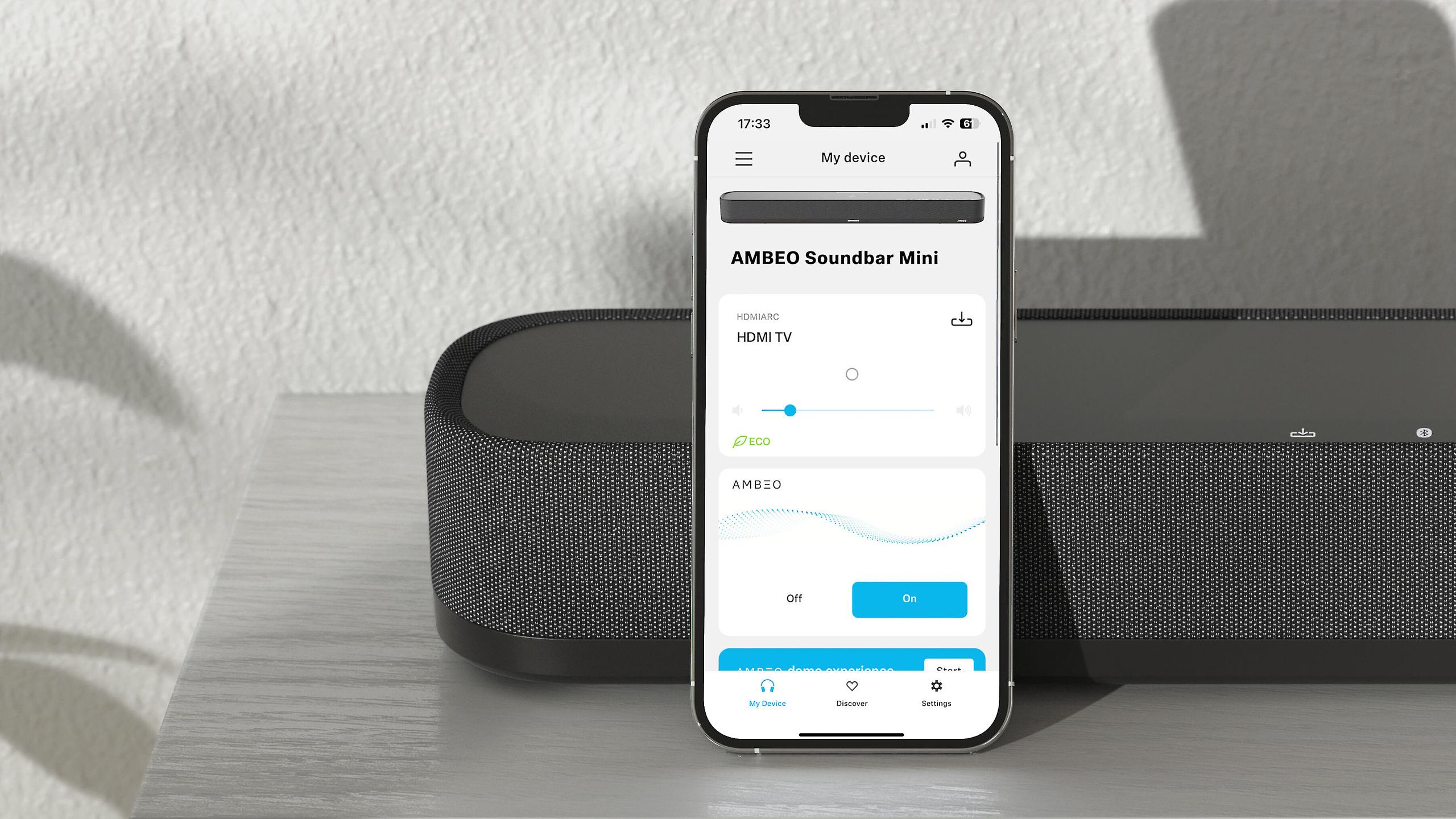
Yes, both offer comprehensive app control. The Ultimea Poseidon D50 includes a dedicated app with 10-band equalizer, 121 preset matrices, and independent satellite speaker volume control. The Sennheiser AMBEO Mini uses the AMBEO|OS app for sound optimization, streaming service integration, and automated room calibration. The Ultimea's app focuses more on manual customization, while the Sennheiser's emphasizes automated optimization.
The Sennheiser AMBEO Soundbar Mini is ideal for apartments due to its single-unit design, no additional components, and automated calibration that optimizes sound for smaller spaces. The Ultimea Poseidon D50 5.1 Soundbar requires multiple speaker placement and may overwhelm smaller rooms with its dedicated subwoofer. Apartment dwellers should choose the Sennheiser for its space efficiency and neighbor-friendly design.
Both soundbars excel at dialogue reproduction but through different approaches. The Ultimea Poseidon D50 features dedicated dialogue enhancement modes and can isolate speech frequencies effectively. The Sennheiser AMBEO Mini includes Voice Enhancement technology and Night Mode for clear speech at lower volumes. Both provide significant improvement over TV speakers, with the Sennheiser's premium drivers offering slight refinement advantages for dialogue clarity.
We've done our best to create useful and informative comparisons to help you decide what product to buy. Our research uses advanced automated methods to create this comparison and perfection is not possible - please contact us for corrections or questions. These are the sites we've researched in the creation of this article: youtube.com - eu.ultimea.com - newegg.com - tvsbook.com - youtube.com - provantage.com - ultimea.com - techradar.com - community.ultimea.com - homedepot.com - community.ultimea.com - ultimea.com - ultimea.de - youtube.com - medisamhealthcenter.com - ultimea.com - youtube.com - walmart.com - techradar.com - sennheiser-hearing.com - stereonet.com - rtings.com - youtube.com - youtube.com - newsroom.sennheiser.com - whathifi.com - baybloorradio.com - sennheiser-hearing.com - files.bbystatic.com

Privacy Policy
Terms and Conditions - Affiliate Policy
Home Security
© Copyright 2008-2026.
11816 Inwood Rd #1211, Dallas, TX 75244