

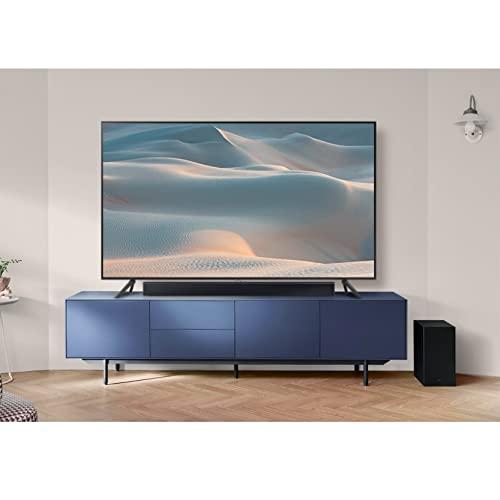
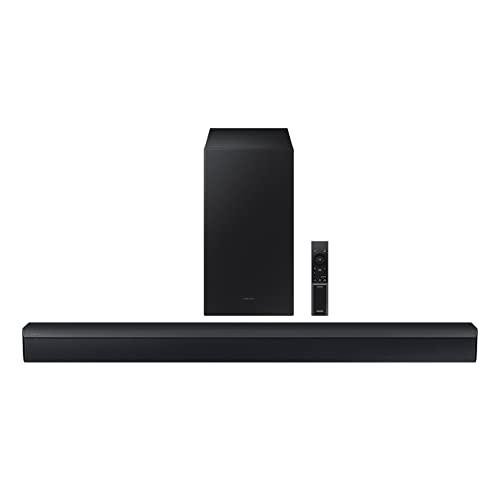


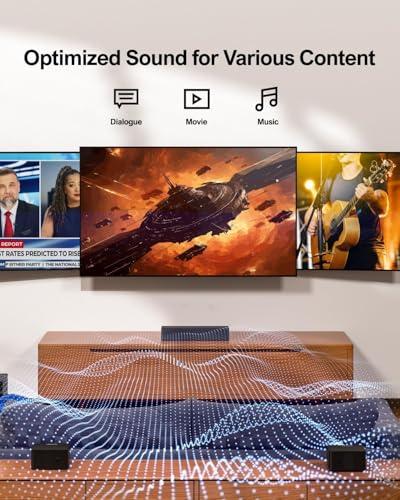

When you're tired of straining to hear dialogue over your TV's tinny built-in speakers, a soundbar becomes an essential upgrade. But choosing between different approaches can feel overwhelming. Today we're comparing two fundamentally different philosophies in home audio: the streamlined Samsung HW-C450 2.1-channel soundbar versus the full surround experience of the Ultimea Poseidon D50 5.1 system.
These aren't just different models—they represent completely different strategies for improving your TV audio. One prioritizes simplicity and refined processing, while the other delivers authentic surround sound at a budget price. Understanding which approach suits your needs will save you from buyer's remorse and ensure you get the audio experience you're actually looking for.
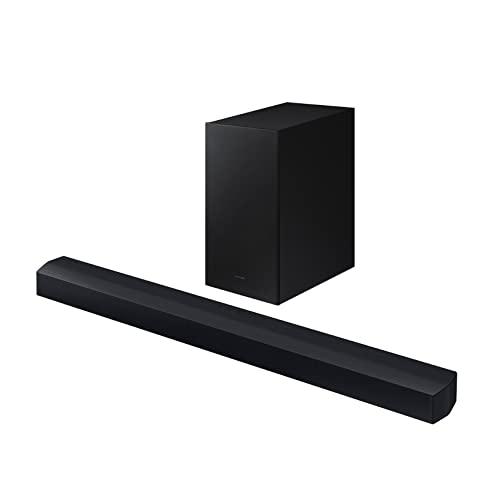
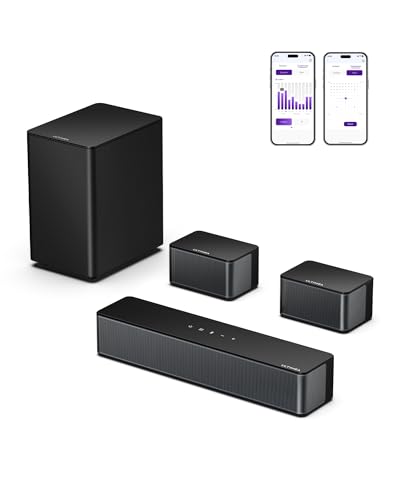
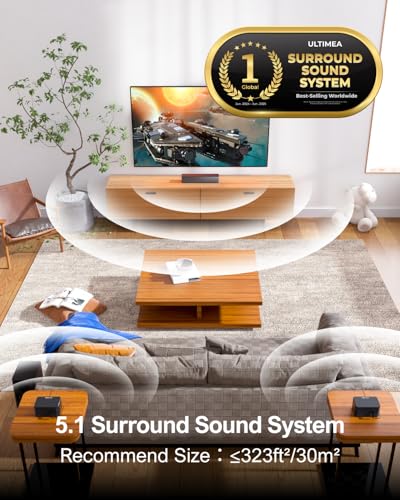
Before diving into specifics, let's decode what those channel numbers actually tell you. The Samsung HW-C450 is a 2.1 system, meaning it has two main speakers (left and right channels) plus one subwoofer (the ".1" represents the dedicated bass channel). The Ultimea Poseidon D50 is a 5.1 system with five main speakers—left, center, right, and two rear speakers—plus that same dedicated subwoofer.
This difference fundamentally changes how audio reaches your ears. With 2.1 systems, all sound originates from the front of your room, relying on digital processing to create the illusion of surround sound. True 5.1 systems physically place speakers around you, creating authentic directional audio where helicopter sounds actually seem to fly overhead and footsteps approach from behind.
The technology has evolved significantly since these models launched. The Samsung HW-C450 represents Samsung's 2023 entry-level approach, focusing on virtual surround processing that's become much more sophisticated in recent years. Meanwhile, the Ultimea Poseidon D50 launched in 2024 as part of a new wave of budget 5.1 systems that were previously impossible to manufacture at accessible price points.
The most dramatic difference between these systems lies in how they create spatial audio. The Samsung HW-C450 uses DTS Virtual:X technology—a sophisticated digital processing system that analyzes audio signals and uses psychoacoustic tricks to fool your brain into perceiving surround sound from just three physical speakers.
This processing works by carefully timing and adjusting frequencies to create phase differences that your ears interpret as directional cues. It's genuinely impressive technology, and in smaller rooms (under 150 square feet), it can create a noticeably wider soundstage than basic stereo. However, it's still fundamentally limited by physics—all sound originates from your TV area.
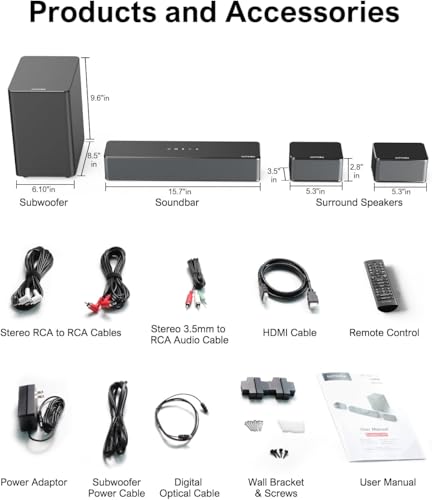
The Ultimea Poseidon D50 takes the direct approach with physical rear speakers connected by 19.6-foot cables. When a movie's helicopter flies from left to right and behind you, you actually hear it move through space because different speakers are producing the sound at different times. This creates what audio engineers call "discrete channel separation"—each speaker handles distinct audio information rather than processing tricks.
Our research into user experiences consistently shows that people notice the surround difference immediately with the Ultimea system. One reviewer described watching Top Gun: Maverick and being "genuinely startled" by aircraft sounds that seemed to come from behind and above, something that's impossible with front-firing speakers alone.
The Samsung does have one advantage here: its Surround Sound Expansion mode can be adjusted or turned off entirely. Some people find aggressive surround processing fatiguing during long listening sessions, and Samsung gives you that control. The Ultimea, being true surround, is always creating that enveloping effect—which is either exactly what you want or potentially overwhelming depending on your preferences.
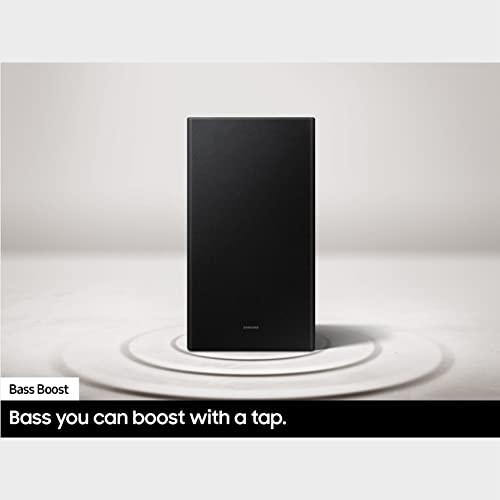
Both systems include wireless subwoofers, but their personalities differ significantly. The Samsung HW-C450 packs a 220-watt subwoofer that's tuned for impact. Its Bass Boost mode can shake your couch during action sequences, and the frequency response digs deeper into sub-bass territory—those rumbling low frequencies you feel as much as hear.
This approach works brilliantly for movies and bass-heavy music genres. The Samsung's subwoofer uses a larger driver and more powerful amplifier, resulting in bass that hits harder and extends lower. During explosion scenes or electronic music, you'll definitely notice the difference.
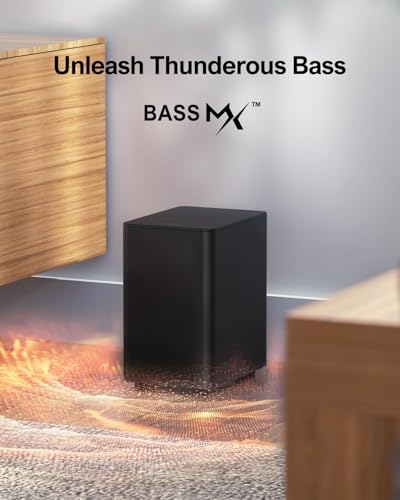
The Ultimea Poseidon D50 takes a more balanced approach with its BassMX technology. This system uses a 5.25-inch driver with what Ultimea calls an "optimized magnetic circuit" and 15mm diaphragm excursion—technical terms that essentially mean the speaker can move more air efficiently without distortion.
The result is bass that integrates better with dialogue and music without overwhelming other frequencies. While it doesn't hit quite as deep or hard as the Samsung, it maintains better definition. You can distinguish between different bass instruments instead of just feeling a general rumble.
For home theater use, this becomes a critical consideration. If your living situation requires consideration of neighbors or family members, the Ultimea's more controlled bass response might be preferable. The Samsung's more aggressive bass tuning is fantastic when you can turn it up, but it can dominate the mix at moderate volumes.
Clear dialogue might be the most important aspect of any TV audio upgrade, and both systems handle it differently. The Samsung HW-C450 includes dedicated Voice Enhance technology that specifically boosts the frequency range where human speech occurs—typically between 2-5 kHz.
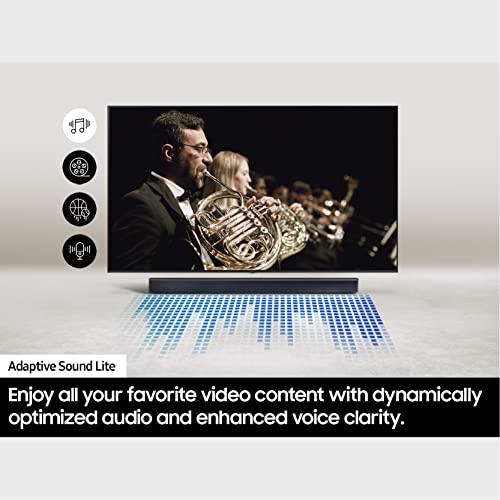
More impressively, its Adaptive Sound Lite feature analyzes incoming audio in real-time and automatically adjusts processing based on content type. When you switch from a music video to a news program, the system recognizes the change and emphasizes dialogue frequencies accordingly. This automation works remarkably well in practice, maintaining consistent dialogue clarity without manual intervention.
The Samsung also includes Night Mode, which compresses the dynamic range—reducing the difference between loud and quiet sounds. This keeps explosions from being too jarring while ensuring whispered dialogue remains audible. For late-night viewing or apartments with thin walls, this feature proves invaluable.
The Ultimea Poseidon D50 handles dialogue through proper 5.1 channel separation. In true surround mixes, dialogue typically comes through a dedicated center channel, which the system can emphasize independently of music and effects. While it lacks the Samsung's specialized processing, the physical separation often produces more natural-sounding speech.
However, the Ultimea requires more manual adjustment to optimize dialogue. Its 10-band equalizer allows precise frequency tuning, but you'll need to understand which frequencies to adjust—or spend time experimenting with its 121 preset EQ matrices to find what works for your content.
This category reveals a significant gap between the systems. The Samsung HW-C450 relies primarily on optical digital connection and Bluetooth 4.2—connections that work but represent older standards. Most notably, it lacks any HDMI connectivity, including HDMI ARC (Audio Return Channel), which has become the preferred method for connecting soundbars to modern TVs.
This limitation means you're stuck with optical cable's bandwidth restrictions, which cap you at basic Dolby Digital and DTS. You also miss out on features like CEC control, which allows your TV remote to control soundbar volume and settings.
The Ultimea Poseidon D50 includes HDMI eARC (enhanced Audio Return Channel), the latest standard that supports higher-quality audio formats and better device integration. It also features Bluetooth 5.3, which offers improved range, stability, and lower latency compared to the Samsung's older Bluetooth implementation.
For future-proofing, this connectivity difference matters significantly. As streaming services and gaming consoles support increasingly advanced audio formats, the Samsung's optical-only connection becomes a bottleneck. The Ultimea's HDMI eARC ensures compatibility with whatever audio developments come next.
The philosophical difference between these systems extends to user control. The Samsung HW-C450 emphasizes automated optimization—its Adaptive Sound Lite, Voice Enhance, and Game Mode handle most adjustments automatically. You get six preset sound modes that cover most use cases without requiring audio engineering knowledge.
This approach works well for users who want better sound without complexity. The Samsung consistently produces good results across different content types with minimal intervention. Its integration with Samsung TVs is particularly seamless, allowing control through your existing TV remote.
The Ultimea Poseidon D50 caters to users who enjoy customization. Its smartphone app provides access to a full 10-band equalizer, multiple surround modes, and independent volume control for the rear speakers. This level of control allows you to optimize the system for your specific room acoustics and personal preferences.
The Ultimea also offers adjustable surround levels—you can dial back the rear speakers if the effect feels too pronounced, or boost them for more immersion. This flexibility proves particularly valuable since every room responds differently to surround sound.
However, with great power comes great responsibility. The Ultimea's extensive customization can overwhelm users who just want to plug in and enjoy better audio. Finding the right settings requires time and experimentation.
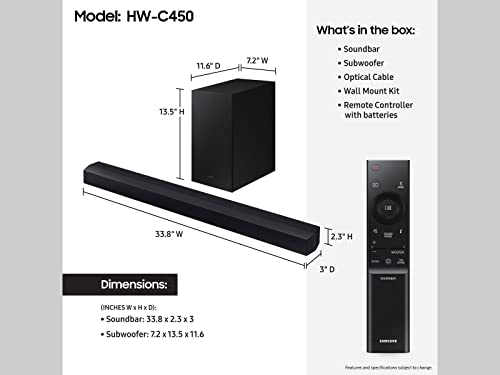
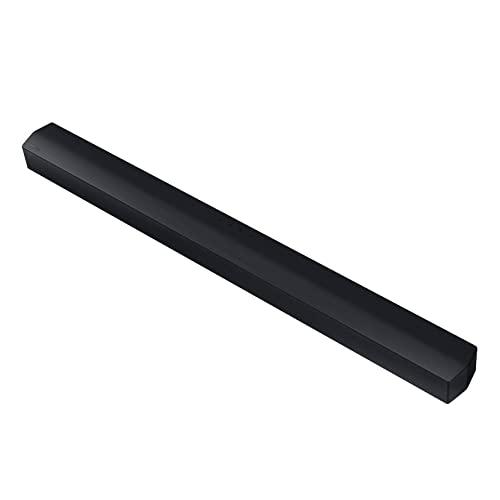
The Samsung HW-C450 wins decisively on installation simplicity. The wireless subwoofer pairs automatically, requiring no manual configuration. You connect a single optical cable to your TV, plug in both components, and you're done. The compact soundbar fits easily under most TVs, and wall mounting requires just the included bracket.
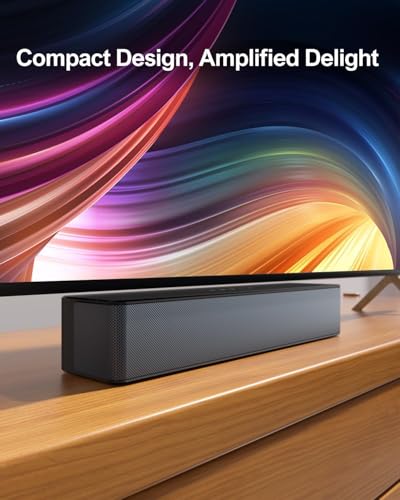
The Ultimea Poseidon D50 demands more planning. Those rear speakers need positioning behind your listening area, connected by nearly 20-foot cables that you'll need to route around or under your room. This isn't necessarily difficult, but it requires forethought and potentially some cable management solutions.
Room size also becomes a factor with the Ultimea. In very small rooms, the rear speakers might be too close to listeners, creating an unnatural surround effect. The system works best in medium to large rooms where proper speaker spacing is possible.
The wireless subwoofer setup is comparable between both systems, but the Ultimea requires positioning four separate components optimally rather than just two.
At the time of writing, the Ultimea Poseidon D50 typically costs less than the Samsung HW-C450 while delivering more speakers, more power, and more advanced connectivity. This price-to-feature ratio makes the Ultimea a standout value proposition in the soundbar market.
The Samsung commands a premium for its brand reputation, refined processing, and simplified operation. You're paying more for fewer speakers, but you're getting Samsung's audio engineering expertise and customer support infrastructure.
For many buyers, the decision comes down to whether Samsung's processing refinements and ease of use justify the higher cost and reduced feature set. The brand certainly delivers on build quality and long-term reliability, but the feature gap is substantial.
The Samsung HW-C450 makes sense for specific situations and user types. If you live in a small apartment where rear speakers would be impractical, the Samsung's virtual surround processing maximizes the soundstage from limited space. Users with hearing difficulties often prefer its specialized dialogue enhancement over the Ultimea's manual adjustments.
The Samsung also suits people who prioritize music listening equally with movies and TV. Its stereo imaging and bass response work well for various music genres, while true surround systems can make music feel artificially spacious.
The Ultimea Poseidon D50 targets users seeking maximum immersion and value. If you have space for proper rear speaker placement and want to experience movies as directors intended, the authentic surround sound justifies the slightly more complex setup.
Gamers particularly benefit from the Ultimea's directional audio. Being able to pinpoint enemy locations through authentic surround positioning provides a competitive advantage that virtual processing simply cannot match.
Home theater enthusiasts should strongly consider the Ultimea. Its HDMI eARC connectivity, extensive customization options, and true 5.1 channels create a foundation that will remain relevant as audio technology continues advancing.
Both soundbars successfully address the fundamental problem of terrible TV audio, but they do so through completely different approaches. The Samsung HW-C450 offers refined simplicity with impressive processing that maximizes performance from minimal hardware. The Ultimea Poseidon D50 delivers authentic surround sound and premium features at an aggressive price point.
For most users seeking home theater improvement, the Ultimea Poseidon D50 represents exceptional value. Its true surround sound, extensive connectivity, and customization options provide a foundation for years of audio enjoyment. The slightly more complex setup pays dividends in long-term satisfaction and future compatibility.
However, the Samsung HW-C450 remains the better choice for users prioritizing simplicity, music listening, or small room applications. Its processing sophistication and dialogue enhancement justify the premium for users who value refinement over raw features.
The soundbar market has evolved dramatically in recent years, with budget options like the Ultimea offering features previously reserved for expensive systems. This democratization of high-quality audio means you no longer need to compromise on surround sound to stay within a reasonable budget—you just need to decide whether you want authentic immersion or streamlined simplicity.
| Samsung HW-C450 | Ultimea Poseidon D50 |
|---|---|
| Channel Configuration - Determines surround sound authenticity | |
| 2.1 channels (soundbar + subwoofer, virtual surround) | 5.1 channels (soundbar + subwoofer + 2 rear speakers, true surround) |
| Total Power Output - Affects volume and dynamic range | |
| 300W total (25W soundbar + 40W standby consumption listed) | 320W total system power |
| Surround Sound Technology - How immersive audio is created | |
| DTS Virtual:X processing from front speakers only | Physical rear speakers + SurroundX algorithm for authentic 360° sound |
| Subwoofer Power - Determines bass impact and depth | |
| 220W wireless subwoofer with Bass Boost mode | BassMX technology with 5.25" driver and optimized magnetic circuit |
| Connectivity Options - Future-proofing and device compatibility | |
| Optical, USB, Bluetooth 4.2 (no HDMI connectivity) | HDMI eARC, Optical, USB, AUX, Bluetooth 5.3 |
| Audio Customization - Control over sound signature | |
| 6 preset modes with Adaptive Sound Lite automation | 10-band EQ, 121 preset matrices, smartphone app control |
| Dialogue Enhancement - Critical for TV and movie clarity | |
| Dedicated Voice Enhance mode + Adaptive Sound Lite | Manual EQ adjustment + center channel separation in 5.1 mix |
| Installation Complexity - Setup difficulty and room requirements | |
| Plug-and-play with wireless sub, fits under most TVs | Requires rear speaker cable routing (19.6ft) and room planning |
| Smart Features - Modern conveniences and integration | |
| Samsung TV remote integration, One Remote Control support | Full smartphone app control with independent speaker adjustments |
| Ideal Room Size - Where each system performs best | |
| Small to medium rooms (under 200 sq ft) | Medium to large rooms (150+ sq ft) where rear speakers can be properly spaced |
| Primary Use Case Strengths - What each excels at | |
| Music listening, dialogue clarity, simplified operation | Movie immersion, gaming directional audio, customization flexibility |
The Ultimea Poseidon D50 delivers superior surround sound with true 5.1 channels including physical rear speakers, while the Samsung HW-C450 uses virtual surround processing from front speakers only. For authentic home theater immersion, the Ultimea Poseidon D50 creates genuine 360-degree audio that you can't get from virtual processing.
The Samsung HW-C450 is a 2.1 system with left/right speakers plus a subwoofer, relying on digital processing for surround effects. The Ultimea Poseidon D50 is a true 5.1 system with dedicated rear speakers that physically place sound around your room. This means the Ultimea provides authentic surround sound while the Samsung creates virtual surround from the front.
The Samsung HW-C450 is significantly easier to install with just a soundbar and wireless subwoofer that pairs automatically. The Ultimea Poseidon D50 requires running speaker cables to rear speakers positioned behind your seating area. If you want plug-and-play simplicity, choose the Samsung HW-C450.
The Samsung HW-C450 typically delivers deeper, more powerful bass with its dedicated Bass Boost mode and 220W subwoofer. The Ultimea Poseidon D50 offers more balanced bass that integrates better with dialogue and doesn't overpower other frequencies. For pure bass impact, the Samsung has the edge.
Only the Ultimea Poseidon D50 includes HDMI eARC connectivity, which provides better audio quality and device control. The Samsung HW-C450 lacks HDMI entirely, relying on optical and Bluetooth connections. For modern TV integration and future-proofing, the Ultimea offers superior connectivity options.
The Samsung HW-C450 excels at dialogue clarity with dedicated Voice Enhance technology and Adaptive Sound Lite that automatically optimizes speech. While the Ultimea Poseidon D50 can separate dialogue through its center channel, it requires manual adjustment. For effortless dialogue improvement, the Samsung is the better choice.
The Samsung HW-C450 integrates seamlessly with Samsung TV remotes and supports One Remote Control functionality. The Ultimea Poseidon D50 offers smartphone app control with extensive customization options but may require separate remote control. The Samsung provides simpler TV integration.
The Ultimea Poseidon D50 provides extensive customization with a 10-band equalizer, 121 preset EQ settings, and independent speaker volume controls through its smartphone app. The Samsung HW-C450 focuses on automated optimization with fewer manual adjustments. Audio enthusiasts will prefer the Ultimea's flexibility.
Both soundbars include gaming modes, but the Ultimea Poseidon D50 offers superior directional audio for competitive gaming through its physical rear speakers. The Samsung HW-C450 provides Game Mode processing but lacks true positional audio. For serious gaming, the Ultimea delivers better spatial awareness.
The Samsung HW-C450 works better in small spaces where rear speakers would be too close to listeners. Its virtual surround processing is more appropriate for compact rooms. The Ultimea Poseidon D50 performs best in medium to large rooms where rear speakers can be properly positioned away from the seating area.
The Ultimea Poseidon D50 typically costs less while providing more speakers, true surround sound, and advanced connectivity features. The Samsung HW-C450 commands a premium for brand reliability and simplified operation. For raw features per dollar, the Ultimea offers exceptional value.
Choose the Ultimea Poseidon D50 if you want authentic surround sound, have space for rear speakers, and prioritize maximum immersion for movies and gaming. Select the Samsung HW-C450 if you prefer simple setup, live in a small space, or prioritize dialogue clarity and music listening over surround effects.
We've done our best to create useful and informative comparisons to help you decide what product to buy. Our research uses advanced automated methods to create this comparison and perfection is not possible - please contact us for corrections or questions. These are the sites we've researched in the creation of this article: e-catalog.com - alibaba.com - smart.dhgate.com - greentoe.com - requiremints.com - versus.com - bhphotovideo.com - rtings.com - soundmachine.com.mt - samsung.com - samsung.com - youtube.com - bhphotovideo.com - newegg.com - images.samsung.com - bestbuy.com - samsung.com - youtube.com - jsappliance.com - gadgetsleo.com - youtube.com - saraappliance.com - walmart.com - youtube.com - eu.ultimea.com - newegg.com - tvsbook.com - youtube.com - provantage.com - ultimea.com - techradar.com - community.ultimea.com - homedepot.com - community.ultimea.com - ultimea.com - ultimea.de - youtube.com - medisamhealthcenter.com - ultimea.com - youtube.com - walmart.com

Privacy Policy
Terms and Conditions - Affiliate Policy
Home Security
© Copyright 2008-2026.
11816 Inwood Rd #1211, Dallas, TX 75244