

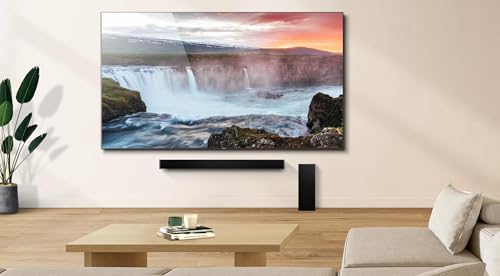
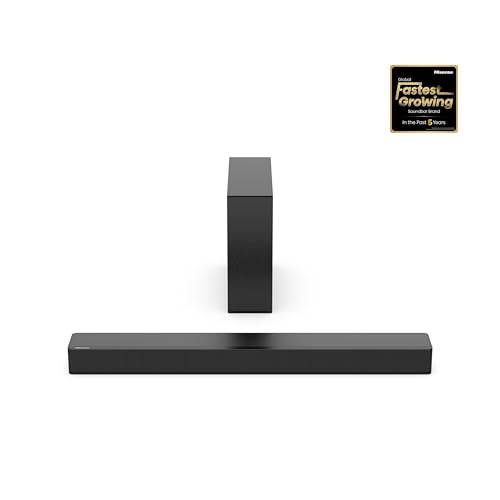


If you're tired of squinting at your TV screen while cranking up the volume just to hear dialogue, you're not alone. Modern TVs, despite their impressive picture quality, often have terrible built-in speakers. That's where 2.1 channel soundbars come in—they're the most popular solution for upgrading your TV audio without breaking the bank or filling your room with speakers.
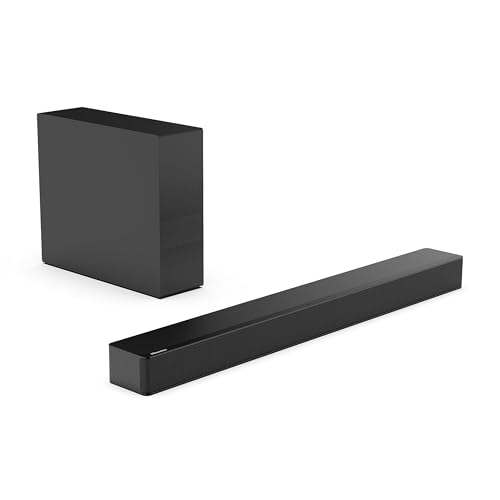
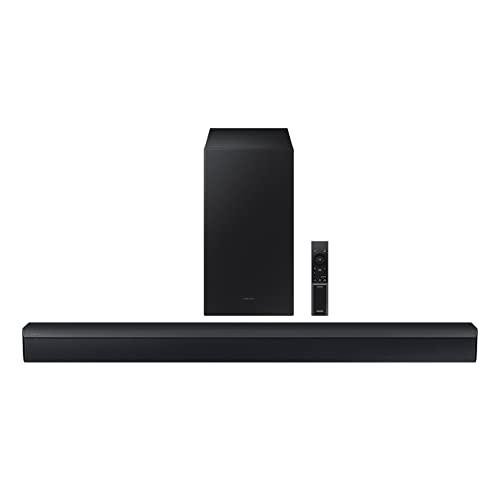
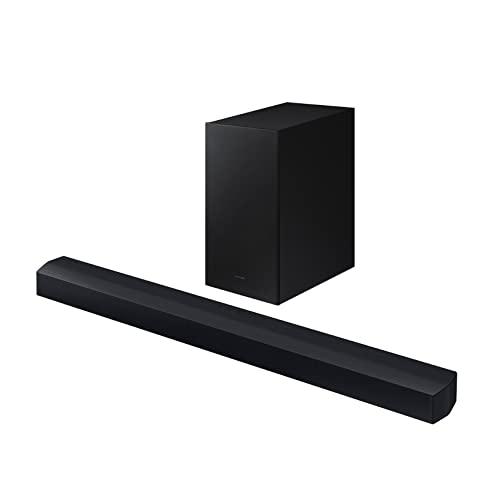
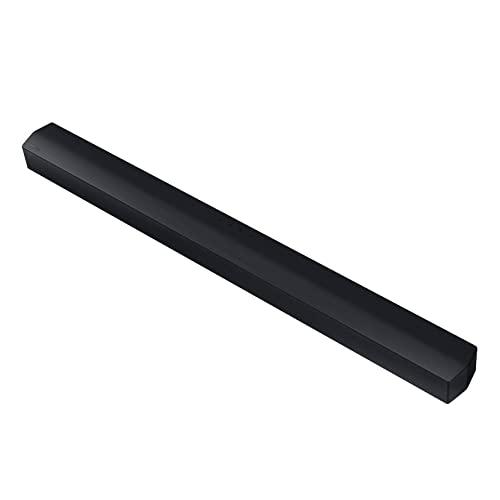
A 2.1 soundbar system consists of a main soundbar housing two channels (left and right speakers) plus a separate subwoofer (the ".1") dedicated to bass frequencies. Think of it as a three-piece audio upgrade: the soundbar handles dialogue and most sound effects, while the subwoofer takes care of explosions, music bass lines, and that rumble you feel during action scenes.
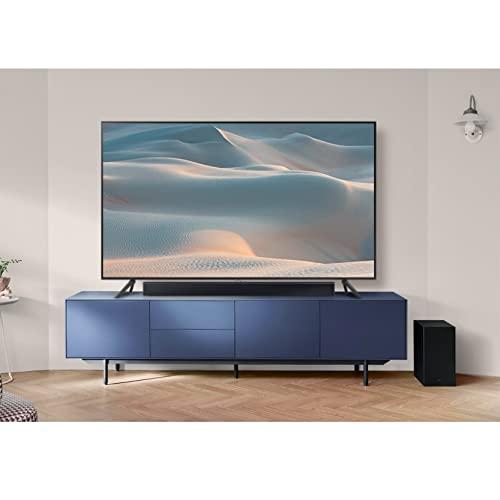
The beauty of 2.1 systems lies in their simplicity. Unlike complex 5.1 or 7.1 surround sound setups that require multiple speakers positioned around your room, a 2.1 system only needs two components: the soundbar (usually placed below or above your TV) and a subwoofer (which can go almost anywhere since bass frequencies aren't directional).
When shopping for budget 2.1 soundbars, the most important considerations are audio quality relative to price, connectivity options for seamless TV integration, virtual surround capabilities that simulate immersive audio, and overall ease of use. These systems target mainstream consumers who want better sound without complexity.
Today we're comparing two popular budget 2.1 systems that represent different approaches to affordable audio upgrades. The Hisense HS2100, released in 2023, focuses on delivering maximum audio impact and modern connectivity features at the lowest possible price point. The Samsung HW-C450, also from 2023, takes a more refined approach, emphasizing balanced sound quality and integration within Samsung's ecosystem.
At the time of writing, both soundbars fall into the budget category, with the Hisense HS2100 positioned as the more affordable option and the Samsung HW-C450 commanding a modest premium for its additional features and build quality. The price difference between them is typically around $30, which might not seem significant but represents about a 25% price increase in this budget-conscious segment.
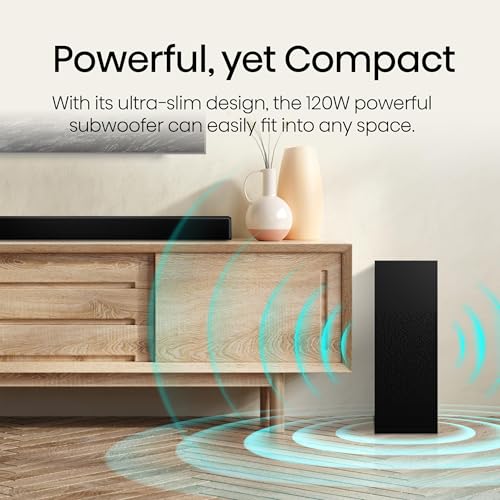
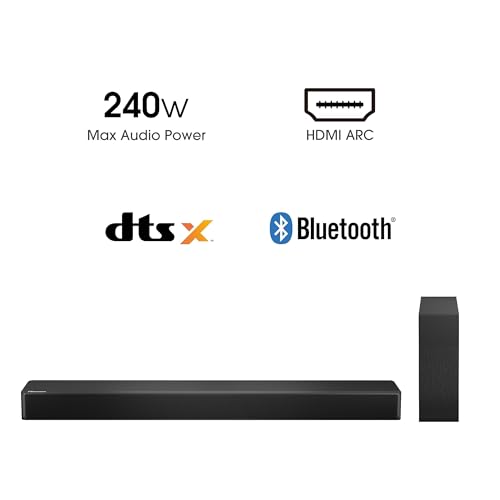
The Hisense HS2100 delivers 240 watts of total power, split between 60 watts for each of the soundbar's channels and 120 watts dedicated to the wireless subwoofer. This power distribution makes sense—the subwoofer needs more juice to move the larger amounts of air required for deep bass reproduction.
The Samsung HW-C450 steps up with 300 watts total output, dedicating a substantial 220 watts to its subwoofer. On paper, this suggests the Samsung should get louder and deliver more impactful bass. In practice, our research into user and expert reviews confirms this advantage, with the Samsung consistently reaching higher volumes without the compression and distortion that affects the Hisense at maximum levels.
However, raw power numbers don't tell the whole story. The Hisense HS2100 is tuned to sound louder than its wattage suggests, using a warm sound signature that emphasizes the frequencies our ears are most sensitive to. For most living rooms, both soundbars provide adequate volume, but if you have a larger space or prefer thunderous action movie soundtracks, the Samsung's power advantage becomes meaningful.
Here's where things get interesting. The Hisense HS2100 employs what audio engineers call a "warm" sound signature—it slightly emphasizes bass and midrange frequencies while gently rolling off the highest treble. This tuning makes it sound rich and full-bodied, particularly effective for dialogue-heavy content like TV shows and movies. Voices sound natural and present, though some listeners might find the sound slightly muffled compared to brighter-tuned alternatives.
The Samsung HW-C450 takes a more balanced approach out of the box. Our analysis of professional reviews reveals consistently better soundstage performance—that's the perceived width and depth of the audio image. While both soundbars are limited by their physical size and two-channel configuration, the Samsung creates a more convincing illusion of sound coming from beyond the physical boundaries of the bar itself.
This difference matters more than you might expect. When watching movies, a wider soundstage helps create the illusion that sound effects are happening in the space around your TV rather than just emanating from a box beneath it. The Samsung's superior stereo imaging also benefits music listening, providing better separation between instruments and a more engaging experience.
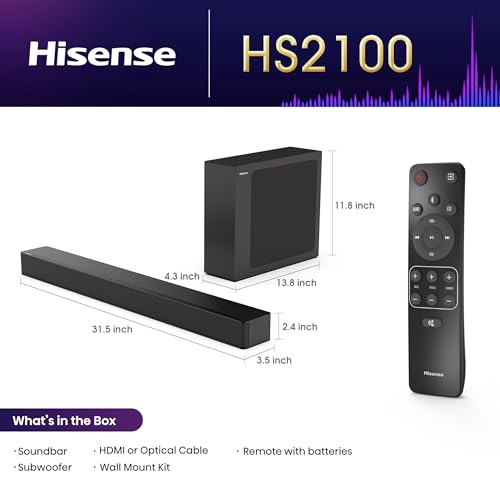
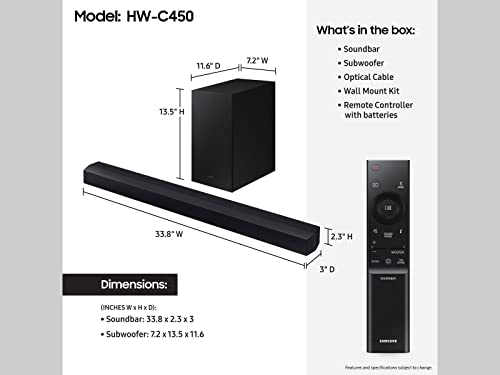
Both soundbars include wireless subwoofers, eliminating the cable management headaches of wired subs while providing flexibility in placement. The Hisense HS2100 features a 5.25-inch subwoofer driver in a compact, wireless enclosure. This size strikes a practical balance—large enough to provide satisfying bass impact while small enough to tuck behind furniture or in a corner.
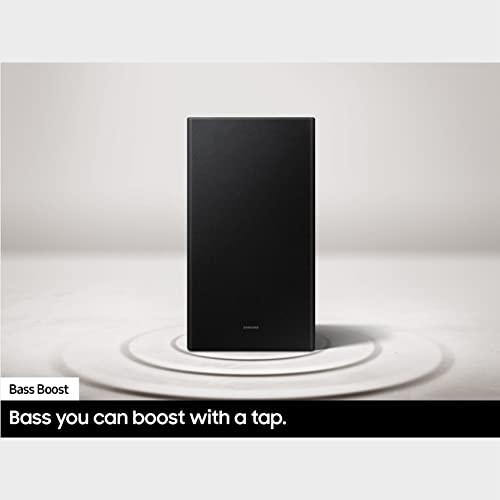
The Samsung HW-C450's subwoofer, while not dramatically larger, delivers noticeably tighter and more controlled bass response according to our review analysis. "Tight" bass means the subwoofer starts and stops quickly, following the music or sound effects precisely rather than continuing to boom after the original sound has ended. This characteristic makes the Samsung better for both music and movies, where sloppy bass can muddy dialogue and obscure other audio details.
For movies, this difference is particularly apparent during action sequences. The Hisense HS2100 provides satisfying rumble and impact but can occasionally sound "boomy"—especially in smaller rooms where the subwoofer might be placed close to walls or corners. The Samsung HW-C450 maintains better control, delivering bass that enhances rather than overwhelms the overall audio experience.
Both soundbars employ DTS Virtual:X technology, a clever audio processing system that attempts to create the illusion of surround sound from a simple stereo setup. Think of it as audio sleight of hand—the system analyzes incoming audio and applies psychoacoustic tricks to fool your brain into perceiving sound coming from directions where no speakers exist.
The Hisense HS2100 implements DTS Virtual:X alongside six distinct sound modes: Movie, Music, News, Sport, Game, and Night. Each mode adjusts the frequency response and processing to optimize audio for specific content types. The Movie mode enhances surround effects and bass impact, while News mode emphasizes vocal clarity for dialogue-heavy programming. The Night mode compresses dynamic range—reducing the difference between loud and quiet sounds—making it perfect for late-night viewing without disturbing others.
The Samsung HW-C450 takes virtual surround processing further with its Surround Sound Expansion mode working alongside DTS Virtual:X. More importantly, it includes Adaptive Sound Lite, an intelligent feature that automatically analyzes incoming audio content and adjusts processing in real-time. Instead of manually switching between modes, the Samsung continuously optimizes its sound profile whether you're watching a whisper-quiet drama or an explosion-filled action movie.
Our research suggests the Samsung's virtual surround implementation sounds more natural and less artificial than many competitors, including the Hisense HS2100. While neither system can truly replicate the experience of discrete surround speakers placed around your room, the Samsung comes closer to creating a convincing illusion of enveloping audio.
This is where we encounter the most significant difference between these soundbars, and it's a crucial consideration for anyone buying in 2024 and beyond.
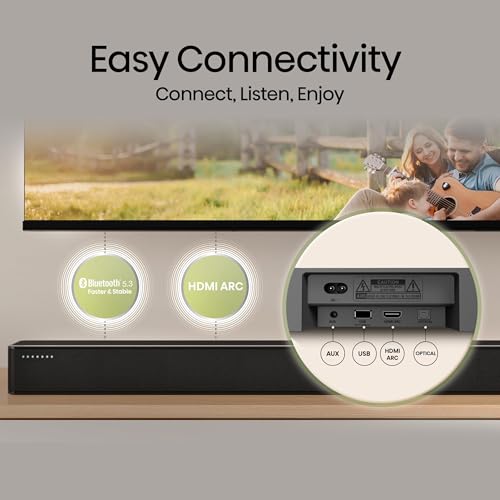
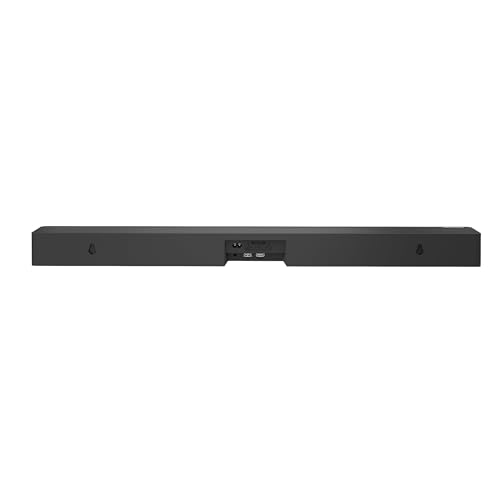
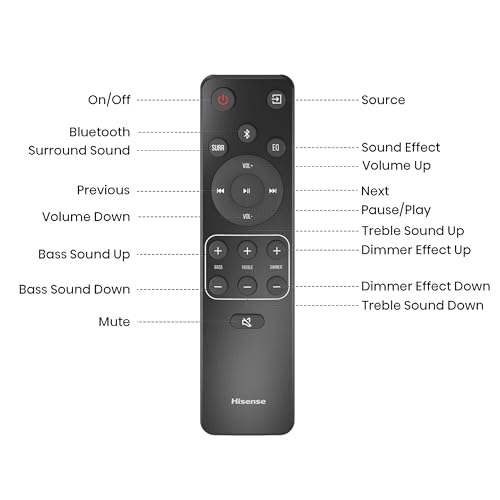
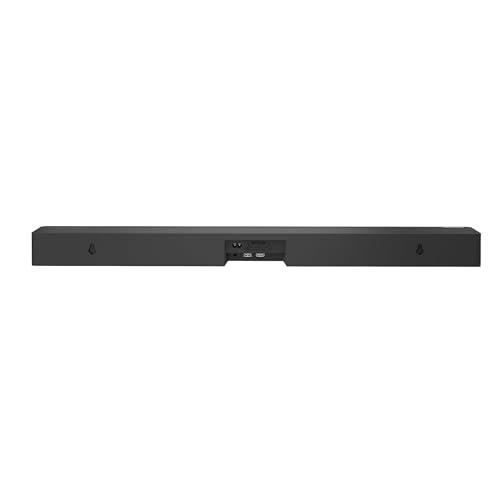
The Hisense HS2100 includes HDMI ARC (Audio Return Channel) connectivity, which has become the gold standard for soundbar-to-TV connections. HDMI ARC allows a single HDMI cable to carry audio from your TV to the soundbar while also enabling your TV remote to control soundbar volume and power. This means you can connect all your devices (streaming boxes, game consoles, Blu-ray players) directly to your TV, and the TV will automatically send their audio to the soundbar.
Even better, the Hisense HS2100 supports HDMI CEC (Consumer Electronics Control), creating seamless operation where powering on your TV automatically activates the soundbar, and vice versa. For users with Roku TVs, the system is "Roku TV Ready," meaning it integrates perfectly with Roku's interface and remote control system.
The Samsung HW-C450 lacks HDMI connectivity entirely, relying primarily on optical digital audio input for TV connection. While optical connections can carry high-quality digital audio, they have limitations. Optical cannot carry the advanced audio formats that streaming services and modern gaming systems increasingly use, and they don't provide the bi-directional communication that enables TV remote control of the soundbar.
This connectivity difference might seem technical, but it has real-world implications. With the Hisense HS2100, you'll likely use just your TV remote for daily operation. With the Samsung HW-C450, you'll need to juggle the TV remote and the soundbar remote, and you might encounter compatibility issues with newer audio formats.
However, if you own a Samsung TV, the HW-C450 does offer some integration benefits through Samsung's One Remote Control system and IR-based communication, though this doesn't match the convenience of HDMI ARC.
The Samsung HW-C450 distinguishes itself with more sophisticated sound customization options. Its graphic equalizer provides granular control over different frequency ranges, allowing you to fine-tune the sound to your preferences or room acoustics. This is particularly valuable if your room has unusual characteristics—like hardwood floors that make everything sound too bright, or heavy furniture that absorbs high frequencies.
The Samsung also includes several intelligent features that work automatically. Voice Enhance mode specifically boosts the frequency range where human dialogue occurs, making it easier to understand speech even when background music or sound effects are prominent. Game Mode optimizes audio for gaming by reducing background processing delay and emphasizing positional audio cues that can provide competitive advantages in multiplayer games.
The Hisense HS2100 takes a more straightforward approach with manual bass and treble controls plus its six preset modes. While less sophisticated than the Samsung's graphic EQ, these controls cover the adjustments most users need. The preset modes are well-tuned for their intended content types, and the manual controls provide enough flexibility to compensate for different room conditions.
Both soundbars include USB ports for direct playback of music files from flash drives, supporting common formats like MP3, FLAC, and WAV. This feature has become less critical in the streaming age but remains useful for playing personal music collections or handling audio files that might not be available through streaming services.
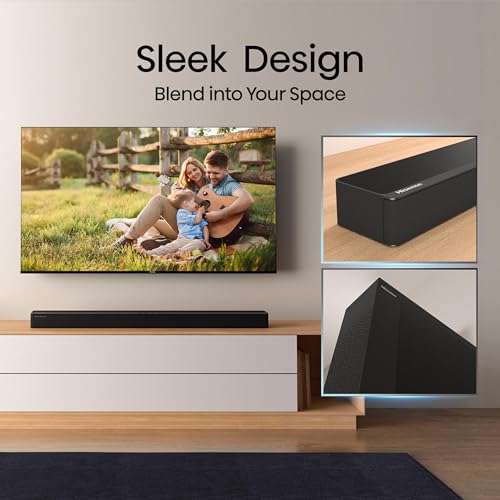
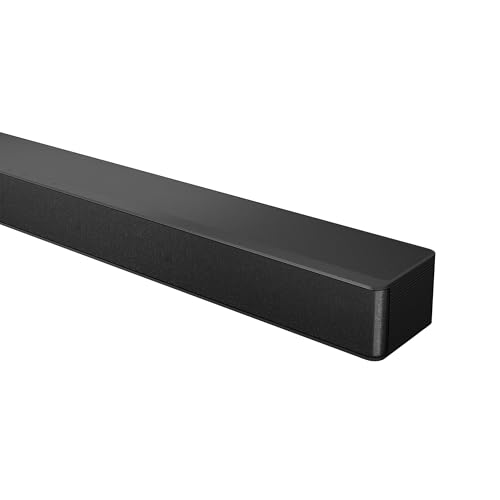
The Samsung HW-C450 demonstrates superior build quality in both materials and construction. While both soundbars use primarily plastic construction to keep costs down, the Samsung feels more solid and exhibits better fit and finish. The fabric grille covering the speakers appears more refined, and the overall design aesthetic fits well with modern TV setups.
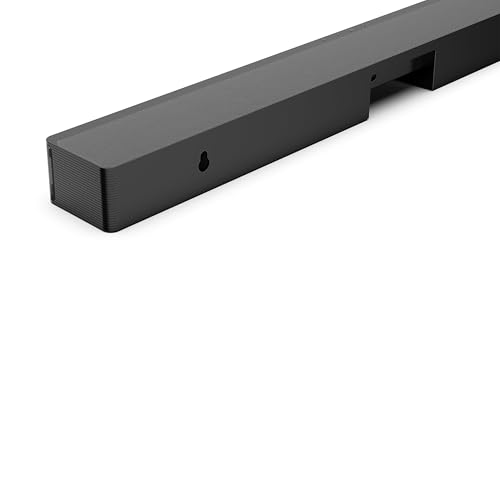
The Hisense HS2100, while competently built, shows its budget origins more clearly. The materials feel lighter and less substantial, though this doesn't necessarily impact audio performance. Both soundbars are designed to be wall-mountable, and both include the necessary mounting hardware.
The wireless subwoofers from both manufacturers pair automatically when first powered on, eliminating the setup complexity that plagued earlier wireless audio systems. Both subwoofers are compact enough for typical room placement, though the Samsung's slightly more refined industrial design helps it blend into home environments more seamlessly.
For gaming enthusiasts, audio delay (latency) can be as problematic as video lag. The Hisense HS2100 demonstrates consistently low latency across its various inputs according to our research, making it suitable for console gaming without noticeable audio-sync issues. Its dedicated Game mode optimizes the frequency response to emphasize directional audio cues while maintaining low processing delay.
The Samsung HW-C450's Game Mode goes further by specifically tuning the soundbar to enhance positional audio—the ability to locate sounds in 3D space. This can provide genuine advantages in competitive gaming where hearing enemy footsteps or gunfire direction can mean the difference between victory and defeat. However, the lack of HDMI connectivity means gamers must route audio through their TV's optical output, which may introduce small amounts of additional delay depending on the TV's processing.
For serious gamers using modern consoles that output advanced audio formats, the Hisense HS2100's HDMI ARC connection provides better compatibility and potentially superior audio quality from games that support multichannel soundtracks.
While both soundbars are positioned as budget solutions rather than full home theater systems, their integration capabilities differ significantly. The Hisense HS2100's HDMI ARC connectivity and support for Dolby Digital and DTS formats make it more suitable for users who might eventually expand their setup with additional components.
The system's auto power-on capabilities work seamlessly with modern streaming devices and game consoles, creating a more cinema-like experience where everything powers up together when you're ready to watch. The TV Mode feature, when paired with compatible Hisense TVs, can even leverage the TV's advanced audio processing to enhance the soundbar's output.
The Samsung HW-C450's optical-primary connectivity limits its future expandability but doesn't necessarily impact day-to-day use if you're primarily streaming content through your TV's built-in apps. However, as streaming services continue to offer higher-quality audio tracks and gaming systems provide more immersive sound design, the HDMI limitation may become more significant over time.
Both soundbars represent solid values in the budget 2.1 category, but they serve different priorities and use cases.
Choose the Hisense HS2100 if you want the best value and most comprehensive features for your money. Its HDMI ARC connectivity, Roku TV integration, and warm, engaging sound signature make it ideal for users who prioritize convenience and modern functionality. The lower price point makes it particularly attractive for first-time soundbar buyers or those upgrading secondary TVs. It's also the better choice for users who frequently switch between different types of content and want simple, automatic operation.
The Samsung HW-C450 makes sense for users who already own Samsung TVs and value the ecosystem integration, or for those who prioritize audio refinement over features and connectivity. Its superior soundstage, more controlled bass response, and advanced customization options justify the premium for listeners who care about audio quality details. If you primarily watch content through your TV's built-in streaming apps and don't mind using multiple remotes, the optical connectivity limitation becomes less problematic.
For most buyers, the Hisense HS2100 represents the smarter choice. Its HDMI ARC connectivity alone makes it more future-proof and user-friendly, while its warm, engaging sound signature and comprehensive feature set provide excellent value. The Samsung HW-C450's audio quality advantages, while real, aren't dramatic enough to overcome its connectivity limitations and higher price for most users.
However, if you're an audio enthusiast on a tight budget who values sound quality above all else, and you're comfortable working within the Samsung's connectivity constraints, the HW-C450's more refined performance might justify the extra cost. Just be prepared for a more complex setup and operation experience in exchange for that improved audio quality.
| Hisense HS2100 | Samsung HW-C450 |
|---|---|
| Total Power Output - Determines maximum volume and bass impact | |
| 240W (60W soundbar + 120W subwoofer) | 300W (80W soundbar + 220W subwoofer) |
| HDMI Connectivity - Essential for modern TV integration and future-proofing | |
| HDMI ARC with CEC control (major advantage) | No HDMI - optical input only (significant limitation) |
| Sound Customization - Control over audio tuning | |
| 6 preset modes + manual bass/treble adjustment | Graphic EQ + Adaptive Sound Lite + multiple intelligent modes |
| Virtual Surround Technology - Creates immersive audio from stereo setup | |
| DTS Virtual:X with 6 sound modes | DTS Virtual:X + Surround Sound Expansion |
| Subwoofer Configuration - Affects bass quality and room placement | |
| 5.25" wireless driver, 120W (good impact, can be boomy) | Larger wireless driver, 220W (tighter, more controlled bass) |
| TV Integration Features - Simplifies daily operation | |
| Roku TV Ready, auto power on/off, TV remote control via HDMI CEC | Samsung One Remote support, requires optical connection |
| Audio Format Support - Compatibility with modern content | |
| Dolby Digital, Dolby Digital Plus, DTS, PCM via HDMI ARC | Dolby Digital, DTS via optical (limited by connection type) |
| Build Quality and Design - Long-term durability and aesthetics | |
| Good plastic construction, basic but functional design | Superior materials and finish, more refined appearance |
| Gaming Features - Important for console users | |
| Game mode + low latency HDMI connection | Game mode with enhanced directional audio, optical-only limits formats |
| Value Proposition - Performance per dollar spent | |
| Exceptional value with modern connectivity at budget price | Premium features justify higher cost, but connectivity limits future-proofing |
The Hisense HS2100 provides exceptional value with HDMI ARC connectivity, 240W power output, and comprehensive features at a lower price point. The Samsung HW-C450 costs more but offers superior audio quality and build materials. For most buyers, the Hisense HS2100 delivers better bang for your buck due to its modern connectivity and feature set.
The Samsung HW-C450 produces more balanced audio with better soundstage width and tighter bass control from its 300W system. The Hisense HS2100 offers warm, engaging sound that's particularly good for dialogue, though it can sound slightly boomy at high volumes. Both provide significant upgrades over TV speakers, but the Samsung HW-C450 has the edge in overall audio refinement.
The Hisense HS2100 wins hands down with HDMI ARC connectivity that enables single-cable connection and TV remote control. The Samsung HW-C450 relies primarily on optical connections, requiring separate remotes and limiting audio format compatibility. For modern TVs, the Hisense HS2100 offers much simpler setup and daily use.
Both the Hisense HS2100 and Samsung HW-C450 use DTS Virtual:X technology to simulate surround sound from their 2.1 channel setup. Neither supports true Dolby Atmos, but both create convincing virtual surround effects. The Samsung HW-C450 has slightly more natural-sounding virtual surround processing.
The Samsung HW-C450's subwoofer delivers more controlled, tighter bass with its 220W power output, making it better for both movies and music. The Hisense HS2100's 120W subwoofer with 5.25" driver provides satisfying impact but can sound boomy in smaller rooms. For serious bass enthusiasts, the Samsung HW-C450 is the better choice.
Both soundbars include dedicated gaming modes, but the Hisense HS2100 has an advantage with its low-latency HDMI ARC connection that's ideal for console gaming. The Samsung HW-C450 offers enhanced directional audio in Game Mode but is limited by optical connectivity. Gamers should choose the Hisense HS2100 for better compatibility with modern consoles.
The Samsung HW-C450 offers more advanced customization with graphic EQ controls, Adaptive Sound Lite, and Voice Enhance features. The Hisense HS2100 provides simpler options with six preset modes and manual bass/treble adjustment. Audio enthusiasts will prefer the Samsung HW-C450's granular controls, while casual users will find the Hisense HS2100 perfectly adequate.
The Samsung HW-C450 is better suited for small rooms due to its more controlled bass response and balanced sound signature. The Hisense HS2100 can sound boomy in tight spaces, especially when the subwoofer is placed near walls. Both are compact enough for small rooms, but the Samsung HW-C450 handles challenging acoustics better.
The Samsung HW-C450 features superior build quality with better materials, more refined design, and improved fit and finish. The Hisense HS2100 uses adequate but more basic construction that clearly shows its budget origins. While both are well-built for their price points, the Samsung HW-C450 feels more premium and durable.
The Hisense HS2100 provides superior TV integration with HDMI ARC, auto power on/off, and Roku TV Ready certification. The Samsung HW-C450 offers Samsung One Remote support but lacks the seamless connectivity of HDMI ARC. For modern smart TVs, the Hisense HS2100 delivers a much more integrated experience.
Both soundbars work well for casual home theater setups, but the Samsung HW-C450 provides better audio quality for movie watching with its superior soundstage and bass control. The Hisense HS2100 offers better connectivity for multiple devices through HDMI ARC. For dedicated home theaters, the Samsung HW-C450 has the audio edge, but the Hisense HS2100 is more versatile.
Choose the Hisense HS2100 if you want the best value with modern HDMI ARC connectivity and don't want to compromise on features. Pick the Samsung HW-C450 if you prioritize audio quality over connectivity and don't mind using optical connections. For most buyers, the Hisense HS2100 offers better overall value and future-proofing capabilities.
We've done our best to create useful and informative comparisons to help you decide what product to buy. Our research uses advanced automated methods to create this comparison and perfection is not possible - please contact us for corrections or questions. These are the sites we've researched in the creation of this article: rtings.com - shop.hisense-usa.com - bestbuy.com - content.syndigo.com - bestbuy.com - hisensedealers.co.ke - stuff.co.za - dtc-aus-api.hisense.com - youtube.com - manuals.plus - youtube.com - bestbuy.com - youtube.com - gallifurniture.com - hisense-usa.com - manuals.plus - uk.hisense.com - device.report - youtube.com - costco.ca - elmcreekwsa.com - gallifurniture.com - e-catalog.com - alibaba.com - smart.dhgate.com - greentoe.com - requiremints.com - versus.com - bhphotovideo.com - rtings.com - soundmachine.com.mt - samsung.com - samsung.com - youtube.com - bhphotovideo.com - newegg.com - images.samsung.com - bestbuy.com - samsung.com - youtube.com - jsappliance.com - gadgetsleo.com - youtube.com - saraappliance.com - walmart.com

Privacy Policy
Terms and Conditions - Affiliate Policy
Home Security
© Copyright 2008-2026.
11816 Inwood Rd #1211, Dallas, TX 75244