







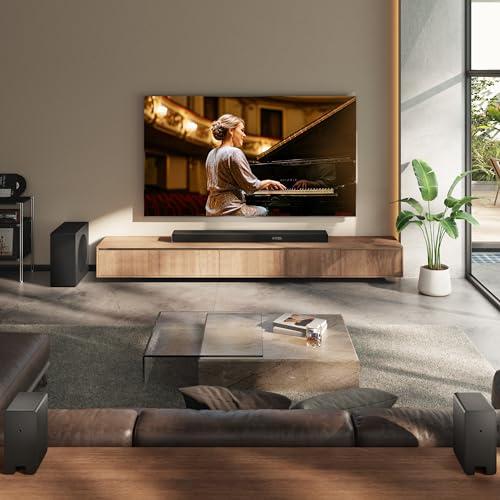
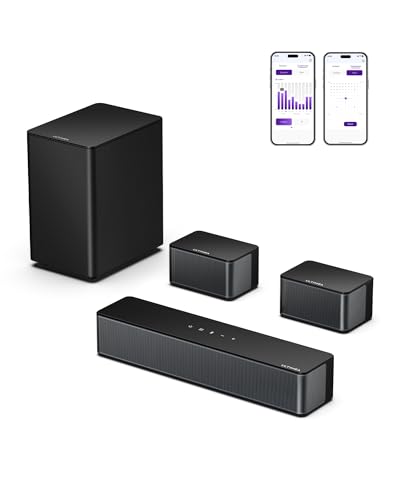


The soundbar market has exploded over the past few years, transforming from simple TV audio upgrades into sophisticated home theater systems. At the time of writing, two compelling options represent dramatically different approaches to surround sound: the premium Hisense AX5140Q with its cutting-edge Dolby Atmos technology and the value-focused Ultimea Poseidon D50 offering a complete physical surround system at a fraction of the cost.
These products highlight the central question facing anyone shopping for a soundbar: Do you invest in advanced spatial audio technology that creates overhead effects, or do you prioritize getting real physical speakers positioned around your room for traditional surround sound accuracy? The answer depends on your content consumption habits, room setup, and budget priorities.
The soundbar category has evolved far beyond the basic 2.1 systems (left, right, and subwoofer) that dominated the market just five years ago. Today's systems range from simple stereo upgrades to complex 5.1.4 configurations that can rival traditional home theater receiver setups.
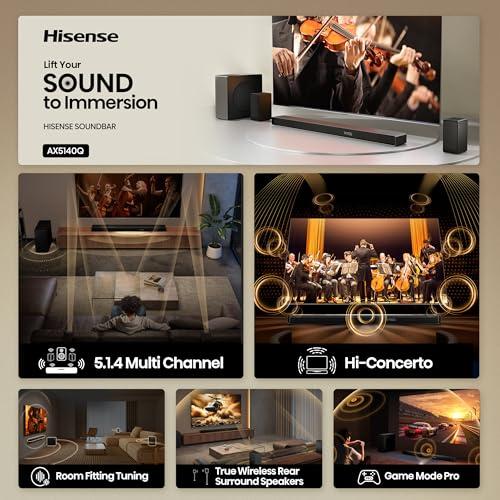
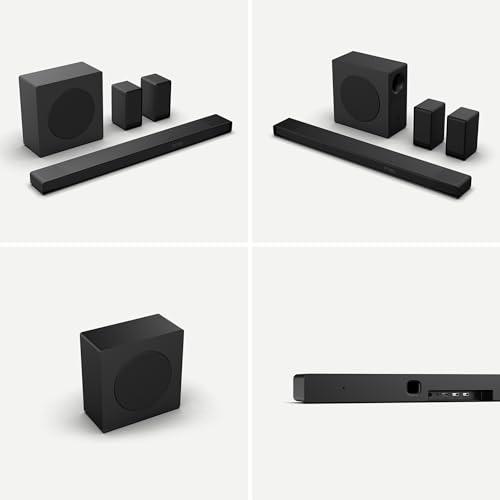
The numbers in these configurations tell you exactly what you're getting. The first number represents front-facing channels (left, center, right), the second indicates the subwoofer count, and the third number—when present—shows height channels that fire sound upward to reflect off your ceiling. So a 5.1.4 system like the Hisense AX5140Q has five main channels, one subwoofer, and four height speakers creating overhead effects.
Channel configuration determines how immersive your surround experience will be. More channels generally mean better sound positioning, but only if they're implemented as real speakers rather than virtual processing. Spatial audio support through Dolby Atmos and DTS:X has become the new premium standard, adding a vertical dimension that places sounds above and around listeners. Power output drives how loud and dynamic your system can get, while connectivity options determine how easily it integrates with your existing setup.
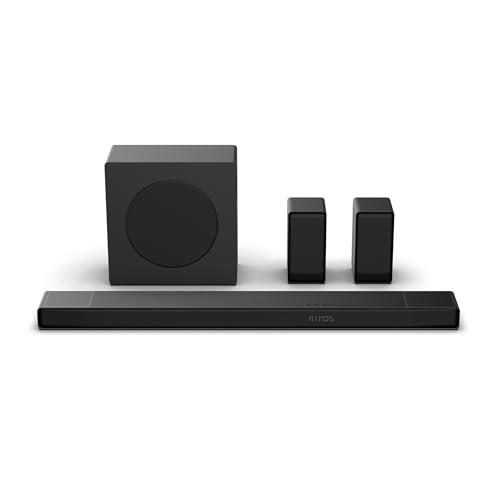
The Hisense AX5140Q, released in 2024, represents the latest generation of premium soundbars with full wireless rear speakers and advanced AI processing. The Ultimea Poseidon D50, also a 2025 model, takes a different approach by focusing on traditional 5.1 surround with extensive customization options at an accessible price point.
The Hisense AX5140Q positions itself as a premium spatial audio solution, delivering 600W of maximum power through its sophisticated 5.1.4 channel architecture. What makes this system special isn't just the power—it's the inclusion of four dedicated up-firing speakers that create genuine overhead effects.
Dolby Atmos and DTS:X support represents the cutting edge of home audio technology. Instead of traditional surround sound that keeps all audio on a horizontal plane around you, these formats add a vertical dimension. When you're watching a movie with an Atmos soundtrack and it's raining on screen, you'll actually hear the raindrops coming from above your head rather than just from the front speakers. The same applies to helicopters flying overhead, ambient forest sounds, or the subtle reverb effects in a cathedral scene.
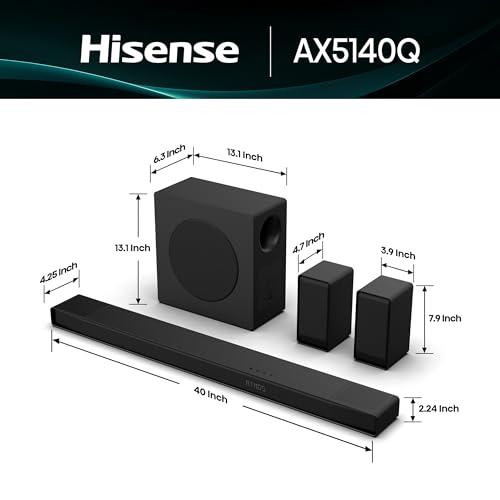
The Hisense AX5140Q accomplishes this through four physical up-firing drivers—two mounted on top of the main soundbar and two more in the wireless rear speakers. These fire sound toward your ceiling, where it reflects down to create the illusion of overhead speakers without actually mounting anything above your seating area. This approach works remarkably well in rooms with standard 8-10 foot ceilings and relatively flat surfaces.
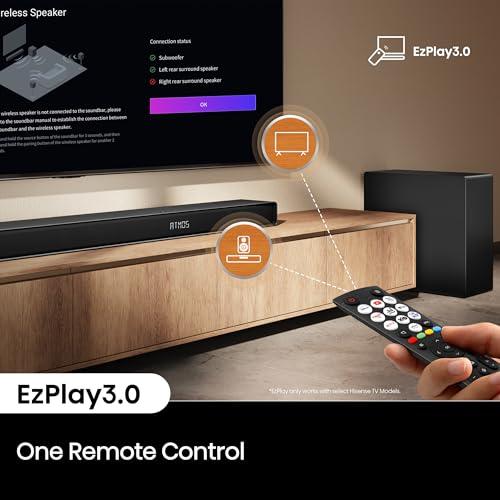
Hi-Concerto integration represents Hisense's ecosystem approach, allowing the soundbar to work seamlessly with compatible Hisense TVs. This isn't just marketing fluff—the TV and soundbar can coordinate their processing to create a more coherent soundstage, improve lip-sync, and enable unified control through your TV remote. When both components share the same processing algorithms, you get better imaging and more natural sound transitions across the entire system.
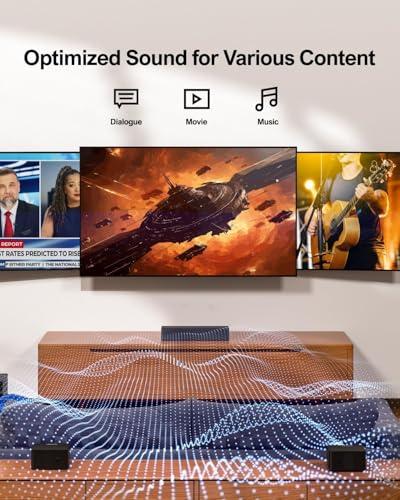
The AI EQ Mode goes beyond simple preset adjustments. The system analyzes incoming content in real-time, identifying whether you're watching dialogue-heavy drama, action movies, or music content, then automatically adjusts frequency response and dynamics accordingly. This eliminates the constant need to switch between presets as you change content types.
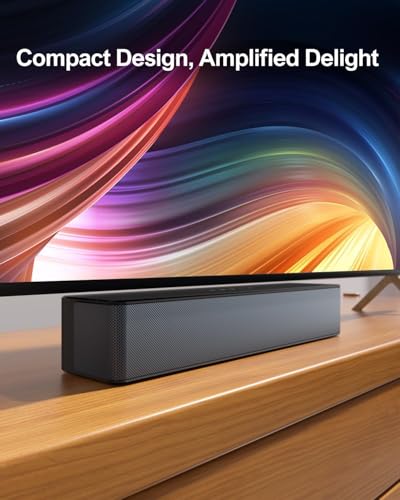
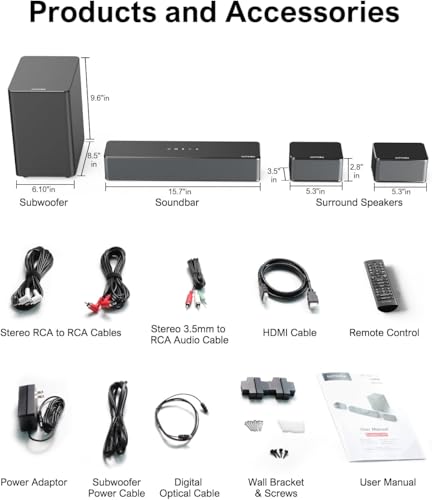
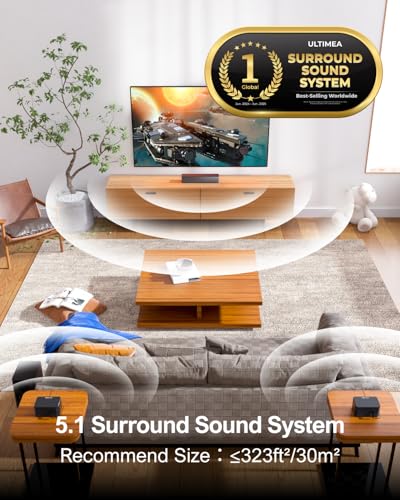
The Ultimea Poseidon D50 takes a fundamentally different approach, focusing on delivering a complete physical surround system rather than advanced processing. At a significantly lower price point, it includes everything you need for true 5.1 surround: a main soundbar, wireless subwoofer, and two dedicated satellite speakers for rear positioning.
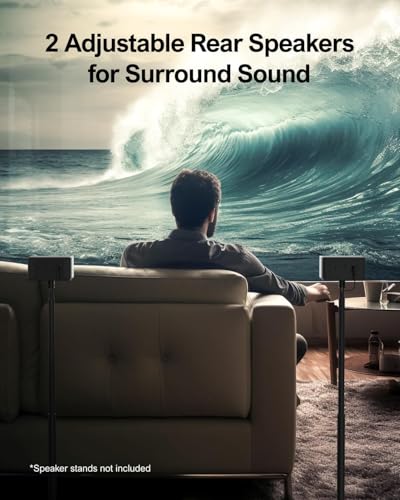
Physical satellite speakers represent a major advantage over soundbars that simulate surround effects through processing. When you have actual speakers positioned behind your seating area, connected via included 19.6-foot cables, sounds genuinely originate from those locations. This creates precise positional accuracy that virtual surround processing simply cannot match, especially for classic movie soundtracks and traditional surround content.
The SurroundX algorithm with integrated DSP (Digital Signal Processing) chip intelligently converts standard stereo audio into 5.1 surround signals. This means even content that wasn't originally mixed for surround sound—like most TV shows, podcasts, or stereo music—gets expanded into a more immersive presentation. The algorithm analyzes the stereo signal and extracts elements like vocals, ambient sounds, and effects, then redistributes them across all five speakers for a wider, more engaging soundstage.
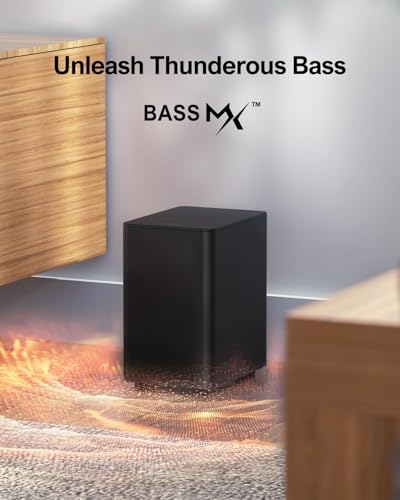
BassMX technology in the 5.25-inch subwoofer represents Ultimea's focus on bass performance. The technology combines an optimized magnetic circuit design with a larger enclosure and enhanced 15mm diaphragm excursion (how far the speaker cone can move). This engineering approach produces deeper, more controlled bass response compared to typical budget subwoofers that often sound boomy or one-note.
Perhaps most impressive is the Ultimea Poseidon D50's customization capability: 121 preset EQ matrices combined with a 10-band manual equalizer accessible through a dedicated smartphone app. This level of fine-tuning control is typically reserved for much more expensive systems and allows users to dial in their preferred sound signature with remarkable precision.
The most significant performance difference between these systems lies in their approach to spatial audio. The Hisense AX5140Q's four up-firing speakers create a fundamentally different listening experience compared to traditional horizontal surround sound.
Based on our evaluation of expert reviews and user feedback, Atmos content on the Hisense delivers convincingly realistic overhead effects. When watching scenes with rain, the sound genuinely appears to come from above rather than being projected forward and processed to simulate height. Aircraft flyovers move smoothly from front to back while maintaining their elevated position, and ambient effects like wind through trees create an enveloping dome of sound around the listening position.
However, this advantage only applies to content specifically mixed for Dolby Atmos or DTS:X. For traditional stereo or 5.1 content—which still represents the majority of what most people watch—the Ultimea Poseidon D50's physical surround positioning often provides more accurate and engaging results.
The Ultimea's SurroundX processing excels with traditional content by creating width and depth without artificial overhead effects. Music listening particularly benefits from this approach, as the algorithm can separate vocals to the center channel while spreading instruments across the front stage and adding subtle ambience to the rear speakers.
The Hisense AX5140Q's 600W maximum output provides substantial advantages for larger rooms and high-volume listening. This power reserve translates into better dynamic contrast—the difference between quiet dialogue and explosive action sequences—and maintains clarity even during complex, loud passages.
In practical terms, this means the Hisense can fill larger spaces effectively while the Ultimea Poseidon D50's 320W output works best in medium-sized rooms up to about 380 square feet. The power difference becomes most noticeable during action movies with wide dynamic range, where the Hisense delivers more impactful transients and maintains better separation between effects during busy scenes.
Interestingly, our research suggests the Ultimea Poseidon D50 often provides more satisfying bass performance despite its smaller 5.25-inch subwoofer compared to the Hisense AX5140Q's 6.5-inch unit. This apparent contradiction comes down to engineering focus and tuning philosophy.
The Ultimea's BassMX technology prioritizes bass impact and extension, using advanced magnetic circuit design to maximize the smaller driver's output. User reviews consistently praise its tight, punchy bass that enhances both music listening and movie sound effects without becoming boomy or overwhelming.
The Hisense takes a more balanced approach, tuning its subwoofer to integrate seamlessly with the overall system rather than maximizing pure bass output. This creates better overall coherence but may leave bass enthusiasts wanting more low-frequency impact, particularly for music listening.
The physical satellite speakers included with the Ultimea Poseidon D50 provide a significant advantage in surround positioning accuracy. When sounds are meant to come from behind you, they actually originate from speakers positioned behind your seating area rather than being processed and projected from the front soundbar.
This difference is particularly noticeable in movie scenes with specific directional effects—approaching vehicles, crowd ambience, or subtle environmental sounds that should envelope the listener. The Ultimea's physical positioning creates more convincing surround effects for traditional 5.1 content.
The Hisense AX5140Q's wireless rear speakers also provide discrete surround channels, but the system's strength lies more in its height effects and overall processing sophistication rather than traditional left/right surround accuracy.
For dedicated home theater use, your choice between these systems should align with your content consumption patterns. If you frequently watch modern movies and shows with Dolby Atmos soundtracks—increasingly common on Netflix, Disney+, and 4K Blu-ray releases—the Hisense AX5140Q provides a noticeably more immersive experience.
The overhead effects in Atmos content genuinely enhance the viewing experience beyond simple volume increases. Action sequences feel more enveloping, while subtle atmospheric details like distant thunder or ambient forest sounds create a more convincing sense of place.
However, for viewers who primarily watch traditional TV content, classic movies, or cable programming without Atmos mixing, the Ultimea Poseidon D50 often delivers more consistent satisfaction. Its physical surround speakers and extensive EQ customization allow fine-tuning that matches your room acoustics and personal preferences more precisely than automated processing.
Music performance reveals another clear differentiation between these systems. The Ultimea Poseidon D50's 10-band equalizer and 121 preset matrices enable detailed sound signature adjustments that can transform the listening experience for different musical genres.
Its BassMX subwoofer particularly excels with bass-heavy music genres, providing tight, controlled low-frequency response that enhances electronic music, hip-hop, and rock without overwhelming midrange clarity. The ability to independently adjust satellite speaker volume allows users to dial in the perfect amount of ambient spread for their music preferences.
The Hisense AX5140Q takes a more hands-off approach with its AI EQ processing, which works well for users who prefer automated optimization but offers less control for music enthusiasts who want to fine-tune their sound signature.
Modern gaming audio has embraced spatial audio technologies, making the Hisense AX5140Q particularly appealing for PlayStation 5 and Xbox Series X owners. Games with 3D audio support benefit significantly from the height channels, creating more immersive environmental audio and better positional awareness in competitive gaming.
The Ultimea Poseidon D50's Game Pro mode and physical surround positioning also enhance gaming, particularly for traditional surround-mixed games where precise directional audio helps with situational awareness in first-person shooters or racing games.
Despite its premium positioning, the Hisense AX5140Q has some notable limitations. The system lacks dedicated side surround speakers, relying instead on the main soundbar and rear wireless units to create the surround field. True 5.1 positioning technically requires speakers at your sides as well as behind you.
The 6.5-inch subwoofer, while adequate for most content, may disappoint users seeking maximum bass impact for music listening or large room applications. The system's seven preset EQ modes also pale in comparison to the Ultimea's extensive customization options.
Room compatibility represents another consideration. The up-firing Atmos speakers work best in rooms with relatively low ceilings (8-10 feet) and hard surfaces for reflection. Rooms with vaulted ceilings, heavy acoustic treatment, or unusual layouts may not achieve optimal height effects.
The Ultimea Poseidon D50 completely lacks height channel processing, meaning it cannot reproduce Dolby Atmos or DTS:X content as intended. This limitation becomes more significant as streaming services and content creators increasingly adopt spatial audio formats.
The wired satellite speakers, while providing positioning advantages, require careful cable management and room planning. The included 19.6-foot cables offer reasonable flexibility, but some room layouts may require additional extension or creative routing.
Power limitations also constrain the Ultimea in larger rooms or for high-volume listening. While 320W handles most normal use cases adequately, it may compress dynamic content or lack the headroom needed for party-level volumes.
The choice between the Hisense AX5140Q and Ultimea Poseidon D50 ultimately depends on your priorities, content habits, and budget constraints.
Choose the Hisense AX5140Q if you're investing in a future-oriented system that prioritizes cutting-edge spatial audio technology. This makes sense if you frequently consume Atmos content through streaming services or 4K Blu-ray, enjoy gaming on modern consoles, or want the convenience of wireless setup with automated optimization. The premium price point (roughly three times higher at the time of writing) is justified by the advanced processing and wireless convenience.
Choose the Ultimea Poseidon D50 if you want maximum surround sound value with extensive customization options. This system excels for users who enjoy fine-tuning their audio experience, listen to significant amounts of music, or prioritize traditional surround accuracy over modern spatial audio formats. The exceptional value proposition includes everything needed for complete 5.1 surround at a fraction of premium system costs.
The technical capabilities of both systems have improved significantly since their 2024-2025 releases, with firmware updates enhancing processing algorithms and connectivity stability. However, the fundamental philosophical differences—premium spatial audio versus complete physical surround—remain unchanged.
For most users, the deciding factor comes down to content consumption patterns and budget flexibility. If spatial audio represents the future of your home entertainment, the Hisense provides that experience today. If you want proven surround sound technology with extensive customization at exceptional value, the Ultimea delivers exactly that package.
Both systems represent thoughtful approaches to their respective market segments, offering genuine performance advantages within their intended use cases. The key is matching their capabilities to your specific needs and room requirements.
| Hisense AX5140Q 5.1.4Ch Dolby Atmos DTS:X Sound Bar | Ultimea Poseidon D50 5.1 Soundbar Home Theater (2025) |
|---|---|
| Channel Configuration - Determines surround immersion and overhead effects | |
| 5.1.4 channels with four up-firing speakers for height effects | 5.1 channels with horizontal surround only |
| Spatial Audio Support - Essential for modern movie and gaming content | |
| Full Dolby Atmos and DTS:X with physical height drivers | No Atmos support; traditional surround processing only |
| Maximum Power Output - Drives volume capability and dynamic range | |
| 600W maximum (better for large rooms and high volumes) | 320W peak (adequate for medium rooms up to 380 sq ft) |
| Rear Speaker Configuration - Affects surround positioning and setup complexity | |
| Two wireless rear speakers (easier setup, no cables) | Two wired satellite speakers with 19.6ft cables (precise positioning) |
| Subwoofer Design - Impacts bass performance and room integration | |
| 6.5" wireless subwoofer (balanced integration) | 5.25" wireless with BassMX technology (bass-focused tuning) |
| Sound Customization - Controls how much you can fine-tune audio | |
| 7 preset modes with AI EQ (automated optimization) | 121 EQ presets + 10-band manual equalizer (extensive control) |
| Smart Features - Affects ease of use and TV integration | |
| Hi-Concerto TV integration, AI room calibration, EzPlay 3.0 | Smartphone app control with granular settings |
| Connectivity Options - Determines device compatibility | |
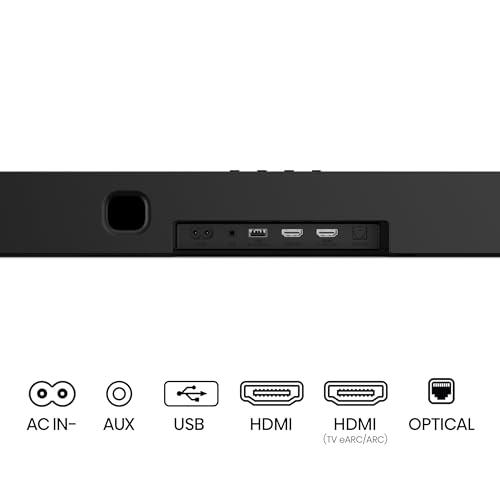
| HDMI eARC, optical, AUX, USB, Bluetooth 5.3 | HDMI eARC, optical, AUX, USB, Bluetooth 5.3 |
| Installation Complexity - Affects setup time and cable management | |
| Fully wireless audio (only power cables needed) | Requires satellite speaker cable routing and management |
| Ideal Room Size - Determines effectiveness in your space | |
| Scalable for any room size with 600W output | Optimized for 250-380 sq ft rooms |
| Target Use Case - Who each system serves best | |
| Modern content with Atmos, gaming, automated setup preference | Traditional surround accuracy, music listening, customization enthusiasts |
| Value Proposition - What you get for the investment | |
| Premium spatial audio technology at higher cost | Complete physical surround system at exceptional value |
For home theater use, the Hisense AX5140Q is better if you watch modern movies and shows with Dolby Atmos soundtracks. Its 5.1.4 configuration with four up-firing speakers creates genuine overhead effects that make action scenes and atmospheric content more immersive. The Ultimea Poseidon D50 excels for traditional surround content with its physical rear satellite speakers providing precise positional accuracy for classic movie soundtracks.
The key difference is spatial audio capability. The Hisense AX5140Q supports Dolby Atmos and DTS:X with height channels that place sounds above your head, while the Ultimea Poseidon D50 focuses on traditional 5.1 surround sound with physical satellite speakers for accurate horizontal positioning. The Hisense targets modern content with 3D audio, while the Ultimea prioritizes complete surround coverage at an accessible price.
The Ultimea Poseidon D50 typically delivers more impactful bass despite having a smaller 5.25" subwoofer. Its BassMX technology is specifically engineered for low-frequency impact with optimized magnetic circuits and enhanced diaphragm excursion. The Hisense AX5140Q has a larger 6.5" subwoofer but tunes it for overall system balance rather than maximum bass output.
Yes, both systems include rear speakers, but they work differently. The Hisense AX5140Q comes with two wireless rear speakers that connect without cables, making setup easier. The Ultimea Poseidon D50 includes two wired satellite speakers with 19.6-foot cables, requiring cable management but providing more precise surround positioning for traditional content.
The Ultimea Poseidon D50 is generally better for music due to its extensive customization options, including 121 EQ presets and a 10-band manual equalizer accessible via smartphone app. Its bass-focused subwoofer also enhances musical genres. The Hisense AX5140Q uses AI EQ for automated optimization but offers less manual control for fine-tuning your preferred sound signature.
Yes, both the Hisense AX5140Q and Ultimea Poseidon D50 work with any TV brand through HDMI eARC, optical, or AUX connections. However, the Hisense offers additional integration features like Hi-Concerto and EzPlay when paired with compatible Hisense TVs, providing enhanced control and optimization capabilities.
The Hisense AX5140Q is easier to set up because all audio connections are wireless—you only need to plug in power cables for each component. The Ultimea Poseidon D50 requires routing the included 19.6-foot cables to position the satellite speakers behind your seating area, which involves more planning and cable management during installation.
The Hisense AX5140Q delivers 600W maximum output compared to the Ultimea Poseidon D50's 320W peak power. This difference means the Hisense can play louder and handle more dynamic content in larger rooms, while the Ultimea is optimized for medium-sized spaces up to 380 square feet.
Only the Hisense AX5140Q supports Dolby Atmos and DTS:X with four physical up-firing speakers that create overhead effects. The Ultimea Poseidon D50 does not support Atmos technology and focuses instead on traditional 5.1 surround sound processing through its SurroundX algorithm for horizontal audio positioning.
Both systems work well for gaming but in different ways. The Hisense AX5140Q excels with modern consoles like PS5 and Xbox Series X that support 3D audio, creating more immersive environmental effects. The Ultimea Poseidon D50 offers a Game Pro mode and physical surround positioning that enhances directional awareness in competitive gaming, plus extensive EQ customization for different game types.
The Ultimea Poseidon D50 provides significantly more manual customization with 121 preset EQ matrices, a 10-band manual equalizer, and independent satellite volume control through its smartphone app. The Hisense AX5140Q focuses on automated optimization through AI EQ and room calibration but offers fewer manual adjustment options with just seven preset sound modes.
The Ultimea Poseidon D50 offers exceptional value by including a complete 5.1 surround system with physical satellite speakers at a significantly lower price point. The Hisense AX5140Q represents premium value for buyers prioritizing cutting-edge spatial audio technology and wireless convenience, but costs considerably more. Your best value depends on whether you prioritize advanced Atmos features or complete traditional surround at an accessible price.
We've done our best to create useful and informative comparisons to help you decide what product to buy. Our research uses advanced automated methods to create this comparison and perfection is not possible - please contact us for corrections or questions. These are the sites we've researched in the creation of this article: shop.hisense-usa.com - manuals.plus - dolby.com - youtube.com - gzhls.at - rtings.com - youtube.com - bestbuy.com - manuals.plus - bestbuy.com - hisense-usa.com - youtube.com - device.report - manuals.plus - youtube.com - device.report - manuals.plus - youtube.com - youtube.com - eu.ultimea.com - newegg.com - tvsbook.com - youtube.com - provantage.com - ultimea.com - techradar.com - community.ultimea.com - homedepot.com - community.ultimea.com - ultimea.com - ultimea.de - youtube.com - medisamhealthcenter.com - ultimea.com - youtube.com - walmart.com

Privacy Policy
Terms and Conditions - Affiliate Policy
Home Security
© Copyright 2008-2026.
11816 Inwood Rd #1211, Dallas, TX 75244