








Choosing the right soundbar in 2025 feels more complex than ever. Gone are the days when soundbars were just basic TV audio upgrades—today's premium models promise full home theater experiences that can rival traditional surround sound systems. But with so many different approaches to immersive audio, how do you know which one actually delivers?
I've spent considerable time researching two standout options that represent completely different philosophies: the ULTIMEA Skywave X40 with its traditional multi-speaker setup, and the Sennheiser AMBEO Mini with its cutting-edge virtualization technology. Both promise Dolby Atmos immersion, but they achieve it in fundamentally different ways.
Before diving into specifics, it helps to understand what separates premium soundbars from basic models. The key differentiator is spatial audio—the ability to create sounds that seem to come from above, behind, and around you, not just from the TV. This technology, primarily through Dolby Atmos (a format that adds height information to surround sound), transforms flat TV audio into three-dimensional experiences where helicopters fly overhead and rain seems to fall from the ceiling.
Premium soundbars achieve this immersion through two main approaches: physical speakers positioned throughout your room, or psychoacoustic processing (using digital tricks to fool your brain into hearing sounds from directions they're not actually coming from). Each method has distinct advantages, and understanding these differences is crucial for making the right choice.
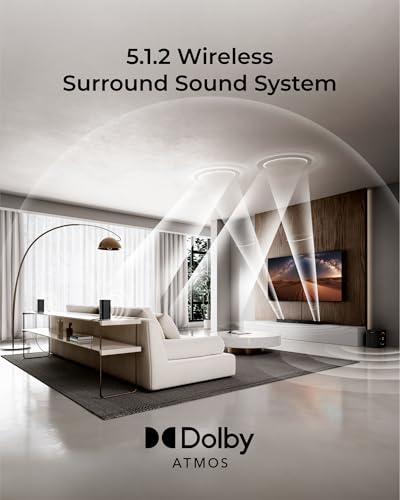
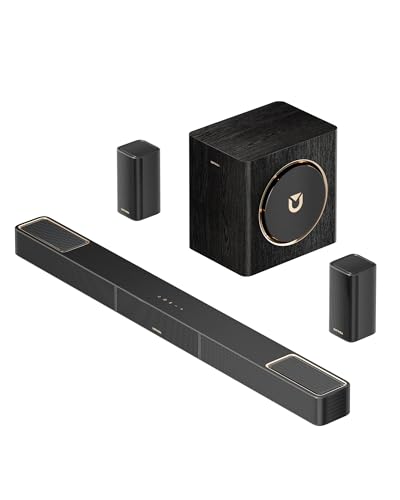
The ULTIMEA Skywave X40, released in 2025, follows the traditional approach with discrete physical components. You get a main soundbar, a wireless subwoofer, and two wireless rear speakers—eight total speakers creating genuine 5.1.2 surround sound. The "5.1.2" designation means five main channels (left, center, right, and two surrounds), one subwoofer channel, and two height channels for overhead effects.
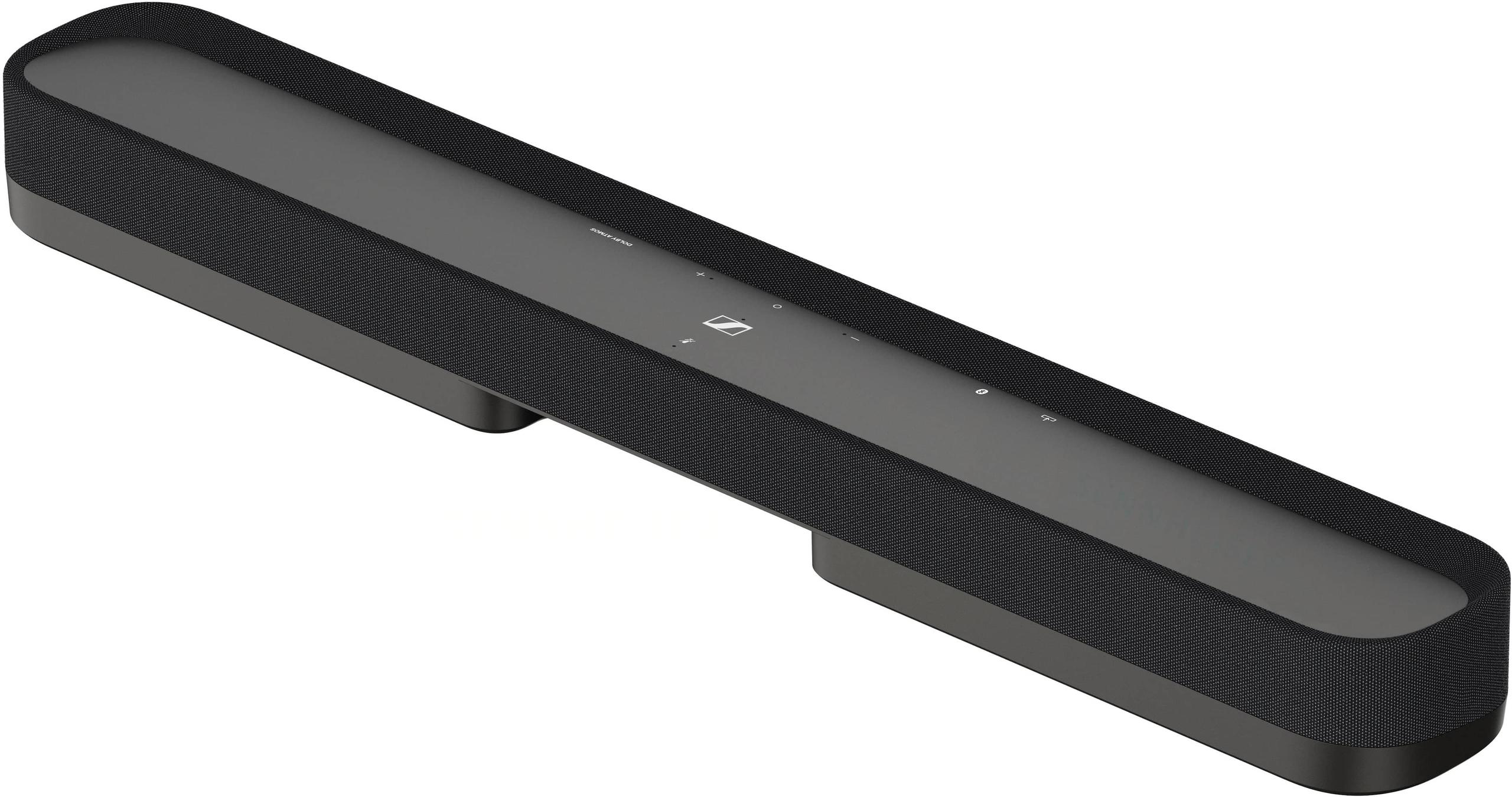
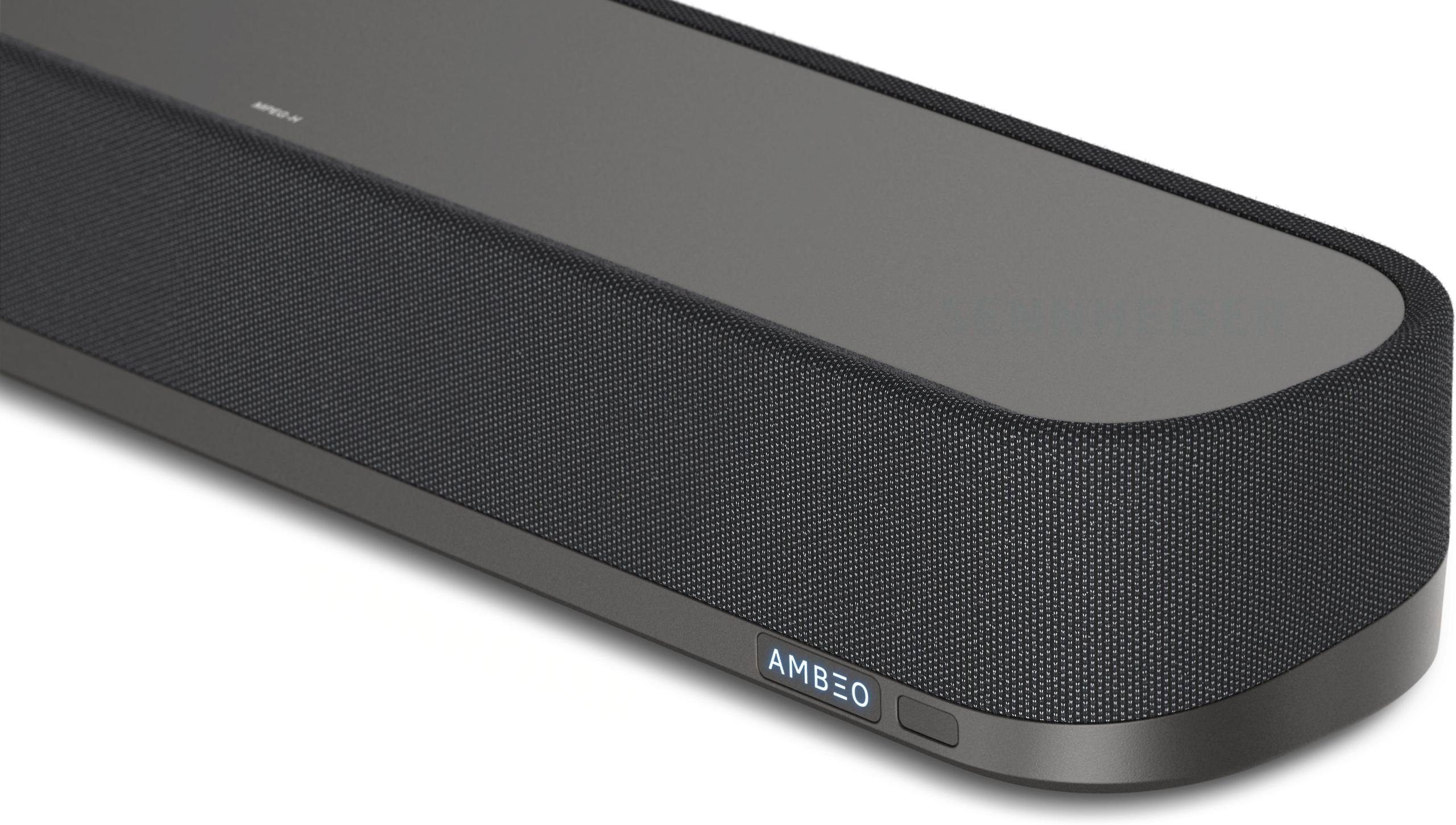
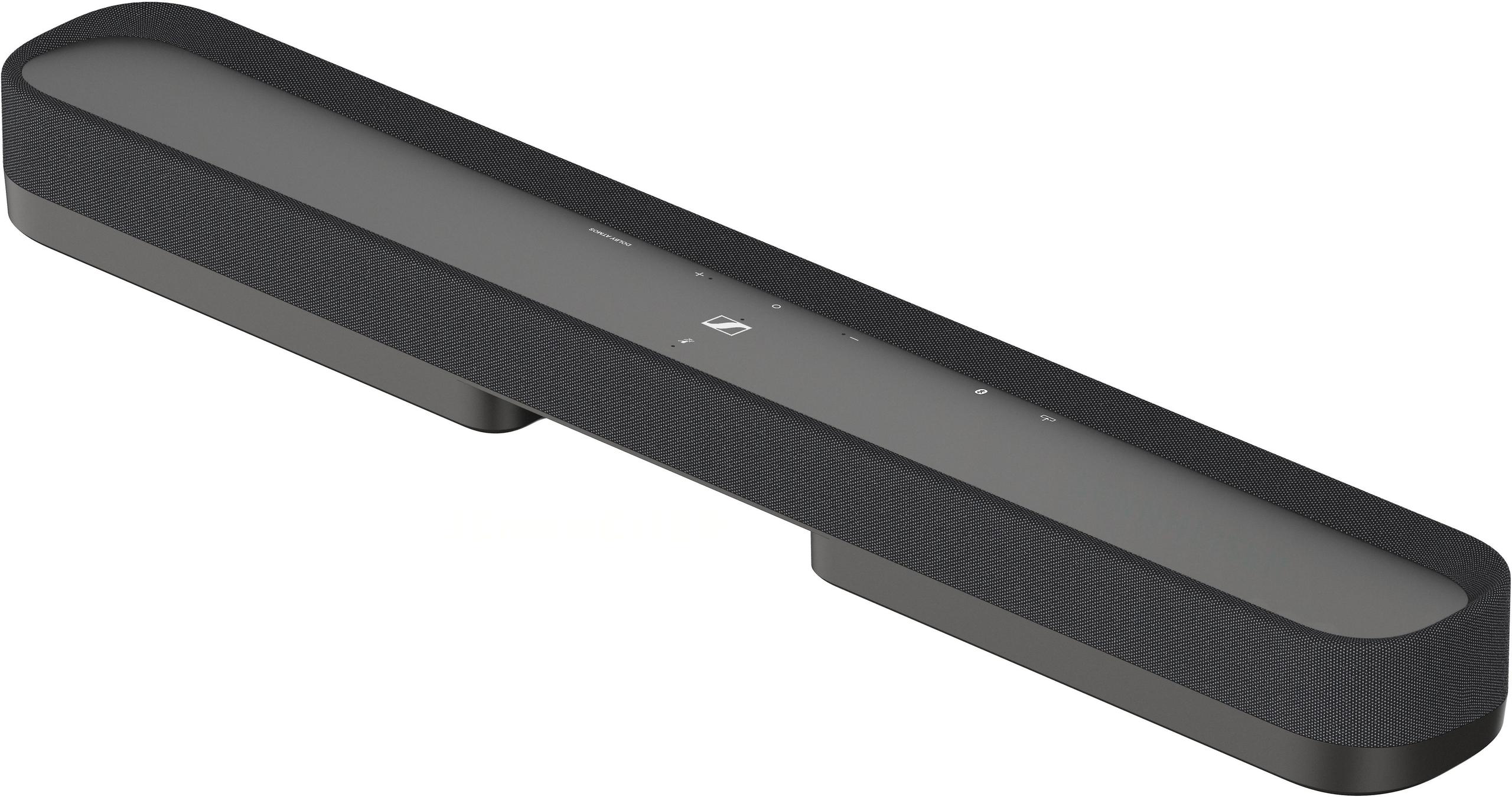
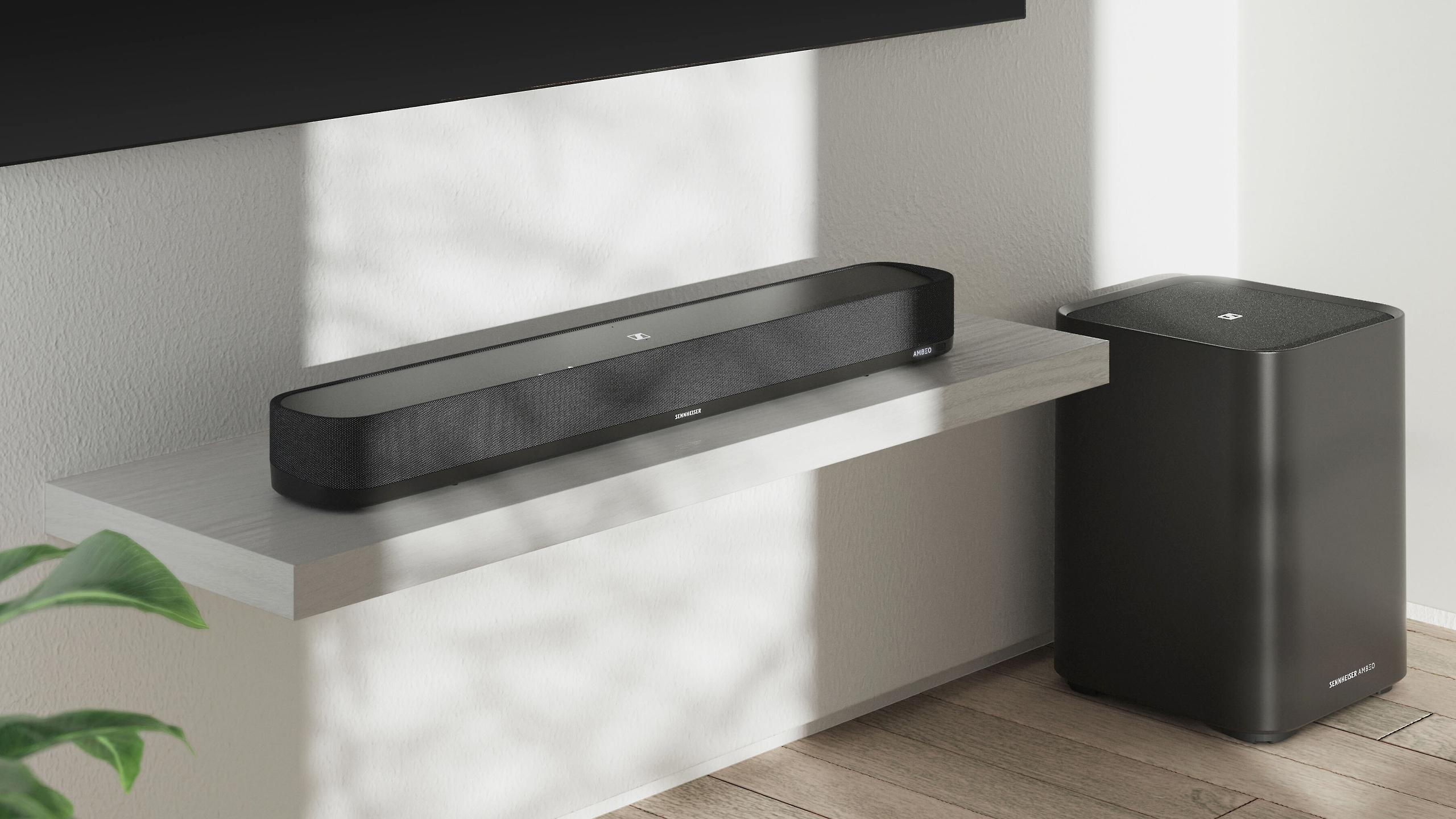
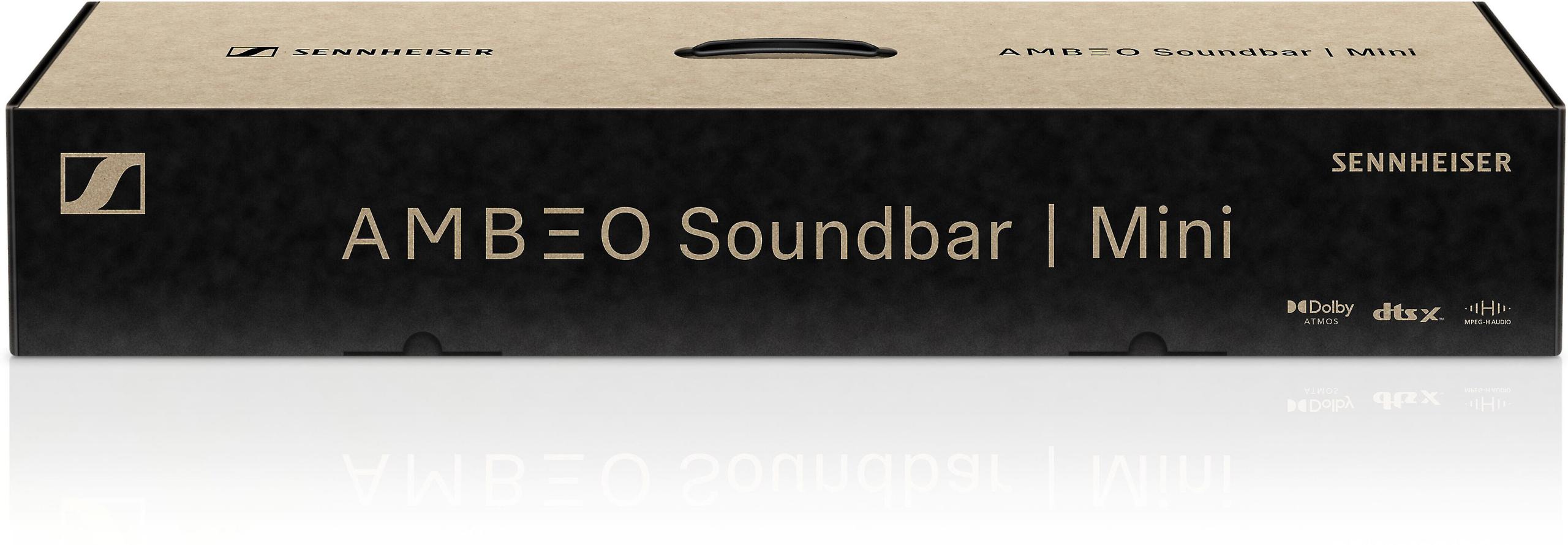
In contrast, the Sennheiser AMBEO Mini, launched in 2023, packs everything into a single 27.5-inch unit. Despite its compact size, it creates virtual 7.1.4 surround sound—seven main channels, one subwoofer channel, and four height channels—all through sophisticated audio processing developed with the Fraunhofer Institute, a renowned German research organization.
This fundamental difference shapes everything else about these products, from setup complexity to performance characteristics.
When it comes to filling a room with sound, the ULTIMEA Skywave X40 holds a commanding advantage with its 530W peak power output. This isn't just about volume—higher power means better dynamic range (the difference between quiet and loud sounds), cleaner performance at high volumes, and the ability to maintain clarity during intense action sequences.
The system achieves this through several technical innovations. Its GaN (Gallium Nitride) amplifier operates at 98% efficiency compared to traditional silicon amplifiers' 70-80% efficiency. This means less energy wasted as heat and faster response times—about 8x faster than conventional amplifiers. In practical terms, you get cleaner, more controlled sound even when pushing the system hard.
The Sennheiser AMBEO Mini, with its 250W output, takes a different approach focused on precision over raw power. While this might seem like a significant disadvantage, Sennheiser's engineering philosophy prioritizes accurate sound reproduction and sophisticated processing over sheer volume. For smaller to medium-sized rooms, this power level proves adequate, especially given the unit's impressive efficiency.
However, power differences become most apparent during demanding content. Action movies with explosive soundtracks, bass-heavy music, or large room setups will favor the Skywave's additional headroom. The AMBEO Mini might compress dynamic peaks or struggle to maintain clarity at party volumes.
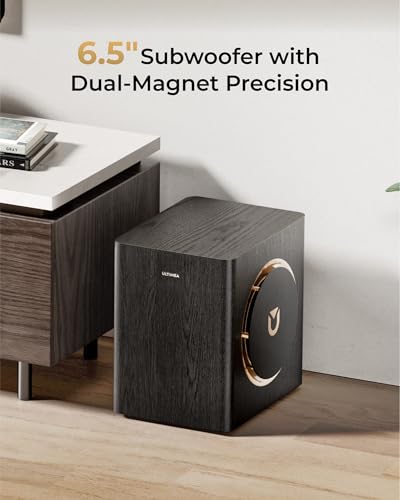
Bass performance significantly impacts the overall experience, particularly for movies and gaming. The ULTIMEA Skywave X40 includes a dedicated 6.5-inch wireless subwoofer utilizing Gravus Ultra-Linear Bass Technology—a proprietary design that extends frequency response down to 35Hz while minimizing distortion.
This dedicated subwoofer approach offers several advantages. Physical separation from the main soundbar eliminates vibration interference, allowing cleaner midrange reproduction. The larger driver size and dedicated enclosure enable deeper, more impactful bass that you can actually feel during explosions or music with substantial low-end content.
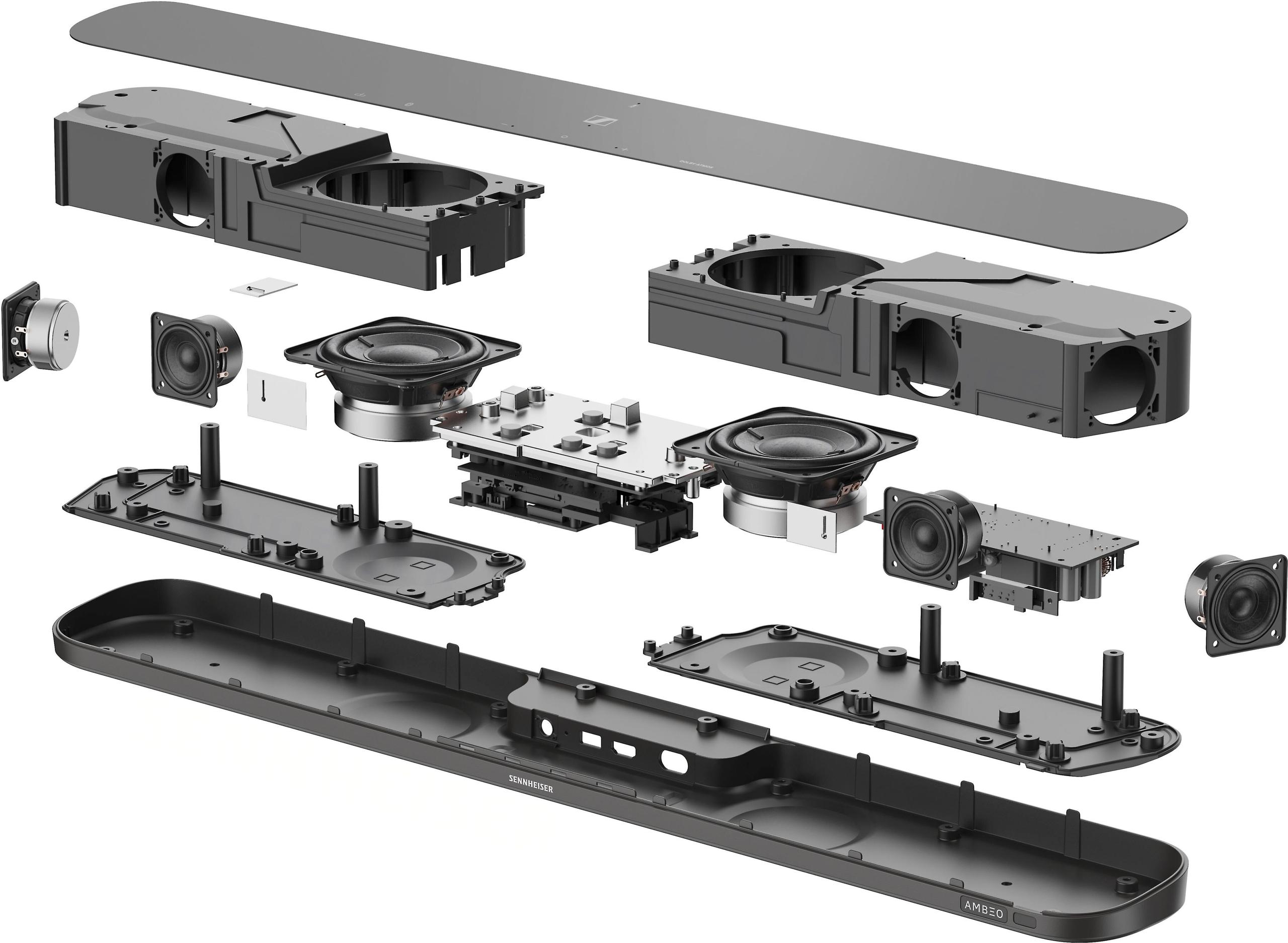
The Sennheiser AMBEO Mini incorporates dual 4-inch subwoofers directly into its compact chassis, reaching down to 43Hz. While respectable for an all-in-one unit, this 8Hz difference represents a meaningful gap in perceived bass depth. The smaller drivers and shared enclosure also mean less tactile impact during demanding passages.
However, the AMBEO Mini's integrated design offers placement advantages. You don't need to find an appropriate spot for a separate subwoofer, and the system's room calibration can optimize bass response for your specific setup. Sennheiser also offers an optional AMBEO Sub for users wanting deeper extension, though this obviously increases the total system cost.
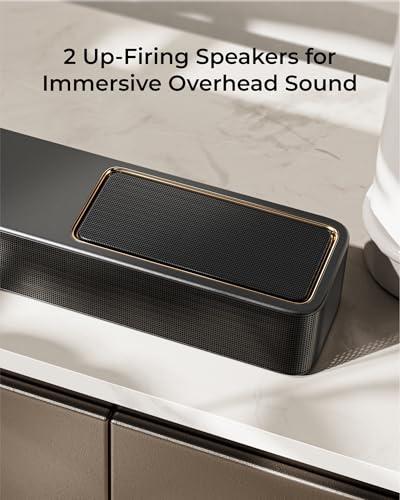
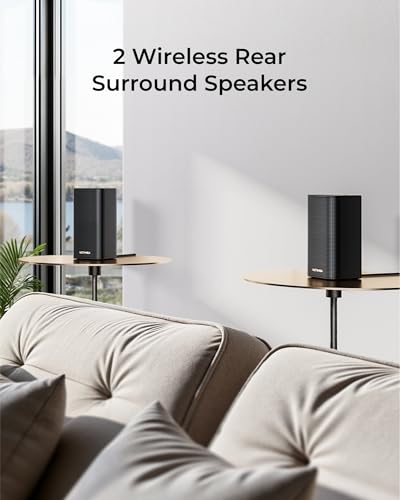
Here's where these systems diverge most dramatically. The ULTIMEA Skywave X40 creates surround sound the traditional way—by placing speakers where surround sounds should come from. Its two wireless rear speakers provide genuine behind-you audio positioning, while two up-firing drivers in the main soundbar bounce sound off your ceiling to create height effects.
This physical approach offers consistent performance regardless of where you sit. The rear speakers maintain proper surround imaging whether you're centered on the couch or sitting off to one side. The height effects depend on ceiling height and reflectivity, but when conditions are favorable, the overhead positioning feels natural and convincing.
The Sennheiser AMBEO Mini achieves its 7.1.4 virtualization through advanced psychoacoustic processing. Using precise timing, phase manipulation, and frequency filtering, it tricks your brain into perceiving sounds from directions they're not physically coming from. This virtualization technology, developed with Fraunhofer's expertise in spatial audio, can create remarkably convincing surround and height effects from just six strategically positioned drivers.
However, virtualization effectiveness varies significantly based on room acoustics, listener position, and individual hearing characteristics. Some people immediately perceive convincing surround effects, while others struggle to hear anything beyond good stereo imaging. The system's automatic room calibration helps optimize performance for your specific environment, but it cannot overcome fundamental acoustic limitations.
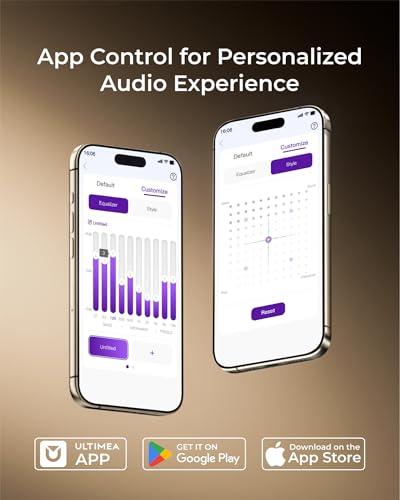
The ULTIMEA Skywave X40 emphasizes user customization and wireless performance. Its NEURACORE processing engine delivers 2,000 MIPS (Million Instructions Per Second) of computational power for real-time audio optimization. The accompanying app provides a 10-band equalizer and 121 preset sound profiles, allowing extensive fine-tuning for different content types and personal preferences.
The system's CineMesh wireless technology deserves particular attention. Using dual 5GHz transmission with less than 20ms latency, it maintains rock-solid connections between the main unit and wireless components. This ultra-low latency proves crucial for gaming and ensures lip-sync accuracy during movie viewing.
The Sennheiser AMBEO Mini focuses on intelligent automation and format versatility. Its adaptive mode automatically analyzes incoming audio content and adjusts processing accordingly, switching between music and movie optimizations without user intervention. The system supports an impressive array of formats including Dolby Atmos, DTS:X, MPEG-H, and Sony's 360 Reality Audio.
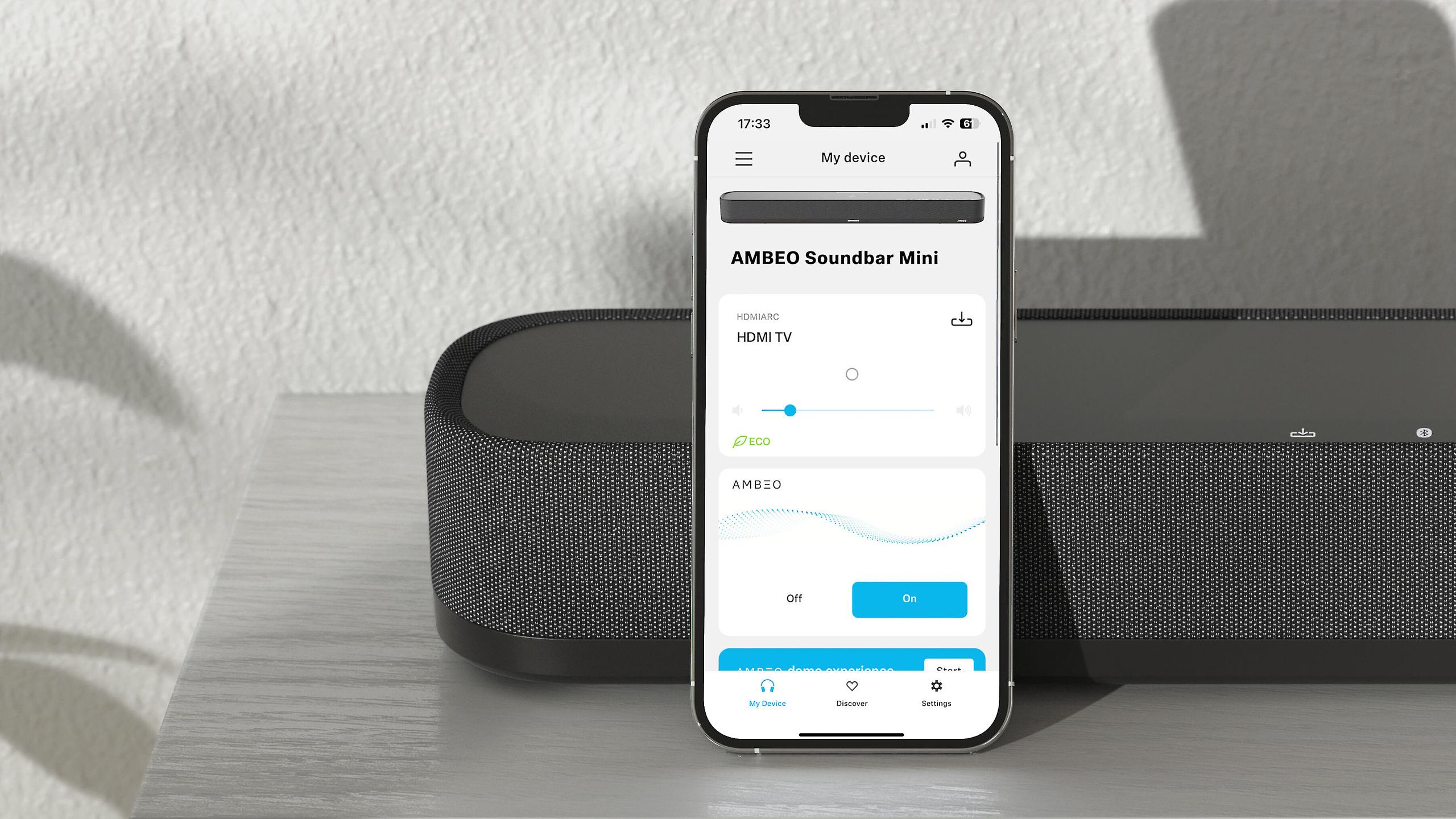
Built-in Alexa voice control adds convenience for basic functions, while the automatic room calibration uses four precision microphones to map your space's acoustic characteristics. This calibration process, running automatically during setup, optimizes the virtualization algorithms for your specific room dimensions and furnishings.
Installation complexity differs substantially between these systems. The ULTIMEA Skywave X40 requires positioning four separate components: the main soundbar (typically below your TV), the subwoofer (flexible placement within wireless range), and two rear speakers (behind or to the sides of your seating area). While the wireless connections eliminate cable runs, you'll need power outlets for each component.
This multi-component approach offers placement flexibility—you can optimize each element's position for best performance. However, it also means more visual impact and potential spouse/roommate objections to speakers scattered around the room.
The Sennheiser AMBEO Mini presents as a single elegant unit that can sit on a TV stand or mount to the wall using included hardware. Its compact dimensions and refined aesthetics blend into most living rooms without dominating the visual space. Setup involves connecting power and a single HDMI cable to your TV's eARC port.
From a WAF (Wife Acceptance Factor) perspective, the AMBEO Mini clearly wins. Its minimalist footprint and premium materials create an upscale appearance that many find more attractive than multiple black boxes positioned around the room.
Both systems support modern connectivity standards, but with different emphases. The ULTIMEA Skywave X40 includes HDMI eARC (enhanced Audio Return Channel) for high-quality audio transmission from your TV, plus optical, USB, and Bluetooth 5.4 connectivity. The newer Bluetooth standard offers improved range, stability, and audio quality compared to older versions.
The 4K HDR passthrough capability allows connecting devices like game consoles directly to the soundbar, which then passes video to your TV while processing the audio internally. This feature proves particularly valuable for gaming setups where you want the soundbar handling audio processing.
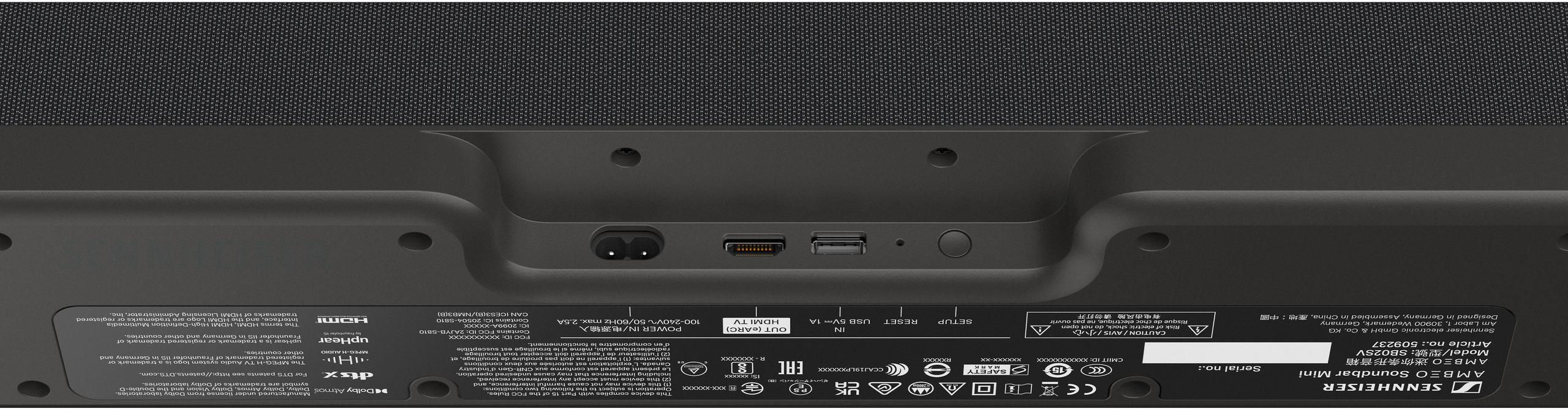
The Sennheiser AMBEO Mini provides similar HDMI eARC and USB connectivity, plus integrated Wi-Fi for streaming services and software updates. Its Bluetooth 5.0 implementation, while slightly older than the Skywave's 5.4, still delivers reliable wireless performance for most applications.
The AMBEO's network connectivity enables direct streaming from services like Spotify Connect and Tidal Connect, bypassing your TV entirely for music playback. This proves convenient for dedicated music listening sessions where you don't need the TV powered on.
Room size and acoustics significantly influence performance for both systems. The ULTIMEA Skywave X40 excels in medium to large spaces where its 530W output and discrete speakers can truly shine. Open floor plans, high ceilings, and rooms larger than 400 square feet benefit from its additional power and authentic surround positioning.
The physical rear speakers maintain consistent surround imaging regardless of room shape or furniture placement. Even in acoustically challenging environments with hard surfaces or irregular layouts, the discrete speaker placement ensures predictable performance.
The Sennheiser AMBEO Mini performs best in smaller, more controlled acoustic environments. Rectangular rooms with defined listening positions, moderate ceiling heights, and some acoustic treatment (even just furniture and carpeting) allow its virtualization technology to work most effectively.
Apartments, condos, and bedroom setups often favor the AMBEO Mini due to space constraints and neighbor considerations. Its sophisticated processing can create impressive immersion despite the compact form factor, and the integrated design eliminates concerns about optimal subwoofer placement in small spaces.
Gaming introduces specific requirements that influence soundbar choice. The ULTIMEA Skywave X40's sub-20ms wireless latency ensures audio remains synchronized with fast-paced gaming action. Higher power output helps reproduce dynamic gaming soundtracks and effects with appropriate impact.
The discrete rear speakers provide authentic positional audio for competitive gaming, where hearing enemy footsteps or gunfire direction can influence gameplay outcomes. Many modern games support Dolby Atmos, allowing full utilization of the 5.1.2 channel configuration.
The Sennheiser AMBEO Mini offers broader format support that benefits gaming, including native support for various spatial audio formats beyond just Dolby Atmos. However, the additional processing required for virtualization may introduce slight latency that sensitive gamers notice.
For casual gaming, both systems perform admirably. Competitive gamers or those prioritizing audio positioning accuracy might lean toward the Skywave's physical speaker approach.
At the time of writing, pricing positions these products differently in the market hierarchy. The ULTIMEA Skywave X40 offers exceptional value as a complete 5.1.2 system with all components included. Compared to building equivalent performance with separate components, the integrated approach provides substantial cost savings.
The Sennheiser AMBEO Mini, while commanding a premium price reflecting its brand heritage and sophisticated technology, frequently appears on sale at significant discounts. These promotional periods can make it competitive with systems offering less advanced features.
Long-term ownership considerations favor different aspects of each system. The Skywave's multiple components mean more potential failure points but also easier replacement of individual elements. The AMBEO Mini's single-unit design reduces complexity but makes any repair more disruptive.
Both manufacturers provide reasonable warranty coverage, though Sennheiser's two-year coverage exceeds many competitors' standard one-year terms.
After extensive research and evaluation of expert and user consensus, clear recommendations emerge based on specific use cases.
Choose the ULTIMEA Skywave X40 if you prioritize authentic surround sound with maximum flexibility. Its combination of high power output, discrete speakers, and true wireless convenience suits larger rooms, demanding content, and users who want traditional surround sound benefits without running speaker cables. The extensive customization options appeal to audio enthusiasts who enjoy tweaking settings for optimal performance.
The Skywave particularly excels for home theater setups where movie impact and dynamic range take priority. Its dedicated subwoofer and higher power output deliver the visceral experience many associate with compelling cinema audio.
Choose the Sennheiser AMBEO Mini for sophisticated audio processing in a space-efficient package. Its virtualization technology, automatic optimization, and premium build quality suit users prioritizing convenience and aesthetics without completely sacrificing immersive audio capabilities.
The AMBEO Mini works best for apartments, smaller rooms, or situations where visual minimalism matters. Its intelligent processing and broad format support benefit users who prefer automated optimization over manual adjustment.
Both represent excellent approaches to premium soundbar audio, just with different philosophies and optimal applications. The key lies in honestly assessing your room, priorities, and long-term usage patterns to determine which approach better matches your specific needs.
| ULTIMEA Skywave X40 5.1.2 Soundbar System | Sennheiser AMBEO Soundbar Mini |
|---|---|
| Audio Architecture - Determines authenticity of surround sound | |
| True 5.1.2 channels with physical speakers | Virtual 7.1.4 channels through processing |
| Power Output - Critical for room-filling sound and dynamics | |
| 530W peak power (excellent for large rooms) | 250W total power (adequate for small-medium rooms) |
| Physical Components - Affects setup complexity and performance | |
| 4 components: soundbar, subwoofer, 2 rear speakers | Single compact soundbar unit |
| Bass Extension - Lower frequencies create more impactful movie experience | |
| 35Hz with dedicated 6.5" wireless subwoofer | 43Hz with built-in dual 4" subwoofers |
| Wireless Technology - Determines reliability of rear speaker connection | |
| Dual 5GHz CineMesh with <20ms latency | Bluetooth 5.0 and Wi-Fi (no wireless speakers) |
| Room Optimization - Helps system adapt to your space | |
| Standard EQ settings with 121 presets | Automatic room calibration with microphones |
| Smart Features - Convenience and voice control capabilities | |
| App control with 10-band EQ | Built-in Alexa, adaptive audio processing |
| Dimensions - Space requirements and aesthetic impact | |
| Multiple components require room positioning | Single 27.5" × 2.6" × 4" unit |
| Audio Format Support - Compatibility with streaming content | |
| Dolby Atmos | Dolby Atmos, DTS:X, MPEG-H, 360 Reality Audio |
| Connectivity Options - Determines device compatibility | |
| HDMI eARC, Optical, USB, Bluetooth 5.4 | HDMI eARC, USB-A, Bluetooth 5.0, Wi-Fi |
| Setup Complexity - Time and effort required for installation | |
| Moderate (position 4 wireless components) | Simple (single unit, automatic calibration) |
| Best Use Case - Ideal room size and priorities | |
| Medium-large rooms prioritizing authentic surround | Small-medium rooms prioritizing convenience and aesthetics |
The ULTIMEA Skywave X40 is significantly better for large rooms due to its 530W peak power output compared to the Sennheiser AMBEO Mini's 250W. The Skywave X40's discrete rear speakers and dedicated subwoofer also provide more consistent coverage across larger spaces, while the AMBEO Mini's virtualization works best in smaller, controlled environments.
Yes, the ULTIMEA Skywave X40 includes wireless rear speakers that provide authentic surround sound positioning, while the Sennheiser AMBEO Mini uses virtualization technology to simulate surround effects from a single soundbar. Physical rear speakers deliver more consistent surround imaging regardless of your seating position.
The ULTIMEA Skywave X40 delivers superior bass with its dedicated 6.5-inch wireless subwoofer extending down to 35Hz, compared to the Sennheiser AMBEO Mini's built-in dual 4-inch subwoofers that reach 43Hz. For deep, impactful bass in movies and music, the Skywave X40's dedicated subwoofer provides noticeably more punch.
The ULTIMEA Skywave X40 offers true 5.1.2 channels with physical speakers, meaning 5 main channels, 1 subwoofer, and 2 height channels. The Sennheiser AMBEO Mini creates virtual 7.1.4 channels (7 main, 1 sub, 4 height) through processing, offering more theoretical channels but without physical speaker separation.
The Sennheiser AMBEO Mini is much easier to set up as a single unit with automatic room calibration, requiring only power and one HDMI connection. The ULTIMEA Skywave X40 requires positioning four separate wireless components around your room, though all connections are wireless after initial power setup.
Both the ULTIMEA Skywave X40 and Sennheiser AMBEO Mini include optical inputs for older TVs without HDMI eARC. However, you'll get the best performance and full feature access using HDMI eARC connections, which both soundbars support for high-quality audio transmission.
The Sennheiser AMBEO Mini is ideal for small apartments due to its compact single-unit design and sophisticated virtualization that works well in smaller spaces. The ULTIMEA Skywave X40 requires space for multiple components and may provide more power than needed in typical apartment settings.
Yes, both soundbars support Dolby Atmos. The ULTIMEA Skywave X40 uses physical up-firing speakers for height effects, while the Sennheiser AMBEO Mini creates virtual overhead sound through advanced processing. The AMBEO Mini also supports additional formats like DTS:X and 360 Reality Audio.
The ULTIMEA Skywave X40 typically offers better value as a complete 5.1.2 system with all components included. The Sennheiser AMBEO Mini commands a premium for its brand reputation and advanced virtualization technology, though it frequently appears on sale at more competitive pricing.
The Sennheiser AMBEO Mini can be expanded with optional AMBEO wireless subwoofers for enhanced bass. The ULTIMEA Skywave X40 comes as a complete system with all components included, offering less expansion potential but providing everything needed for full surround sound out of the box.
The ULTIMEA Skywave X40 edges ahead for gaming with its sub-20ms wireless latency and higher power output for dynamic game soundtracks. The discrete rear speakers also provide accurate positional audio for competitive gaming. The Sennheiser AMBEO Mini supports more audio formats but may introduce slight processing delays.
Both excel at music but differently. The Sennheiser AMBEO Mini offers audiophile-grade processing and can upmix stereo content for room-filling sound, plus direct streaming capabilities. The ULTIMEA Skywave X40 provides more powerful, dynamic music reproduction with its higher output and dedicated subwoofer, making it better for genres requiring strong bass impact.
We've done our best to create useful and informative comparisons to help you decide what product to buy. Our research uses advanced automated methods to create this comparison and perfection is not possible - please contact us for corrections or questions. These are the sites we've researched in the creation of this article: bestbuy.com - shopabunda.com - youtube.com - youtube.com - youtube.com - youtube.com - ultimea.com - walmart.com - youtube.com - hometechnologyreview.com - community.ultimea.com - avsforum.com - youtube.com - youtube.com - youtube.com - bestbuy.com - hometechnologyreview.com - techradar.com - sennheiser-hearing.com - stereonet.com - rtings.com - youtube.com - youtube.com - newsroom.sennheiser.com - whathifi.com - baybloorradio.com - sennheiser-hearing.com - files.bbystatic.com

Privacy Policy
Terms and Conditions - Affiliate Policy
Home Security
© Copyright 2008-2026.
11816 Inwood Rd #1211, Dallas, TX 75244