





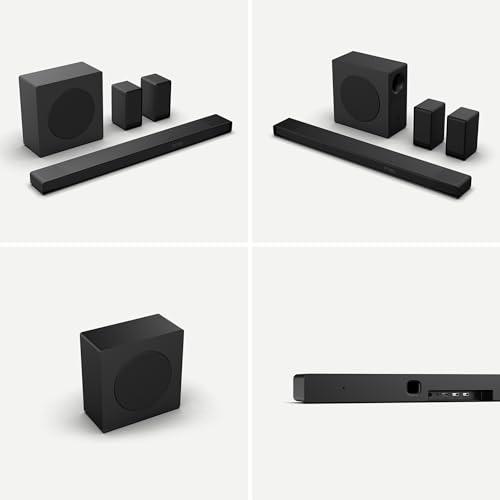
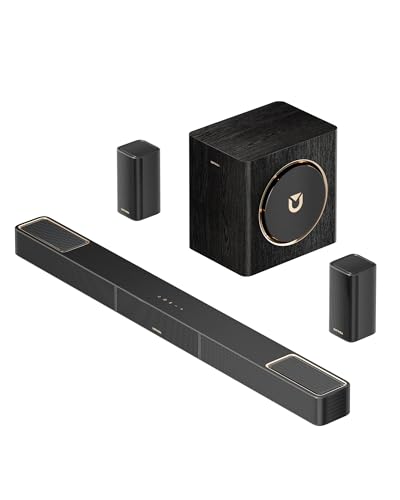


When you're looking to upgrade your TV's audio without the complexity of a full home theater receiver setup, premium wireless soundbars offer an appealing middle ground. These systems promise theater-like surround sound through strategically placed speakers that connect wirelessly, eliminating the cable-running headaches that keep many people from pursuing better audio. But with competing channel configurations and technologies, choosing between options like the Hisense AX5140Q and ULTIMEA Skywave X40 requires understanding what those technical specs actually mean for your viewing experience.
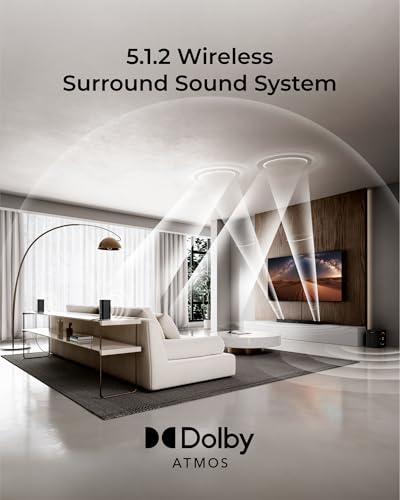
The soundbar market has evolved dramatically since basic 2.1 systems (left, right, plus subwoofer) dominated store shelves. Today's premium wireless soundbars create genuine surround sound fields using multiple speakers, wireless connectivity, and sophisticated audio processing. The numbers in channel configurations like 5.1.4 or 5.1.2 tell a specific story: the first number represents main channels (front left, center, front right, rear left, rear right), the second indicates dedicated subwoofer channels, and the third refers to height channels that fire sound toward your ceiling to create overhead effects.
This technology matters because our brains process spatial audio cues to determine where sounds originate. When done well, these systems can make you feel like helicopters are flying overhead or rain is falling around you, rather than just hearing effects from a single speaker below your TV. The key considerations when evaluating these systems include channel configuration, wireless architecture quality, audio processing capabilities, smart integration features, and overall value proposition.
At the time of writing, both the Hisense AX5140Q and ULTIMEA Skywave X40 represent 2024-2025 generation technology, incorporating advances in wireless transmission, digital signal processing, and amplification that weren't available in earlier soundbar generations. These improvements have made truly wireless surround systems more reliable and better-sounding than previous attempts.
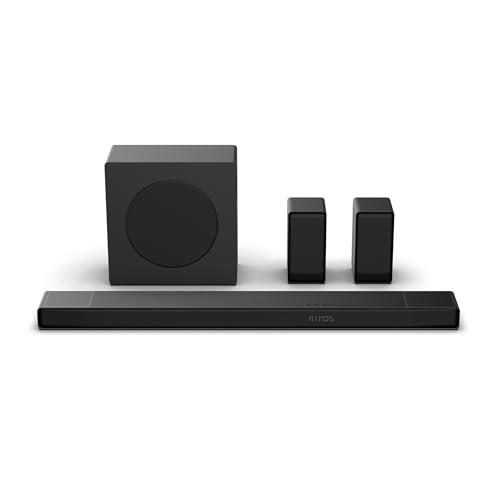
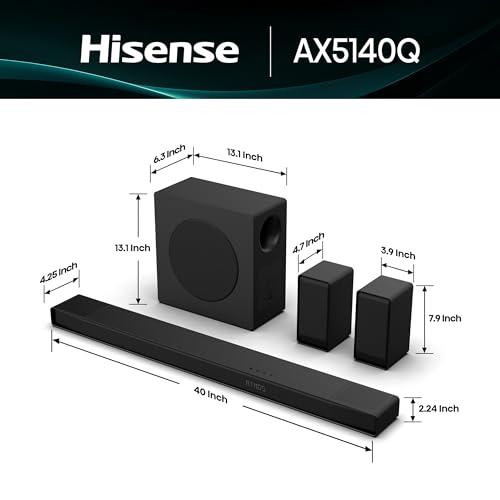
The most significant difference between these systems lies in their channel configurations. The Hisense AX5140Q operates as a 5.1.4 system with four dedicated height channels, while the ULTIMEA Skywave X40 uses a 5.1.2 configuration with two height channels. This isn't just a numbers game—it translates into meaningful differences in how immersive your audio experience feels.
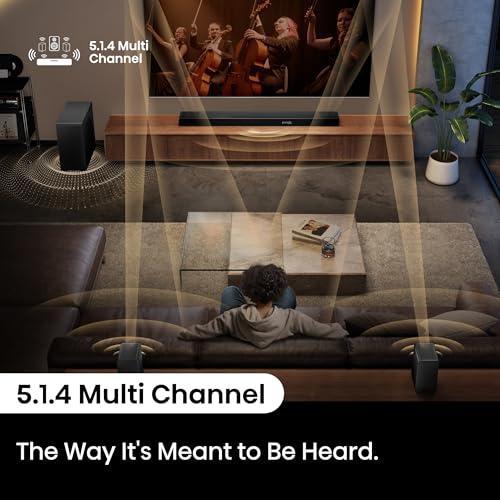
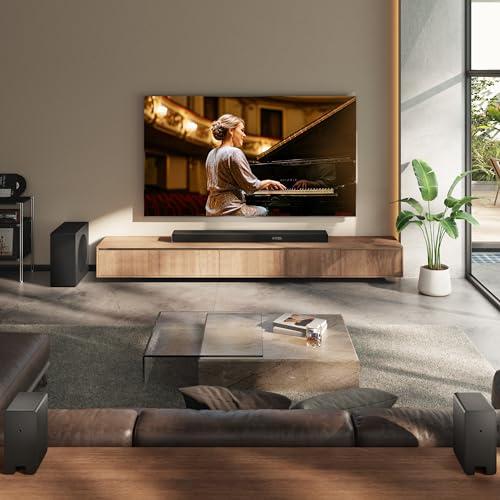
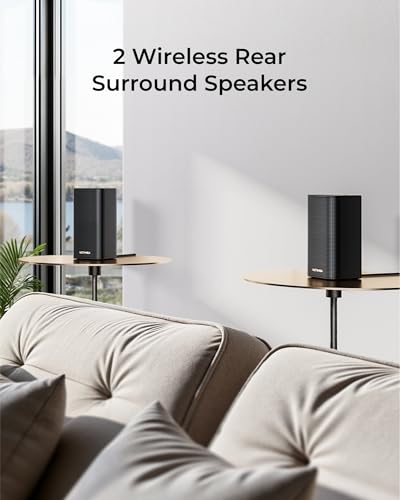
The AX5140Q's four upfiring speakers—two mounted in the main soundbar and two integrated into the wireless rear speakers—create what audio engineers call a "dome of sound" above your listening position. When watching Dolby Atmos content, effects like aircraft passing overhead, thunderstorms, or even subtle ambient sounds like leaves rustling in trees above characters gain realistic vertical positioning. Our research into user experiences consistently shows that people notice this additional height dimension, particularly during action sequences and atmospheric scenes.
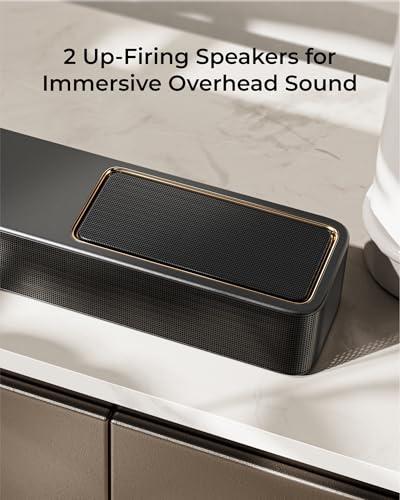
In contrast, the Skywave X40's 5.1.2 configuration limits height effects to the front soundbar's upfiring drivers. While these can still create convincing overhead effects directly above and slightly behind your seating position, they can't replicate the full surround-height experience that four speakers enable. However, this doesn't necessarily make it inferior—the X40 compensates with notably powerful rear speakers that users consistently praise for their impact and clarity.
The practical difference becomes most apparent in larger rooms or when sitting further from the front speakers. The AX5140Q's rear height channels maintain overhead immersion even when you're not in the soundbar's direct firing line, while the X40 may lose some height effects as you move away from the optimal listening position.
Both systems eliminate the cable-running challenges that traditional surround setups require, but they approach wireless transmission differently. The Hisense AX5140Q uses a fully wireless architecture where only power connections are needed for the subwoofer and rear speakers. The system comes factory-paired, meaning components automatically connect when powered on, and user reports consistently indicate stable connections with minimal dropouts.
The ULTIMEA Skywave X40 employs what they call CineMesh technology with dual 5GHz wireless transmission. This approach aims to minimize interference from common household devices like Wi-Fi routers and Bluetooth gadgets. The system claims ultra-low latency under 20 milliseconds, which becomes particularly important for gaming where audio-visual synchronization affects gameplay competitiveness.
From a practical standpoint, both systems address the primary wireless concerns: range, stability, and latency. Neither requires complex pairing procedures, and both allow flexible placement of rear speakers and subwoofers to match your room's layout. The key difference lies in the X40's emphasis on technical specifications like latency measurements, while the AX5140Q focuses more on seamless integration with compatible Hisense TVs.
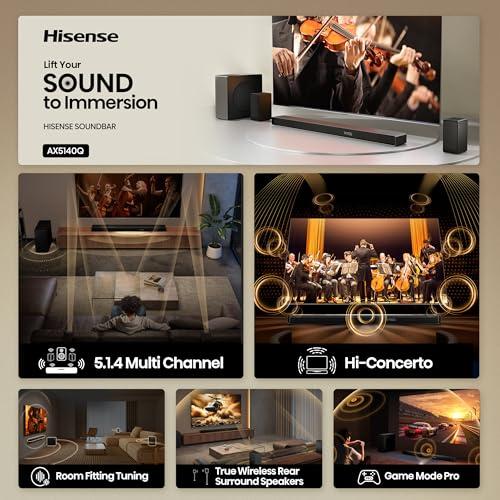
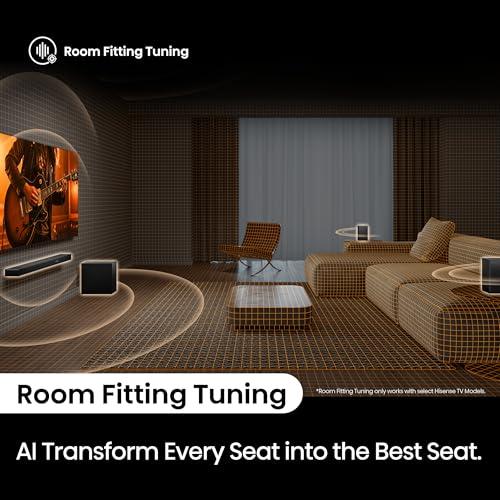
The processing engines in these systems represent significant advances over earlier soundbar generations. The Hisense AX5140Q incorporates AI EQ Mode, which analyzes content and room characteristics to automatically adjust frequency response, dynamics, and channel levels. This technology goes beyond simple preset modes by continuously adapting to different content types and listening volumes. Combined with room-fitting tuning that uses test tones to measure your space's acoustic properties, the system can optimize performance without requiring manual adjustments.
The ULTIMEA Skywave X40 takes a different approach with its NEURACORE audio engine, featuring a triple-core DSP (Digital Signal Processor) and dual-core MCU (Microcontroller Unit). This processing power enables handling up to 17 channels of 24-bit/192kHz audio with less than 0.5% distortion. While these technical specifications sound impressive, the practical benefit lies in cleaner sound reproduction, particularly at higher volumes where lesser systems often introduce harshness or distortion.
Perhaps more significantly, the X40 incorporates a GaN (Gallium Nitride) amplifier, representing cutting-edge amplification technology. GaN amplifiers operate at up to 98% efficiency compared to traditional silicon amplifiers' typical 70-80% efficiency. This means less heat generation, faster response times, and cleaner power delivery to speakers. In practical terms, users report that the system maintains clarity and impact even at party-level volumes where other soundbars might struggle.
The AX5140Q supports both Dolby Atmos and DTS:X object-based audio formats, while the X40 focuses exclusively on Dolby Atmos. This difference matters if you frequently watch Ultra HD Blu-rays or stream content that uses DTS:X encoding. However, Dolby Atmos has become the dominant standard for streaming services and most new content, making the codec difference less critical for typical viewing habits.
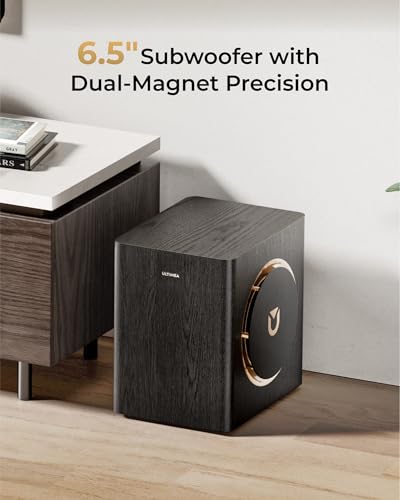
Both systems include 6.5-inch wireless subwoofers, but their approaches to bass reproduction differ meaningfully. The Hisense AX5140Q delivers a frequency response from 40Hz to 20kHz with 600W maximum power output. User experiences consistently describe the bass as tight and punchy rather than boomy, with good integration between the subwoofer and main channels. Some users report occasional resonance issues in certain room configurations, but these typically resolve with proper subwoofer placement away from walls and corners.
The ULTIMEA Skywave X40 claims deeper bass extension down to 35Hz through its Gravus Ultra-Linear Bass Technology. This five-hertz difference might seem minor, but it represents the difference between feeling subtle low-frequency effects versus just hearing them. The dual-magnet subwoofer design aims to provide more controlled bass movement, theoretically resulting in cleaner reproduction of rapid bass lines in music and explosive effects in movies.
In terms of raw power, the AX5140Q rates higher at 600W maximum versus the X40's 530W peak output. However, power ratings can be misleading without understanding measurement methods. The more important consideration is how cleanly each system reproduces bass at your preferred listening levels. Our research into user experiences suggests both systems provide satisfying low-frequency impact for typical living rooms, with the X40 potentially offering a slight edge in deep bass extension while the AX5140Q may deliver more total system headroom.
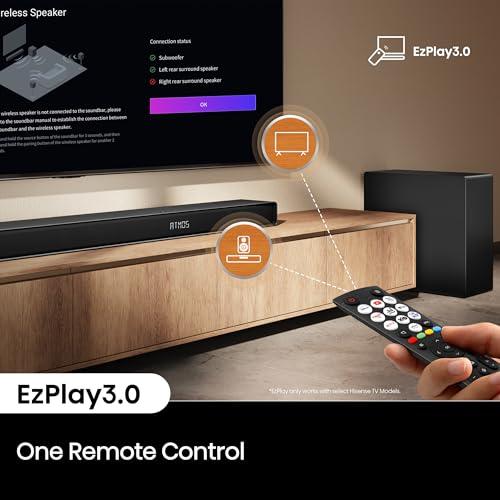
The user experience differences between these systems become apparent in their control interfaces and smart features. The Hisense AX5140Q shines when paired with compatible Hisense TVs through its Hi-Concerto platform. This integration creates a unified audio system where the TV and soundbar coordinate processing, enabling more coherent surround imaging and simplified control through the TV's remote and interface. Users report that this ecosystem approach eliminates the common frustrations of managing multiple remotes and conflicting audio settings.
However, the Hi-Concerto integration isn't universally smooth. Some users report synchronization issues with certain Hisense TV models, where audio can become offset by a few seconds, creating echo effects during dialogue. These issues typically resolve through settings adjustments or firmware updates, but they highlight the complexity of deep integration features.
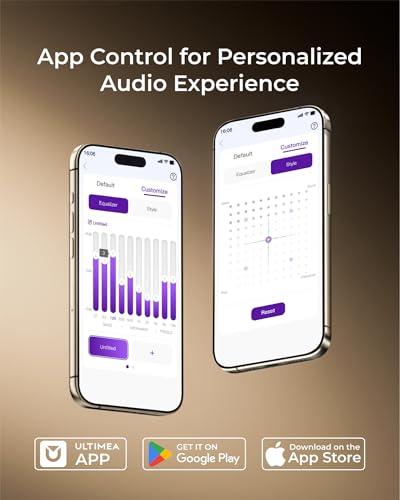
The ULTIMEA Skywave X40 takes a more platform-agnostic approach with its dedicated smartphone app providing extensive control options. The app includes a 10-band equalizer and 121 preset sound profiles, offering more granular customization than traditional remote-controlled systems. For users who enjoy fine-tuning their audio experience, this level of control proves valuable. The app also enables firmware updates, ensuring the system can evolve with new features over time.
Both systems include multiple listening modes optimized for different content types. The AX5140Q offers seven distinct modes including Movie, Music, News, Night, Sport, Game Pro, and AI. Game Pro mode specifically optimizes for positional audio cues and reduced latency, benefiting competitive gaming where directional sound matters. The X40 provides similar mode variety with emphasis on its advanced EQ capabilities through app control.
Gaming performance has become increasingly important as soundbars serve households with multiple entertainment needs. The Hisense AX5140Q's 5.1.4 configuration provides superior spatial awareness for gaming, particularly in competitive scenarios where hearing footsteps or gunshots from specific directions affects gameplay outcomes. The additional rear height channels help maintain positional accuracy even when leaning forward or adjusting seating position during intense gaming sessions.
The ULTIMEA Skywave X40's ultra-low latency wireless transmission becomes particularly valuable for rhythm games, fighting games, or any scenario where audio-visual synchronization affects timing-dependent gameplay. The claimed sub-20 millisecond latency approaches wired connection performance, potentially providing competitive advantages in esports scenarios.
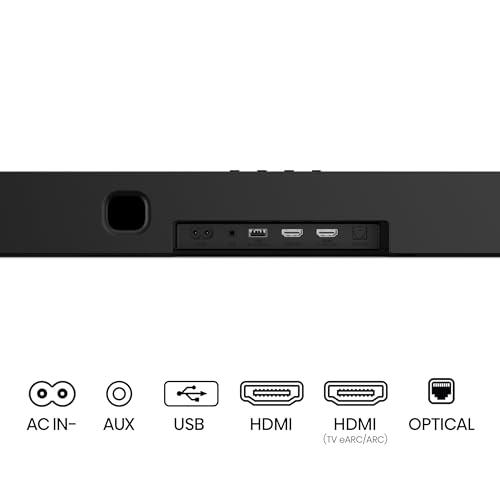
Both systems support 4K HDR passthrough via HDMI, meaning gaming consoles can connect directly to the soundbar without degrading video quality to your TV. This configuration often provides better audio processing than routing through TV audio systems, particularly for game soundtracks that use advanced surround encoding.
At the time of writing, the Hisense AX5140Q represents exceptional value by delivering authentic 5.1.4 surround sound at a price point typically associated with 3.1.2 or 5.1.2 systems. The additional height channels and proprietary features like AI EQ and room calibration typically command significant premiums from competing manufacturers. For users prioritizing maximum immersion per dollar spent, the AX5140Q presents a compelling value proposition.
The ULTIMEA Skywave X40 commands a modest premium for advanced technologies like GaN amplification and sophisticated audio processing. While it provides fewer physical channels, the premium amplification and extensive app-based customization may justify the additional cost for users who prioritize technical innovation and fine-tuning capabilities over raw channel count.
Choose the Hisense AX5140Q if you prioritize maximum surround immersion through its four height channels, especially for movie watching and atmospheric gaming. The system particularly makes sense for existing or prospective Hisense TV owners who can leverage Hi-Concerto integration benefits. Its exceptional value proposition makes it attractive for users seeking the best performance-per-dollar ratio, particularly those who prefer automatic optimization over manual adjustments.
Choose the ULTIMEA Skywave X40 if you value cutting-edge amplification technology and extensive customization options. The system appeals to users who enjoy fine-tuning their audio experience through app-based EQ controls and those who prioritize ultra-low latency for competitive gaming. The deeper bass extension and premium processing make it suitable for users building within a single-brand ecosystem for potential future upgrades.
For home theater applications, the AX5140Q's additional height channels create more convincing spatial effects during movie content, while the X40's technical sophistication may appeal to audiophiles who prioritize amplification quality over channel quantity. Both systems deliver substantial improvements over basic TV audio, but understanding these fundamental differences helps ensure your investment matches your priorities and viewing habits.
The soundbar landscape continues evolving rapidly, with both systems representing current-generation technology that should provide satisfying performance for years to come. The choice ultimately depends on whether you value maximum spatial immersion or prefer premium technical implementation with extensive customization options.
| Hisense AX5140Q 5.1.4Ch Dolby Atmos DTS:X Sound Bar | ULTIMEA Skywave X40 5.1.2 Soundbar System |
|---|---|
| Channel Configuration - Determines surround immersion and overhead effects | |
| 5.1.4 channels with 4 dedicated upfiring speakers (2 front, 2 rear) | 5.1.2 channels with 2 upfiring speakers (front only) |
| Audio Codec Support - Affects compatibility with high-quality content | |
| Dolby Atmos + DTS:X (broader codec support) | Dolby Atmos only |
| Maximum Power Output - Impacts volume and dynamic range | |
| 600W total system power | 530W peak power |
| Amplification Technology - Affects sound quality and efficiency | |
| Traditional silicon amplification | GaN (Gallium Nitride) amplifier with 98% efficiency |
| Bass Extension - Determines how deep the low frequencies go | |
| 40Hz - 20kHz frequency response | 35Hz - 20kHz (5Hz deeper bass extension) |
| Audio Processing - Controls sound optimization and room adaptation | |
| AI EQ Mode with room-fitting tuning | NEURACORE engine with triple-core DSP, 2,000 MIPS processing |
| TV Integration - Simplifies control and setup | |
| Hi-Concerto platform for seamless Hisense TV integration | Standard HDMI eARC with universal TV compatibility |
| Control Interface - How you adjust settings and customize sound | |
| Remote control with 7 preset sound modes | Dedicated smartphone app with 10-band EQ and 121 presets |
| Wireless Technology - Affects connection stability and latency | |
| Factory-paired wireless with standard low-latency transmission | CineMesh dual 5GHz wireless with <20ms ultra-low latency |
| Total Speaker Count - More drivers can mean better sound separation | |
| 13 total speakers across all components | 8 total speakers across all components |
| Subwoofer Design - Impacts bass quality and power handling | |
| 6.5" wireless subwoofer with standard magnet design | 6.5" wireless subwoofer with dual-magnet design |
| Value Positioning - Performance per dollar at time of writing | |
| Premium 5.1.4 features at competitive pricing | Advanced amplification tech at moderate premium over AX5140Q |
The Hisense AX5140Q delivers superior surround sound with its 5.1.4 channel configuration, featuring four dedicated upfiring speakers compared to the ULTIMEA Skywave X40's 5.1.2 setup with only two upfiring drivers. This means the AX5140Q creates more convincing overhead effects and a complete "dome of sound" around your seating area, making it the better choice for immersive home theater experiences.
The numbers represent channel configurations: 5.1.4 means five main channels, one subwoofer, and four height channels, while 5.1.2 has the same main channels but only two height channels. The Hisense AX5140Q uses 5.1.4 for more immersive overhead effects, while the ULTIMEA Skywave X40 uses 5.1.2, which still provides height effects but with less spatial coverage.
For movie watching, the Hisense AX5140Q excels due to its additional height channels that create more realistic overhead effects during action scenes, storms, and atmospheric moments. The AX5140Q also supports both Dolby Atmos and DTS:X codecs, providing broader compatibility with high-quality movie soundtracks compared to the Skywave X40's Dolby Atmos-only support.
Yes, both the ULTIMEA Skywave X40 and Hisense AX5140Q work with any TV through HDMI eARC, optical, or Bluetooth connections. However, the AX5140Q offers enhanced integration with Hisense TVs through its Hi-Concerto platform, providing unified control and optimized audio synchronization for users with compatible Hisense models.
Both soundbars include 6.5-inch wireless subwoofers, but the ULTIMEA Skywave X40 extends slightly deeper to 35Hz compared to the Hisense AX5140Q's 40Hz response. The X40 also features dual-magnet subwoofer design and Gravus Ultra-Linear Bass Technology for potentially cleaner low-frequency reproduction, though both provide satisfying bass for most rooms.
Both soundbars excel for gaming but in different ways. The Hisense AX5140Q provides better spatial awareness through its four height channels and dedicated Game Pro mode, ideal for competitive gaming where directional audio matters. The ULTIMEA Skywave X40 offers ultra-low wireless latency under 20ms, making it excellent for rhythm games and fast-paced action where audio-visual synchronization is critical.
Both the Hisense AX5140Q and ULTIMEA Skywave X40 feature factory-paired wireless components that connect automatically when powered on. The AX5140Q offers simpler setup for Hisense TV owners through Hi-Concerto integration, while the X40 provides universal compatibility with its CineMesh wireless technology working reliably across all TV brands.
The Hisense AX5140Q works primarily through its included remote control and compatible Hisense TV interfaces, though it supports the ConnectLife app for additional features. The ULTIMEA Skywave X40 includes a dedicated smartphone app that provides extensive control with 10-band EQ adjustment and 121 preset sound profiles, offering more customization than traditional remote control.
The Hisense AX5140Q delivers 600W maximum power output compared to the ULTIMEA Skywave X40's 530W peak power. However, the X40 uses advanced GaN amplification technology that operates at 98% efficiency, potentially providing cleaner sound quality even at the lower power rating. Both provide sufficient power for typical home theater applications.
Yes, both the ULTIMEA Skywave X40 and Hisense AX5140Q support Bluetooth connectivity for wireless music streaming from smartphones, tablets, and other devices. The X40 features Bluetooth 5.4 for improved range and stability, while the AX5140Q uses Bluetooth 5.3, with both providing reliable wireless audio streaming for music listening.
The Hisense AX5140Q typically offers exceptional value by providing authentic 5.1.4 surround sound with premium features like AI EQ and room calibration at a competitive price point. The ULTIMEA Skywave X40 commands a modest premium for advanced GaN amplification technology and extensive app-based customization, making it better value for users prioritizing technical sophistication over channel count.
Both soundbar systems feature reliable wireless rear speakers with stable connections. The Hisense AX5140Q uses factory-paired wireless technology that users consistently report as dependable with minimal dropouts. The ULTIMEA Skywave X40 employs dual 5GHz CineMesh technology specifically designed to avoid interference from household Wi-Fi and Bluetooth devices, ensuring consistent wireless performance for both systems.
We've done our best to create useful and informative comparisons to help you decide what product to buy. Our research uses advanced automated methods to create this comparison and perfection is not possible - please contact us for corrections or questions. These are the sites we've researched in the creation of this article: shop.hisense-usa.com - manuals.plus - dolby.com - youtube.com - gzhls.at - rtings.com - youtube.com - bestbuy.com - manuals.plus - bestbuy.com - hisense-usa.com - youtube.com - device.report - manuals.plus - youtube.com - device.report - manuals.plus - youtube.com - bestbuy.com - shopabunda.com - youtube.com - youtube.com - youtube.com - youtube.com - ultimea.com - walmart.com - youtube.com - hometechnologyreview.com - community.ultimea.com - avsforum.com - youtube.com - youtube.com - youtube.com - bestbuy.com - hometechnologyreview.com

Privacy Policy
Terms and Conditions - Affiliate Policy
Home Security
© Copyright 2008-2026.
11816 Inwood Rd #1211, Dallas, TX 75244