




When your TV's built-in speakers make dialogue sound like it's coming from a tin can, it's time for a soundbar. But here's where things get interesting: not all soundbars are created equal, and the gap between entry-level and premium systems has never been wider.
Today we're comparing two fundamentally different approaches to better TV audio. The ULTIMEA Skywave X40, released in 2024, represents the new wave of affordable home theater systems that bring cinema-quality surround sound to your living room. Meanwhile, the Bose Solo Soundbar Series 2, also from 2024, takes the opposite approach—delivering reliable, simplified audio enhancement without the complexity.
The choice between these two isn't just about budget (though that matters). It's about deciding whether you want to transform your entire audio experience or simply make your current setup sound better. Let's dive into what makes each approach work and help you figure out which one fits your life.
The soundbar market has evolved dramatically over the past few years. What started as simple speaker bars designed to improve TV dialogue has exploded into everything from basic stereo units to full-blown wireless surround systems that rival traditional home theater setups.
At the basic level, you have stereo soundbars like the Bose Solo Series 2. These use two or more speakers arranged horizontally to create a wider, clearer sound than your TV can manage alone. They're perfect for dialogue clarity and music, but they can't create the sense of sounds coming from behind or above you.
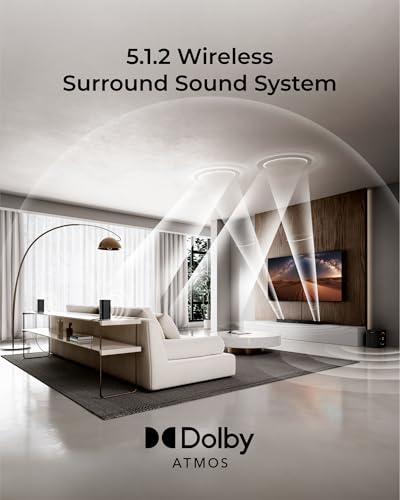
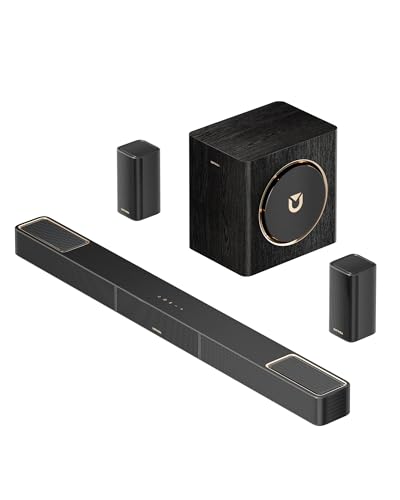
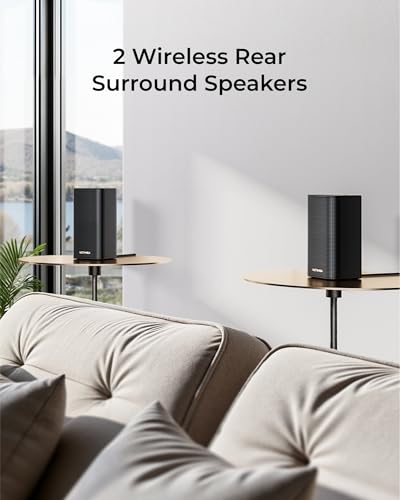
Then there are surround sound systems like the ULTIMEA Skywave X40. These use multiple speakers positioned around your room to create what's called a "soundstage"—essentially fooling your brain into thinking sounds are coming from specific directions in 3D space. The "5.1.2" designation tells you exactly what you're getting: five main speakers (front left, center, front right, and two rear surrounds), one subwoofer for bass, and two height speakers that fire sound toward your ceiling to create overhead effects.
The key consideration here is what audio engineers call "immersion." Basic soundbars improve clarity and volume, while surround systems create the sensation that you're inside the movie or game rather than just watching it.
The ULTIMEA Skywave X40 represents something we haven't seen much of until recently: a true 5.1.2 Dolby Atmos system that doesn't require running speaker wires across your room or spending premium brand money. Released in 2024, it incorporates several technological advances that make wireless surround sound actually work reliably.
The most impressive aspect of the Skywave X40 is its CineMesh wireless technology. Traditional wireless speakers often suffer from audio lag—that annoying delay where explosions happen on screen before you hear them. ULTIMEA solved this using dual 5GHz wireless transmission with latency under 20 milliseconds. To put that in perspective, anything under 40ms is generally imperceptible to human ears, so 20ms is exceptionally tight synchronization.
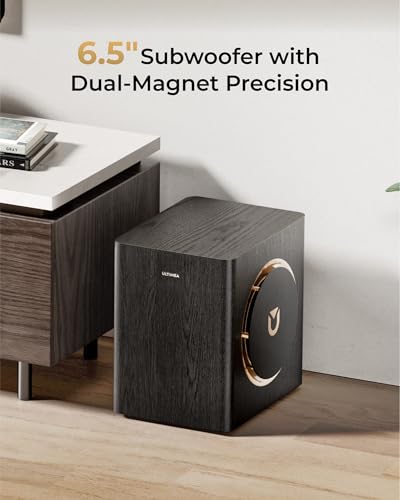
The system's 530W peak power output might sound like marketing fluff, but it translates to real-world performance. The 6.5-inch subwoofer uses what ULTIMEA calls "Gravus Ultra-Linear Bass Technology," which essentially means it can produce deep, clean bass (down to 35Hz) without the distortion that usually happens when small speakers try to push too much air. For reference, 35Hz covers the fundamental frequencies of most movie soundtracks' low-end effects—those rumbles you feel during action sequences.
Perhaps most interesting is the GaN (Gallium Nitride) amplifier technology. Traditional amplifiers use silicon semiconductors that generate significant heat and can become less efficient under load. GaN amplifiers run at up to 98% efficiency and generate 50% less heat, which means they can maintain clean, undistorted sound even when pushing high volumes. This isn't just technical showboating—it directly translates to better performance during demanding movie scenes.
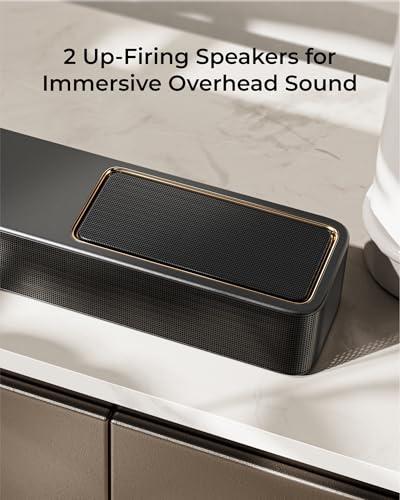
The ULTIMEA Skywave X40's two up-firing speakers deserve special attention. Dolby Atmos works by bouncing sound off your ceiling to create the illusion of overhead effects. When helicopters fly overhead in a movie, or rain falls in a forest scene, you actually perceive these sounds as coming from above rather than just from the front speakers.
Based on our research into user experiences, this effect is surprisingly convincing when properly set up. Reviewers consistently mention being able to pinpoint the direction of effects—something that's impossible with traditional stereo soundbars. However, Atmos effectiveness depends heavily on your room having a reasonably flat ceiling at appropriate height (8-10 feet works best).
The Skywave X40 is designed for medium to large living spaces—think 300+ square feet. In smaller rooms, the 530W output can actually be overwhelming, while larger spaces benefit from the system's ability to create an enveloping soundfield without cranking the volume to uncomfortable levels.
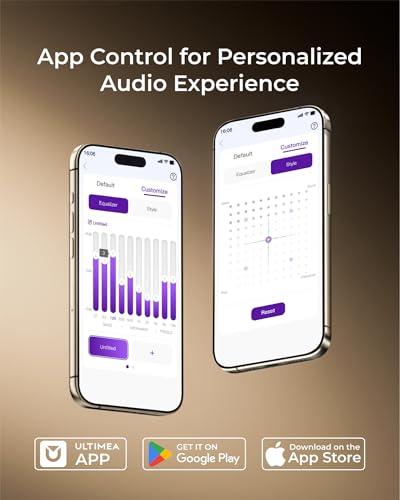
User reviews suggest the system excels particularly with movie content and gaming, where the surround effects and deep bass create genuine immersion. Music performance is solid, though audiophiles might notice that it's tuned more for cinematic impact than critical listening. The smart app control with 10-band EQ does allow for significant customization, which helps tailor the sound to different content types.
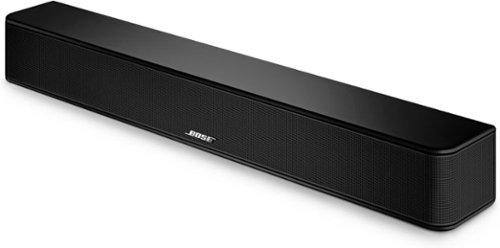
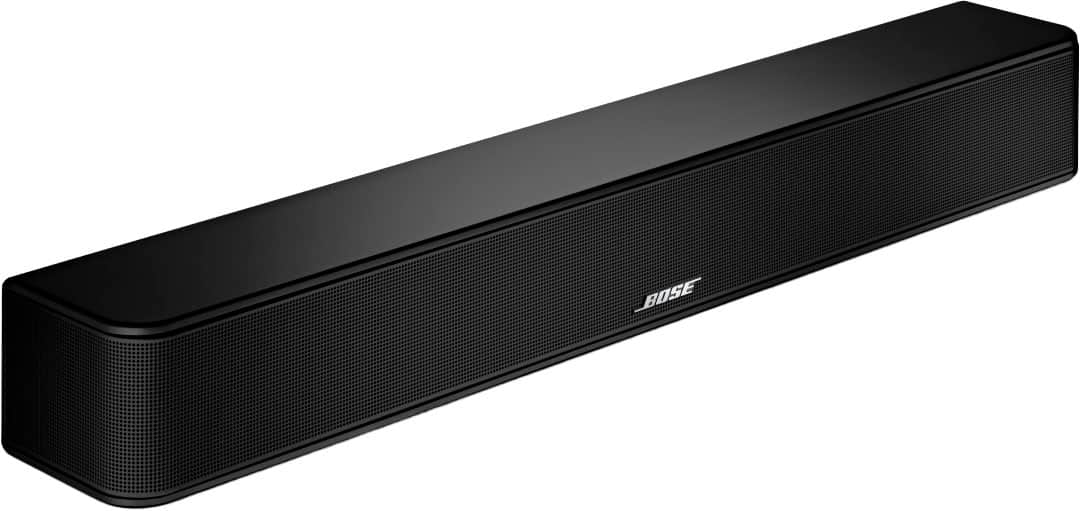
The Bose Solo Soundbar Series 2, also released in 2024, takes a completely different philosophy. Rather than trying to recreate a movie theater in your living room, it focuses on doing one thing exceptionally well: making TV dialogue clearer and more intelligible.
Bose's approach centers around what they call "dialogue mode"—specialized digital signal processing that enhances the frequency range where human speech occurs (roughly 300Hz to 3400Hz) while reducing competing background noise. This isn't just an EQ adjustment; it's active processing that can identify and emphasize vocal patterns in real-time.
The two full-range drivers are angled outward rather than firing straight ahead. This creates a wider stereo image than you'd expect from such a compact unit, and the angled positioning helps create some sense of spatial audio even without true surround speakers. Users report that this design makes it feel like dialogue is coming more directly from the TV screen rather than from a box sitting below it.
The Bose Solo Series 2 represents something increasingly rare in consumer electronics: intentional restraint. There's no subwoofer because Bose determined that the dialogue clarity mission was better served by focusing on mid-range frequencies rather than trying to reproduce deep bass from a compact enclosure.
This design choice makes sense when you consider the physics involved. Small speakers can either do mid-range frequencies well or try to do everything poorly. By accepting the limitation of reduced bass response, Bose can optimize the drivers for what matters most in TV and podcast content—clear, natural-sounding voices.
The single optical cable connection reflects this simplicity philosophy. While the ULTIMEA system offers HDMI eARC, 4K passthrough, and multiple inputs, the Bose acknowledges that most users just want to connect their soundbar to their TV and be done with it.
Based on user feedback, the Bose Solo Series 2 performs exactly as advertised. Dialogue becomes noticeably clearer, and the overall sound is warmer and fuller than typical TV speakers. However, it's important to calibrate expectations—this isn't going to create movie theater experiences or provide the bass response for action films that some users might expect.
Where the Bose particularly shines is with dialogue-heavy content: news, documentaries, talk shows, and podcasts. The dialogue enhancement mode isn't just marketing speak—users consistently report being able to understand speech better, even at lower volumes, which is particularly valuable for late-night viewing or hearing-impaired users.
This is where the two approaches diverge most dramatically. The ULTIMEA Skywave X40 includes a dedicated 6.5-inch subwoofer that can reproduce frequencies down to 35Hz. To understand why this matters, consider that movie explosions, thunder, and music fundamentals often occur in the 20-80Hz range. Without a subwoofer, these effects lose their physical impact—you hear them, but you don't feel them.
The Bose Solo Series 2 simply can't compete in this range. Its small drivers are optimized for mid-range clarity, which means bass-heavy content will sound thin by comparison. However, for users who primarily watch news, sitcoms, or dialogue-heavy dramas, this limitation is largely irrelevant.
The surround sound difference is perhaps the most significant performance gap between these systems. The ULTIMEA's 5.1.2 configuration creates genuine directional audio—sounds appear to come from specific locations around your room. This is particularly noticeable in movie scenes with off-screen dialogue, ambient effects, or directional sounds like cars passing by.
User reviews of the Skywave X40 consistently mention being surprised by the convincing surround effects, particularly from the wireless rear speakers. The height channels add another dimension that's especially effective with atmospheric content—rain, aircraft, or music venues with ceiling-mounted speakers in the original recording.
The Bose Solo Series 2 creates a wider stereo image than most compact soundbars thanks to its angled drivers, but it can't create the illusion of sounds coming from behind or above you. This isn't a flaw—it's simply a different approach focused on frontal soundstage width rather than 360-degree immersion.
Dynamic range refers to the difference between the quietest and loudest sounds a system can reproduce clearly. This is crucial for movie content, where whispered dialogue might be followed immediately by explosive action sequences.
The ULTIMEA Skywave X40's 530W power output and GaN amplifier technology allow it to handle these transitions without compression or distortion. The system can reproduce quiet dialogue clearly while still having headroom for impactful sound effects. User reports suggest the system maintains clarity even at high volumes, which is particularly important for larger rooms or when competing with ambient noise.
The Bose Solo Series 2 takes a different approach, using dynamic range compression to keep dialogue consistently audible even during quieter passages. This is actually beneficial for many TV viewing scenarios, as it reduces the need to constantly adjust volume during movies with widely varying audio levels.
At the time of writing, these systems occupy very different price tiers, which makes direct value comparison complex. The ULTIMEA Skywave X40 typically costs roughly twice as much as the Bose Solo Series 2, but delivers exponentially more audio hardware and capability.
From a pure cost-per-component perspective, the Skywave X40 represents exceptional value. Comparable 5.1.2 systems from established brands often cost 3-4 times more, making ULTIMEA's offering particularly compelling for budget-conscious home theater enthusiasts.
However, value isn't just about getting the most components for your dollar. The Bose Solo Series 2 offers the value of simplicity and reliability. Bose's reputation for consistent audio quality and the system's plug-and-play nature have genuine worth for users who prioritize convenience over maximum performance.
The complexity difference between these systems can't be overstated. Setting up the ULTIMEA Skywave X40 involves positioning four separate components around your room, ensuring the wireless connections are stable, and potentially fine-tuning the audio balance through the smartphone app. While the wireless technology eliminates speaker cable runs, you still need power outlets for each component.
Based on user experiences, most people spend 30-60 minutes achieving optimal ULTIMEA setup, including room positioning and app configuration. The reward is a properly calibrated surround system, but it does require patience and willingness to experiment with placement.
The Bose Solo Series 2 setup involves connecting one optical cable and plugging in the power cord. Total time investment: under five minutes. For many users, this simplicity is worth more than additional audio features they might never fully utilize.
After analyzing extensive user feedback and technical capabilities, clear usage patterns emerge for each system.
Are serious about home entertainment. If you regularly watch movies, play video games, or enjoy content where audio immersion enhances the experience, the surround sound capabilities justify the additional complexity and cost.
Have a dedicated viewing space. Medium to large living rooms (300+ square feet) with primary TV viewing areas benefit most from the X40's power and surround capabilities. The system is designed to fill substantial spaces with immersive audio.
Enjoy the setup process. Users who appreciate optimizing their systems and don't mind spending time with app-based customization will find the ULTIMEA's extensive controls rewarding rather than overwhelming.
Want future-proof connectivity. The HDMI eARC, 4K passthrough, and modern Bluetooth standards mean this system will remain compatible with evolving TV and streaming technology.
Prioritize dialogue clarity above all else. If your primary frustration with TV audio is understanding speech—particularly for news, documentaries, or dialogue-heavy shows—the Bose directly addresses this need without unnecessary complexity.
Value simplicity and reliability. Users who want immediate improvement without setup time, additional components, or smartphone apps will appreciate the Solo Series 2's straightforward approach.
Have space constraints. Small apartments, bedrooms, or secondary viewing areas where multiple speakers aren't practical benefit from the compact, single-unit design.
Trust established audio brands. Bose's decades of audio expertise and reputation for consistent quality provide peace of mind for users who prefer proven rather than cutting-edge technology.
These soundbars solve different problems and serve different users. The ULTIMEA Skywave X40 transforms your living room into a home theater, creating immersive experiences that genuinely enhance movie and gaming content. The Bose Solo Series 2 makes TV watching more enjoyable by ensuring you never miss dialogue or strain to hear clearly.
Your choice ultimately depends on whether you want to upgrade your entire audio experience or simply fix the most common TV audio problem. Both approaches have merit, but they're not really competing for the same user—they're offering different solutions for different priorities.
Based on our research and user feedback analysis, the ULTIMEA represents exceptional value for home theater enthusiasts willing to invest in setup time, while the Bose offers reliable improvement for users who value simplicity above maximum performance. Neither choice is wrong—they're just designed for different definitions of what "better TV audio" means to you.
| ULTIMEA Skywave X40 5.1.2 Soundbar System | Bose Solo Soundbar Series 2 |
|---|---|
| Channel Configuration - Determines surround sound capability | |
| 5.1.2 Dolby Atmos with overhead effects | 2.0 stereo (left/right only) |
| Total Components - Affects setup complexity and room coverage | |
| 4 pieces: soundbar, subwoofer, 2 wireless rear speakers | 1 piece: single soundbar unit |
| Peak Power Output - Controls volume and bass impact | |
| 530W (fills large rooms with impactful sound) | Not specified (designed for dialogue clarity) |
| Subwoofer - Essential for movie bass and music fullness | |
| 6.5-inch wireless subwoofer (35Hz bass extension) | None (limited low-frequency response) |
| Height Speakers - Creates overhead Dolby Atmos effects | |
| 2 up-firing speakers in main bar | None (no overhead audio) |
| Wireless Technology - Affects reliability and setup | |
| Dual 5GHz CineMesh with <20ms latency | Standard Bluetooth 4.0 |
| HDMI Connectivity - Important for modern TV integration | |
| HDMI eARC with 4K HDR passthrough | None (optical connection only) |
| Smart Controls - Determines customization options | |
| Dedicated app with 10-band EQ, 121 presets | Basic remote control only |
| Room Size Suitability - Matches power to space requirements | |
| Medium to large rooms (300+ sq ft) | Small to medium rooms (up to 300 sq ft) |
| Primary Strength - What each does exceptionally well | |
| Immersive home theater experience with true surround | Crystal-clear dialogue enhancement |
| Setup Time - Reality check for installation | |
| 30-60 minutes (positioning 4 components) | Under 5 minutes (single cable connection) |
| Best Content Types - Where each system excels | |
| Movies, gaming, music with dynamic range | TV shows, news, podcasts, dialogue-heavy content |
The ULTIMEA Skywave X40 is significantly better for movies due to its 5.1.2 Dolby Atmos surround sound system with wireless rear speakers and overhead effects. It creates an immersive home theater experience with directional audio and deep bass from its dedicated subwoofer. The Bose Solo Series 2 is better for TV shows and dialogue-heavy content, as it's specifically designed to enhance speech clarity and vocal intelligibility.
The primary difference is that the ULTIMEA Skywave X40 is a complete 5.1.2 surround sound system with multiple wireless speakers, while the Bose Solo Series 2 is a simple stereo soundbar. The ULTIMEA provides true surround sound with overhead Dolby Atmos effects, whereas the Bose focuses on improving dialogue clarity from a single compact unit.
The Bose Solo Series 2 is much easier to set up, requiring only a single optical cable connection and taking under 5 minutes. The ULTIMEA Skywave X40 requires positioning four separate components (soundbar, subwoofer, and two rear speakers) around your room, typically taking 30-60 minutes for optimal setup.
The ULTIMEA Skywave X40 includes a 6.5-inch wireless subwoofer that provides deep bass down to 35Hz, making it excellent for movies and music. The Bose Solo Series 2 has no subwoofer and limited bass response, focusing instead on mid-range clarity for dialogue. If you want impactful bass for movies, the ULTIMEA is the clear choice.
The Bose Solo Series 2 is better suited for small rooms and apartments due to its compact single-unit design and focus on dialogue clarity. The ULTIMEA Skywave X40 is designed for medium to large rooms (300+ square feet) and may be overwhelming in smaller spaces due to its 530W power output and multiple speakers.
Both soundbars offer wireless connectivity options. The ULTIMEA Skywave X40 features Bluetooth 5.4 and can also connect via HDMI eARC or optical cable. The Bose Solo Series 2 includes Bluetooth 4.0 for wireless streaming but requires an optical cable connection to your TV for the best audio quality.
The ULTIMEA Skywave X40 offers exceptional value for home theater enthusiasts, providing a complete 5.1.2 Dolby Atmos system at a fraction of the cost of comparable premium brand systems. The Bose Solo Series 2 provides excellent value for users seeking simple dialogue enhancement with minimal setup complexity and the reliability of the Bose brand.
Yes, the ULTIMEA Skywave X40 fully supports Dolby Atmos with dedicated up-firing speakers that create overhead sound effects. The Bose Solo Series 2 does not support Dolby Atmos, as it's a stereo soundbar focused on dialogue enhancement rather than immersive surround sound.
The ULTIMEA Skywave X40 is significantly better for gaming due to its surround sound capabilities, powerful bass, and ultra-low wireless latency under 20ms. The directional audio helps with spatial awareness in games, while the subwoofer adds impact to explosions and effects. The Bose Solo Series 2 lacks the immersive audio features that enhance modern gaming experiences.
Both soundbars improve dialogue clarity, but in different ways. The Bose Solo Series 2 features specialized dialogue enhancement mode that's specifically designed to make speech more intelligible. The ULTIMEA Skywave X40 also improves dialogue through its dedicated center channel and overall superior audio processing, though it's optimized more for overall cinematic experience.
The Bose Solo Series 2 requires virtually no maintenance due to its simple single-unit design. The ULTIMEA Skywave X40 has more components that may require occasional repositioning or troubleshooting of wireless connections, though the system is generally reliable once properly set up. Both systems include remote controls that may need battery replacement over time.
The ULTIMEA Skywave X40 is already a complete surround sound system and doesn't require expansion, though it includes app-based customization with extensive EQ settings. The Bose Solo Series 2 cannot be expanded with additional speakers, so if you want more immersive audio later, you'd need to replace the entire system rather than adding components.
We've done our best to create useful and informative comparisons to help you decide what product to buy. Our research uses advanced automated methods to create this comparison and perfection is not possible - please contact us for corrections or questions. These are the sites we've researched in the creation of this article: bestbuy.com - shopabunda.com - youtube.com - youtube.com - youtube.com - youtube.com - ultimea.com - walmart.com - youtube.com - hometechnologyreview.com - community.ultimea.com - avsforum.com - youtube.com - youtube.com - youtube.com - bestbuy.com - hometechnologyreview.com - rtings.com - bose.com - bose.com - assets.bose.com - bestbuy.com - youtube.com - pistonheads.com - costco.com - googlenestcommunity.com - youtube.com - discussions.apple.com

Privacy Policy
Terms and Conditions - Affiliate Policy
Home Security
© Copyright 2008-2026.
11816 Inwood Rd #1211, Dallas, TX 75244