









If you've ever watched a movie on your TV and struggled to hear the dialogue over explosions, you're not alone. Modern TVs, while visually stunning, often have terrible built-in speakers. They're simply too thin to house decent audio hardware. That's where soundbars come in—they're designed to dramatically improve your TV's audio without the complexity of a full surround sound system.
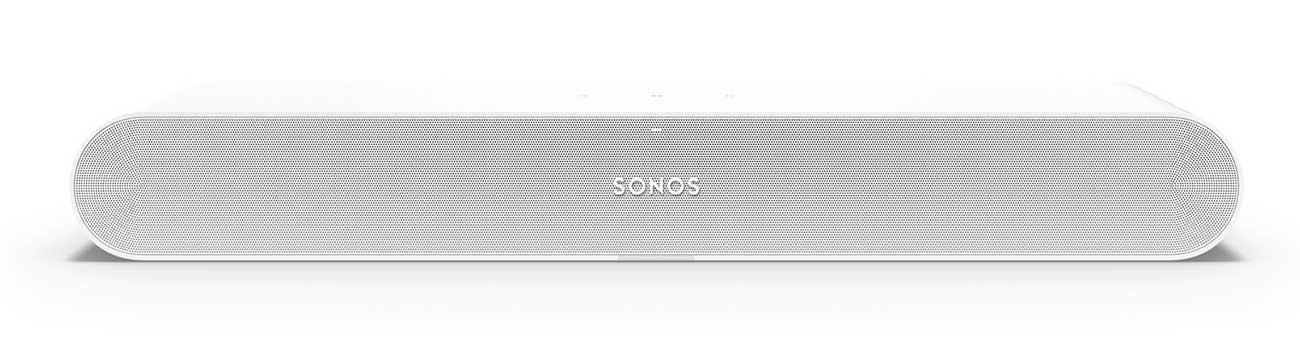
But choosing the right soundbar can be confusing. Today, we're comparing two very different approaches: the Amazon Fire TV Soundbar Plus 5.1 Channel System, which delivers true surround sound with multiple speakers, and the Sonos Ray Soundbar, a premium stereo soundbar that excels at music and integrates with smart home systems.
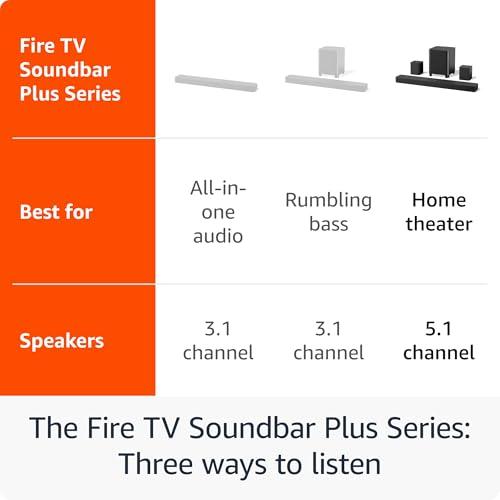
Before diving into these specific models, it's worth understanding what separates great soundbars from mediocre ones. The most important factor is channel configuration—this refers to how many separate audio channels the soundbar can reproduce. A 2.0 system has left and right channels (stereo), while a 5.1 system adds a center channel for dialogue, two surround channels for ambient effects, and a subwoofer for bass (the ".1" represents the subwoofer).
Audio processing capabilities matter too. Modern content often uses advanced formats like Dolby Atmos, which adds height information to create a three-dimensional soundscape. However, not all soundbars handle these formats equally—some use "virtualization" (computer processing to simulate surround effects) rather than physical speakers positioned around your room.
Connectivity options determine how easily the soundbar integrates with your existing setup. HDMI eARC (enhanced Audio Return Channel) provides the highest quality connection and often allows your TV remote to control the soundbar. Optical connections are more universal but don't support the highest quality audio formats.
Finally, ecosystem integration—how well the soundbar works with streaming services, smart home devices, and other audio equipment—can significantly impact your daily experience.
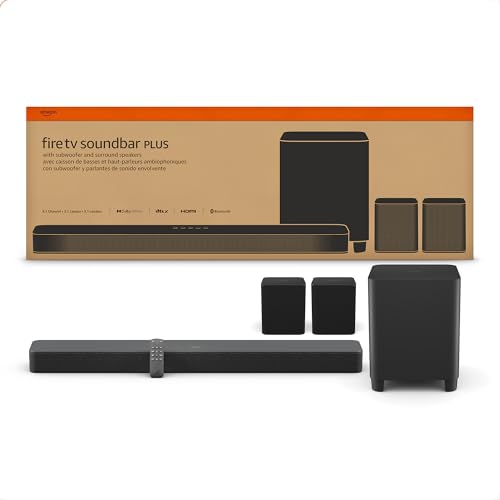
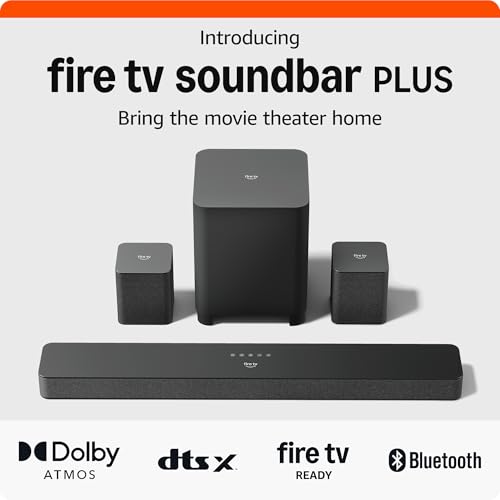
Released in 2023, the Amazon Fire TV Soundbar Plus 5.1 represents the "more is more" philosophy. Amazon took their original Fire TV Soundbar and expanded it into a complete surround system with a wireless subwoofer and rear satellite speakers. At the time of writing, it's priced competitively for a complete 5.1 system, though it costs significantly more than basic soundbars.
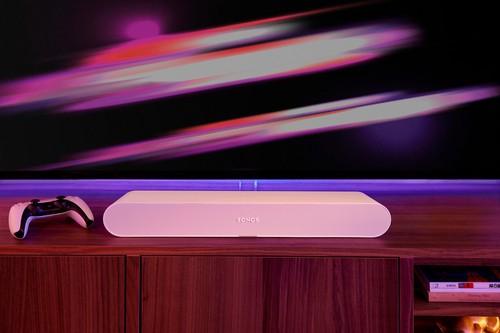
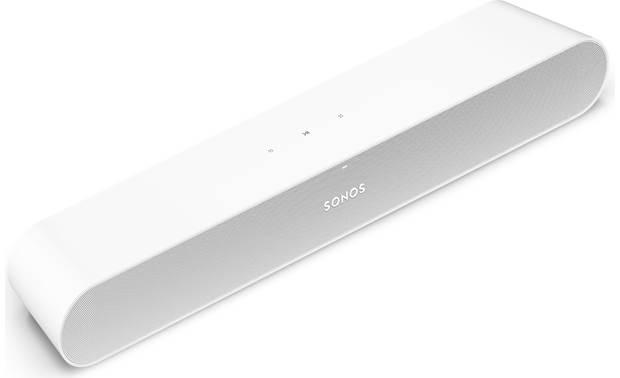
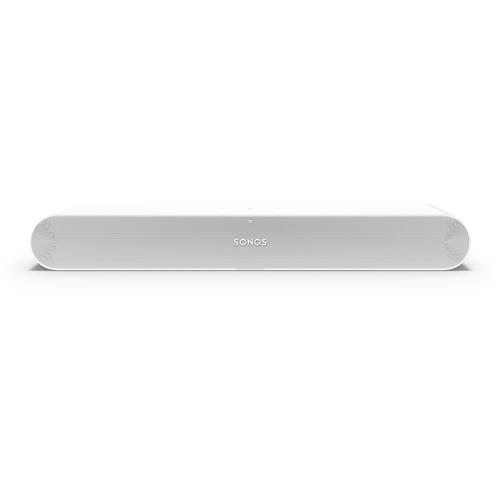
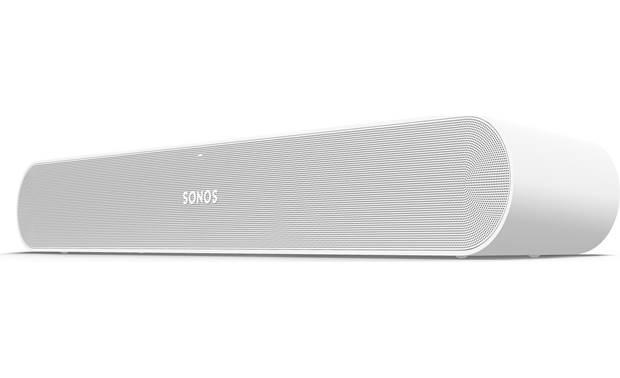
The Sonos Ray, launched in 2022, takes the opposite approach. Despite being from a company known for premium multi-room audio systems, the Ray is Sonos's most affordable soundbar. It focuses on doing stereo audio exceptionally well rather than attempting surround sound. Its pricing reflects this streamlined approach—it costs considerably less than the Amazon system at the time of writing.
These different philosophies create distinct advantages and limitations that we'll explore throughout this comparison.
The most striking difference between these soundbars lies in their fundamental audio approach. The Amazon Fire TV Soundbar Plus 5.1 uses six separate speakers to create true 5.1 surround sound. The main soundbar houses three full-range speakers, three tweeters (high-frequency drivers), and two woofers (low-frequency drivers). This gives you a dedicated center channel that makes dialogue crystal clear, separate left and right channels for stereo effects, and the wireless rear speakers add genuine surround ambiance.
When watching movies, this setup creates an enveloping experience. Helicopters actually seem to fly from one side of your room to the other, and ambient sounds like rain or crowd noise fill the space around you. The wireless subwoofer handles the heavy lifting for explosions and musical bass, delivering the kind of low-end impact that makes action scenes visceral.
However, our research into user and expert consensus reveals some limitations in the Amazon system's execution. The soundstage—how wide and seamless the audio image appears—has noticeable gaps. This means when sounds pan from left to right, they can seem to disappear in the middle rather than smoothly transitioning. For music listening, this creates an unnatural presentation that some find distracting.
The Sonos Ray takes a completely different approach with its stereo-only design. Using just two tweeters and two midwoofers, it focuses entirely on creating exceptional two-channel audio. The proprietary acoustic architecture includes a bass reflex system with specially designed ports that minimize distortion while maximizing bass response from such a compact enclosure.
What's remarkable about the Ray is how much it accomplishes with fewer components. The frequency response is notably balanced, meaning different types of audio content—from dialogue to music to sound effects—are reproduced with accurate relative volumes. The midrange, where most human voices and musical instruments live, is particularly well-executed. This creates a presentation that many find more natural and less fatiguing for extended listening sessions.
The Ray also includes Trueplay room correction, a sophisticated feature that uses an iOS device's microphone to measure your room's acoustics and automatically adjust the soundbar's output. This means the Ray can sound excellent whether it's placed in a small bedroom or a large living room, adapting to your specific space's acoustic properties.
Here's where the fundamental difference becomes most apparent. The Amazon Fire TV Soundbar Plus 5.1 delivers genuine surround sound through its wireless rear speakers. These satellites, while somewhat lightweight in construction, create authentic surround effects by physically placing sound sources behind your listening position.
The system supports modern audio formats including Dolby Atmos and DTS:X, though it implements these through virtualization rather than dedicated height speakers. This means while you get convincing left-to-right and front-to-back effects, overhead sounds are simulated through digital processing rather than physically projected from above.
In practice, this works well for most content. Movie soundtracks come alive with ambient effects properly positioned around the room. The experience is genuinely immersive in a way that stereo soundbars simply cannot match, regardless of how sophisticated their processing might be.
The Sonos Ray, being a stereo-only system, cannot create true surround effects. When it receives 5.1 content (which is increasingly common on streaming services and Blu-ray discs), it must downmix everything into stereo. This means surround information gets folded into the left and right channels, losing the spatial positioning that makes surround sound compelling.
However, the Ray compensates for this limitation with superior stereo imaging. The soundstage, while not extending behind you, is wider and more coherent than the Amazon system's front channels. For content that's primarily dialogue-driven—most TV shows, news, documentaries—this difference in surround capability matters less than you might expect.
If music playback is important to you, the differences between these systems become even more pronounced. The Sonos Ray was clearly designed with music as a primary use case. The balanced frequency response, refined midrange reproduction, and superior stereo imaging create an engaging musical experience that rivals dedicated music speakers at similar price points.
The Ray's integration with streaming services adds significant value here. Built-in support for Spotify Connect, Tidal Connect, and Apple AirPlay 2 means you can stream high-quality music directly to the soundbar without involving your TV. The Sonos app provides access to virtually every major streaming service, and the ability to group multiple Sonos speakers throughout your home creates a true whole-house audio system.
The Amazon Fire TV Soundbar Plus 5.1 takes a more aggressive approach to music, with what audio enthusiasts call an "excited" sound signature. This means certain frequencies, particularly in the bass range, are emphasized to create more immediate impact. For some genres—electronic music, hip-hop, rock—this can be quite engaging. The dedicated subwoofer provides bass extension and impact that the compact Ray simply cannot match.
However, this tuning philosophy can make the Amazon system less suitable for acoustic music, jazz, classical, or other genres where tonal accuracy matters more than impact. The rear speakers don't contribute to music playback in most configurations, so you're essentially using a 3.1 system (left, center, right, plus subwoofer) for stereo content.
Modern soundbars need to integrate seamlessly with today's streaming-focused entertainment systems, but these two models take notably different approaches to connectivity.
The Amazon Fire TV Soundbar Plus 5.1 focuses on traditional AV connections with HDMI eARC and optical inputs. The HDMI connection is particularly valuable—it supports high-bandwidth audio formats and allows your TV's remote to control the soundbar's volume and basic functions. Amazon even includes an HDMI cable, which many competitors omit. Bluetooth connectivity handles wireless music streaming from phones and tablets.
The system's integration with Fire TV devices is seamless when both are connected via HDMI. Settings adjustments can be made through the TV's interface, and the Fire TV remote gains control over soundbar functions. However, despite the "Fire TV" branding, the soundbar itself doesn't function as a streaming device—it has no Wi-Fi connectivity or built-in apps.
The Sonos Ray makes a bold connectivity choice by including only an optical digital input. This might seem limiting, but it reflects Sonos's streaming-first philosophy. The Ray connects to your home network via Wi-Fi or Ethernet, giving it access to streaming services without requiring your TV to be on.
This approach has advantages and limitations. The Ray can play music from dozens of streaming services independently, and the Sonos app provides a sophisticated control interface. Apple AirPlay 2 support enables high-quality wireless streaming from iOS devices. However, the lack of HDMI means you miss out on the highest-quality audio formats and convenient TV remote control.
Notably, the Ray lacks Bluetooth connectivity entirely. This reflects Sonos's preference for Wi-Fi streaming, which provides better sound quality and doesn't require devices to be in close proximity. However, it means you can't easily stream from Android devices or other Bluetooth sources without using the TV as an intermediary.
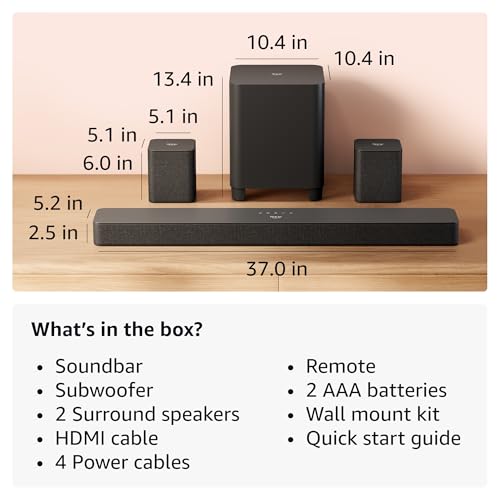
Setting up the Amazon Fire TV Soundbar Plus 5.1 involves more steps but isn't particularly complicated. All components arrive pre-paired, so you simply need to position the wireless subwoofer and rear speakers, then power everything on. The subwoofer needs to be placed on the floor (typically near a wall for optimal bass response), while the rear speakers need positioning behind or to the sides of your seating area.
The system includes wall-mounting hardware for the main soundbar, and the wireless rear speakers can be placed on stands or mounted on walls. Finding optimal placement for all components can require some experimentation, particularly in smaller rooms where options are limited.
Once set up, daily use is straightforward but basic. The included remote provides access to four EQ presets (Movie, Music, Sports, Night mode), dialogue enhancement, and bass/treble adjustments. However, all settings must be made via the physical remote—there's no smartphone app for advanced adjustments or room correction.
The Sonos Ray offers a dramatically simpler physical setup since it's a single unit. At just 94 cm long and 13.2 cm deep, it fits easily in most TV stands without overwhelming the space. The compact design means it works well in secondary rooms or smaller spaces where a full surround system would be impractical.
However, the Ray's sophistication lies in its software. The Sonos S2 app handles initial setup, which includes connecting to your Wi-Fi network and configuring audio settings. If you have an iOS device, the Trueplay room correction process involves walking around your room while the app plays test tones, automatically optimizing the sound for your specific space.
The app provides ongoing control over EQ settings, streaming services, and multi-room functionality. This software-centric approach means the Ray's capabilities can expand over time through updates, and it integrates seamlessly with other Sonos products if you decide to build a larger system.
Determining value requires considering what you're actually getting for your money. At the time of writing, the Amazon Fire TV Soundbar Plus 5.1 represents exceptional value for users prioritizing surround sound capabilities. You're getting a complete 5.1 system with wireless subwoofer and rear speakers at a price point where many competitors offer only stereo or basic 2.1 configurations.
The inclusion of genuine rear speakers for surround effects, support for modern audio formats like Dolby Atmos, and strong bass performance from the dedicated subwoofer create an entertainment experience that significantly surpasses most TV speakers and basic soundbars. For movie enthusiasts or gamers who prioritize immersive audio, this represents strong value despite the higher price point.
However, the Amazon system's limitations become apparent when considering long-term use and versatility. The lack of room correction means performance varies significantly based on placement and room acoustics. The basic EQ options and absence of a smartphone app limit customization. Most significantly, the emphasized sound signature and soundstage gaps make it less suitable for music listening or other non-cinematic content.
The Sonos Ray, while considerably less expensive at the time of writing, represents a different value calculation. You're paying for premium build quality, sophisticated acoustic engineering, and comprehensive software features in a compact package. The superior music performance, room correction capabilities, and ecosystem integration provide long-term value that extends beyond basic TV audio improvement.
The Ray's limitations—particularly the lack of surround sound—are significant for certain use cases. However, for users whose primary concerns are dialogue clarity, music performance, and integration with modern streaming services, the Ray delivers performance that competes with much more expensive alternatives.
For dedicated home theater use, the choice between these systems becomes clearer. The Amazon Fire TV Soundbar Plus 5.1 is fundamentally designed for this application. The true 5.1 surround capability, powerful subwoofer, and support for modern audio formats create the kind of immersive experience that makes movie nights genuinely exciting.
The system can fill larger rooms with sound and handle action-heavy content with appropriate impact. The dialogue clarity from the dedicated center channel ensures you won't miss important plot points, while the surround speakers add the ambient effects that make you feel part of the action.
However, the high audio latency reported by users creates potential issues for gaming or interactive content where audio-visual synchronization is critical. This can often be addressed through manual A/V sync adjustments, but it's an additional complication.
The Sonos Ray can certainly improve your home theater experience over built-in TV speakers, but it's not designed primarily for this use. The stereo-only configuration means you'll miss the spatial effects that make modern movie soundtracks compelling. While the excellent dialogue clarity and balanced sound signature work well for dialogue-heavy content, action sequences lack the impact and immersion of true surround systems.
After researching user experiences and expert evaluations, clear usage patterns emerge for each system.
Choose the Amazon Fire TV Soundbar Plus 5.1 if you prioritize the cinematic experience. This system excels for users whose primary use cases involve movies, TV shows with complex soundtracks, and gaming. The true surround sound capability and powerful bass create an engaging entertainment experience that transforms how you experience visual content.
This system makes the most sense for primary living rooms or dedicated media spaces where the visual impact of multiple speakers isn't a concern. It's particularly valuable for users already invested in the Amazon ecosystem, where the Fire TV integration provides additional convenience.
The Amazon system is also the better choice if you're seeking maximum audio impact per dollar spent. The complete 5.1 configuration provides capabilities that would cost significantly more from premium audio brands.
Choose the Sonos Ray if you value sound quality over surround effects. This soundbar excels for users whose content consumption includes significant music listening, dialogue-heavy shows, or situations where aesthetic considerations matter as much as performance.
The Ray makes particular sense for secondary rooms, smaller spaces, or situations where you're building toward a larger Sonos ecosystem. Its superior music performance and streaming integration provide daily value beyond just TV audio improvement.
From a long-term perspective, the Ray's software-centric approach and room correction capabilities mean it's likely to maintain its performance advantages over time, while the Amazon system's hardware-focused design provides immediate impact but limited upgrade potential.
The decision ultimately comes down to your primary use case: immersive entertainment versus refined audio quality. Both soundbars dramatically improve over built-in TV speakers, but they serve different priorities and lifestyles. Consider your content consumption patterns, room constraints, and whether you're building a complete entertainment system or simply want better TV audio—the right choice should become clear based on these factors.
| Amazon Fire TV Soundbar Plus 5.1 Channel System | Sonos Ray Soundbar |
|---|---|
| Channel Configuration - Determines surround sound capabilities and immersion level | |
| True 5.1 channels with wireless subwoofer and rear satellites | Stereo only (2.0 channels) |
| Audio Format Support - Affects compatibility with modern streaming content | |
| Dolby Atmos (virtualized), DTS:X, Dolby TrueHD, DTS-HD MA | Dolby Digital, DTS (downmixed to stereo) |
| Connectivity Options - Determines ease of setup and audio quality | |
| HDMI eARC, Optical, Bluetooth, USB-A | Optical only, Wi-Fi, Apple AirPlay 2 |
| Room Correction Technology - Optimizes sound for your specific space | |
| None (manual EQ adjustments only) | Trueplay automatic room correction (iOS required) |
| Music Streaming Integration - Direct access to services without TV | |
| Bluetooth only (requires paired device) | Built-in Spotify Connect, Tidal Connect, AirPlay 2 |
| Physical Components - Affects placement flexibility and room impact | |
| 4 pieces: soundbar, subwoofer, 2 rear speakers | Single soundbar unit |
| Multiroom Capabilities - Ability to expand throughout home | |
| None (standalone system only) | Full Sonos ecosystem integration |
| App Control and Advanced Features - Long-term customization options | |
| Physical remote only, basic EQ presets | Comprehensive Sonos S2 app with detailed controls |
| Dialogue Clarity Technology - Critical for understanding speech | |
| Dedicated center channel with dialogue enhancement | Dialogue enhancement mode with balanced frequency response |
| Bass Performance - Important for movies and music impact | |
| Dedicated 10.4" wireless subwoofer | Built-in bass with port design (no separate subwoofer) |
| Setup Complexity - Time and effort required for installation | |
| Multiple wireless components, optimal placement required | Single unit, plug-and-play setup |
| Best Use Cases - Primary scenarios where each excels | |
| Movies, gaming, large rooms, surround sound priority | Music, smaller spaces, multi-room audio, streaming focus |
The Amazon Fire TV Soundbar Plus 5.1 Channel System is significantly better for movies and TV shows due to its true 5.1 surround sound configuration. With dedicated rear speakers and a wireless subwoofer, it creates an immersive cinematic experience where sound effects move around your room. The Sonos Ray Soundbar only offers stereo sound, which means surround sound content gets downmixed and you lose the spatial audio effects that make movies exciting.
The Amazon Fire TV Soundbar Plus 5.1 Channel System has five separate audio channels plus a subwoofer, creating true surround sound with rear speakers positioned behind you. The Sonos Ray Soundbar is a stereo soundbar with just left and right channels. This means the Amazon system can place sounds all around your room, while the Ray keeps all audio in front of you, though with excellent clarity and balance.
The Sonos Ray Soundbar excels at music playback with its balanced frequency response and superior stereo imaging. It's designed specifically for high-quality music reproduction and integrates directly with streaming services like Spotify and Apple Music. While the Amazon Fire TV Soundbar Plus 5.1 Channel System can play music, its emphasized bass and movie-focused tuning make it less accurate for musical content.
The Sonos Ray Soundbar has built-in Wi-Fi and direct access to streaming services through the Sonos app, plus support for Spotify Connect and Apple AirPlay 2. The Amazon Fire TV Soundbar Plus 5.1 Channel System requires Bluetooth pairing with your phone or connection through your TV to access streaming services, as it doesn't have Wi-Fi or built-in streaming capabilities.
The Sonos Ray Soundbar is much easier to set up since it's a single unit that only needs power and an optical cable connection. The Amazon Fire TV Soundbar Plus 5.1 Channel System requires positioning four separate wireless components around your room - the main soundbar, subwoofer, and two rear speakers - which takes more time and planning for optimal placement.
The Sonos Ray Soundbar can be expanded with additional Sonos speakers throughout your home to create a multi-room audio system, and you can add a Sonos subwoofer and rear speakers for surround sound. The Amazon Fire TV Soundbar Plus 5.1 Channel System is a complete system that cannot be expanded - what you buy is what you get.
Both soundbars excel at dialogue clarity but through different approaches. The Amazon Fire TV Soundbar Plus 5.1 Channel System uses a dedicated center channel speaker specifically for dialogue, plus dialogue enhancement features. The Sonos Ray Soundbar achieves excellent speech clarity through its balanced frequency response and superior midrange reproduction, making voices sound natural and clear.
The Amazon Fire TV Soundbar Plus 5.1 Channel System offers HDMI eARC, optical input, Bluetooth, and USB-A connections, with an HDMI cable included. The Sonos Ray Soundbar has only optical input for TV connection but adds Wi-Fi connectivity and Apple AirPlay 2 for wireless streaming - notably, it lacks Bluetooth connectivity entirely.
The Sonos Ray Soundbar is ideal for small rooms due to its compact single-unit design and Trueplay room correction that automatically adjusts sound for your space. The Amazon Fire TV Soundbar Plus 5.1 Channel System requires space for a subwoofer and rear speakers, making it more challenging to position optimally in smaller rooms.
The Amazon Fire TV Soundbar Plus 5.1 Channel System supports advanced formats including Dolby Atmos, DTS:X, and Dolby TrueHD, though Atmos is virtualized rather than using dedicated height speakers. The Sonos Ray Soundbar supports standard formats like Dolby Digital and DTS but downmixes surround content to stereo since it lacks rear channels.
Value depends on your priorities. The Amazon Fire TV Soundbar Plus 5.1 Channel System offers exceptional value for surround sound capabilities, giving you a complete 5.1 system with wireless components. The Sonos Ray Soundbar provides better value for music listening and long-term flexibility, with premium build quality and ecosystem integration at a lower price point.
The Amazon Fire TV Soundbar Plus 5.1 Channel System can be controlled with your TV remote when connected via HDMI eARC, and offers seamless integration with Fire TV devices. The Sonos Ray Soundbar supports basic volume control through your TV remote via optical connection, but advanced features require the Sonos app on your smartphone.
We've done our best to create useful and informative comparisons to help you decide what product to buy. Our research uses advanced automated methods to create this comparison and perfection is not possible - please contact us for corrections or questions. These are the sites we've researched in the creation of this article: rtings.com - cordbusters.co.uk - techradar.com - developer.amazon.com - t3.com - hometechnologyreview.com - youtube.com - hometechnologyreview.com - whathifi.com - hometechnologyreview.com - hometechnologyreview.com - youm.design - hometechnologyreview.com - dolby.com - tomsguide.com - soundandvision.com - youtube.com - techradar.com - en.community.sonos.com - rtings.com - howtogeek.com - youtube.com - cnet.com - sonos.com - videoandaudiocenter.com

Privacy Policy
Terms and Conditions - Affiliate Policy
Home Security
© Copyright 2008-2026.
11816 Inwood Rd #1211, Dallas, TX 75244