




If you've ever cranked up an action movie only to have dialogue whispered while explosions blow out your eardrums, you know why soundbars exist. TV speakers are generally terrible—they're tiny, poorly positioned, and designed more for saving space than delivering quality audio. That's where soundbars step in as the middle ground between tinny TV audio and a full-blown home theater system that costs thousands and requires running wires through your walls.
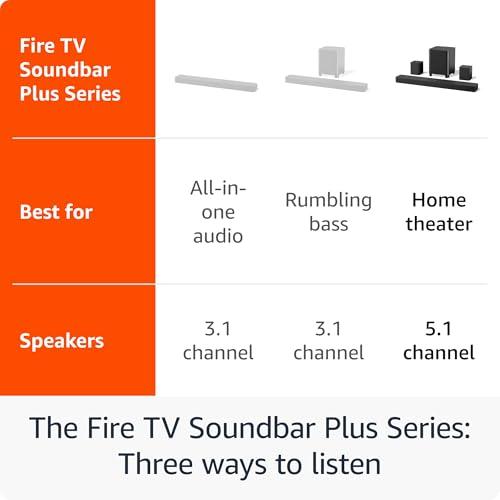
Before diving into our comparison between the Samsung HW-C450 and Amazon Fire TV Soundbar Plus, let's establish what makes a soundbar work. The most important specification is the channel configuration, expressed in numbers like 2.1 or 5.1. The first number represents main channels (left, right, center), while the second indicates subwoofer presence. So a 2.1 system has left and right speakers plus a subwoofer, while 5.1 adds a center channel and two rear surround speakers.
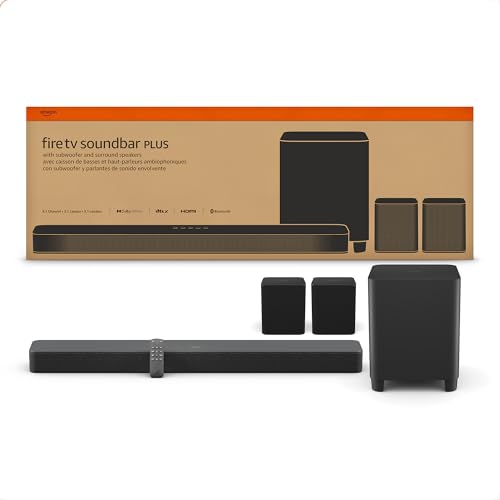
This channel difference fundamentally separates our two products. The Samsung HW-C450 is a 2.1 system that uses digital processing to simulate surround sound, while the Amazon Fire TV Soundbar Plus provides true 5.1 surround with physical speakers positioned around your room.
Released in 2023, both soundbars represent current-generation technology, though they target vastly different price points and user expectations. At the time of writing, you can expect to pay around $150 for the Samsung and roughly $400 for the Amazon system—a significant gap that reflects their different approaches to solving the TV audio problem.
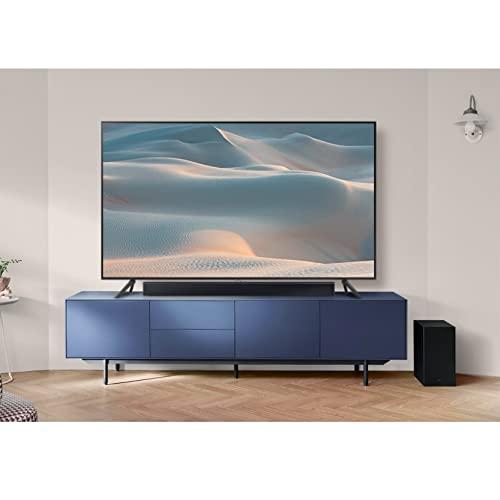
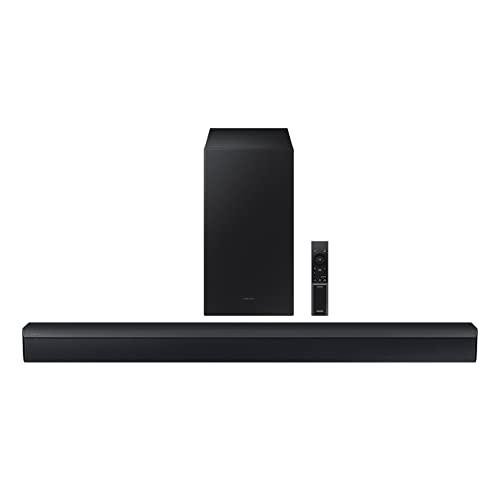
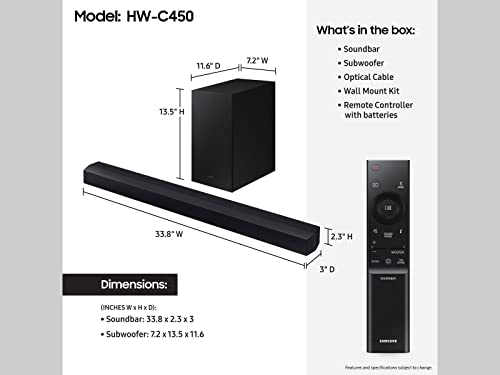
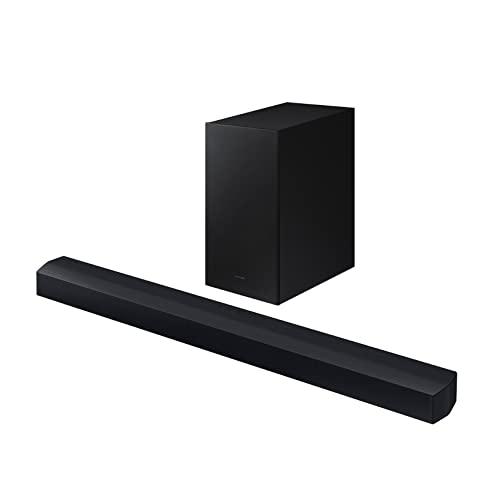
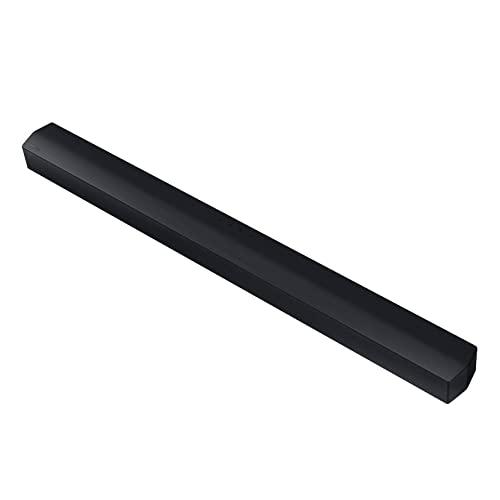
The Samsung HW-C450 embodies the "keep it simple" philosophy. Samsung designed this as an entry-level system that dramatically improves TV audio without breaking the bank or complicating your living room setup. The soundbar itself measures about 34 inches wide, making it suitable for TVs from 40-65 inches, and weighs just over three pounds—light enough for easy wall mounting.
What makes the HW-C450 particularly appealing is its wireless subwoofer, which automatically pairs with the main bar and can be placed anywhere within about 30 feet. This subwoofer handles frequencies below roughly 150Hz, which includes the rumble of explosions, the thump of music bass lines, and the low-frequency effects that make movies feel more impactful. Without it, the main bar would sound thin and weak during action scenes.
The technical star of the Samsung HW-C450 is DTS Virtual:X processing. This technology uses psychoacoustic algorithms—basically tricks that fool your brain—to create the impression of surround sound from just two main speakers. It analyzes incoming audio and applies precise delays and phase adjustments to make sounds appear to come from behind or beside you, even though they're actually coming from the front. While not as convincing as real surround speakers, it's surprisingly effective for movies and shows.
Samsung also included several practical features that show they understand real-world usage. Adaptive Sound Lite continuously analyzes what you're watching and adjusts the audio profile automatically—boosting dialogue during talking scenes and enhancing effects during action sequences. Game Mode reduces audio latency (delay) and emphasizes directional cues, making it easier to locate enemies in competitive gaming. Voice Enhance specifically boosts the frequency range where human speech lives, around 1-4kHz, making dialogue clearer even at low volumes.
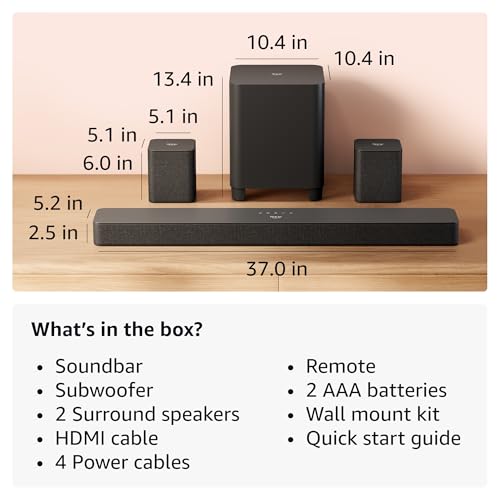
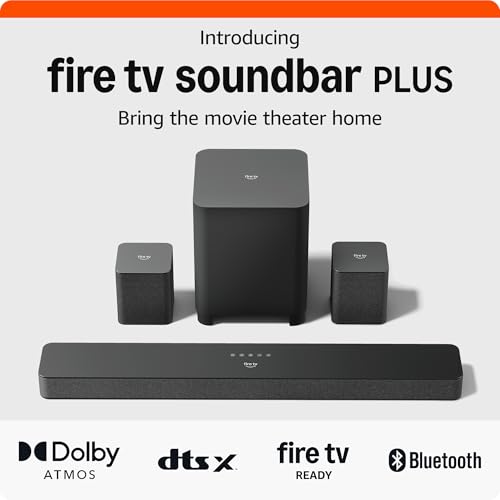
The Amazon Fire TV Soundbar Plus takes a fundamentally different approach by providing actual 5.1 surround sound through discrete speakers. Instead of using digital trickery to simulate surround effects, you get physical speakers placed around your room: a soundbar for front channels, a subwoofer for bass, and two satellite speakers for rear effects.
This physical separation creates a genuinely immersive soundstage that virtual processing simply cannot match. When a helicopter flies overhead in a movie, the sound actually moves from your front speakers to your rear ones, creating convincing spatial audio that places you inside the action. The dedicated center channel, built into the main soundbar, anchors dialogue and ensures speech remains clear even during complex audio scenes.
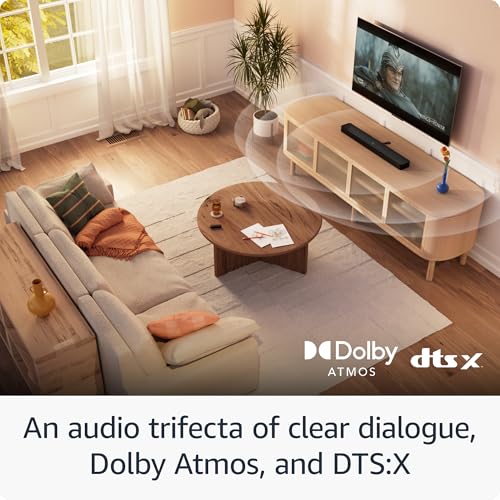
The Fire TV Soundbar Plus supports both Dolby Atmos and DTS:X—advanced audio formats that add height information to create three-dimensional soundscapes. However, since this system lacks upward-firing speakers, these formats are virtualized rather than physically reproduced. Think of it as enhanced surround sound that's more convincing than basic 5.1 but not quite true overhead audio.
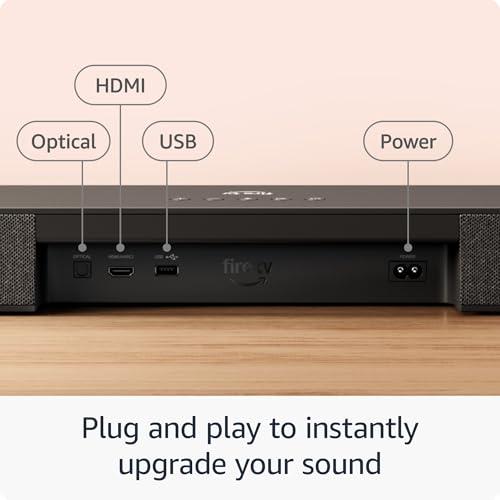
Connectivity represents another major advantage. The Fire TV Soundbar Plus includes HDMI eARC (enhanced Audio Return Channel), which carries high-bandwidth audio signals from your TV and allows control through your TV's remote. This eliminates the need for multiple remotes and supports advanced audio formats that optical connections cannot handle. The eARC connection also enables features like automatic power-on when you start your TV and synchronized volume control.
The most critical performance difference between these systems lies in soundstage width and imaging precision. The Samsung HW-C450 creates a fairly narrow sound field centered on the soundbar itself. While DTS Virtual:X adds some spatial width, sounds still appear to originate primarily from the front of your room. For casual TV watching and smaller rooms, this works perfectly well and provides clear improvement over built-in TV speakers.
The Amazon Fire TV Soundbar Plus, however, creates a true 360-degree sound environment. Rear speakers handle ambient effects, background music, and surround channels, while the front soundbar focuses on dialogue and main effects. This separation allows each speaker to specialize, resulting in cleaner overall sound and more convincing spatial effects.
Based on user feedback and professional reviews, dialogue clarity—arguably the most important performance metric—favors different systems depending on content type. The Samsung HW-C450 excels with news, talk shows, and dialogue-heavy dramas thanks to its Voice Enhance feature and center-focused audio processing. The Fire TV Soundbar Plus handles complex movie soundtracks better, preventing dialogue from getting buried in effects and maintaining speech intelligibility during action scenes.
Bass performance shows a clear winner. The Samsung HW-C450's subwoofer uses a smaller driver (around 6 inches) in a compact enclosure, providing adequate low-end extension for most content but lacking the authority for serious action movies or music listening. Users consistently report that bass can become boomy when placed near walls, requiring careful positioning for optimal sound.
The Amazon Fire TV Soundbar Plus features a larger, more powerful subwoofer that delivers deeper, more controlled bass. This translates to more impactful explosions, fuller music reproduction, and better integration with the main channels. However, some users note that default bass levels can overpower dialogue, requiring adjustment through the remote control.
Gaming performance reveals interesting differences in approach. The Samsung HW-C450 includes a dedicated Game Mode that specifically targets competitive gaming needs. This mode reduces background processing to minimize audio latency—the delay between on-screen action and corresponding sound. It also emphasizes mid-frequency effects where footsteps, gunshots, and environmental cues typically live, making it easier to locate opponents in first-person shooters.
The Amazon Fire TV Soundbar Plus doesn't offer specific gaming optimization, but its true surround sound provides inherent advantages for spatial audio games. The rear speakers deliver genuine directional cues that help with situational awareness in open-world games and competitive multiplayer matches. The HDMI eARC connection also typically provides lower latency than optical connections, though this varies by TV manufacturer.
Content optimization features differ significantly between systems. The Samsung HW-C450 focuses on automatic adjustments through Adaptive Sound Lite, which analyzes incoming audio and applies appropriate processing without user intervention. This works well for mixed content viewing where you might switch between news, movies, and music throughout the evening.
The Fire TV Soundbar Plus offers manual EQ presets (Film, Music, Sports, Night) that require user selection but provide more targeted optimization. The Night mode compresses dynamic range—reducing the difference between quiet dialogue and loud effects—for apartment-friendly late-night viewing.
Installation complexity represents a major decision factor. The Samsung HW-C450 requires minimal setup: connect the soundbar to your TV via optical cable, plug in both components, and the wireless subwoofer pairs automatically. Wall mounting takes about 15 minutes with the included hardware, and the compact subwoofer can hide almost anywhere with AC power access.
The Amazon Fire TV Soundbar Plus demands more planning and effort. While all components arrive pre-paired, you need to position rear speakers appropriately for surround effects—typically behind your main seating area and slightly elevated. This requires either furniture placement or wall mounting, plus access to power outlets for each rear speaker. The larger subwoofer also needs more space and careful positioning to avoid overpowering the room.
Room size considerations heavily influence which system works better. The Samsung HW-C450 excels in bedrooms, small apartments, and secondary viewing areas where space constraints and neighbor considerations matter. Its modest power output and compact components won't overwhelm smaller spaces, and virtual surround processing works adequately at closer listening distances.
The Amazon Fire TV Soundbar Plus needs room to breathe—literally. Surround speakers require several feet of separation from listeners to create proper imaging, making this system most effective in dedicated living rooms or media rooms. In smaller spaces, the rear speakers might sit too close to listeners, creating an unbalanced or overwhelming sound experience.
Connection options reveal another significant divide. The Samsung HW-C450 relies primarily on optical digital input, which handles standard Dolby Digital and DTS soundtracks but cannot carry advanced formats like Dolby TrueHD or uncompressed multichannel audio. Bluetooth provides wireless music streaming, though with some audio compression, and USB allows direct playback from storage devices.
This limitation means the Samsung HW-C450 cannot take advantage of the highest-quality audio tracks found on 4K Blu-ray discs or premium streaming services. For most users, this doesn't matter—compressed Dolby Digital from Netflix or cable TV still sounds dramatically better than TV speakers—but it represents a ceiling on audio quality that more demanding users might eventually find limiting.
The Amazon Fire TV Soundbar Plus's HDMI eARC support future-proofs the system for high-quality audio sources. eARC carries uncompressed multichannel audio, supports object-based formats like Dolby Atmos, and enables advanced TV integration features. This connection standard has become essential for modern home theater setups, making the Fire TV system more compatible with current and future audio formats.
Neither system functions as a smart speaker or streaming device, despite the "Fire TV" branding on Amazon's soundbar. The Fire TV name refers specifically to on-screen integration with Amazon's streaming devices—when connected to a Fire TV via HDMI, you can control soundbar settings through the TV's interface rather than using a separate remote.
The Samsung HW-C450 offers similar integration with Samsung TVs through the company's One Remote system, allowing control through your TV remote when connected via optical cable. This eliminates remote clutter and simplifies daily operation for Samsung TV owners.
Both systems lack voice assistant integration, Wi-Fi connectivity, or multi-room audio features found in more expensive soundbars. This keeps complexity and costs down while focusing purely on improving TV audio quality.
At the time of writing, the price difference between these systems—roughly $250—represents a significant investment jump that must be justified by substantially better performance. The Samsung HW-C450 delivers exceptional value for its price point, providing meaningful audio improvement at minimal cost and complexity. It transforms TV audio from annoying to pleasant and works well for the majority of casual viewing scenarios.
The Amazon Fire TV Soundbar Plus costs nearly three times more but provides genuine surround sound that creates immersive experiences impossible to achieve with virtual processing. This premium represents good value compared to separate component systems that would cost significantly more, but only if you can take advantage of the true surround capabilities.
Choose the Samsung HW-C450 if you want simple, effective TV audio improvement without major investment or complexity. It's perfect for apartments, bedrooms, secondary viewing areas, or situations where you primarily watch news, talk shows, and casual entertainment. The virtual surround processing provides some spatial effects while keeping setup minimal and costs reasonable.
Select the Amazon Fire TV Soundbar Plus if you have a dedicated living room or media space where you watch movies, play games, and want genuinely immersive audio experiences. The true 5.1 surround sound justifies the higher cost for users who will appreciate the spatial audio benefits, and the HDMI eARC connectivity ensures compatibility with current and future high-quality audio sources.
Neither system is wrong for its intended audience. The Samsung HW-C450 succeeds by making good audio accessible and simple, while the Amazon Fire TV Soundbar Plus provides premium features for users willing to invest in better performance. Your choice should align with your viewing habits, room constraints, and budget priorities rather than following any universal "best" recommendation.
| Samsung HW-C450 | Amazon Fire TV Soundbar Plus |
|---|---|
| Channel Configuration - Determines surround sound quality and immersion | |
| 2.1 channels (simulated surround via DTS Virtual:X) | True 5.1 channels with physical rear speakers |
| Price Range - Major factor in value decision | |
| Budget-friendly entry-level (~$150 at time of writing) | Premium mid-range (~$400 at time of writing) |
| Setup Complexity - Affects ease of installation | |
| Simple 2-component setup (soundbar + wireless subwoofer) | 4-component system requiring rear speaker placement |
| Room Size Suitability - Match system to your space | |
| Small to medium rooms (up to 200 sq ft) | Medium to large rooms (200-400+ sq ft) |
| HDMI Connectivity - Future-proofing and audio quality | |
| No HDMI (optical input only) | HDMI eARC for high-quality audio and TV integration |
| Dolby Atmos Support - Enhanced 3D audio experience | |
| Not supported | Virtualized Dolby Atmos (no physical height speakers) |
| Gaming Features - Optimization for console/PC gaming | |
| Dedicated Game Mode with reduced latency | No specific gaming mode but true surround positioning |
| Voice Enhancement - Critical for dialogue clarity | |
| Voice Enhance mode for speech optimization | Dedicated center channel for natural dialogue |
| Subwoofer Power - Bass impact and room filling | |
| Compact 6" wireless subwoofer (adequate bass) | Larger, more powerful subwoofer (deeper, controlled bass) |
| Smart TV Integration - Simplified control experience | |
| One Remote with Samsung TVs via optical | Deep Fire TV integration via HDMI eARC |
| Expansion Options - Future upgrade possibilities | |
| Can add Samsung wireless rear speakers | Complete 5.1 system (no expansion needed) |
| Best For - Target user scenarios | |
| Apartments, bedrooms, casual viewing, budget buyers | Dedicated home theaters, movie enthusiasts, premium experience |
The key difference is channel configuration: the Samsung HW-C450 is a 2.1 system that uses virtual surround sound processing, while the Amazon Fire TV Soundbar Plus provides true 5.1 surround sound with physical rear speakers. This means the Amazon system creates genuine spatial audio around your room, while the Samsung relies on digital processing to simulate surround effects from the front soundbar.
The Samsung HW-C450 is better suited for small spaces. Its compact 2.1 design works well in rooms up to 200 square feet without overwhelming the space. The Amazon Fire TV Soundbar Plus needs more room for proper rear speaker placement and can sound unbalanced in smaller areas where surround speakers sit too close to listeners.
The Samsung HW-C450 doesn't support HDMI connections at all—it uses optical input only. The Amazon Fire TV Soundbar Plus includes HDMI eARC, which provides better audio quality, easier TV integration, and support for advanced audio formats. If your TV has HDMI ARC/eARC, the Amazon system offers significant connectivity advantages.
Both excel at dialogue but in different ways. The Samsung HW-C450 features a dedicated Voice Enhance mode that specifically boosts speech frequencies, making it excellent for news and TV shows. The Amazon Fire TV Soundbar Plus uses a dedicated center channel that naturally anchors dialogue, preventing speech from getting buried during complex movie soundtracks.
The Samsung HW-C450 includes a specific Game Mode that reduces audio latency and emphasizes directional cues for competitive gaming. The Amazon Fire TV Soundbar Plus doesn't have gaming-specific features but provides genuine surround positioning that helps with spatial awareness in games. For competitive gaming, choose Samsung; for immersive single-player games, the Amazon system works better.
The Samsung HW-C450 requires minimal space—just room for the soundbar under your TV and placement anywhere for the wireless subwoofer. The Amazon Fire TV Soundbar Plus needs significantly more planning, requiring proper positioning of two rear speakers behind your seating area, plus space for a larger subwoofer.
The Amazon Fire TV Soundbar Plus delivers superior bass with its larger, more powerful subwoofer that provides deeper and more controlled low-frequency response. The Samsung HW-C450 has adequate bass for casual viewing but lacks the impact needed for action movies or music listening, and can become boomy when placed near walls.
Yes, but differently. The Samsung HW-C450 works with Samsung TV remotes through One Remote Control integration when connected via optical. The Amazon Fire TV Soundbar Plus integrates deeply with Fire TV devices via HDMI eARC, allowing control through your TV's interface and remote.
The Samsung HW-C450 wins for simplicity—just connect one optical cable and plug in the pre-paired wireless subwoofer. The Amazon Fire TV Soundbar Plus requires more effort, including positioning four separate components and ensuring proper rear speaker placement for optimal surround sound performance.
The Samsung HW-C450 works with any TV that has an optical output, though Samsung TV owners get additional remote integration features. The Amazon Fire TV Soundbar Plus works with any TV with HDMI ARC/eARC, but Fire TV device owners get enhanced menu integration and control features.
For dedicated home theater setups, the Amazon Fire TV Soundbar Plus is clearly superior. Its true 5.1 surround sound, support for advanced audio formats like Dolby Atmos, and HDMI eARC connectivity create a much more immersive movie-watching experience. The Samsung HW-C450 works for casual home theater use but can't match the spatial audio and bass impact of the Amazon system.
This depends on your needs and budget. The Samsung HW-C450 provides excellent immediate value for basic TV audio improvement at a lower cost. The Amazon Fire TV Soundbar Plus costs significantly more but offers genuine surround sound and modern connectivity that won't become outdated as quickly, making it better long-term value for serious home entertainment enthusiasts.
We've done our best to create useful and informative comparisons to help you decide what product to buy. Our research uses advanced automated methods to create this comparison and perfection is not possible - please contact us for corrections or questions. These are the sites we've researched in the creation of this article: e-catalog.com - alibaba.com - smart.dhgate.com - greentoe.com - requiremints.com - versus.com - bhphotovideo.com - rtings.com - soundmachine.com.mt - samsung.com - samsung.com - youtube.com - bhphotovideo.com - newegg.com - images.samsung.com - bestbuy.com - samsung.com - youtube.com - jsappliance.com - gadgetsleo.com - youtube.com - saraappliance.com - walmart.com - rtings.com - cordbusters.co.uk - techradar.com - developer.amazon.com - t3.com - hometechnologyreview.com - youtube.com - hometechnologyreview.com - whathifi.com - hometechnologyreview.com - hometechnologyreview.com - youm.design - hometechnologyreview.com - dolby.com

Privacy Policy
Terms and Conditions - Affiliate Policy
Home Security
© Copyright 2008-2026.
11816 Inwood Rd #1211, Dallas, TX 75244