


When your TV's built-in speakers sound like they're coming from inside a cardboard box, it's time to upgrade. But choosing the right soundbar can feel overwhelming with dozens of options ranging from basic stereo bars to complex multi-speaker systems. Today we're diving deep into two dramatically different approaches: the Ultimea Aura A40 U2601 and the Amazon Fire TV Soundbar Plus 5.1.
These systems couldn't be more different in philosophy. One prioritizes maximum channel count and customization at an aggressive price point, while the other focuses on wireless convenience and premium audio format support at roughly three times the cost. Let's break down which approach makes more sense for your home theater setup.
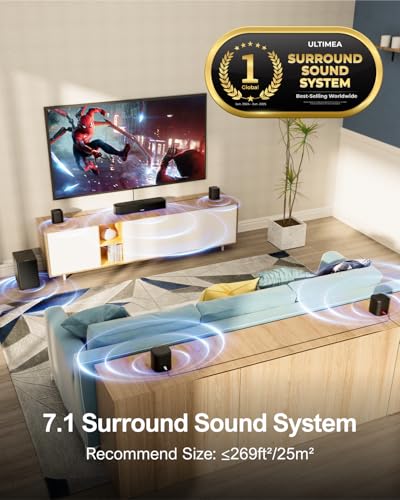
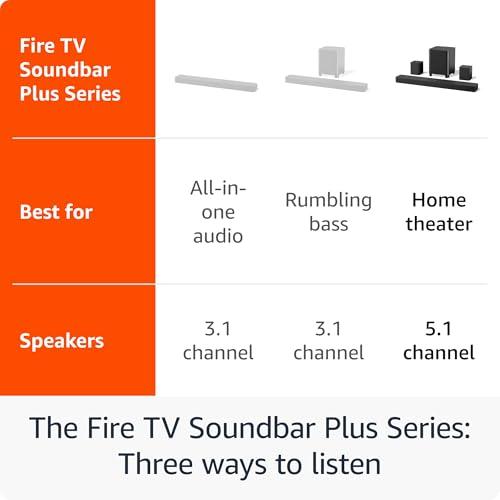
Before jumping into specifics, it's worth understanding what separates excellent soundbars from mediocre ones. The most important factor is channel configuration—this refers to how many separate audio streams the system can handle. A 5.1 system has five main speakers (left, center, right, left surround, right surround) plus one subwoofer for bass. The Ultimea Aura A40 goes further with a 7.1 configuration, adding two additional surround channels for even more precise sound placement.
But channel count only tells part of the story. How those channels are delivered matters enormously. Physical speakers placed around your room create true discrete surround sound, where each channel comes from its actual location. Virtual surround processing, on the other hand, uses digital tricks to simulate surround effects from fewer speakers—clever, but not as convincing to your ears.
Room acoustics play a huge role too. Soundbars designed for small apartments won't have the power or bass extension needed for large living rooms. Similarly, a system optimized for a dedicated home theater might overwhelm a bedroom setup. Getting this balance right is crucial for satisfaction with your purchase.
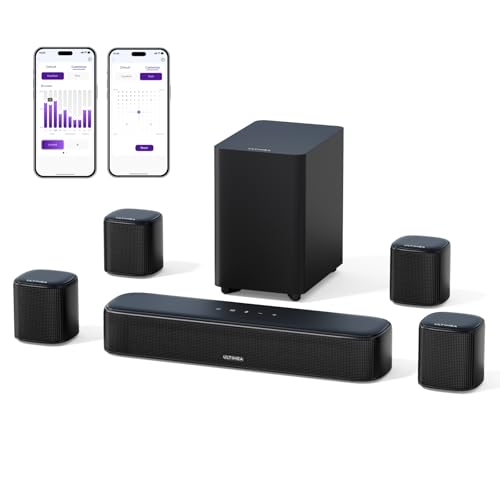
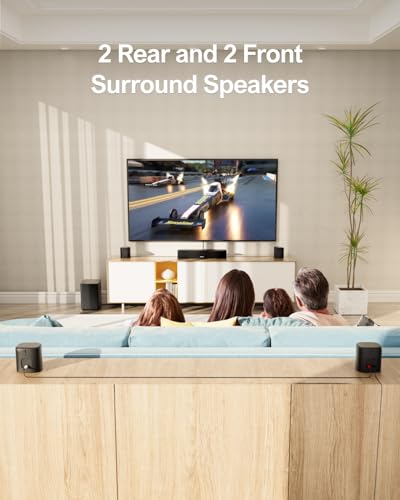
Released in 2023, the Ultimea Aura A40 U2601 takes an uncommon approach in today's soundbar market. Instead of relying on virtual processing or a single soundbar unit, it includes four actual surround speakers that you position around your room—two in front, two in back. This creates what audio engineers call a "true 7.1 system" where each channel has its own dedicated driver.
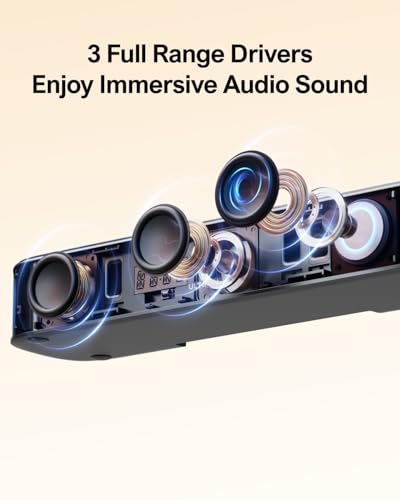
The system's heart is its SurroundX and BassMX technologies, which are Ultimea's proprietary audio processing algorithms. SurroundX optimizes the timing and frequency response between all eight speakers (three in the main bar, four surrounds, one subwoofer) to create seamless sound transitions as effects move around your room. BassMX handles the low-frequency management, ensuring the 4-inch subwoofer integrates properly with the smaller satellite speakers.
What makes this technically interesting is the frequency response specification: 65Hz to 18kHz with less than 1% distortion. That 65Hz lower limit means you'll hear the fundamental frequencies of explosions and music bass lines, not just their harmonics. Many competing systems start rolling off around 80-100Hz, leaving bass feeling thin and unsatisfying.
The Ultimea's maximum sound pressure level exceeds 98dB, which is loud enough to fill most home theaters without strain. For reference, normal conversation sits around 60dB, while a movie theater runs about 85dB during action scenes. Having that extra headroom means the system stays clean and undistorted even when you crank it up.
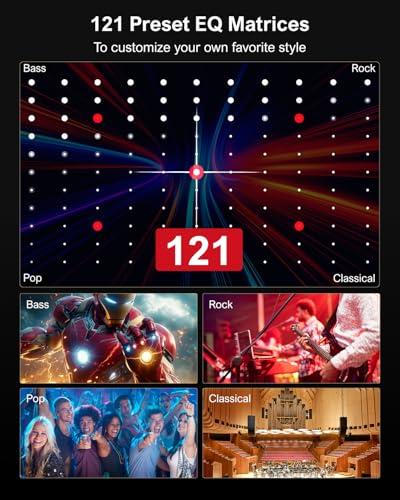
Where the Ultimea truly shines is customization. The ULTIMEA Smart App provides access to 121 preset EQ matrices covering everything from classical music to heavy metal, plus a full 10-band equalizer for creating your own sound signature. This level of control is rare at any price point, let alone in budget-friendly systems.
The app also offers six adjustable surround levels, which is practically essential when working with physical rear speakers. Depending on your room size and speaker placement, you might want subtle ambient effects or full theatrical immersion. Being able to dial this in precisely makes the difference between a system that sounds great in the store versus one that sounds perfect in your actual living room.
Based on extensive user feedback and expert evaluations, the Ultimea's biggest strength is dialogue clarity. The dedicated center channel combined with app-based voice enhancement means you can actually understand what characters are saying, even during loud action sequences. This might seem basic, but it's where many soundbars fall short.
Gaming performance deserves special mention. The discrete surround speakers create genuinely useful directional audio—you can pinpoint enemy footsteps in first-person shooters or hear approaching vehicles from their actual direction. Virtual surround processing simply can't match this level of spatial accuracy.
Music reproduction is surprisingly good for a system focused on home theater use. The balanced frequency response and extensive EQ options mean it handles everything from acoustic folk to electronic dance music competently. The bass has punch without overwhelming midrange details, and the highs stay clear without becoming harsh.
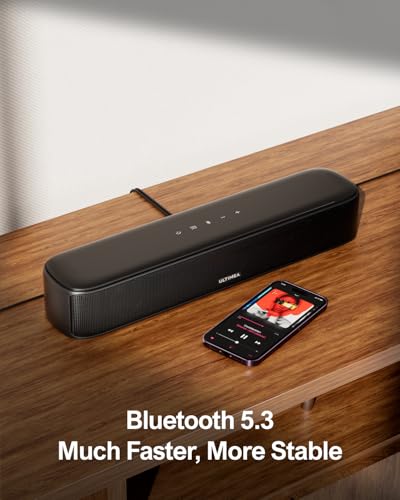
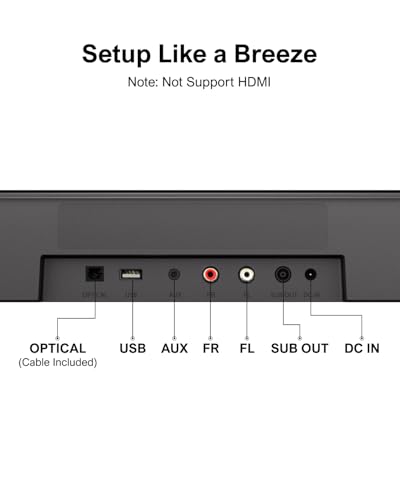
The Ultimea's biggest limitation is connectivity. There's no HDMI input, just optical, AUX, USB, and Bluetooth 5.3. For many users, this isn't a problem—optical carries surround sound just fine from most TVs. But it does mean missing out on advanced audio formats like Dolby Atmos or the convenience of HDMI's automatic switching.
Cable management is the other major consideration. Running speaker wires to rear surrounds isn't difficult, but it requires planning and permanent installation. The included cables are reasonably long (6 meters for rear speakers), but you'll need to route them around your room somehow.
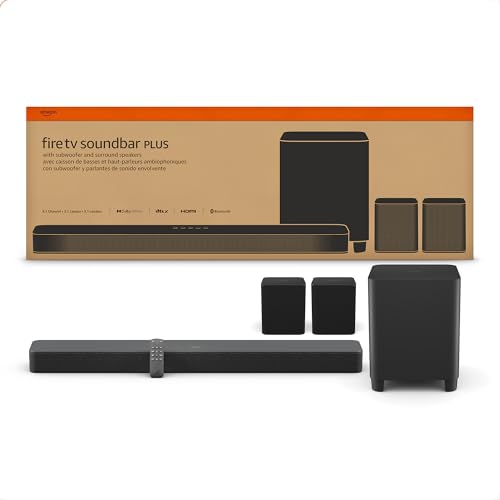
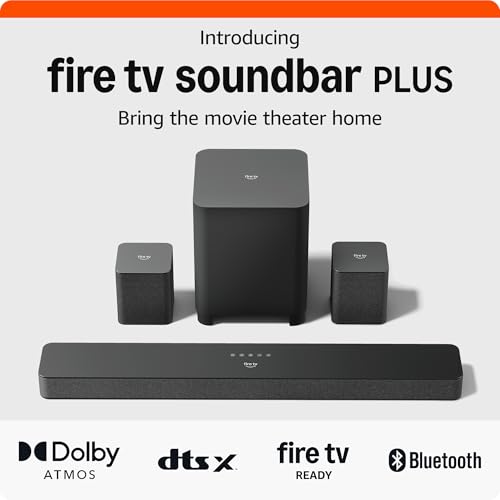
Amazon's entry, also released in 2023, represents the modern wireless soundbar philosophy. Everything connects wirelessly except for power cables, and the system emphasizes ease of setup over maximum performance per dollar.
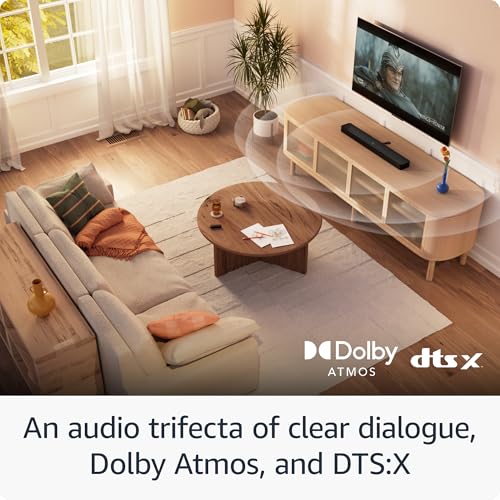
The Amazon Fire TV Soundbar Plus supports Dolby Atmos and DTS:X, which are object-based audio formats. Instead of just sending audio to specific channels, these formats include metadata about where sounds should appear in 3D space. A helicopter can move smoothly overhead, rain can fall from above, or footsteps can track precisely across the room.
However, there's an important caveat: the Amazon system virtualizes these height effects rather than using dedicated up-firing drivers. This means the overhead positioning isn't as convincing as true Atmos systems with physical height speakers, but it's still more immersive than basic 5.1 surround.
The system also handles lossless audio formats like Dolby TrueHD and DTS-HD Master Audio, which preserve the full quality of Blu-ray soundtracks. This is where that HDMI eARC connection becomes valuable—it has the bandwidth to pass these high-quality formats that optical connections can't handle.
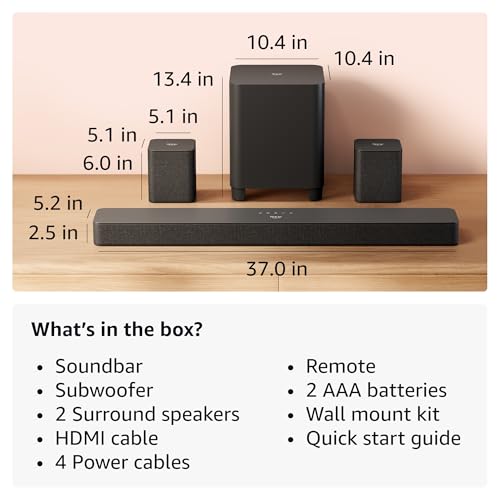
The Amazon's wireless subwoofer is substantially larger than the Ultimea's wired unit, measuring over 10 inches on each side. This translates to deeper, more powerful bass that can pressurize larger rooms. The wireless connection eliminates the need to run cables to wherever you place it, offering much more flexibility in room setup.
Based on user reports, this subwoofer can overpower dialogue during heavy action scenes, but the included remote provides bass level adjustment to dial in the right balance. The wireless connection proves reliable in practice, with minimal dropout or interference issues.
When connected to Fire TV devices via HDMI, the Amazon soundbar can be controlled directly through the TV's interface. You can adjust EQ settings, volume, and input selection using your Fire TV remote rather than juggling multiple controllers. This integration feels seamless once set up and reduces the remote control clutter that plagues many home theaters.
The four EQ presets (Movie, Music, Sports, Night) cover most use cases adequately, though they lack the granular control of the Ultimea's app. Night mode is particularly well-implemented, compressing the dynamic range so you can hear dialogue clearly without bass-heavy explosions disturbing neighbors or family.
Expert evaluations consistently praise the Amazon system's dialogue reproduction, crediting the dedicated center channel and well-tuned frequency response. The soundstage is wider than most single-bar systems, though not quite as enveloping as true discrete surrounds.
Music performance is solid but not exceptional. The larger drivers provide fuller sound than typical soundbars, but the tuning prioritizes movie content over musical accuracy. The bass can be impressive, but midrange and treble sometimes feel recessed, particularly with deeper voices.
The wireless surround speakers add meaningful immersion compared to virtualized systems, but they're not as precisely positioned or powerful as the Ultimea's discrete channels. They work well for ambient effects and general surround enhancement but won't provide the pinpoint accuracy that gaming or critical movie watching demands.
At roughly three times the price of the Ultimea, value becomes a significant concern. You're paying a substantial premium for wireless convenience and format support rather than raw performance improvements.
The lack of a mobile app is frustrating for users who want detailed control. All adjustments must be made via the physical remote or Fire TV interface, limiting your ability to fine-tune the sound for different content or personal preferences.
Audio latency over ARC connections can be problematic with some TVs, requiring manual adjustment of lip-sync settings. This is a common issue with many soundbars, but the Amazon system lacks automatic compensation features found in some premium models.
This is where the philosophical difference becomes most apparent. The Ultimea's four physical surround speakers create true 360-degree sound placement that virtual processing simply cannot match. When a car drives past in a movie, you hear it travel from specific locations around your room rather than a generalized "surround effect."
The Amazon system's wireless rear speakers provide genuine surround enhancement over single-bar solutions, but the 5.1 configuration leaves gaps that the 7.1 Ultimea fills. For gaming or action movies where directional accuracy matters, this difference is immediately noticeable.
The Amazon's larger wireless subwoofer wins on raw power and room-filling capability. If you have a large living room or open floor plan, its deeper extension and higher output will create more impressive low-frequency effects.
The Ultimea's smaller wired subwoofer suits small to medium rooms perfectly but can struggle in larger spaces. However, its integration with the main speakers is often more seamless, avoiding the common problem of bass that sounds disconnected from the rest of the audio.
Both systems excel here, which is crucial since dialogue intelligibility is the primary reason people upgrade from TV speakers. The Ultimea offers more granular voice enhancement through its app, while the Amazon provides hardware-based dialogue boosting via remote control.
In practice, both keep speech clear during loud action scenes, but the Ultimea's app control allows more precise tuning for different room acoustics and personal preferences.
The Amazon system's Dolby Atmos and DTS:X support provides a more modern feature set, especially for streaming content and newer Blu-rays. However, these benefits are partially negated by the lack of discrete height speakers.
The Ultimea forgoes advanced formats but delivers more convincing surround effects through physical speaker placement. For most content, especially older movies and TV shows, this discrete approach provides better immersion than virtualized object-based audio.
You're working with a budget under $200 and want the most immersive surround sound possible at that price point. The discrete 7.1 configuration and extensive customization options provide exceptional value, especially for dedicated home theater rooms where you can properly install the surround speakers.
Gaming enthusiasts should strongly consider the Ultimea for its superior directional accuracy. The difference in competitive gaming or immersive single-player experiences is substantial when you can precisely locate audio cues.
If you enjoy tweaking audio settings and trying different sound signatures, the comprehensive app control makes the Ultimea significantly more flexible than systems with basic remote adjustment.
Your budget allows for the premium (at the time of writing, roughly three times more expensive), and wireless convenience is a top priority. The system excels in situations where running speaker cables isn't practical or desirable.
Large rooms benefit from the Amazon's more powerful wireless subwoofer and higher overall output capability. If you're trying to fill an open-concept living space or large family room, the extra power justifies the cost difference.
Fire TV ecosystem users will appreciate the integrated control and seamless operation, though remember this soundbar doesn't include streaming capabilities itself—just integration with existing Fire TV devices.
Based on extensive research into user experiences and expert evaluations, the Ultimea Aura A40 delivers remarkable value for users who can accommodate its wired speaker requirements. The discrete 7.1 surround sound and comprehensive customization options provide performance that typically costs much more.
The Amazon Fire TV Soundbar Plus justifies its premium pricing for users who prioritize wireless convenience and modern format support over pure performance per dollar. It's a solid choice for larger rooms and less dedicated installations.
For most home theater enthusiasts, especially those on a budget, the Ultimea represents exceptional value. The performance gap between these systems isn't nearly as large as the price difference suggests. However, if wireless convenience is essential and budget isn't a primary concern, the Amazon system provides a more user-friendly experience with adequate performance for most applications.
The soundbar market continues evolving rapidly, with new models arriving regularly. But these two systems represent fundamentally different approaches that will likely remain relevant: maximum performance per dollar through physical speakers versus wireless convenience with premium features. Understanding which philosophy matches your priorities will lead to years of listening satisfaction.
| Ultimea Aura A40 U2601 | Amazon Fire TV Soundbar Plus 5.1 |
|---|---|
| Channel Configuration - More channels mean better surround sound immersion | |
| 7.1 channels with 4 physical surround speakers | 5.1 channels with 2 wireless surround speakers |
| Surround Speaker Setup - Physical placement creates more accurate directional audio | |
| 4 wired surround speakers (2 front, 2 rear) | 2 wireless satellite speakers (rear only) |
| Subwoofer Design - Wireless offers placement flexibility, larger size means deeper bass | |
| 4-inch wired subwoofer | Larger wireless subwoofer (10.4" x 10.4" x 13.4") |
| HDMI Connectivity - Essential for modern TVs and advanced audio formats | |
| No HDMI (optical, AUX, USB, Bluetooth only) | HDMI eARC with cable included |
| Audio Format Support - Premium formats provide better surround effects | |
| Standard PCM, Dolby Digital, DTS | Dolby Atmos, DTS:X, Dolby TrueHD, DTS-HD MA |
| Mobile App Control - Apps allow detailed customization vs basic remote adjustment | |
| Full ULTIMEA Smart App with 121 EQ presets | No app support, remote control only |
| EQ Customization - More options let you fine-tune sound for your room and preferences | |
| 121 preset matrices + 10-band equalizer | 4 basic presets (Movie, Music, Sports, Night) |
| Frequency Response - Lower numbers mean deeper bass extension | |
| 65Hz - 18kHz (excellent bass reach for the price) | Not specified (likely similar range) |
| Maximum Volume - Higher SPL means louder playback without distortion | |
| >98dB SPL | Not specified |
| Bluetooth Version - Newer versions offer better connection stability | |
| Bluetooth 5.3 | Bluetooth 5.0 |
| Room Size Recommendation - Matching power to room size prevents under/overpowering | |
| 108-270 sq ft (small to medium rooms) | Larger rooms (more powerful subwoofer) |
| Setup Complexity - Wired systems require cable management, wireless systems are plug-and-play | |
| Wired surround speakers need cable runs | All wireless except power connections |
| Value Proposition - Performance per dollar spent | |
| Exceptional value with true 7.1 surround at budget price | Premium pricing for wireless convenience and format support |
The Ultimea Aura A40 delivers superior surround sound with its true 7.1 channel configuration and four physical surround speakers placed around your room. This creates genuine directional audio where you can pinpoint exactly where sounds are coming from. The Amazon Fire TV Soundbar Plus offers 5.1 channels with two wireless rear speakers, which provides good surround effects but not the same level of precision as the Ultimea's discrete speaker placement.
The Ultimea Aura A40 requires running speaker cables to four surround speakers, with 2-meter cables for front speakers and 6-meter cables for rear placement. The Amazon Fire TV Soundbar Plus is almost entirely wireless - only the main soundbar, subwoofer, and satellite speakers need power connections, making it much easier to set up without cable management.
The Ultimea Aura A40 excels for gaming due to its precise directional audio from physical surround speakers. You can accurately locate enemy footsteps, gunfire, and vehicle sounds, giving you a competitive advantage in first-person shooters and immersive single-player games. The Amazon Fire TV system provides decent gaming audio but can't match the spatial accuracy of discrete surround speakers.
The Ultimea Aura A40 includes a comprehensive smart app with 121 preset EQ settings, 10-band equalizer, and adjustable surround levels for complete customization. The Amazon Fire TV Soundbar Plus has no mobile app - all controls must be done through the included remote or Fire TV interface if connected to a compatible device.
The Amazon Fire TV Soundbar Plus features a larger wireless subwoofer that delivers deeper, more powerful bass suitable for bigger rooms and louder volumes. The Ultimea Aura A40 has a smaller 4-inch wired subwoofer that provides adequate bass for small to medium rooms but may struggle in larger spaces.
The Amazon Fire TV Soundbar Plus supports Dolby Atmos and DTS:X audio formats, though it virtualizes height effects rather than using dedicated up-firing speakers. The Ultimea Aura A40 doesn't support advanced audio formats like Atmos but compensates with true discrete surround sound from physical speakers.
The Amazon Fire TV Soundbar Plus is significantly easier to install - all components are pre-paired and wireless, requiring only power connections and one HDMI cable to your TV. The Ultimea Aura A40 requires running speaker cables around your room and positioning four separate surround speakers, taking more time and planning.
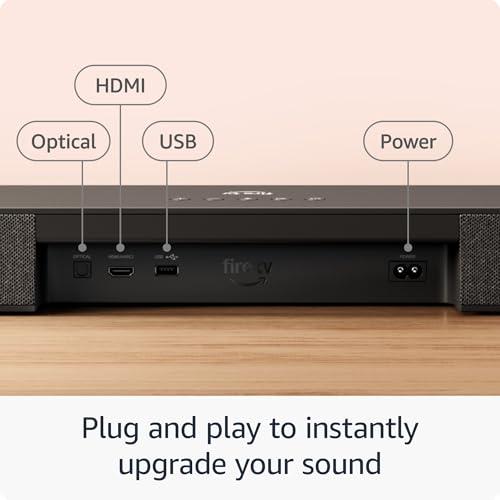
The Amazon Fire TV Soundbar Plus connects via HDMI eARC or optical input, working with most modern TVs. The Ultimea Aura A40 uses optical, AUX, USB, and Bluetooth connections but lacks HDMI, which may limit compatibility with some newer TV features but still works with virtually all televisions.
The Ultimea Aura A40 provides exceptional value with true 7.1 surround sound, extensive app customization, and four physical surround speakers at a budget-friendly price point. The Amazon Fire TV system costs significantly more but offers wireless convenience, premium audio format support, and easier setup.
The Ultimea Aura A40 is optimized for small to medium rooms (108-270 square feet) and requires space to position four surround speakers around your seating area. The Amazon Fire TV Soundbar Plus works better in larger rooms due to its more powerful subwoofer and doesn't require as much speaker placement planning.
The Ultimea Aura A40 offers extensive sound customization through its mobile app, including 121 preset EQ matrices, 10-band equalizer, and adjustable surround levels. The Amazon Fire TV Soundbar Plus provides four basic EQ presets (Movie, Music, Sports, Night) and bass/treble adjustments through the remote control.
The Ultimea Aura A40 is ideal for apartments due to its room size optimization, night mode for quiet listening, and ability to fine-tune surround levels through the app. However, the Amazon Fire TV Soundbar Plus might be more practical if you can't run speaker cables or need the flexibility of wireless components for frequent room rearrangement.
We've done our best to create useful and informative comparisons to help you decide what product to buy. Our research uses advanced automated methods to create this comparison and perfection is not possible - please contact us for corrections or questions. These are the sites we've researched in the creation of this article: walmart.com - newegg.com - youtube.com - ultimea.com - youtube.com - device.report - ultimea.co - manuals.plus - homestudiobasics.com - youtube.com - bestbuy.com - community.ultimea.com - manuals.plus - eu.ultimea.com - navesapeugeot.com.br - bestbuy.com - images.thdstatic.com - provantage.com - ultimea.com - bestbuy.com - rtings.com - cordbusters.co.uk - techradar.com - developer.amazon.com - t3.com - hometechnologyreview.com - youtube.com - hometechnologyreview.com - whathifi.com - hometechnologyreview.com - hometechnologyreview.com - youm.design - hometechnologyreview.com - dolby.com

Privacy Policy
Terms and Conditions - Affiliate Policy
Home Security
© Copyright 2008-2026.
11816 Inwood Rd #1211, Dallas, TX 75244