






When your TV's built-in speakers just aren't cutting it anymore—whether you're straining to hear dialogue or missing the rumble of explosions—a soundbar upgrade becomes essential. But the soundbar market has evolved dramatically since the early days of simple stereo bars. Today's options range from ultra-compact dialogue enhancers to full-blown home theater replacement systems that rival traditional surround setups.
Two products perfectly illustrate this divide: the Hisense AX5140Q, a comprehensive 5.1.4-channel system released in 2023, and the Sonos Ray, a minimalist stereo soundbar that debuted in 2022. While both aim to improve your TV audio experience, they represent fundamentally different philosophies about what a soundbar should accomplish.
The soundbar landscape has transformed significantly over the past few years. Early models were essentially wide speakers that made dialogue clearer and added some bass. Modern soundbars, however, have split into distinct categories based on their intended use and technical complexity.
Entry-level soundbars (typically 2.0 or 2.1 channel configurations) focus on basic audio improvement with minimal setup complexity. The "2.0" designation means two channels (left and right), while "2.1" adds a subwoofer for bass enhancement—that ".1" represents the dedicated low-frequency channel.
Mid-tier systems usually feature 3.1 or 5.1 configurations, where "3.1" includes left, right, and center channels plus a subwoofer, while "5.1" adds rear surround channels. These systems begin incorporating surround sound processing to create a more immersive experience.
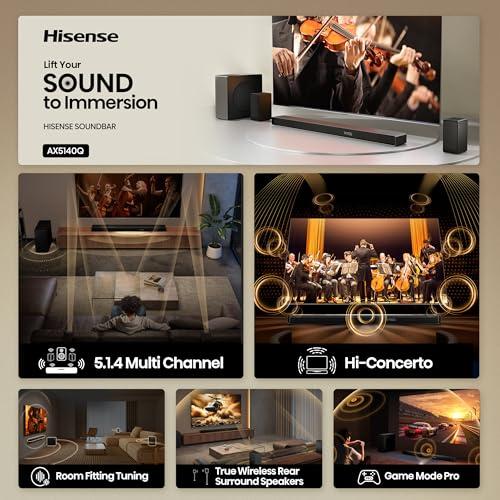
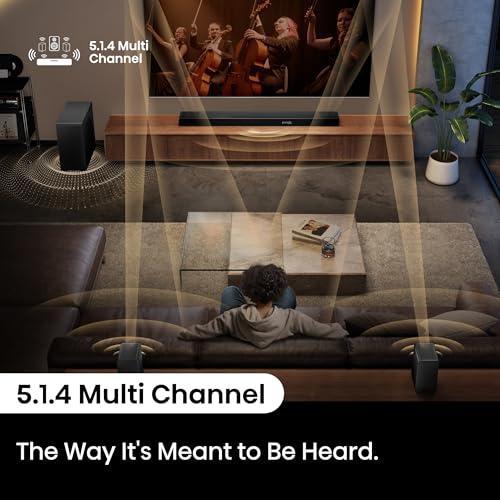
Premium home theater packages like the Hisense AX5140Q push into 5.1.4 territory. That "5.1.4" specification breaks down to five main channels (front left, center, front right, plus two surround channels), one subwoofer channel, and four height channels that fire sound upward to bounce off your ceiling. This creates what audio engineers call "object-based audio"—where sounds can be precisely positioned in three-dimensional space around you.
The key consideration when choosing between these categories isn't just price—it's understanding what type of audio experience matters most in your daily routine.
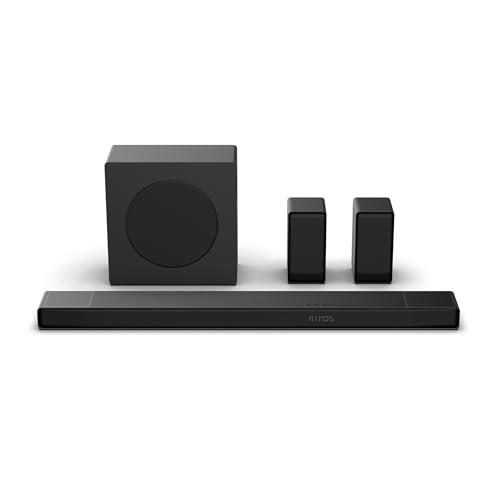
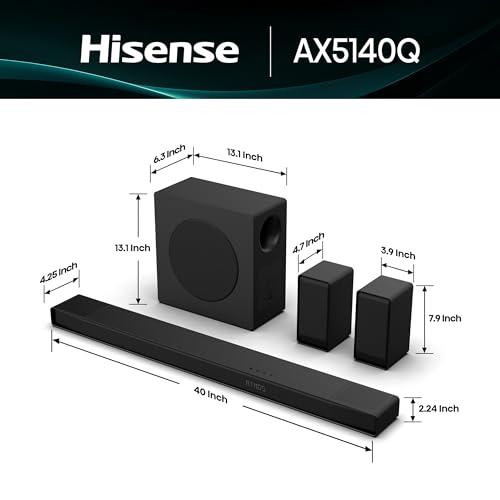
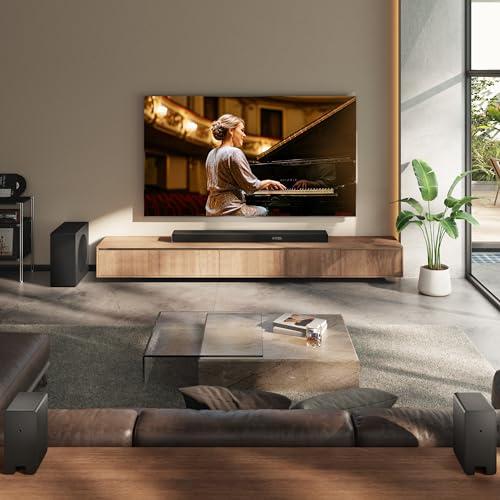
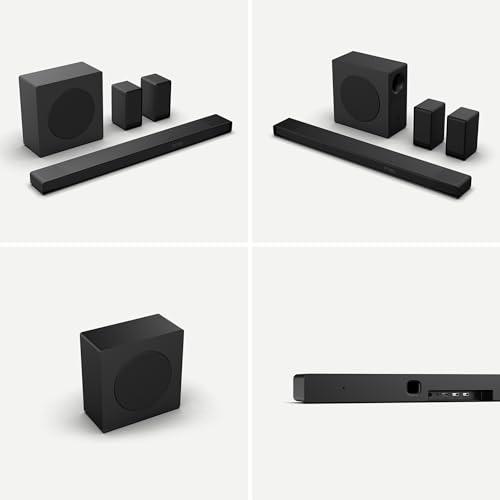
The Hisense AX5140Q represents what happens when manufacturers decide to pack genuine home theater capability into a soundbar package. Released in 2023, this system includes not just a main soundbar, but a wireless subwoofer and wireless rear speakers that each contain their own upward-firing drivers for height effects.
What makes the Hisense AX5140Q special is its commitment to physical speaker placement rather than relying purely on digital tricks. The system uses discrete drivers positioned around your room to create actual surround sound—the same principle that high-end home theater systems have used for decades.
The main soundbar houses five full-range drivers and three tweeters (high-frequency speakers that handle crisp details like dialogue and sound effects). The wireless rear speakers each contain full-range drivers plus their own upward-firing units, while the 6.5-inch subwoofer handles the low-frequency effects that make explosions feel visceral rather than just heard.
This physical approach matters because human hearing evolved to detect sound direction based on subtle timing and volume differences between our ears. When sounds actually come from behind you—like approaching footsteps in a horror movie—your brain processes this as genuine spatial information rather than an audio illusion.
The Hisense AX5140Q supports both Dolby Atmos and DTS:X, which are "object-based" audio formats. Traditional surround sound assigns specific sounds to specific channels—dialogue goes to the center speaker, music to the left and right, effects to the surrounds. Object-based audio instead treats sounds as independent objects that can be positioned anywhere in three-dimensional space.
When you're watching a scene with a helicopter flying overhead, Dolby Atmos can move that sound smoothly from front to back and left to right while also controlling its height. The AX5140Q's upward-firing drivers bounce sound off your ceiling to create this height dimension, effectively turning your room into a sound dome.
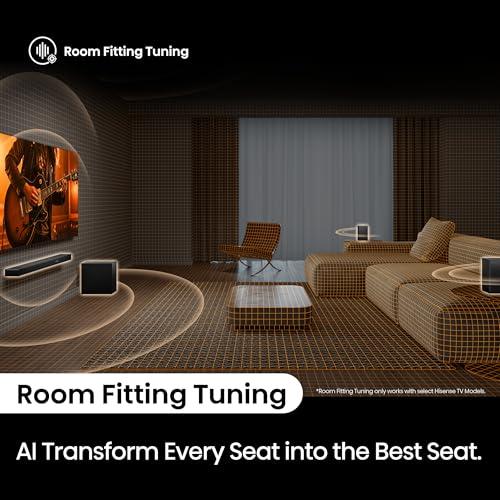
This technology has improved significantly since Dolby Atmos launched in 2012. Modern implementations like those in the AX5140Q use more sophisticated room calibration and processing algorithms to adapt to different ceiling heights and room acoustics.
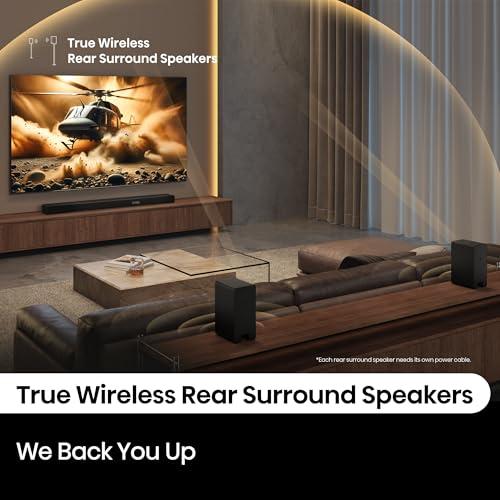
One of the Hisense AX5140Q's most practical advantages is its wireless rear speaker design. Traditional home theater systems require running cables from your receiver to rear speakers, which often means drilling holes, hiding wires under carpets, or accepting visible cable runs along baseboards.
The AX5140Q eliminates this hassle by transmitting multichannel audio wirelessly to both the subwoofer and rear speakers. Each component only needs a power connection, dramatically simplifying installation. Based on user reviews we've analyzed, most people complete setup within an hour, including the system's automatic room calibration process.
This wireless approach uses dedicated low-latency transmission protocols designed specifically for multichannel audio. Unlike Bluetooth, which introduces compression and delay, these proprietary wireless systems maintain audio quality and keep all speakers perfectly synchronized with the video.
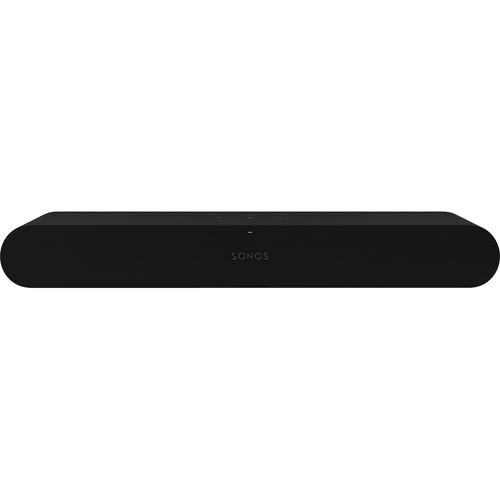
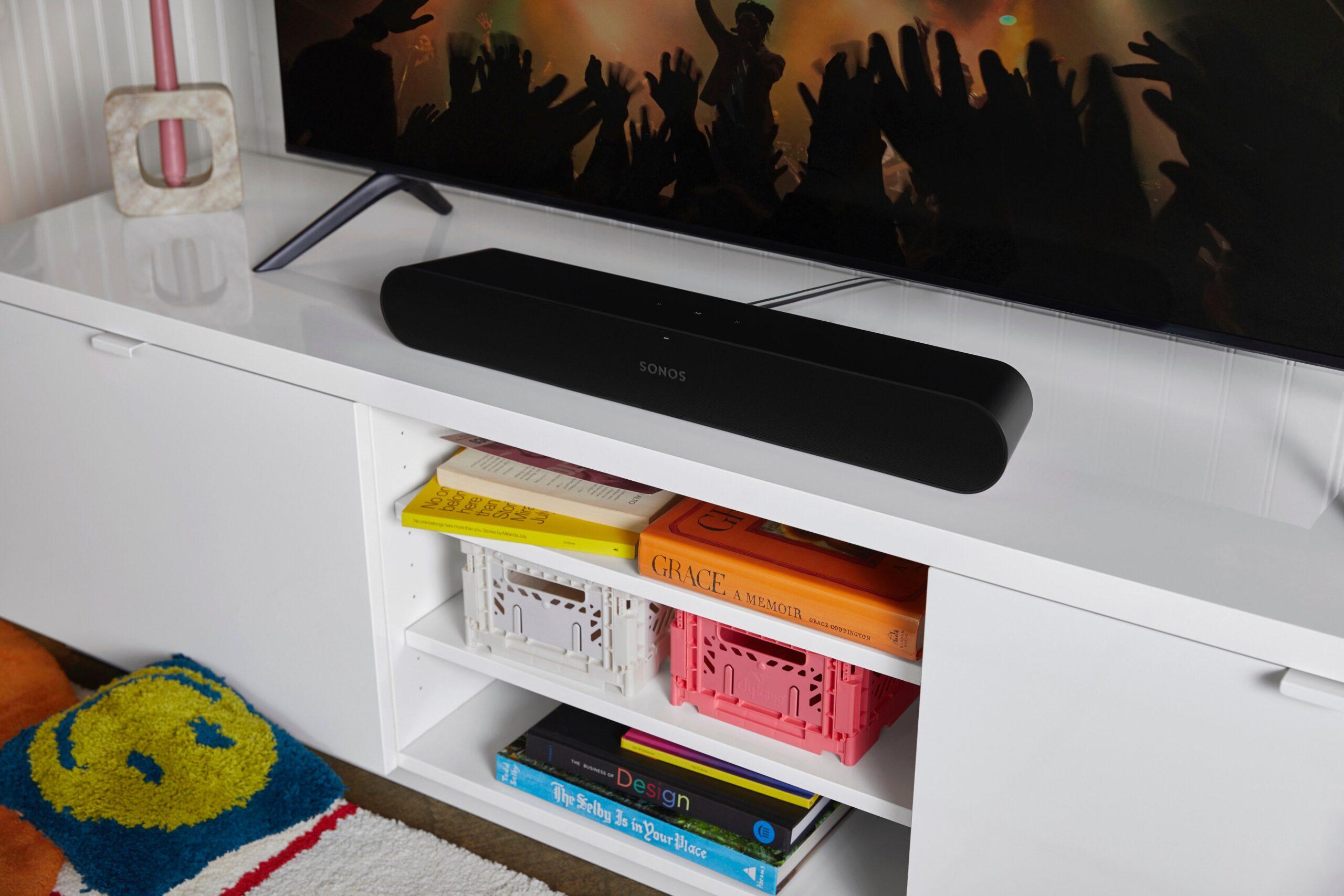
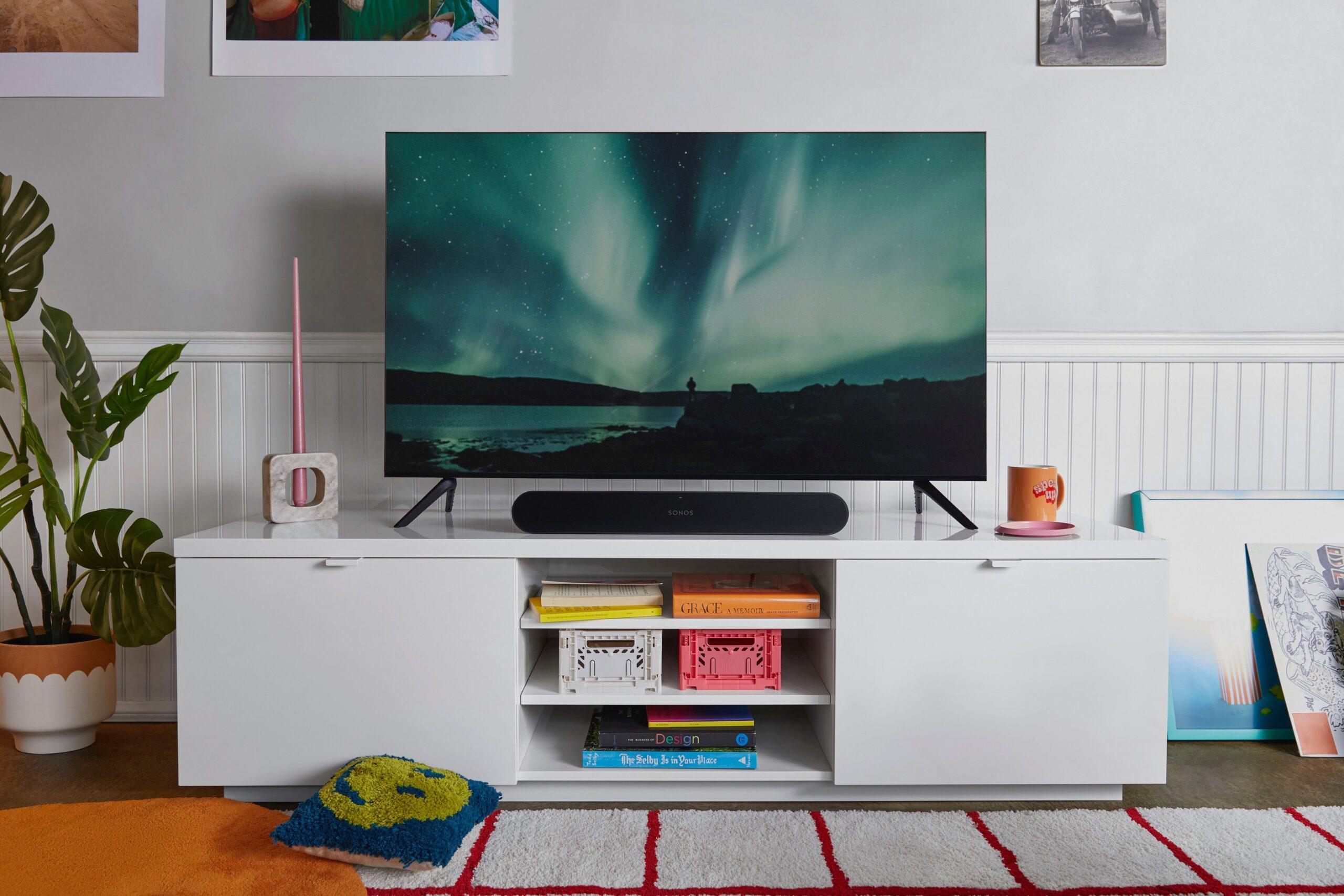
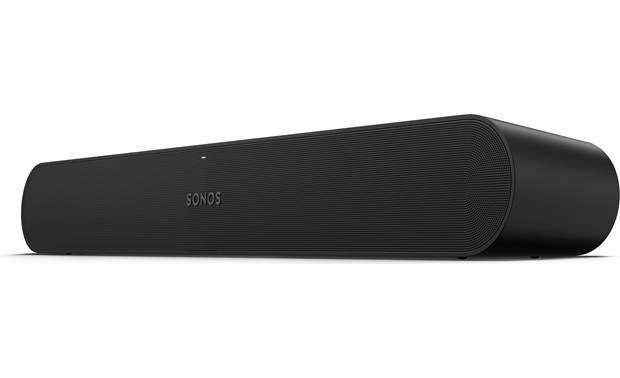
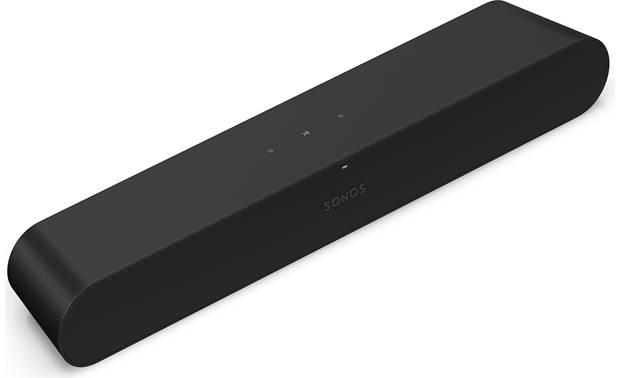
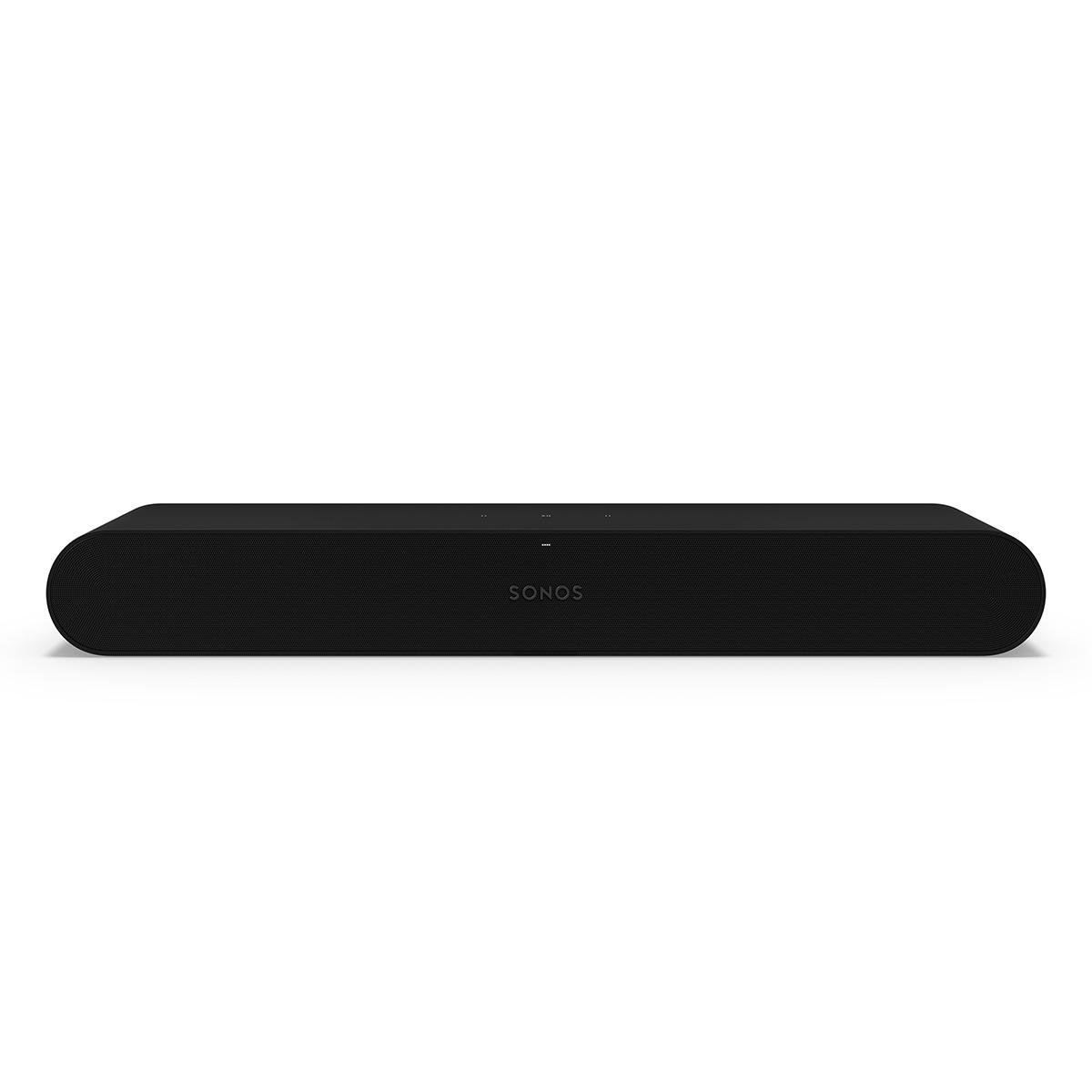
The Sonos Ray, released in 2022, represents a completely different philosophy. Rather than maximizing channel count and surround complexity, Sonos focused on perfecting the fundamentals: dialogue clarity, music reproduction, and seamless streaming integration.
Despite its compact 22-inch width, the Sonos Ray employs sophisticated acoustic engineering to overcome the limitations of its size. The soundbar uses four custom-designed drivers: two central full-range units that handle most of the frequency spectrum, plus two precision tweeters for high-frequency detail.
What's particularly clever is the Ray's bass reflex system. Two carefully tuned bass ports work with the internal drivers to extend low-frequency response well beyond what you'd expect from such a small enclosure. This technique, borrowed from high-end bookshelf speakers, uses the air movement in the ports to reinforce bass frequencies rather than requiring a larger driver or separate subwoofer.
The Sonos Ray's standout feature is its Speech Enhancement technology, which specifically targets the frequency ranges where human voices naturally occur. Most TV dialogue falls between 300Hz and 3,000Hz, and the Ray uses dynamic processing to ensure this range remains clear even during complex soundtracks.
This focus on dialogue clarity addresses one of the most common complaints about modern TV and movie audio: the tendency for voices to get buried under music and effects. The phenomenon has worsened over the past decade as content creators optimize audio for theater systems while TV speakers have actually gotten smaller and worse.
Our research into user reviews reveals that dialogue improvement is often the single most noticeable upgrade when switching from TV speakers to the Sonos Ray, even though it lacks a dedicated center channel that traditional wisdom suggests is essential for speech clarity.
The Ray's connection to the broader Sonos ecosystem represents a different kind of value proposition. While the Hisense AX5140Q provides immediate comprehensive surround sound, the Sonos Ray serves as an entry point into a whole-home audio system that can expand over time.
Sonos has spent nearly two decades perfecting wireless multi-room audio, and the Ray benefits from this expertise. The Wi-Fi-based streaming provides better range and audio quality than Bluetooth, while integration with services like Spotify, Apple Music, and Amazon Music makes daily music listening significantly more convenient than traditional soundbars.
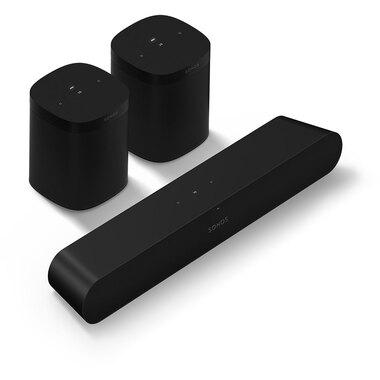
The ecosystem approach also enables future expansion. You can add a Sonos Sub for enhanced bass, Sonos rear speakers for true surround sound, or integrate the Ray into a larger multi-room setup where music plays throughout your home in perfect synchronization.
The difference in surround sound capability between these systems is dramatic and represents the core decision point for most buyers. The Hisense AX5140Q creates genuine spatial audio through physical speaker placement, while the Sonos Ray relies primarily on stereo enhancement with some virtual surround processing.
When watching Dolby Atmos content—whether it's the latest Marvel movie or a nature documentary with overhead bird sounds—the AX5140Q provides convincing directional effects. Sounds genuinely appear to come from behind, above, and around you because they actually do. The rear speakers create rear-channel effects that simply cannot be replicated by front-facing drivers, no matter how sophisticated the processing.
The Sonos Ray, while excellent at what it does, cannot overcome the physics of having all drivers facing forward. It can widen the stereo image and enhance dialogue, but it won't make you duck when a TIE fighter screams overhead.
The subwoofer inclusion with the Hisense AX5140Q provides a significant advantage for movie and gaming content. The dedicated 6.5-inch driver can reproduce frequencies down to around 40Hz, covering the range where explosions, engine rumbles, and musical bass fundamentals live.
The Sonos Ray's bass ports and optimized tuning punch well above the soundbar's weight class, but physics ultimately limits how much low-end a compact speaker can produce. For dialogue-heavy content and most music, this limitation isn't noticeable. For action movies and bass-heavy music genres, the difference becomes apparent.
Based on our analysis of user feedback, the AX5140Q's subwoofer integrates smoothly with the main system when properly positioned, avoiding the boomy, disconnected bass that plagues many budget home theater packages.
This category represents the Sonos Ray's strongest advantage. The Wi-Fi connectivity, comprehensive streaming service integration, and audio tuning optimized for music reproduction make it superior for daily listening.
The Hisense AX5140Q includes Bluetooth 5.3 and multiple music-focused EQ presets, but its design optimization for home theater content means music can sometimes sound overly processed or spatially diffuse. The full surround system excels at creating an expansive soundstage for concerts and music videos, but for casual streaming, the Ray's more direct approach often sounds more natural.
The Sonos ecosystem integration provides access to high-quality streaming protocols and seamless service switching that Bluetooth-based systems simply can't match. The ability to queue up music from your phone while the system continues playing what's currently streaming represents the kind of thoughtful user experience that justifies Sonos's premium positioning.
Modern gaming increasingly relies on spatial audio for competitive advantages, particularly in first-person shooters and racing games where directional cues can mean the difference between victory and defeat. The Hisense AX5140Q includes a dedicated Game Pro mode that optimizes the surround processing for gaming scenarios.
This mode typically reduces audio processing latency while enhancing positional accuracy. The true surround speaker configuration provides genuine advantages for hearing approaching enemies, determining vehicle positions, or navigating complex environments using audio cues.
The Sonos Ray provides basic gaming audio enhancement but cannot replicate the spatial advantages of true surround sound. For casual gaming, this limitation isn't significant, but competitive gamers will notice the difference immediately.
The Hisense AX5140Q requires thoughtful speaker placement to achieve optimal performance. The rear speakers need positioning behind your primary seating area with clear paths for both power connections and wireless signal transmission. The subwoofer benefits from corner placement for maximum bass extension, though it should avoid positions that create boomy resonances.
Room size becomes a crucial factor with the AX5140Q. In spaces smaller than about 150 square feet, the full system can feel overwhelming, while rooms larger than 400 square feet might expose the limitations of the 600-watt total system power.
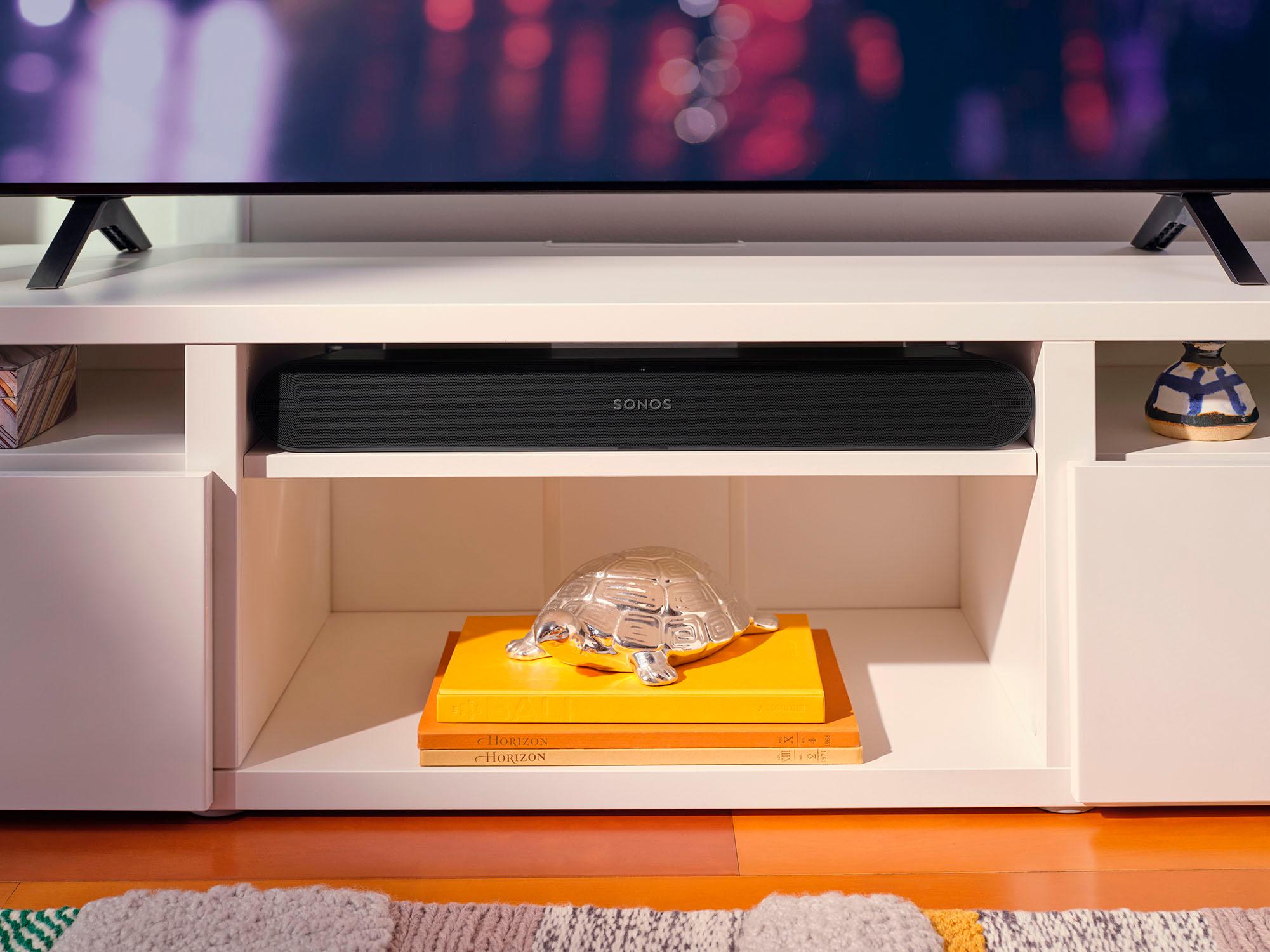
The Sonos Ray's minimal footprint and single-unit design make it suitable for virtually any space. Its 22-inch width fits comfortably under most TVs 43 inches and larger, while the low-profile design suits everything from bedroom setups to main living areas.
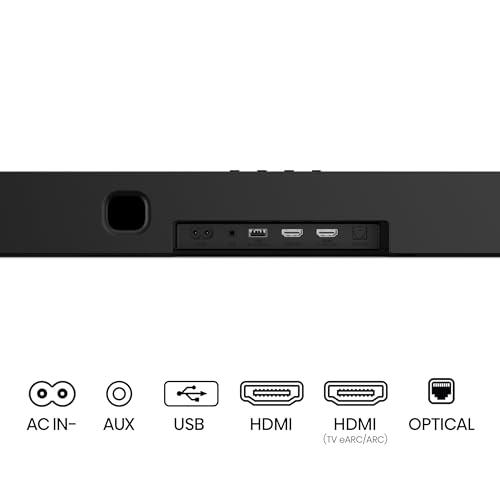
Both systems handle modern connectivity requirements but through different approaches. The AX5140Q provides HDMI eARC for high-bandwidth audio from compatible TVs, plus optical and Bluetooth inputs for legacy devices. The HDMI passthrough supports 4K60 video, though it lacks some of the latest gaming-focused features like 4K120 or variable refresh rate support.
The Sonos Ray deliberately simplifies connectivity to optical audio only, which limits it to compressed surround formats but ensures broad TV compatibility. The lack of HDMI means missing out on lossless Dolby Atmos tracks from streaming services, though most users won't notice this limitation in typical viewing scenarios.
Wi-Fi streaming represents a significant advantage for the Ray in daily use. The always-connected nature enables instant music playback and voice assistant integration when combined with other Sonos products, while Bluetooth requires pairing and connection management.
At the time of writing, these products occupy different value propositions despite both being positioned as mid-range options. The Hisense AX5140Q provides exceptional value for users seeking comprehensive surround sound, offering performance that traditionally required separate receivers and speakers costing significantly more.
The Sonos Ray commands a premium for its build quality, ecosystem integration, and brand reputation, but delivers correspondingly refined performance in its core competencies. The value calculation depends heavily on how you weigh immediate surround sound capability against long-term expandability and daily usability.
The AX5140Q represents a complete system with limited expansion possibilities beyond what's included. While this provides immediate satisfaction, it also means the system's capabilities are essentially fixed.
The Sonos Ray functions as a foundation for future expansion within the Sonos ecosystem. Adding a Sub later provides bass extension that rivals dedicated systems, while Sonos rear speakers can create true surround sound. This modular approach allows spreading the cost over time while upgrading incrementally.
You're primarily focused on movie and gaming entertainment where surround sound immersion adds significant value. The system excels for users who regularly watch action films, nature documentaries, or play competitive games where spatial audio provides advantages.
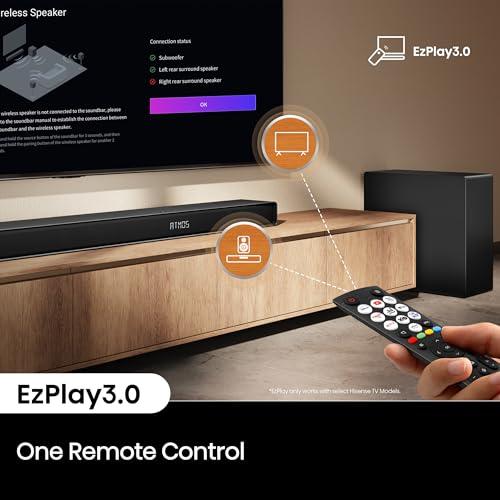
The AX5140Q also makes sense if you want immediate comprehensive surround sound without future upgrade considerations. It's particularly appealing for users who own compatible Hisense TVs that can take advantage of the Hi-Concerto integration features.
Room layout compatibility is essential—you need space for rear speaker placement and tolerance for multiple powered components. The system works best in dedicated entertainment spaces where the full surround experience can be properly implemented.
Your priority is daily music listening combined with TV audio improvement, particularly if you value streaming convenience and ecosystem integration. The Ray excels for users who stream music regularly and want seamless service access.
Simplicity and space constraints favor the Ray, especially in bedrooms, apartments, or multi-purpose rooms where full surround systems aren't practical. The single-unit design and minimal setup requirements suit users who want better audio without complexity.
Long-term expandability within a premium ecosystem appeals to users who might want to build a whole-home audio system over time. Starting with the Ray provides a foundation for future Sonos additions while delivering immediate improvements.
The choice ultimately comes down to whether you prioritize immersive home theater experience or refined daily audio enhancement. Both products excel in their intended roles, but serve fundamentally different needs in the modern audio landscape.
| Hisense AX5140Q | Sonos Ray |
|---|---|
| Channel Configuration - Determines surround sound immersion level | |
| 5.1.4 channels with physical rear speakers and height channels | 2.0 stereo channels with virtual surround processing |
| Included Components - What you get in the box affects total value | |
| Soundbar + wireless subwoofer + wireless rear speakers | Soundbar only (subwoofer and rears sold separately) |
| Dolby Atmos Support - Essential for 3D movie audio experience | |
| Full Dolby Atmos and DTS:X with real height speakers | No Atmos support (stereo enhancement only) |
| Bass Response - Critical for movie impact and music fullness | |
| Dedicated 6.5" wireless subwoofer included | Built-in bass ports (no separate subwoofer) |
| Setup Complexity - Time and effort required for installation | |
| Multi-component wireless system requiring speaker placement | Single unit with optical cable connection only |
| Connectivity Options - Determines device compatibility | |
| HDMI eARC, optical, Bluetooth 5.3, USB | Optical audio only (no HDMI or Bluetooth) |
| Streaming Integration - Daily music listening convenience | |
| Basic Bluetooth streaming with EQ presets | Wi-Fi streaming with full Sonos ecosystem access |
| Gaming Performance - Competitive advantage for spatial audio | |
| Game Pro mode with true directional surround sound | Basic stereo enhancement (no positional advantages) |
| Room Size Suitability - Optimal performance environment | |
| Medium to large rooms (150-400+ sq ft) with rear speaker space | Any room size, especially compact spaces |
| Expandability - Future upgrade potential | |
| Complete system with limited expansion options | Foundation for modular Sonos ecosystem expansion |
| Dialogue Clarity - Most common TV audio complaint | |
| Multiple sound modes including dedicated News/Voice preset | Specialized Speech Enhancement technology |
| Total System Power - Volume and dynamic range capability | |
| 600W across all components for room-filling sound | Unspecified wattage optimized for compact performance |
The Hisense AX5140Q is significantly better for home theater use. It provides true 5.1.4 surround sound with physical rear speakers, a wireless subwoofer, and Dolby Atmos support for immersive movie experiences. The Sonos Ray is a stereo soundbar focused on dialogue clarity rather than surround sound immersion.
Yes, the Hisense AX5140Q includes a wireless 6.5-inch subwoofer and wireless rear speakers in the complete package. The Sonos Ray is a standalone soundbar without a subwoofer, though you can add a Sonos Sub separately for additional cost.
Both excel at dialogue clarity but through different approaches. The Sonos Ray features specialized Speech Enhancement technology specifically designed for voice reproduction. The Hisense AX5140Q offers multiple sound modes including dedicated News/Voice presets for clear dialogue. Most users find both significantly clearer than TV speakers.
The Sonos Ray is designed for expansion within the Sonos ecosystem—you can add a Sonos Sub, rear speakers, or integrate with whole-home audio over time. The Hisense AX5140Q provides a complete surround system immediately but has limited expansion options beyond what's included.
The Sonos Ray is superior for music streaming with Wi-Fi connectivity, comprehensive streaming service integration, and access to the Sonos ecosystem. The Hisense AX5140Q offers Bluetooth 5.3 and music EQ presets but is optimized primarily for home theater rather than daily music listening.
Only the Hisense AX5140Q supports Dolby Atmos and DTS:X with real upward-firing speakers for height effects. The Sonos Ray does not support Dolby Atmos and focuses on stereo audio enhancement with some virtual surround processing.
The Sonos Ray is much easier to install, requiring only a power connection and optical audio cable. The Hisense AX5140Q involves positioning multiple wireless components (soundbar, subwoofer, rear speakers) around your room, though most users complete setup within an hour.
The Hisense AX5140Q offers more traditional connectivity with HDMI eARC, optical, Bluetooth 5.3, and USB inputs. The Sonos Ray deliberately simplifies with optical audio only, focusing instead on Wi-Fi streaming and ecosystem integration rather than multiple physical connections.
The Sonos Ray is better suited for small spaces with its compact 22-inch design and single-unit simplicity. The Hisense AX5140Q requires space for rear speaker placement and can feel overwhelming in rooms smaller than 150 square feet.
The Hisense AX5140Q is significantly better for gaming with its Game Pro mode and true surround sound providing competitive advantages for directional audio cues. The Sonos Ray offers basic audio enhancement but cannot replicate the spatial awareness benefits of real surround speakers.
This depends on your priorities. The Hisense AX5140Q provides exceptional value for comprehensive surround sound, including components that would traditionally cost much more separately. The Sonos Ray offers premium build quality and ecosystem integration at a higher price point but serves different needs focused on simplicity and music streaming.
The Hisense AX5140Q includes HDMI input with 4K 60Hz passthrough, allowing you to connect consoles directly to the soundbar. The Sonos Ray lacks HDMI inputs entirely, requiring you to connect devices directly to your TV and use optical or eARC for audio.
We've done our best to create useful and informative comparisons to help you decide what product to buy. Our research uses advanced automated methods to create this comparison and perfection is not possible - please contact us for corrections or questions. These are the sites we've researched in the creation of this article: shop.hisense-usa.com - manuals.plus - dolby.com - youtube.com - gzhls.at - rtings.com - youtube.com - bestbuy.com - manuals.plus - bestbuy.com - hisense-usa.com - youtube.com - device.report - manuals.plus - youtube.com - device.report - manuals.plus - youtube.com - techradar.com - soundandvision.com - youtube.com - appleinsider.com - youtube.com - sonos.com - cnet.com - howtogeek.com - pcrichard.com - en.community.sonos.com - epicsystems.tech - en.community.sonos.com - cepro.com - videoandaudiocenter.com

Privacy Policy
Terms and Conditions - Affiliate Policy
Home Security
© Copyright 2008-2026.
11816 Inwood Rd #1211, Dallas, TX 75244