




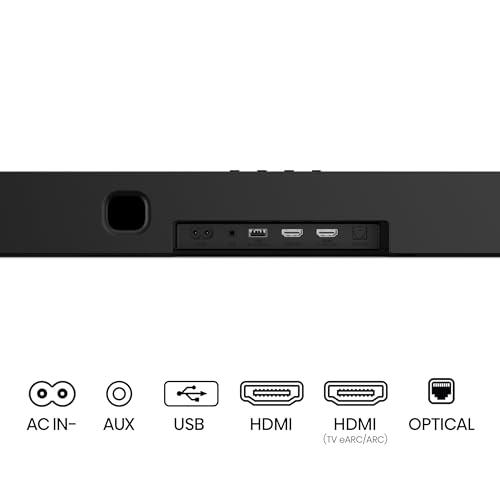
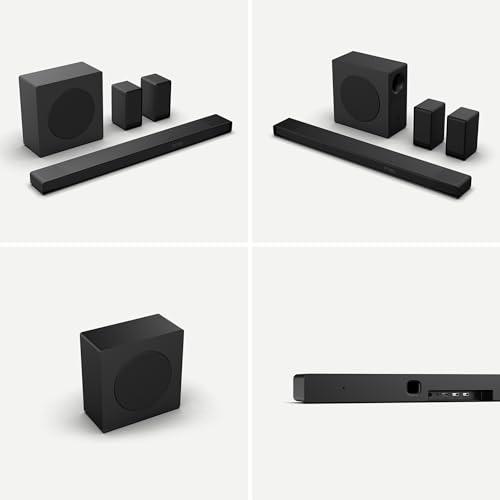
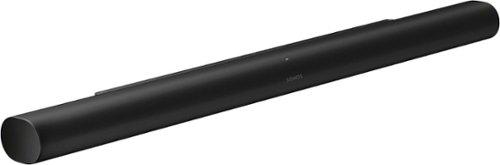
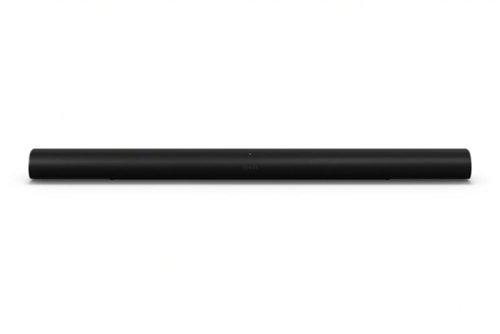
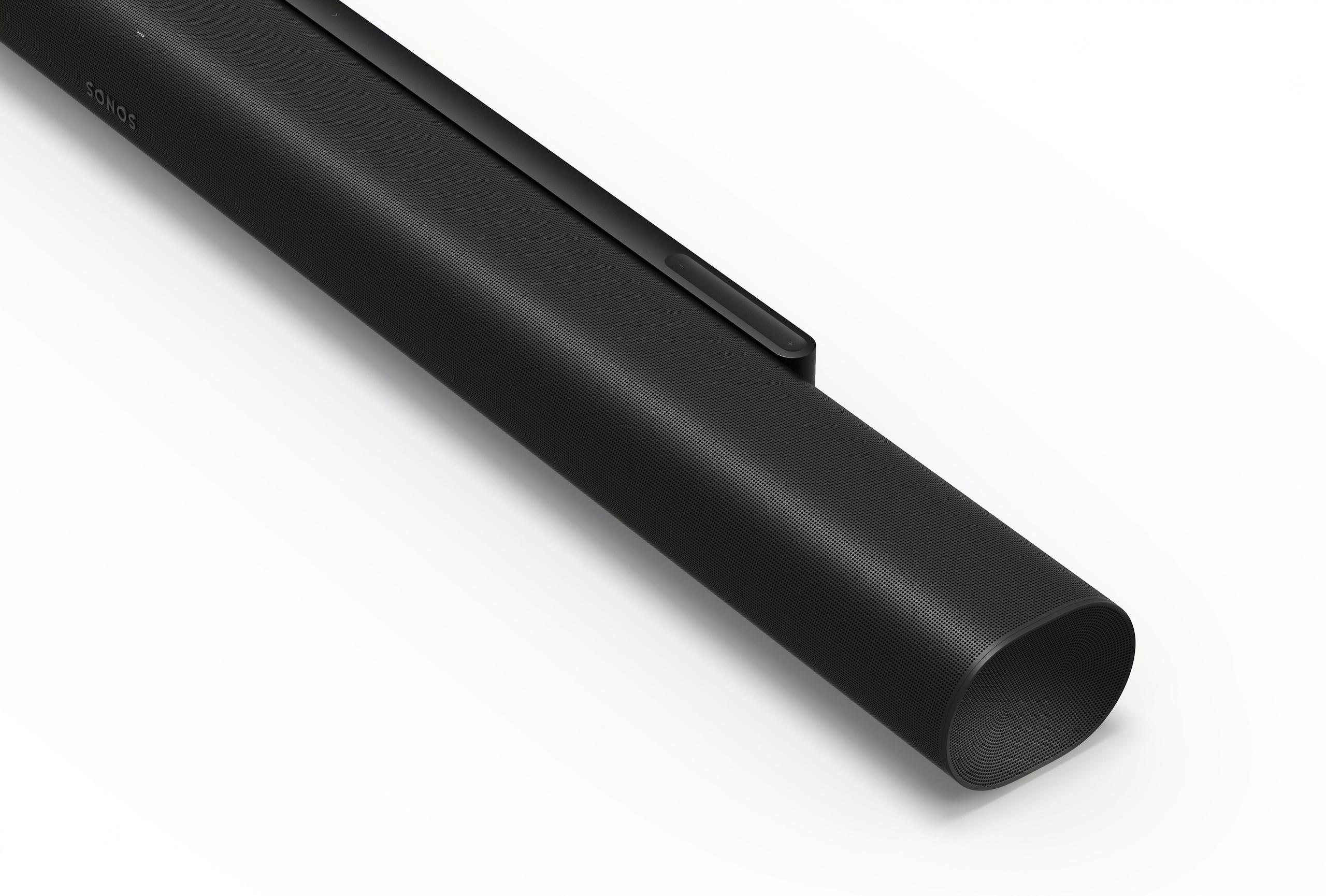
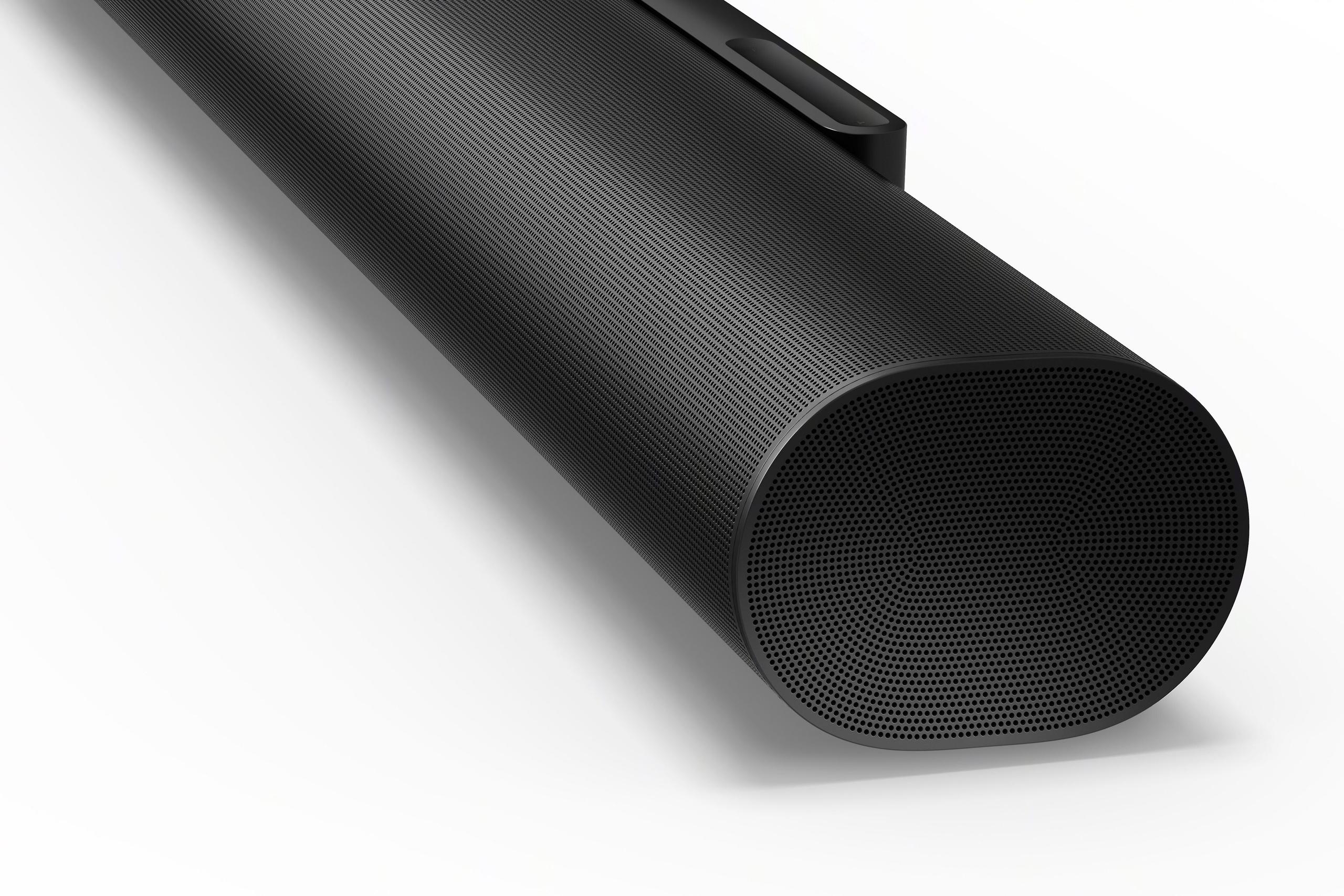
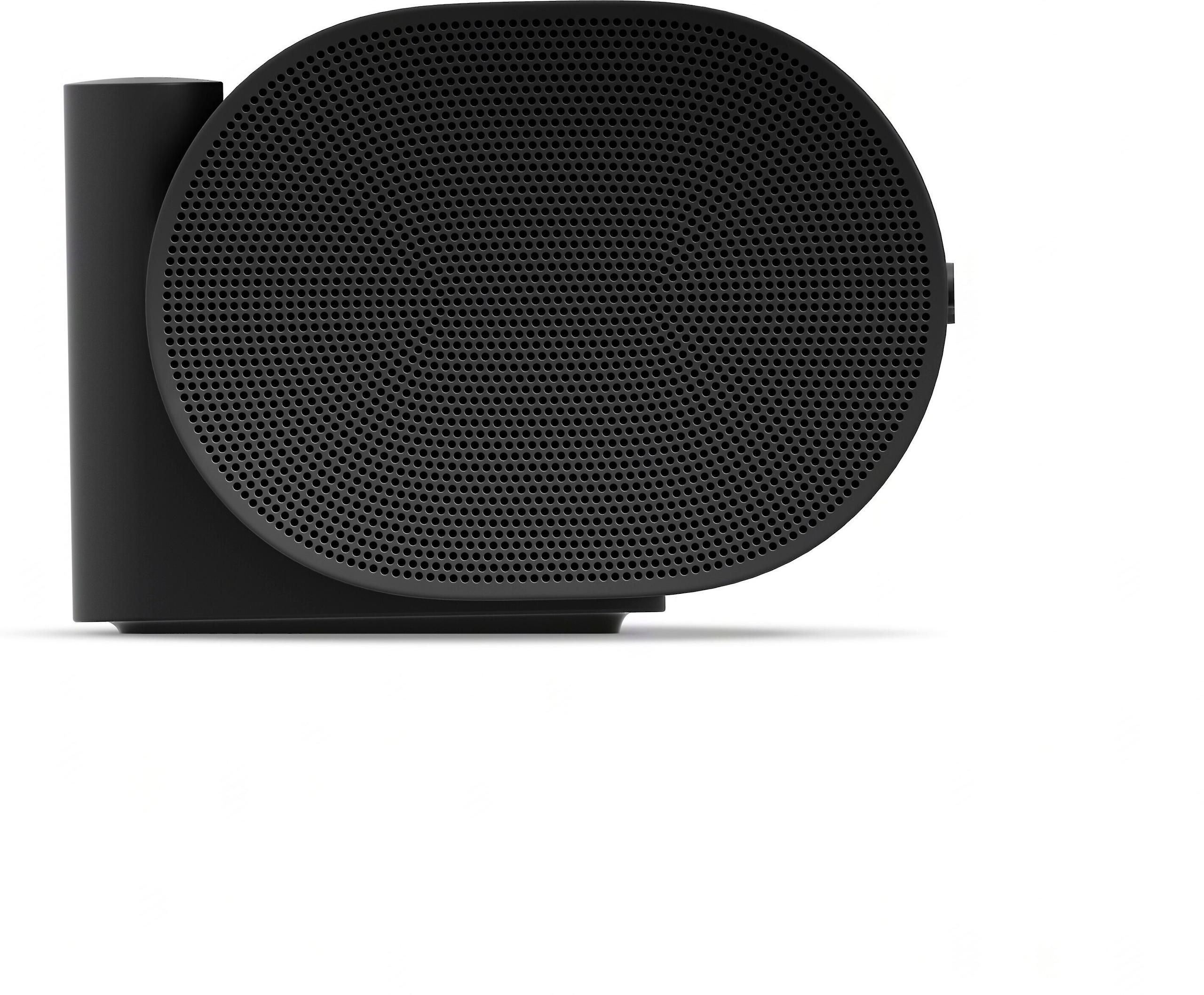
When shopping for a premium soundbar in 2024, you're faced with a fundamental choice that goes beyond just comparing specifications. Do you want a complete surround sound system that gives you everything out of the box, or would you prefer a sophisticated single-unit solution that you can expand over time? This decision perfectly captures the difference between the Hisense AX5140Q 5.1.4Ch Dolby Atmos soundbar and the Sonos Arc Ultra.
Both products represent dramatically different philosophies in premium home theater audio. The Hisense AX5140Q delivers a complete 5.1.4-channel system including wireless subwoofer and rear speakers at a budget-friendly price point. Meanwhile, the Sonos Arc Ultra focuses on engineering excellence in a single soundbar that costs significantly more but offers superior build quality and ecosystem integration.
Before diving into the comparison, it's worth understanding what makes these premium soundbars different from the basic models that simply make your TV louder. Both the Hisense AX5140Q and Sonos Arc Ultra support Dolby Atmos, which is a technology that adds height information to soundtracks. Instead of just having sound come from left, right, and center, Dolby Atmos can make you hear helicopters flying overhead or rain falling from above.
The numbers in soundbar descriptions like "5.1.4" or "9.1.4" tell you exactly what kind of surround experience you're getting. The first number represents ear-level channels (front left, center, front right, plus surround channels). The second number indicates subwoofer channels for deep bass. The final number shows height channels that create those overhead effects. More channels generally mean more immersive sound, but the implementation matters just as much as the raw numbers.
Both soundbars also support DTS:X (in the Hisense's case) and various other surround formats. These competing standards to Dolby Atmos work similarly, creating three-dimensional soundscapes that wrap around your listening position. The key difference is that some content is mastered in one format or another, so having both gives you maximum compatibility.
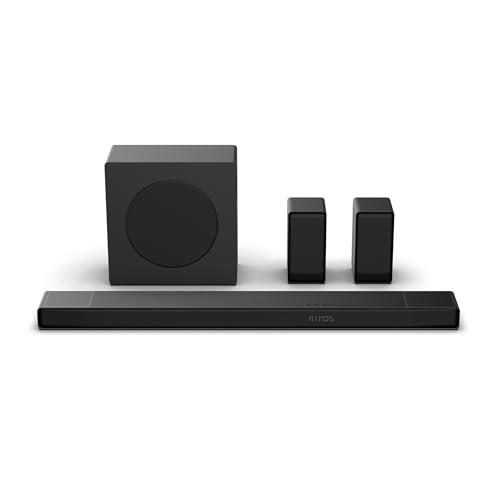
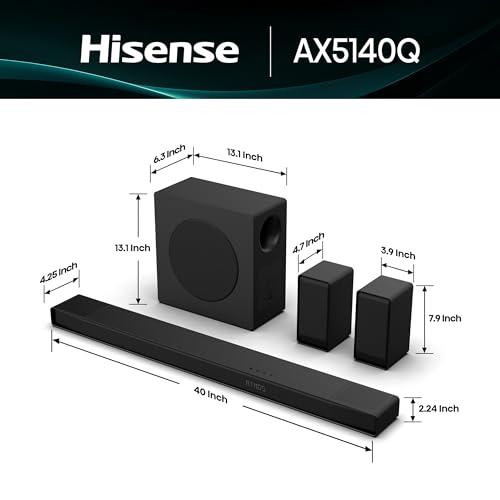
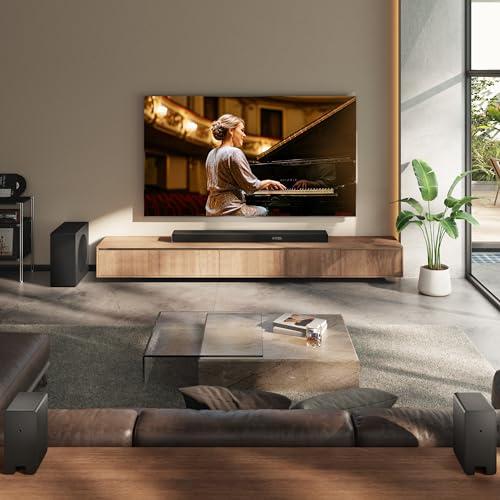
The Hisense AX5140Q, released in 2024, represents what I consider the most practical approach to premium surround sound for most households. When you open the box, you get everything needed for genuine 5.1.4-channel Dolby Atmos: a main soundbar, a wireless 6.5-inch subwoofer, and two wireless rear speakers that each include upfiring drivers.
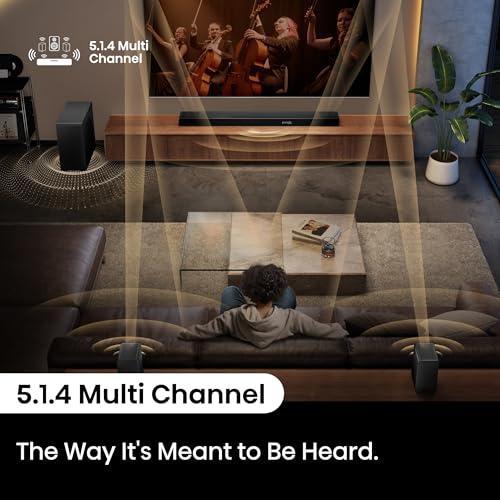
Those upfiring drivers deserve special attention because they're what make height effects work. Instead of mounting speakers in your ceiling, these drivers point sound upward to bounce off the ceiling back down to your ears. The Hisense system includes four of these upfiring speakers total—two in the main bar and two in the rear speakers. This creates genuine overhead effects from multiple positions, not just the front of the room.
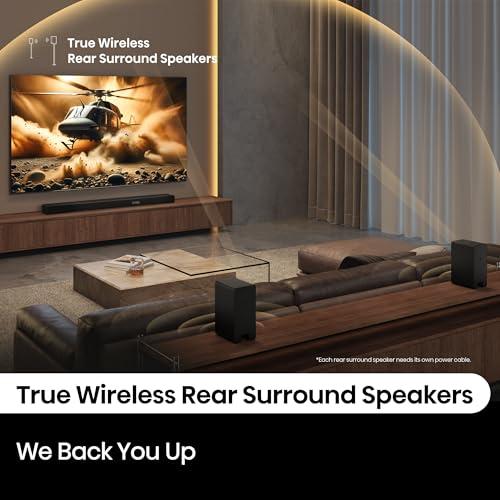
The biggest advantage of the Hisense AX5140Q is its use of actual discrete rear speakers. When an explosion happens behind the main character in a movie, or when an enemy sneaks up behind you in a video game, that sound comes from actual speakers positioned behind your seating area. This creates what audio engineers call "true surround" as opposed to "virtual surround" that tries to trick your ears using psychoacoustic processing.
Virtual surround can be impressive, but physics matters. Having real speakers behind you creates a convincing bubble of sound that's particularly noticeable during action sequences or gaming sessions. The wireless connection means you don't need to run cables across your room, solving the biggest practical challenge of traditional surround systems.
The included 6.5-inch subwoofer handles all the deep bass effects that smaller soundbar drivers simply can't reproduce. Movie explosions, thunderstorms, and the deep rumble of spaceships all come through with proper impact. Based on user feedback, this subwoofer provides sufficient depth for most living rooms, though it occasionally exhibits some resonance issues in certain room configurations that can make dialogue sound slightly echo-y.
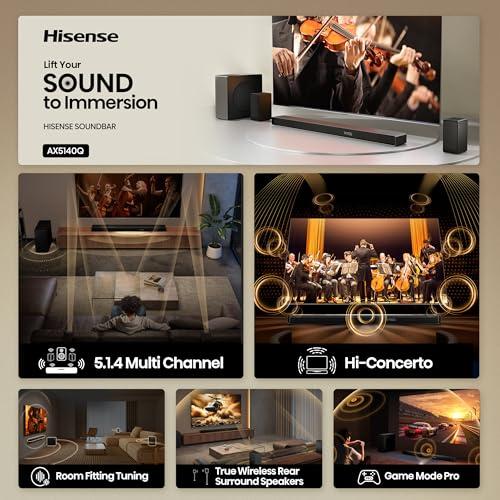
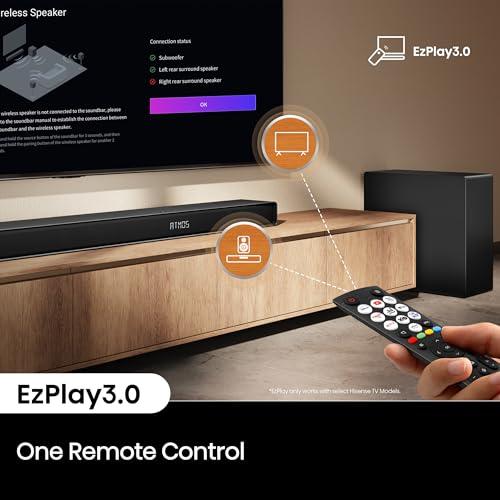
Hisense developed a proprietary platform called Hi-Concerto that's designed to optimize the AX5140Q when paired with compatible Hisense TVs. This integration allows the TV and soundbar to work as a unified system, sharing processing duties and providing simplified control through the TV interface. When it works properly, Hi-Concerto can improve lip-sync performance and create more cohesive surround imaging.
However, our research into user experiences reveals that Hi-Concerto isn't always reliable. Some users report sync issues where dialogue emerges from both the TV and soundbar separately, creating an echo effect that requires disabling the feature. This highlights an important consideration: while brand ecosystems can offer advantages, they also introduce potential compatibility complications.
The Hisense system also includes AI-driven sound processing that automatically detects content types and adjusts the audio profile accordingly. Movie mode emphasizes surround effects and dynamic range, while Game Pro mode tightens bass response and enhances positional audio cues. These modes represent genuine differences in sound signature rather than marketing gimmicks, making the system adaptable to different use cases without constant manual adjustment.
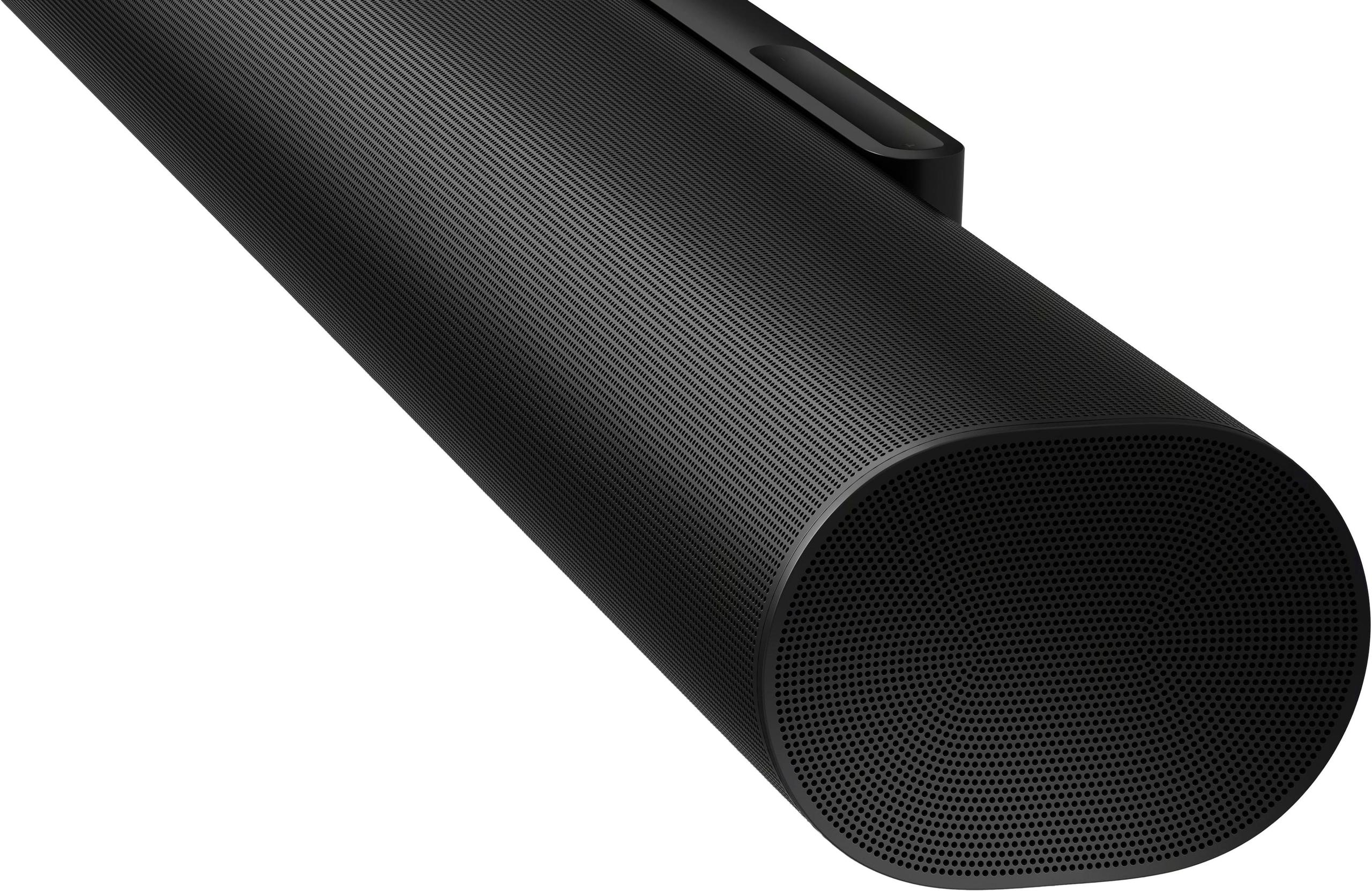
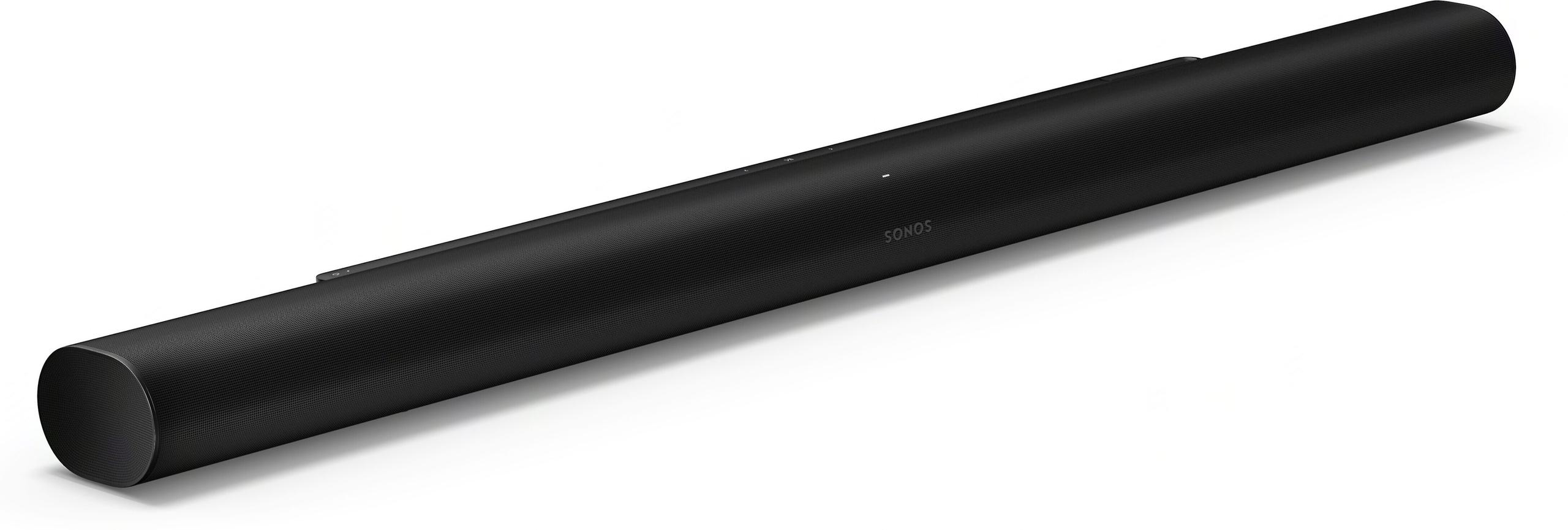
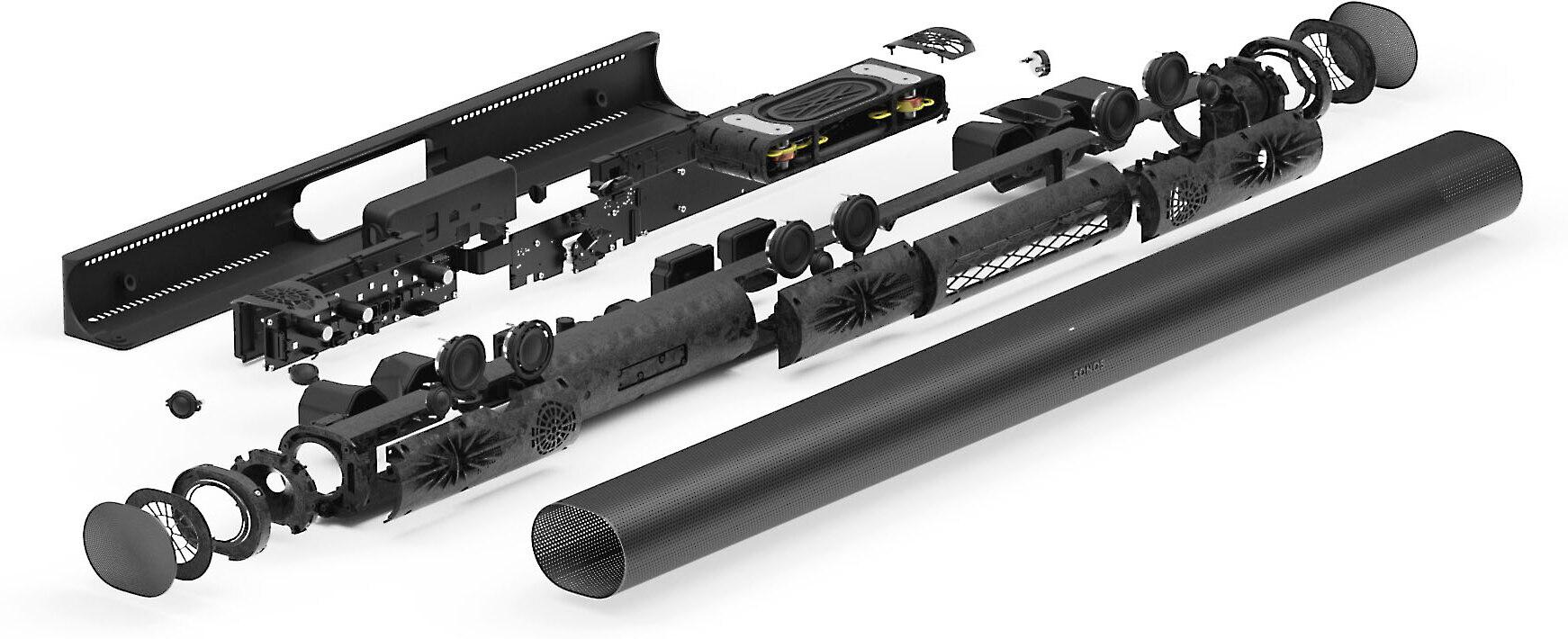
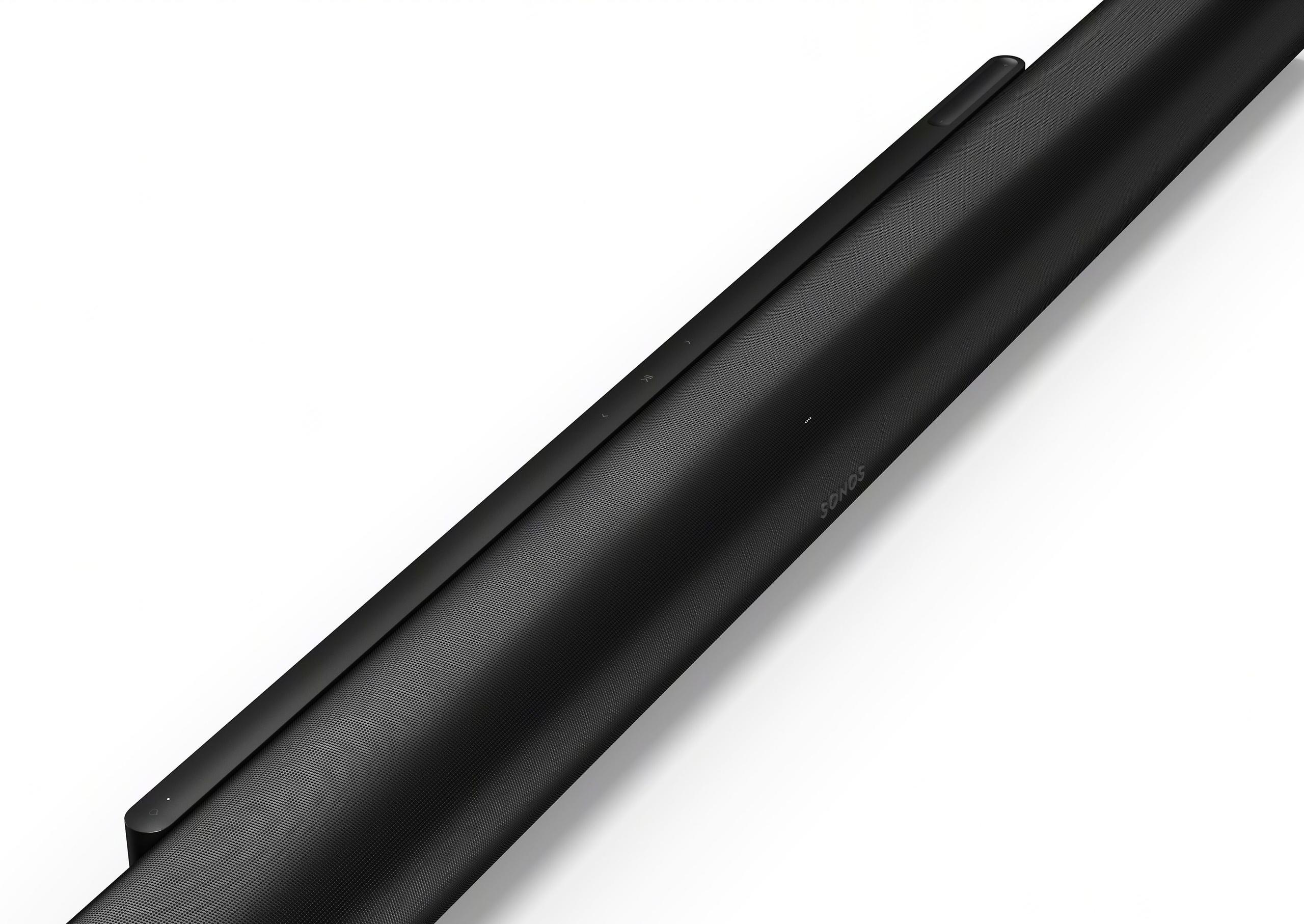
The Sonos Arc Ultra, also released in 2024, takes a completely different approach to premium audio. Rather than including separate components, Sonos packed 14 custom-engineered drivers into a single sophisticated soundbar that creates a 9.1.4-channel experience through advanced processing and precise driver placement.
The breakthrough innovation in the Arc Ultra is Sonos's Sound Motion technology. Traditional subwoofers use large drivers that move back and forth to push air and create bass frequencies. Sound Motion uses a completely different approach with a four-motor, dual-membrane woofer that produces deep bass with minimal physical movement. This allows Sonos to pack serious low-frequency capability into a much smaller space.
The practical benefit is that the Arc Ultra delivers surprisingly robust bass without needing a separate subwoofer, while still leaving room for six midwoofers and seven tweeters to handle other frequency ranges. This integrated approach means fewer components cluttering your living room, but it also means you can't position the bass source separately for optimal room acoustics.
The Sonos Arc Ultra's 14-driver array includes precisely angled tweeters that fire upward, sideways, and forward to create convincing surround effects without rear speakers. The system uses sophisticated digital signal processing to time the arrival of sound waves from different drivers, creating the illusion that sound is coming from positions where no physical speakers exist.
Custom colinear waveguides—essentially shaped channels that control how sound waves propagate—focus the center channel performance for exceptional dialogue clarity. This is particularly important because the center channel handles most movie dialogue, and poor center channel performance is the most common complaint about soundbars.
Based on professional reviews and user consensus, the Arc Ultra achieves more convincing virtual surround than most competitors, though it still can't quite match the immersion of having actual rear speakers. The trade-off is convenience and aesthetic appeal versus maximum spatial accuracy.
The Sonos Arc Ultra includes Trueplay, which uses your smartphone's microphone to measure how sound reflects in your specific room and then adjusts the soundbar's output accordingly. This room correction technology, available on both iOS and Android devices, can significantly improve performance by compensating for problematic acoustics.
The Speech Enhancement feature uses AI to detect human voices and offers four different levels of dialogue boost. Unlike simple treble boosts that can make voices sound harsh, this processing specifically targets speech frequencies while leaving music and effects largely unchanged. This is particularly valuable for households where hearing ability varies or for late-night viewing when you need dialogue to cut through at lower volumes.
The bass performance difference between these systems illustrates their different design philosophies. The Hisense AX5140Q's dedicated 6.5-inch wireless subwoofer can physically move more air than any soundbar-integrated solution. This translates to deeper extension and more physical impact during action sequences or music with significant low-frequency content.
However, the Sonos Arc Ultra's Sound Motion woofer technology produces what many reviewers describe as tighter, more musical bass. Instead of the sometimes boomy or resonant character that dedicated subwoofers can exhibit in certain rooms, the integrated approach provides bass that blends seamlessly with the midrange frequencies.
For home theater use, the Hisense system will generally provide more visceral impact during explosion scenes or thunderstorms. The Sonos Arc Ultra offers more refined bass that works better for music listening and doesn't overpower dialogue frequencies.
Both systems excel at dialogue reproduction, but through different methods. The Hisense AX5140Q uses dedicated center channel drivers with AI processing to enhance voice intelligibility. In most content, this produces clear, well-anchored dialogue that stays locked to the screen even during complex action sequences.
The Sonos Arc Ultra takes dialogue performance further with its custom waveguides and advanced Speech Enhancement processing. The four-level AI dialogue boost is more sophisticated than typical treble boosts, and the superior driver integration means voices sound more natural even when enhanced. Professional reviewers consistently note that the Arc Ultra often doesn't need dialogue enhancement enabled because the base tuning already prioritizes midrange clarity.
This is where the fundamental difference between these systems becomes most apparent. The Hisense AX5140Q's physical rear speakers create genuine surround sound that's particularly effective for:
The Sonos Arc Ultra's virtual surround processing is among the best available, but it faces the inherent limitations of psychoacoustic tricks. It excels when:
Both systems handle Dolby Atmos height effects well, but differently. The Hisense system's four discrete upfiring drivers (two front, two rear) create more convincing overhead effects because they originate from multiple physical positions. Rain, aircraft, and ambient effects have better spatial definition and movement across the ceiling plane.
The Sonos Arc Ultra's upfiring drivers and sophisticated processing create impressive height effects from fewer physical sources. The 9.1.4 processing can map complex Atmos objects with greater precision than the Hisense system's 5.1.4 capability, but it's ultimately working with fewer physical anchor points.
For gaming enthusiasts, these systems offer different advantages. The Hisense AX5140Q's Game Pro mode tightens bass response and enhances positional cues, while the physical rear speakers provide genuine directional audio that can offer competitive advantages in shooters or open-world games.
The Sonos Arc Ultra offers lower overall latency and more consistent performance across different input types. Its HDMI eARC implementation tends to be more reliable for gaming consoles, and the lack of wireless rear speakers eliminates any potential sync issues between front and rear channels.
Both systems support 4K passthrough at 60Hz, though neither handles the 120Hz gaming that newer consoles can provide. For high refresh rate gaming, you'll want to connect consoles directly to your TV and use eARC for audio.
At the time of writing, the pricing difference between these systems is substantial, with the Sonos Arc Ultra costing approximately 2.5 times more than the Hisense AX5140Q. This price gap represents one of the starkest value propositions in the premium soundbar category.
The Hisense system delivers exceptional value by including everything needed for complete 5.1.4 surround sound at a price that many competing soundbars charge for just the main unit. You get immediate access to genuine surround immersion without additional purchases or setup complexity.
The Sonos Arc Ultra justifies its premium pricing through superior engineering, build quality, and ecosystem integration. The modular approach means you can start with just the soundbar and add a Sub and Era 300 rear speakers over time, eventually creating a system that surpasses the Hisense in refinement and spatial accuracy—but at a total cost that's significantly higher.
The Hisense AX5140Q is designed as a complete solution with limited expandability. What you buy is what you get, which is perfectly adequate for most users but offers little room for future upgrades beyond potentially adding a more powerful subwoofer.
The Sonos Arc Ultra is the foundation of a broader ecosystem. Adding the Sonos Sub provides deeper bass extension than the Sound Motion woofer alone. Era 300 rear speakers create true surround that can match or exceed the Hisense system's spatial accuracy. The Sonos Ace headphones integrate seamlessly for private listening. This modularity appeals to enthusiasts who want to build their system gradually or who value the flexibility to optimize each component separately.
The Hisense AX5140Q offers simpler initial setup because all components are included and designed to work together immediately. The wireless rear speakers pair automatically, and the room calibration process is straightforward. However, optimal rear speaker placement still requires thought and available space behind your seating area.
The Sonos Arc Ultra initially offers the simplest setup—just power and one HDMI connection. However, the sophistication of Trueplay tuning and the complexity of potential ecosystem expansion can make the overall experience more involved for users who want to maximize performance.
You want maximum surround immersion for the lowest investment and your room can accommodate rear speaker placement. This system makes sense for:
You value engineering excellence and want a premium foundation that can grow over time. This system suits:
If neither extreme appeals to you, consider that Sonos offers the Beam Gen 2 at roughly 60% of the Arc Ultra's price, providing Sonos quality with expandability at a more accessible entry point. Similarly, Hisense offers 5.1.2 systems at even lower prices that sacrifice some height capability for additional budget savings.
The choice between the Hisense AX5140Q and Sonos Arc Ultra ultimately comes down to your priorities, room constraints, and willingness to invest in premium engineering.
The Hisense system represents exceptional value for buyers who want immediate, complete surround immersion without compromise. Despite its budget positioning, it delivers genuine 5.1.4 performance that many more expensive systems can't match. The physical rear speakers create convincing surround effects that virtual processing simply cannot replicate.
The Sonos Arc Ultra offers superior refinement, engineering excellence, and ecosystem flexibility for buyers who appreciate premium audio components and prefer gradual investment over immediate completeness. Its dialogue clarity and integrated bass response showcase what's possible when engineering budget isn't constrained by aggressive pricing targets.
Both systems represent the pinnacle of their respective design philosophies. Your choice should align with whether you prioritize maximum immersion per dollar or premium engineering with room for growth. Either way, you'll end up with a dramatically better home theater experience than what your TV speakers can provide.
| Hisense AX5140Q 5.1.4Ch Dolby Atmos DTS:X Sound Bar | Sonos Arc Ultra Dolby Atmos Soundbar |
|---|---|
| Channel Configuration - Determines surround immersion capability | |
| 5.1.4 channels with physical rear speakers | 9.1.4 channels virtualized from single unit |
| What's Included - Affects total cost and setup complexity | |
| Complete system: soundbar + wireless sub + wireless rear speakers | Standalone soundbar only (sub and rears sold separately) |
| Driver Count - More drivers typically mean better sound separation | |
| 14 total drivers across all components | 14 drivers in soundbar alone |
| Bass Solution - Deep bass handling approach | |
| Dedicated 6.5" wireless subwoofer included | Integrated Sound Motion woofer technology |
| Physical Surround Sound - True vs virtual rear effects | |
| Real wireless rear speakers with upfiring drivers | Virtual surround processing from front soundbar |
| Dolby Atmos Height Channels - Overhead effect capability | |
| 4 physical upfiring drivers (2 front, 2 rear) | 7 tweeters including upfiring drivers |
| Room Calibration - Optimizes sound for your space | |
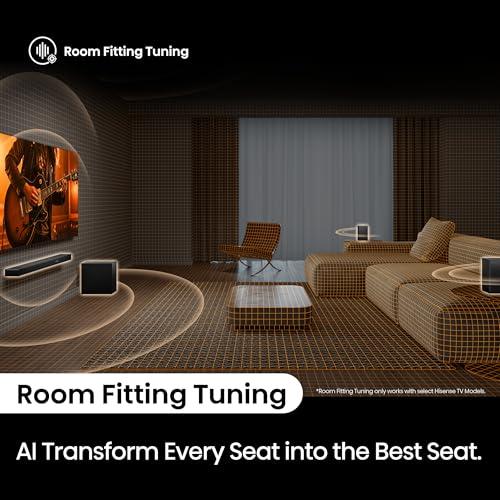
| AI EQ and room fitting tuning | Trueplay tuning (iOS and Android compatible) |
| Connectivity Options - Input flexibility | |
| HDMI eARC, optical, AUX, USB, Bluetooth 5.3 | HDMI eARC, WiFi, Bluetooth 5.3, AirPlay 2 |
| Expandability - Future upgrade potential | |
| Limited expansion beyond included components | Full Sonos ecosystem integration with Sub and Era speakers |
| Smart Features - AI and voice integration | |
| AI sound modes, Hi-Concerto (Hisense TV optimization) | Advanced Speech Enhancement, Alexa/Google Assistant |
| Setup Complexity - Installation and configuration effort | |
| Moderate (multiple wireless components to position) | Simple initially, complex with ecosystem expansion |
| Best Use Case - Ideal buyer scenario | |
| Maximum surround immersion at budget price | Premium engineering with modular expansion |
The Hisense AX5140Q provides superior surround sound immersion because it includes actual wireless rear speakers that create genuine 360-degree audio. The Sonos Arc Ultra uses advanced virtual surround processing from a single unit, which is impressive but cannot match the spatial accuracy of physical rear speakers for action movies and gaming.
The Hisense AX5140Q includes everything for complete surround sound: the main soundbar, wireless 6.5" subwoofer, and two wireless rear speakers with upfiring drivers. The Sonos Arc Ultra is a standalone soundbar only - you'll need to purchase the Sonos Sub and Era rear speakers separately for a comparable surround experience.
The Sonos Arc Ultra excels at dialogue clarity with custom colinear waveguides and AI-powered Speech Enhancement offering four adjustable levels. While the Hisense AX5140Q also provides good dialogue performance with AI voice enhancement, the Sonos Arc Ultra consistently delivers more natural and intelligible speech without needing enhancement modes.
Yes, both soundbars fully support Dolby Atmos. The Hisense AX5140Q delivers 5.1.4-channel Dolby Atmos with four physical upfiring speakers, while the Sonos Arc Ultra creates 9.1.4-channel Dolby Atmos using 14 precisely-engineered drivers and advanced processing from a single unit.
This depends on your preference. The Hisense AX5140Q includes a dedicated 6.5" wireless subwoofer that provides deeper bass extension and more physical impact for movies and gaming. The Sonos Arc Ultra uses breakthrough Sound Motion technology for integrated bass that's tighter and more musical but may lack the ultimate depth of a dedicated subwoofer.
The Sonos Arc Ultra offers extensive expandability through the Sonos ecosystem - you can add the Sonos Sub, Era 300 rear speakers, and integrate with other Sonos products for multi-room audio. The Hisense AX5140Q has limited expansion options since it's designed as a complete system, though you could potentially add a more powerful subwoofer.
The Hisense AX5140Q is easier for complete surround setup since all components are included and pair automatically. The Sonos Arc Ultra has simpler initial setup with just power and HDMI connections, but becomes more complex if you add ecosystem components like the Sub and rear speakers later.
The fundamental difference is approach: the Hisense AX5140Q provides a complete 5.1.4 surround system with physical components at a budget-friendly price, while the Sonos Arc Ultra offers premium engineering and ecosystem flexibility in a single sophisticated unit that costs significantly more but delivers superior refinement.
The Hisense AX5140Q has advantages for gaming due to its physical rear speakers providing genuine positional audio and Game Pro mode optimized for directional cues. However, the Sonos Arc Ultra offers lower latency and more reliable HDMI performance. Both support 4K 60Hz passthrough for modern gaming consoles.
Yes, both the Hisense AX5140Q and Sonos Arc Ultra work with any TV that has HDMI eARC or optical connections. The Hisense soundbar offers additional optimization features when paired with Hisense TVs through Hi-Concerto integration, but this isn't required for operation.
The Hisense AX5140Q offers exceptional value by including a complete 5.1.4 surround system with subwoofer and rear speakers at a fraction of competitors' prices. The Sonos Arc Ultra provides premium value through superior engineering, build quality, and ecosystem integration, but requires significantly higher investment for comparable surround capabilities.
Both soundbars support wireless music streaming. The Hisense AX5140Q offers Bluetooth 5.3 connectivity for direct streaming from phones and tablets. The Sonos Arc Ultra provides more streaming options including Bluetooth 5.3, WiFi, AirPlay 2, and direct integration with streaming services through the Sonos app for superior audio quality and multi-room capabilities.
We've done our best to create useful and informative comparisons to help you decide what product to buy. Our research uses advanced automated methods to create this comparison and perfection is not possible - please contact us for corrections or questions. These are the sites we've researched in the creation of this article: shop.hisense-usa.com - manuals.plus - dolby.com - youtube.com - gzhls.at - rtings.com - youtube.com - bestbuy.com - manuals.plus - bestbuy.com - hisense-usa.com - youtube.com - device.report - manuals.plus - youtube.com - device.report - manuals.plus - youtube.com - bestbuy.com - shopjetson.com - youtube.com - ign.com - crutchfield.com - dowtechnologies.com - sonos.com - appleinsider.com - pcrichard.com - clefdesol.com - sonos.com - businessinsider.com - audioadvice.com - en.community.sonos.com

Privacy Policy
Terms and Conditions - Affiliate Policy
Home Security
© Copyright 2008-2026.
11816 Inwood Rd #1211, Dallas, TX 75244