


If you're tired of straining to hear dialogue on your TV or want to feel the rumble of movie explosions, you're probably looking at soundbars. These sleek audio systems have become the go-to solution for improving TV sound without turning your living room into a tangle of wires and speakers. But choosing between different soundbars can be confusing, especially when you're comparing products from completely different price tiers.
Today we're looking at two soundbars that represent opposite ends of the market: the budget-friendly Samsung HW-C450 and the premium Hisense AX5140Q. While both will dramatically improve your TV's audio, they take fundamentally different approaches to the problem—and come with very different price tags.
Before diving into specifics, let's talk about what soundbars actually do and why the differences between models matter so much. Think of your TV's built-in speakers as the audio equivalent of a smartphone camera from 2010—technically functional, but severely limited by space constraints and cost-cutting measures.
Soundbars solve this by dedicating much more space and power to audio reproduction. The most basic models use multiple drivers (the technical term for individual speakers) arranged horizontally to create a wider soundstage than your TV can manage. More advanced models add subwoofers for deep bass, rear speakers for true surround sound, and even upward-firing drivers that bounce sound off your ceiling to create overhead effects.
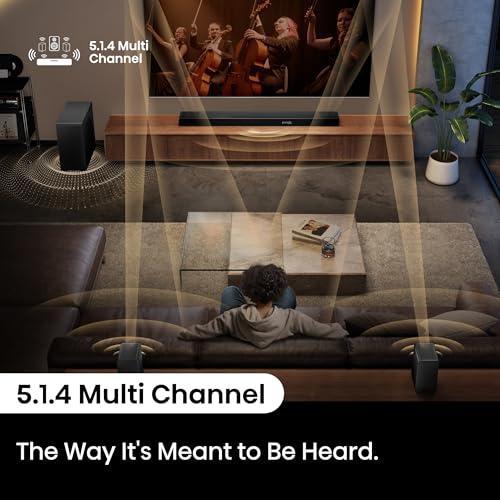
The key specifications you'll encounter are channel configurations like "2.1" or "5.1.4." These numbers tell you exactly what you're getting: the first number represents main channels (left, right, center), the second indicates subwoofers, and the third (when present) shows height channels for overhead effects. A 2.1 system gives you stereo sound plus bass, while a 5.1.4 system delivers full surround sound with height effects—essentially the difference between a decent stereo and a movie theater.
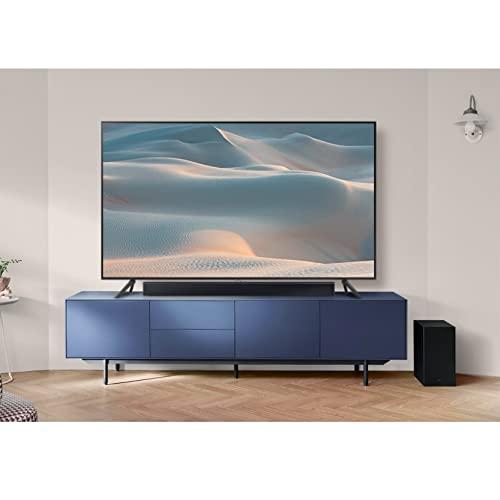
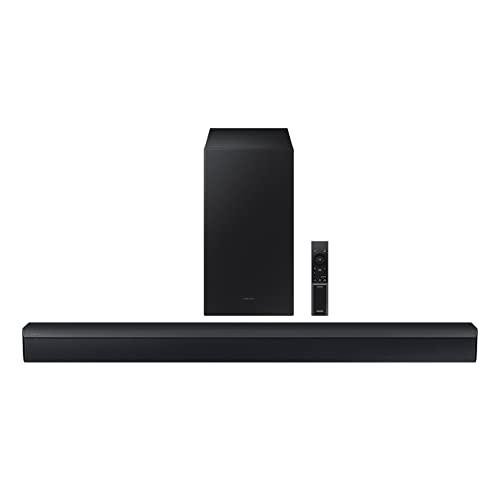
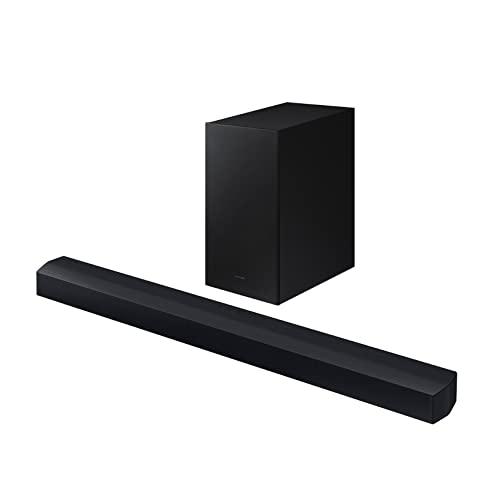
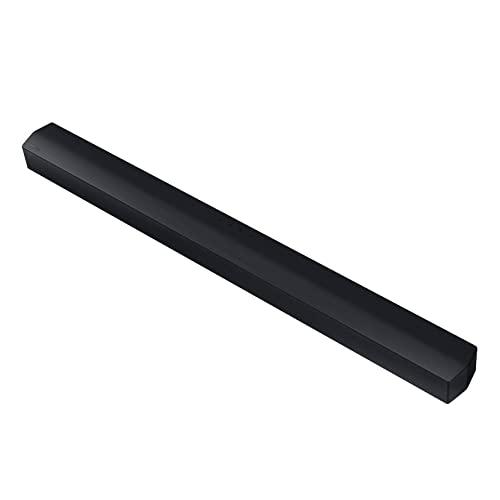
The Samsung HW-C450, released in 2023, represents Samsung's entry-level approach to soundbar design. It's a 2.1-channel system that focuses on solving the most common TV audio complaints—muddy dialogue and weak bass—without overwhelming users with complexity or breaking the bank.
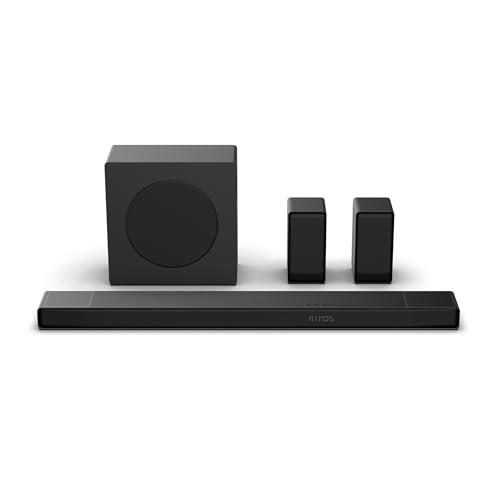
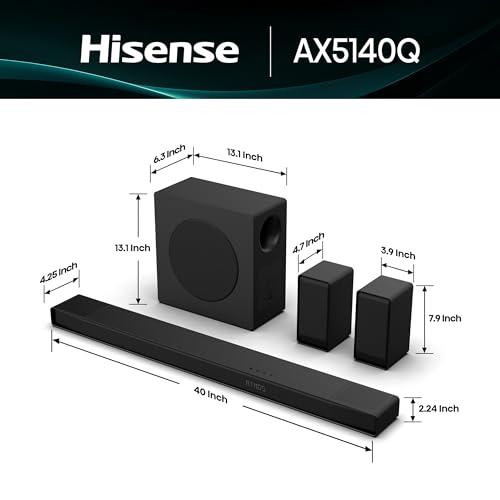
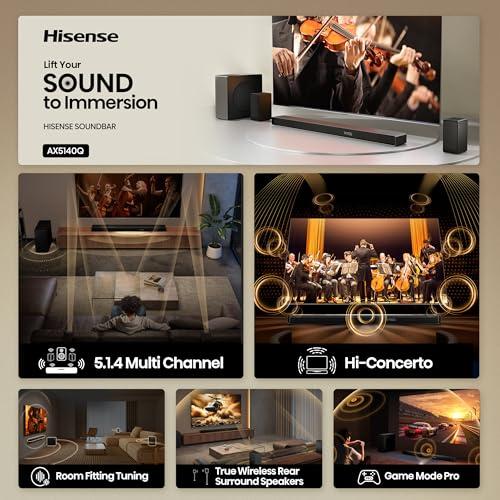
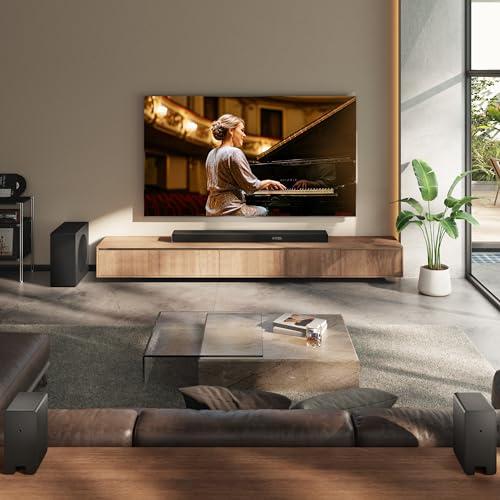
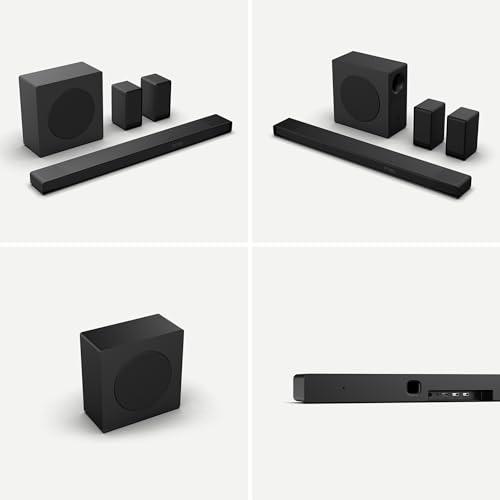
On the other end of the spectrum sits the Hisense AX5140Q, also from 2023, which takes a completely different philosophy. This 5.1.4-channel system aims to recreate a genuine home theater experience with physical surround speakers and dedicated height channels for Dolby Atmos content. Where Samsung went simple, Hisense went comprehensive.
These different approaches reflect broader trends in the soundbar market. As streaming services increasingly offer Dolby Atmos content—that's the format that creates those impressive overhead sound effects in movies—manufacturers face a choice: build affordable systems that enhance basic audio, or create more complex systems that can handle advanced formats properly.
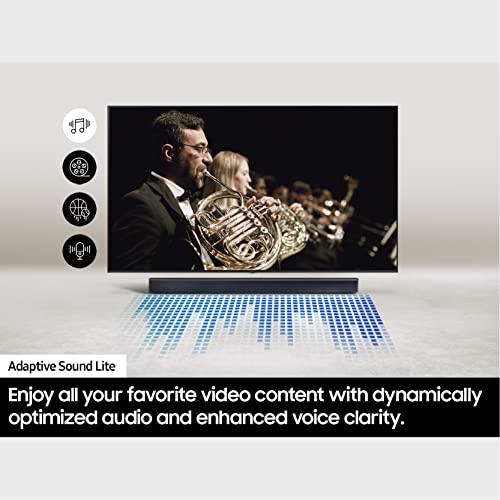
Both soundbars excel at their primary job: making TV dialogue clearer and more natural than your TV's built-in speakers. The Samsung HW-C450 uses a technique called center channel processing, where the soundbar analyzes audio to identify and emphasize speech frequencies. This works particularly well with the Voice Enhance mode, which specifically targets the frequency range where human voices sit most prominently.
The Hisense AX5140Q takes this further with a true center channel configuration as part of its 5.1 setup. Having a dedicated center speaker means dialogue has its own physical driver, preventing speech from competing with background music and effects. In practice, this creates noticeably better separation during busy movie scenes where explosions and music might otherwise overwhelm conversation.
From our research into user experiences and expert reviews, both systems deliver significant improvements over TV speakers, but the Hisense provides a more refined experience. The difference becomes most apparent during complex content like action movies or dense TV dramas where multiple audio elements compete for your attention.
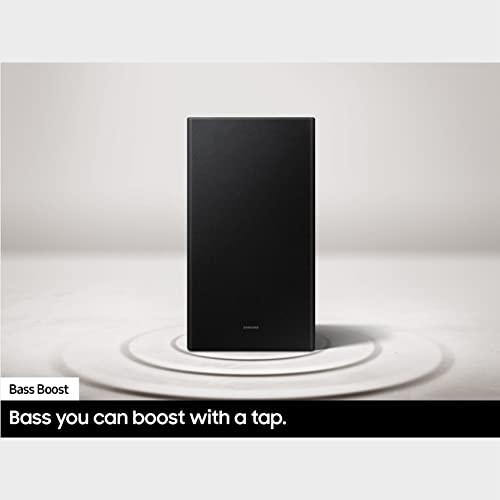
This is where the fundamental differences between these systems become most obvious. The Samsung HW-C450 includes a wireless subwoofer with a 6-inch driver that delivers solid low-frequency enhancement for its price range. It's designed to add enough bass to make movie soundtracks feel more impactful without overwhelming smaller rooms.
However, the Hisense AX5140Q uses a larger 6.5-inch subwoofer with significantly more power behind it. More importantly, it's part of a calibrated multi-channel system where the subwoofer only handles the lowest frequencies, allowing the other speakers to focus on midrange and treble reproduction. This specialization creates tighter, more controlled bass that integrates seamlessly with the rest of the audio spectrum.
In real-world listening, the Samsung provides satisfying bass for casual movie watching and music, but the Hisense delivers the kind of deep, room-shaking low end that makes action sequences genuinely thrilling. If you've ever noticed how movie theater sound seems to hit you in the chest during explosions, the Hisense gets much closer to recreating that experience at home.
Here's where these systems diverge most dramatically. The Samsung HW-C450 uses DTS Virtual:X technology to simulate surround sound effects. This clever audio processing analyzes stereo or multichannel content and uses psychoacoustic principles—basically tricks that exploit how your brain processes directional audio—to create the impression of sound coming from around you.
Virtual surround can be surprisingly effective, especially in smaller rooms. The Samsung does create a wider soundstage than your TV speakers and can make movie effects feel more spacious. However, it's still fundamentally limited by having only two main speakers positioned in front of you.
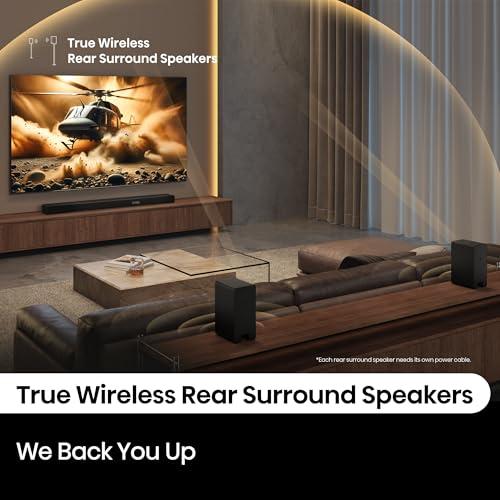
The Hisense AX5140Q takes an entirely different approach with genuine 5.1.4 surround sound. This means physical rear speakers behind your listening position, creating true directional audio. When a helicopter flies overhead in a movie, you actually hear it move from front to back through real speaker placement, not audio processing trickery.
The height channels deserve special mention here. The Hisense includes four upward-firing speakers—two in the main soundbar and two in the rear units—that bounce sound off your ceiling to create overhead effects. This is how Dolby Atmos content is supposed to work, with sound objects precisely placed in three-dimensional space around you.
Based on extensive user feedback and professional reviews, the difference in immersion between these approaches is substantial. The Samsung creates a pleasant enhancement over TV audio, while the Hisense can genuinely replicate the spatial experience of a movie theater when set up properly.
Modern gaming demands low latency (minimal delay between controller input and audio response) and clear directional cues. The Samsung HW-C450 includes a dedicated Game Mode that optimizes processing for reduced delay and enhanced positional audio within its virtual surround limitations.
For casual gaming, this works well. The Samsung provides clear audio cues and doesn't introduce noticeable lag that would interfere with gameplay timing. However, competitive gamers who need precise directional awareness—like hearing exactly where footsteps are coming from in a shooter—will find the virtual surround processing somewhat limiting.
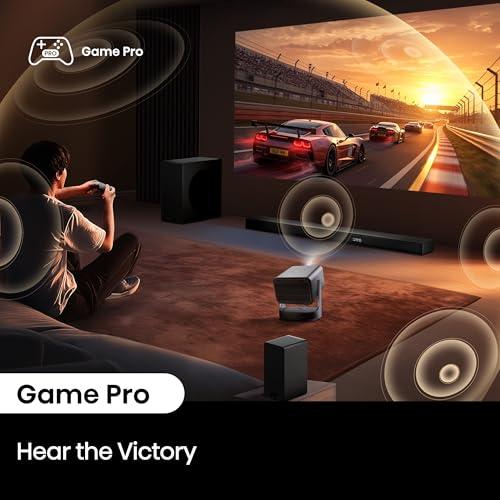
The Hisense AX5140Q offers a Game Pro mode that leverages its physical surround speakers for much more accurate positional audio. With actual rear speakers, you can distinguish between sounds coming from directly behind versus off to your sides, which provides a genuine competitive advantage in games where audio cues matter.
The trade-off is setup complexity. While the Samsung works well for gaming right out of the box, the Hisense requires proper speaker positioning to deliver optimal gaming performance. For serious gamers with dedicated setups, this investment pays off significantly.
The connectivity differences between these systems reflect their target audiences and design philosophies. The Samsung HW-C450 keeps things simple with optical digital input for TV connection, USB for basic music playback, and Bluetooth 4.2 for wireless streaming from phones and tablets.
This minimalist approach has pros and cons. On the positive side, setup is straightforward—connect one optical cable and you're done. The downside is missing modern features like HDMI ARC (Audio Return Channel), which would allow the TV remote to control soundbar volume and enable automatic power synchronization.
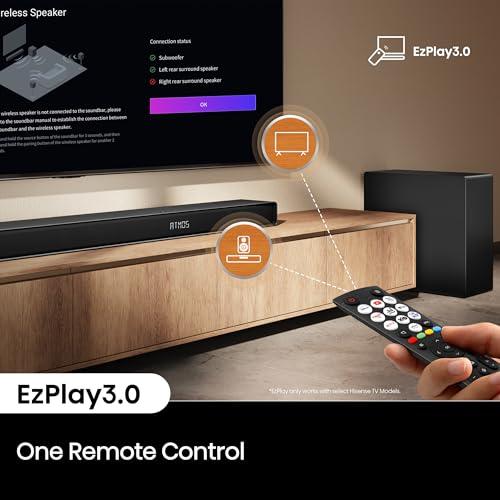
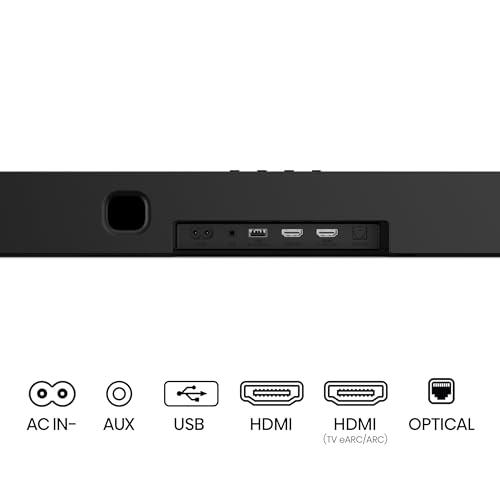
The Hisense AX5140Q offers comprehensive connectivity including HDMI eARC (enhanced Audio Return Channel), which supports high-bandwidth audio formats and seamless TV integration. The HDMI input with 4K60 passthrough means you can connect game consoles or streaming devices directly to the soundbar while maintaining full video quality to your TV.
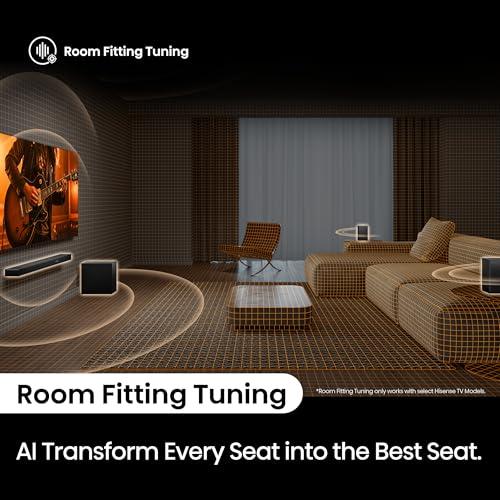
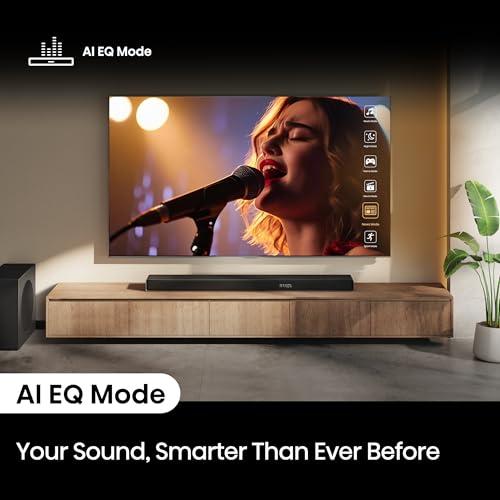
More significantly, the Hisense includes advanced features like AI EQ mode, which analyzes content in real-time to optimize sound characteristics, and room calibration that uses test tones to adapt the system to your specific listening environment. These aren't just marketing gimmicks—they represent meaningful improvements in how the system adapts to different content and room acoustics.
This is where the fundamental differences between these approaches become most apparent for long-term satisfaction. The Samsung HW-C450 supports standard Dolby Digital and DTS formats that cover most TV content and older streaming material. For current broadcast TV and basic streaming, this coverage is perfectly adequate.
However, streaming services are increasingly offering Dolby Atmos content. Netflix, Disney+, Amazon Prime, and others now include Atmos tracks on many movies and shows. Without proper Atmos support, this content gets downmixed to standard surround sound, losing the height and spatial information that makes modern content more immersive.
The Hisense AX5140Q fully supports both Dolby Atmos and DTS:X, the two major immersive audio formats. This means you can experience content exactly as directors intended, with sounds precisely placed in three-dimensional space around and above you.
As someone who has followed home theater technology for years, I can confidently say that Atmos support has become increasingly important since 2020. What started as a premium feature for enthusiasts has become mainstream, and content libraries are expanding rapidly. Buying a soundbar without Atmos support in 2024 feels like buying a 1080p TV when 4K content was becoming common.
The Samsung HW-C450 earns high marks for user-friendly installation. The wireless subwoofer pairs automatically, requiring only power connections for both the soundbar and sub. Most users report going from unboxing to listening in under 30 minutes, making it ideal for people who want immediate improvement without technical complexity.
The Hisense AX5140Q requires more investment in proper setup. Beyond the main soundbar and subwoofer, you'll need to position the rear speakers appropriately behind your listening area. This typically means running power cables to outlets near your seating and spending time with the room calibration process to optimize performance.
While this additional complexity might seem daunting, the payoff is substantial. A properly configured 5.1.4 system delivers dramatically better performance than a hastily installed one. The room calibration process, which uses test tones and microphone feedback to adjust levels and timing, can make the difference between good sound and truly immersive audio.
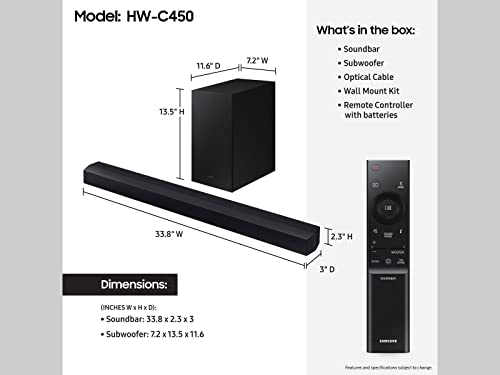
For casual users who primarily want better TV audio, the Samsung HW-C450 integrates seamlessly into existing setups. Its compact profile fits under most TVs without dominating the room aesthetically, and the wireless subwoofer can be tucked discretely beside furniture.
However, dedicated home theater enthusiasts should seriously consider the Hisense AX5140Q. Its physical surround speakers and height channels create a genuine theater experience that transforms movie watching from passive consumption to active immersion. When properly set up with Atmos content, the system can make you forget you're in your living room rather than a premium cinema.
The key consideration is room suitability. The Hisense requires adequate space behind seating for rear speakers and benefits from rooms with reflective ceilings for optimal height effects. Apartments or compact living spaces might not provide the physical requirements for this system to perform at its best.
At the time of writing, these systems occupy very different value propositions. The Samsung HW-C450 represents excellent entry-level value, delivering meaningful audio improvements at a budget-friendly price point. For users spending their first money on audio enhancement, it provides a logical stepping stone that won't break the bank.
The Hisense AX5140Q costs significantly more—roughly 2.5 times the Samsung's price—but delivers proportionally greater capabilities. When compared to separating buying individual components for a 5.1.4 system, it offers compelling value for the channel count and features included.
From a long-term perspective, the Hisense represents better future-proofing. As streaming services continue expanding Atmos content libraries and audio technology evolves, having proper format support becomes increasingly valuable. The Samsung might require replacement sooner as your content consumption and expectations evolve.
After researching extensively and analyzing countless user experiences, clear recommendations emerge for different user types.
Choose the Samsung HW-C450 if you're upgrading from TV speakers for the first time, live in a smaller space, primarily watch standard TV content, or want hassle-free installation. It excels at dialogue enhancement and adds satisfying bass without complexity or high cost. This soundbar makes particular sense for bedrooms, apartments, or secondary viewing areas where simplicity matters more than ultimate performance.
The Hisense AX5140Q makes sense for users who have dedicated home theater spaces, regularly consume Dolby Atmos content, enjoy immersive gaming, or want a system that won't need upgrading as content formats evolve. Despite its higher cost, it delivers genuine theater-like experiences that justify the investment for serious audio enthusiasts.
The fundamental question isn't which soundbar is "better"—they excel in their respective categories. Instead, consider whether you want basic audio enhancement or comprehensive home theater transformation. Your answer to that question, combined with your budget and space constraints, should guide your decision.
For most users taking their first step beyond TV speakers, the Samsung provides excellent value and immediate satisfaction. For those ready to invest in a true home theater experience, the Hisense offers capabilities that will remain impressive and relevant for years to come.
| Samsung HW-C450 | Hisense AX5140Q |
|---|---|
| Channel Configuration - Determines surround sound capability and immersion level | |
| 2.1 channels (stereo + subwoofer) | 5.1.4 channels (full surround + height speakers) |
| Physical Speaker Components - More speakers mean better spatial audio | |
| Soundbar + wireless subwoofer | Soundbar + subwoofer + 2 rear speakers + 4 upfiring speakers |
| Total Power Output - Higher wattage provides better dynamics and room-filling sound | |
| 300W total | 600W total |
| Dolby Atmos Support - Essential for modern streaming content with overhead effects | |
| No (DTS Virtual:X simulation only) | Yes (true Dolby Atmos with physical height speakers) |
| DTS Format Support - Advanced surround processing for enhanced immersion | |
| DTS Virtual:X (simulated surround) | DTS:X (object-based immersive audio) |
| HDMI Connectivity - Modern connection standard for best audio quality | |
| None (optical input only) | HDMI eARC with 4K60 passthrough |
| Setup Complexity - Time and effort required for installation | |
| Simple (30 minutes, auto-pairing) | Complex (1-2 hours with speaker positioning) |
| Room Size Suitability - Optimal performance based on listening space | |
| Small to medium rooms | Medium to large rooms with rear speaker placement |
| Gaming Features - Optimizations for low latency and directional audio | |
| Game Mode with virtual positioning | Game Pro Mode with true surround positioning |
| Smart Features - AI processing and room adaptation capabilities | |
| Adaptive Sound Lite | AI EQ Mode + Room Calibration |
| Best Use Case - Primary scenarios where each excels | |
| TV dialogue enhancement, casual viewing | Home theater immersion, Atmos content |
The Samsung HW-C450 is a simple 2.1-channel system with just a soundbar and wireless subwoofer, designed for basic TV audio improvement. The Hisense AX5140Q is a complete 5.1.4 surround sound system with physical rear speakers and upfiring drivers for true Dolby Atmos effects. The Samsung focuses on dialogue clarity and bass enhancement, while the Hisense delivers full theater-like immersion.
The Samsung HW-C450 is ideal for smaller spaces due to its compact design and simple two-component setup. It only requires the main soundbar under your TV and a wireless subwoofer that can be placed anywhere. The Hisense AX5140Q needs space for rear speakers behind your seating area, making it less practical for cramped living situations.
No, only the Hisense AX5140Q supports true Dolby Atmos with its dedicated upfiring speakers that create overhead sound effects. The Samsung HW-C450 uses DTS Virtual:X to simulate surround sound effects but cannot properly decode or reproduce Dolby Atmos content from streaming services like Netflix, Disney+, or Amazon Prime.
The Samsung HW-C450 is significantly easier to install, typically taking 15-30 minutes with automatic wireless subwoofer pairing and simple optical cable connection. The Hisense AX5140Q requires 1-2 hours for proper setup, including positioning rear speakers behind your seating area and running room calibration for optimal performance.
Both offer gaming modes, but the Hisense AX5140Q provides superior gaming audio with its Game Pro mode and physical surround speakers for accurate directional cues. This helps in competitive gaming where hearing enemy positions matters. The Samsung HW-C450 has a Game Mode that enhances virtual surround effects, adequate for casual gaming but less precise for competitive play.
The Samsung HW-C450 offers excellent entry-level value for users wanting basic TV audio improvement without major investment. The Hisense AX5140Q costs significantly more but provides genuine home theater capabilities with multiple physical speakers and advanced format support. Value depends on whether you want simple enhancement or comprehensive surround sound.
The Samsung HW-C450 supports basic TV remote control when connected to compatible Samsung TVs but lacks HDMI ARC for universal TV remote integration. The Hisense AX5140Q includes HDMI eARC support, allowing most modern TV remotes to control volume and power functions seamlessly across different TV brands.
The Hisense AX5140Q is vastly superior for home theater use with true 5.1.4 surround sound, Dolby Atmos support, and physical speakers that create genuine spatial audio effects. Movies with overhead sounds, directional effects, and surround ambience will sound dramatically more immersive. The Samsung HW-C450 provides good dialogue clarity and bass but remains front-focused.
The Samsung HW-C450 requires minimal space with just the soundbar placement under your TV and flexible subwoofer positioning anywhere in the room. The Hisense AX5140Q needs considerably more space, requiring proper placement of rear speakers behind your seating area and enough room for the upfiring speakers to bounce sound off the ceiling effectively.
The Samsung HW-C450 handles music adequately with its 2.1 setup and Bluetooth connectivity for streaming from phones. However, the Hisense AX5140Q provides much better music reproduction with its multiple speakers, wider soundstage, and more powerful amplification. The surround speakers create a more enveloping musical experience, especially for live recordings or spatial audio content.
The Hisense AX5140Q offers better future-proofing with support for modern audio formats like Dolby Atmos and DTS:X that are becoming standard in streaming content. The Samsung HW-C450 may feel outdated sooner as more content uses advanced audio formats it cannot properly reproduce, potentially requiring replacement as your expectations grow.
Choose the Samsung HW-C450 if you want simple TV audio improvement, have limited space or budget, and primarily watch standard TV content. Pick the Hisense AX5140Q if you have a dedicated home theater space, regularly watch Dolby Atmos content, want true surround sound immersion, and don't mind the complex setup. The decision comes down to whether you want basic enhancement or comprehensive theater experience.
We've done our best to create useful and informative comparisons to help you decide what product to buy. Our research uses advanced automated methods to create this comparison and perfection is not possible - please contact us for corrections or questions. These are the sites we've researched in the creation of this article: e-catalog.com - alibaba.com - smart.dhgate.com - greentoe.com - requiremints.com - versus.com - bhphotovideo.com - rtings.com - soundmachine.com.mt - samsung.com - samsung.com - youtube.com - bhphotovideo.com - newegg.com - images.samsung.com - bestbuy.com - samsung.com - youtube.com - jsappliance.com - gadgetsleo.com - youtube.com - saraappliance.com - walmart.com - shop.hisense-usa.com - manuals.plus - dolby.com - youtube.com - gzhls.at - rtings.com - youtube.com - bestbuy.com - manuals.plus - bestbuy.com - hisense-usa.com - youtube.com - device.report - manuals.plus - youtube.com - device.report - manuals.plus - youtube.com

Privacy Policy
Terms and Conditions - Affiliate Policy
Home Security
© Copyright 2008-2026.
11816 Inwood Rd #1211, Dallas, TX 75244