



If you've ever found yourself cranking up the TV volume just to understand what characters are saying, or felt like explosions in movies sound more like muffled pops, you're dealing with the fundamental weakness of modern TV speakers. As TVs have gotten thinner and more elegant, their built-in audio has gotten progressively worse. This is where dedicated sound systems come in, but choosing between different approaches can be confusing.
Today we're comparing two very different solutions: the Hisense HT Saturn, which takes the "go big or go home" approach with a complete wireless surround system, and the Denon Home Sound Bar 550, which keeps things simple with a smart single-unit design. At the time of writing, these products sit in completely different price brackets, with the Hisense costing more than double the Denon, so the question becomes whether that premium delivers proportional value.
The home theater audio world has evolved dramatically over the past few years. Traditional 5.1 surround systems with wires running everywhere are giving way to wireless solutions, while virtual surround processing has improved enough to create convincing spatial effects from a single soundbar. The key considerations haven't changed though: you want better dialogue clarity, more immersive sound effects, and music that actually has some life to it.
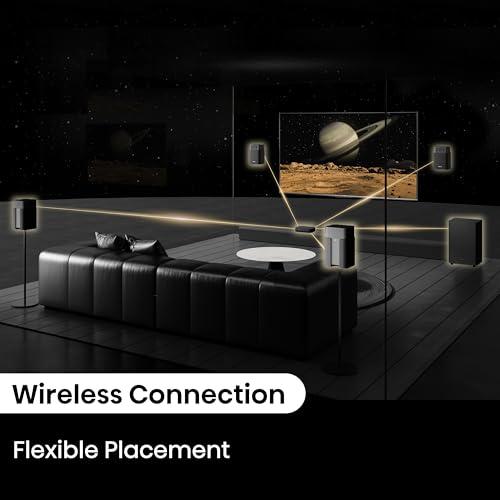
What has changed is how systems achieve these goals. Some manufacturers focus on cramming more drivers into a single soundbar and using digital processing to simulate surround effects. Others, like the Hisense HT Saturn, take the approach of actually putting speakers where surround speakers should go – behind and beside you – just without the hassle of running wires.
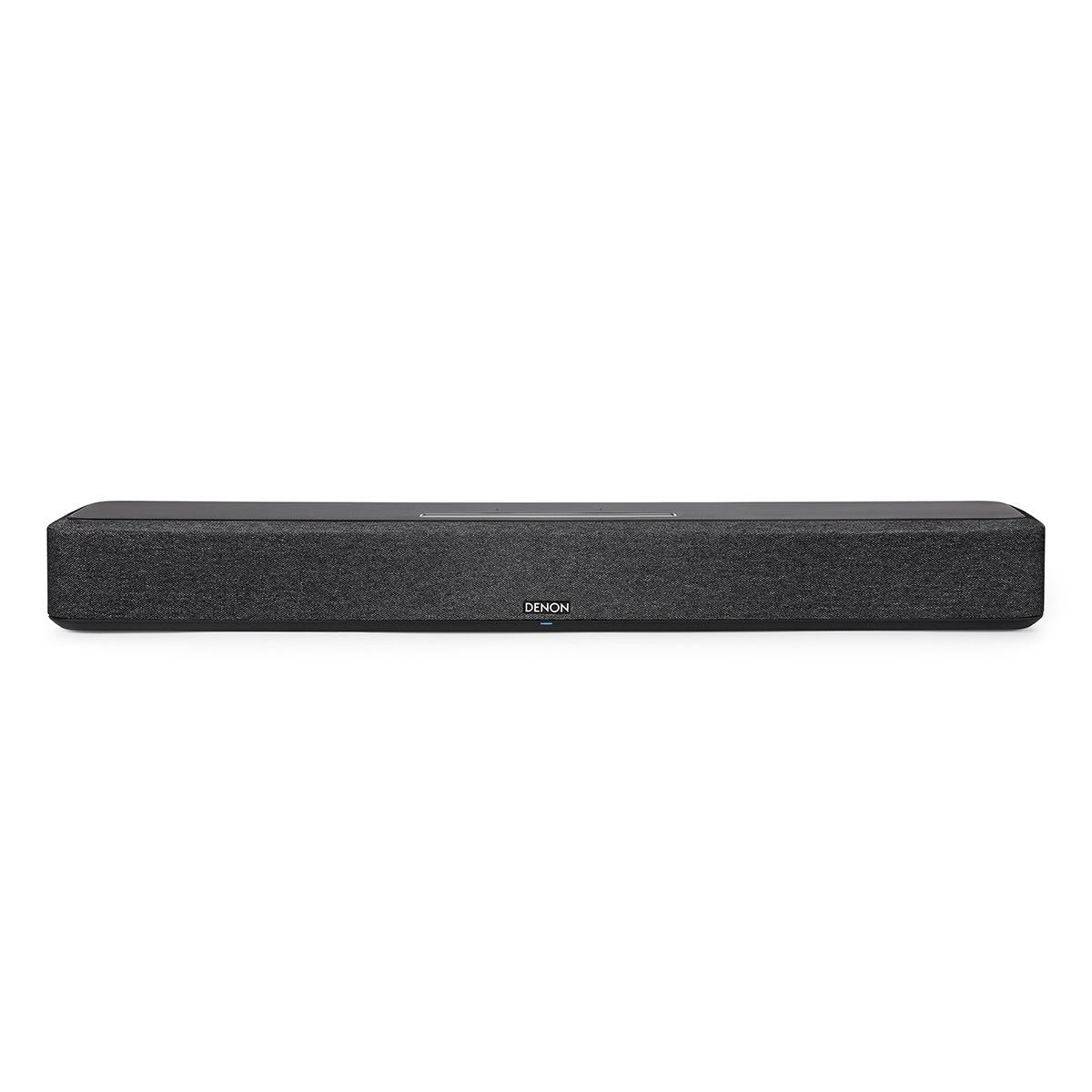
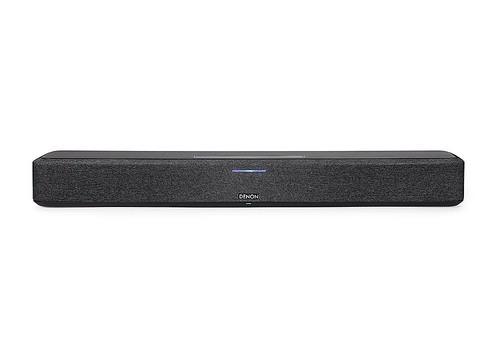
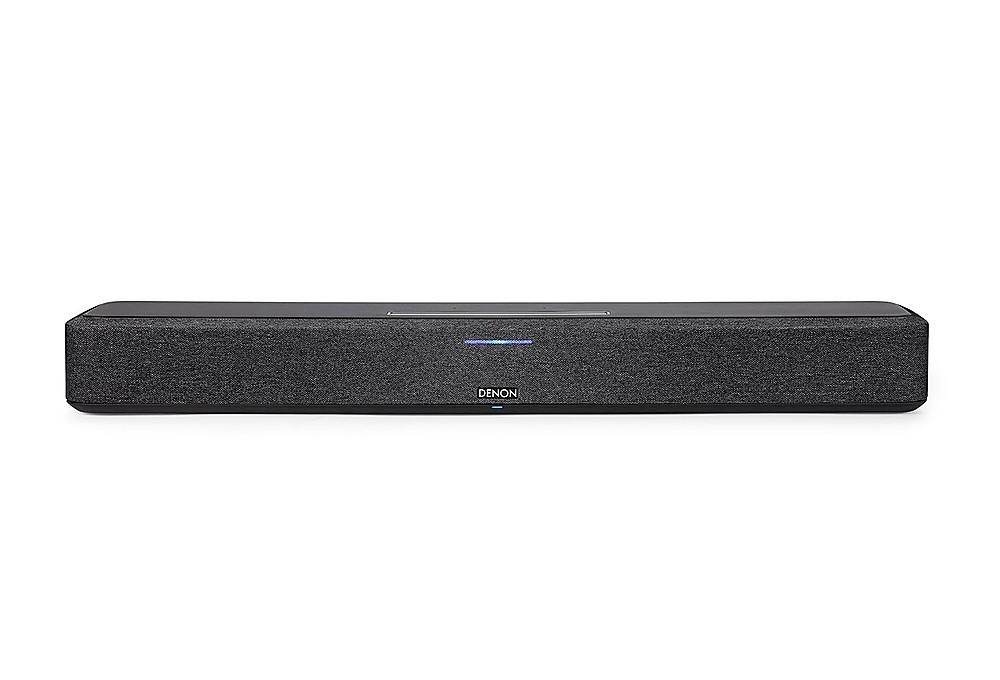
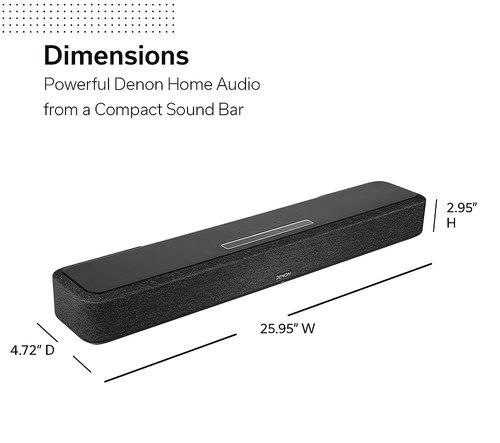
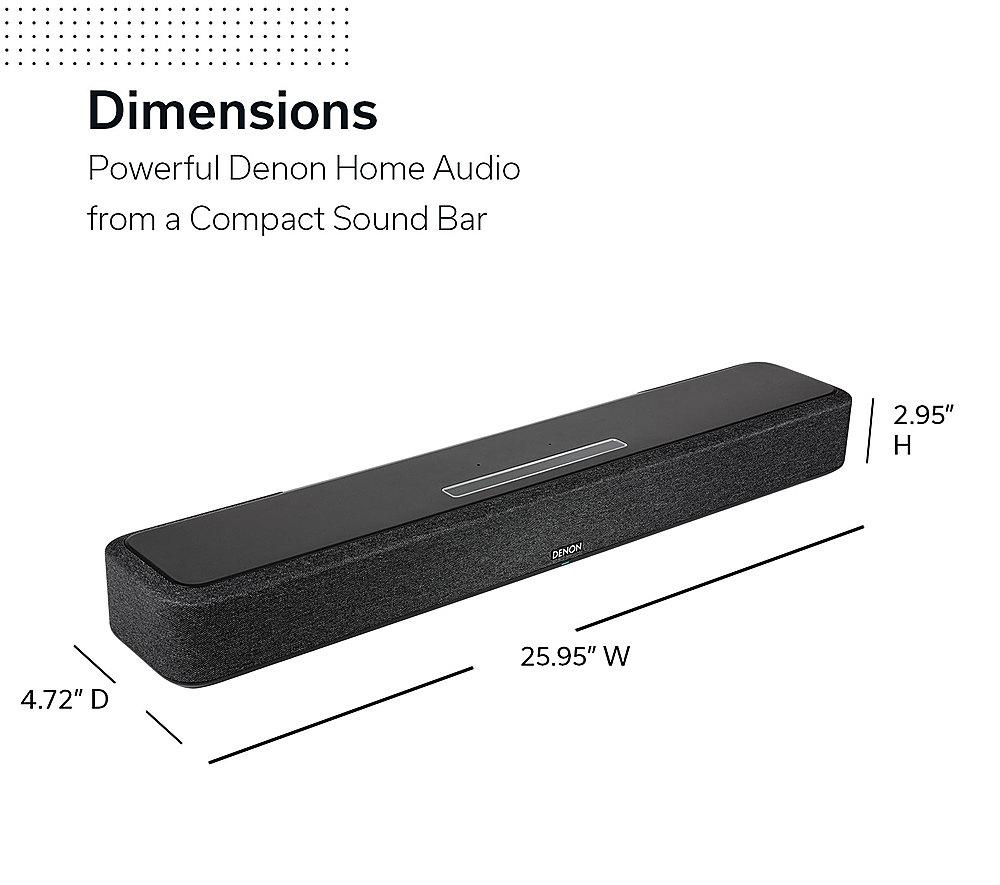
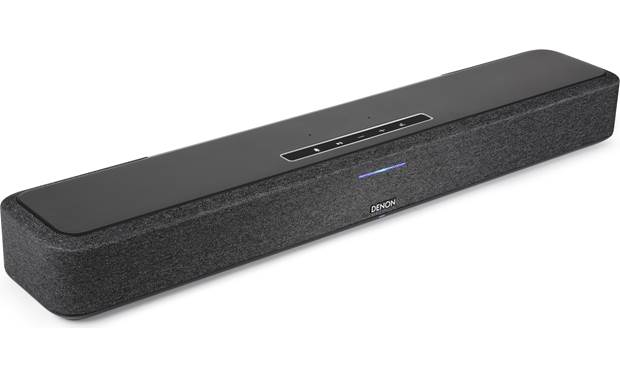
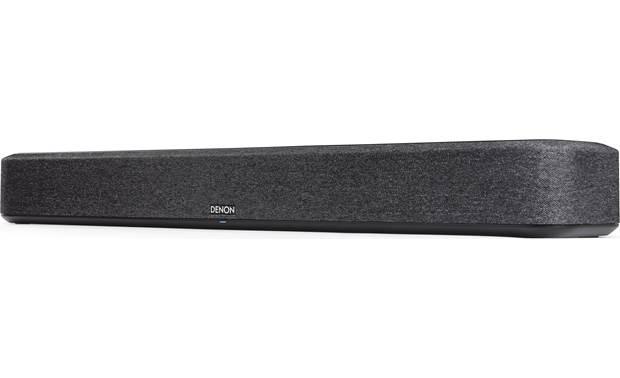
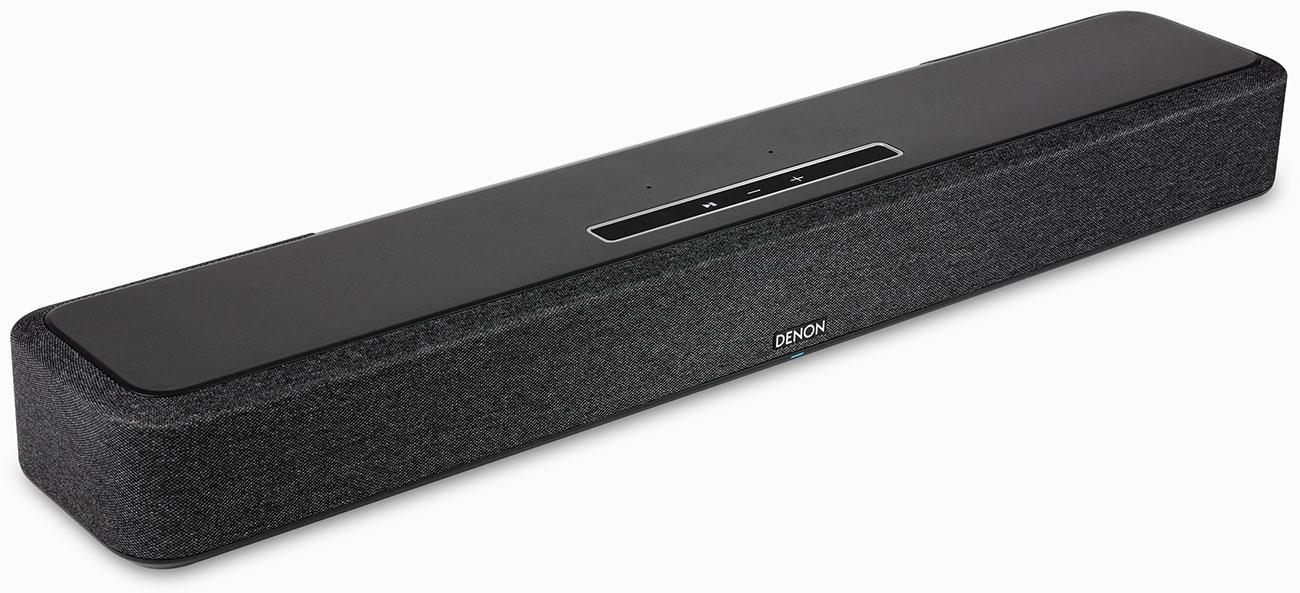
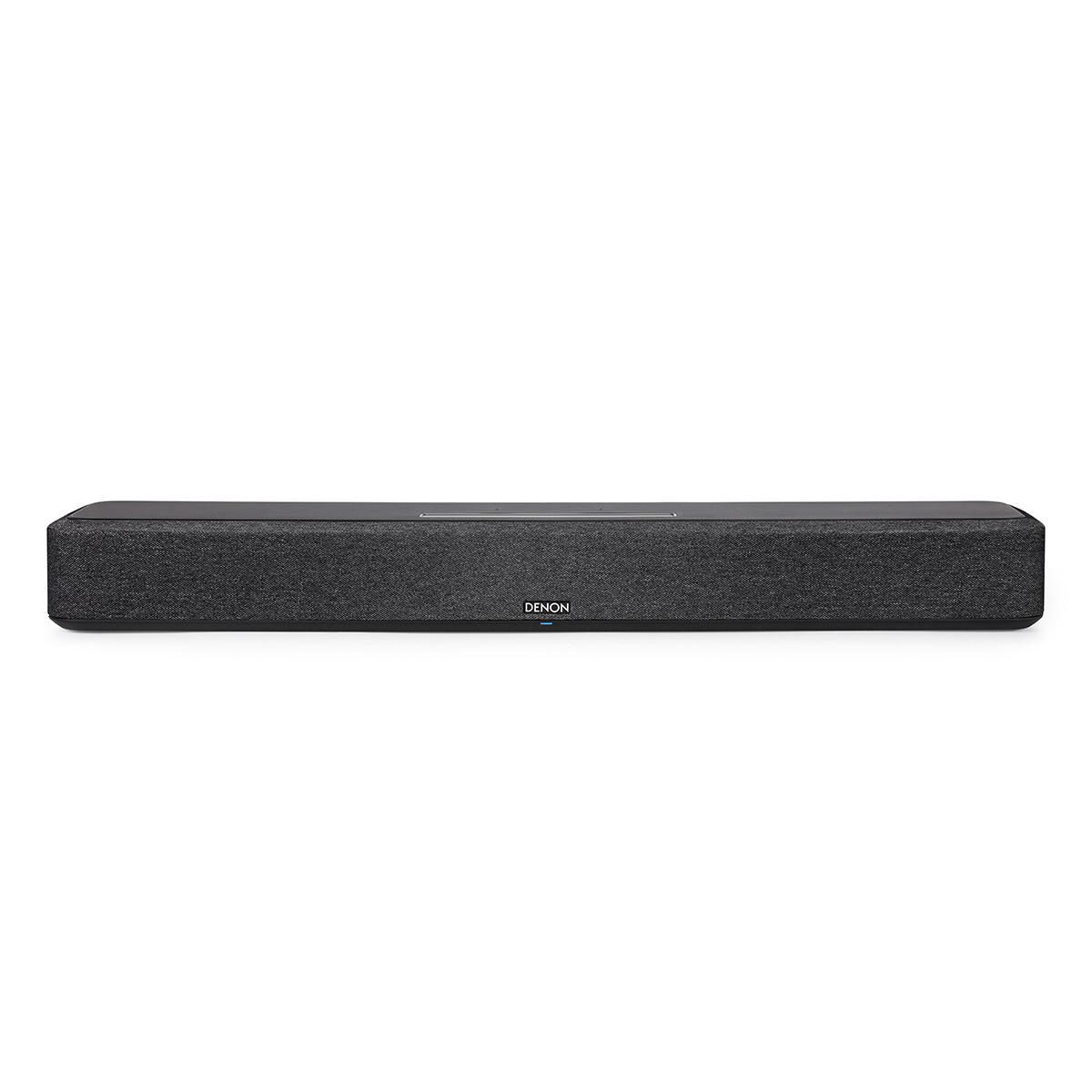
The Denon Home 550 represents the first approach: a compact 26-inch soundbar that uses virtual processing to create the illusion of surround sound. The Hisense HT Saturn represents the second: a complete 4.1.2 system with four satellite speakers and a subwoofer that connect wirelessly to create genuine surround sound.
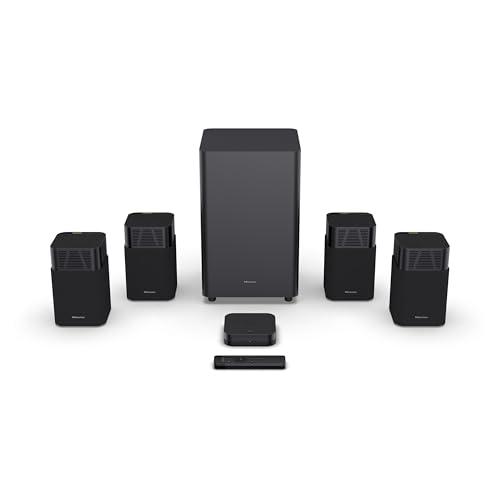
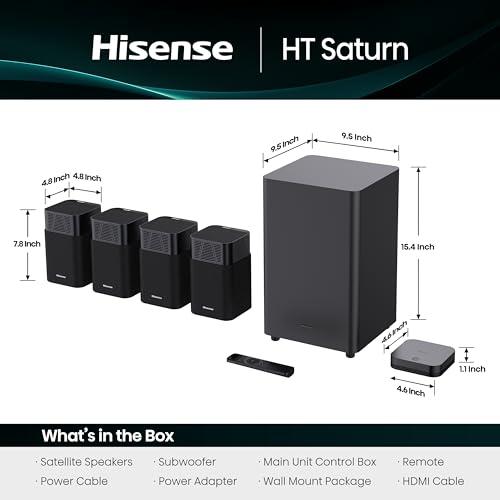
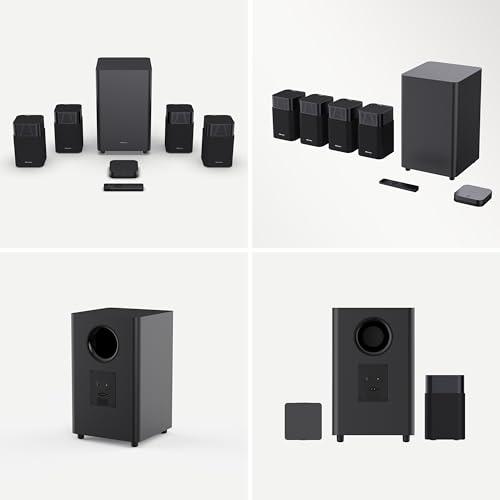
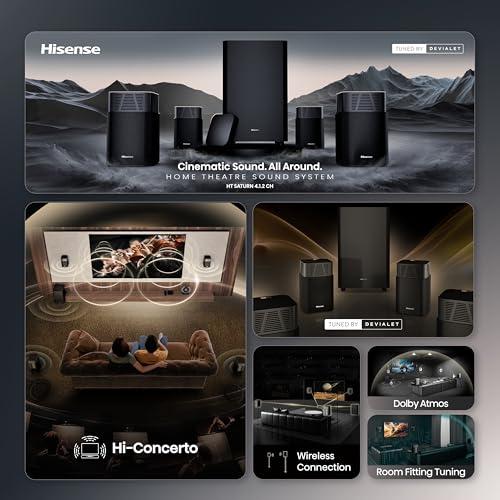
When Hisense released the HT Saturn in 2025, they weren't just making another soundbar – they were making a statement. The system includes a central control unit (think of it as the brain), four compact satellite speakers, and a 6.5-inch wireless subwoofer. That's 13 total speakers working together to fill your room with sound.
The most impressive technical achievement is the wireless coordination between all these components. The system uses three different wireless frequency bands (2.4GHz, 5.2GHz, and 5.8GHz) to maintain rock-solid connections between all speakers. This tri-band approach prevents the audio dropouts and delay issues that plague cheaper wireless speaker systems.
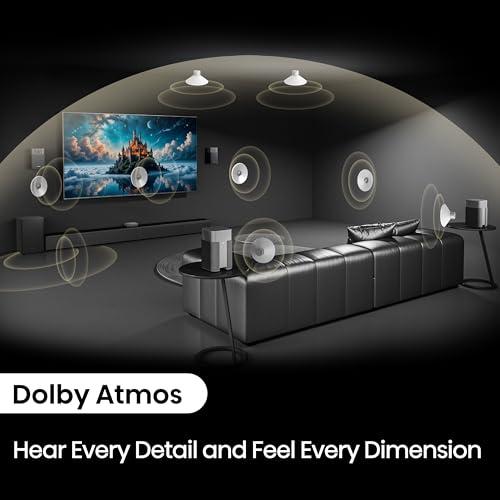
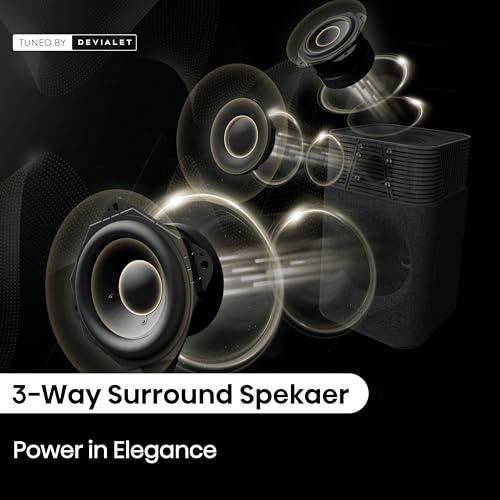
Each satellite speaker houses three drivers: two full-range drivers and a tweeter. This three-way design means each speaker can handle bass, midrange, and treble independently, creating much cleaner sound than single-driver satellite speakers. The upward-firing drivers in the front satellites bounce sound off your ceiling to create height effects for Dolby Atmos content – those moments when helicopters fly overhead or rain falls around you in movies.
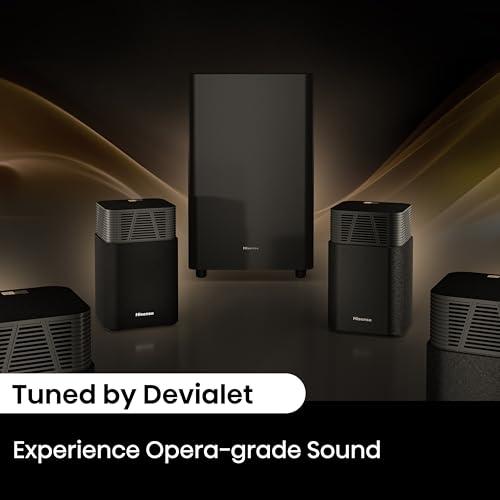
What sets the HT Saturn apart further is its tuning by Devialet, the French company known for ultra-high-end audio equipment costing tens of thousands of dollars. Devialet's involvement isn't just marketing – their acoustic engineers calibrated the crossover points, frequency response, and time alignment between all 13 speakers to work together seamlessly. The result is what they call "opera-grade" sound, meaning the kind of clarity and detail you'd expect in a concert hall.
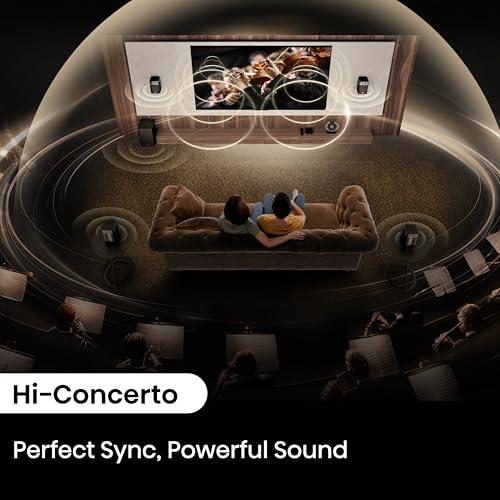
The system also includes Hi-Concerto technology, which is genuinely clever. When connected to a compatible Hisense TV, the HT Saturn can use the TV's built-in speakers as additional channels, essentially turning your TV into part of the sound system. This creates an even wider front soundstage and helps anchor dialogue to the screen more convincingly.
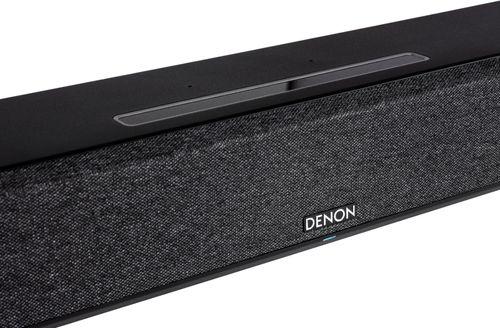
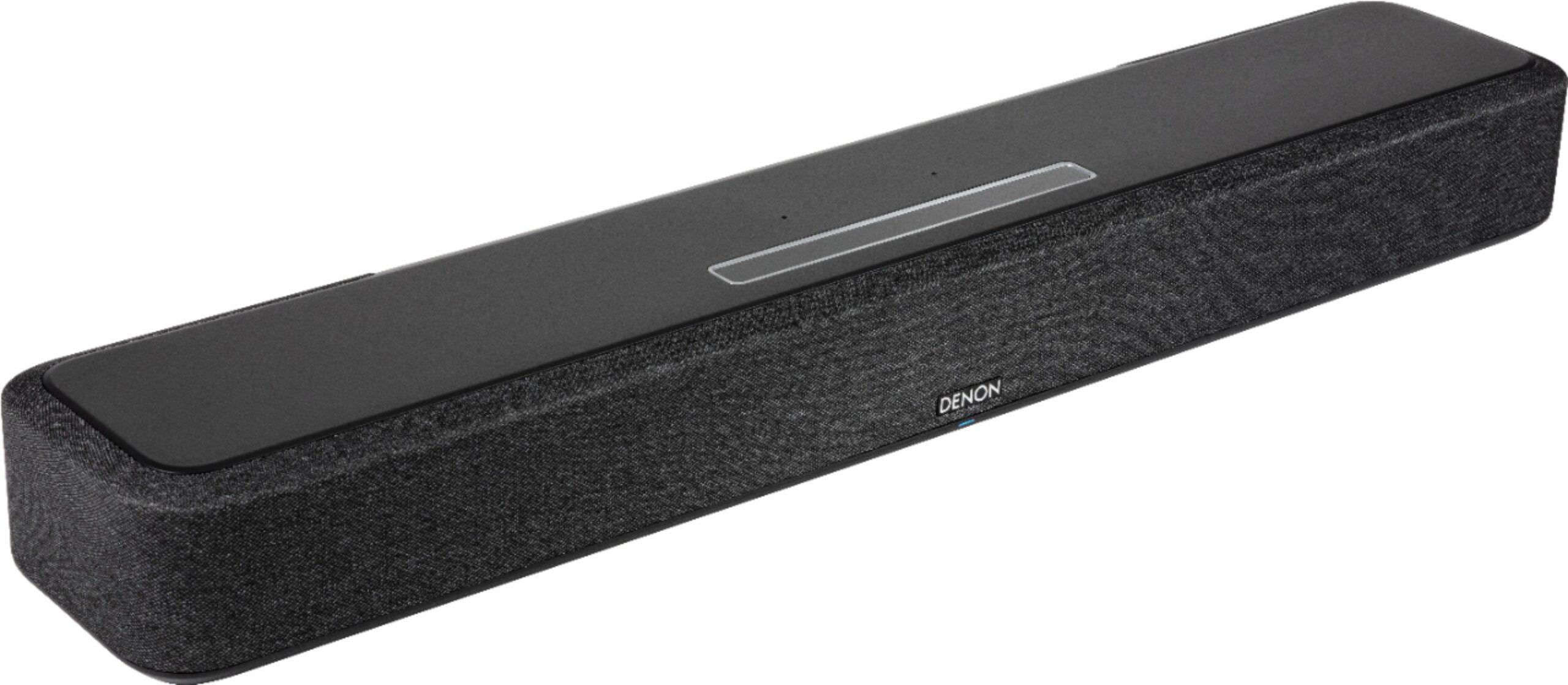
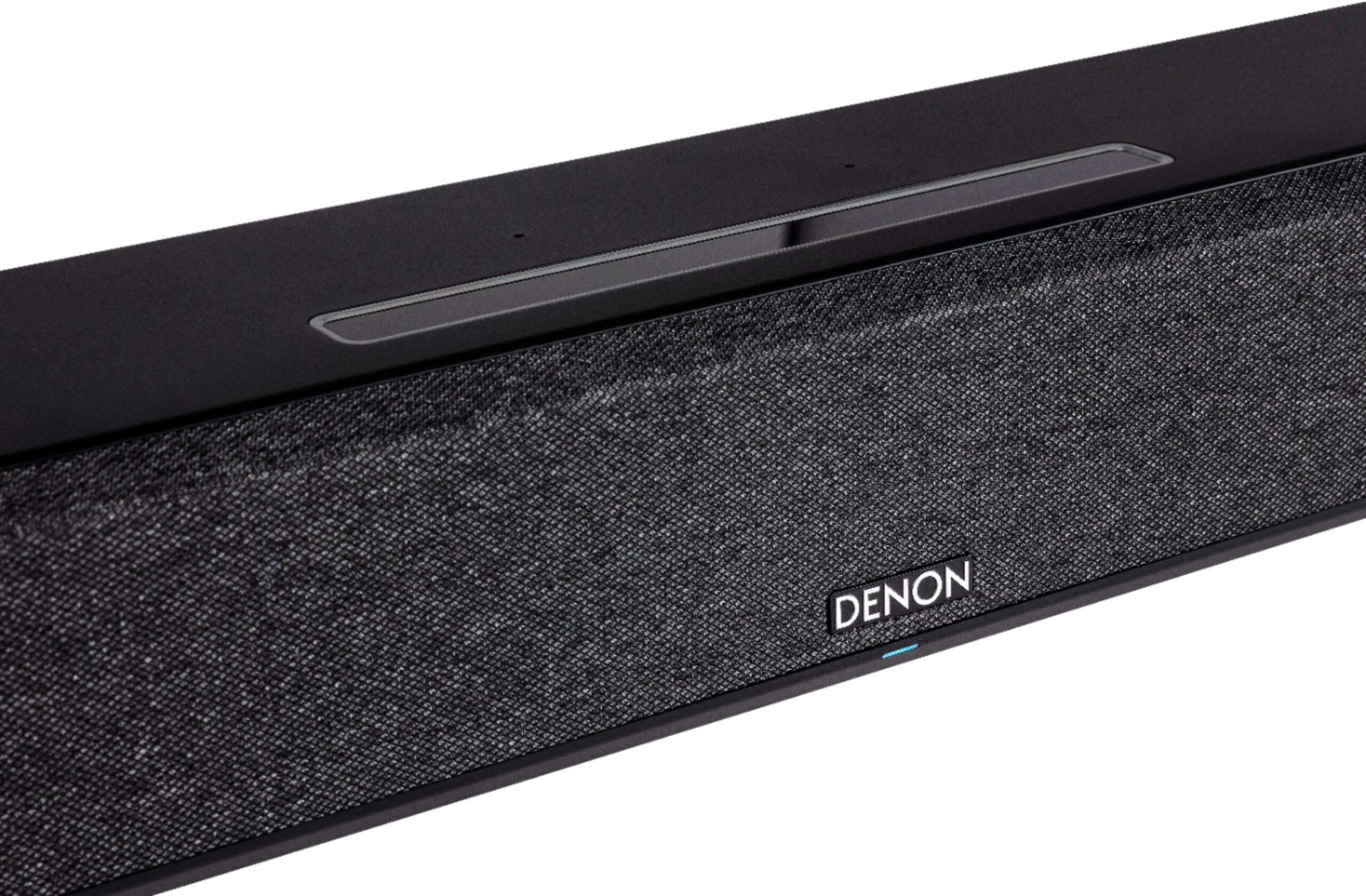
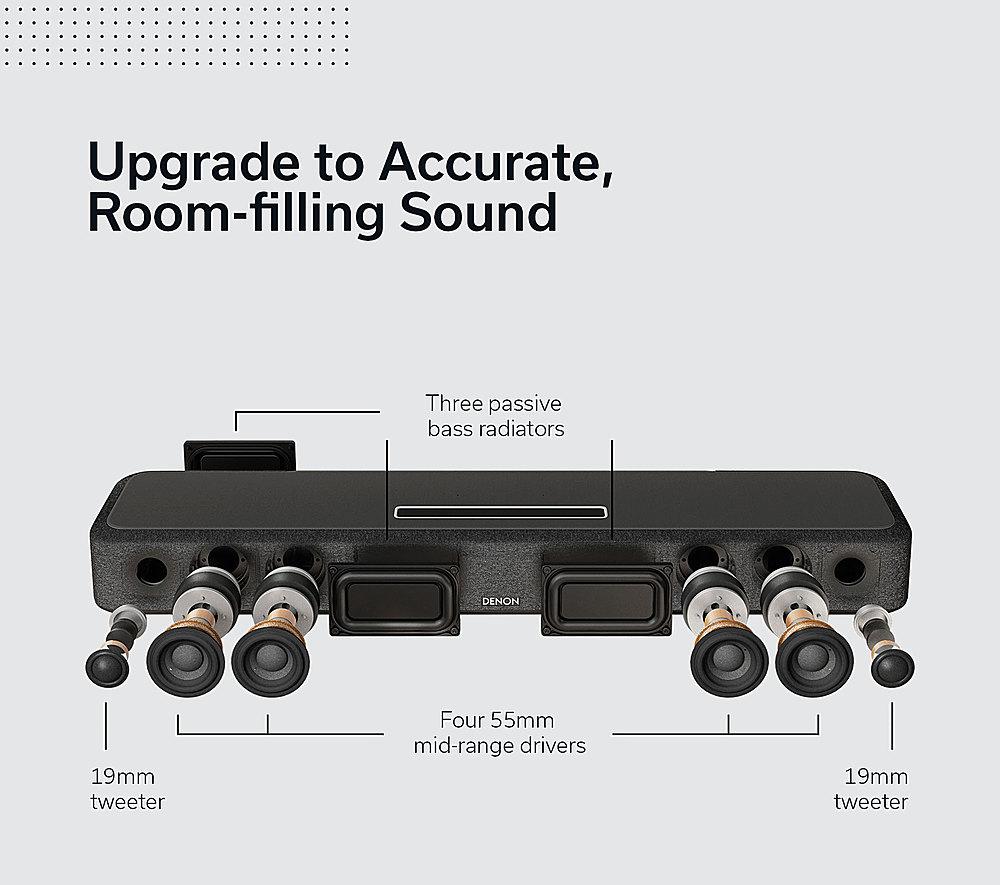
The Denon Home 550, released in 2021, takes the opposite approach. Instead of multiple speakers, it packs six drivers into a single 26-inch bar: four full-range drivers, two tweeters, and three passive radiators (which work like subwoofers to extend bass response). This design keeps things simple while still delivering meaningful audio improvements over TV speakers.
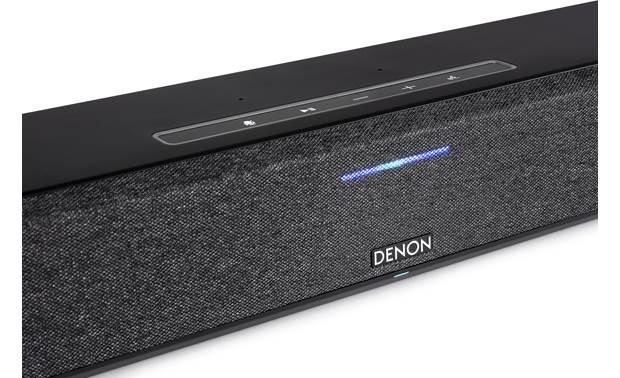
Where the Denon really shines is in its smart features. Built-in Amazon Alexa means you can control the soundbar with voice commands, adjust volume, switch inputs, or even control your smart home devices. The HEOS platform (Denon's multi-room audio system) lets you stream music from over 30 services directly to the soundbar, and it supports high-resolution audio up to 24-bit/192kHz – substantially better than CD quality.
The Home 550 also includes Apple AirPlay 2, so iPhone and Mac users can stream audio wirelessly with better quality and more stable connections than basic Bluetooth. The soundbar can even be part of a larger HEOS ecosystem, connecting with other Denon speakers throughout your home for synchronized multi-room audio.
For surround sound, the Denon relies on virtual processing. Advanced algorithms analyze incoming audio and use psychoacoustic principles (how your brain interprets sound direction) to create the impression that sounds are coming from beside and behind you, even though they're only coming from the front-facing soundbar.
Our research into professional reviews and user feedback reveals clear performance differences between these systems. The HT Saturn consistently receives praise for its genuinely immersive surround experience. When reviewers describe it as a "soundbar killer," they're referring to the fundamental difference between virtual and physical surround sound.
With the Hisense system, when a car drives around you in a movie, it actually travels between discrete speakers positioned around your room. This creates what audio engineers call "localization" – your brain can pinpoint exactly where sounds are coming from. The height channels add vertical dimension, so helicopters, rain, and atmospheric effects seem to come from above rather than just from the front.
The Devialet tuning becomes apparent in the system's ability to handle complex soundtracks. During quiet dialogue scenes, voices remain clear and centered despite having no dedicated center channel speaker. This "phantom center" effect requires precise calibration between the left and right front speakers – something Devialet excels at. In action scenes, the system maintains clarity even when all 13 speakers are working together, avoiding the muddy, congested sound that often plagues multi-speaker systems.
The Denon Home 550 takes a different approach to quality. Professional measurements show excellent THD (Total Harmonic Distortion) performance at normal listening levels, meaning the sound stays clean and undistorted. The dialogue enhancement feature genuinely helps with speech clarity, boosting the frequency ranges where human voices sit while reducing competing sounds.
However, the virtual surround processing has inherent limitations. While it can create a sense of width and some directionality, it can't truly place sounds behind you or create the precise localization of the HT Saturn. The effect works best in acoustically favorable rooms and depends heavily on your seating position.
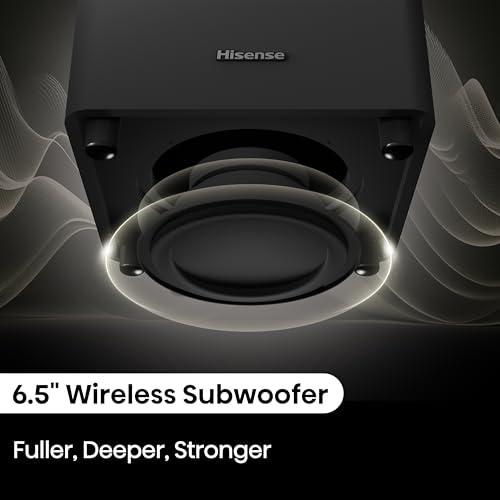
Bass reproduction reveals another key difference between these systems. The HT Saturn includes a dedicated 6.5-inch wireless subwoofer that extends frequency response down to 40Hz. This means you'll feel the rumble of explosions, the weight of musical bass lines, and the atmospheric impact that makes movies more engaging.
The wireless subwoofer design offers a significant practical advantage: you can place it wherever it sounds best in your room, whether that's in a corner to maximize output or along a wall to minimize resonance issues. This flexibility often makes the difference between boomy, overwhelming bass and tight, impactful low-frequency reproduction.
The Denon Home 550 uses three passive radiators to extend its bass response, which works better than you might expect from a soundbar-only solution. However, our analysis of user reviews consistently notes limitations with deep bass content. Action movies, electronic music, and modern film soundtracks often contain information below 50Hz that the Denon simply can't reproduce without an optional subwoofer (sold separately).
Power handling differences become apparent when you want to fill larger rooms or listen at reference levels (the volume cinemas use). The HT Saturn delivers between 500-720W of total power across its 13 speakers, providing substantial headroom for dynamic peaks in movie soundtracks.
Professional reviews note that the Denon Home 550 "doesn't get very loud" compared to systems with dedicated amplification for each driver. This isn't necessarily a problem for smaller rooms or apartment living, but it limits the system's ability to create the kind of immersive, enveloping sound that makes movies feel cinematic.
The dynamic range – the difference between the quietest and loudest sounds the system can reproduce – also favors the Hisense system. With separate speakers handling different frequency ranges and spatial zones, the system can simultaneously deliver subtle ambient details and powerful impact effects without compression or distortion.
The Denon Home 550 clearly wins the smart features comparison. Built-in Alexa voice control eliminates the need for a separate smart speaker, and the HEOS platform provides access to streaming services like Spotify, Amazon Music, and Tidal with higher quality than Bluetooth streaming.
Apple AirPlay 2 support is particularly valuable for iOS users, offering better quality and more reliable connections than Bluetooth, plus the ability to use the soundbar as part of Apple's multi-room audio system alongside HomePods and other AirPlay speakers.
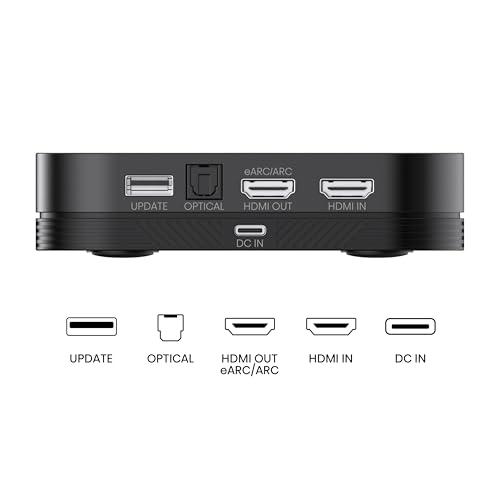
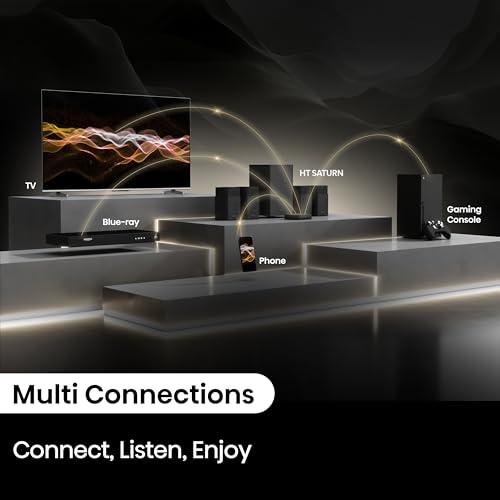
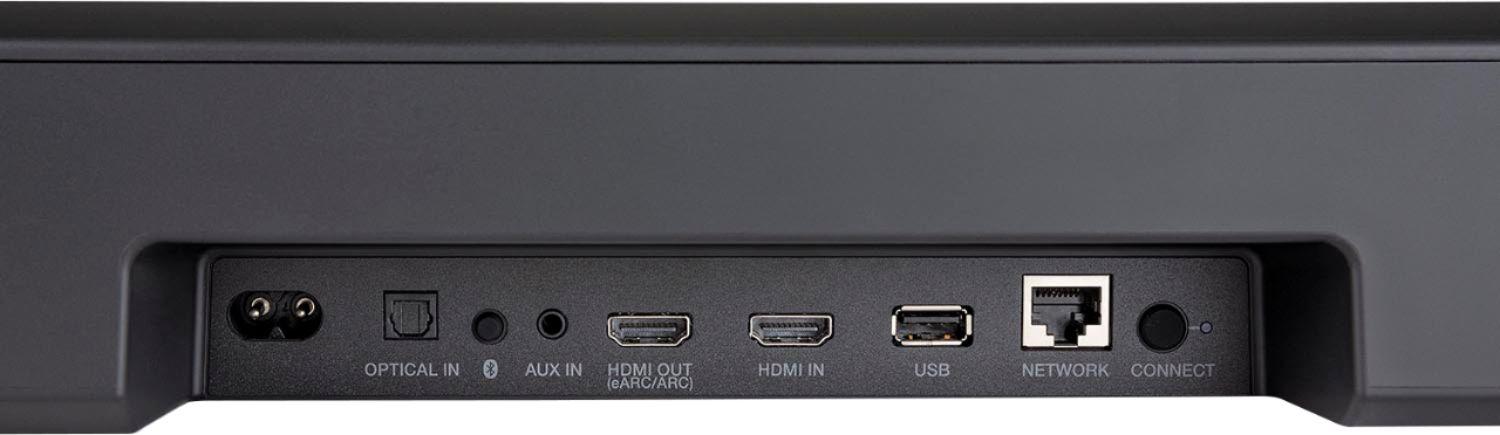
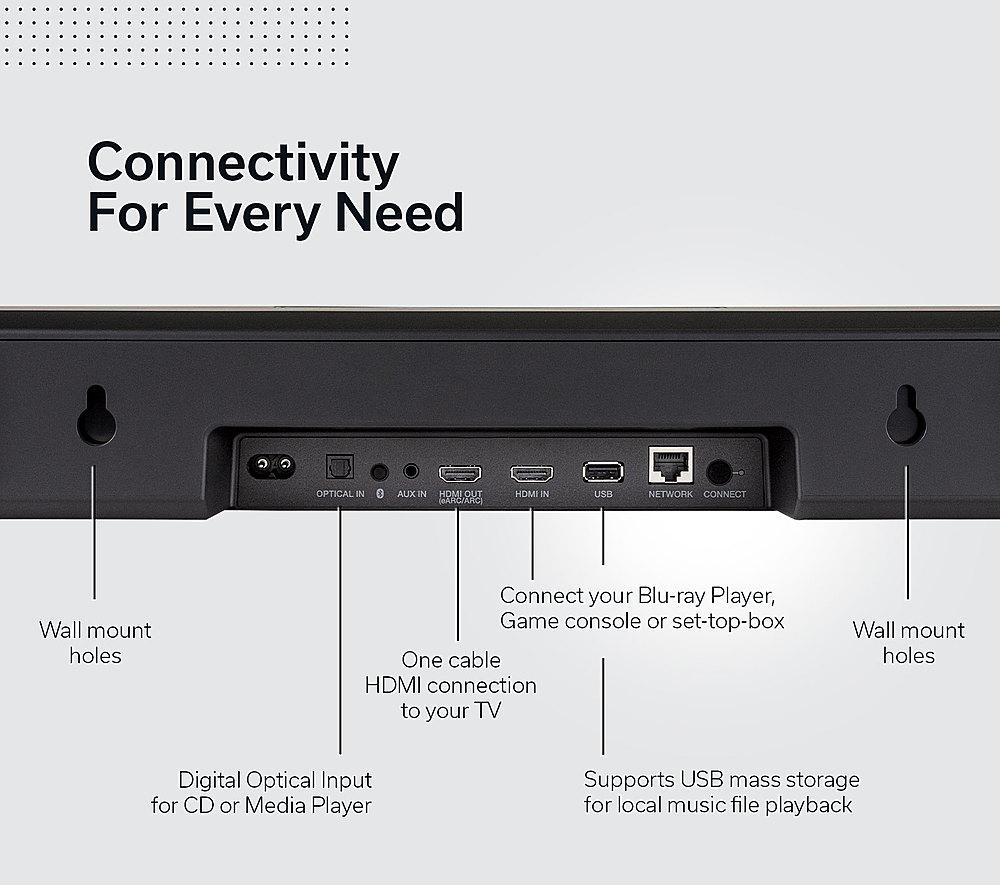
The HT Saturn takes a more focused approach to connectivity. Its HDMI eARC connection supports the latest lossless audio formats, and Bluetooth 5.3 provides better range and stability than the Denon's older Bluetooth 4.1 implementation. However, it lacks Wi-Fi connectivity entirely, limiting it to HDMI, optical, and Bluetooth sources.
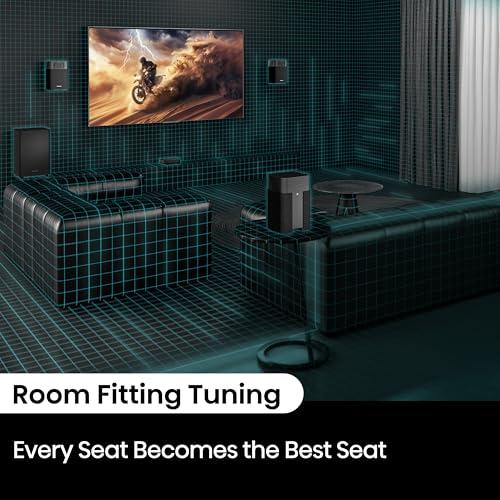
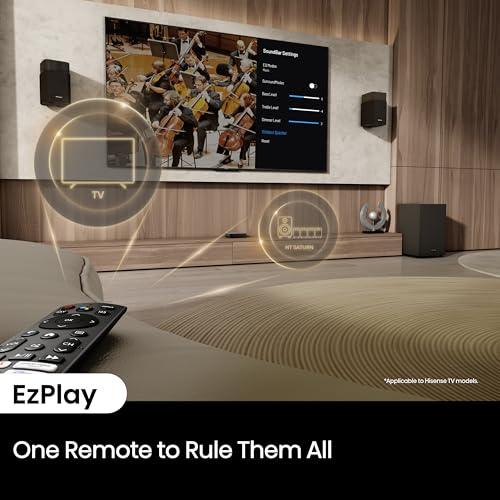
For integration with TVs, the Hisense system offers unique advantages if you own a compatible Hisense TV. The EZPlay feature lets you control the sound system directly from your TV's menu system using the TV remote, while Room Fitting Tuning automatically calibrates the system to your room's acoustics. These features represent the kind of tight integration that's only possible when the same company makes both the TV and sound system.
Setting up the Denon Home 550 couldn't be simpler: plug it in, connect one HDMI cable to your TV, and you're essentially done. The soundbar fits under virtually any TV 55 inches or larger, and wall-mounting requires only the included template and a few screws.
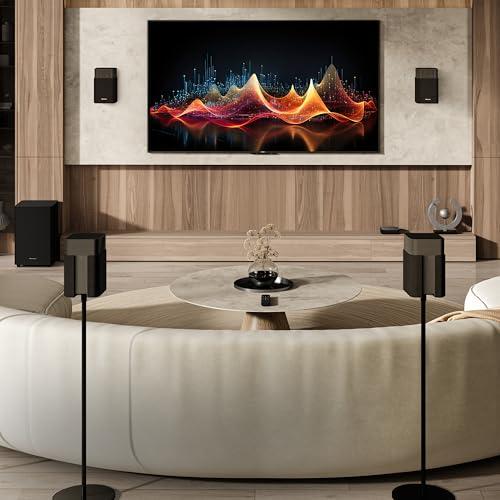
The HT Saturn requires more planning and effort. You need to position four satellite speakers around your seating area, each requiring access to power outlets. The good news is that all audio connections are wireless – you only need to plug each speaker into power, and they automatically pair with the control unit.
Finding optimal positions for the satellites is crucial for best performance. The rear speakers should be slightly behind and to the sides of your main seating position, while the front satellites need clear space above them for the upward-firing drivers to reflect off your ceiling effectively. This setup process takes longer than connecting a single soundbar, but the payoff in sound quality is substantial.
Both systems include wall-mounting hardware, though the HT Saturn's satellite speakers are more flexible in placement options. You can wall-mount them, place them on stands, or even put them on shelves or furniture – the wireless design eliminates the cable-running challenges of traditional surround systems.
At the time of writing, the price difference between these systems is significant, with the HT Saturn costing roughly double the Denon Home 550. This raises the fundamental question: is genuine surround sound worth the premium over virtual processing and smart features?
The HT Saturn essentially gives you what would traditionally require a complete home theater setup with AV receiver, five speakers, and subwoofer – all of which would cost significantly more if purchased separately from audio specialty brands. The Devialet tuning and wireless convenience justify much of the premium, especially considering comparable Devialet products cost many times more.
The Denon Home 550 represents excellent value in the smart soundbar category. You get meaningful audio improvements over TV speakers, comprehensive streaming capabilities, voice control, and multi-room expansion potential. For many users, these features provide better daily utility than ultimate sound quality.
The optional subwoofer for the Denon adds to the total cost but significantly improves bass performance. Even with this addition, the total price remains well below the HT Saturn, though you still won't achieve the same level of surround immersion.
The Hisense HT Saturn makes most sense for movie enthusiasts who prioritize audio quality above convenience features. If you have a dedicated home theater room or large living room where you can properly position the satellite speakers, and you watch significant amounts of surround-encoded content (movies, games, premium TV shows), the system delivers a genuinely cinematic experience that virtual processing can't match.
Hisense TV owners get additional value through the seamless integration features, making the HT Saturn particularly attractive if you're already in the Hisense ecosystem or planning a TV upgrade. The Hi-Concerto and Room Fitting technologies provide capabilities you simply can't get with other TV brands.
The Denon Home 550 is ideal for users who want significantly better audio than TV speakers without the complexity of multiple components. If you stream most of your content, value voice control and smart home integration, or have space constraints that make satellite speaker placement impractical, the Denon provides the best balance of performance and convenience.
Smart home enthusiasts will appreciate how the Denon integrates with existing Amazon Alexa setups and HEOS multi-room systems. If you're building a connected home audio system throughout multiple rooms, the HEOS platform provides a foundation for future expansion.
The Denon Home 550, released in 2021, represents mature soundbar technology with proven smart features. However, its older HDMI 2.0b standard lacks some gaming-specific features like Variable Refresh Rate (VRR) and Auto Low Latency Mode (ALLM) that newer systems support.
The HT Saturn, launching in 2025, incorporates newer wireless standards and processing technologies. Its three-band wireless system addresses connectivity issues that plagued earlier wireless speakers, while Bluetooth 5.3 provides better range and power efficiency than older standards.
Both systems support current surround formats (Dolby Atmos, DTS:X), but the HT Saturn's physical implementation will remain relevant longer than virtual processing approaches, which depend on continued software development and room acoustic assumptions that may not match your specific situation.
Choose the HT Saturn if you're serious about movie and gaming audio, have space for satellite speakers, own or plan to buy a Hisense TV, and want the best possible surround experience regardless of complexity. The Devialet tuning and genuine multi-channel design deliver performance that justifies the premium for audio enthusiasts.
Choose the Denon Home 550 if you want substantial audio improvement with minimal setup complexity, value smart features and streaming integration, or need a system that works excellently with any TV brand. The built-in voice control and multi-room capabilities provide daily convenience that many users find more valuable than ultimate sound quality.
Consider your room and lifestyle honestly. A well-positioned Denon soundbar with optional subwoofer often provides better practical results than improperly placed satellite speakers, while the HT Saturn's full potential requires commitment to optimal placement and room setup.
Both systems dramatically improve upon TV audio, but they serve different priorities: the Hisense maximizes performance for dedicated listening, while the Denon maximizes convenience for everyday use. Your choice depends on which philosophy better matches your space, budget, and entertainment habits.
| Hisense HT Saturn HTSATURN | Denon Home Sound Bar 550 |
|---|---|
| System Type - Determines immersion level and setup complexity | |
| Complete 4.1.2 wireless surround system with 4 satellites + subwoofer | Single soundbar with virtual surround processing |
| Speaker Configuration - More drivers typically mean better sound separation | |
| 13 total speakers: 4 satellites (3 drivers each) + 6.5" wireless subwoofer | 6 drivers in soundbar: 4 full-range + 2 tweeters + 3 passive radiators |
| Surround Sound Technology - Physical vs virtual affects realism | |
| True physical surround with rear/side speakers + upward-firing Atmos | Virtual surround processing with Dolby Height Virtualization |
| Power Output - Higher wattage enables louder, cleaner sound | |
| 500-720W total across all speakers | Not specified (professional reviews note "doesn't get very loud") |
| Audio Tuning - Premium tuning improves overall sound quality | |
| Tuned by Devialet (French high-end audio specialists) | Standard Denon tuning with dialogue enhancement |
| Smart Features - Voice control and streaming add daily convenience | |
| Basic remote control, Hi-Concerto TV integration | Amazon Alexa built-in, HEOS multi-room, Apple AirPlay 2 |
| Connectivity Standards - Newer standards offer better performance | |
| HDMI eARC, Bluetooth 5.3, tri-band wireless (2.4/5.2/5.8GHz) | HDMI eARC, Bluetooth 4.1, Wi-Fi for streaming |
| Installation Complexity - Balance between performance and convenience | |
| Requires positioning 4 satellites + subwoofer (wireless connections) | Single soundbar placement under TV |
| Room Size Suitability - Larger rooms need more power and coverage | |
| Medium to large rooms (genuine surround coverage) | Small to medium rooms (virtual processing limitations) |
| TV Integration - Brand matching unlocks additional features | |
| Seamless integration with Hisense TVs (Room Fitting, EZPlay control) | Works with any TV brand, no special integration |
| Expandability - Future upgrade potential | |
| Complete system, no expansion options | Optional subwoofer, connects to HEOS multi-room system |
| Bass Extension - Lower frequencies add impact to movies/music | |
| 40Hz with included 6.5" wireless subwoofer | Limited bass without optional subwoofer (sold separately) |
The Hisense HT Saturn is a complete wireless surround system with four satellite speakers and a subwoofer that creates true physical surround sound. The Denon Home Sound Bar 550 is a single soundbar that uses virtual processing to simulate surround effects. The HT Saturn delivers genuine 360-degree audio, while the Denon focuses on simplicity and smart features.
The Hisense HT Saturn is superior for movies and home theater due to its physical surround speakers that place sound effects around your room. It supports Dolby Atmos with real height channels and includes a dedicated subwoofer for deep bass. The Denon Home 550 works well for casual movie watching but can't match the immersive experience of the HT Saturn's true surround setup.
The Hisense HT Saturn includes a 6.5-inch wireless subwoofer in the package, providing deep bass down to 40Hz. The Denon Home Sound Bar 550 has built-in bass drivers but limited low-frequency extension - you'll need to purchase an optional subwoofer separately for full bass impact with the Denon.
The Denon Home Sound Bar 550 is much easier to install - just place the soundbar under your TV and connect one HDMI cable. The Hisense HT Saturn requires positioning four satellite speakers around your room, though all connections are wireless and only need power outlets. Setup complexity favors the Denon for convenience.
The Denon Home Sound Bar 550 has Amazon Alexa built-in for full voice control of volume, inputs, and smart home devices. The Hisense HT Saturn doesn't include voice control but can be controlled through compatible Hisense TV menus using your TV remote.
The Denon Home Sound Bar 550 is better suited for small rooms due to its compact single-unit design and virtual surround processing that doesn't require space for multiple speakers. The Hisense HT Saturn needs adequate room for satellite speaker placement and performs best in medium to large spaces.
The Denon Home Sound Bar 550 excels at wireless streaming with built-in Wi-Fi, HEOS multi-room platform, and Apple AirPlay 2 support. The Hisense HT Saturn only offers Bluetooth 5.3 streaming without Wi-Fi capabilities, making the Denon the clear winner for streaming music services.
The Hisense HT Saturn delivers superior sound quality with its Devialet tuning, 13 total speakers, and true surround sound positioning. While the Denon Home Sound Bar 550 offers good sound quality with clean dialogue enhancement, it can't match the HT Saturn's immersive audio experience and powerful amplification.
The Denon Home Sound Bar 550 can expand as part of the HEOS multi-room ecosystem with additional Denon speakers throughout your home. The Hisense HT Saturn is a complete, non-expandable system - you get all components included but cannot add more speakers later.
Value depends on your priorities. The Denon Home Sound Bar 550 offers excellent value for smart features, streaming capabilities, and decent sound improvement at a lower price point. The Hisense HT Saturn provides premium value for serious audio enthusiasts who want the best possible surround sound experience.
The Denon Home Sound Bar 550 works with any TV brand and connects via standard HDMI or optical connections. The Hisense HT Saturn works with any TV but unlocks special features like Hi-Concerto integration and Room Fitting calibration only with compatible Hisense TVs.
The Hisense HT Saturn is superior for gaming due to its true surround sound that accurately positions game audio effects around you, plus powerful bass for impactful explosions and music. While the Denon Home 550 works fine for gaming, it can't provide the same level of spatial immersion as the HT Saturn's physical speaker placement.
We've done our best to create useful and informative comparisons to help you decide what product to buy. Our research uses advanced automated methods to create this comparison and perfection is not possible - please contact us for corrections or questions. These are the sites we've researched in the creation of this article: bestbuy.com - youtube.com - blog.son-video.com - youtube.com - youtube.com - techradar.com - ecoustics.com - jbhifi.com.au - shop.hisense-usa.com - bhphotovideo.com - bestbuy.com - digitalreviews.net - hisense-usa.com - projectorscreenstore.com - valueelectronics.com - dolby.com - giftpack.ai - consumerreports.org - soundandvision.com - crutchfield.com - rtings.com - crutchfield.com - gzhls.at - denon.com - walmart.com - youtube.com - whathifi.com - bestbuy.com

Privacy Policy
Terms and Conditions - Affiliate Policy
Home Security
© Copyright 2008-2026.
11816 Inwood Rd #1211, Dallas, TX 75244