

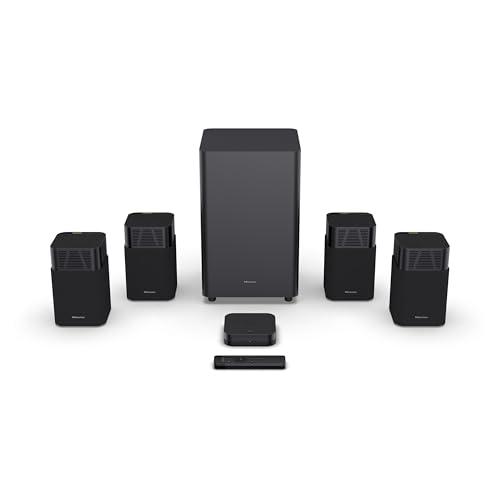





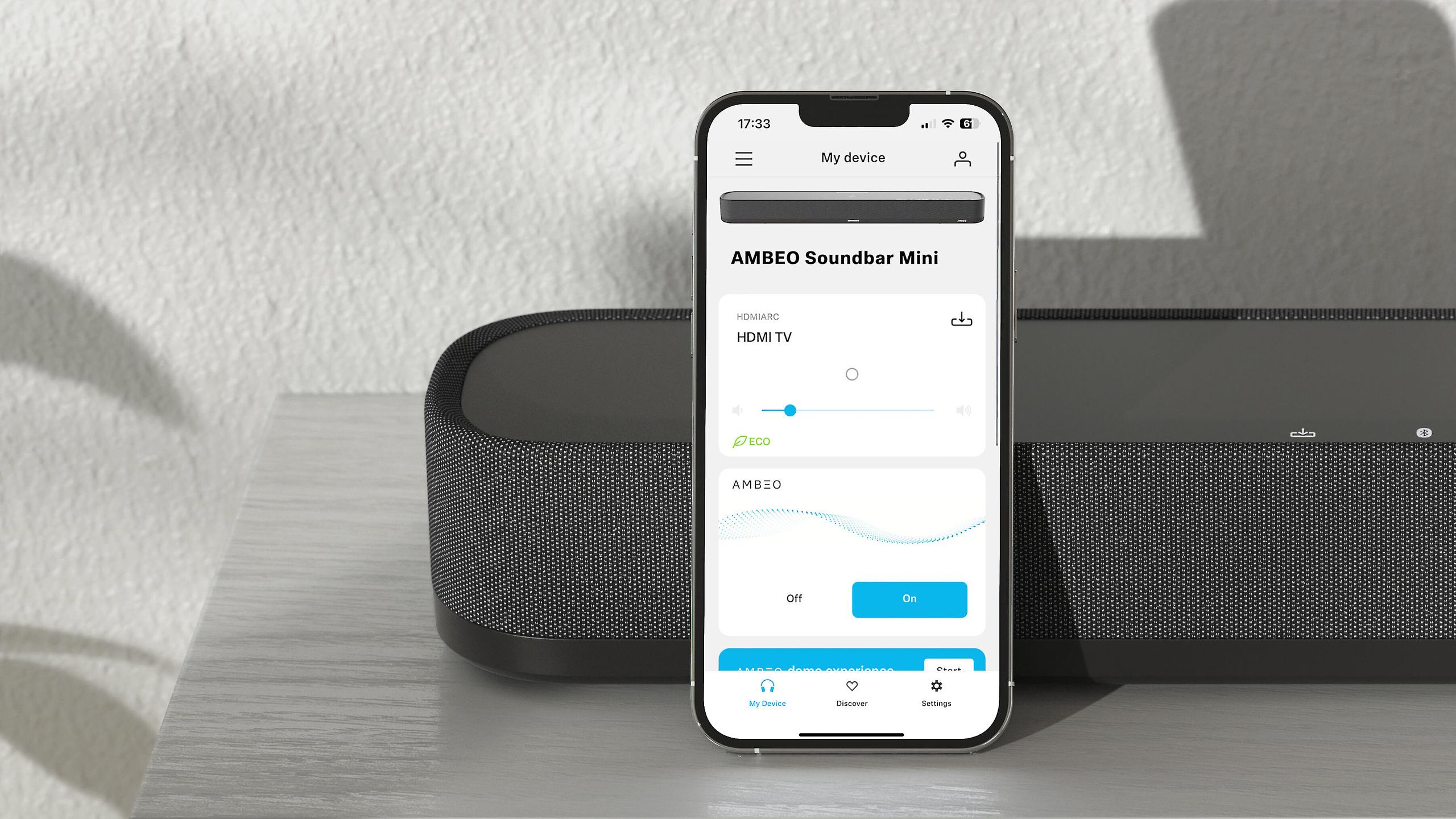
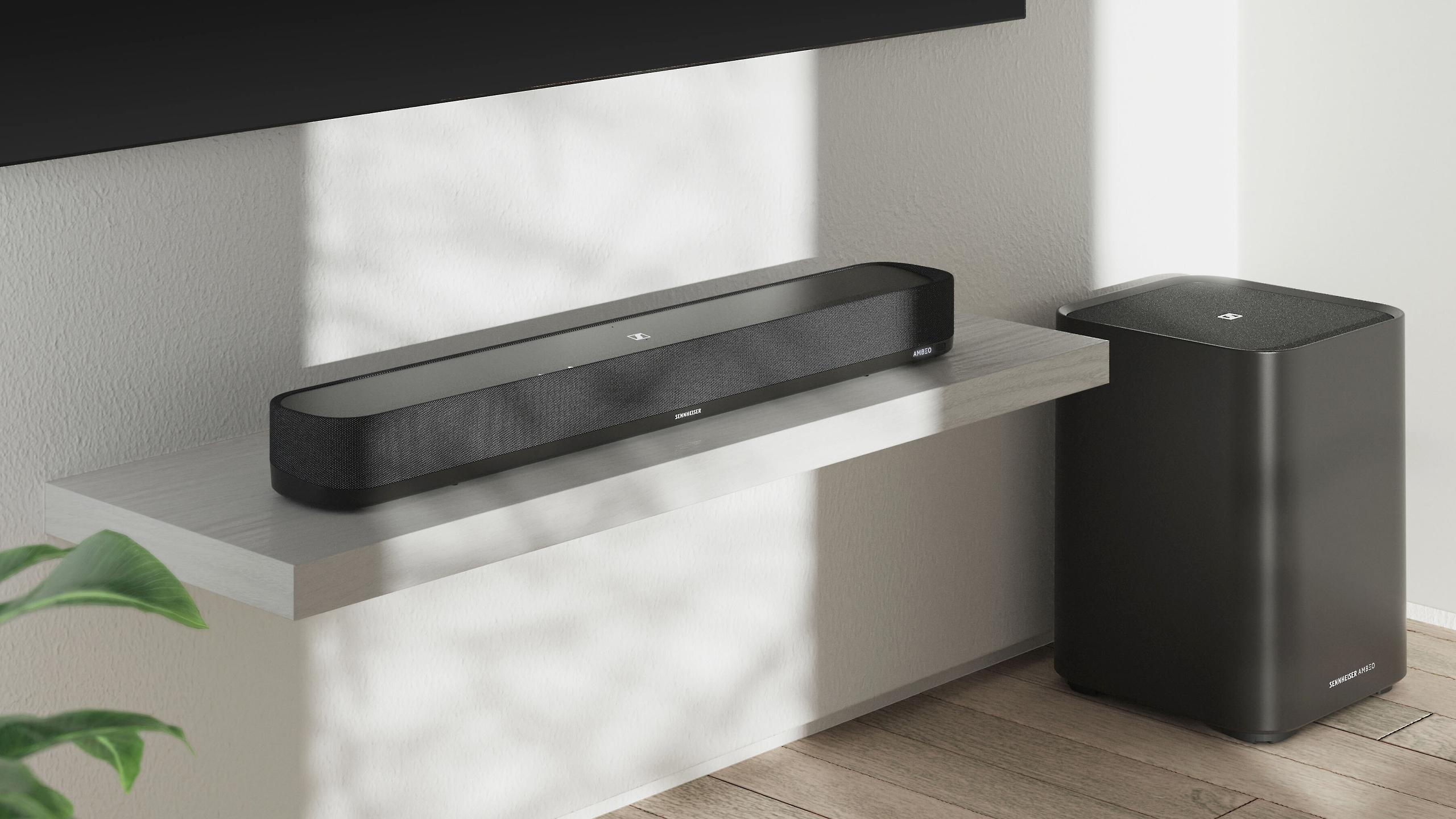
The world of home theater audio has evolved dramatically over the past few years, with manufacturers taking two distinct approaches to delivering that coveted "cinema at home" experience. On one hand, we have systems like the Hisense HT Saturn HTSATURN, which launched in 2024 as part of the latest wave of true wireless surround systems. On the other, there's the Sennheiser AMBEO Soundbar Mini, released in 2023, representing the pinnacle of single-unit spatial audio processing.
Both products aim to solve the same fundamental problem: how do you get genuinely immersive surround sound without running speaker wires throughout your room or dealing with the complexity of traditional AV receivers? However, they take radically different approaches, and understanding these differences is crucial to making the right choice for your specific situation.
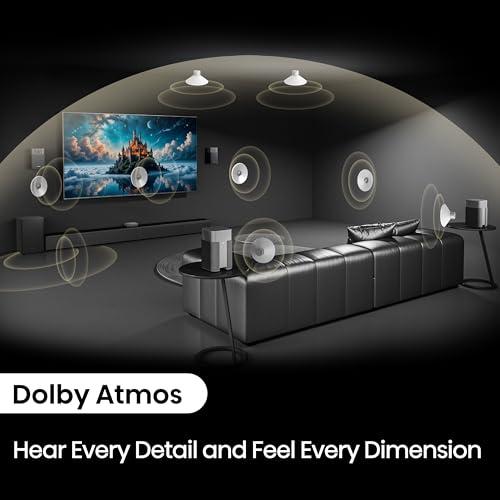
Before diving into the specifics, it's helpful to understand what we mean by immersive audio. Traditional surround sound uses multiple speakers placed around your room to create the illusion that sounds are coming from different directions—like a helicopter flying overhead in a movie or footsteps approaching from behind. The latest evolution of this concept is object-based audio formats like Dolby Atmos and DTS:X, which don't just move sounds around horizontally but also add a vertical dimension, creating a true three-dimensional sound bubble around you.
The challenge has always been installation complexity. Running wires to rear speakers and mounting ceiling speakers for height effects requires significant effort and often permanent modifications to your room. This is where modern wireless systems and advanced soundbar processing come in, each offering different solutions to this age-old problem.
The Hisense HT Saturn represents what many consider the logical evolution of home theater systems. Released in 2024, it earned the prestigious EISA Best Product Award for 2025-2026, recognizing its innovative approach to wireless surround sound. Rather than trying to simulate surround effects from a single point, this system gives you actual speakers positioned around your room—just without the wires.
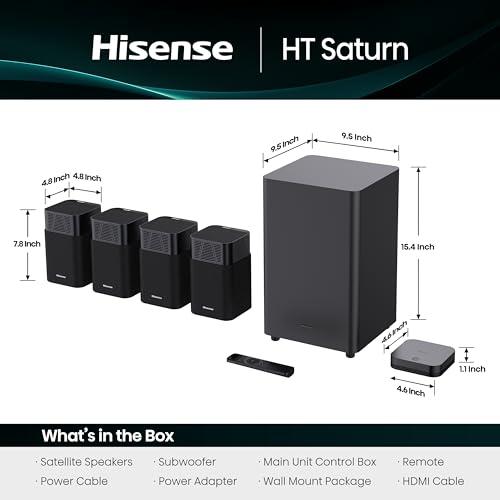
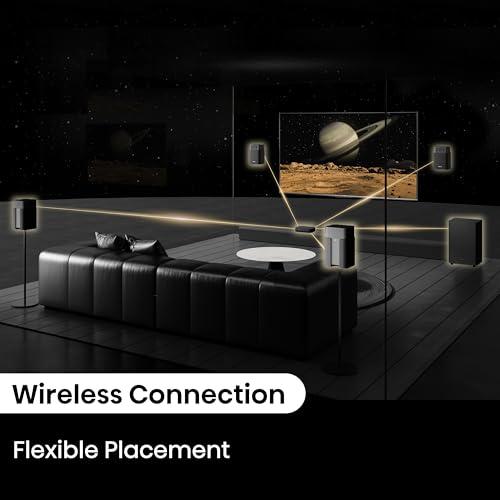
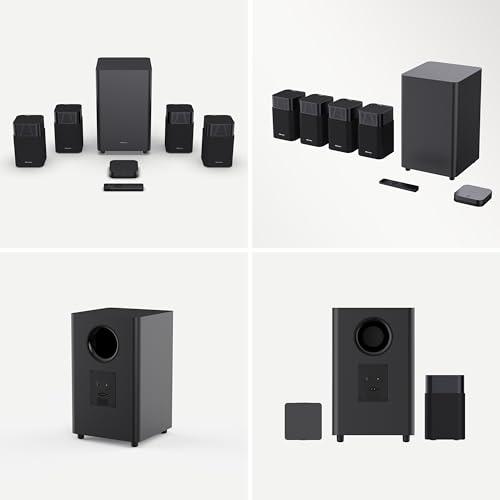
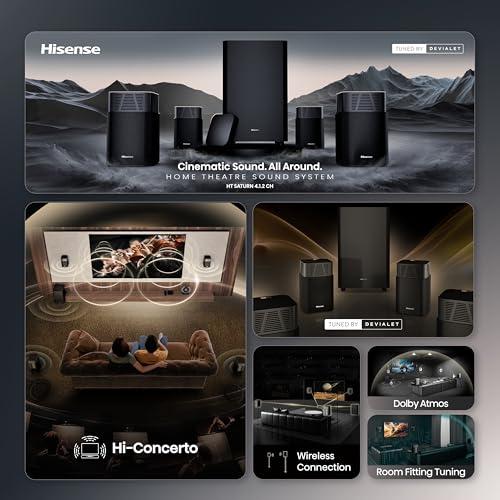
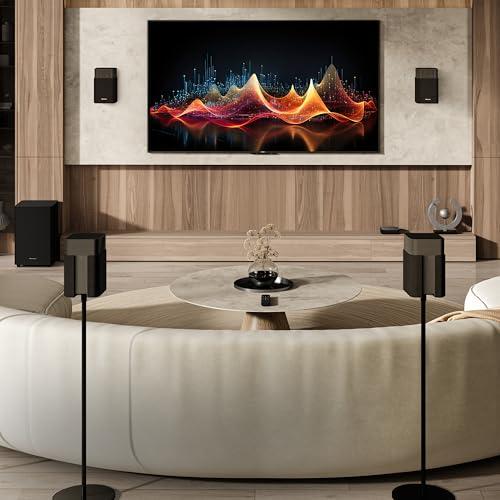
The HT Saturn consists of six separate components: a central control unit, four satellite speakers, and a wireless subwoofer. This creates what's technically called a 4.1.2 system—four main channels (front left/right, rear left/right), one subwoofer channel, and two height channels for Dolby Atmos effects. The magic happens through a sophisticated tri-band wireless system operating on 2.4GHz, 5.2GHz, and 5.8GHz frequencies simultaneously. This multi-frequency approach ensures rock-solid connections between all components while minimizing interference from your Wi-Fi network and other wireless devices.
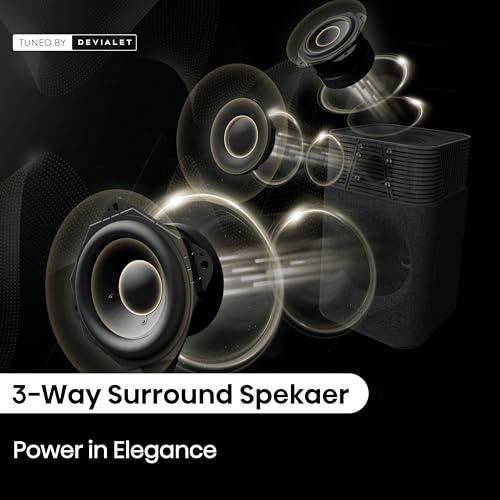
Each satellite speaker is essentially a miniature three-way speaker system, packing multiple full-range drivers and a precision tweeter into a compact 4.8-inch cube. The system includes up-firing drivers that bounce sound off your ceiling to create those crucial overhead effects that make Dolby Atmos so immersive. When properly positioned, these 13 total speakers work together to create a genuine 360-degree sound field that physically surrounds you.
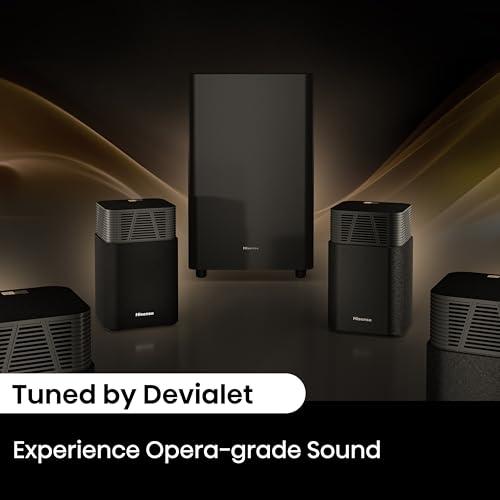
What sets the HT Saturn apart from typical wireless systems is its tuning by Devialet, the French audio company known for their high-end speakers that can cost as much as a small car. Devialet's involvement isn't just marketing—they've applied their acoustic engineering expertise to optimize how all these speakers work together. This includes sophisticated crossover design (how different frequencies are distributed between speakers) and phase alignment (ensuring sound waves from different speakers arrive at your ears in perfect timing).
The result is what reviewers consistently describe as "opera-grade" sound quality, with exceptional clarity across the entire frequency spectrum. Despite not having a dedicated center channel speaker, the system creates what's called a "phantom center" that positions dialogue with remarkable precision between the front left and right speakers.
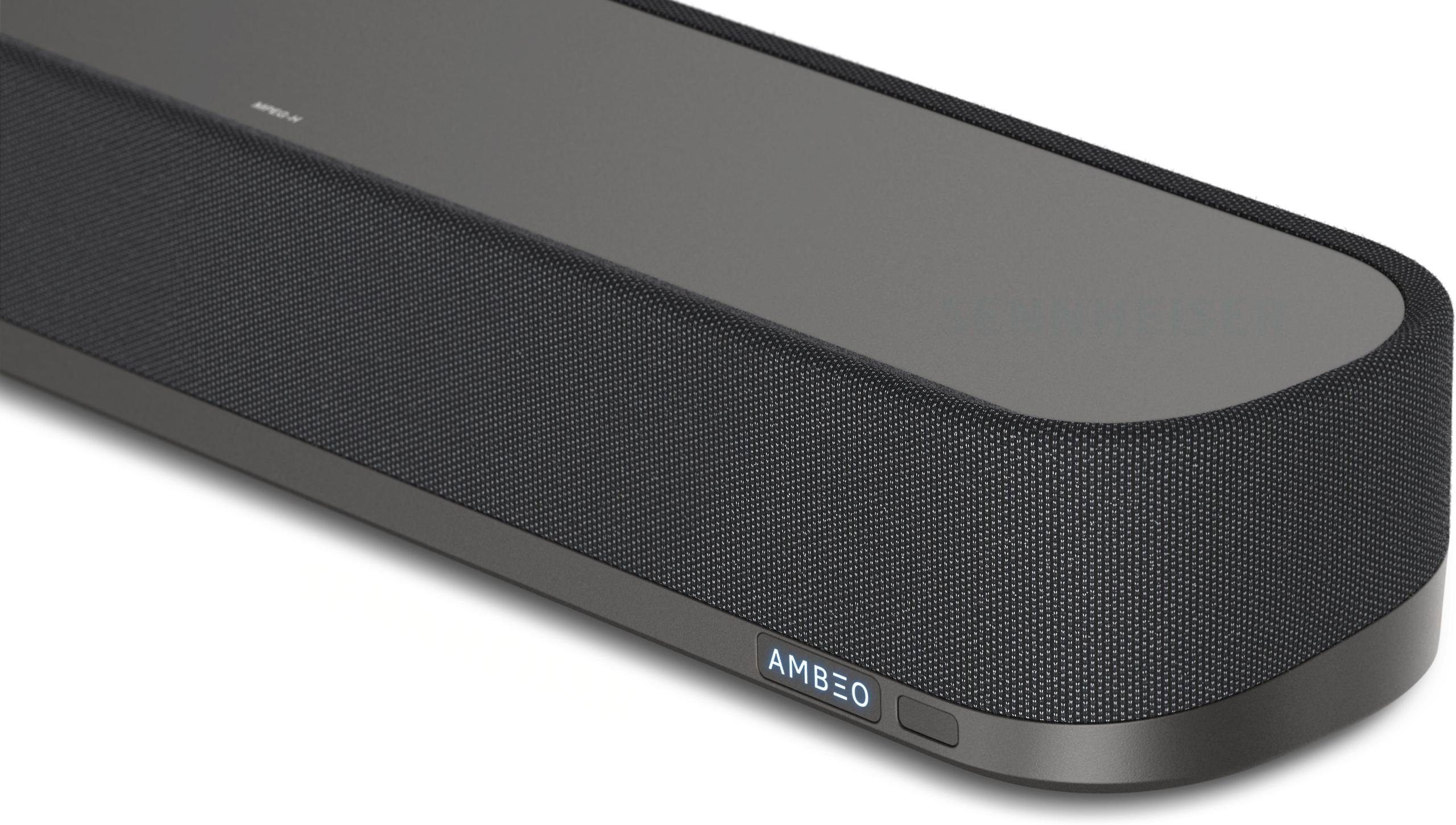
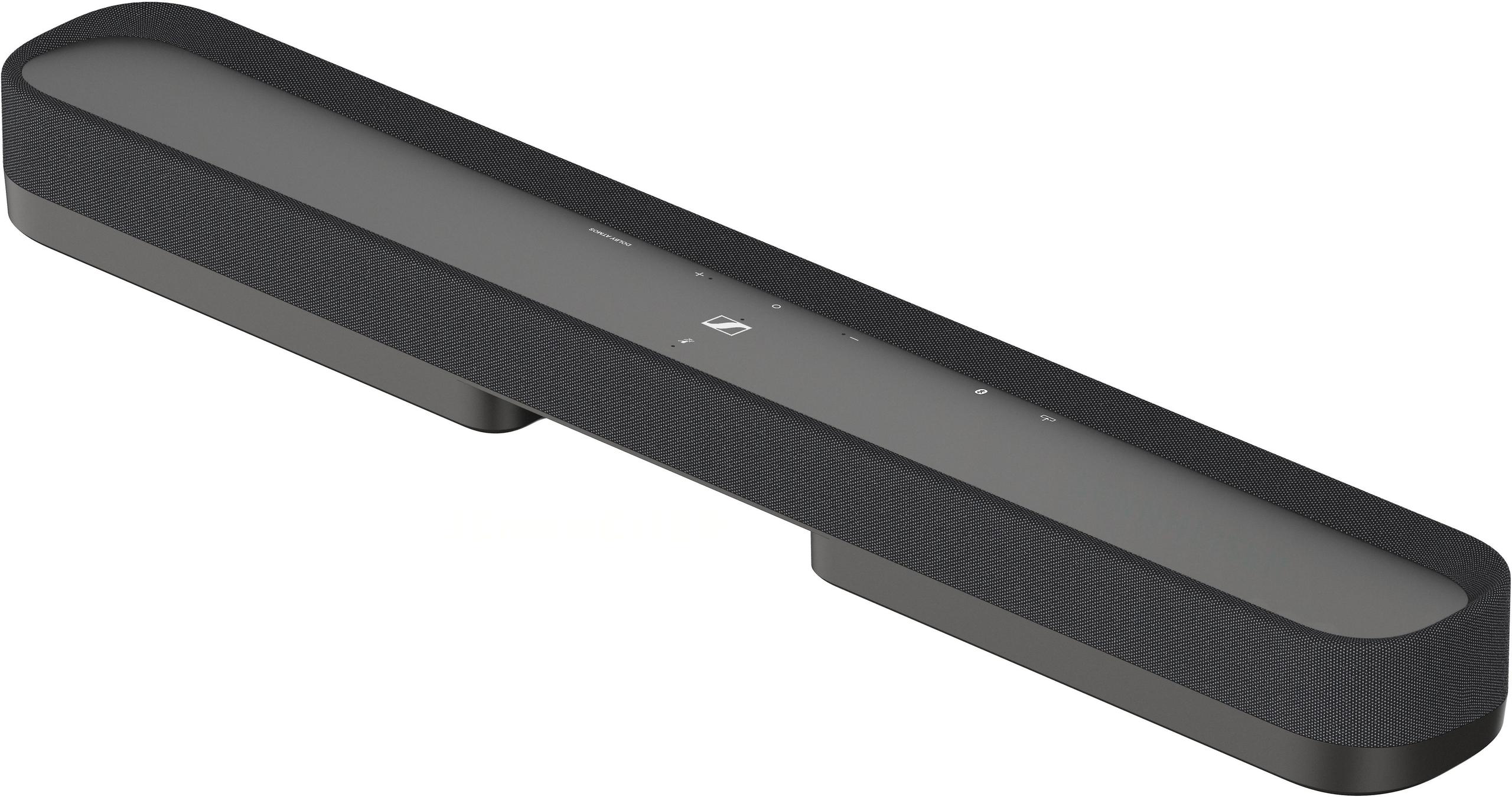
The Sennheiser AMBEO Soundbar Mini, launched in 2023, takes a completely different approach to the same problem. Instead of using multiple physical speakers, it employs advanced digital signal processing to create virtual surround effects from a single compact unit. This represents the latest evolution in spatial audio processing, building on research that Sennheiser conducted with Germany's Fraunhofer Institute.
The AMBEO technology is essentially an extremely sophisticated audio illusion. The soundbar analyzes incoming audio signals and applies complex mathematical algorithms to manipulate the sound waves in ways that trick your brain into perceiving sounds as coming from locations where there are no physical speakers. It uses techniques like head-related transfer functions (HRTF)—basically a mathematical model of how your ears and brain naturally process spatial audio cues.
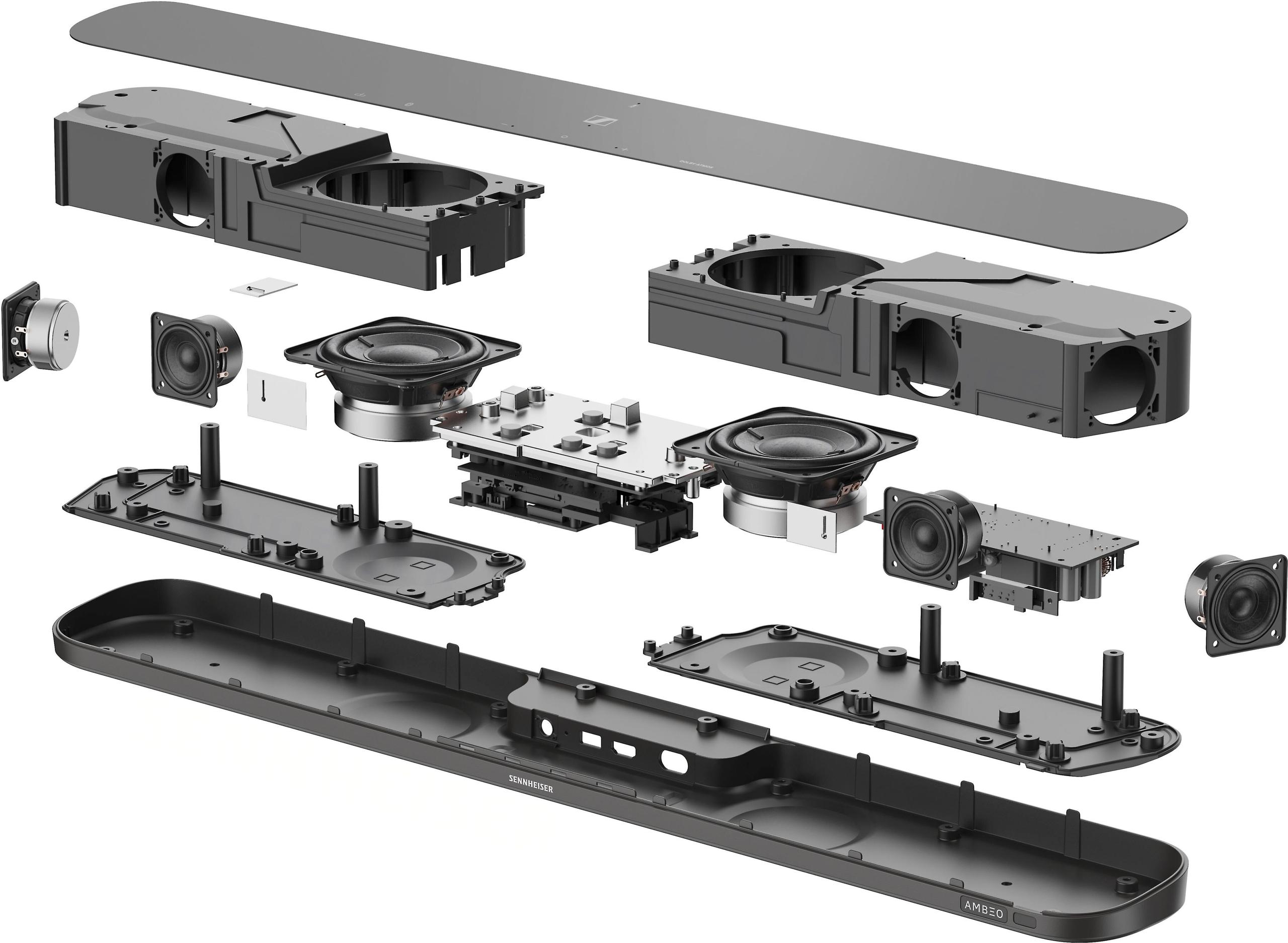
The AMBEO Mini includes four high-precision microphones that perform automatic room calibration when you first set it up. This process measures how sound reflects off your walls, ceiling, and furniture, then adjusts the processing algorithms accordingly. The result can be surprisingly convincing, with many reviewers reporting genuine surround and overhead effects that seem to come from all around the room.
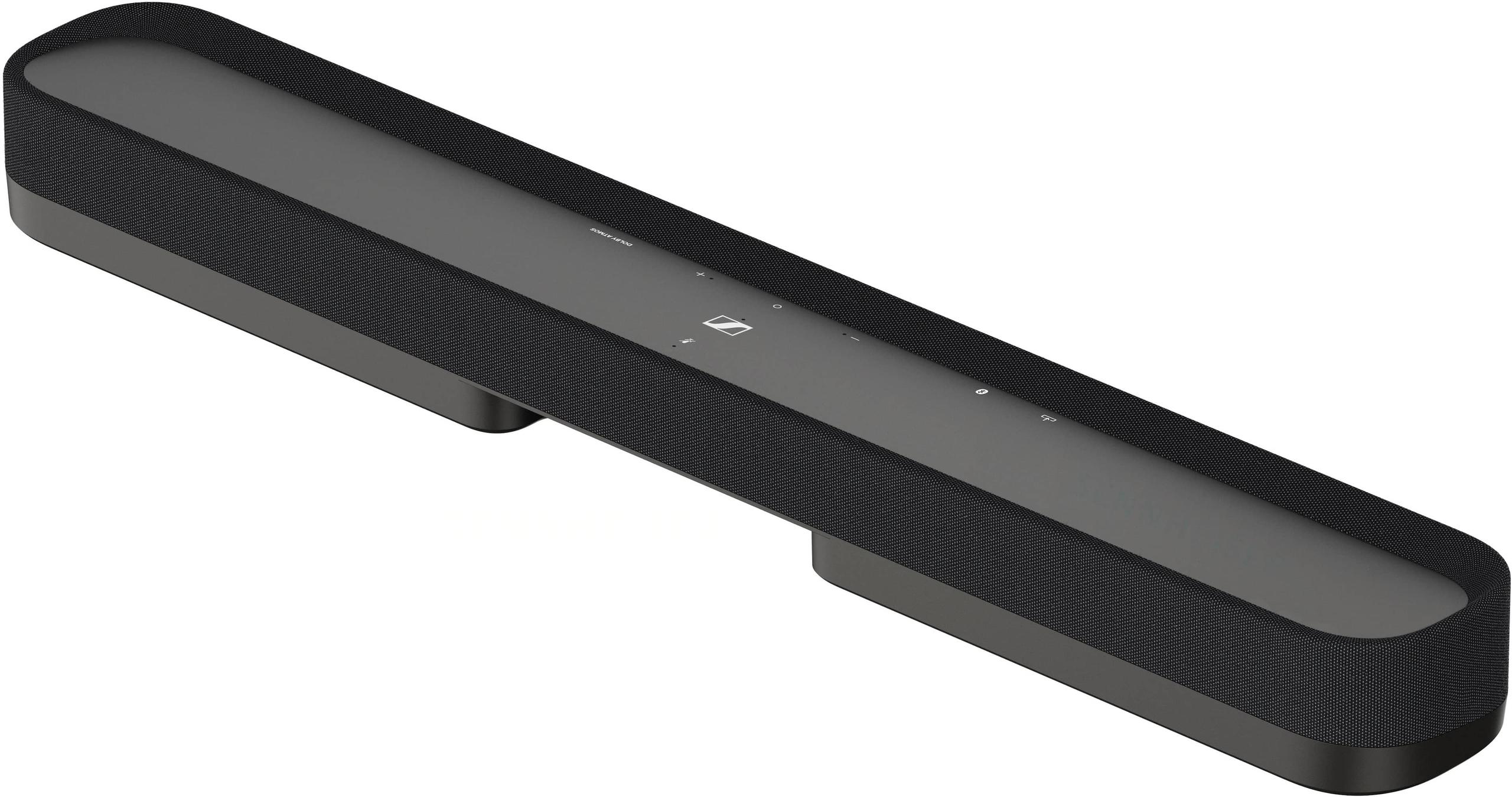
What's remarkable about the AMBEO Mini is how much spatial audio performance it delivers from such a compact package. At just 27.6 inches wide and 2.6 inches tall, it's designed specifically for smaller living spaces where multiple speakers simply aren't practical. The built-in dual 4-inch subwoofers extend bass response down to 43Hz, which is quite impressive for such a small enclosure.
This is where the fundamental difference in approaches becomes most apparent. The HT Saturn provides what audio engineers call "discrete channel separation"—sounds actually originate from physically separate locations around your room. When a helicopter flies overhead in a movie, the sound literally moves from speaker to speaker, creating authentic positional audio that your ears can naturally localize.
Based on our research into user and professional reviews, the HT Saturn's surround effects are consistently described as more convincing and precise than what single soundbars can achieve. The physical placement of rear speakers creates genuine surround envelopment that's particularly noticeable in action movies and gaming. The up-firing drivers in each satellite speaker provide height effects that reviewers find more believable than virtual processing alone.
The AMBEO Mini, while impressive for a single unit, faces the inherent limitations of trying to create spatial illusions from one location. However, Sennheiser's processing is sophisticated enough that many users report surprisingly convincing surround effects, especially for dialogue and ambient sounds. The system excels at creating what reviewers describe as a "wide soundstage" that extends beyond the physical boundaries of the soundbar itself.
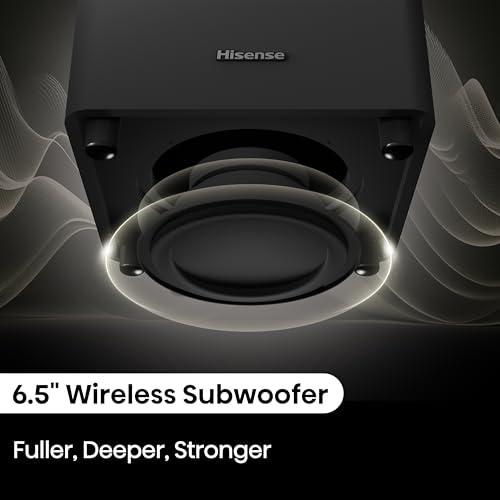
This is perhaps the most significant performance difference between these systems. The HT Saturn includes a dedicated 6.5-inch wireless subwoofer that can be positioned anywhere in your room for optimal bass response. This flexibility is crucial because bass performance is heavily dependent on room acoustics and speaker placement relative to walls and corners.
Professional reviews consistently praise the HT Saturn's bass as "substantial" and "well-integrated," providing the kind of low-frequency impact that makes action movies truly visceral. The subwoofer's 40W dedicated amplification and ability to reach down to 40Hz means it can reproduce the deepest sound effects in modern movie soundtracks.
The AMBEO Mini, while incorporating dual 4-inch subwoofers, faces the physical limitations of its compact design. Reviews frequently mention that bass performance is the system's primary limitation, with many users eventually adding Sennheiser's optional wireless subwoofer to achieve satisfying low-frequency performance. This isn't necessarily a flaw—it's a conscious design trade-off for the compact form factor.
Surprisingly, both systems excel at dialogue reproduction despite their different approaches. The HT Saturn creates its phantom center channel through precise phase and level matching between the front left and right speakers, enhanced by Devialet's acoustic tuning. Reviewers consistently note that voices sound naturally centered and clear, even during complex action sequences.
The AMBEO Mini also receives high marks for dialogue clarity, which is particularly impressive given its lack of a discrete center channel. Sennheiser's voice enhancement processing and the soundbar's wide-dispersion drivers work together to create clear, intelligible speech that remains anchored to the screen position.
The HT Saturn, with its 720W total system power and distributed speaker placement, is designed to fill medium to large rooms effectively. The ability to position satellites around a larger space means the surround effects remain convincing even in rooms where a single soundbar might struggle to create adequate spatial audio.
Conversely, the AMBEO Mini is specifically engineered for smaller spaces like apartments, bedrooms, or compact living rooms. Its 250W power output and processing algorithms are optimized for these environments, where the shorter distances between the soundbar and listening positions actually help the virtualization effects work more convincingly.
The installation experience represents another significant difference between these approaches. The HT Saturn requires more initial setup time and consideration of speaker placement, but the payoff is potentially superior performance. You'll need to position four satellite speakers around your room and find an optimal location for the subwoofer, along with ensuring power outlets are available at each location.
However, the system's wireless design eliminates the complexity of running speaker wires, and the automatic pairing between components makes the technical setup straightforward. The inclusion of wall mounting hardware for the satellites provides flexibility in positioning, though you'll want to ensure adequate clearance above each speaker for the up-firing drivers to work effectively.
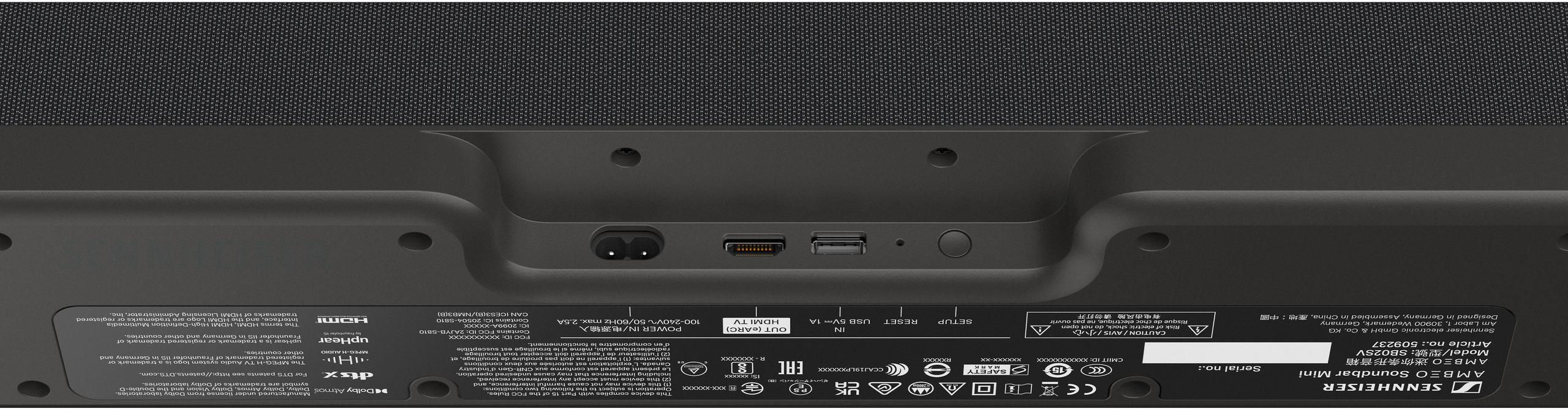
The AMBEO Mini offers a dramatically simpler setup experience—essentially plug and play. The automatic room calibration system handles most of the acoustic optimization automatically, and the single-unit design means you only need one power outlet and one HDMI connection to your TV.
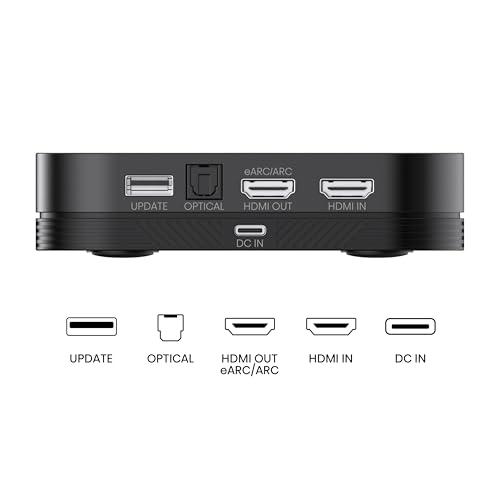
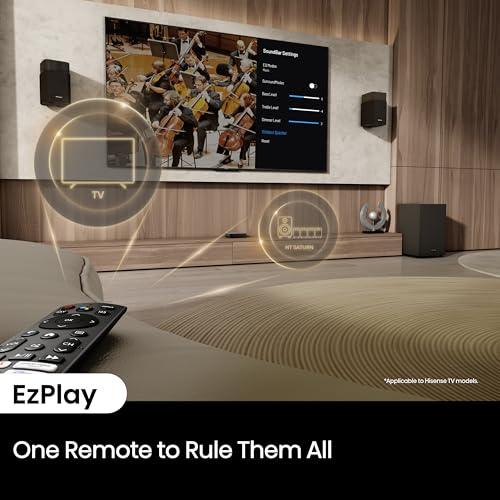
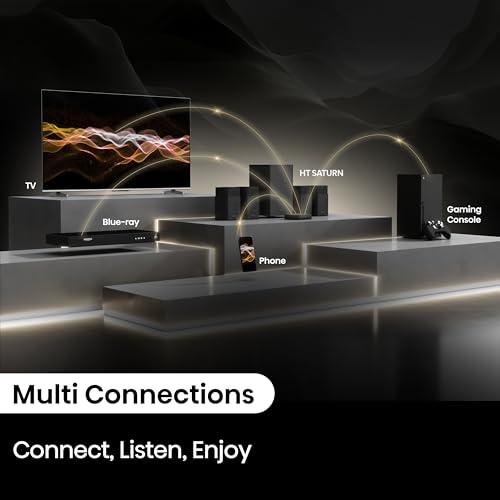
Both systems embrace modern connectivity expectations but with different emphases. The HT Saturn focuses on seamless integration with TV sources through HDMI eARC and includes 4K 60Hz pass-through for gaming consoles and media players. Its Bluetooth 5.3 connectivity provides reliable wireless streaming from mobile devices, while the EzPlay feature enables single-remote control when paired with compatible Hisense TVs.
The AMBEO Mini takes a more comprehensive approach to streaming connectivity, with built-in Wi-Fi enabling direct connection to services like Spotify Connect and Tidal Connect. The addition of Apple AirPlay 2 support makes it particularly attractive for users invested in the Apple ecosystem. However, it lacks HDMI pass-through capability and optical input, which may limit compatibility with some source devices.
At the time of writing, these systems occupy different price tiers, which is important to consider alongside their performance differences. The HT Saturn represents a higher initial investment but provides a complete surround sound system with all components included. When you factor in the true multi-channel performance, dedicated subwoofer, and premium Devialet tuning, the cost per performance ratio is quite compelling for those seeking authentic surround sound.
The AMBEO Mini offers a lower entry point into premium soundbar technology, but achieving optimal performance typically requires the addition of Sennheiser's wireless subwoofer, which increases the total system cost significantly. However, this modular approach allows for gradual system building, which may appeal to budget-conscious buyers.
Both systems represent current-generation technology with support for the latest audio formats including Dolby Atmos, DTS:X, and emerging formats like 360 Reality Audio. The HT Saturn, being the newer release, incorporates the latest wireless connectivity standards and reflects lessons learned from earlier wireless surround systems.
The AMBEO Mini benefits from Sennheiser's ongoing refinement of their spatial audio processing, with firmware updates potentially improving performance over time. However, the physical limitations of single-unit design mean there are inherent ceilings to how much the experience can be enhanced through software alone.
After extensive research into professional reviews and user feedback, clear patterns emerge about who should choose which system. The HT Saturn is the better choice for those who prioritize maximum performance and have the room size and setup flexibility to accommodate multiple speakers. It's particularly compelling for dedicated home theater rooms or larger living spaces where the authentic surround sound experience justifies the additional complexity.
The system excels in scenarios where you're primarily watching movies, gaming, or consuming content where spatial audio effects are important. The included subwoofer and overall power output make it suitable for reference-level listening that can truly rival commercial cinema experiences.
The AMBEO Mini makes more sense for space-conscious users who still want premium audio quality without the footprint of multiple speakers. It's ideal for apartments, bedrooms, or any situation where aesthetic minimalism is important alongside sound quality. The sophisticated processing ensures you're getting genuinely impressive spatial audio, even if it can't quite match the accuracy of discrete physical channels.
For music listening, both systems perform well, though the HT Saturn's Devialet tuning gives it an edge in overall fidelity across all content types. The AMBEO Mini excels particularly in situations where you need the flexibility to easily move or upgrade the system later.
Ultimately, both represent excellent solutions to the modern home theater challenge, just optimized for different priorities and living situations. The choice comes down to whether you value maximum performance and don't mind the complexity of multiple components, or prefer the elegance and simplicity of a single-unit solution with impressive virtual surround capabilities.
| Hisense HT Saturn HTSATURN 4.1.2Ch Sound Bar System | Sennheiser AMBEO Soundbar Mini |
|---|---|
| System Architecture - Fundamentally different approaches to surround sound | |
| True 4.1.2 wireless system with 6 physical components: control unit + 4 satellites + subwoofer | Single compact soundbar using AMBEO virtualization technology |
| Total Speakers - More drivers generally mean better sound separation | |
| 13 speakers total (8 full-range, 4 tweeters, 1 subwoofer driver) distributed across room | 4-channel soundbar with dual built-in 4" subwoofers |
| Power Output - Higher wattage enables louder volumes and better dynamics | |
| 720W total system power (480W soundbar, 240W subwoofer) | 250W total power output |
| Audio Tuning - Professional calibration affects overall sound quality | |
| Tuned by Devialet audio experts for "opera-grade" sound | Sennheiser's audiophile expertise with AMBEO spatial processing |
| Bass Performance - Critical for action movies and immersive experience | |
| Dedicated wireless 6.5" subwoofer with flexible room placement | Built-in dual 4" subs; optional separate subwoofer available for purchase |
| Room Size Compatibility - Ensures optimal performance in your space | |
| Medium to large rooms (distributed speakers fill bigger spaces effectively) | Small to medium rooms, apartments, bedrooms (optimized for compact spaces) |
| Setup Complexity - Balance between performance and convenience | |
| Requires positioning 4 satellites + subwoofer around room (all wireless connections) | Single unit setup with automatic room calibration via built-in microphones |
| Height Effects - Essential for Dolby Atmos overhead sound | |
| Physical up-firing drivers in satellite speakers for authentic ceiling reflections | Advanced virtualization creates simulated overhead effects from single unit |
| Connectivity Options - Affects compatibility with your devices | |
| HDMI eARC, Optical input, Bluetooth 5.3, USB port, 4K 60Hz pass-through | HDMI eARC (no pass-through), Wi-Fi, Bluetooth 5.0, AirPlay 2, streaming services |
| Smart Integration - Convenience features for daily use | |
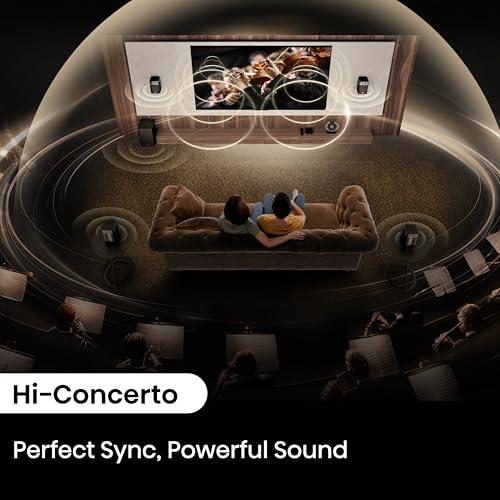
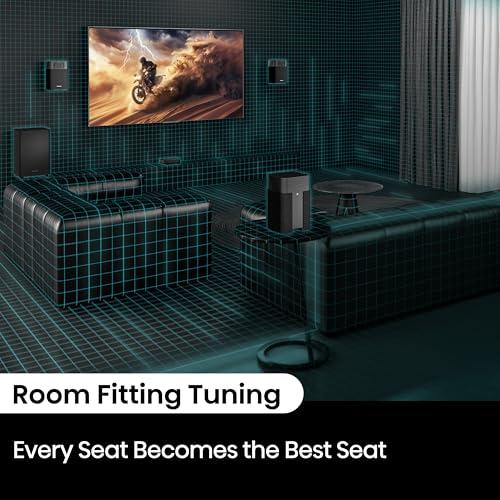
| HT Saturn EzPlay with Hisense TVs, Hi-Concerto technology, Room Fitting Tuning | Smart Control app, Spotify/Tidal Connect, voice enhancement, automatic calibration |
| Physical Footprint - Important for room aesthetics and placement flexibility | |
| 6 separate components require multiple power outlets and strategic positioning | Single 27.6" x 2.6" x 3.9" unit with minimal visual impact |
| Value Proposition - Complete system vs modular approach | |
| Higher upfront cost but includes all components for full surround experience | Lower entry price but may need separate subwoofer purchase for optimal bass |
The Hisense HT Saturn HTSATURN is a complete wireless surround system with 6 separate components (4 satellite speakers, 1 subwoofer, 1 control unit) that creates true surround sound. The Sennheiser AMBEO Soundbar Mini is a single compact soundbar that uses advanced virtualization technology to simulate surround effects from one unit.
The Hisense HT Saturn is better for large rooms due to its 720W total power output and distributed speaker placement that can physically fill bigger spaces. The AMBEO Mini is specifically designed for small to medium rooms and apartments where its 250W output and compact design are more appropriate.
The Hisense HT Saturn includes a dedicated 6.5" wireless subwoofer as part of the complete system. The Sennheiser AMBEO Mini has built-in dual 4" subwoofers, but many users find they need to purchase Sennheiser's optional wireless subwoofer for satisfying bass performance.
The Sennheiser AMBEO Mini is much easier to set up - just plug in one unit and connect one HDMI cable. The Hisense HT Saturn requires positioning 4 satellite speakers and a subwoofer around your room, though all connections are wireless so no speaker wires are needed.
Both support Dolby Atmos, but differently. The HT Saturn uses physical up-firing drivers in its satellite speakers to bounce sound off your ceiling for authentic overhead effects. The AMBEO Mini uses sophisticated virtualization to create simulated overhead sound from its single unit.
The Hisense HT Saturn offers better overall value as it includes all components needed for true surround sound at its price point. The AMBEO Mini has a lower entry cost but achieving optimal performance typically requires purchasing an additional subwoofer, increasing the total investment.
Both systems work with any TV that has HDMI eARC or optical output. However, the Hisense HT Saturn offers enhanced integration features like Room Fitting Tuning and Hi-Concerto when paired with Hisense TVs. The AMBEO Mini works universally but lacks brand-specific optimizations.
Both excel at music, but the HT Saturn has an edge due to its Devialet tuning and distributed speaker array that creates a wider, more immersive soundstage. The AMBEO Mini delivers excellent music quality from its compact design with clear highs and detailed midrange.
The Hisense HT Saturn uses a tri-band wireless system (2.4GHz, 5.2GHz, 5.8GHz) for stable connections between all components. The AMBEO Mini connects to your network via Wi-Fi and Bluetooth, plus includes streaming service integration like Spotify Connect and AirPlay 2.
The HT Saturn is generally better for gaming due to its true surround sound placement and dedicated subwoofer that enhance spatial awareness and impact effects. The AMBEO Mini can provide good gaming audio but the virtual surround may not be as precise for competitive gaming where directional audio matters.
Both systems excel at dialogue clarity despite different approaches. The Hisense HT Saturn creates a stable phantom center channel through its front speakers with Devialet tuning. The AMBEO Mini uses voice enhancement processing and wide-dispersion drivers to maintain clear, centered speech.
The Sennheiser AMBEO Mini offers more flexibility for future upgrades with its modular approach - you can add a subwoofer later or easily replace the single unit. The Hisense HT Saturn is a complete fixed system that can't be expanded, but includes everything needed for optimal performance from day one.
We've done our best to create useful and informative comparisons to help you decide what product to buy. Our research uses advanced automated methods to create this comparison and perfection is not possible - please contact us for corrections or questions. These are the sites we've researched in the creation of this article: bestbuy.com - youtube.com - blog.son-video.com - youtube.com - youtube.com - techradar.com - ecoustics.com - jbhifi.com.au - shop.hisense-usa.com - bhphotovideo.com - bestbuy.com - digitalreviews.net - hisense-usa.com - projectorscreenstore.com - valueelectronics.com - dolby.com - giftpack.ai - techradar.com - sennheiser-hearing.com - stereonet.com - rtings.com - youtube.com - youtube.com - newsroom.sennheiser.com - whathifi.com - baybloorradio.com - sennheiser-hearing.com - files.bbystatic.com

Privacy Policy
Terms and Conditions - Affiliate Policy
Home Security
© Copyright 2008-2026.
11816 Inwood Rd #1211, Dallas, TX 75244