

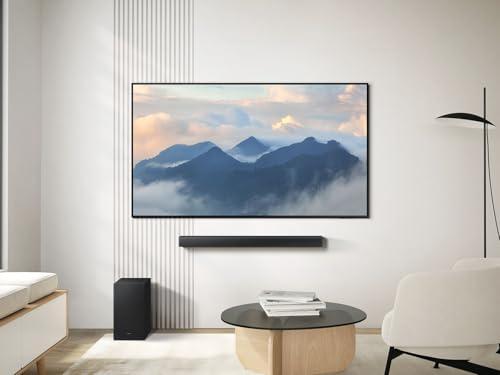
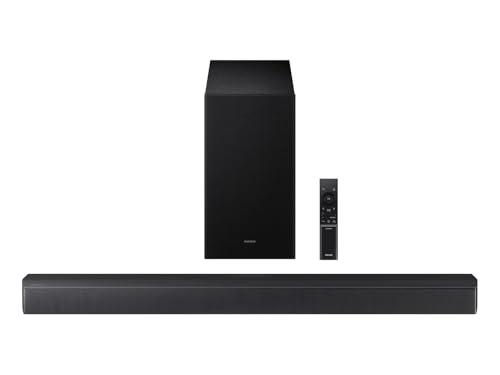
When your TV's built-in speakers just aren't cutting it anymore, you're faced with a choice that's become increasingly complex. The traditional soundbar approach—exemplified by Samsung's HW-B630F—has dominated living rooms for years. But newer systems like the Hisense HT Saturn are challenging that formula entirely, replacing the single soundbar with multiple wireless speakers scattered around your room.
Both systems promise to transform your audio experience, but they take radically different approaches to get there. Understanding these differences is crucial because the wrong choice could leave you with either underwhelming performance or unnecessary complexity for your needs.
The wireless audio landscape has evolved dramatically since 2020. We've moved beyond simple Bluetooth speakers to sophisticated systems that can decode complex surround sound formats and create immersive 3D audio experiences. The key breakthrough has been reliable wireless transmission between multiple speakers—something that was plagued with delay and connection issues just a few years ago.
When evaluating these systems, the most important considerations are dialogue clarity (can you understand what people are saying without cranking the volume?), surround immersion (does it feel like you're in the action?), bass impact (can you feel explosions and music), setup complexity (how much work is involved?), and value proposition (does the performance justify the cost?).
The Samsung HW-B630F, released in 2025 as part of Samsung's budget-focused B-series lineup, represents the refined evolution of the traditional soundbar. Meanwhile, the Hisense HT Saturn, also from 2025, represents a bold reimagining of what home audio can be—essentially a wireless home theater system disguised as a soundbar alternative.
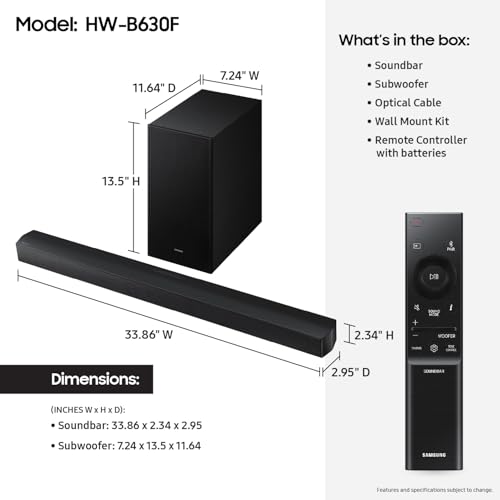
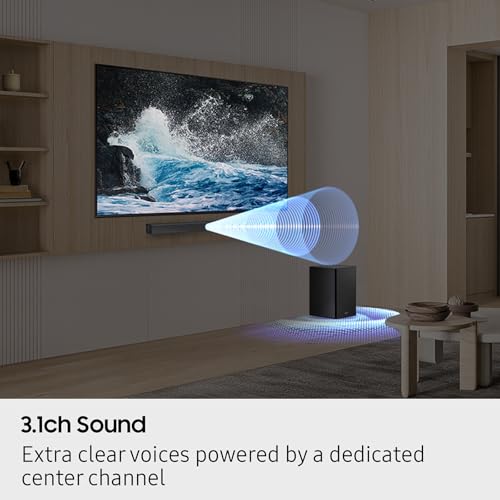
The Samsung HW-B630F follows the tried-and-true soundbar approach that has worked for millions of living rooms. You get a sleek 34-inch bar that sits below your TV, housing three separate speaker channels: left, center, and right. This is called a "3.1" configuration—the "3" refers to those front channels, and the "1" is the separate wireless subwoofer that handles deep bass.
What makes this approach successful is the dedicated center channel speaker inside the soundbar. This center channel is tuned specifically for human speech frequencies, ensuring that dialogue from movies, TV shows, and news programs stays clear and anchored to the screen. When actors are speaking, their voices come directly from the center of your TV rather than floating somewhere between the left and right sides.
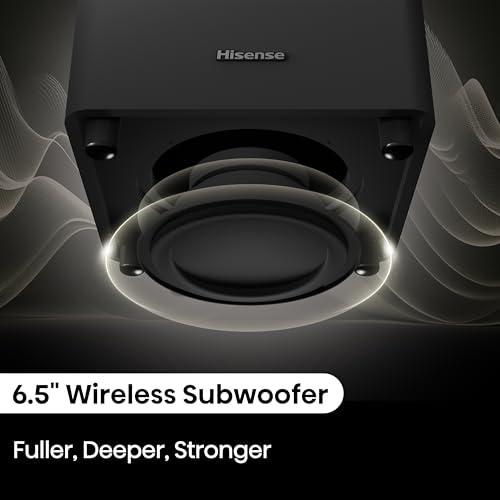
The wireless subwoofer—a separate box with a 6-inch bass driver—connects to the soundbar without any cables, giving you flexibility in placement while adding the low-frequency impact that makes explosions feel real and music sound full.
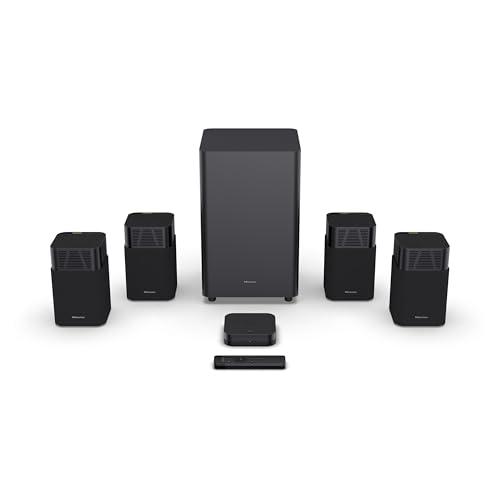
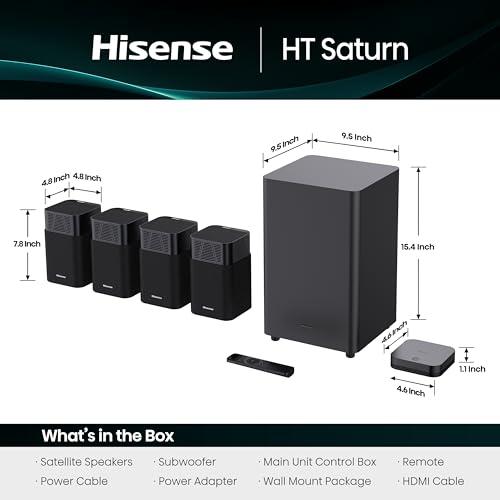
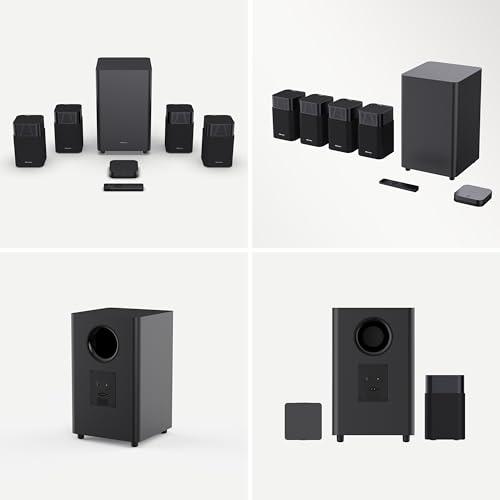
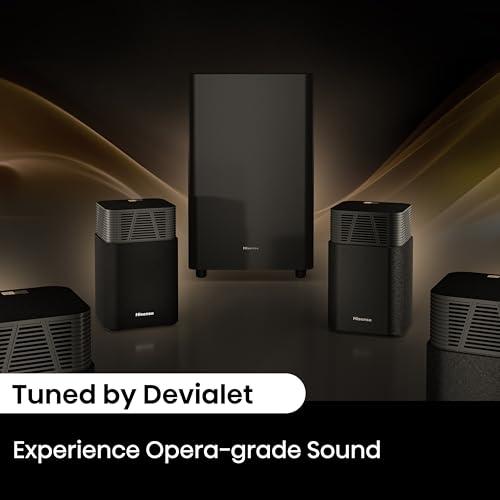
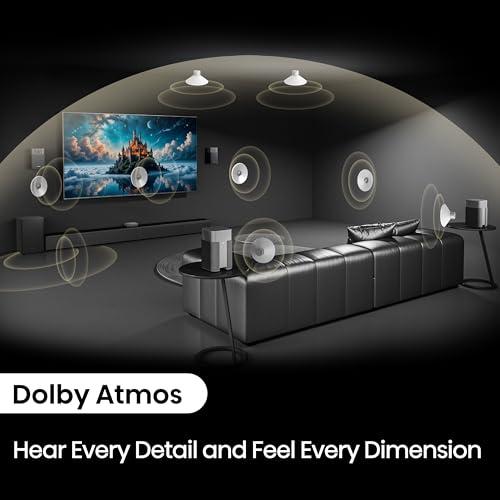
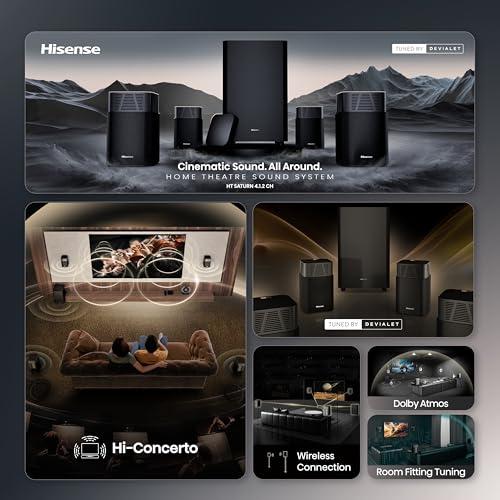
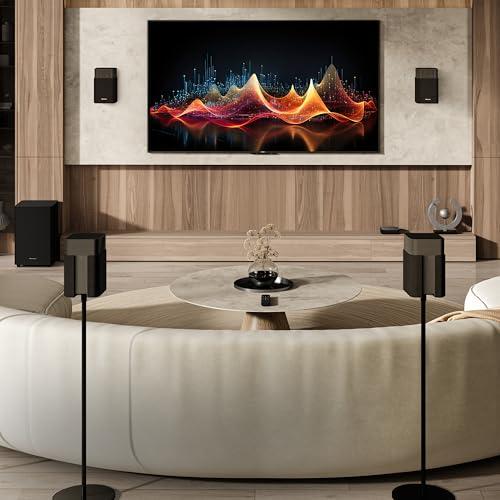
The Hisense HT Saturn throws out the soundbar playbook entirely. Instead of one bar, you get four compact satellite speakers that you position around your room, plus a wireless subwoofer. This creates what's called a "4.1.2" system—four main speakers, one subwoofer, and two additional "height" channels that bounce sound off your ceiling.
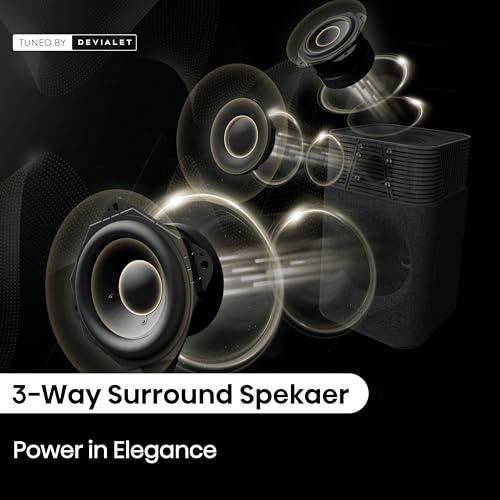
Each satellite speaker is surprisingly small (about the size of a paperback book standing upright) but packs multiple drivers—the individual speaker cones that produce different frequency ranges. Two of the front satellites include upward-firing drivers that reflect sound off your ceiling, creating the illusion that audio is coming from above your head. This is essential for modern Dolby Atmos soundtracks, where helicopters fly overhead or rain falls from the sky.
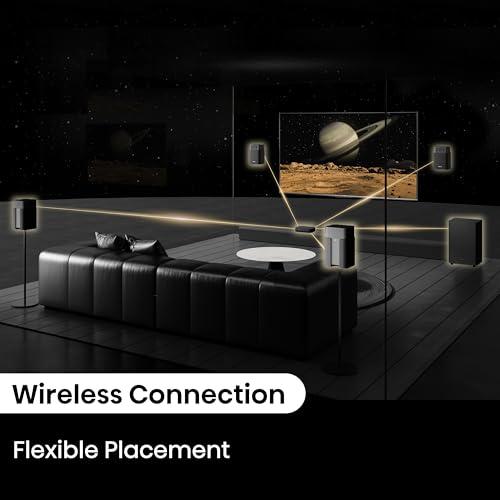
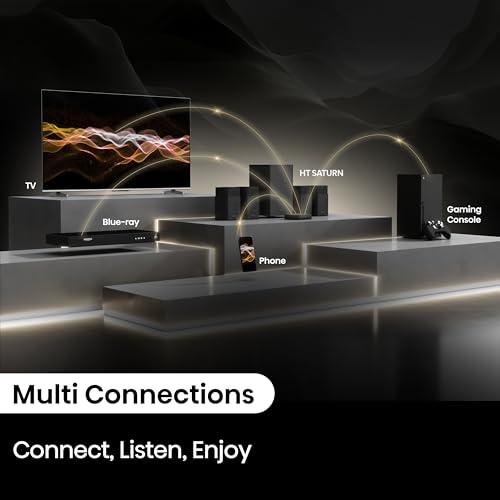
The revolutionary aspect is that all five components communicate wirelessly using three different frequency bands (2.4GHz, 5.2GHz, and 5.8GHz). This tri-band approach ensures stable connections even in homes crowded with WiFi networks, smart devices, and other wireless interference.
For most people, clear dialogue is the most important aspect of any audio upgrade. Nothing is more frustrating than constantly adjusting the volume because you can't understand what characters are saying.
The Samsung HW-B630F has a significant advantage here thanks to its physical center channel speaker. This dedicated driver is positioned exactly where your TV's center is, creating a natural anchor point for voices. Samsung has tuned this center channel specifically for speech frequencies (roughly 300Hz to 3kHz, where most human vocal energy lives), and their Voice Enhance mode can boost these frequencies even further when needed.
Our research into user experiences consistently shows that people notice dialogue improvement immediately with the Samsung system. Even at lower volumes—crucial for late-night viewing—voices remain intelligible because they're not competing with music and effects coming from the same drivers.
The Hisense HT Saturn takes a different approach called "phantom center" technology. Instead of a physical center speaker, it uses precise timing and level adjustments between the left and right front satellites to create the illusion that voices are coming from the center. This technique, refined by high-end audio company Devialet (which tuned the Hisense system), can work remarkably well.
However, phantom center imaging is more sensitive to your listening position and room acoustics. If you're sitting off to one side, or if your room has unusual reflective surfaces, dialogue can appear to "wander" or lose focus. Expert reviews suggest the Hisense delivers impressively stable dialogue for a phantom center system, but it can't match the foolproof consistency of a physical center channel.
This is where the fundamental difference between these systems becomes most apparent.
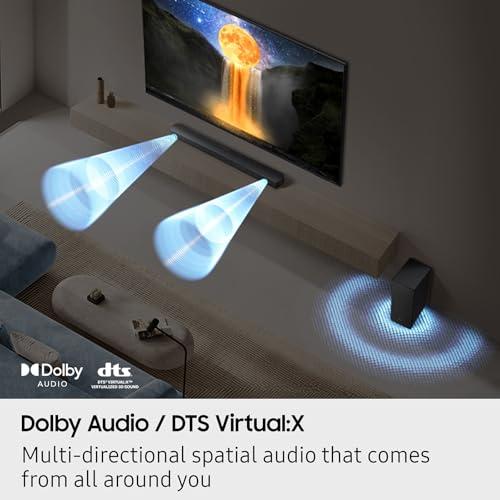
The Samsung HW-B630F uses DTS Virtual:X processing to create simulated surround effects. This technology analyzes incoming audio and redistributes certain frequencies and timing cues to make sounds appear wider than the physical soundbar. It's clever signal processing that can make explosions seem to come from beyond the bar's edges and create a sense of spaciousness.
But virtual surround has inherent limitations. Physics dictates that sound coming from a single point (your soundbar) can only be manipulated so much before the illusion breaks down. The Samsung does an admirable job creating a wider soundstage than TV speakers, but it can't truly place sounds behind you or create the sensation of objects moving through three-dimensional space.
The Hisense HT Saturn delivers genuine surround sound because it has speakers actually positioned around your listening area. When a car chases scenes moves from front to back, you hear it travel between physically separate speakers. The two upward-firing drivers create height effects that can genuinely place sounds above your head—essential for modern Dolby Atmos and DTS:X soundtracks.
User reports from action movies like "Blade Runner 2049" describe rain seeming to fall from above, while helicopter scenes create convincing overhead movement. This level of immersion simply isn't possible with virtual processing, no matter how sophisticated.
The trade-off is complexity. The Hisense system requires careful speaker placement to achieve optimal results. The satellites need to be positioned at specific angles relative to your seating, and the upward-firing drivers require adequate ceiling height and reflective surfaces to work properly. In rooms with vaulted ceilings or excessive sound absorption, the height effects may be diminished.
Both systems include wireless subwoofers, but with different approaches to low-frequency reproduction.
The Samsung HW-B630F's 6-inch subwoofer is tuned for a balance between impact and restraint. It provides enough low-end energy to make explosions feel substantial and music sound full, without overwhelming smaller rooms or annoying neighbors. The bass integration is smooth, meaning the transition between the subwoofer and the main soundbar speakers is seamless—you don't notice where one stops and the other begins.
The Hisense HT Saturn's 6.5-inch subwoofer extends deeper into bass frequencies (down to 40Hz compared to the Samsung's unspecified but likely higher cutoff) and has more power behind it. In larger rooms, this translates to more visceral impact during action sequences and fuller reproduction of music with deep bass content.
However, neither system allows you to upgrade or add additional subwoofers later—a limitation compared to traditional home theater receivers that accept multiple subs for even bass distribution in large rooms.
While both systems are designed primarily for home theater use, music performance matters for many users.
The Samsung HW-B630F is tuned with a slight emphasis on dialogue frequencies, which can make some music sound overly mid-focused. It's perfectly adequate for background music or casual listening, but audiophile-quality music reproduction isn't its strength.
The Hisense HT Saturn benefits from Devialet's acoustic engineering, which brings high-end audio principles to a mass-market product. The wider physical separation between speakers creates a more spacious soundstage for stereo music, and the frequency response (40Hz to 20kHz) covers the full audible spectrum. Multiple drivers in each satellite allow better separation of different frequency ranges, resulting in clearer highs and more defined midrange.
For serious music listening, the Hisense is clearly superior, though at its price point, you might consider dedicated stereo speakers instead.
The Samsung HW-B630F epitomizes plug-and-play simplicity. You place the soundbar below your TV (or mount it on the wall with included brackets), position the subwoofer anywhere within about 30 feet, and connect a single HDMI cable to your TV. The subwoofer pairs automatically, and you're ready to go within minutes.
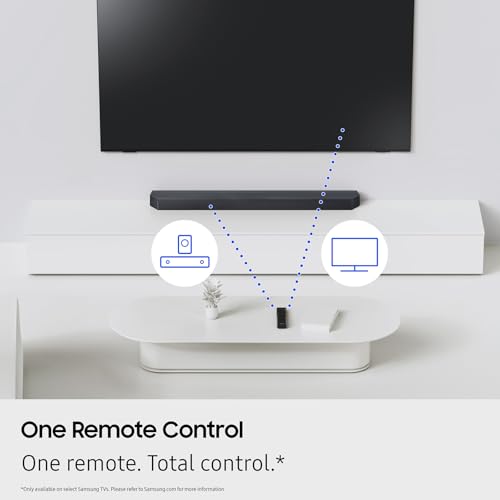
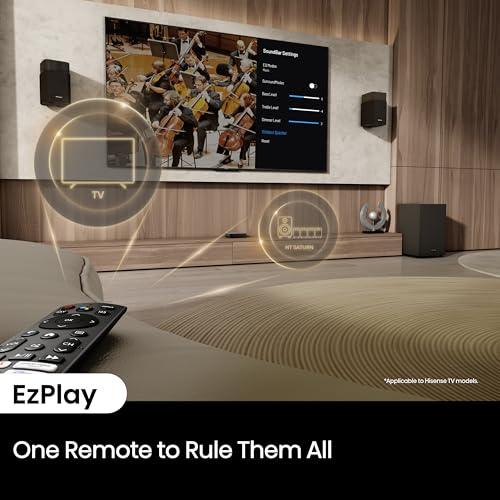
The system integrates seamlessly with Samsung TVs through their "One Remote Control" feature, meaning your TV remote can control the soundbar's volume and basic functions. For non-Samsung TVs, HDMI ARC (Audio Return Channel) provides similar integration, though you'll need the included soundbar remote for mode changes.
Setting up the Hisense HT Saturn requires more planning and effort. You need to position four satellite speakers around your room, each requiring its own power outlet. The front satellites should be at roughly ear level when seated, while the rear satellites work best slightly behind and above your listening position.
The system includes wall-mount brackets for flexible placement, but finding optimal positions often requires experimentation. Room acoustics play a crucial role—hard surfaces help reflect the upward-firing drivers, while carpets and furniture can absorb sound and reduce surround effects.
Once positioned, the wireless pairing process is automatic, with LED indicators showing connection status. The tri-band wireless system proves reliable in our research, with users rarely reporting connection drops or audio delays.
The Samsung HW-B630F includes several intelligent audio processing modes. Adaptive Sound analyzes incoming content and automatically adjusts EQ and dynamics—quieter passages get boosted while loud sections are controlled, reducing the need for constant volume adjustments. Game Mode optimizes directional cues for gaming, while Night Mode compresses dynamic range for late-night viewing without disturbing others.
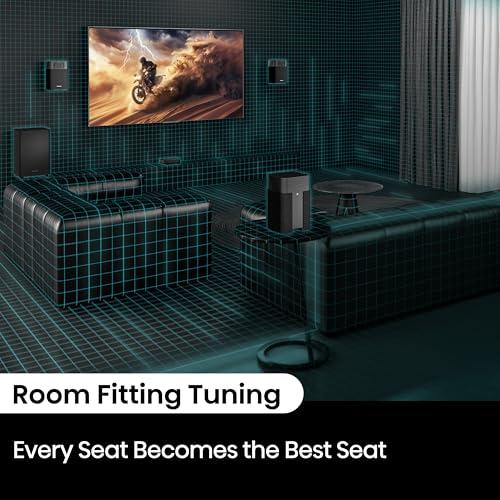
The Hisense HT Saturn goes further with Room Fitting Tuning, an automatic calibration system that optimizes audio performance for your specific space when paired with compatible Hisense TVs. This feature measures your room's acoustic response and adjusts timing, levels, and EQ accordingly—similar to systems found in much more expensive dedicated home theater equipment.
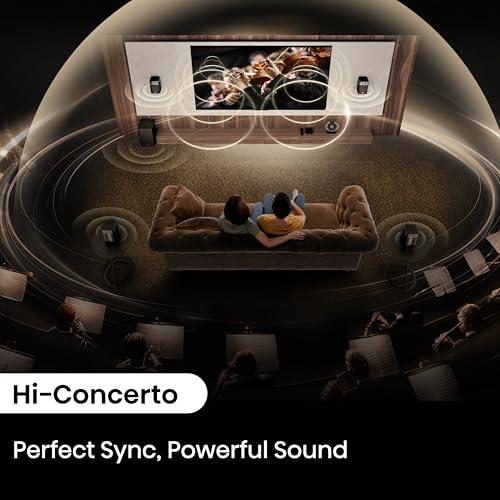
The Hisense also features Hi-Concerto technology, which can simultaneously use your TV's built-in speakers along with the satellite system to create an even wider soundstage. This unique feature effectively turns your entire TV into an additional center channel.
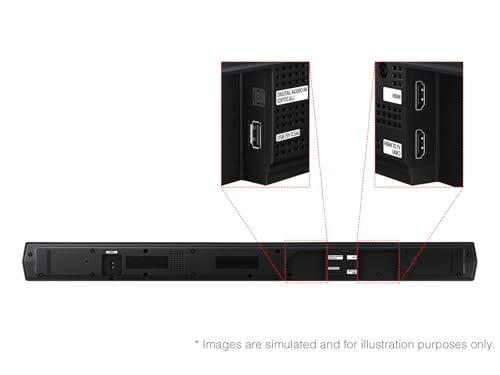
The Samsung HW-B630F uses HDMI 1.4, which limits video pass-through to 1080p resolution. This means if you have 4K sources like a gaming console or Blu-ray player, you'll need to connect them directly to your TV rather than running them through the soundbar. While this isn't a deal-breaker, it does limit connectivity options and prevents the soundbar from serving as an HDMI hub.
The lack of eARC (enhanced Audio Return Channel) also means the Samsung can only receive compressed audio formats from your TV. Lossless formats like Dolby TrueHD (found on many Blu-ray discs) get downconverted to regular Dolby Digital, though most users won't notice the difference.
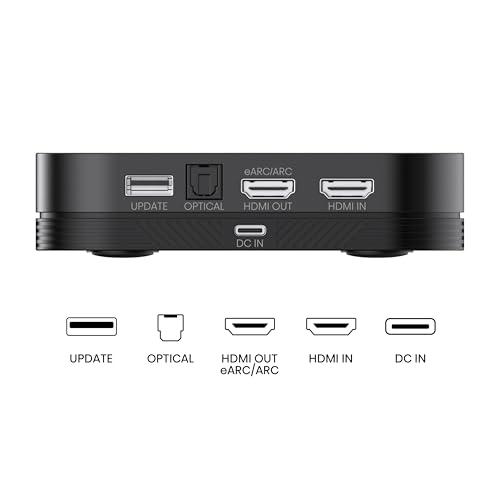
The Hisense HT Saturn includes full HDMI eARC support with 4K HDR pass-through, making it compatible with the latest gaming consoles and media players. This allows lossless Dolby Atmos and DTS:X transmission from your TV, preserving maximum audio quality.
Modern streaming services and Blu-ray discs increasingly use object-based audio formats like Dolby Atmos, where individual sound elements can be placed precisely in 3D space rather than being limited to fixed channels.
The Samsung HW-B630F cannot decode these formats natively—it receives them as standard surround sound and processes them through DTS Virtual:X. While this creates some spatial enhancement, you're not experiencing the content as the filmmakers intended.
The Hisense HT Saturn fully supports both Dolby Atmos and DTS:X, with the physical speaker layout to reproduce height effects properly. As more content adopts these formats, this becomes increasingly valuable for future-proofing your investment.
At the time of writing, these systems occupy very different price tiers, with the Hisense HT Saturn costing roughly five times more than the Samsung HW-B630F. This dramatic price difference reflects their fundamentally different approaches and target audiences.
The Samsung HW-B630F delivers exceptional value for users seeking a significant upgrade over TV speakers without complexity or high cost. It excels in scenarios where dialogue clarity is paramount—news, sitcoms, dramas, and casual movie watching.
If you have a Samsung TV, the integration benefits make it even more attractive. The system works particularly well in smaller to medium-sized rooms where virtual surround processing can be effective and where a single soundbar's output is sufficient.
This system makes sense for apartment dwellers who can't position multiple speakers, budget-conscious buyers who want immediate improvement, and anyone who values simplicity over ultimate performance.
The Hisense HT Saturn targets home theater enthusiasts willing to invest in dramatically superior immersion. The price premium buys you genuine 3D audio experiences that can rival much more expensive dedicated home theater systems.
This system excels for movie buffs who prioritize Dolby Atmos content, gamers who want positional audio advantages, and users with larger rooms where distributed speakers create better sound coverage than a single soundbar could achieve.
The Devialet tuning and advanced features like room calibration appeal to audio enthusiasts who appreciate technical sophistication, while the unique Hi-Concerto integration maximizes value for Hisense TV owners.
Choose the Samsung HW-B630F if your primary goals are clear dialogue improvement and solid bass impact at an affordable price. It's ideal for users who want immediate improvement over TV speakers without the complexity of positioning multiple speakers or the expense of a premium system.
Choose the Hisense HT Saturn if immersive home theater experiences justify the significantly higher investment. The true Dolby Atmos capability, room-filling surround sound, and audiophile-grade tuning create experiences that the Samsung simply cannot match, regardless of price.
The decision ultimately comes down to your priorities: convenience and value versus performance and immersion. Both systems succeed in their intended roles, but they serve very different users and use cases. Consider your room size, budget flexibility, and how much audio quality matters to your entertainment experience. The "wrong" choice isn't necessarily about the product—it's about matching the system to your specific needs and expectations.
| Samsung HW-B630F | Hisense HT Saturn |
|---|---|
| System Configuration - Determines immersion level and setup complexity | |
| Traditional 3.1ch soundbar + wireless subwoofer | Revolutionary 4.1.2ch with four wireless satellites + subwoofer |
| Audio Format Support - Critical for modern streaming and Blu-ray content | |
| Dolby Digital 5.1, DTS 5.1 only (no Atmos/DTS:X) | Full Dolby Atmos, DTS:X, Dolby TrueHD support |
| Surround Sound Technology - Affects how realistic effects sound | |
| DTS Virtual:X simulation from soundbar | True physical surround with overhead height channels |
| Dialogue Clarity - Most important for TV shows and movies | |
| Dedicated physical center channel speaker | Phantom center using left/right speakers |
| HDMI Connectivity - Impacts 4K device compatibility | |
| HDMI 1.4 ARC only (1080p pass-through) | HDMI eARC with 4K HDR pass-through |
| Setup Complexity - Time and effort required | |
| Simple: soundbar + subwoofer placement | Complex: position four satellites optimally |
| Room Integration Features - Smart optimization capabilities | |
| Adaptive Sound, Voice Enhance, Night Mode | Room Fitting Tuning, Hi-Concerto TV integration |
| Subwoofer Specifications - Low-frequency impact | |
| 6" wireless driver (unspecified frequency range) | 6.5" wireless driver (40Hz-20kHz response) |
| Smart TV Integration - Convenience features | |
| Samsung One Remote Control, HDMI CEC | EZPlay control, works with any TV brand |
| Tuning Philosophy - Audio character and quality | |
| Dialogue-focused for TV content | Devialet "opera-grade" audiophile tuning |
| Physical Footprint - Space requirements | |
| Single 34" soundbar + subwoofer | Four compact satellites requiring strategic placement |
| Wireless Technology - Connection stability | |
| Basic 2.4GHz for subwoofer | Tri-band (2.4G/5.2G/5.8G) for all speakers |
| Price Tier - Value proposition at time of writing | |
| Budget-friendly upgrade option | Premium home theater investment (5x more expensive) |
The Samsung HW-B630F has a clear advantage for dialogue thanks to its dedicated physical center channel speaker. This center driver is specifically tuned for human speech frequencies and keeps voices anchored to your TV screen. The Hisense HT Saturn uses phantom center technology, which can work well but is more sensitive to your seating position and room acoustics.
The Samsung HW-B630F is a 3.1 system with three front channels (left, center, right) plus one subwoofer. The Hisense HT Saturn is a 4.1.2 system with four main speakers, one subwoofer, and two height channels that bounce sound off your ceiling for Dolby Atmos effects. The Hisense provides true surround sound while the Samsung uses virtual processing.
The Samsung HW-B630F is much simpler to install. You just place the soundbar under your TV and position the wireless subwoofer anywhere in the room. The Hisense HT Saturn requires positioning four separate satellite speakers around your room, each needing its own power outlet and optimal placement for best performance.
No, only the Hisense HT Saturn fully supports Dolby Atmos and DTS:X with its upward-firing height channels. The Samsung HW-B630F can receive Atmos content but downconverts it to regular surround sound, then uses DTS Virtual:X to simulate some spatial effects.
The Samsung HW-B630F is ideal for small to medium rooms where its virtual surround processing can be effective. The Hisense HT Saturn actually works better in larger rooms where you have space to properly position the four satellite speakers and where the distributed audio creates better coverage.
Yes, both systems work with any TV brand. The Samsung HW-B630F offers special integration features with Samsung TVs like One Remote Control, but works fine with other brands via HDMI ARC or optical connection. The Hisense HT Saturn has advanced features like Hi-Concerto with Hisense TVs but functions perfectly with any TV.
The Hisense HT Saturn is superior for gaming due to its true surround sound that can accurately place directional audio cues like footsteps and gunfire around you. The Samsung HW-B630F has a dedicated Game Mode that enhances directional cues, but it's still limited to virtual surround processing from a single soundbar.
Both include wireless subwoofers, but the Hisense HT Saturn has a slightly larger 6.5" driver compared to the Samsung's 6" driver, and extends deeper to 40Hz. The Samsung HW-B630F provides adequate bass for most rooms, while the Hisense offers more powerful low-frequency impact for larger spaces.
The Samsung HW-B630F offers exceptional value as a significant upgrade over TV speakers at a budget-friendly price. The Hisense HT Saturn costs significantly more but delivers cinema-level immersion with true Dolby Atmos. The "better value" depends on your budget and how much audio quality matters to you.
The Samsung HW-B630F includes wall-mount brackets and can be easily mounted below your TV like a traditional soundbar. The Hisense HT Saturn also includes wall-mount hardware, but you'll need to mount four separate satellite speakers in optimal positions around your room, which requires more planning and installation work.
The Hisense HT Saturn is superior for music thanks to Devialet's audiophile tuning, wider speaker separation, and full-range frequency response (40Hz-20kHz). The Samsung HW-B630F is adequate for casual music listening but is primarily tuned for dialogue and TV content rather than high-fidelity music reproduction.
The Samsung HW-B630F supports Samsung's optional Wireless Rear Speaker Kit to upgrade from 3.1 to 5.1 channels. The Hisense HT Saturn cannot be expanded with additional speakers - it's a complete system as-is. Neither system allows you to upgrade or add different subwoofers.
We've done our best to create useful and informative comparisons to help you decide what product to buy. Our research uses advanced automated methods to create this comparison and perfection is not possible - please contact us for corrections or questions. These are the sites we've researched in the creation of this article: samsung.com - bhphotovideo.com - crutchfield.com - youtube.com - bestproducts.com - videoandaudiocenter.com - pcrichard.com - bhphotovideo.com - samsung.com - youtube.com - requiremints.com - karlsonline.com - crutchfield.com - youtube.com - donstv.com - samsung.com - bhphotovideo.com - youtube.com - youtube.com - crutchfield.com - costco.ca - rtings.com - crutchfield.com - accio.com - bhphotovideo.com - manuals.plus - samsung.com - saraappliance.com - bestbuy.com - youtube.com - blog.son-video.com - youtube.com - youtube.com - techradar.com - ecoustics.com - jbhifi.com.au - shop.hisense-usa.com - bhphotovideo.com - bestbuy.com - digitalreviews.net - hisense-usa.com - projectorscreenstore.com - valueelectronics.com - dolby.com - giftpack.ai

Privacy Policy
Terms and Conditions - Affiliate Policy
Home Security
© Copyright 2008-2026.
11816 Inwood Rd #1211, Dallas, TX 75244