

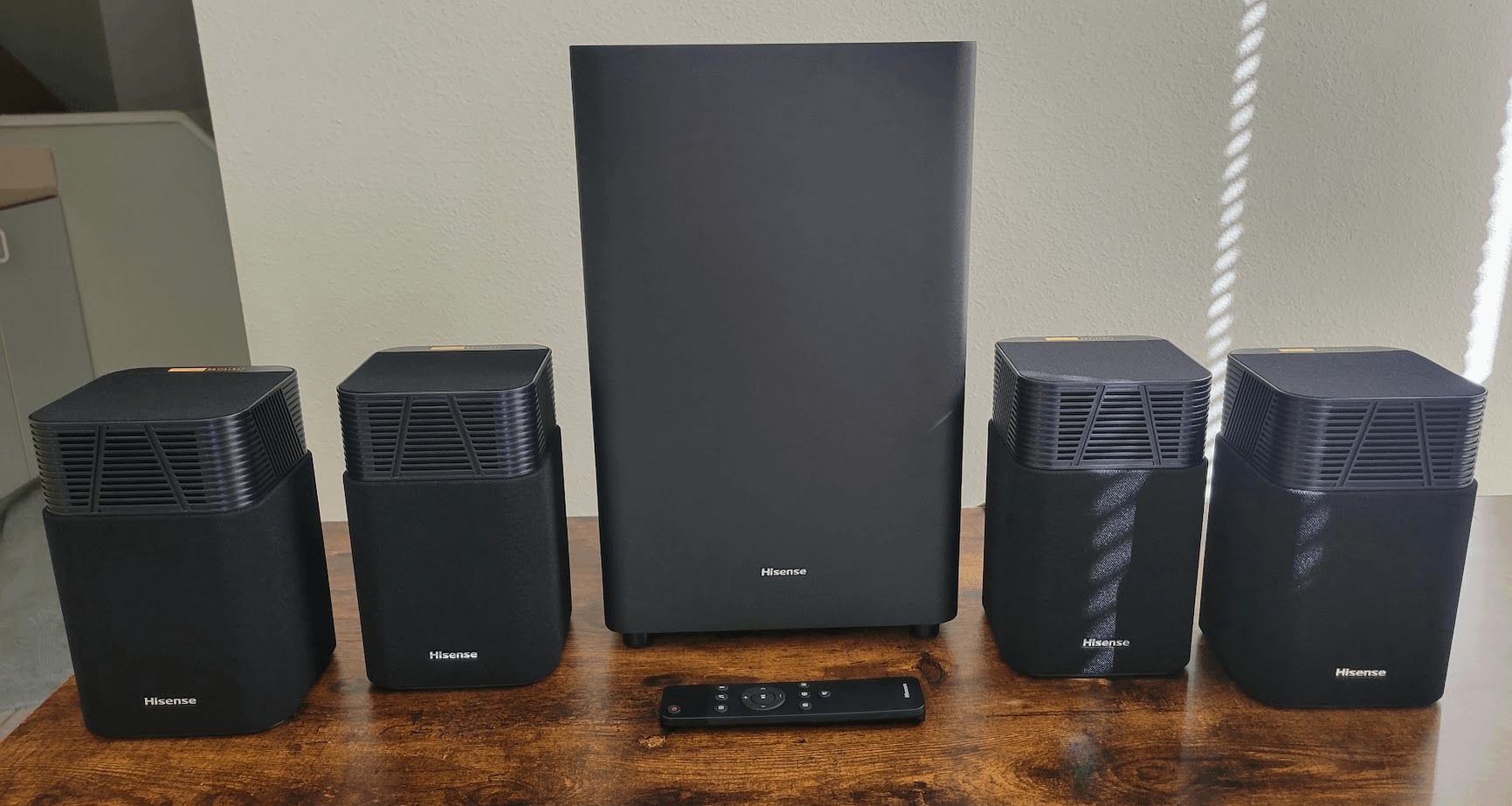

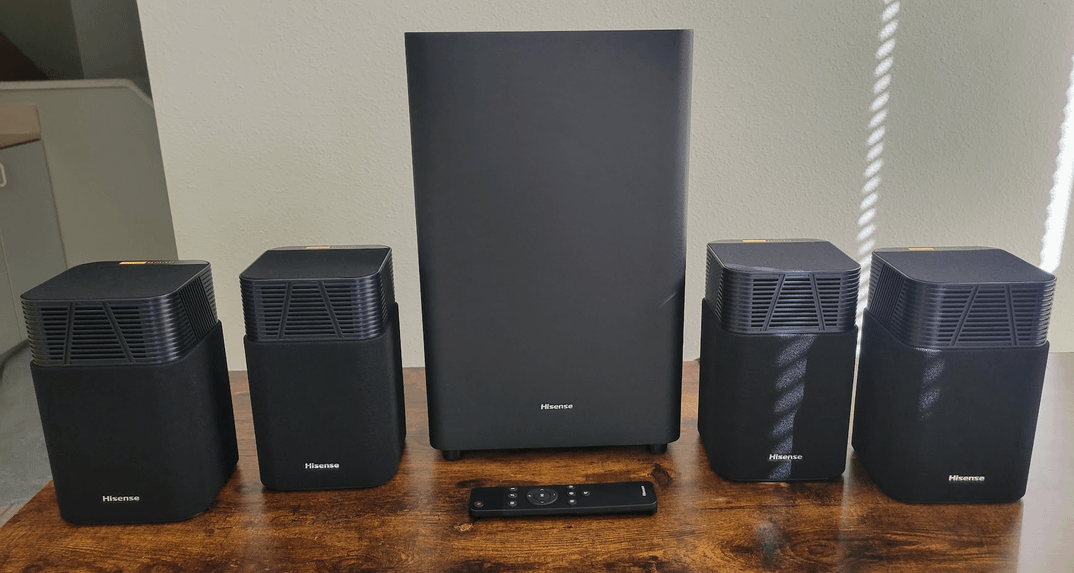
There's something refreshing about a company that looks at the premium audio market and says, "We can do that for half the price." That's exactly what Hisense has done with the HT Saturn, a wireless home theater system that takes direct aim at Sony's $2,500 Bravia Theater Quad while asking for just $1,300. After spending considerable time with this system and analyzing feedback from both professional reviewers and everyday users, I can confidently say this is the most impressive audio product Hisense has ever made. It's not perfect—no system at this price could be—but it delivers an immersive cinematic experience that punches well above its weight class.
The Saturn represents a new approach to home theater audio. Instead of a traditional soundbar with satellite speakers tacked on, you get four discrete wireless speakers that you can position around your room, plus a proper subwoofer to handle the low end. Everything communicates wirelessly through a compact central hub, and the whole system has been tuned by Devialet, the French audio company known for speakers that cost more than most people's cars. The result is a system that creates a genuinely enveloping sound field without the complexity and cable mess of traditional surround sound.
At its heart, the Saturn is a 4.1.2 system, which means four main speakers, one subwoofer, and two channels dedicated to height effects. Each of those four satellite speakers contains three drivers: a front-firing full-range driver for the main sound, an angled tweeter for detail and clarity, and an up-firing driver that bounces sound off your ceiling to create those overhead Dolby Atmos effects. It's clever engineering that manages to create a three-dimensional sound bubble from just four speakers.
The wireless implementation uses a tri-band system operating on 2.4GHz, 5.2GHz, and 5.8GHz frequencies. This isn't just marketing speak—it actually matters. Traditional wireless audio systems can suffer from dropouts or interference, but the Saturn's approach keeps everything synchronized without any noticeable lag. Multiple reviewers specifically tested this for gaming, and the consensus was clear: there's effectively zero latency. The audio stays perfectly locked to the video, whether you're watching movies or playing fast-paced games.
Connectivity is straightforward. HDMI eARC connects to your TV and handles everything including 4K HDR passthrough. There's also an optical input for older equipment and Bluetooth 5.3 for streaming music from your phone. The system supports all the major surround formats: Dolby Atmos, Dolby TrueHD, DTS:X, and DTS-HD Master Audio. You won't find Wi-Fi streaming capabilities like Spotify Connect or AirPlay, which is one area where the Sony competitor pulls ahead, but the Bluetooth implementation works well enough for casual music listening.
The most interesting features are locked behind Hisense's ecosystem. If you own a compatible Hisense TV—particularly the U8 or U7 series—you unlock Hi-Concerto mode, which turns your TV's built-in speakers into a makeshift center channel. This is actually a bigger deal than it sounds, and we'll get into why when we talk about performance. You also get Room Fitting Tuning, which analyzes your space and adjusts the sound accordingly, though this automatic calibration isn't nearly as sophisticated as what you'd get from a high-end AV receiver. EzPlay 3.0 puts all the Saturn's settings on your TV screen, which is far more convenient than squinting at the tiny display on the included remote.
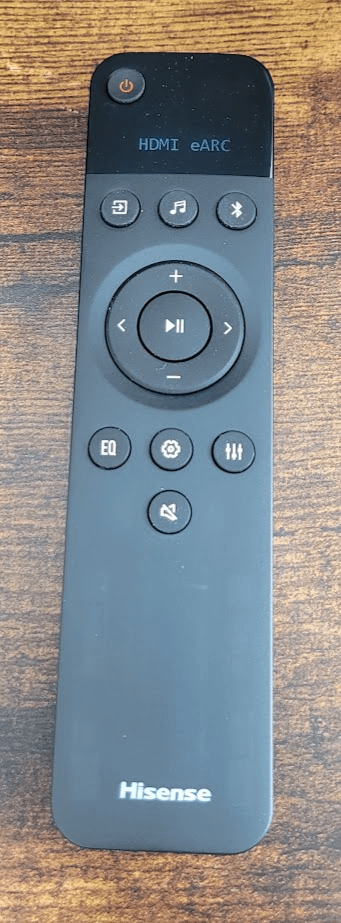
Speaking of that remote, it's functional but uninspiring. It has a small LED screen that shows settings changes, but there's no backlighting, which seems like an odd oversight for equipment you'll mostly use in dark rooms. If you own a Hisense TV, you can control everything through your TV remote instead, which is genuinely convenient.
The system offers five audio presets tailored for different content: Standard, Movie, Music, Sport, and Game. There are also five sound effects you can toggle: Night Mode for compressed dynamics, Surround for enhanced spatial effects, Voice for dialogue boost, AI for intelligent optimization, and Virtual:X for DTS's spatial upmixing. These aren't subtle—they make real, audible differences. The Movie preset emphasizes high-frequency detail for that crisp film sound, while Music mode beefs up the bass and treble for a punchier presentation.
The Saturn's design philosophy prioritizes discretion over showmanship. Each satellite speaker stands just under eight inches tall and less than five inches wide, making them significantly more compact than Sony's competing speakers. They're finished in matte black with acoustic fabric covering the lower sections, giving them a premium look that won't clash with most home décor. At 3.4 pounds each, they feel substantial without being heavy, and the build quality is solid. You won't mistake them for luxury audio equipment, but they're well-made and attractive enough.
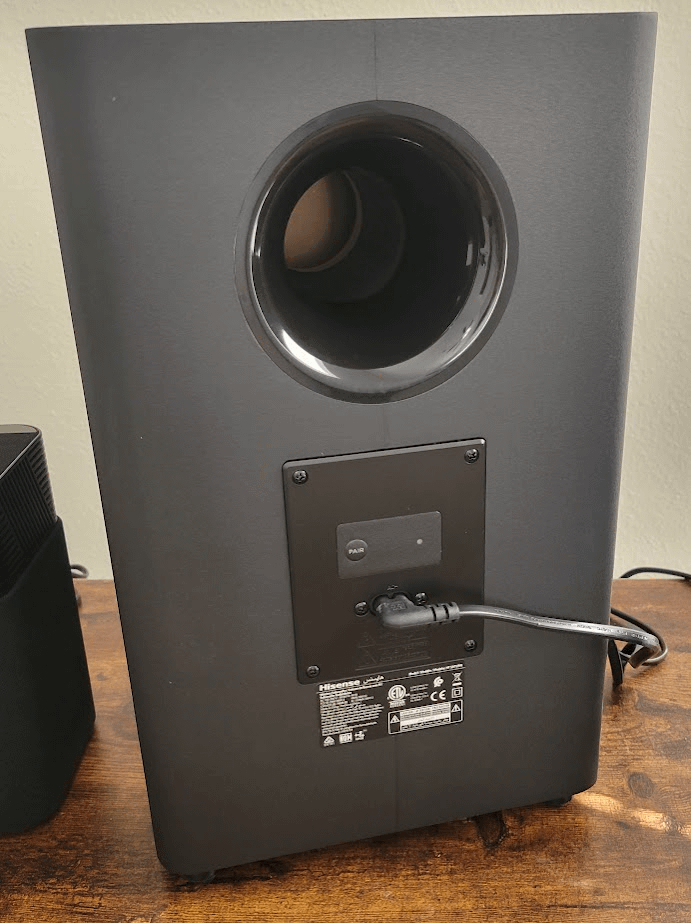
The subwoofer is similarly restrained in size, measuring about 13 inches tall with a 6.5-inch down-firing driver. It weighs 11 pounds, which gives it enough mass to stay planted during heavy bass passages. The compact central hub sits near your TV and houses all the connections—it's barely larger than a paperback book and can be tucked out of sight easily.
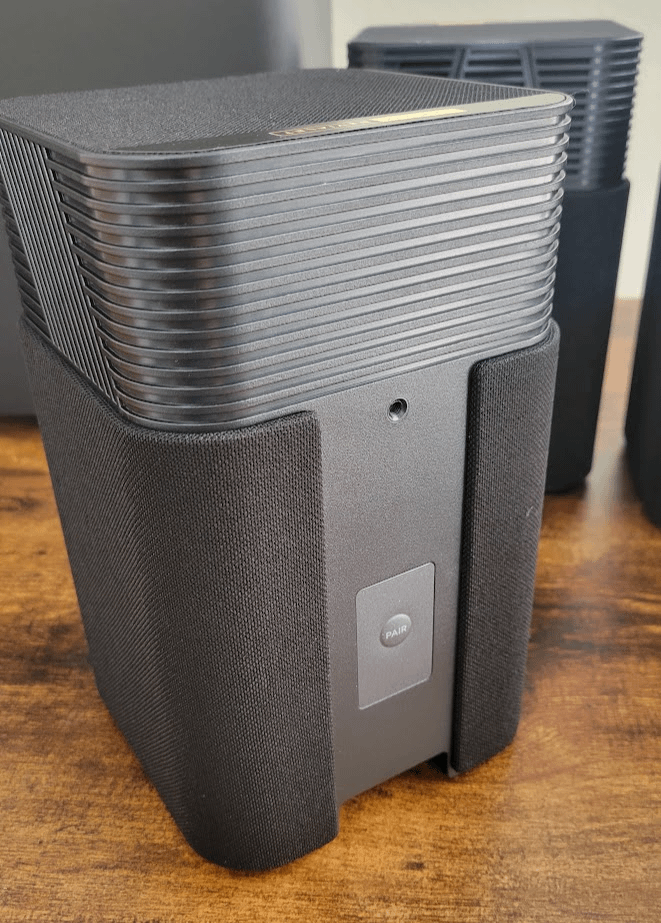
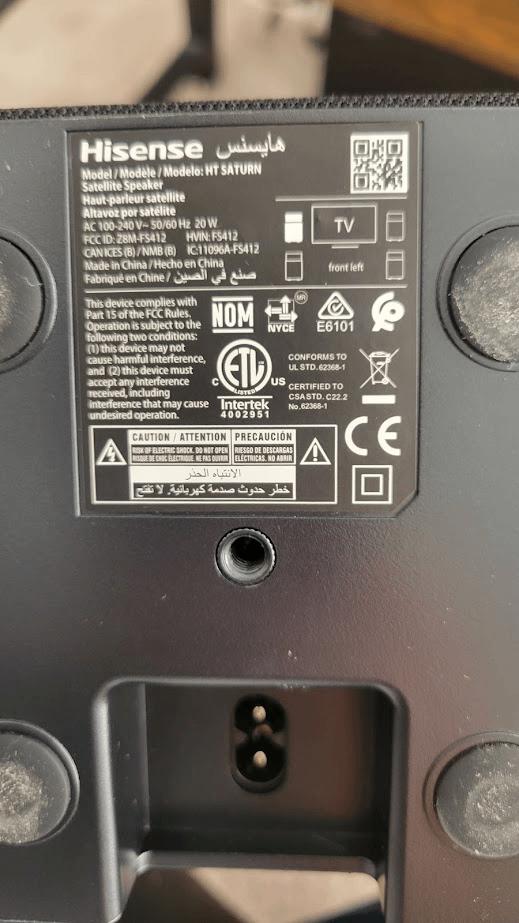
Every speaker includes a wall-mounting bracket in the box. Here's where I made my first rookie mistake: I assumed all four speakers were identical and placed them randomly around the room. They look identical from every angle, so it seemed reasonable. The system gave me an error during setup, and after some head-scratching, I discovered that each speaker has a tiny label on the bottom indicating whether it's front left, front right, rear left, or rear right. And I do mean tiny—you'll need to flip each speaker over and squint to read the small text. Once I sorted out which speaker went where (feeling appropriately foolish), the setup process became genuinely simple: position the speakers, plug them in, and connect the hub to your TV via HDMI. The speakers automatically pair with the hub, and you're ready to go. Multiple reviewers mentioned that setup took just minutes, and it would have for me too if I'd checked the bottoms first.
But here's the catch, and it's a significant one: while the audio signal is wireless, the power isn't. Each of the five components needs its own AC power connection. That means five power cables snaking to outlets around your room. The included cables are only 4.3 feet long, which severely limits placement flexibility unless you're prepared to run extension cords. This undermines the wireless convenience significantly. Yes, you avoid running speaker wire, but you're still dealing with multiple cables. It's a compromise that makes sense from an engineering standpoint—wireless power transfer for speakers would be impractical—but it's frustrating nonetheless.
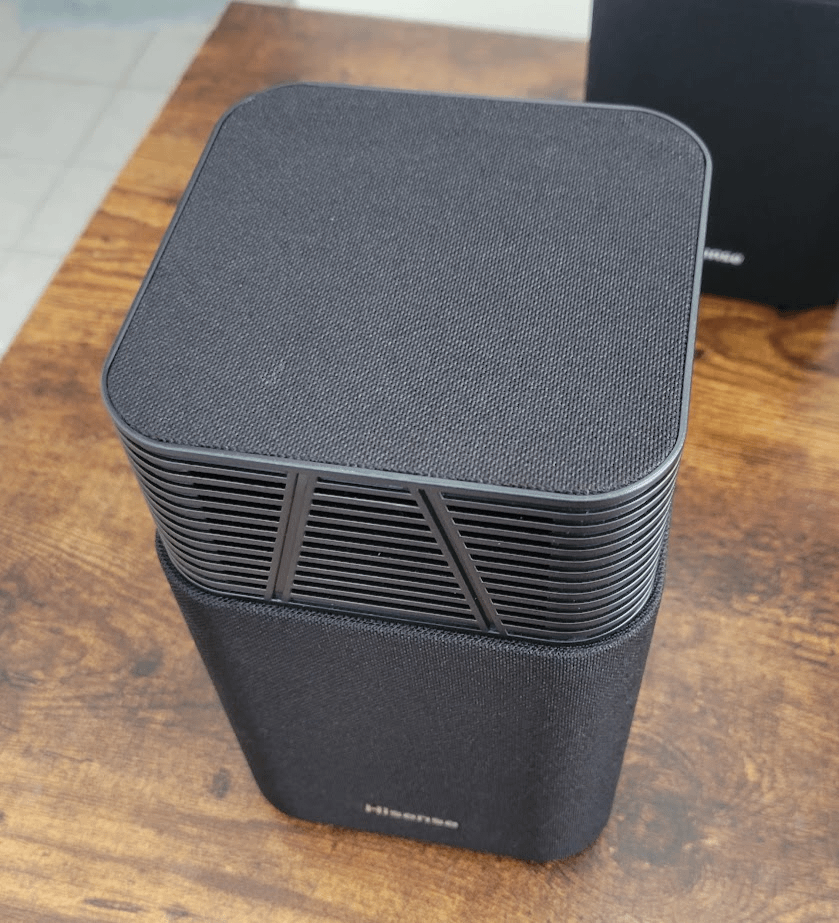
The small size is mostly an advantage, but it does come with a tradeoff. Those compact cabinets can't move as much air as larger speakers, and that becomes apparent when you push the system to high volumes. We'll get into that more in the performance section.
The Saturn's software experience emphasizes simplicity over customization. Power everything on, and the speakers automatically sync with the hub. There's no complex calibration process to navigate, no measuring distances or setting levels for each speaker. For most people, this plug-and-play approach is perfect. For audio enthusiasts who want to fine-tune every parameter, it's limiting.
You can't adjust individual speaker levels, which means you can't boost the rear speakers if they feel too quiet or dial back the subwoofer if it's overwhelming. There are no distance settings, no delay adjustments, no parametric EQ. You get the five presets, the five sound effects, and basic bass and treble controls. That's it. For a system at this price, more granular control would be welcome.
The automatic Room Fitting Tuning works reasonably well if you have a compatible Hisense TV, adjusting frequency response to compensate for room acoustics. But it's not as sophisticated as the calibration systems you'd find on proper AV receivers, which use microphones to analyze your room in detail and make precise corrections.
Firmware updates happen via USB stick, not over-the-air, which feels antiquated. You download the update file to a thumb drive, plug it into the hub, and let it install. It's not difficult, but it's not as seamless as wireless updates that happen automatically in the background.
The lack of a mobile app is conspicuous. Most modern audio equipment offers smartphone control with visual interfaces and detailed settings. The Saturn requires either the small physical remote or, if you own a Hisense TV, the TV's remote. It's adequate but not elegant.
This is where things get interesting. The Saturn delivers performance that genuinely impresses, creating an immersive sound field that rivals systems costing considerably more. But it's not without limitations, and there's one significant issue we need to address head-on.
Let's start with the positives. The Dolby Atmos implementation is surprisingly effective. When reviewers tested the system with Blade Runner 2049, particularly the rain scene, they reported being able to sense the rain falling all around and above their heads. The up-firing drivers in each speaker bounce sound off the ceiling to create convincing overhead effects. It's not the same as having actual ceiling-mounted speakers—nothing can fully replicate that—but for a system at this price point, the height channels work remarkably well.
The spatial positioning is equally impressive. During action sequences, sounds move around the room with precision. In one test with Transformers, during a scene where a character flips and transforms, the audio tracked the movement convincingly enough to create a genuine sense of being inside the car. You can pinpoint specific sounds—footsteps, creaking doors, environmental details—coming from distinct locations in the sound field. This is where having four discrete speakers instead of a soundbar really pays off. The physical separation creates a wider, more realistic soundstage with better imaging.
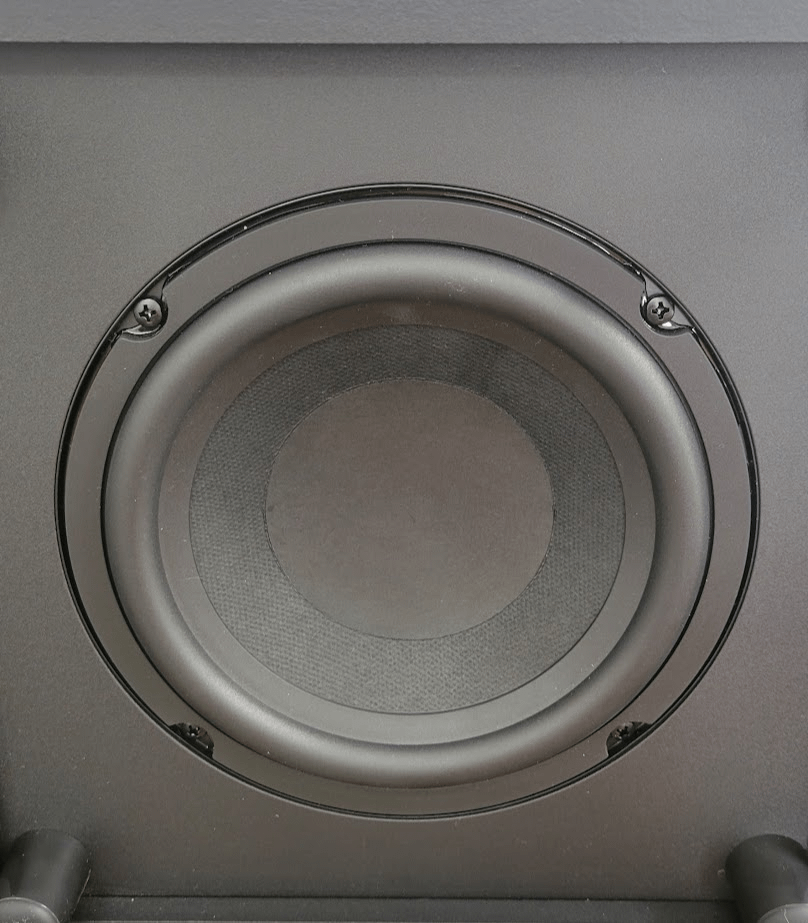
The subwoofer is the system's secret weapon. Unlike the Sony Bravia Theater Quad, which sells the subwoofer separately as a $350-400 add-on, Hisense includes one in the box. And it's not just checking a box—it's actually quite good. The 6.5-inch driver produces controlled, impactful bass that doesn't sound like it's flapping around or distorting, even during demanding passages. During action sequences with explosions and crashes, the sub provides the visceral rumble that makes cinema exciting. It reaches down to 40Hz, which is respectable if not class-leading, and it has enough output to pressurize medium to large rooms effectively.
For movies and TV shows, the Saturn excels. The combination of spatial accuracy, overhead effects, and solid bass creates an engaging, theatrical experience. When you're watching Dune or any other modern film mixed for Atmos, the system delivers the goods. The level of detail and immersion is far beyond what any TV's built-in speakers could manage, and it competes admirably with soundbars that cost hundreds more.
Gaming performance is similarly excellent. The low-latency wireless connection ensures perfect sync between audio and video, and the spatial audio capabilities translate beautifully to games. When you're playing something like Spider-Man, being able to precisely locate sounds around you adds to the immersion significantly. Several reviewers specifically noted that gaming on the Saturn felt like playing in a theater compared to TV speakers.
Music playback is more of a mixed bag. The system is clearly tuned with movies in mind, and while it handles music competently, it doesn't reach the level of dedicated stereo systems. Bass can be overpowering with some tracks unless you adjust the settings, and the overall balance leans toward excitement rather than accuracy. The Bluetooth-only wireless music limits quality to 16-bit/44.1kHz, which is fine for casual listening but falls short of lossless streaming formats. If music is your primary use case, you'd be better served by a proper stereo setup.
Now we need to talk about the biggest concern for home theater: the phantom center channel. This is the Saturn's most significant compromise, and it's one that affects every system that lacks a dedicated center speaker. In a traditional home theater, the center channel anchors dialogue to the screen. When someone speaks on-screen, the sound comes from the screen. It's intuitive and natural. With the Saturn, dialogue comes from the front left and right speakers simultaneously, creating what's called a phantom center image.
In theory, if you're sitting in the sweet spot equidistant from both speakers, your brain fuses the two sources into a single center image. In practice, results vary. Some reviewers found the phantom center convincingly centered the dialogue. Others noticed that voices didn't seem firmly anchored to the screen, sometimes sounding like they were coming from two distinct speakers rather than a single central point. The effectiveness depends heavily on your seating position and how you've positioned the speakers.
Here's the critical insight: you can dramatically improve the phantom center by placing the front left and right speakers close to your TV and not too far apart. The closer they are to each other and to the screen, the more convincing the phantom image becomes. If you spread them wide across a large room for maximum stereo separation, the phantom center falls apart. This is a fundamental trade-off in physics—you can't have both an ultra-wide soundstage and a rock-solid phantom center. For the Saturn, prioritizing a narrower placement near the TV significantly improves dialogue clarity and localization.
If you own a compatible Hisense TV, the Hi-Concerto feature solves this problem entirely by using the TV's speakers as an actual center channel. Multiple reviewers confirmed this works brilliantly, anchoring dialogue firmly to the screen. But if you don't own a Hisense TV, you need to be thoughtful about speaker placement to get the best dialogue performance.
There's another limitation worth noting: high-volume performance. When pushed to maximum volume, the system starts to show strain. Reviewers measured significant distortion above about 85 decibels, with midrange clipping and harsh treble becoming apparent. The recommendation is to keep volume around 65% of maximum for the cleanest sound. For most people in medium-sized rooms, this isn't a dealbreaker—65% is still plenty loud for immersive movie watching. But if you have a very large space or you like reference-level volume that rattles the walls, the Saturn's compact drivers can't quite deliver without compromising sound quality.
The 4.1.2 configuration itself represents a limitation for purists. True Dolby Atmos ideally requires at least a 5.1.4 setup—five main channels, one subwoofer, and four height channels. The Saturn's 4.1.2 means you're missing a dedicated center channel, side surrounds, and rear height channels. This constrains how effectively the system can render complex Atmos soundtracks with dozens of simultaneous sound objects. You'll get a convincing sense of immersion and height, but it's not as complete as what a more elaborate setup can achieve.
In medium-to-large rooms, the Saturn performs admirably. It has enough output to fill spaces effectively, and the four-speaker layout creates genuine surround envelopment. In very large rooms or open-concept layouts, the single 6.5-inch subwoofer and relatively modest power output start to show limitations. The system is well-matched to rooms where the TV is in the 65-85 inch range and viewers are sitting within about 15 feet.
Comparing directly to the Sony Bravia Theater Quad, the performance gap is narrower than the price gap. The Sony offers a slightly wider soundstage, more sophisticated auto-calibration, and better connectivity options including Wi-Fi streaming and multiple wireless codecs. Its 4.0.4 configuration with four height channels provides more complete Atmos rendering. But the Saturn counters with more dynamic, impactful sound, a more exciting presentation, and that included subwoofer. Sony's system costs $2,500 for the four speakers alone, and you need to add the subwoofer separately if you want proper bass. The Saturn delivers about 85-90% of the performance for 52% of the cost. For most buyers, that's a compelling value equation.
The Saturn doesn't exist in a vacuum, and at $1,300, it faces stiff competition from several strong alternatives. Let's see how it compares to three systems in its general price range, focusing on value, key differences, and bass performance.
Samsung HW-Q900F (~$1,200) - Samsung's 7.1.2 soundbar system costs $100 less than the Saturn and takes a fundamentally different approach. Instead of four discrete satellite speakers, you get a single long soundbar with side-firing drivers, two height channels, and an 8-inch wireless subwoofer. The soundbar configuration is 54 inches wide and packs 14 drivers into its frame. It delivers 546 watts of total power and includes Samsung's Q-Symphony feature for TV speaker integration, similar to Hisense's Hi-Concerto.
The value proposition here is interesting. The Samsung costs slightly less and offers a true 7.1.2 channel configuration with a dedicated center channel that solves the phantom center issue completely. Setup is simpler since you're only positioning a bar and a sub, not four speakers. The SpaceFit Sound Pro calibration is sophisticated, and the build quality is excellent.
But here's where the Saturn pulls ahead: those four discrete speakers create a dramatically wider soundstage than any soundbar can manage. When you place satellite speakers eight or ten feet apart instead of clustering drivers in a single bar, the spatial separation is night and day. The Samsung's side-firing drivers create a wider field than forward-firing soundbars, but they can't match the physical separation of the Saturn's setup. The trade-off is that 8-inch subwoofer versus the Saturn's 6.5-inch. The Samsung's sub digs slightly deeper and moves more air, though both are adequate for medium-sized rooms. If you value simplicity and a dedicated center channel, the Samsung makes sense. If you want the most immersive spatial audio, the Saturn's discrete speaker placement wins.
JBL Bar 1300X MK2 (~$1,200-$1,700) - This is the closest direct competitor to the Saturn, and it's fascinating because JBL takes yet another hybrid approach. You get a massive 54-inch soundbar as your foundation, but it has detachable battery-powered wireless speakers at each end that you can remove and position as surround speakers. Plus there's a serious 12-inch wireless subwoofer that anchors the whole system.
The specs are impressive: 11.1.4 channels, 1,570 watts maximum power, 29 drivers spread across the system. That 12-inch sub reaches down to 33Hz and produces room-shaking bass that's noticeably more powerful than either the Saturn's 6.5-inch or Samsung's 8-inch subwoofers. The JBL's PureVoice 2.0 technology for dialogue clarity is genuinely advanced, and unlike the Saturn, you get a proper center channel. Connectivity is extensive with Wi-Fi streaming, AirPlay 2, Chromecast, and multiple HDMI inputs.
So why consider the Saturn? Price and placement flexibility. The JBL costs up to $400 more depending on where you buy it, and that 54-inch soundbar dominates your entertainment center. The detachable surround speakers are clever, but they need charging and you're constrained by battery life during long movie sessions. The Saturn's four truly independent speakers give you more placement options and never run out of power since they're plugged in. The JBL delivers more channels, more power, and deeper bass, but the Saturn offers 85% of the performance at potentially half the cost. If budget is a major concern and you don't need that massive bass, the Saturn is the smarter value. If you want the most impressive spec sheet and don't mind spending more, the JBL is hard to beat.
Sony Bravia Theater Quad (~$2,200-$2,500 without sub) - This is the premium option that the Saturn was explicitly designed to undercut, and it's worth understanding what that extra $1,200 buys you. The Sony is a true 4.0.4 system with four discrete wireless speakers, each larger and heavier than the Saturn's satellites. The build quality is exceptional, with premium materials and a refined aesthetic that makes the Saturn look budget by comparison.
What you're really paying for is Sony's 360 Spatial Sound Mapping technology, which is significantly more sophisticated than the Saturn's simpler calibration. The Sony system creates phantom speakers throughout your room using advanced signal processing, delivering a more enveloping soundstage. The speakers themselves have superior drivers with three-way designs and more refined tuning than the Saturn's Devialet work. Connectivity is extensive: Wi-Fi streaming, AirPlay, multiple codecs, seamless Sony TV integration.
But here's the catch: the Sony doesn't include a subwoofer. You need to spend an additional $350-600 for Sony's SA-SW3 or SA-SW5 wireless subs, bringing your total to $2,550-3,100. And you're locked into Sony's subwoofer options; you can't use any other brand. Multiple reviewers noted the Sony needs a sub badly; without one, bass feels hollow and lightweight.
The Saturn includes its 6.5-inch subwoofer in the box for $1,300 total. You're getting a complete system that delivers room-filling sound without another required purchase. The Sony's spatial processing is more advanced, the speakers sound more refined, and the overall experience is more polished. But that level of refinement costs more than twice as much. For most buyers, the Saturn delivers 85-90% of the Sony experience at 45% of the price when you factor in the subwoofer. That's exceptional value.
The bottom line on comparisons: each system makes different compromises. The Samsung prioritizes simplicity and a proper center channel. The JBL goes for maximum channels and bass power. The Sony delivers premium refinement and the most sophisticated processing. The Saturn balances discrete speaker placement, included subwoofer, and aggressive pricing. If you want the best overall value with genuinely immersive wireless surround sound, the Saturn is hard to argue against.
I pushed the Hisense HT Saturn to its limits in my large room, cranking heavy bass music to maximum volume, and I was genuinely impressed. The speakers filled the space with authority, maintaining clarity and power without falling apart. There was no distortion, no muddiness, just clean, impactful sound that made me appreciate how much engineering Devialet contributed to this project. The build quality is solid—these speakers feel substantial and well-made, not like budget equipment that cuts corners.
The Saturn isn't perfect. The phantom center issue is real, though manageable with proper speaker placement or a Hisense TV. The high-volume distortion limits headroom for those who want reference-level output. The lack of granular customization frustrates enthusiasts who want to fine-tune every setting. The five power cables undermine the wireless convenience. And if you're a Dolby Atmos purist who insists on a 5.1.4 minimum, the 4.1.2 configuration falls short.
But here's what matters: for $1,300, you get a genuinely immersive wireless home theater system that creates an enveloping three-dimensional sound field, delivers impactful bass, and handles dialogue with clarity—especially if you take the time to position the front speakers properly. The setup is simple, the build quality is good, and the performance punches well above the price point. This is the best audio product Hisense has ever made, and it's not close.
I give the Hisense HT Saturn my highly recommended award. It's the wireless home theater value champion of 2025, making premium spatial audio accessible to buyers who aren't ready to spend $2,500 on Sony's offering. If you own a Hisense TV, it's an absolute no-brainer. If you don't, it's still an excellent choice as long as you understand the phantom center trade-offs and position your speakers thoughtfully.
For movie and TV enthusiasts with medium to large rooms who want the immersive experience of discrete surround sound without the complexity of traditional home theater, the Saturn delivers. It's not reference-quality audio equipment, but it's not trying to be. It's trying to give you 90% of the experience at 50% of the cost, and on that mission, it succeeds brilliantly.




Privacy Policy
Terms and Conditions - Affiliate Policy
Home Security
© Copyright 2008-2026.
11816 Inwood Rd #1211, Dallas, TX 75244