





When you're ready to upgrade from your TV's built-in speakers, the world of premium soundbars offers two distinctly different philosophies. At the time of writing, Samsung's traditional approach with the HW-Q800D costs roughly half what you'll pay for Hisense's revolutionary distributed speaker system, the HT Saturn. But this isn't simply about expensive versus affordable—these represent fundamentally different ways of creating immersive home theater sound.
Premium soundbars aren't just louder versions of basic models. They're engineered to solve the core problem of home theater audio: how do you create the sensation of being surrounded by sound when you're sitting in front of speakers that are all in one location?
The answer involves channel configuration—essentially, how many different audio streams the system can handle independently. Think of it like having multiple musicians in an orchestra: the more players you have in different positions, the richer and more complex the performance becomes. A 5.1.2 system like the Samsung HW-Q800D has seven distinct audio channels (five main channels, one subwoofer, and two height channels), while the Hisense HT Saturn's 4.1.2 configuration trades one main channel for more power and unique speaker placement.
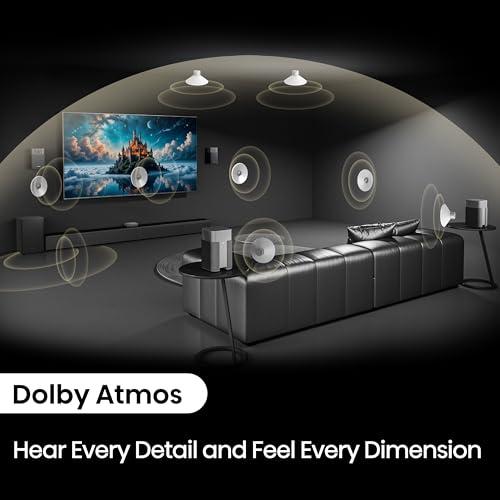
Dolby Atmos represents the biggest advancement in home theater audio in the past decade. Instead of just having sound come from left, right, and center, Atmos adds a vertical dimension. Rain sounds like it's falling from above, helicopters seem to fly overhead, and explosions feel like they're happening around you rather than just in front of you. Both systems support Atmos, but they achieve these height effects very differently.
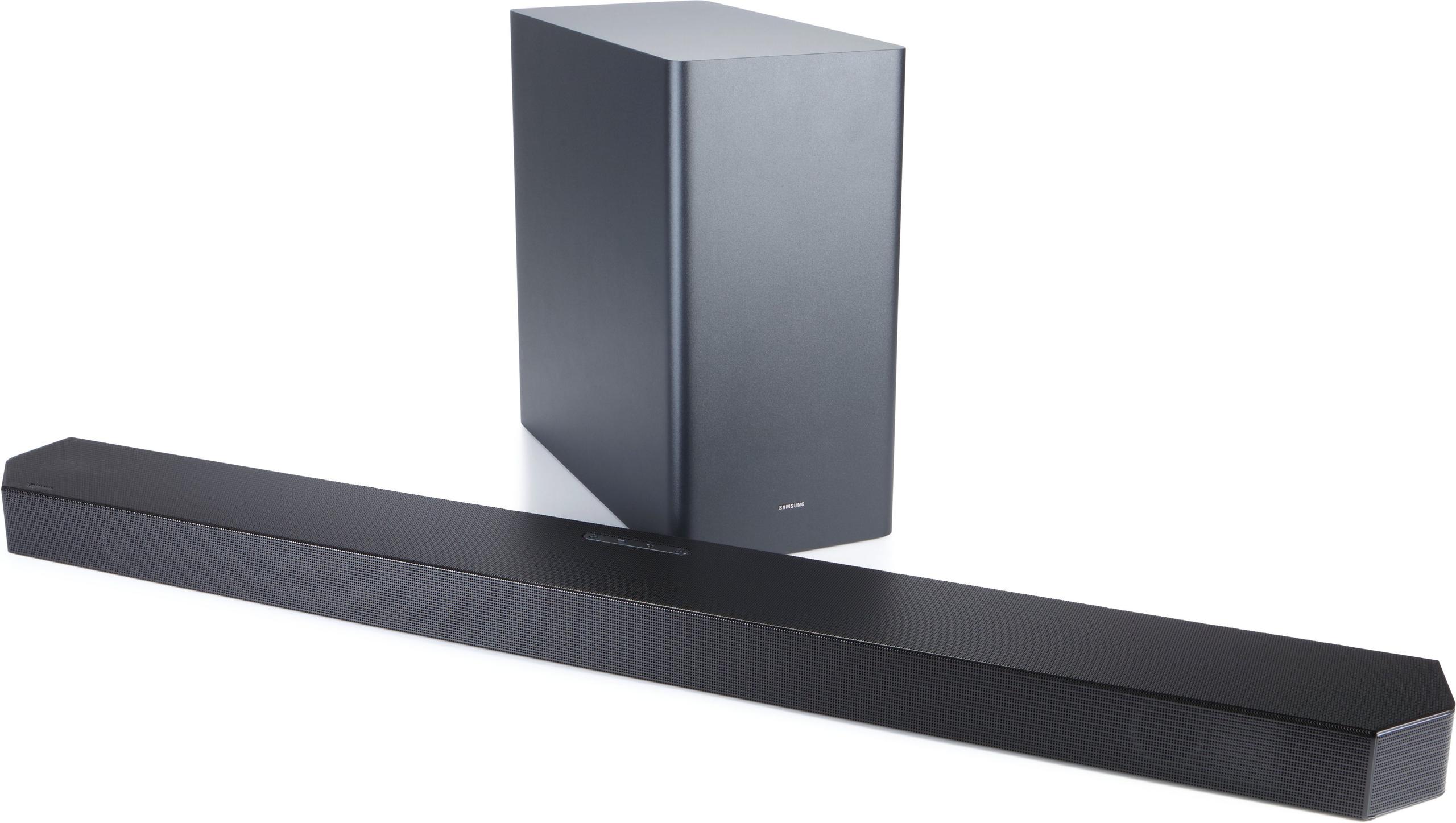
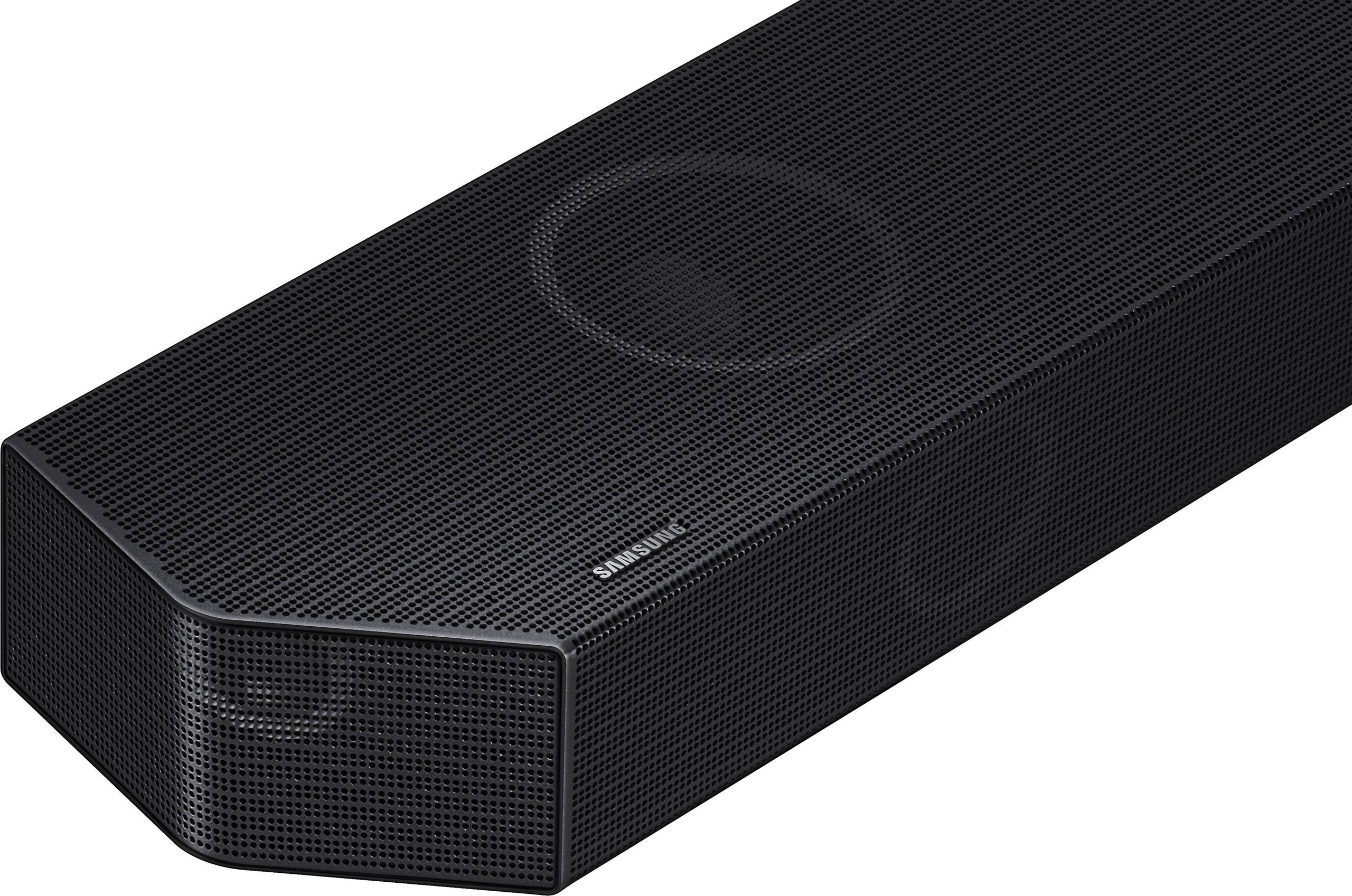
Released in 2024, the Samsung HW-Q800D represents the refined evolution of traditional soundbar design. Samsung has spent years perfecting this approach, and it shows in the thoughtful engineering details.
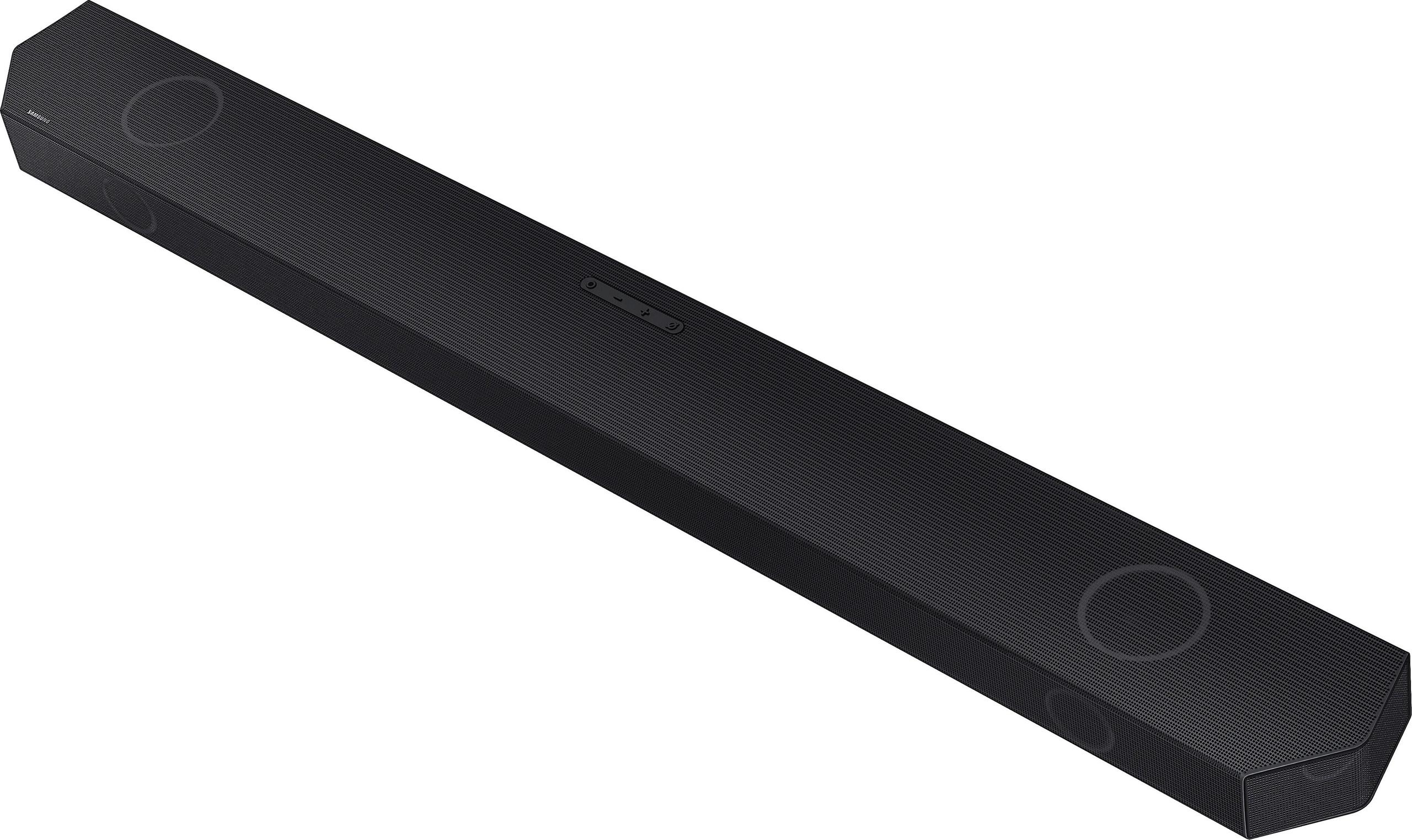
The system centers around a single, elegant soundbar that houses multiple drivers arranged to create distinct audio channels. The dedicated center channel is crucial here—it's specifically tuned to reproduce human speech with maximum clarity. This matters more than you might think. In most movie soundtracks, dialogue occupies a narrow frequency range, and having a speaker optimized for these frequencies means actors' voices remain clear even when explosions are booming around them.
The HW-Q800D's Active Voice Amplifier goes a step further, using real-time audio analysis to automatically boost dialogue when the system detects background noise or music is overwhelming speech. It's like having an audio engineer constantly adjusting levels to keep conversations intelligible.
Samsung's SpaceFit Sound technology uses built-in microphones to analyze your room's acoustics, then adjusts the audio output accordingly. Hard surfaces that create echoes get compensated with different processing than soft furnishings that absorb sound. This automatic calibration means you get optimized performance without needing to manually adjust dozens of settings.
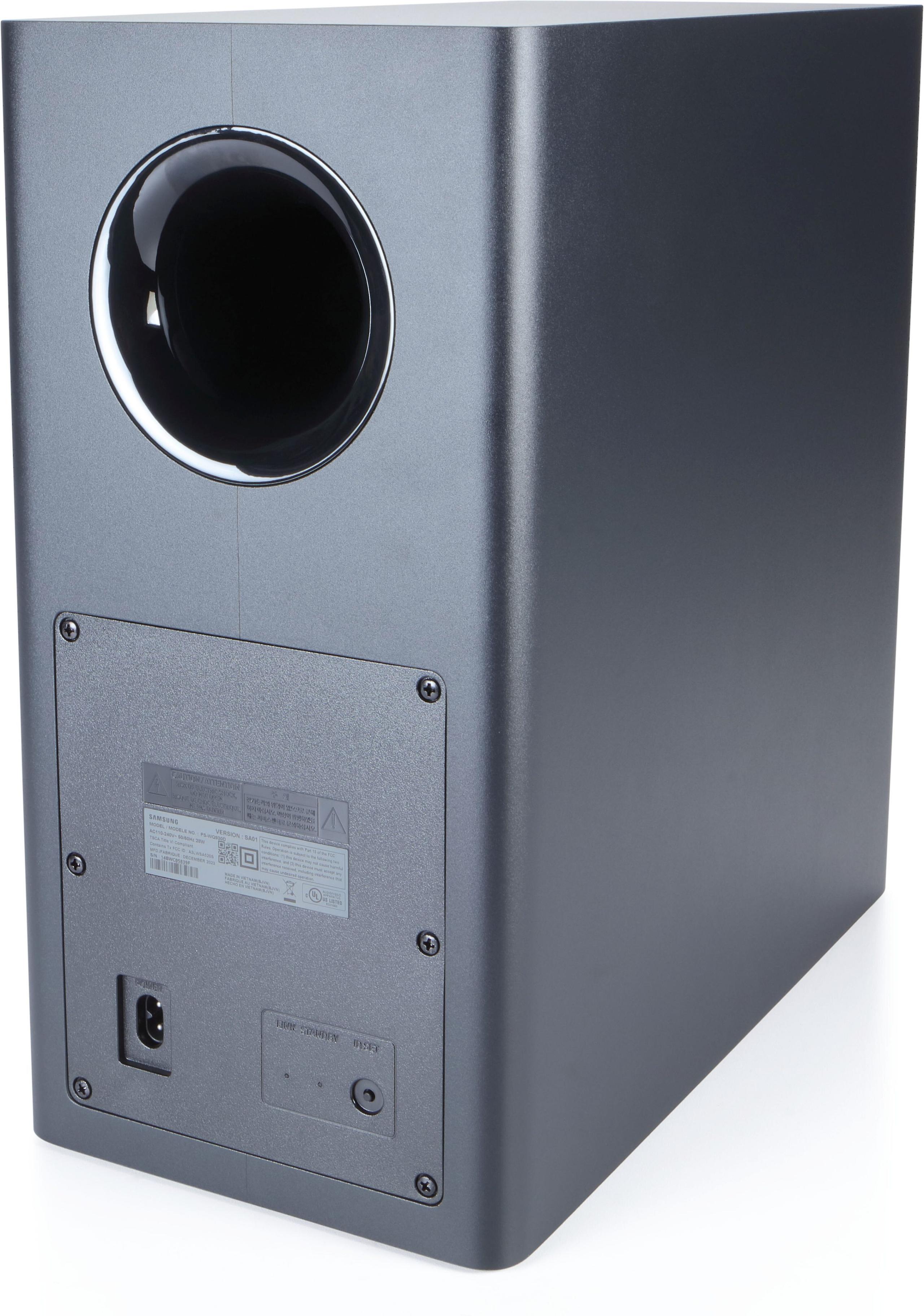
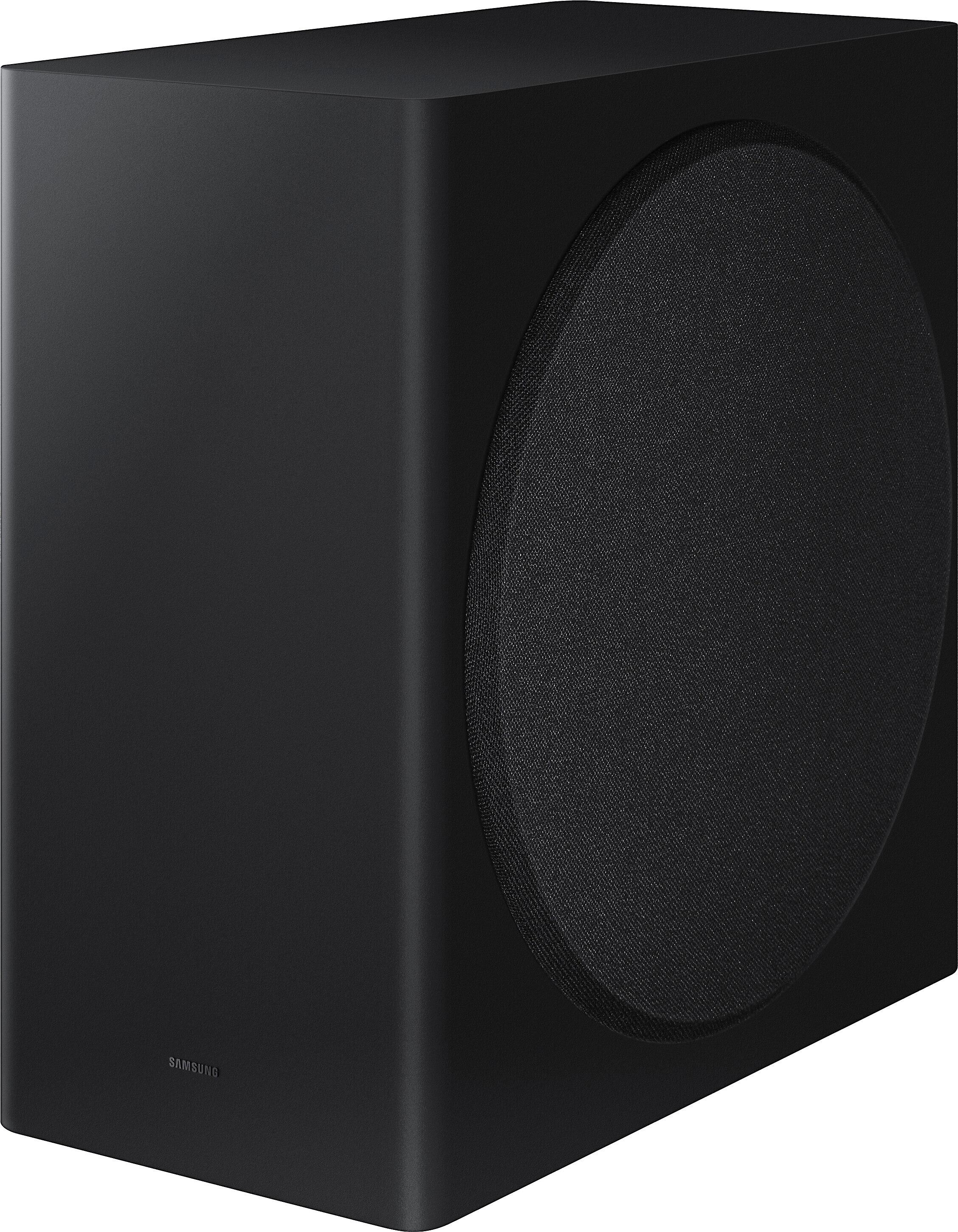
The wireless 8-inch subwoofer provides the foundation for bass response down to around 40Hz. To put that in perspective, the lowest note on a bass guitar is about 41Hz, so this system can reproduce the full range of most music and movie soundtracks. The side-firing design helps distribute bass energy throughout the room rather than beaming it directly at you.
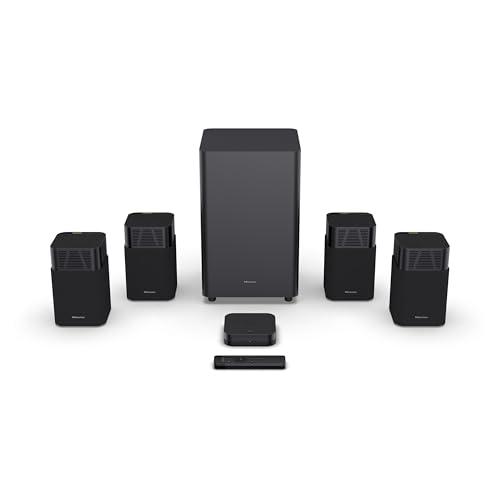
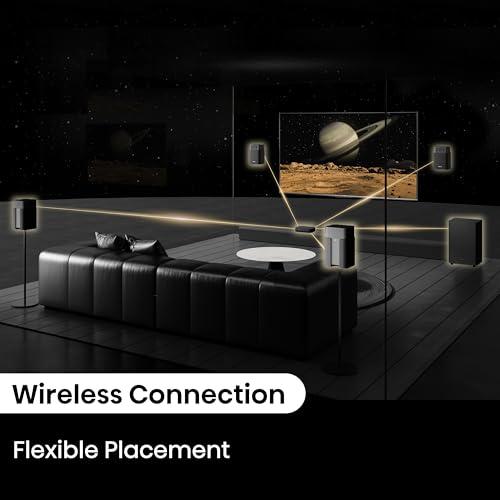
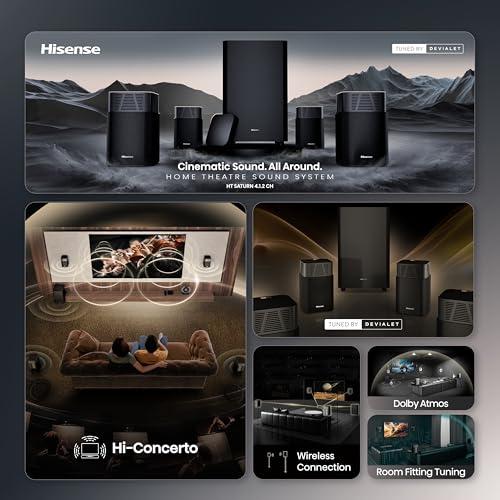
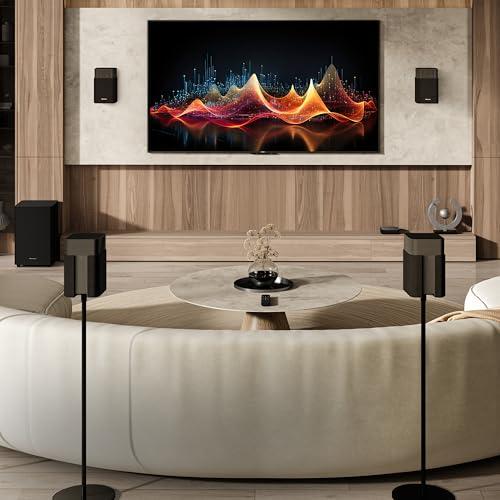
The Hisense HT Saturn, launched in late 2024, abandons the traditional soundbar concept entirely. Instead of trying to create the illusion of surround sound from a single location, it actually places speakers around your room.
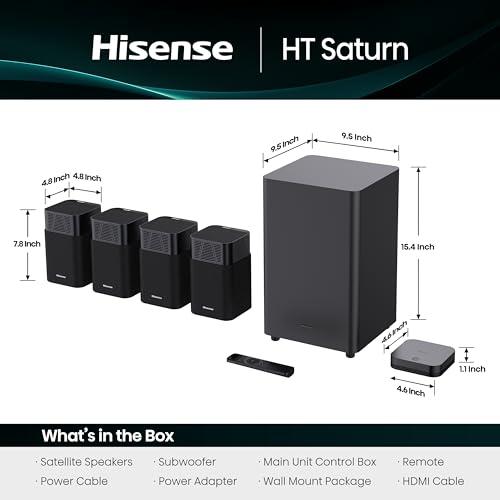
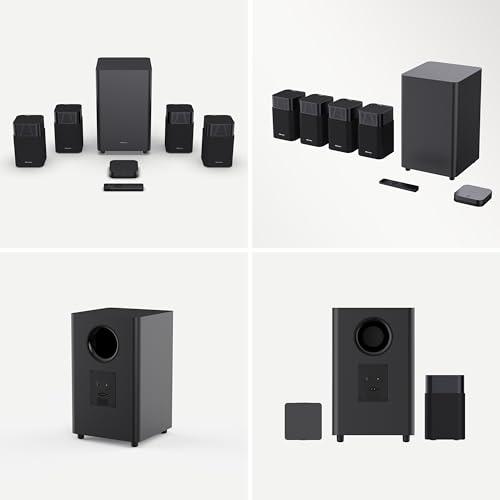
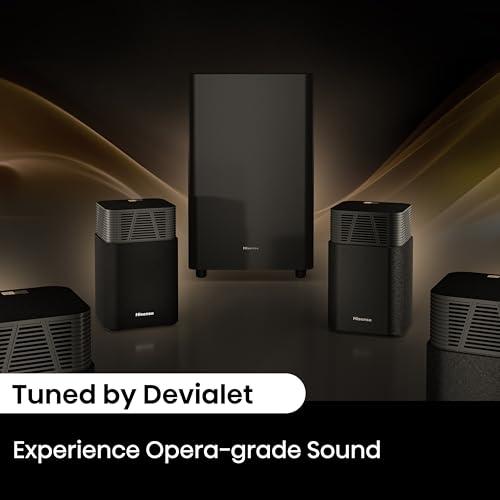
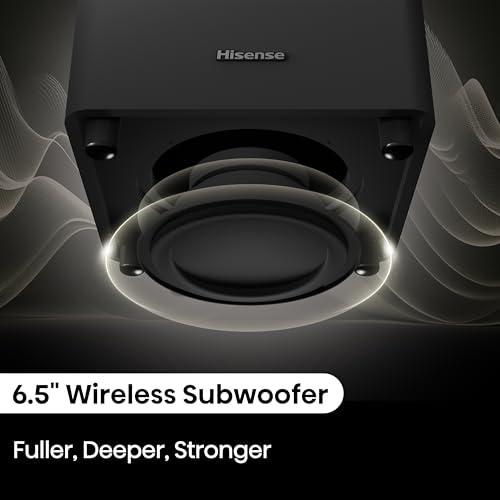
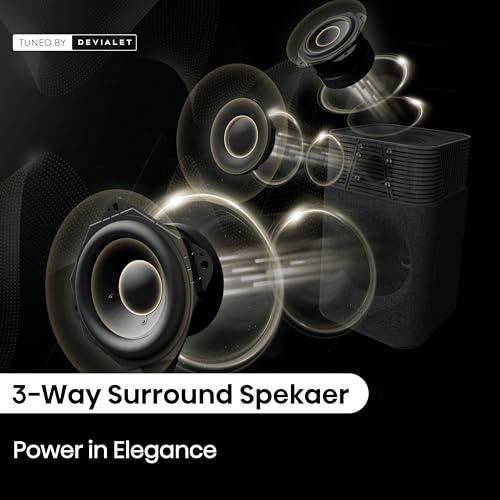
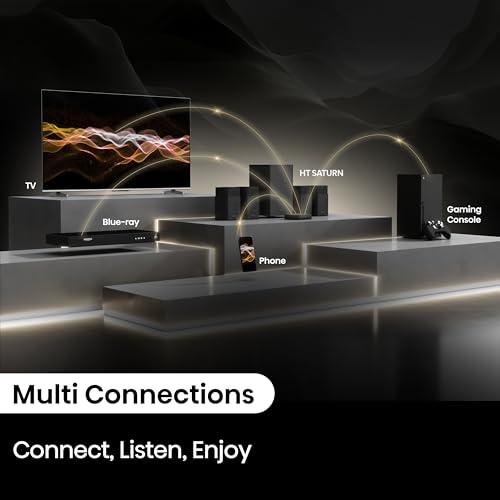
The system consists of four compact satellite speakers plus a wireless subwoofer, connected to a central control hub. Each satellite contains multiple drivers—three-way designs with separate woofers, mid-range drivers, and tweeters. This is the same approach used in high-end bookshelf speakers, allowing each satellite to reproduce the full frequency range with minimal distortion.
What makes this particularly interesting is the Devialet tuning. Devialet is a French company known for extremely expensive, audiophile-grade speakers that can cost more than a car. Their acoustic engineers have calibrated the HT Saturn's frequency response, crossover points (where one driver hands off to another), and overall sound signature. This collaboration brings genuine high-end audio expertise to a mass-market product.
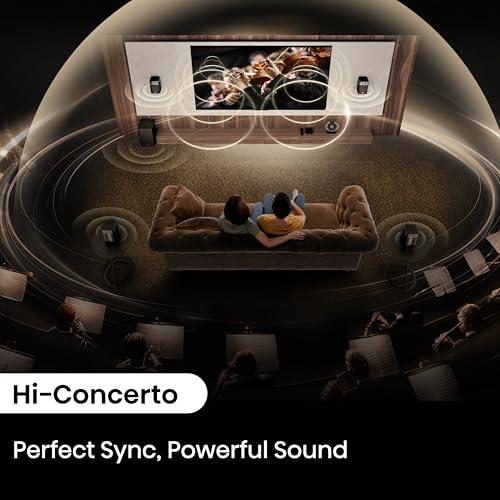
The distributed design creates what audio engineers call a larger soundstage. Instead of all sound originating from the front of your room, effects can genuinely seem to come from beside and behind you because there are actual speakers in those locations. When a car drives across the screen in an action movie, the sound follows naturally from speaker to speaker rather than relying on psychoacoustic tricks to fool your brain.
For movie watching, the differences between these systems become immediately apparent. The Samsung HW-Q800D excels at dialogue clarity, which is actually the most important performance metric for most users. Poor dialogue reproduction is the number one complaint about soundbars, and Samsung has engineered their dedicated center channel specifically to solve this problem.
The HW-Q800D's Atmos height effects work through up-firing drivers that bounce sound off your ceiling. This can create convincing overhead effects, but it requires specific room conditions—particularly a relatively low, flat ceiling. In rooms with vaulted ceilings or lots of soft furnishings, the height effects become less noticeable.
The Hisense HT Saturn takes a more brute-force approach to immersion. With 720 watts of total power distributed across 13 drivers, it simply has more acoustic energy to work with. Bass hits harder, dynamic range is wider, and the overall presentation is more forceful. The distributed speakers create genuine surround effects that don't rely on room acoustics to work properly.
However, the HT Saturn makes an interesting trade-off by not including a dedicated center channel. Instead, it uses the left and right front speakers to create a phantom center—a technique where identical audio signals from two speakers convince your brain that sound is coming from between them. When done well, phantom center can work effectively, but it requires precise speaker positioning and listening location.
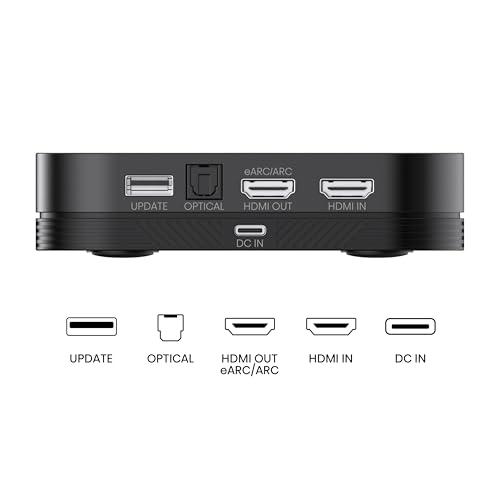
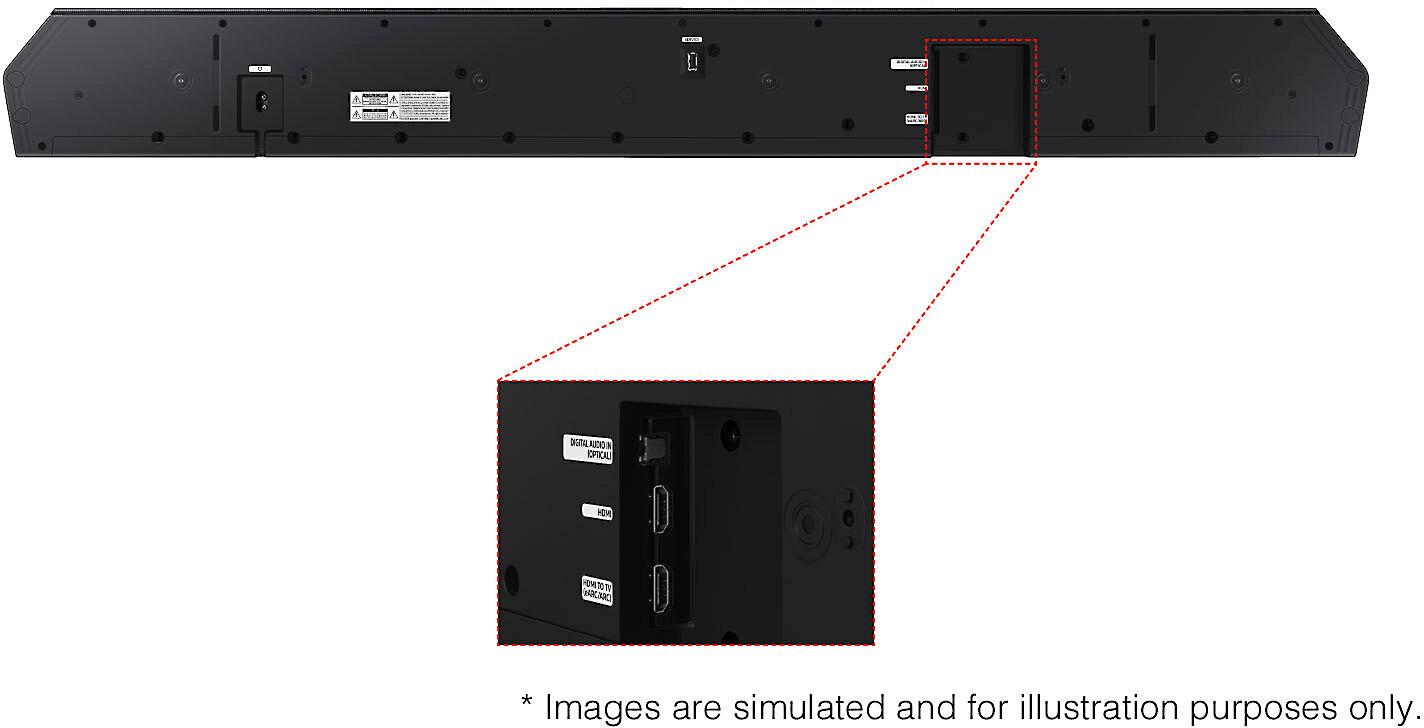
Gaming represents where the technical differences between these systems become most significant. The Hisense HT Saturn includes HDMI 2.1 support, which enables 4K video at 120 frames per second with Variable Refresh Rate (VRR). These features are essential for getting the best experience from PlayStation 5 and Xbox Series X consoles.
VRR is particularly important for competitive gaming. It synchronizes the display refresh rate with the console's output, eliminating screen tearing and reducing input lag—the delay between pressing a button and seeing the result on screen. The HT Saturn's support for these features means it won't become a bottleneck in your gaming setup.
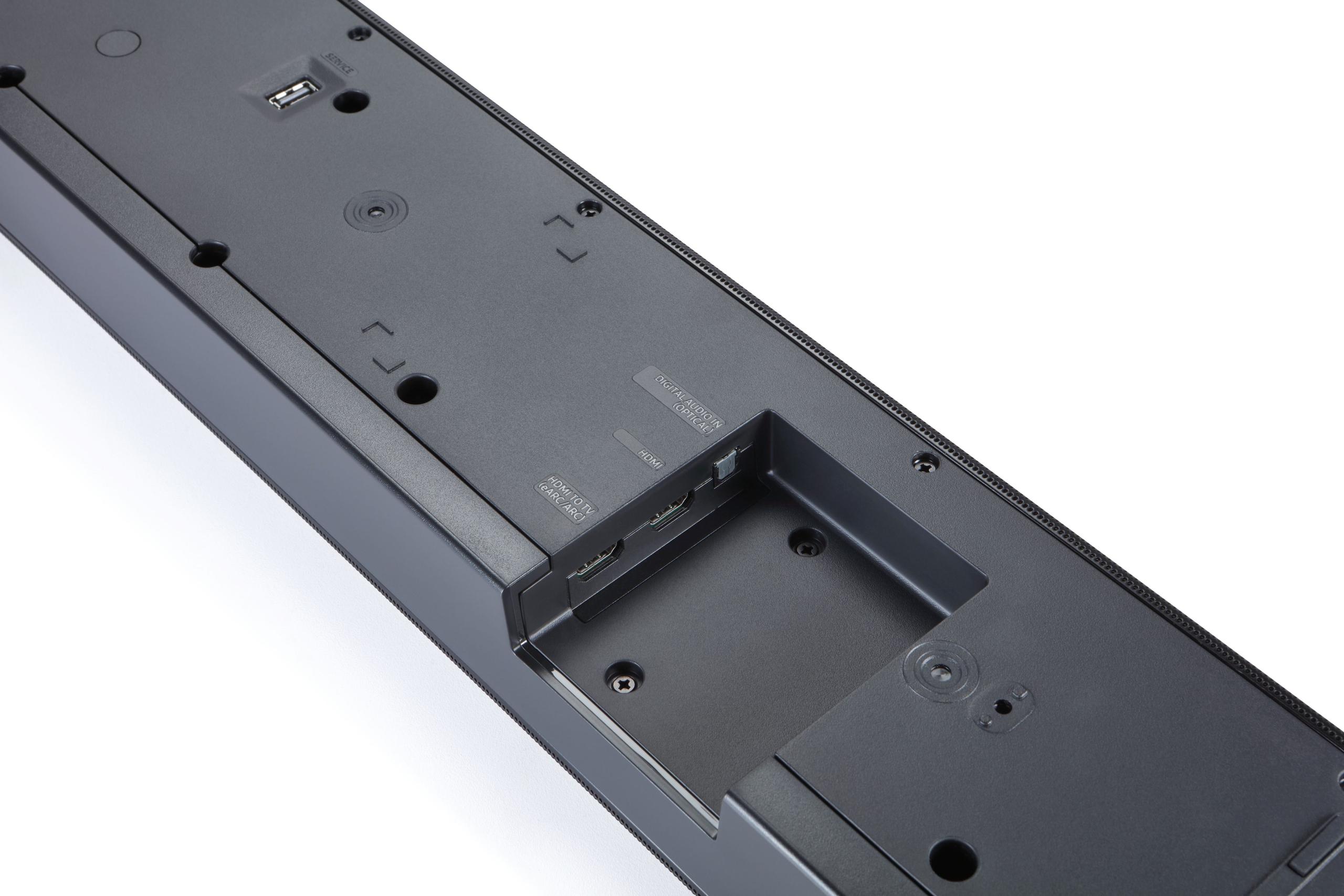
The Samsung HW-Q800D is limited to 4K at 60fps without VRR support. This isn't necessarily a problem for casual gaming, but serious gamers will notice the difference. The system does include a dedicated Game Pro mode that optimizes audio processing for gaming, reducing latency and enhancing directional audio cues that help identify enemy positions.
Both systems handle music well, but again with different strengths. The Samsung HW-Q800D includes a 7-band graphic equalizer that lets you adjust specific frequency ranges. This level of customization is rare in soundbars and allows you to tailor the sound signature to your preferences or room acoustics.
The HT Saturn's Devialet tuning becomes most apparent with music playback. The frequency response is more linear—meaning it doesn't artificially boost or cut any particular frequencies—which results in more accurate reproduction of how the music was intended to sound. The higher power output also provides better dynamic range, the difference between the quietest and loudest sounds the system can reproduce without distortion.
Modern soundbars aren't just audio devices—they're smart home components that need to work seamlessly with your other technology. This is where brand ecosystem becomes important.
If you own a Samsung TV, the HW-Q800D offers Q-Symphony technology that uses both the TV's built-in speakers and the soundbar simultaneously. Rather than disabling the TV speakers (as most soundbars do), Q-Symphony coordinates them to create a larger, more enveloping sound field. The TV speakers handle some mid-range frequencies while the soundbar focuses on dialogue and effects, creating a more spacious presentation.
The Samsung system also integrates with Samsung's SmartThings ecosystem, allowing voice control through Bixby, Alexa, or Google Assistant. You can include the soundbar in automation routines—for example, having it automatically switch to Night Mode when you activate a "bedtime" scene.
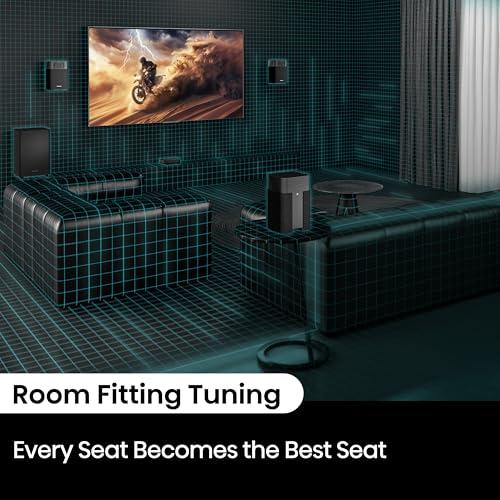
The Hisense HT Saturn offers Hi-Concerto technology with compatible Hisense TVs, which serves a similar function to Q-Symphony. The system can also perform Room Fitting Tuning when paired with newer Hisense TVs, using the TV's interface to optimize audio calibration for your specific space.
The installation experience differs dramatically between these systems. The Samsung HW-Q800D requires minimal setup—mount the soundbar below your TV, place the subwoofer somewhere in the room, and connect a single HDMI cable. The clean aesthetic works well in most living rooms without dominating the space.
The HT Saturn demands more planning. Four satellite speakers need power outlets and positioning throughout your room. While they're designed to be compact and visually unobtrusive, they still require dedicated space on shelves, stands, or wall mounts. The payoff is better performance, but you need to be willing to embrace a more complex setup.
For apartment dwellers or anyone with strict aesthetic requirements, the Samsung's simplicity is a significant advantage. For dedicated home theater enthusiasts who prioritize performance over convenience, the Hisense approach makes more sense.
At the time of writing, the HW-Q800D costs roughly half what you'll pay for the HT Saturn, making the value comparison complex. The Samsung delivers approximately 80% of the performance for 40% of the cost, which represents exceptional value in the traditional sense.
However, the HT Saturn offers performance that typically requires spending significantly more on separate components. A comparable traditional home theater system with separate receiver, speakers, and subwoofer could easily cost double the HT Saturn's price while requiring much more complex setup and room treatment.
Future-proofing is another consideration. The HT Saturn's HDMI 2.1 support ensures compatibility with current and next-generation gaming consoles and media devices. The HW-Q800D may require replacement sooner if 4K/120Hz content becomes more prevalent.
Choose the Samsung HW-Q800D if you prioritize simplicity, dialogue clarity, and integration with Samsung devices. It's ideal for apartment living, primarily TV and movie watching, and situations where aesthetics matter as much as performance. The excellent value proposition makes it a smart choice for most users who want premium features without premium complexity.
The Hisense HT Saturn makes sense for dedicated home theater enthusiasts who have the space and patience for a more complex setup. It's the better choice for large rooms, serious movie watching, current-generation gaming, and anyone who values the most immersive audio experience possible. The Devialet tuning and distributed speaker design offer genuinely premium performance that justifies the higher cost.
Both systems represent the current state-of-the-art in their respective approaches. The Samsung perfects the traditional soundbar concept with thoughtful engineering and smart features, while the Hisense reimagines what a soundbar can be by abandoning the single-unit limitation entirely. Your choice ultimately depends on whether you value convenience or maximum performance—both are excellent at what they're designed to do.
| Hisense HT Saturn HTSATURN | Samsung HW-Q800D |
|---|---|
| Channel Configuration - Determines surround sound accuracy and dialogue clarity | |
| 4.1.2 channels with phantom center (relies on precise positioning for dialogue) | 5.1.2 channels with dedicated center (superior dialogue clarity in all room layouts) |
| Speaker Design - Affects immersion and soundstage width | |
| 4 distributed satellite speakers + wireless subwoofer (true surround positioning) | Single soundbar + wireless 8" subwoofer (virtual surround processing) |
| Total Power Output - Controls dynamic range and bass impact | |
| 720W across 13 drivers (powerful, room-filling sound) | 360W across 10 drivers (adequate for most rooms, may compress at high volumes) |
| Audio Tuning - Determines overall sound quality and accuracy | |
| Devialet-tuned with audiophile-grade frequency response | Samsung's consumer-focused tuning with Active Voice Amplifier |
| HDMI Gaming Features - Critical for PS5/Xbox Series X owners | |
| HDMI 2.1 with 4K/120Hz and VRR support (future-proof gaming) | HDMI with 4K/60Hz only (adequate for casual gaming, limiting for serious gamers) |
| TV Integration - Enhances performance with compatible TVs | |
| Hi-Concerto with Hisense HT Saturn TVs for expanded soundstage | Q-Symphony with Samsung TVs uses TV speakers + soundbar simultaneously |
| Room Calibration - Optimizes sound for your specific space | |
| Room Fitting Tuning via compatible Hisense TV interface | SpaceFit Sound with built-in microphones analyzes room acoustics automatically |
| Installation Complexity - Affects setup time and living room aesthetics | |
| Complex: 4 satellites need power outlets and positioning throughout room | Simple: Single soundbar placement with wireless subwoofer |
| Smart Features - Convenience and app control capabilities | |
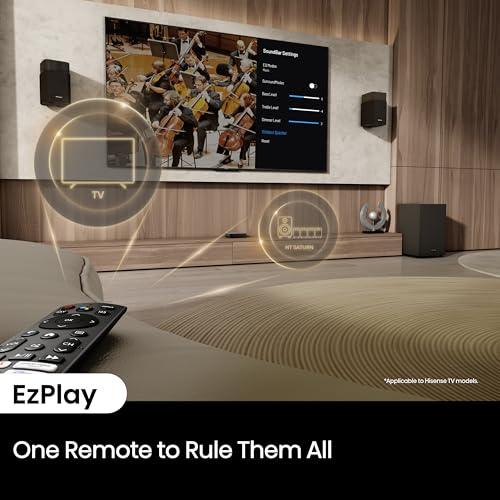
| Basic smart features, EZPlay TV remote control | Comprehensive SmartThings integration, voice assistant support, 7-band EQ |
| Best Use Cases - Who should choose each system | |
| Large rooms, movie enthusiasts, current-gen gaming, audiophile preferences | Medium rooms, Samsung TV owners, dialogue-focused viewing, simple setup priority |
The Hisense HT Saturn uses a distributed speaker design with four separate satellite speakers placed around your room, while the Samsung HW-Q800D is a traditional single soundbar design. The HT Saturn creates true surround sound through physical speaker placement, whereas the HW-Q800D relies on virtual surround processing from one location.
The Samsung HW-Q800D excels at dialogue clarity thanks to its dedicated center channel and Active Voice Amplifier technology that automatically enhances speech. The Hisense HT Saturn uses a phantom center channel that can work well but requires more precise positioning to achieve optimal dialogue reproduction.
Yes, both the Hisense HT Saturn and Samsung HW-Q800D support Dolby Atmos for three-dimensional audio. The HT Saturn uses distributed speakers for more convincing height effects, while the HW-Q800D uses up-firing drivers that bounce sound off your ceiling.
The Samsung HW-Q800D is much easier to install, requiring only the soundbar placement and wireless subwoofer positioning. The Hisense HT Saturn requires placing four satellite speakers around your room, each needing power outlets, making setup more complex but potentially more rewarding for performance.
The Hisense HT Saturn is better for gaming with HDMI 2.1 support, 4K/120Hz passthrough, and VRR compatibility for PS5 and Xbox Series X. The Samsung HW-Q800D is limited to 4K/60Hz, making it adequate for casual gaming but less ideal for current-generation consoles.
The Hisense HT Saturn performs better in large rooms due to its higher 720W power output and distributed speaker placement that fills space more effectively. The Samsung HW-Q800D with 360W is better suited for medium-sized rooms where its virtual processing can work effectively.
Both systems work with any TV brand, but each offers enhanced features with their respective manufacturers. The Samsung HW-Q800D provides Q-Symphony integration with Samsung TVs, while the Hisense HT Saturn offers Hi-Concerto features with compatible Hisense televisions.
The Hisense HT Saturn offers superior music performance with Devialet tuning for audiophile-grade sound quality and higher power output for better dynamic range. The Samsung HW-Q800D provides good music playback with a 7-band equalizer for customization but focuses more on TV and movie optimization.
Both systems include wireless subwoofers, but the Hisense HT Saturn delivers more powerful bass due to its higher total power output and system design. The Samsung HW-Q800D features an 8-inch side-firing subwoofer that provides adequate bass for most users but may not satisfy those wanting maximum low-frequency impact.
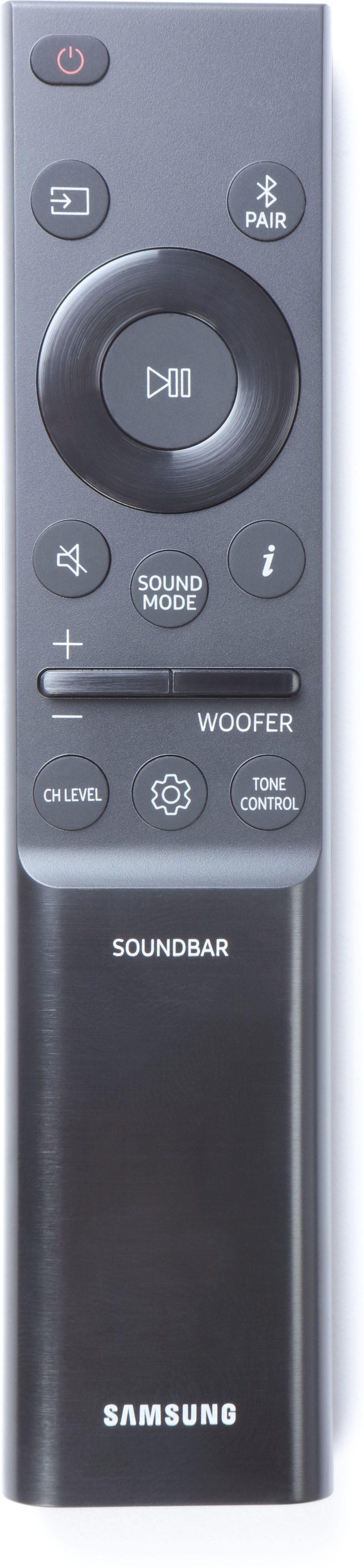
The Samsung HW-Q800D provides more comprehensive smart features including SmartThings integration, voice assistant support, and extensive app control. The Hisense HT Saturn focuses more on audio performance with basic smart features and EZPlay TV remote control functionality.
Yes, both excel at home theater applications but in different ways. The Samsung HW-Q800D offers excellent dialogue clarity and convenient setup ideal for most home theaters. The Hisense HT Saturn provides more immersive surround sound with true speaker positioning, making it better for dedicated home theater rooms where setup complexity isn't a concern.
Value depends on your priorities. The Samsung HW-Q800D offers exceptional value with premium features at a more accessible price point and simple installation. The Hisense HT Saturn provides premium performance that typically requires much more expensive separate components, justifying its higher cost for serious audio enthusiasts.
We've done our best to create useful and informative comparisons to help you decide what product to buy. Our research uses advanced automated methods to create this comparison and perfection is not possible - please contact us for corrections or questions. These are the sites we've researched in the creation of this article: bestbuy.com - youtube.com - blog.son-video.com - youtube.com - youtube.com - techradar.com - ecoustics.com - jbhifi.com.au - shop.hisense-usa.com - bhphotovideo.com - bestbuy.com - digitalreviews.net - hisense-usa.com - projectorscreenstore.com - valueelectronics.com - dolby.com - giftpack.ai - techradar.com - valueelectronics.com - samsung.com - rtings.com - samsung.com - crutchfield.com - samsung.com - samsung.com - samsung.com - shidirect.com

Privacy Policy
Terms and Conditions - Affiliate Policy
Home Security
© Copyright 2008-2026.
11816 Inwood Rd #1211, Dallas, TX 75244