






















When your TV's built-in speakers sound like someone stuffed cotton in a shoebox, it's time for a soundbar upgrade. But which direction should you go? The soundbar market has exploded over the past few years, offering everything from basic stereo strips to sophisticated systems that can make your living room feel like a movie theater.
Today we're comparing two very different approaches to better TV audio: the Samsung HW-B630F, a value-focused 3.1-channel system from 2022, and the Sonos Arc, a premium Dolby Atmos soundbar that launched in 2020 and helped establish the blueprint for modern immersive audio bars.
Before diving into these specific models, let's talk about what actually matters in a soundbar. The most important factors are channel configuration (how many separate audio channels the system can reproduce), audio format support (which types of surround sound it can decode), connectivity options, and whether it includes features like room correction or voice assistants.
Channel configuration tells you how many discrete audio streams a soundbar can handle. A 2.1 system has left and right channels plus a subwoofer (.1 indicates the subwoofer). A 3.1 adds a dedicated center channel specifically for dialogue. More advanced systems like 5.1.2 include surround channels (the 5), a subwoofer (.1), and height channels (the final 2) that bounce sound off your ceiling to create overhead effects.
Audio format support determines what types of content your soundbar can properly decode. Basic formats like stereo PCM and Dolby Digital work with virtually everything, but newer immersive formats like Dolby Atmos require specific hardware support and processing power to create those three-dimensional soundscapes that make helicopters seem to fly overhead.
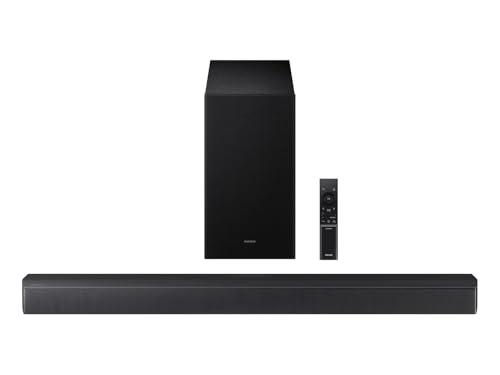
The Samsung HW-B630F represents Samsung's practical approach to soundbar design. Released in early 2022 as part of their B-series lineup, it focuses on delivering the fundamentals exceptionally well: clear dialogue, impactful bass, and easy integration with Samsung TVs. At the time of writing, it's priced as an entry-to-mid-range option, making it accessible to most households looking to upgrade from TV speakers.
The Sonos Arc, launched in mid-2020, took a different path entirely. Sonos bet that people wanted a single, elegant unit that could deliver genuine Dolby Atmos immersion while integrating seamlessly into a smart home ecosystem. It's positioned as a premium product with pricing to match, but it established many of the features we now expect from high-end soundbars.
Since 2020, we've seen the soundbar market mature significantly. Dolby Atmos support has trickled down to more affordable models, voice assistant integration has become standard, and manufacturers have gotten better at creating convincing virtual surround effects. However, both of these models have remained relevant because they execute their respective approaches so well.
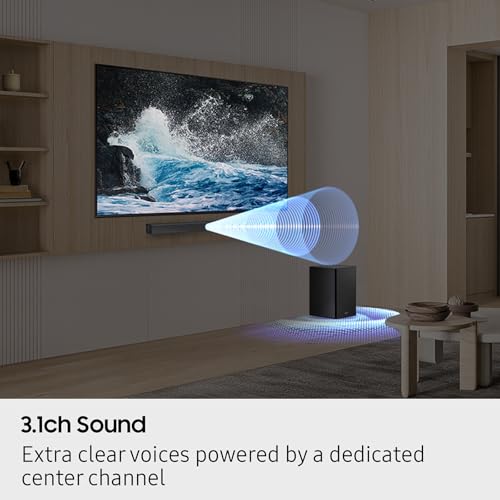
The Samsung HW-B630F takes a conventional but effective approach with its 3.1-channel configuration. Those three numbers represent left, center, and right channels in the main soundbar unit, with the wireless subwoofer handling the low frequencies. This setup might sound basic compared to more complex systems, but it excels at the fundamentals.
The dedicated center channel makes an enormous difference for dialogue clarity. Instead of trying to create a phantom center image between left and right speakers (like stereo systems do), the Samsung HW-B630F has a physical driver positioned exactly where voices should come from – the center of your screen. This means actors' voices stay locked to their mouths even if you're sitting off to the side of your couch.
Samsung's Voice Enhance mode takes this further by selectively boosting the frequency ranges where human speech lives (roughly 300Hz to 3kHz) without making everything sound tinny. Combined with their Adaptive Sound processing, which analyzes incoming audio and adjusts EQ automatically, the Samsung HW-B630F consistently delivers clear dialogue whether you're watching a whispered drama or an explosion-filled action movie.
The included wireless subwoofer deserves special mention. Many soundbars in this price range either skip the subwoofer entirely or offer it as an expensive add-on. Samsung includes a 6-inch front-firing sub that connects wirelessly to the main bar, giving you genuine low-frequency extension without additional cables or setup complexity. During our research into user experiences, this consistently emerged as one of the system's strongest points – the bass feels substantial and room-filling without becoming boomy or overwhelming the dialogue.
The Sonos Arc represents a completely different philosophy. Instead of separate components, everything lives in one sleek 45-inch bar housing 11 individual drivers. This isn't just about convenience – it's about creating a precisely tuned acoustic system where every driver works together.
The real magic happens with Dolby Atmos processing. The Sonos Arc includes upward-firing drivers that bounce sound off your ceiling to create the illusion of height channels. When a helicopter flies overhead in a movie, you actually hear it above you, not just in front of you. This three-dimensional soundstage transforms how you experience content, making action sequences more immersive and even stereo music feel more spacious.
But Atmos isn't just about dramatic effects. The Sonos Arc's sophisticated processing creates a much wider and deeper soundstage than its physical dimensions suggest. Instruments in a jazz recording seem to occupy specific positions in space rather than coming from a single point source. This spatial accuracy extends to dialogue as well – voices have natural dimensionality that makes them easier to follow and more engaging.
The Sonos Arc also benefits from Trueplay room calibration, though this feature only works with iOS devices (a frustrating limitation for Android users). Trueplay uses your phone's microphone to measure how sound reflects around your room, then adjusts the speaker's output to compensate for acoustic issues. The difference is remarkable – bass becomes tighter, highs become clearer, and the overall tonal balance improves significantly.
This is where the philosophical differences between these soundbars become most apparent. The Samsung HW-B630F includes a dedicated subwoofer right in the box, giving you immediate, satisfying bass response. That 6-inch driver can move serious air, providing the rumble for explosions and the foundation for music that makes everything feel more impactful.
The Sonos Arc takes a different approach with eight elliptical woofers built into the main unit. These drivers are impressive for their size and deliver surprisingly substantial bass for a single-bar solution. However, they simply can't move as much air as a dedicated subwoofer. For apartment dwellers or those who prefer a minimalist setup, the Sonos Arc's built-in bass might be perfectly adequate. But for home theater enthusiasts who want to feel every explosion, the optional Sonos Sub becomes almost mandatory – and that's a significant additional investment.
During our research, we found that most users were initially impressed with the Sonos Arc's bass performance, but many eventually added the subwoofer to achieve the full-range impact they wanted. The Samsung HW-B630F, meanwhile, delivered satisfying bass response right out of the box with no additional purchases required.
Gaming has become increasingly important for soundbar performance, especially as consoles like the PlayStation 5 and Xbox Series X emphasize spatial audio. The Samsung HW-B630F includes a dedicated Game Mode that optimizes audio processing for interactive content.
Game Mode does several important things: it reduces audio latency (the delay between when something happens on screen and when you hear it), emphasizes directional audio cues that help you locate enemies or objectives, and applies cross-talk cancellation to make positional information more precise. If you play competitive multiplayer games where hearing footsteps or gunshots accurately can mean the difference between winning and losing, these features provide a genuine advantage.
The Sonos Arc, despite its superior overall audio processing, doesn't include gaming-specific optimizations. Its general audio processing might actually introduce slight latency that could hurt competitive gaming performance. For casual gaming or single-player cinematic experiences, the Sonos Arc's immersive Atmos effects can actually enhance the experience, but serious gamers will prefer the Samsung HW-B630F's dedicated optimization.
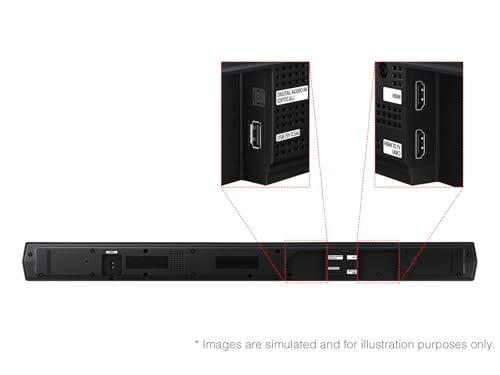
The Samsung HW-B630F takes a practical approach to connections, offering both HDMI ARC and optical digital inputs plus a USB port for direct music playback. This means it works with virtually any TV or source device, regardless of age. However, it's limited to HDMI 1.4, so it can't pass through 4K video signals – you'll need to connect your 4K sources directly to your TV and use ARC to send audio back to the soundbar.
The Sonos Arc is more forward-thinking but also more restrictive. It requires HDMI eARC (enhanced Audio Return Channel) to unlock its full potential, including lossless Dolby Atmos formats. While Sonos includes an optical adapter for older TVs, you'll miss out on the highest-quality audio formats without eARC support. This future-focused approach means the Sonos Arc will stay relevant longer, but it might not work optimally with older equipment.
This is where the Sonos Arc truly shines. It's not just a soundbar – it's a smart speaker that happens to excel at TV audio. Built-in Amazon Alexa lets you control playback, check weather, control smart home devices, and more using just your voice. Apple AirPlay 2 support means iPhone and iPad users can stream music effortlessly, and the whole system integrates seamlessly with other Sonos speakers throughout your home.
The Sonos app experience is also significantly more sophisticated than what Samsung offers. You can create multi-room audio groups, adjust detailed EQ settings, and access streaming services directly without needing your TV. If you're building a connected home audio system, the Sonos Arc becomes the centerpiece of something much larger.
The Samsung HW-B630F keeps things simpler with basic Bluetooth connectivity and integration with Samsung TVs through their One Remote system. If you own a Samsung TV, the experience is seamless – your TV remote controls the soundbar automatically. But there's no broader smart home integration or multi-room audio capability.
At the time of writing, these products occupy very different price tiers, and that difference significantly impacts their value equations. The Samsung HW-B630F represents exceptional value for buyers who want immediate, dramatic improvement over TV speakers without spending premium prices. You get a complete 3.1 system with wireless subwoofer, clear dialogue enhancement, solid gaming features, and easy setup.
The Sonos Arc costs significantly more but delivers experiences the Samsung simply cannot match. Genuine Dolby Atmos immersion, sophisticated room correction, extensive smart features, and integration into a broader audio ecosystem justify the premium for users who prioritize these capabilities. However, to achieve comparable bass impact, you'll need to add the Sonos Sub, which further increases the total investment.
From a pure performance-per-dollar perspective, the Samsung HW-B630F wins decisively. But if your budget allows and you value the premium features, the Sonos Arc provides experiences that feel truly next-generation compared to traditional soundbars.
Choose the Samsung HW-B630F if you want the biggest immediate improvement in TV audio quality without spending premium prices. It's perfect for households that primarily watch TV shows and movies, game occasionally, and want something that just works without complexity. The included subwoofer means you get satisfying bass right away, and the dialogue clarity improvements will be immediately apparent to everyone in your family.
The Samsung HW-B630F also makes sense if you own Samsung TVs and want seamless integration, or if you prefer traditional remote control over app-based operation. It's an excellent choice for apartments or smaller spaces where the wireless subwoofer provides adequate bass without needing additional components.
Choose the Sonos Arc if you're looking to build a premium home audio system over time and want genuine Dolby Atmos immersion. It's ideal for streaming-focused households with modern TVs that support eARC, and especially compelling for Apple users who will benefit from seamless AirPlay integration.
The Sonos Arc makes most sense for audio enthusiasts who understand that the initial purchase is just the beginning – adding the Sub and potentially rear speakers creates a truly impressive home theater system. If you value long-term software support, multi-room audio capability, and cutting-edge features, the premium is justified.
Both soundbars excel at their intended purposes, but they serve different audiences. The Samsung HW-B630F delivers outstanding value by focusing on the fundamentals that matter most: clear dialogue, satisfying bass, and easy operation. The Sonos Arc pioneers the future of home audio with immersive Atmos processing, smart features, and ecosystem integration.
For most people looking to upgrade from TV speakers, the Samsung HW-B630F provides the biggest improvement for the least money. But for those ready to invest in a premium audio experience that will grow and evolve over time, the Sonos Arc offers capabilities that feel genuinely transformative.
The choice ultimately comes down to your priorities: immediate value and simplicity, or long-term investment in a premium audio ecosystem. Both paths lead to dramatically better sound than what your TV can provide on its own.
| Samsung HW-B630F B-Series 3.1ch Soundbar System | Sonos Arc Wireless Sound Bar with Dolby Atmos, Apple AirPlay 2, and Built-in Voice Assistant |
|---|---|
| Channel Configuration - Determines dialogue clarity and surround capabilities | |
| 3.1 channels (3 front + wireless subwoofer) | 5.0.2 channels (5 ear-level + 2 height channels) |
| Dolby Atmos Support - Essential for modern immersive movie experiences | |
| No (limited to Dolby Digital 5.1) | Yes (full Dolby Atmos with upward-firing drivers) |
| Subwoofer Included - Critical for bass impact without additional cost | |
| Yes (6" wireless subwoofer included) | No (requires separate $700+ Sonos Sub for comparable bass) |
| Physical Dimensions - Important for TV compatibility and room aesthetics | |
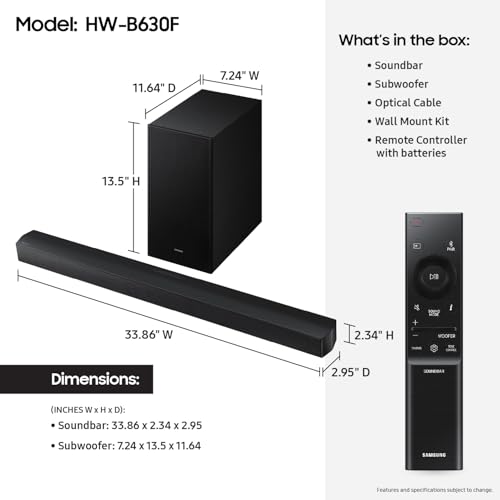
| Bar: 33.9" W × 2.3" H × 2.95" D, Sub: 7.2" W × 13.5" H × 11.6" D | Single unit: 45" W × 3.4" H × 4.5" D |
| Gaming Optimization - Matters for console gaming and competitive play | |
| Dedicated Game Mode with low latency and directional enhancement | No gaming-specific features (general processing may add latency) |
| Smart Features - Affects daily usability and ecosystem integration | |
| Basic Bluetooth, Samsung TV integration, no voice assistant | Built-in Alexa, Apple AirPlay 2, Wi-Fi streaming, Sonos ecosystem |
| HDMI Connectivity - Determines compatibility with modern 4K sources | |
| HDMI ARC (1.4) + optical input | HDMI eARC only (requires adapter for optical) |
| Room Calibration - Automatically optimizes sound for your space | |
| Basic auto-calibration | Trueplay tuning (iOS devices only) |
| Voice Enhancement - Critical for clear dialogue in movies and TV | |
| Voice Enhance mode plus dedicated center channel | Speech Enhancement feature with advanced processing |
| Multi-Room Audio - Enables whole-home audio system expansion | |
| Not supported | Full Sonos ecosystem integration with wireless grouping |
| Audio Format Support - Affects compatibility with streaming and physical media | |
| Dolby Digital, DTS 5.1, PCM | Dolby Digital/Plus/TrueHD/Atmos (no DTS formats) |
| Night Mode - Reduces loud sounds for late-night viewing | |
| Yes (dynamic range compression) | Yes (reduces intensity of loud sounds) |
The Samsung HW-B630F excels at dialogue clarity thanks to its dedicated center channel and Voice Enhance mode. The physical center speaker ensures voices stay locked to the screen, while the Voice Enhance feature boosts speech frequencies. The Sonos Arc also offers excellent dialogue with its Speech Enhancement feature and sophisticated processing, but the Samsung HW-B630F's dedicated center channel gives it a slight edge for crystal-clear conversations.
The Samsung HW-B630F includes a wireless 6-inch subwoofer in the box, providing immediate, room-filling bass without additional purchases. The Sonos Arc has eight built-in woofers that deliver respectable bass for a single unit, but it lacks the deep, impactful low-end that comes with a dedicated subwoofer. For full bass performance, the Sonos Arc requires adding the separate Sonos Sub.
Only the Sonos Arc supports true Dolby Atmos with upward-firing drivers that create overhead sound effects. The Samsung HW-B630F is limited to traditional surround formats like Dolby Digital 5.1 and uses virtual processing to simulate wider soundstages, but cannot produce genuine height effects like the Sonos Arc.
The Samsung HW-B630F offers more connection options with HDMI ARC, optical input, and USB port, making it compatible with older TVs and devices. The Sonos Arc focuses on HDMI eARC for the highest audio quality but includes an optical adapter. The Sonos Arc also adds Wi-Fi and Apple AirPlay 2 for wireless streaming, while the Samsung HW-B630F relies on Bluetooth.
The Samsung HW-B630F is superior for gaming with its dedicated Game Mode that reduces latency and enhances directional audio cues for competitive play. This makes it easier to locate enemies and hear important gameplay sounds. The Sonos Arc lacks gaming-specific optimizations and may introduce slight audio delay that could affect competitive gaming performance.
The Sonos Arc has built-in Amazon Alexa for voice control of music, smart home devices, and basic soundbar functions. The Samsung HW-B630F doesn't include a built-in voice assistant but works with Bixby on Samsung devices and can be controlled through Samsung's SmartThings ecosystem.
Both soundbars offer straightforward setup, but the Samsung HW-B630F has a slight advantage with its plug-and-play approach and automatic wireless subwoofer pairing. The Sonos Arc requires the Sonos app and Wi-Fi network setup, though the process is well-guided. Samsung TV owners get the easiest experience with the Samsung HW-B630F through automatic detection and One Remote integration.
The Sonos Arc offers superior expandability within the Sonos ecosystem, allowing you to add wireless rear speakers and the Sonos Sub for a complete surround system. The Samsung HW-B630F supports Samsung's optional wireless rear speaker kit but has more limited expansion options compared to the comprehensive Sonos Arc ecosystem.
The Samsung HW-B630F provides exceptional value by including a complete 3.1 system with wireless subwoofer at an entry-to-mid-range price point. The Sonos Arc costs significantly more but delivers premium features like Dolby Atmos, smart home integration, and multi-room audio. For immediate TV audio improvement on a budget, the Samsung HW-B630F wins on value.
The Samsung HW-B630F measures 33.9 inches wide with a separate subwoofer that requires additional floor space. The Sonos Arc is a single 45-inch unit that's taller and deeper but eliminates the need for a separate subwoofer placement. Both work well with TVs 40 inches and larger, though the Sonos Arc offers a cleaner, minimalist aesthetic.
The Sonos Arc significantly outperforms the Samsung HW-B630F in smart features with built-in Alexa, Apple AirPlay 2, Wi-Fi streaming, and integration with the comprehensive Sonos app ecosystem. The Samsung HW-B630F keeps things simple with Bluetooth connectivity and Samsung TV integration, making it better for users who prefer traditional remote control over app-based operation.
The Samsung HW-B630F works with virtually any TV through HDMI ARC or optical connection, with enhanced integration on Samsung TVs. The Sonos Arc works best with TVs that support HDMI eARC for full Dolby Atmos capability, though it includes an optical adapter for older TVs. Both soundbars are compatible with most modern televisions, but the Samsung HW-B630F offers broader compatibility with older equipment.
We've done our best to create useful and informative comparisons to help you decide what product to buy. Our research uses advanced automated methods to create this comparison and perfection is not possible - please contact us for corrections or questions. These are the sites we've researched in the creation of this article: samsung.com - bhphotovideo.com - crutchfield.com - youtube.com - bestproducts.com - videoandaudiocenter.com - pcrichard.com - bhphotovideo.com - samsung.com - youtube.com - requiremints.com - karlsonline.com - crutchfield.com - youtube.com - donstv.com - samsung.com - bhphotovideo.com - youtube.com - youtube.com - crutchfield.com - costco.ca - rtings.com - crutchfield.com - accio.com - bhphotovideo.com - manuals.plus - samsung.com - saraappliance.com - whathifi.com - soundandvision.com - en.community.sonos.com - cnet.com - worldwidestereo.com - abt.com - creativeaudio.net - target.com - sonos.com - worldwidestereo.com - businessinsider.com - en.community.sonos.com - youtube.com

Privacy Policy
Terms and Conditions - Affiliate Policy
Home Security
© Copyright 2008-2026.
11816 Inwood Rd #1211, Dallas, TX 75244